

Description
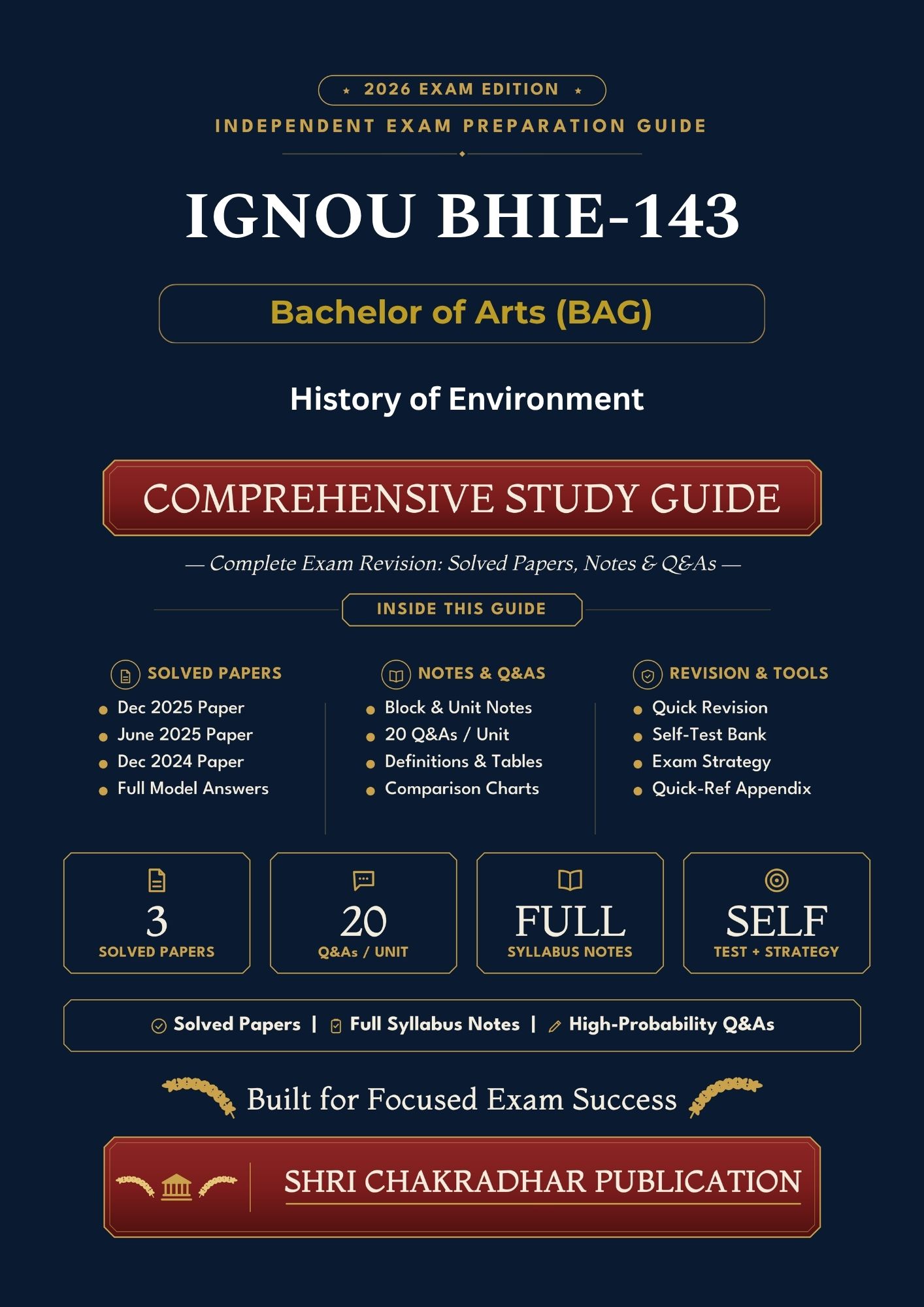
IGNOU BHIE-143 Book (History of Environment) is a 2026 English-medium study guide for Bachelor of Arts (BAG) learners. It is designed around 12 verified Units and supports concept learning, Unit-wise revision, previous-year-question practice and TEE preparation.
History papers demand more than remembering dates: students need chronology, causation, change over time, historiographical perspective and carefully selected evidence in the same answer. In History of Environment, this becomes especially important around environmental history and early societies, medieval and early modern environmental issues, colonialism, conservation and environmental health. The guide organises each period as a sequence of context, turning points, institutions, debates and consequences, making it easier to build a chronological argument without reducing history to a list of facts. The sequence is intended to help learners study in short, repeatable sessions while keeping the full syllabus visible.
For more IGNOU study material, visit IGNOU Study Material. Use the present guide alongside IGNOU’s official self-learning material, your current assignment booklet and the latest TEE instructions.
An Overview of the IGNOU BHIE-143 Help Book
The BHIE-143 guide gives learners a complete revision route for History of Environment without presenting itself as a replacement for IGNOU material. The book functions as an organised revision layer over IGNOU material. Its value lies in turning a broad syllabus into manageable study sessions without changing the academic scope of the course.
This Book Is Useful For
This book is useful for students who need one organised companion for self-study, assignment-oriented understanding and TEE revision. It supports students who want to combine official SLM reading with concise revision notes and purposeful question practice.
It is particularly suited to first-time learners, working students, students returning after a study gap and anyone who wants syllabus-linked question practice without unsupported “sure-shot” claims.
What’s Inside This BHIE-143 Book
The book combines syllabus coverage with active revision tools so that reading can turn into recall and written practice. Each part is written to support a concrete study action—understand a concept, connect two ideas, build a short answer, attempt a longer response or revise a weak area.
- Course map and Unit-wise notes: verified syllabus themes with concise explanations and key terms.
- Answer-building support: prompts for introductions, arguments, comparisons and conclusions.
- Practice and recap: subject-specific questions plus short checkpoints for TEE revision.
Complete Syllabus Coverage – All 12 Units
The verified IGNOU source for BHIE-143 does not expose a separate official Block grouping, so no artificial Block names have been created. The guide follows 12 official Unit structure and keeps the syllabus sequence intact.
| Revision Group | Verified Unit Theme |
|---|---|
| Theme group 1 | environmental history and early societies |
| Theme group 2 | medieval and early modern environmental issues |
| Theme group 3 | colonialism, conservation and environmental health |
| Theme group 4 | development, gender and environmental movements |
This unit-only treatment is deliberate: where IGNOU does not publish Block labels in the verified source, the book uses Unit-wise coverage rather than inventing a structure that may mislead students.
How This Book Maps to the IGNOU BHIE-143 Exam Pattern
The exam-preparation approach is built around explanation, structured response and revision rather than prediction. History answers are easier to evaluate when they establish the time-frame, identify the central process, develop two or three connected arguments and end with a reasoned historical assessment.
For History of Environment, students should practise at least three answer modes: a direct concept or text-based explanation, a comparison or relationship question, and a longer analytical response that brings together more than one Unit theme. The sample questions in this guide are practice prompts, not claims about the actual TEE paper.
Why Students Prefer Our IGNOU BHIE-143 Guide Book & Study Material
The guide supports organised self-study while preserving the course scope. It is meant to reduce friction in self-study by keeping course structure, key terms, writing practice and revision prompts in a single, consistent format.
- Verified syllabus structure is shown clearly instead of being replaced by a generic chapter list.
- Unit-wise language keeps revision practical while official syllabus coverage is described using Blocks only where Blocks are verified.
- Practice material is labelled as practice and does not pretend to be an official or leaked question paper.
- Concept explanations and answer cues are kept together so students can move from reading to writing.
- The 2026 edition is designed as an independent academic support resource for IGNOU learners.
Compiled & Reviewed By
This guide is compiled and reviewed by the SCP Panel of Experts under BK Sahni, Shri Chakradhar Publication. The editorial approach is to keep the verified course structure visible, write in student-friendly language and separate academic support from unsupported promises.
How to Use the IGNOU BHIE-143 Help Book for TEE and Assignments
A simple study cycle works better than repeated passive reading. A practical routine is to study one theme, close the book, recall the main points aloud or on paper, and then attempt a short answer outline before checking what was missed.
- Map the syllabus: mark the Blocks or Units already understood and identify the weakest areas.
- Read with a purpose: study one small theme and note only definitions, arguments, examples or textual points that matter.
- Recall without looking: write five to seven points from memory before reopening the material.
- Practise an answer: create a short outline first, then expand selected questions into full responses.
- Use assignments ethically: understand the topic and prepare your own submission in accordance with IGNOU guidelines.
- Finish with selective revision: return to weak concepts, recurring terminology and previous questions instead of rereading everything.
High-Probability Questions from IGNOU BHIE-143 (Sample)
These are course-aligned practice questions chosen from the verified themes; they are not guaranteed predictions of the examination paper. Use them to test whether you can organise a complete answer without copying a prepared response.
- Trace the development of environmental history and early societies, indicating the main developments and their historical importance.
- Examine the causes and consequences of medieval and early modern environmental issues, indicating the main developments and their historical importance.
- Discuss the historical significance of colonialism, conservation and environmental health, indicating the main developments and their historical importance.
- Compare interpretations of development, gender and environmental movements, indicating the main developments and their historical importance.
- Assess the transformation of environmental history and early societies, indicating the main developments and their historical importance.
IGNOU BHIE-143 Sample Question Paper (TEE Format Template)
This is a non-official practice template for timed revision, not an IGNOU question paper. It helps students simulate selection, planning and writing under a fixed study session.
Practice instruction: Set a time limit appropriate to your preparation, attempt a balanced selection of questions, and write each answer in your own words using the current official course requirements as the final reference.
- Question 1: Trace the development of environmental history and early societies, indicating the main developments and their historical importance.
- Question 2: Examine the causes and consequences of medieval and early modern environmental issues, indicating the main developments and their historical importance.
- Question 3: Discuss the historical significance of colonialism, conservation and environmental health, indicating the main developments and their historical importance.
- Question 4: Compare interpretations of development, gender and environmental movements, indicating the main developments and their historical importance.
- Question 5: Assess the transformation of environmental history and early societies, indicating the main developments and their historical importance.
Related IGNOU BHIE-143 Additional Supports
These optional supports are for students who want separate help with assignments, handwritten work, previous-year questions or guess-paper revision in addition to the present study guide.
- IGNOU BHIE-143 Solved Assignment
- IGNOU BHIE-143 Handwritten Assignment
- IGNOU BHIE-143 Solved PYQs
- IGNOU BHIE-143 Solved Guess Paper
Delivery, Returns & Payment Options
The physical guide is supplied as an A5 paperback and orders are processed through the store’s available checkout and delivery options. Students should review the current product-page shipping, payment and return information at the time of ordering because serviceability and timelines can vary by location.
How Students Use This Guide
Students can use the guide as a planning and revision tool rather than as a substitute for their own reading and writing. For revision, alternate between reading and retrieval. Read a small section, write what you remember without looking, then compare and correct the gaps before moving on.
Free Downloads: IGNOU BHIE-143 Exam Support PDFs
Use official IGNOU resources first when looking for current assignments, study material and examination-related documents. Free official resources are useful for checking the exact session requirements before using any supplementary guide.
- IGNOU eGyanKosh for official digital study material where available.
- IGNOU Assignments for current assignment papers and session-specific instructions.
- IGNOU’s official question-paper and examination pages for previous papers, date sheets and notices when published.
Download BHIE-143 Study Material Free via eGyanKosh (Step-by-Step)
eGyanKosh is IGNOU’s official digital repository and should be the first place to check for the university’s self-learning material. The exact menu or collection path can change, but the course code remains the most reliable search key.
- Open eGyanKosh.
- Search for BHIE-143 using the course code rather than only the subject title.
- Open the course collection or book record that matches History of Environment.
- Check the Block or Unit titles against your current course material before downloading files.
- Save the official PDFs for reference and use this guide as a separate revision aid.
Frequently Asked Questions (FAQ)
1. How many Blocks does IGNOU BHIE-143 have?
The verified official source does not expose a separate Block grouping for BHIE-143. It publishes 12 as numbered Units, and this guide follows that verified Unit structure rather than inventing Blocks.
2. What subject does BHIE-143 cover?
BHIE-143 covers History of Environment. The guide follows the verified course themes and keeps Unit-wise revision aligned with that scope.
3. Is this an official IGNOU publication?
No. It is an independent academic study-support resource from Shri Chakradhar Publication and is intended to supplement official IGNOU material.
4. Can I use this book for TEE revision?
Yes. It is designed for concept revision, answer planning, previous-question practice and final TEE preparation, while official IGNOU instructions remain the final authority.
5. Does the book include previous-year-question oriented practice?
Yes. It includes practice shaped around common university question types and previous-question revision, without claiming that any question is guaranteed to appear.
6. Can it help with assignments?
It can help you understand course concepts and plan answers. Students should prepare and submit their own work according to IGNOU guidelines and their current assignment instructions.
7. What is the medium of the BHIE-143 guide?
This product is prepared for English medium, as shown in the product information table. Check your registered course medium before ordering.
8. Is eGyanKosh material still necessary?
Yes. Official IGNOU self-learning material is the primary academic reference; this guide is a supplementary tool for organised revision and practice.
9. Does the guide guarantee marks or a pass?
No. No study guide can guarantee marks, results or exact question predictions. Performance depends on preparation, understanding, writing and the applicable examination requirements.
Conclusion
The IGNOU BHIE-143 Book is intended to make preparation for History of Environment more organised by combining verified syllabus coverage, Unit-wise revision, practice questions and a clear study method. Use it with official IGNOU material, current assignments and previous questions so that your preparation remains both practical and academically grounded.
To order, visit the IGNOU BHIE-143 Book order page. Check the course code and medium before placing the order.
Disclaimer: This is an independent academic study-support resource published by Shri Chakradhar Publication (Pvt.) Ltd. It is not affiliated with, endorsed by, or an official publication of IGNOU. It is designed to supplement, not replace, IGNOU’s official study material. Syllabus and exam patterns may change – please verify the latest information through official IGNOU channels. Students should prepare and submit their own work as per IGNOU guidelines. All trademarks belong to their respective owners.