

Description
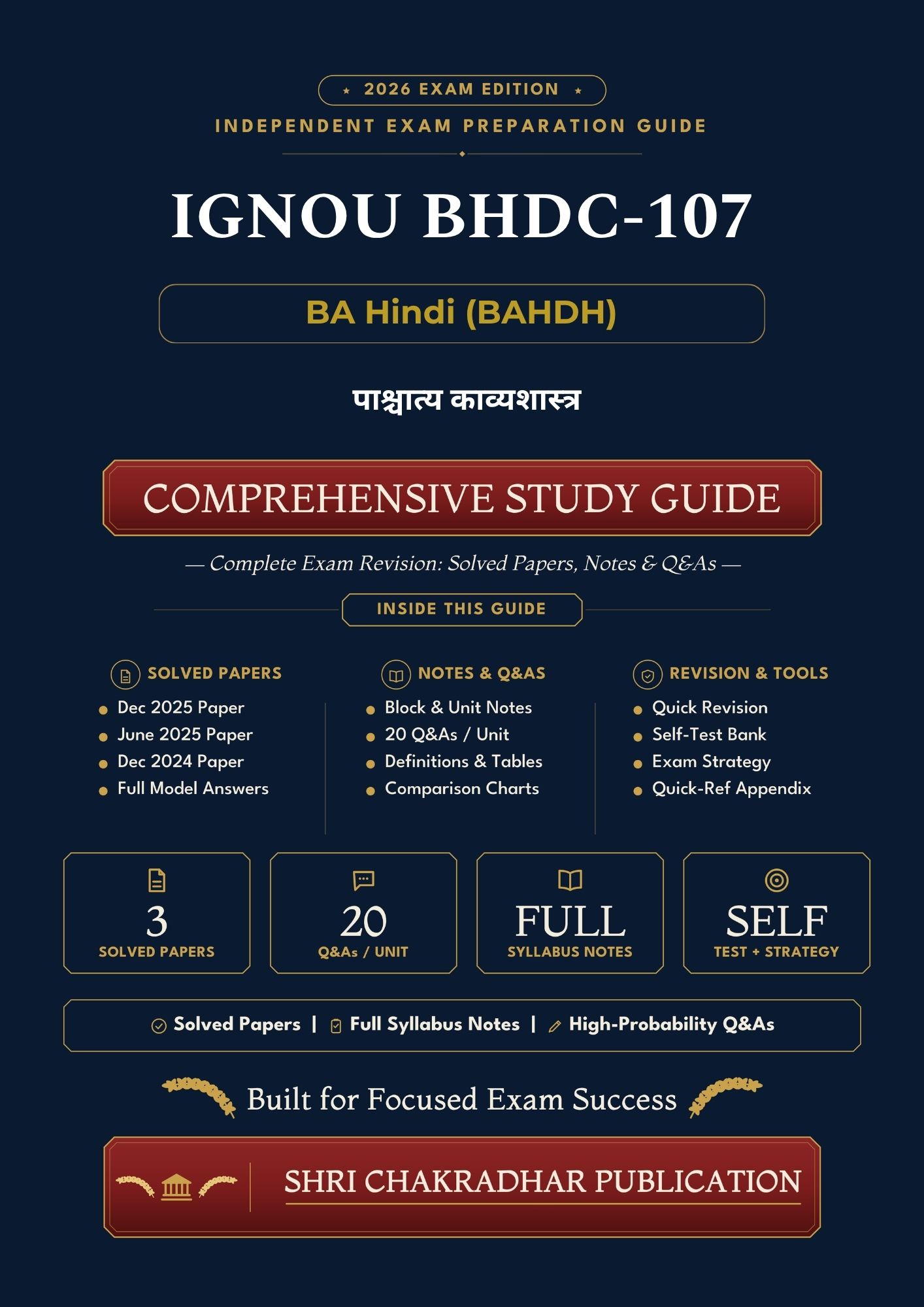
IGNOU BHDC-107 Book (पाश्चात्य काव्यशास्त्र) is built as a working map of पाश्चात्य काव्यशास्त्र, not as a pile of disconnected notes. It follows 15 verified Units and turns the verified sequence into Unit-wise revision, written practice and a final TEE recap.
Many learners finish a first reading yet still struggle to retrieve headings, choose examples and sequence an answer when the examination clock is running. In this course, links among प्लेटो का काव्य चिंतन, अरस्तू का साहित्य सिद्धांत and लोंजाइनस: उदात्त की संकल्पना deserve particular attention because they shape both understanding and exam-ready explanation.
For more IGNOU study material, visit IGNOU Study Material. Use this independent guide alongside the latest official IGNOU study material and current examination instructions.
An Overview of the IGNOU BHDC-107 Help Book
This overview answers the first revision question: what is the course actually asking you to understand? It links प्लेटो का काव्य चिंतन, अरस्तू का साहित्य सिद्धांत and लोंजाइनस: उदात्त की संकल्पना with the verified sequence used across पाश्चात्य काव्यशास्त्र.
For written answers, the goal is to move from a precise opening statement to explanation, evidence or illustration, and then a conclusion that returns to the question. In पाश्चात्य काव्यशास्त्र, that means combining literary or media concepts, textual examples, structure, style and critical explanation.
Revise in three passes: first understand the concept, then condense it into headings, and finally practise a timed answer using the headings without looking at notes.
This Book Is Useful For
Use this guide when official material feels extensive and you want a compact route through the course without losing the verified sequence.
- Learners starting पाश्चात्य काव्यशास्त्र and needing a clear syllabus route
- Students who can read the material but need faster retrieval of प्लेटो का काव्य चिंतन and अरस्तू का साहित्य सिद्धांत
- Those revising difficult links between लोंजाइनस: उदात्त की संकल्पना and वर्ड्सवर्थ: काव्यभाषा की अवधारणा
- Candidates working on introductions, headings, examples and conclusions for TEE answers
- Students preparing a final-week checklist without abandoning official IGNOU resources
What’s Inside This BHDC-107 Book
The book brings together course mapping, concept revision and writing practice so learners can switch from reading mode to exam mode without rebuilding their notes from scratch.
- Unit-wise study notes: official sequence converted into concise revision points
- Concept links: connections among definitions, arguments and neighbouring themes
- Answer frames: course-specific ways to organise प्लेटो का काव्य चिंतन and अरस्तू का साहित्य सिद्धांत
- Practice prompts: questions for explanation, comparison, application and evaluation
- Final recap cues: headings and reminders for the last revision cycle
Complete Syllabus Coverage – Official Unit Structure
The official course organisation is the anchor for this guide. Named Blocks are reproduced where verified; Unit-level structure is preserved where a separate Block hierarchy cannot be confirmed.
| Official Unit | Verified Unit Theme |
|---|---|
| Unit 1 | प्लेटो का काव्य चिंतन |
| Unit 2 | अरस्तू का साहित्य सिद्धांत |
| Unit 3 | लोंजाइनस: उदात्त की संकल्पना |
| Unit 4 | वर्ड्सवर्थ: काव्यभाषा की अवधारणा |
| Unit 5 | कॉलरिज का काव्यचिंतन |
| Unit 6 | क्रोचे: अभिव्यंजनावाद |
| Unit 7 | टी. एस. इलियट: परंपरा, निर्वैयक्तिकता और वस्तुनिष्ठ सह-संयोजन |
| Unit 8 | आई. ए. रिचर्ड्स: मूल्य, संप्रेषण एवं समतुल्यता |
| Unit 9 | शास्त्रीयतावाद एवं नव-शास्त्रीयतावाद |
| Unit 10 | नई समीक्षा |
| Unit 11 | मार्क्सवादी समीक्षा |
| Unit 12 | यथार्थवाद, अतियथार्थवाद एवं जादुई यथार्थवाद |
| Unit 13 | आधुनिकता और उत्तर-आधुनिकता |
| Unit 14 | शैली विज्ञान |
| Unit 15 | स्वच्छंदतावाद, संरचनावाद, मनोविश्लेषणवाद और औपनिवेशिकता |
The table is also useful for final-week planning: tick completed coverage, circle uncertain themes and reserve timed writing for the segments that repeatedly cause hesitation.
How This Book Maps to the IGNOU BHDC-107 Exam Pattern
The guide maps content to answer tasks rather than promising repeated questions. A strong response starts by identifying what the command word demands and then selecting only the most relevant course material.
Use प्लेटो का काव्य चिंतन, लोंजाइनस: उदात्त की संकल्पना and वर्ड्सवर्थ: काव्यभाषा की अवधारणा to practise transitions between ideas. Examiners can change the wording, but a learner who understands the relationships can still build a coherent response.
Why Students Prefer Our IGNOU BHDC-107 Guide Book & Study Material
The guide is organised as a revision system rather than a shortcut. Its value comes from linking the researched syllabus with recall and written rehearsal.
Because पाश्चात्य काव्यशास्त्र contains several related strands, the guide uses प्लेटो का काव्य चिंतन, लोंजाइनस: उदात्त की संकल्पना and कॉलरिज का काव्यचिंतन as cross-links. This keeps revision subject-specific and discourages generic answers.
Compiled & Reviewed By
This guide is prepared and reviewed by the Shri Chakradhar Publication (SCP) Panel of Experts / BK Sahni. Its role is to make a researched course structure easier to revise without suggesting affiliation, endorsement or official status.
Independent explanations, practice questions and revision cues supplement the official material. Current syllabus, assignment and TEE notices should always be checked from IGNOU channels.
How to Use the IGNOU BHDC-107 Help Book for TEE and Assignments
Treat the guide as a practice workbook as well as a reading aid. Every study session should end with a small retrieval or writing task.
- Mark every course segment as unread, read, recall-ready or writing-ready.
- For प्लेटो का काव्य चिंतन, prepare meaning, key points and significance on one small sheet.
- For अरस्तू का साहित्य सिद्धांत, prepare one comparison or relationship with another theme.
- Use लोंजाइनस: उदात्त की संकल्पना for a timed short-note drill and check accuracy afterward.
- Use वर्ड्सवर्थ: काव्यभाषा की अवधारणा for a longer answer that includes an example and conclusion.
- At the end of the week, retest the segments that still require notes.
High-Probability Questions from IGNOU BHDC-107 (Sample)
A useful question bank should expose weak understanding rather than encourage guessing. These sample prompts therefore draw from the verified themes of the course.
- Explain प्लेटो का काव्य चिंतन with reference to पाश्चात्य काव्यशास्त्र.
- Discuss the main issues connected with प्लेटो का काव्य चिंतन and give suitable examples.
- Explain अरस्तू का साहित्य सिद्धांत with reference to पाश्चात्य काव्यशास्त्र.
- Discuss the main issues connected with अरस्तू का साहित्य सिद्धांत and give suitable examples.
- Explain लोंजाइनस: उदात्त की संकल्पना with reference to पाश्चात्य काव्यशास्त्र.
- Discuss the main issues connected with लोंजाइनस: उदात्त की संकल्पना and give suitable examples.
- Explain वर्ड्सवर्थ: काव्यभाषा की अवधारणा with reference to पाश्चात्य काव्यशास्त्र.
- Discuss the main issues connected with वर्ड्सवर्थ: काव्यभाषा की अवधारणा and give suitable examples.
Score each outline for relevance, sequence and evidence. A weak outline is a signal to return to the course material before spending time on a full-length response.
IGNOU BHDC-107 Sample Question Paper (TEE Format Template)
The template below is for exam practice only and does not reproduce an official TEE paper. Check the latest IGNOU paper for the actual section pattern and marks.
Practice instruction: Attempt the set under a self-imposed time limit and follow the latest official pattern for question choice and marks.
- Q1. Explain प्लेटो का काव्य चिंतन with reference to पाश्चात्य काव्यशास्त्र.
- Q2. Discuss the main issues connected with प्लेटो का काव्य चिंतन and give suitable examples.
- Q3. Explain अरस्तू का साहित्य सिद्धांत with reference to पाश्चात्य काव्यशास्त्र.
- Q4. Discuss the main issues connected with अरस्तू का साहित्य सिद्धांत and give suitable examples.
- Q5. Explain लोंजाइनस: उदात्त की संकल्पना with reference to पाश्चात्य काव्यशास्त्र.
- Q6. Discuss the main issues connected with लोंजाइनस: उदात्त की संकल्पना and give suitable examples.
- Q7. Explain वर्ड्सवर्थ: काव्यभाषा की अवधारणा with reference to पाश्चात्य काव्यशास्त्र.
- Q8. Discuss the main issues connected with वर्ड्सवर्थ: काव्यभाषा की अवधारणा and give suitable examples.
Use a second attempt to shorten introductions and strengthen the middle of the answer, where explanation and evidence usually carry most of the academic value.
Related IGNOU BHDC-107 Additional Supports
Separate support categories are available for students who want additional assignment or question-practice products for this course code.
- IGNOU BHDC-107 Solved Assignment
- IGNOU BHDC-107 Handwritten Assignment
- IGNOU BHDC-107 Solved PYQs
- IGNOU BHDC-107 Solved Guess Paper
Delivery, Returns & Payment Options
The product format is A5 paperback. Available payment and delivery methods are displayed during checkout, and destination serviceability determines the practical shipping option.
Return or replacement requests are handled according to the store terms in force at the time of order. Keep evidence of any genuine print or courier issue when contacting support.
How Students Use This Guide
Students can use the guide as a progress board: each Unit moves from first reading to recall and finally to writing practice. That makes unfinished preparation visible.
Create a weekly mini-test from प्लेटो का काव्य चिंतन, लोंजाइनस: उदात्त की संकल्पना and प्लेटो का काव्य चिंतन. One question should test definition, one should test connection, and one should test application or critical discussion.
Free Downloads: IGNOU BHDC-107 Exam Support PDFs
Use IGNOU resources to verify the current course and use this book to shorten revision and organise practice. Keeping those roles separate helps maintain academic accuracy.
- Official IGNOU/eGyanKosh self-learning material for BHDC-107
- Current assignment booklet for the applicable session
- Available previous TEE question papers from official IGNOU channels
- Programme guide or prospectus information relevant to BA Hindi (BAHDH)
Download BHDC-107 Study Material Free via eGyanKosh (Step-by-Step)
For original IGNOU study material, start with eGyanKosh. Keep the official PDF folder separate from independent notes so sources remain clear.
- Open the official eGyanKosh course/resource page.
- Check that the page or PDF corresponds to BHDC-107 and पाश्चात्य काव्यशास्त्र.
- Open the required Block, Unit or course file and verify its title before saving it.
- Store the PDFs in a folder named BHDC-107 and keep the verified sequence intact.
- Use the official PDFs for detailed study and this independent guide for Unit-wise revision and answer rehearsal.
Frequently Asked Questions (FAQ)
These FAQs clarify how the guide should be used, what it covers and where official IGNOU material remains essential.
What is the IGNOU BHDC-107 book used for?
It is designed to organise पाश्चात्य काव्यशास्त्र into a practical revision and writing sequence for BHDC-107 learners.
How much of the BHDC-107 syllabus is covered?
The guide follows the researched official structure: 15 verified Units. Unsupported Block headings are not added where the official hierarchy cannot be confirmed.
Is this an official IGNOU publication?
No. This is independent academic study support; IGNOU self-learning material and University notices remain the official sources.
Can I use this BHDC-107 book for TEE revision?
Yes. Use it to revise प्लेटो का काव्य चिंतन, अरस्तू का साहित्य सिद्धांत and लोंजाइनस: उदात्त की संकल्पना, practise outlines and rehearse complete answers while checking the latest official exam instructions.
Does the guide include solved-question practice?
It includes solved-question guidance, answer frameworks and practice prompts. Students should also work with official previous TEE papers.
What medium is this BHDC-107 guide prepared in?
This product is prepared for the Hindi medium shown on the product page, while necessary course terminology is retained for accuracy.
Can this guide replace eGyanKosh material?
No. The guide is a companion to, not a substitute for, official IGNOU study material.
How should I revise BHDC-107 in the final week?
Prioritise weak areas, especially वर्ड्सवर्थ: काव्यभाषा की अवधारणा and कॉलरिज का काव्यचिंतन; rehearse key definitions, write short outlines and complete a few timed answers instead of rereading everything.
Where can I get order or soft-copy support?
Use the WhatsApp support link on this product page for availability and order assistance. Academic updates should still be verified through official IGNOU channels.
Conclusion
The purpose of this BHDC-107 guide is disciplined preparation: cover the researched structure, condense each theme, retrieve it without prompts and practise the question forms that expose weak understanding.
To order, visit the IGNOU BHDC-107 Book order page. Re-check the latest syllabus, assignment and TEE instructions through official IGNOU channels before examination.
Disclaimer: This is an independent academic study-support resource published by Shri Chakradhar Publication (Pvt.) Ltd. It is not affiliated with, endorsed by, or an official publication of IGNOU. It is designed to supplement, not replace, IGNOU’s official study material. Syllabus and exam patterns may change – please verify the latest information through official IGNOU channels. Students should prepare and submit their own work as per IGNOU guidelines. All trademarks belong to their respective owners.