

Description
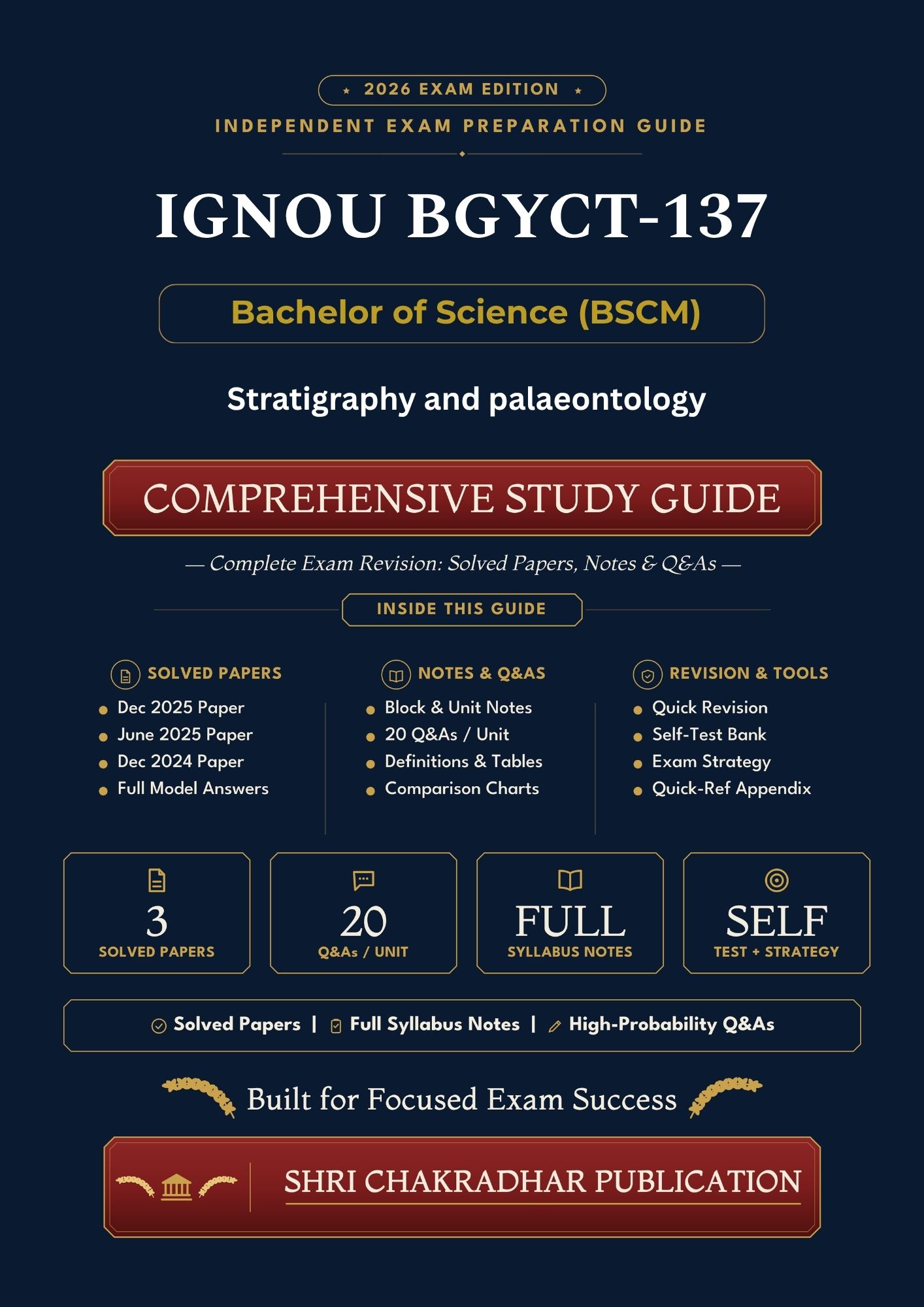
IGNOU BGYCT-137 Book (Stratigraphy and Palaeontology) is a 2026 English-medium study guide for Bachelor of Science (BSCM) / Bachelor of Science (BSCG) learners. It follows the verified official course structure and supports concept learning, Unit-wise revision, previous-year-question practice and TEE preparation across 4 Blocks.
Geology can feel fragmented when rocks, minerals, structures, fossils and tectonic processes are read as separate facts. Exam-ready understanding comes from recognising evidence, interpreting processes and placing observations in geological sequence. Key study areas include stratigraphic principles and correlation, major Indian stratigraphic successions, fossils and palaeontological methods, important invertebrate fossil groups. The guide turns them into smaller tasks for recall, explanation and answer practice.
For more IGNOU study material, visit IGNOU Study Material. Use this independent guide alongside IGNOU’s official self-learning material and the latest university notices.
An Overview of the IGNOU BGYCT-137 Help Book
This guide gives a structured route through Stratigraphy and Palaeontology rather than treating the course as a collection of disconnected chapters. The official sequence moves from Fundamentals of Stratigraphy through Stratigraphy of India, Introduction to Palaeontology and ends with Invertebrate Palaeontology. Keeping that progression visible helps students understand where each Unit belongs and why later topics depend on earlier ones.
For each topic, identify the material or structure, describe diagnostic features, explain the process that produced it and relate the evidence to a wider geological setting or history. Use the official material as the primary source.
This Book Is Useful For
The BGYCT-137 guide is useful for learners who need a clear syllabus map, revision sequence and writing practice.
- Students beginning Stratigraphy and Palaeontology who want to see how the blocks connect.
- Learners revising diagnostic features, geological processes, classifications, diagrams and evidence-based interpretation before the TEE.
- Students practising explanation, comparison and application through previous papers.
- Working learners using short, repeatable study sessions.
- Assignment learners who want concept clarity before writing their own work.
What’s Inside This BGYCT-137 Book
The book links verified syllabus coverage with Unit-level study, question practice and final recap.
- Unit-wise notes: concise explanations in official course sequence.
- Concept and method cues: reminders for diagnostic features, geological processes, classifications, diagrams and evidence-based interpretation.
- Practice sets: rock/mineral comparisons, process diagrams, stratigraphic reasoning and interpretation-based questions shaped around the subject.
- Previous-paper practice: prompts for common answer forms without prediction claims.
- Revision checkpoints: recap points and self-testing prompts.
Complete Syllabus Coverage – All 4 Blocks
The verified official structure contains 4 Blocks. The table below keeps the exact course organisation visible so that revision can be checked against the university material rather than against an invented syllabus.
| Block | Official title | Revision focus |
|---|---|---|
| Block 1 | Fundamentals of Stratigraphy | stratigraphic principles and correlation |
| Block 2 | Stratigraphy of India | major Indian stratigraphic successions |
| Block 3 | Introduction to Palaeontology | fossils and palaeontological methods |
| Block 4 | Invertebrate Palaeontology | important invertebrate fossil groups |
Use each block as a milestone: revise its Units, answer two questions and mark weak concepts before moving on.
How This Book Maps to the IGNOU BGYCT-137 Exam Pattern
This guide maps the course to the kinds of academic tasks that a TEE can require: recall a definition or principle, explain a process, compare related ideas, apply a method, interpret evidence and organise a longer answer. The exact paper pattern can change, so students should always check the latest official question paper before the examination.
For Stratigraphy and Palaeontology, practise rock/mineral comparisons, process diagrams, stratigraphic reasoning and interpretation-based questions. Samples build answer skill and are not predictions of the TEE paper.
Why Students Prefer Our IGNOU BGYCT-137 Guide Book & Study Material
The practical value of the guide is its organisation: official blocks remain visible, Unit-wise reading is broken into manageable tasks, and revision repeatedly returns to the important concepts of Stratigraphy and Palaeontology. This makes it easier to know what has been studied, what still needs practice and what should be revised again before the TEE.
Compiled & Reviewed By
This guide is compiled and reviewed by the SCP Panel of Experts under BK Sahni, Shri Chakradhar Publication. The editorial approach is to keep the verified course structure visible, write in student-friendly language and separate academic support from unsupported promises.
For this edition, the course map was checked against official IGNOU/eGyanKosh material for BGYCT-137. Subject explanations are written as supplementary study support and should be read together with the university’s prescribed material.
How to Use the IGNOU BGYCT-137 Help Book for TEE and Assignments
Use three passes: understand the Unit-wise notes, recall key ideas without looking, then write timed answers and check them against the official Unit.
- Start with Fundamentals of Stratigraphy and note the essential terms or principles.
- Move through the remaining blocks in official order rather than jumping only to familiar topics.
- After each Unit, write one short answer and one longer explanation using diagnostic features, geological processes, classifications, diagrams and evidence-based interpretation.
- Use official assignments as a concept-check, but prepare and submit your own work.
- Before the TEE, revise weak areas first, then use the quick recap and sample questions for active recall.
High-Probability Questions from IGNOU BGYCT-137 (Sample)
These syllabus-based samples are for revision practice, not TEE predictions.
- Describe the diagnostic features and processes in Fundamentals of Stratigraphy in the context of Stratigraphy and Palaeontology.
- Compare the geological evidence covered in Stratigraphy of India in the context of Stratigraphy and Palaeontology.
- Explain the sequence or mechanism associated with Introduction to Palaeontology in the context of Stratigraphy and Palaeontology.
- Discuss the field or interpretive significance of Invertebrate Palaeontology in the context of Stratigraphy and Palaeontology.
- Build a comparative answer linking Fundamentals of Stratigraphy with Invertebrate Palaeontology.
- Choose one concept from each official Block and show how they together explain the wider scope of Stratigraphy and Palaeontology.
- Write a structured short note on a frequently revised concept from Stratigraphy of India, using definition, explanation and example/application.
IGNOU BGYCT-137 Sample Question Paper (TEE Format Template)
This is an independent practice template, not an official IGNOU question paper. Use it to rehearse selection, sequencing and answer writing, then compare your preparation with the latest official TEE paper for BGYCT-137.
Section A – Extended Answers
- Describe the diagnostic features and processes in Fundamentals of Stratigraphy in the context of Stratigraphy and Palaeontology.
- Compare the geological evidence covered in Stratigraphy of India in the context of Stratigraphy and Palaeontology.
- Explain the sequence or mechanism associated with Introduction to Palaeontology in the context of Stratigraphy and Palaeontology.
Section B – Analytical / Short Answers
- Discuss the field or interpretive significance of Invertebrate Palaeontology in the context of Stratigraphy and Palaeontology.
- Build a comparative answer linking Fundamentals of Stratigraphy with Invertebrate Palaeontology.
- Choose one concept from each official Block and show how they together explain the wider scope of Stratigraphy and Palaeontology.
While practising, emphasise diagnostic features, geological processes, classifications, diagrams and evidence-based interpretation and organise each response from concept or evidence to a concise conclusion.
Related IGNOU BGYCT-137 Additional Supports
These are optional additional supports for assignment, handwritten-work, PYQ or guess-paper needs.
- IGNOU BGYCT-137 Solved Assignment
- IGNOU BGYCT-137 Handwritten Assignment
- IGNOU BGYCT-137 Solved PYQs
- IGNOU BGYCT-137 Solved Guess Paper
Delivery, Returns & Payment Options
The guide is supplied as an A5 paperback. Check the current product page at ordering time for available shipping, payment, return and location-serviceability details.
How Students Use This Guide
A practical routine is to study one Unit, make a short recall note, answer one question and repeat until the block is complete. This describes a study method, not a review or result claim.
Free Downloads: IGNOU BGYCT-137 Exam Support PDFs
Use official IGNOU resources first for current study material, assignments and examination documents.
- Official eGyanKosh material for BGYCT-137 where available.
- IGNOU Assignments for current papers and instructions.
- IGNOU Previous Year Question Papers for available TEE papers.
Download BGYCT-137 Study Material Free via eGyanKosh (Step-by-Step)
eGyanKosh is IGNOU’s official digital repository; search by course code for the most reliable match.
- Open eGyanKosh.
- Search for BGYCT-137 using the course code rather than only the subject title.
- Open the record matching Stratigraphy and Palaeontology.
- Check its Block or Unit titles against your course material.
- Save official PDFs and use this guide as a separate revision aid.
Frequently Asked Questions (FAQ)
Common practical questions about this course guide:
How many Blocks does IGNOU BGYCT-137 have?
IGNOU BGYCT-137 has 4 Blocks in the verified eGyanKosh structure, and this guide covers all 4 Blocks.
What is the subject of IGNOU BGYCT-137?
The course is Stratigraphy and Palaeontology. The guide follows the verified official structure and uses Unit-wise revision within that syllabus.
Which programme can use this BGYCT-137 book?
This edition is prepared for Bachelor of Science (BSCM) / Bachelor of Science (BSCG) learners taking BGYCT-137.
What medium is this BGYCT-137 study guide?
This product is prepared in English; students should match it with their intended study and exam medium.
Does the BGYCT-137 book include previous-year-question practice?
Yes. It includes previous-paper-oriented practice, without claiming any sample will repeat in a future exam.
Can I use this guide for IGNOU BGYCT-137 assignments?
Yes, for concept understanding and answer planning; students should prepare and submit their own assignment work.
Is this an official IGNOU publication?
No. It is an independent study-support book published by Shri Chakradhar Publication and is not affiliated with or endorsed by IGNOU.
Where can I download official BGYCT-137 study material?
Use eGyanKosh and search the exact course code BGYCT-137; the official record is linked above.
How should I revise BGYCT-137 before the TEE?
Follow official order, use active recall, practise written answers, check recent papers and finish with weak-area revision.
Conclusion
The IGNOU BGYCT-137 Book supports Stratigraphy and Palaeontology with verified syllabus coverage, Unit-wise revision and subject-specific practice. Use it with official IGNOU material, current assignments and recent question papers.
To order, visit the IGNOU BGYCT-137 Book order page.
Disclaimer: This is an independent academic study-support resource published by Shri Chakradhar Publication (Pvt.) Ltd. It is not affiliated with, endorsed by, or an official publication of IGNOU. It is designed to supplement, not replace, IGNOU’s official study material. Syllabus and exam patterns may change – please verify the latest information through official IGNOU channels. Students should prepare and submit their own work as per IGNOU guidelines. All trademarks belong to their respective owners.