


Description
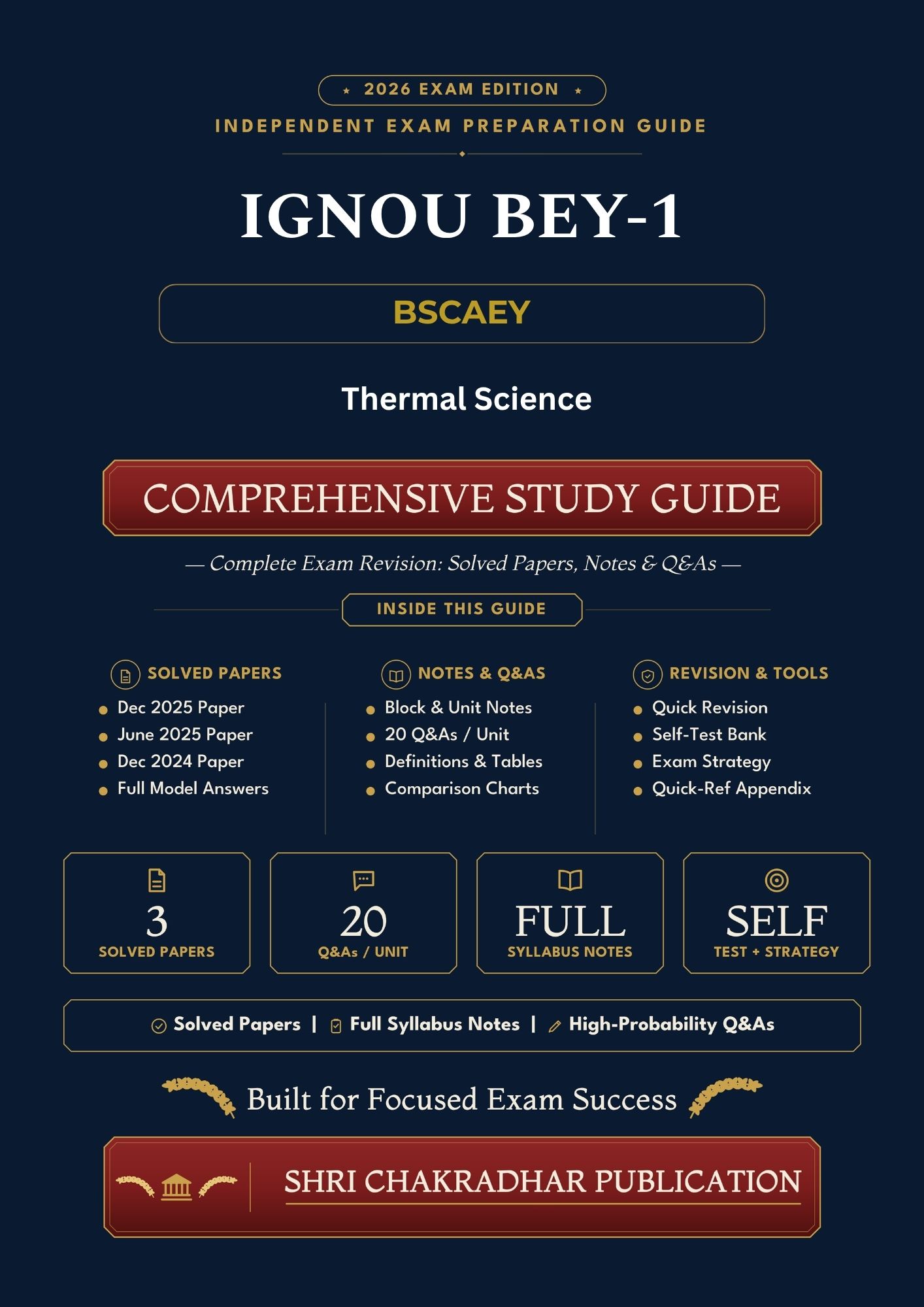
IGNOU BEY-001 Book (Thermal Science) is a 2026 English-medium study companion for BSCAEY, built around the verified syllabus, Unit-wise revision and TEE-oriented answer practice across 4 Blocks.
Energy courses combine engineering principles, resources, conversion systems, efficiency, economics and quantitative methods. Students should connect equations or technical concepts with the performance, management and sustainability of real energy systems. In Thermal Science, that means giving special attention to Introduction to Thermal Science, Steam Based Systems and Heat Transfer and Refrigeration Systems; the guide repeatedly links these areas so revision does not become a list of disconnected facts.
For more IGNOU study material, visit IGNOU Study Material. Use this independent guide together with IGNOU’s official study material, assignments and current examination information.
An Overview of the IGNOU BEY-001 Help Book
For BEY-001, the most efficient revision starts by seeing the whole course before studying individual Units. The guide maps Introduction to Thermal Science, Steam Based Systems and Heat Transfer and the later areas into one continuous preparation plan.
Study each area through principle, governing variables, system or technology, calculation or performance measure and practical energy application. Rework numerical examples and explain what the result means physically.
Course-specific revision lens: For Introduction to Thermal Science, first state the governing idea, then add the process, evidence or method that makes it meaningful in this course. Treat Steam Based Systems and Heat Transfer as an active-recall checkpoint: explain it without notes, identify one connection to another Unit and then attempt a written question. While revising Air Based Systems, separate the essential definition from the application and finish with one example, calculation or observation. For Refrigeration Systems, first state the governing idea, then add the process, evidence or method that makes it meaningful in this course.
Answer architecture for this course: For Introduction to Thermal Science, build the response in layers: key term, main explanation, supporting step or evidence, and a short concluding interpretation. An answer on Steam Based Systems and Heat Transfer should move from context to the central mechanism or argument, then close with the consequence, result or practical significance. An answer on Air Based Systems should move from context to the central mechanism or argument, then close with the consequence, result or practical significance. When a TEE question targets Refrigeration Systems, identify the command word first and choose only the facts, calculations or examples that directly support that task.
This Book Is Useful For
Use this guide when the official material feels extensive and you need a concise route through Thermal Science without losing the syllabus sequence.
- First-time learners building a foundation in Introduction to Thermal Science.
- Students revising energy principles, system components, engineering calculations, efficiency measures, resource characteristics and technical applications.
- Learners practising recent-question styles.
- Working students using short study sessions.
- Assignment learners checking concepts before writing independently.
What’s Inside This BEY-001 Book
Each part of the guide serves a different purpose—understand the topic, retrieve it from memory, practise an answer and return to weak areas.
- Unit-wise notes: concepts arranged around the verified BEY-001 sequence.
- Course cues: focus on Introduction to Thermal Science, Steam Based Systems and Heat Transfer and connected topics.
- Answer practice: engineering explanations, numerical problems, technology comparisons, efficiency calculations and energy-system cases.
- PYQ orientation: practice based on recurring examination task-types, without prediction claims.
- Final recap: quick checkpoints for weak areas before the TEE.
Complete Syllabus Coverage – All 4 Blocks
The verified IGNOU structure is reproduced as the syllabus anchor for this guide. Where IGNOU publishes Blocks, they are named directly; where it publishes a practical, Theme or course-level structure, that format is preserved rather than converted into invented Blocks.
| Block | Official title | Revision focus |
|---|---|---|
| Block 1 | Introduction to Thermal Science | Introduction to Thermal Science |
| Block 2 | Steam Based Systems and Heat Transfer | Steam Based Systems and Heat Transfer |
| Block 3 | Air Based Systems | Air Based Systems |
| Block 4 | Refrigeration Systems | Refrigeration Systems |
Progress through the sequence only after you can explain the main idea without looking at the notes.
How This Book Maps to the IGNOU BEY-001 Exam Pattern
The guide maps syllabus content to common examination actions rather than promising repeated questions. In BEY-001, written practice should demonstrate energy principles, system components, engineering calculations, efficiency measures, resource characteristics and technical applications.
Why Students Prefer Our IGNOU BEY-001 Guide Book & Study Material
The main advantage is organisation. Instead of mixing topics, the guide follows the researched course sequence and repeatedly asks the learner to retrieve and apply what was studied.
This makes weak areas easier to identify before the TEE.
Compiled & Reviewed By
The SCP Panel of Experts, under BK Sahni at Shri Chakradhar Publication, compiles this independent guide. The 2026 review checks the BEY-001 syllabus map against official IGNOU/eGyanKosh sources before the revision copy is organised.
How to Use the IGNOU BEY-001 Help Book for TEE and Assignments
Do not make rereading the only revision method. Combine comprehension with recall and written application.
- Preview the course area and its Units.
- Read the explanation and make a compact recall list.
- Attempt a question on Steam Based Systems and Heat Transfer or the current Unit without looking back.
- Compare your answer with official concepts, not with memorised wording.
- Before the TEE, prioritise weak Units and timed practice.
High-Probability Questions from IGNOU BEY-001 (Sample)
Use these sample questions to test whether you can connect concepts across the syllabus. No future-paper guarantee is implied.
- Explain the engineering principle behind Introduction to Thermal Science in the context of Thermal Science.
- Compare energy-system approaches to Steam Based Systems and Heat Transfer in the context of Thermal Science.
- Discuss performance factors affecting Air Based Systems in the context of Thermal Science.
- Apply the relevant method to Refrigeration Systems in the context of Thermal Science.
- Build a comparative answer linking Introduction to Thermal Science with Refrigeration Systems.
- Write a structured short note on one recurring concept from Thermal Science, using definition, explanation and a relevant example, calculation, process or evidence as appropriate.
- Using the official course sequence, explain how the early topics in Thermal Science prepare the learner for the later analytical or applied areas.
IGNOU BEY-001 Sample Question Paper (TEE Format Template)
Try this sample in one sitting, then use a recent official BEY-001 paper to compare difficulty, command words and coverage.
Section A – Extended Answers
- Explain the engineering principle behind Introduction to Thermal Science in the context of Thermal Science.
- Compare energy-system approaches to Steam Based Systems and Heat Transfer in the context of Thermal Science.
- Discuss performance factors affecting Air Based Systems in the context of Thermal Science.
Section B – Analytical / Short Answers
- Apply the relevant method to Refrigeration Systems in the context of Thermal Science.
- Build a comparative answer linking Introduction to Thermal Science with Refrigeration Systems.
- Write a structured short note on one recurring concept from Thermal Science, using definition, explanation and a relevant example, calculation, process or evidence as appropriate.
Check whether every answer shows the method, evidence or reasoning expected in engineering explanations, numerical problems, technology comparisons, efficiency calculations and energy-system cases.
Related IGNOU BEY-001 Additional Supports
Students who need additional assignment or exam-practice formats can use the four optional supports below.
- IGNOU BEY-001 Solved Assignment
- IGNOU BEY-001 Handwritten Assignment
- IGNOU BEY-001 Solved PYQs
- IGNOU BEY-001 Solved Guess Paper
Delivery, Returns & Payment Options
The A5 paperback is supplied under the delivery, return and payment conditions shown on the live product page at the time of order.
How Students Use This Guide
A useful routine for BEY-001 is one Unit, one recall note and one written answer per study session, with weak areas carried into the next session.
Integrated recall map: Use Introduction to Thermal Science for a one-minute oral explanation, then convert that explanation into a short written response containing the essential terminology and one course-specific connection. Link Steam Based Systems and Heat Transfer to the next course area by identifying one dependency, one contrast and one practical consequence; this makes the topic easier to retrieve in an integrated answer. Link Air Based Systems to the next course area by identifying one dependency, one contrast and one practical consequence; this makes the topic easier to retrieve in an integrated answer. Use Refrigeration Systems for a one-minute oral explanation, then convert that explanation into a short written response containing the essential terminology and one course-specific connection.
Free Downloads: IGNOU BEY-001 Exam Support PDFs
Keep the university material separate from independent revision aids and use official portals for the latest academic documents.
- Official IGNOU/eGyanKosh material for BEY-001.
- IGNOU Assignments for current papers and instructions.
- IGNOU Previous Year Question Papers for available TEE papers.
Download BEY-001 Study Material Free via eGyanKosh (Step-by-Step)
To cross-check BEY-001, open eGyanKosh and match the retrieved record with your registration and current programme information.
- Open the official repository at eGyanKosh.
- Search for BEY-001.
- Match the title and programme context.
- Save the relevant official PDFs.
- Use those PDFs with this independent guide for Unit-wise practice.
Frequently Asked Questions (FAQ)
Use the FAQ to check format, course alignment, official-source access and appropriate use of the book.
What is the verified syllabus structure for BEY-001?
The researched official structure contains 4 Blocks, all represented in this edition.
What subject does BEY-001 cover?
Thermal Science is the course subject; this guide follows the researched official sequence and focuses on Unit-wise revision.
Which programme is this BEY-001 edition for?
This edition is prepared for BSCAEY learners studying BEY-001.
Is this BEY-001 book in English?
This product is prepared in English; students should match it with their intended study and examination medium.
Does it include previous-paper practice?
Yes. Previous-paper-oriented practice is included to improve answer skills, without promising that a question will repeat.
Is BEY-001 assignment preparation covered?
Use it for concept understanding and planning, while writing and submitting your own assignment work according to IGNOU guidelines.
Is this an official IGNOU publication?
No. It is independent academic study support from Shri Chakradhar Publication and is not affiliated with or endorsed by IGNOU.
How do I download the official BEY-001 PDFs?
Search the exact code BEY-001 on eGyanKosh and use the official IGNOU links provided above.
What should I do in the final TEE revision?
Follow the official sequence, use active recall, practise written responses, review recent papers and return to weak Units before the examination.
Conclusion
For Thermal Science, this BEY-001 guide is designed to keep syllabus coverage, recall and answer practice in one manageable 2026 study sequence.
To order, visit the IGNOU BEY-001 Book order page.
Disclaimer: This is an independent academic study-support resource published by Shri Chakradhar Publication (Pvt.) Ltd. It is not affiliated with, endorsed by, or an official publication of IGNOU. It is designed to supplement, not replace, IGNOU’s official study material. Syllabus and exam patterns may change – please verify the latest information through official IGNOU channels. Students should prepare and submit their own work as per IGNOU guidelines. All trademarks belong to their respective owners.


