

Description
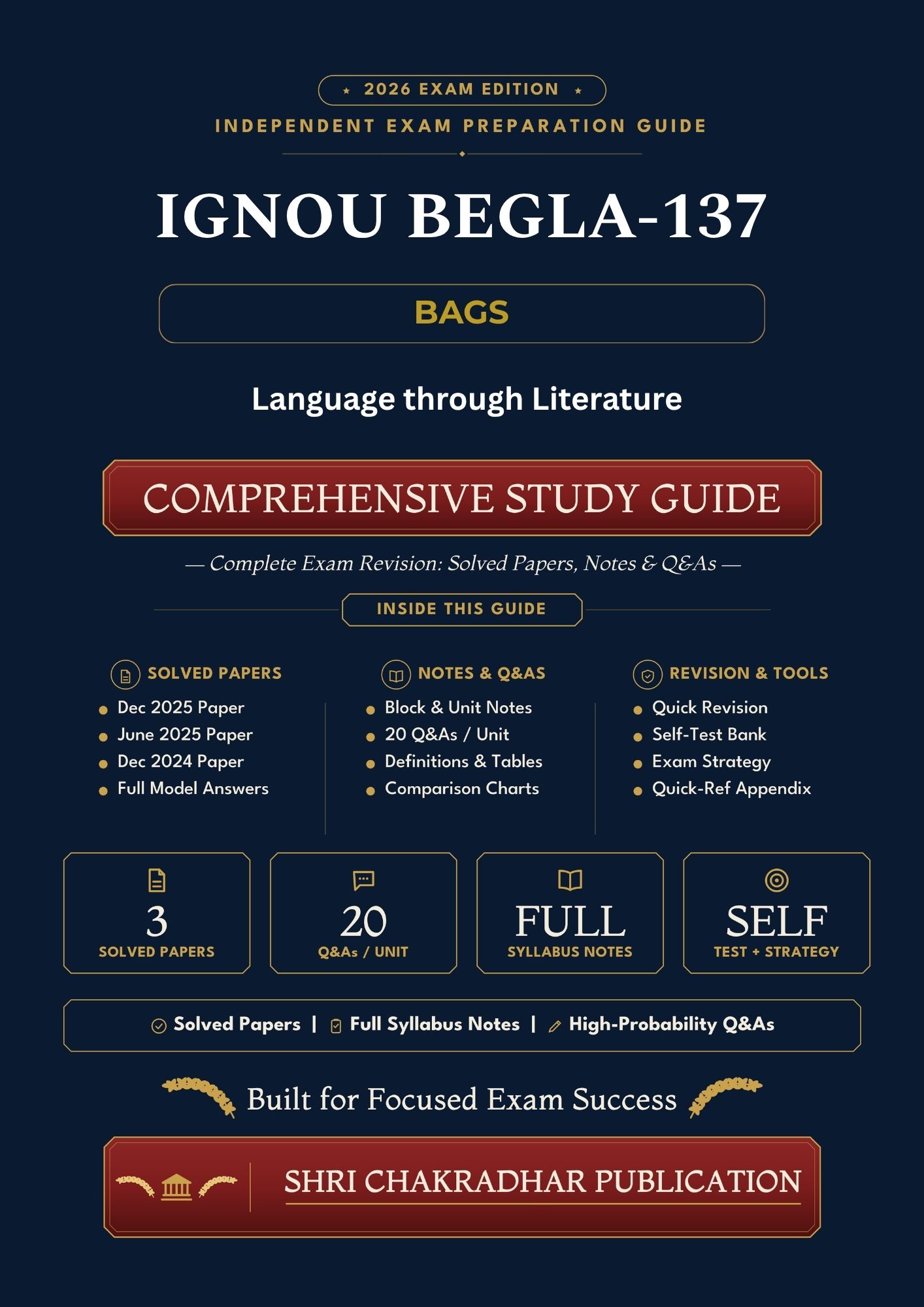
IGNOU BEGLA-137 Book (Language Through Literature) is a 2026 study companion for Language Through Literature that keeps the official course architecture at the centre. Instead of revising randomly, learners can move through 4 verified Blocks in a deliberate Unit-wise sequence.
The syllabus becomes difficult at revision stage when familiar ideas are spread across several Units and the learner has no quick way to see their relationships. In this course, links among vocabulary and meaning, literary language and figures of speech deserve particular attention because they shape both understanding and exam-ready explanation.
For more IGNOU study material, visit IGNOU Study Material. Use this independent guide alongside the latest official IGNOU study material and current examination instructions.
An Overview of the IGNOU BEGLA-137 Help Book
Before memorising definitions, learners should know the architecture of Language Through Literature. The overview therefore treats vocabulary and meaning, literary language and figures of speech as connected study areas rather than isolated chapters.
For written answers, the goal is to move from a precise opening statement to explanation, evidence or illustration, and then a conclusion that returns to the question. In Language Through Literature, that means combining literary or media concepts, textual examples, structure, style and critical explanation.
Revise in three passes: first understand the concept, then condense it into headings, and finally practise a timed answer using the headings without looking at notes.
This Book Is Useful For
This book is most useful when the learner needs structure, not simply more pages to read. It supports first study, revision and answer practice at different stages of the session.
- BAGS learners mapping the full BEGLA-137 course before revision
- Students strengthening recall of vocabulary and meaning, literary language and figures of speech
- Learners who prefer Unit-wise notes aligned with the verified syllabus
- TEE candidates practising structured descriptive answers and short notes
- Students using official IGNOU material as the primary source and this guide as revision support
What’s Inside This BEGLA-137 Book
Inside the guide, every component has a job: clarify the course, shorten retrieval time or improve written practice. The parts are arranged to move from syllabus coverage to active recall.
- Unit-wise study notes: official sequence converted into concise revision points
- Concept links: connections among definitions, arguments and neighbouring themes
- Answer frames: course-specific ways to organise vocabulary and meaning and literary language
- Practice prompts: questions for explanation, comparison, application and evaluation
- Final recap cues: headings and reminders for the last revision cycle
Complete Syllabus Coverage – All 4 Blocks
The official course organisation is the anchor for this guide. Named Blocks are reproduced where verified; Unit-level structure is preserved where a separate Block hierarchy cannot be confirmed.
| Official Block | Official Block Name | Revision Focus |
|---|---|---|
| Block 1 | Understanding the Relationship between Language and Literature through Vocabulary | Revise definitions, major arguments, examples and Unit-wise answer points linked with this Block. |
| Block 2 | Literary Devices | Revise definitions, major arguments, examples and Unit-wise answer points linked with this Block. |
| Block 3 | Structure Words | Revise definitions, major arguments, examples and Unit-wise answer points linked with this Block. |
| Block 4 | Rhetorical Devices | Revise definitions, major arguments, examples and Unit-wise answer points linked with this Block. |
After each study session, mark whether you can explain the segment without notes, whether you need another reading, or whether you still need written practice. Give extra time to areas linked with vocabulary and meaning and structure words.
How This Book Maps to the IGNOU BEGLA-137 Exam Pattern
The guide maps content to answer tasks rather than promising repeated questions. A strong response starts by identifying what the command word demands and then selecting only the most relevant course material.
Use vocabulary and meaning, figures of speech and structure words to practise transitions between ideas. Examiners can change the wording, but a learner who understands the relationships can still build a coherent response.
Why Students Prefer Our IGNOU BEGLA-137 Guide Book & Study Material
A course-specific guide is useful when it helps a learner make decisions—what to read, what to reduce into notes, what to practise and what to revisit.
The revision flow deliberately returns to vocabulary and meaning, literary language and style and discourse. Each return is different: first for understanding, later for retrieval, and finally for timed expression.
Compiled & Reviewed By
The Shri Chakradhar Publication (SCP) Panel of Experts / BK Sahni compiles and reviews this guide as an independent academic-support resource. The editorial objective is accurate course mapping, readable revision and responsible exam practice.
Where structure is verified, it is retained; where a hierarchy is unclear, unsupported Blocks are not invented. Learners are encouraged to cross-check session-specific changes through IGNOU.
How to Use the IGNOU BEGLA-137 Help Book for TEE and Assignments
Use the book in passes rather than reading it repeatedly from page one. A coverage pass, a recall pass and a writing pass create a clearer measure of progress.
- Begin with the verified Block/Unit sequence and identify the next unfinished area.
- Create a one-sentence definition for vocabulary and meaning and a two-sentence explanation for literary language.
- Add one example, text reference, case, policy point or calculation as appropriate to the course.
- Turn figures of speech into a two-minute answer outline before writing in full.
- Compare the finished answer with your headings rather than memorising a fixed paragraph.
- Use the final week for weak themes, especially rhetoric and style and discourse.
High-Probability Questions from IGNOU BEGLA-137 (Sample)
Use these questions to test whether the course can be retrieved without looking at notes. They are practice prompts and carry no guarantee of appearing in a TEE.
- Explain the meaning and significance of vocabulary and meaning in the context of Language Through Literature.
- Discuss the major issues connected with vocabulary and meaning and illustrate your answer with suitable examples.
- Explain the meaning and significance of literary language in the context of Language Through Literature.
- Discuss the major issues connected with literary language and illustrate your answer with suitable examples.
- Explain the meaning and significance of figures of speech in the context of Language Through Literature.
- Discuss the major issues connected with figures of speech and illustrate your answer with suitable examples.
- Explain the meaning and significance of structure words in the context of Language Through Literature.
- Discuss the major issues connected with structure words and illustrate your answer with suitable examples.
Keep the strongest four questions for timed practice and use the remaining prompts as quick oral-recall drills during the last revision cycle.
IGNOU BEGLA-137 Sample Question Paper (TEE Format Template)
This is an independent practice template, not an official IGNOU paper. Its function is to create a timed rehearsal using course-specific questions.
Practice instruction: Attempt the set under a self-imposed time limit and follow the latest official pattern for question choice and marks.
- Q1. Explain the meaning and significance of vocabulary and meaning in the context of Language Through Literature.
- Q2. Discuss the major issues connected with vocabulary and meaning and illustrate your answer with suitable examples.
- Q3. Explain the meaning and significance of literary language in the context of Language Through Literature.
- Q4. Discuss the major issues connected with literary language and illustrate your answer with suitable examples.
- Q5. Explain the meaning and significance of figures of speech in the context of Language Through Literature.
- Q6. Discuss the major issues connected with figures of speech and illustrate your answer with suitable examples.
- Q7. Explain the meaning and significance of structure words in the context of Language Through Literature.
- Q8. Discuss the major issues connected with structure words and illustrate your answer with suitable examples.
Use a second attempt to shorten introductions and strengthen the middle of the answer, where explanation and evidence usually carry most of the academic value.
Related IGNOU BEGLA-137 Additional Supports
Separate support categories are available for students who want additional assignment or question-practice products for this course code.
- IGNOU BEGLA-137 Solved Assignment
- IGNOU BEGLA-137 Handwritten Assignment
- IGNOU BEGLA-137 Solved PYQs
- IGNOU BEGLA-137 Solved Guess Paper
Delivery, Returns & Payment Options
The study guide is a physical A5 paperback unless the product page states otherwise. Courier coverage, dispatch timing and payment choices are those available on the website for the delivery address.
Check the current store policy before purchase. Where a legitimate damage or printing issue occurs, the order and parcel details help support review the request efficiently.
How Students Use This Guide
A useful habit is to turn every study session into an output. The output may be a concept map, a short answer, a comparison table or a timed paragraph.
In Language Through Literature, use vocabulary and meaning as an anchor and connect literary language, figures of speech and structure words around it. A visual link between themes often improves retrieval when a question combines areas.
Free Downloads: IGNOU BEGLA-137 Exam Support PDFs
Before relying on any third-party summary, confirm the course through official IGNOU material. The resources below are the appropriate starting points for that check.
- Official IGNOU/eGyanKosh self-learning material for BEGLA-137
- Current assignment booklet for the applicable session
- Available previous TEE question papers from official IGNOU channels
- Programme guide or prospectus information relevant to BAGS
Download BEGLA-137 Study Material Free via eGyanKosh (Step-by-Step)
Downloading the official material first gives you a stable reference for definitions, prescribed sequence and any content that needs deeper reading.
- Open the official eGyanKosh course/resource page.
- Check that the page or PDF corresponds to BEGLA-137 and Language Through Literature.
- Open the required Block, Unit or course file and verify its title before saving it.
- Store the PDFs in a folder named BEGLA-137 and keep the verified sequence intact.
- Use the official PDFs for detailed study and this independent guide for Unit-wise revision and answer rehearsal.
Frequently Asked Questions (FAQ)
The answers below explain the scope of the product and the safest way to combine it with official course resources.
What is the IGNOU BEGLA-137 book used for?
The book helps learners revise Language Through Literature in a structured way while using official IGNOU material as the primary academic source.
How much of the BEGLA-137 syllabus is covered?
The guide follows the researched official structure: 4 verified Blocks. Unsupported Block headings are not added where the official hierarchy cannot be confirmed.
Is this an official IGNOU publication?
No. It is independently published by Shri Chakradhar Publication and is not affiliated with, endorsed by, or an official publication of IGNOU.
Can I use this BEGLA-137 book for TEE revision?
Yes. Use it to revise vocabulary and meaning, literary language and figures of speech, practise outlines and rehearse complete answers while checking the latest official exam instructions.
Does the guide include solved-question practice?
Practice material is included to improve answer organisation; pair it with official question papers for session-specific pattern awareness.
What medium is this BEGLA-137 guide prepared in?
This product is prepared for the English medium shown on the product page, while necessary course terminology is retained for accuracy.
Can this guide replace eGyanKosh material?
No. Use official self-learning material for prescribed study and use this book to organise recall, revision and writing practice.
How should I revise BEGLA-137 in the final week?
Prioritise weak areas, especially structure words and rhetoric; rehearse key definitions, write short outlines and complete a few timed answers instead of rereading everything.
Where can I get order or soft-copy support?
Use the WhatsApp support link on this product page for availability and order assistance. Academic updates should still be verified through official IGNOU channels.
Conclusion
Use the book as a bridge between detailed official reading and timed examination writing. The strongest preparation comes from combining accurate source material with repeated retrieval and selective practice.
To order, visit the IGNOU BEGLA-137 Book order page. Re-check the latest syllabus, assignment and TEE instructions through official IGNOU channels before examination.
Disclaimer: This is an independent academic study-support resource published by Shri Chakradhar Publication (Pvt.) Ltd. It is not affiliated with, endorsed by, or an official publication of IGNOU. It is designed to supplement, not replace, IGNOU’s official study material. Syllabus and exam patterns may change – please verify the latest information through official IGNOU channels. Students should prepare and submit their own work as per IGNOU guidelines. All trademarks belong to their respective owners.