

Description
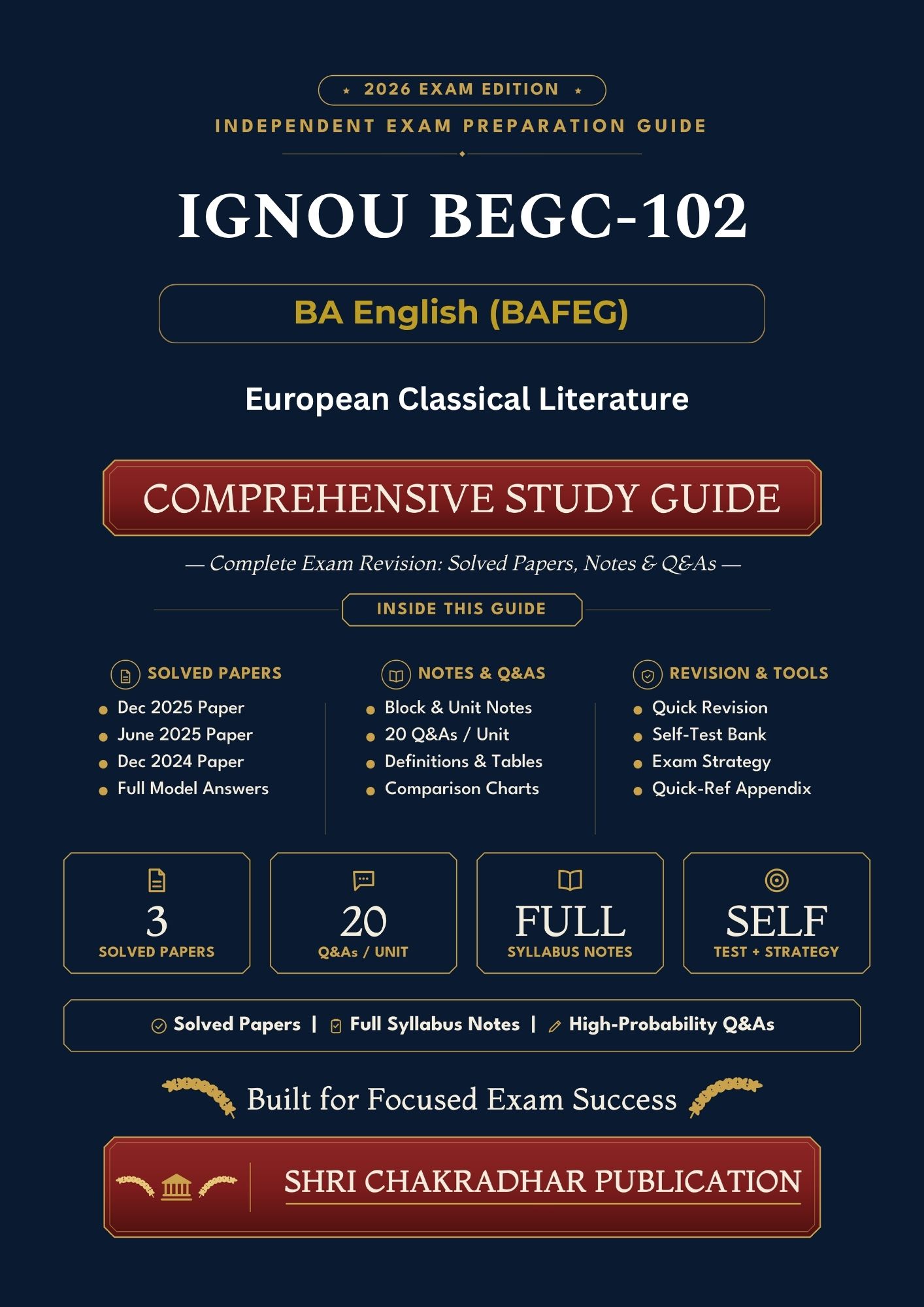
IGNOU BEGC-102 Book (European Classical Literature) is a 2026 English-medium study guide for BA English (BAFEG) learners. It supports concept learning, Unit-wise revision, previous-year-question practice and TEE preparation across 4 Blocks without presenting itself as an official IGNOU publication.
Literature answers need more than plot summary. Students have to connect genre, form, language, character, theme and historical context while keeping the argument focused on the prescribed text. In European Classical Literature, important study areas include Homer: The Iliad, Sophocles: Oedipus Rex, Plautus: Pot of Gold, Horace and Ovid. The guide breaks these areas into manageable reading, recall and writing tasks so that revision remains tied to the actual course.
For more IGNOU study material, visit IGNOU Study Material. Use this independent guide together with IGNOU’s official self-learning material, current assignments and the latest examination notices.
An Overview of the IGNOU BEGC-102 Help Book
This guide gives a structured route through European Classical Literature instead of treating the subject as disconnected chapters. The course moves through Homer: The Iliad, Sophocles: Oedipus Rex, Plautus: Pot of Gold, Horace and Ovid, with later Units asking students to connect earlier concepts, evidence, texts or methods with more analytical questions.
Read each prescribed work with four anchors: context, form, central conflict or idea, and the textual technique through which meaning is created. The official IGNOU material remains the primary syllabus source; this book is organised as a revision and practice companion.
This Book Is Useful For
The BEGC-102 guide is useful for learners who need a clear syllabus map, a repeatable revision sequence and subject-specific writing practice.
- Students beginning European Classical Literature who want to see how the main course areas connect.
- Learners revising textual interpretation, literary form, theme, character, context and critical comparison before the TEE.
- Students practising explanation, comparison and application through previous papers.
- Working learners who need short, repeatable study sessions rather than one long final revision.
- Assignment learners who want concept clarity before preparing and submitting their own work.
What’s Inside This BEGC-102 Book
The book combines verified syllabus mapping with Unit-level study, question practice and final recap. It is designed to make European Classical Literature easier to revise without replacing the prescribed university material.
- Unit-wise notes: concise explanations following the official course sequence.
- Concept and method cues: reminders for textual interpretation, literary form, theme, character, context and critical comparison.
- Practice sets: critical appreciations, text-context essays, character or theme analysis and comparative answers shaped around this course.
- Previous-paper practice: prompts for common answer forms without prediction claims.
- Revision checkpoints: recap points and self-testing prompts for final preparation.
Complete Syllabus Coverage – All 4 Blocks
The official course organisation is kept visible so revision can be checked against IGNOU material rather than an invented syllabus. This is especially important for BEGC-102, where the guide distinguishes verified Blocks, Themes or Unit-based structures exactly as the official repository permits.
| Block | Official title | Revision focus |
|---|---|---|
| Block 1 | Homer: The Iliad | Homer: The Iliad |
| Block 2 | Sophocles: Oedipus Rex | Sophocles: Oedipus Rex |
| Block 3 | Plautus: Pot of Gold | Plautus: Pot of Gold |
| Block 4 | Horace and Ovid | Horace and Ovid |
Use each verified course area as a milestone: revise its Units, write at least two answers and mark weak concepts before moving to the next part of European Classical Literature.
How This Book Maps to the IGNOU BEGC-102 Exam Pattern
This guide maps the course to the academic tasks a TEE can require: define or explain a concept, compare positions, interpret evidence or text, apply a method, and organise a longer argument. The exact question-paper pattern can change, so students should always check the latest official paper before the examination.
For European Classical Literature, practise critical appreciations, text-context essays, character or theme analysis and comparative answers. The sample questions in this book are syllabus-based practice prompts, not guaranteed predictions.
Why Students Prefer Our IGNOU BEGC-102 Guide Book & Study Material
The practical value of the guide is its organisation: the verified course structure remains visible, Unit-wise reading is broken into manageable tasks and revision repeatedly returns to the important concepts of European Classical Literature. This helps students see what has been covered, what still needs practice and which answers need another attempt before the TEE.
The guide also separates factual recall from analytical writing. That distinction is useful in critical appreciations, text-context essays, character or theme analysis and comparative answers, where a correct answer usually needs both knowledge of the syllabus and a clear method of presenting it.
Compiled & Reviewed By
This guide is compiled and reviewed by the SCP Panel of Experts under BK Sahni, Shri Chakradhar Publication. The editorial approach is to keep the verified course structure visible, use student-friendly language and avoid unsupported claims about marks, results or question-paper prediction.
For the 2026 edition, the course map for BEGC-102 was checked against official IGNOU/eGyanKosh material. Subject explanations are supplementary study support and should be read with the university’s prescribed learning material.
How to Use the IGNOU BEGC-102 Help Book for TEE and Assignments
Use three passes: understand the Unit-wise notes, recall the main idea without looking, and then write a timed answer that can be checked against the official Unit. This turns passive reading into active revision.
- Begin with Homer: The Iliad and note the essential terms, arguments, evidence or method.
- Move through the official course sequence instead of revising only familiar topics.
- After each Unit, write one short answer and one longer explanation using textual interpretation, literary form, theme, character, context and critical comparison.
- Use official assignments as a concept-check, but prepare and submit your own work in accordance with IGNOU guidelines.
- Before the TEE, revise weak areas first, then use the sample questions and recap points for active recall.
High-Probability Questions from IGNOU BEGC-102 (Sample)
These course-specific questions are designed as high-value revision practice because they require students to connect major syllabus areas. They are not predictions of the future TEE paper.
- Critically examine Homer: The Iliad in the context of European Classical Literature.
- Discuss the form, theme and context of Sophocles: Oedipus Rex in the context of European Classical Literature.
- Compare the treatment of ideas in Plautus: Pot of Gold in the context of European Classical Literature.
- Explain the literary significance of Horace and Ovid in the context of European Classical Literature.
- Build a comparative answer linking Homer: The Iliad with Horace and Ovid.
- Write a structured short note on one recurring concept from European Classical Literature, using definition, explanation and a relevant example or textual/evidential support.
- Using the official course sequence, explain how the early topics in European Classical Literature prepare the learner for the later analytical areas.
IGNOU BEGC-102 Sample Question Paper (TEE Format Template)
This is an independent practice template, not an official IGNOU question paper. Use it to rehearse selection, sequencing and answer writing, and then compare your preparation with the latest official BEGC-102 TEE paper.
Section A – Extended Answers
- Critically examine Homer: The Iliad in the context of European Classical Literature.
- Discuss the form, theme and context of Sophocles: Oedipus Rex in the context of European Classical Literature.
- Compare the treatment of ideas in Plautus: Pot of Gold in the context of European Classical Literature.
Section B – Analytical / Short Answers
- Explain the literary significance of Horace and Ovid in the context of European Classical Literature.
- Build a comparative answer linking Homer: The Iliad with Horace and Ovid.
- Write a structured short note on one recurring concept from European Classical Literature, using definition, explanation and a relevant example or textual/evidential support.
While practising, emphasise textual interpretation, literary form, theme, character, context and critical comparison. Begin with the central concept or evidence, develop the reasoning in a logical order and finish with a concise conclusion.
Related IGNOU BEGC-102 Additional Supports
These are optional additional supports for students who want assignment help, handwritten work, PYQ practice or guess-paper revision in addition to the study guide.
- IGNOU BEGC-102 Solved Assignment
- IGNOU BEGC-102 Handwritten Assignment
- IGNOU BEGC-102 Solved PYQs
- IGNOU BEGC-102 Solved Guess Paper
Delivery, Returns & Payment Options
The guide is supplied as an A5 paperback. Shipping availability, payment methods, delivery timelines and return conditions can vary by location and order status, so students should check the current product-page terms when placing the order.
How Students Use This Guide
A practical routine is to study one Unit, make a short recall note, answer one question and then repeat the process. For European Classical Literature, learners can alternate concept revision with critical appreciations, text-context essays, character or theme analysis and comparative answers so that reading and writing develop together. This section describes a study method, not a review or result claim.
Free Downloads: IGNOU BEGC-102 Exam Support PDFs
Use official IGNOU resources first for current study material, assignments and examination documents. For BEGC-102, the most useful starting point is the official course record or programme document.
- Official IGNOU/eGyanKosh material for BEGC-102.
- IGNOU Assignments for current papers and instructions.
- IGNOU Previous Year Question Papers for available TEE papers.
Download BEGC-102 Study Material Free via eGyanKosh (Step-by-Step)
eGyanKosh is IGNOU’s official digital repository. Search with the exact course code to reduce the chance of opening an older or similarly named course.
- Open eGyanKosh.
- Search for BEGC-102.
- Open the record matching European Classical Literature.
- Compare the listed Blocks, Themes or Units with your registration and current programme material.
- Save the official PDFs and use this guide separately for revision and answer practice.
Frequently Asked Questions (FAQ)
These answers address common practical questions about the course guide and its use.
How many Blocks does IGNOU BEGC-102 have?
IGNOU BEGC-102 has 4 verified Blocks in the researched official structure, and this guide covers all 4 Blocks.
What is the subject of IGNOU BEGC-102?
The course is European Classical Literature. The guide follows the researched official course structure and uses Unit-wise revision within that syllabus.
Which programme can use this BEGC-102 book?
This edition is prepared for BA English (BAFEG) learners taking BEGC-102.
What medium is this BEGC-102 study guide?
This product is prepared in English. Students should match the book with their intended study and examination medium.
Does the BEGC-102 book include previous-year-question practice?
Yes. It includes previous-paper-oriented practice to develop answer skills, without claiming that any question will repeat in a future examination.
Can I use this guide for IGNOU BEGC-102 assignments?
Yes, for understanding concepts and planning answers. Students should prepare and submit their own assignment work as required by IGNOU.
Is this an official IGNOU publication?
No. It is an independent study-support book published by Shri Chakradhar Publication and is not affiliated with or endorsed by IGNOU.
Where can I download official BEGC-102 study material?
Use eGyanKosh and search the exact course code BEGC-102. The relevant official resource is linked in the free-download section above.
How should I revise BEGC-102 before the TEE?
Follow the official course order, use active recall, practise written answers, check recent question papers and finish with a final review of weak areas.
Conclusion
The IGNOU BEGC-102 Book supports European Classical Literature with course-aligned syllabus mapping, Unit-wise revision and subject-specific practice. Use it with official IGNOU material, current assignments and recent question papers for a balanced 2026 preparation plan.
To order, visit the IGNOU BEGC-102 Book order page.
Disclaimer: This is an independent academic study-support resource published by Shri Chakradhar Publication (Pvt.) Ltd. It is not affiliated with, endorsed by, or an official publication of IGNOU. It is designed to supplement, not replace, IGNOU’s official study material. Syllabus and exam patterns may change – please verify the latest information through official IGNOU channels. Students should prepare and submit their own work as per IGNOU guidelines. All trademarks belong to their respective owners.