

Description
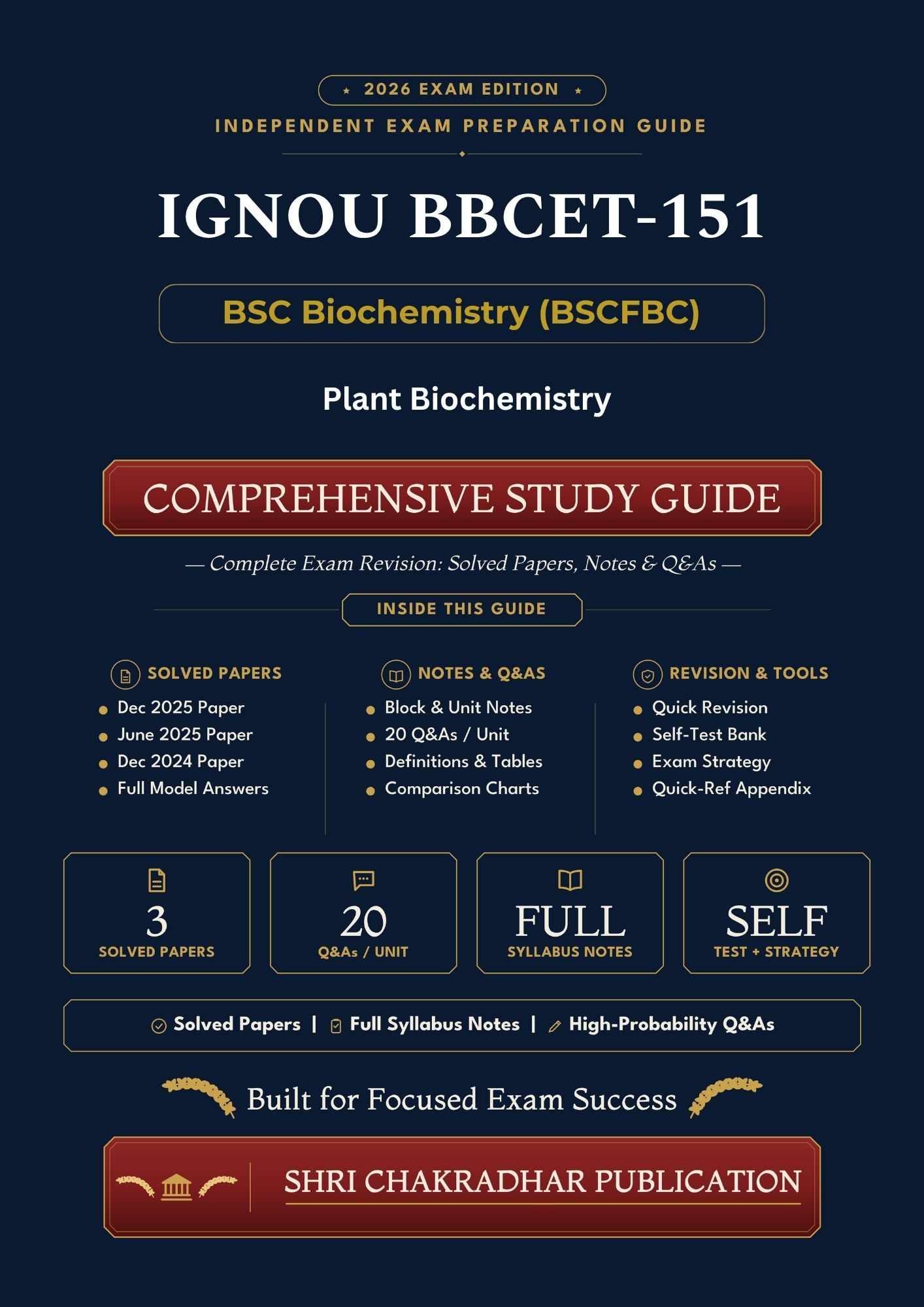
IGNOU BBCET-151 Book (Plant Biochemistry) is organised for BSC Biochemistry (BSCFBC) students who want a 2026 English-medium guide that keeps the verified 4 Blocks visible while supporting Unit-wise study and exam writing.
Students often know individual points in Plant Biochemistry but struggle to convert them into a complete answer. Revise each topic through structure, mechanism, regulation and biological significance. For laboratory courses, connect the principle of the experiment with materials, procedure, observations, calculations and interpretation. The revision flow uses Carbon Assimilation, Respiration and later course areas as linked checkpoints.
For more IGNOU study material, visit IGNOU Study Material. Use this independent guide together with IGNOU’s official study material, assignments and current examination information.
An Overview of the IGNOU BBCET-151 Help Book
The course map is the starting point: Plant Biochemistry is revised in the official order so earlier ideas support later ones. Begin with Carbon Assimilation, then track how the course develops toward Specialised Topics in Plant Biochemistry.
Revise each topic through structure, mechanism, regulation and biological significance. For laboratory courses, connect the principle of the experiment with materials, procedure, observations, calculations and interpretation. This creates a study route rather than a collection of unrelated notes.
Course-specific revision lens: With Carbon Assimilation, focus on the relationship between the core concept and the way IGNOU expects it to be interpreted, applied or demonstrated. For Respiration, first state the governing idea, then add the process, evidence or method that makes it meaningful in this course. While revising Nitrogen Metabolism and Plant Growth Hormones, separate the essential definition from the application and finish with one example, calculation or observation. With Specialised Topics in Plant Biochemistry, focus on the relationship between the core concept and the way IGNOU expects it to be interpreted, applied or demonstrated.
Answer architecture for this course: Use Carbon Assimilation to practise synthesis by linking the immediate Unit with one earlier concept and one later application from the verified course sequence. For Respiration, build the response in layers: key term, main explanation, supporting step or evidence, and a short concluding interpretation. Use Nitrogen Metabolism and Plant Growth Hormones to practise synthesis by linking the immediate Unit with one earlier concept and one later application from the verified course sequence. For Specialised Topics in Plant Biochemistry, build the response in layers: key term, main explanation, supporting step or evidence, and a short concluding interpretation.
This Book Is Useful For
The BBCET-151 guide is designed for students who want to know what to revise, how the topics connect and when to move from reading to writing.
- First-time learners building a foundation in Carbon Assimilation.
- Students revising molecular structures, biochemical pathways, enzyme or gene mechanisms, physiological significance, experimental principles and interpretation.
- Learners practising recent-question styles.
- Working students using short study sessions.
- Assignment learners checking concepts before writing independently.
What’s Inside This BBCET-151 Book
The book is arranged as a working revision tool: course map first, Unit-level study next, followed by practice and final recap.
- Unit-wise notes: concepts arranged around the verified BBCET-151 sequence.
- Course cues: focus on Carbon Assimilation, Respiration and connected topics.
- Answer practice: pathway explanations, mechanism-based questions, diagram-linked answers, biochemical comparisons and laboratory-principle questions.
- PYQ orientation: practice based on recurring examination task-types, without prediction claims.
- Final recap: quick checkpoints for weak areas before the TEE.
Complete Syllabus Coverage – All 4 Blocks
The verified IGNOU structure is reproduced as the syllabus anchor for this guide. Where IGNOU publishes Blocks, they are named directly; where it publishes a practical, Theme or course-level structure, that format is preserved rather than converted into invented Blocks.
| Block | Official title | Revision focus |
|---|---|---|
| Block 1 | Carbon Assimilation | Carbon Assimilation |
| Block 2 | Respiration | Respiration |
| Block 3 | Nitrogen Metabolism and Plant Growth Hormones | Nitrogen Metabolism and Plant Growth Hormones |
| Block 4 | Specialised Topics in Plant Biochemistry | Specialised Topics in Plant Biochemistry |
Treat every listed area as a checkpoint: revise, self-test, practise and then mark it complete.
How This Book Maps to the IGNOU BBCET-151 Exam Pattern
Exam mapping in this guide focuses on what a good response must do with the syllabus. Revise the concept first, then practise the question form and verify recent TEE papers separately.
Why Students Prefer Our IGNOU BBCET-151 Guide Book & Study Material
The guide is useful because coverage and practice stay connected. Students can see where Carbon Assimilation belongs, what remains unread and which written responses still need work.
That visible progress is more useful than repeatedly rereading familiar Units.
Compiled & Reviewed By
The BBCET-151 guide is compiled by the SCP Panel of Experts under BK Sahni. Official course records are used for structure verification, while the explanatory and practice material remains independent supplementary support.
How to Use the IGNOU BBCET-151 Help Book for TEE and Assignments
Study actively: read for understanding, close the book and retrieve the main points, then practise a written response.
- Begin with the official course map.
- Study one manageable Unit at a time.
- Use active recall before checking the notes again.
- Write answers in your own words and keep assignments original.
- Use the final week for retrieval and practice rather than first-time reading.
High-Probability Questions from IGNOU BBCET-151 (Sample)
Use these sample questions to test whether you can connect concepts across the syllabus. No future-paper guarantee is implied.
- Explain the biochemical mechanism of Carbon Assimilation in the context of Plant Biochemistry.
- Relate structure and function in Respiration in the context of Plant Biochemistry.
- Compare the pathways or processes involved in Nitrogen Metabolism and Plant Growth Hormones in the context of Plant Biochemistry.
- Discuss the experimental or physiological significance of Specialised Topics in Plant Biochemistry in the context of Plant Biochemistry.
- Build a comparative answer linking Carbon Assimilation with Specialised Topics in Plant Biochemistry.
- Write a structured short note on one recurring concept from Plant Biochemistry, using definition, explanation and a relevant example, calculation, process or evidence as appropriate.
- Using the official course sequence, explain how the early topics in Plant Biochemistry prepare the learner for the later analytical or applied areas.
IGNOU BBCET-151 Sample Question Paper (TEE Format Template)
Try this sample in one sitting, then use a recent official BBCET-151 paper to compare difficulty, command words and coverage.
Section A – Extended Answers
- Explain the biochemical mechanism of Carbon Assimilation in the context of Plant Biochemistry.
- Relate structure and function in Respiration in the context of Plant Biochemistry.
- Compare the pathways or processes involved in Nitrogen Metabolism and Plant Growth Hormones in the context of Plant Biochemistry.
Section B – Analytical / Short Answers
- Discuss the experimental or physiological significance of Specialised Topics in Plant Biochemistry in the context of Plant Biochemistry.
- Build a comparative answer linking Carbon Assimilation with Specialised Topics in Plant Biochemistry.
- Write a structured short note on one recurring concept from Plant Biochemistry, using definition, explanation and a relevant example, calculation, process or evidence as appropriate.
While answering, make molecular structures, biochemical pathways, enzyme or gene mechanisms, physiological significance, experimental principles and interpretation visible and finish with a concise conclusion or result.
Related IGNOU BBCET-151 Additional Supports
For assignment presentation or extra PYQ/guess-paper practice, these separate supports are available.
- IGNOU BBCET-151 Solved Assignment
- IGNOU BBCET-151 Handwritten Assignment
- IGNOU BBCET-151 Solved PYQs
- IGNOU BBCET-151 Solved Guess Paper
Delivery, Returns & Payment Options
This product is an A5 paperback. Current checkout and product-page terms govern payment, dispatch, delivery and eligible returns.
How Students Use This Guide
A useful routine for BBCET-151 is one Unit, one recall note and one written answer per study session, with weak areas carried into the next session.
Integrated recall map: Use Carbon Assimilation for a one-minute oral explanation, then convert that explanation into a short written response containing the essential terminology and one course-specific connection. For Respiration, create a three-column recall cue covering the core idea, the evidence or working method, and the result or implication that an examiner could ask you to explain. Link Nitrogen Metabolism and Plant Growth Hormones to the next course area by identifying one dependency, one contrast and one practical consequence; this makes the topic easier to retrieve in an integrated answer. Link Specialised Topics in Plant Biochemistry to the next course area by identifying one dependency, one contrast and one practical consequence; this makes the topic easier to retrieve in an integrated answer.
Free Downloads: IGNOU BBCET-151 Exam Support PDFs
For BBCET-151, verify the current syllabus and downloadable material through official IGNOU/eGyanKosh resources before using supplementary notes.
- Official IGNOU/eGyanKosh material for BBCET-151.
- IGNOU Assignments for current papers and instructions.
- IGNOU Previous Year Question Papers for available TEE papers.
Download BBCET-151 Study Material Free via eGyanKosh (Step-by-Step)
To cross-check BBCET-151, open eGyanKosh and match the retrieved record with your registration and current programme information.
- Open the official repository at eGyanKosh.
- Search for BBCET-151.
- Match the title and programme context.
- Save the relevant official PDFs.
- Use those PDFs with this independent guide for Unit-wise practice.
Frequently Asked Questions (FAQ)
These answers clarify the most common questions about the guide, syllabus verification and exam use.
Does BBCET-151 have confirmed Blocks?
The researched official structure contains 4 Blocks, all represented in this edition.
What is IGNOU BBCET-151 about?
Plant Biochemistry is the course subject; this guide follows the researched official sequence and focuses on Unit-wise revision.
Who can use this BBCET-151 book?
This edition is prepared for BSC Biochemistry (BSCFBC) learners studying BBCET-151.
Which language is used in this edition?
This product is prepared in English; students should match it with their intended study and examination medium.
Are PYQ-oriented questions included?
Yes. Previous-paper-oriented practice is included to improve answer skills, without promising that a question will repeat.
Can I consult this book while preparing assignments?
Use it for concept understanding and planning, while writing and submitting your own assignment work according to IGNOU guidelines.
Is this book issued by IGNOU?
No. It is independent academic study support from Shri Chakradhar Publication and is not affiliated with or endorsed by IGNOU.
Which official source should I use for BBCET-151?
Search the exact code BBCET-151 on eGyanKosh and use the official IGNOU links provided above.
What should I do in the final TEE revision?
Follow the official sequence, use active recall, practise written responses, review recent papers and return to weak Units before the examination.
Conclusion
The final aim of this BBCET-151 guide is simple: understand the verified syllabus, retrieve it confidently and practise presenting that understanding clearly in the TEE.
To order, visit the IGNOU BBCET-151 Book order page.
Disclaimer: This is an independent academic study-support resource published by Shri Chakradhar Publication (Pvt.) Ltd. It is not affiliated with, endorsed by, or an official publication of IGNOU. It is designed to supplement, not replace, IGNOU’s official study material. Syllabus and exam patterns may change – please verify the latest information through official IGNOU channels. Students should prepare and submit their own work as per IGNOU guidelines. All trademarks belong to their respective owners.