

Description
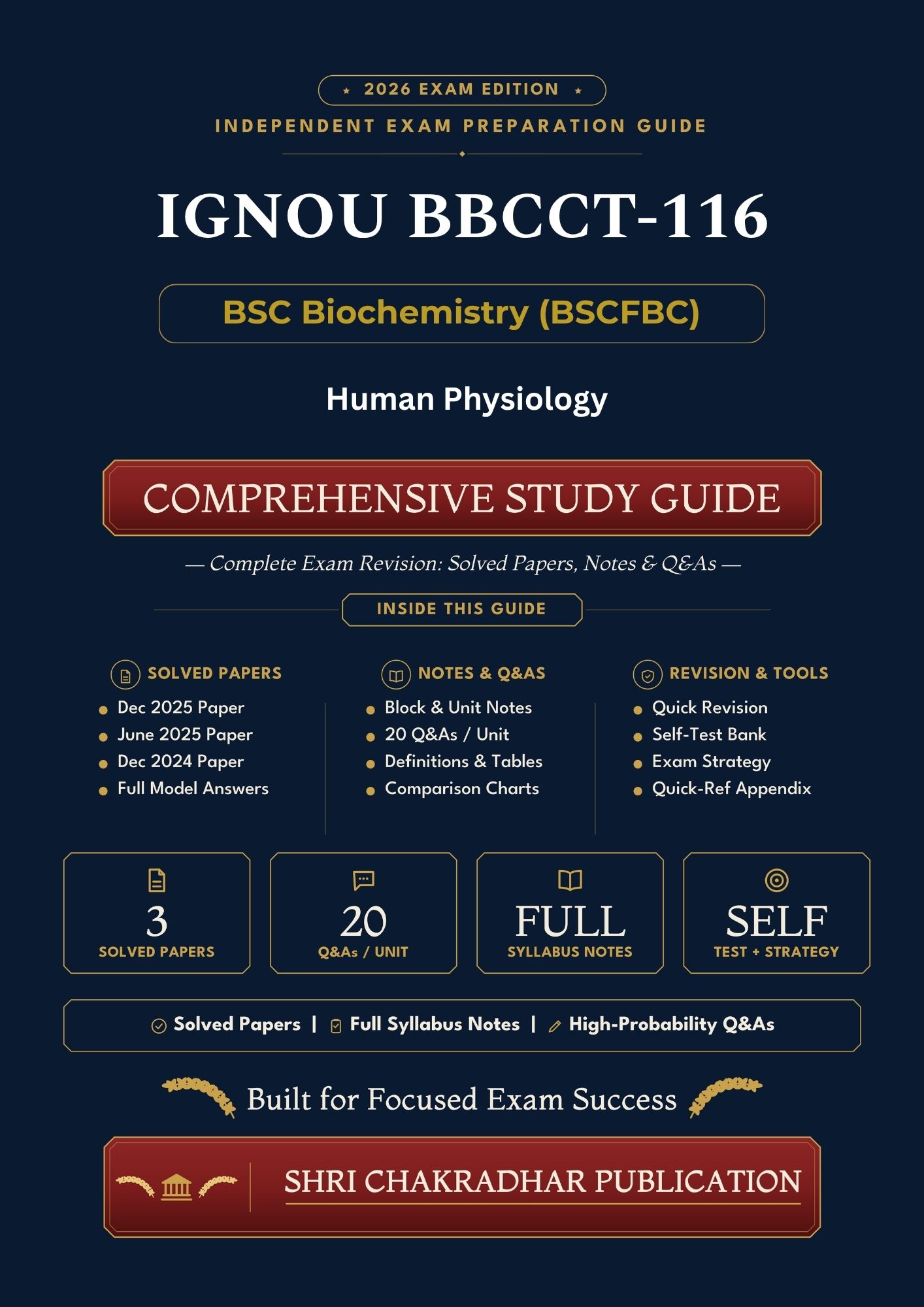
IGNOU BBCCL-116 Book (Human Physiology (Laboratory)) is a 2026 English-medium study companion for BSC Biochemistry (BSCFBC), built around the verified syllabus, Unit-wise revision and TEE-oriented answer practice across 9 Experiments.
Biochemistry combines molecular structures, reactions, pathways and laboratory reasoning. Students need to connect a molecule or process with its cellular role, regulation and experimental evidence rather than memorising isolated reactions. In Human Physiology (Laboratory), that means giving special attention to blood collection processing and storage, total RBC and WBC counting and hemoglobin estimation; the guide repeatedly links these areas so revision does not become a list of disconnected facts.
For more IGNOU study material, visit IGNOU Study Material. Use this independent guide together with IGNOU’s official study material, assignments and current examination information.
An Overview of the IGNOU BBCCL-116 Help Book
For BBCCL-116, the most efficient revision starts by seeing the whole course before studying individual Units. The guide maps blood collection processing and storage, total RBC and WBC counting and the later areas into one continuous preparation plan.
Revise each topic through structure, mechanism, regulation and biological significance. For laboratory courses, connect the principle of the experiment with materials, procedure, observations, calculations and interpretation.
Course-specific revision lens: While revising blood collection processing and storage, separate the essential definition from the application and finish with one example, calculation or observation. For total RBC and WBC counting, first state the governing idea, then add the process, evidence or method that makes it meaningful in this course. With differential leukocyte count, focus on the relationship between the core concept and the way IGNOU expects it to be interpreted, applied or demonstrated. While revising clotting time, separate the essential definition from the application and finish with one example, calculation or observation.
Answer architecture for this course: Use blood collection processing and storage to practise synthesis by linking the immediate Unit with one earlier concept and one later application from the verified course sequence. Use total RBC and WBC counting to practise synthesis by linking the immediate Unit with one earlier concept and one later application from the verified course sequence. When a TEE question targets differential leukocyte count, identify the command word first and choose only the facts, calculations or examples that directly support that task. An answer on clotting time should move from context to the central mechanism or argument, then close with the consequence, result or practical significance.
This Book Is Useful For
This book is most useful when a learner needs structure, not just more reading. It supports planned coverage of Human Physiology (Laboratory) and repeated answer practice.
- Students who want a Unit-wise route through Human Physiology (Laboratory).
- Learners strengthening pathway explanations, mechanism-based questions, diagram-linked answers, biochemical comparisons and laboratory-principle questions.
- Students comparing theory with practical or applied questions.
- Those creating a final-week revision plan.
- Anyone supplementing official IGNOU material with structured practice.
What’s Inside This BBCCL-116 Book
Each part of the guide serves a different purpose—understand the topic, retrieve it from memory, practise an answer and return to weak areas.
- Unit-wise notes: concepts arranged around the verified BBCCL-116 sequence.
- Course cues: focus on blood collection processing and storage, total RBC and WBC counting and connected topics.
- Answer practice: pathway explanations, mechanism-based questions, diagram-linked answers, biochemical comparisons and laboratory-principle questions.
- PYQ orientation: practice based on recurring examination task-types, without prediction claims.
- Final recap: quick checkpoints for weak areas before the TEE.
Complete Syllabus Coverage – Official Practical Manual (9 Experiments)
This section records the verified structure used for BBCCL-116. It deliberately distinguishes Blocks from experiments, Themes or unconfirmed structures so the syllabus is not overstated.
The official IGNOU course is a laboratory manual containing 9 experiments rather than theory Blocks. The table follows the verified experiment sequence without inventing Blocks.
| Experiment | Verified practical focus | Revision task |
|---|---|---|
| Experiment 1 | blood collection processing and storage | Revise the principle, procedure and result from the official manual. |
| Experiment 2 | total RBC and WBC counting | Revise the principle, procedure and result from the official manual. |
| Experiment 3 | differential leukocyte count | Revise the principle, procedure and result from the official manual. |
| Experiment 4 | clotting time | Revise the principle, procedure and result from the official manual. |
| Experiment 5 | hemoglobin estimation | Revise the principle, procedure and result from the official manual. |
| Experiment 6 | albumin-globulin ratio | Revise the principle, procedure and result from the official manual. |
| Experiment 7 | urine pH | Revise the principle, procedure and result from the official manual. |
| Experiment 8 | blood pressure and pulse rate | Revise the principle, procedure and result from the official manual. |
| Experiment 9 | histological slides | Revise the principle, procedure and result from the official manual. |
Use the structure as a revision tracker and return to any area where written recall remains weak.
How This Book Maps to the IGNOU BBCCL-116 Exam Pattern
Exam mapping in this guide focuses on what a good response must do with the syllabus. Revise the concept first, then practise the question form and verify recent TEE papers separately.
Why Students Prefer Our IGNOU BBCCL-116 Guide Book & Study Material
The guide is useful because coverage and practice stay connected. Students can see where blood collection processing and storage belongs, what remains unread and which written responses still need work.
That visible progress is more useful than repeatedly rereading familiar Units.
Compiled & Reviewed By
The BBCCL-116 guide is compiled by the SCP Panel of Experts under BK Sahni. Official course records are used for structure verification, while the explanatory and practice material remains independent supplementary support.
How to Use the IGNOU BBCCL-116 Help Book for TEE and Assignments
Do not make rereading the only revision method. Combine comprehension with recall and written application.
- Begin with the official course map.
- Study one manageable Unit at a time.
- Use active recall before checking the notes again.
- Write answers in your own words and keep assignments original.
- Use the final week for retrieval and practice rather than first-time reading.
High-Probability Questions from IGNOU BBCCL-116 (Sample)
Use these sample questions to test whether you can connect concepts across the syllabus. No future-paper guarantee is implied.
- Explain the biochemical mechanism of blood collection processing and storage in the context of Human Physiology (Laboratory).
- Relate structure and function in total RBC and WBC counting in the context of Human Physiology (Laboratory).
- Compare the pathways or processes involved in differential leukocyte count in the context of Human Physiology (Laboratory).
- Discuss the experimental or physiological significance of clotting time in the context of Human Physiology (Laboratory).
- Explain the biochemical mechanism of hemoglobin estimation in the context of Human Physiology (Laboratory).
- Build a comparative answer linking blood collection processing and storage with hemoglobin estimation.
- Write a structured short note on one recurring concept from Human Physiology (Laboratory), using definition, explanation and a relevant example, calculation, process or evidence as appropriate.
IGNOU BBCCL-116 Sample Question Paper (TEE Format Template)
Use this non-official paper format to rehearse answer selection and pacing before checking the latest IGNOU BBCCL-116 question paper.
Section A – Extended Answers
- Explain the biochemical mechanism of blood collection processing and storage in the context of Human Physiology (Laboratory).
- Relate structure and function in total RBC and WBC counting in the context of Human Physiology (Laboratory).
- Compare the pathways or processes involved in differential leukocyte count in the context of Human Physiology (Laboratory).
Section B – Analytical / Short Answers
- Discuss the experimental or physiological significance of clotting time in the context of Human Physiology (Laboratory).
- Explain the biochemical mechanism of hemoglobin estimation in the context of Human Physiology (Laboratory).
- Build a comparative answer linking blood collection processing and storage with hemoglobin estimation.
While answering, make molecular structures, biochemical pathways, enzyme or gene mechanisms, physiological significance, experimental principles and interpretation visible and finish with a concise conclusion or result.
Related IGNOU BBCCL-116 Additional Supports
The following optional resources extend preparation beyond the study guide without changing the official syllabus.
- IGNOU BBCCL-116 Solved Assignment
- IGNOU BBCCL-116 Handwritten Assignment
- IGNOU BBCCL-116 Solved PYQs
- IGNOU BBCCL-116 Solved Guess Paper
Delivery, Returns & Payment Options
The A5 paperback is supplied under the delivery, return and payment conditions shown on the live product page at the time of order.
How Students Use This Guide
Use the guide as a cycle rather than a one-time read: study, retrieve, write, check and revisit the weakest part of Human Physiology (Laboratory).
Free Downloads: IGNOU BBCCL-116 Exam Support PDFs
Keep the university material separate from independent revision aids and use official portals for the latest academic documents.
- Official IGNOU/eGyanKosh material for BBCCL-116.
- IGNOU Assignments for current papers and instructions.
- IGNOU Previous Year Question Papers for available TEE papers.
Download BBCCL-116 Study Material Free via eGyanKosh (Step-by-Step)
Use BBCCL-116 as the search key in eGyanKosh, then confirm the course title before saving any PDF.
- Go to eGyanKosh and search by code.
- Use BBCCL-116, not only the subject title.
- Verify the matching course record.
- Review the official sequence before making a study plan.
- Return to the repository whenever syllabus doubt arises.
Frequently Asked Questions (FAQ)
These answers clarify the most common questions about the guide, syllabus verification and exam use.
Does BBCCL-116 have confirmed Blocks?
This is an official laboratory manual with 9 experiments, not a theory course with Blocks.
Which subject is linked to BBCCL-116?
Human Physiology (Laboratory) is the course subject; this guide follows the researched official sequence and focuses on Unit-wise revision.
Which programme is this BBCCL-116 edition for?
This edition is prepared for BSC Biochemistry (BSCFBC) learners studying BBCCL-116.
Is this BBCCL-116 book in English?
This product is prepared in English; students should match it with their intended study and examination medium.
Can I practise TEE questions with this guide?
Yes. Previous-paper-oriented practice is included to improve answer skills, without promising that a question will repeat.
Can the guide help with assignments?
Use it for concept understanding and planning, while writing and submitting your own assignment work according to IGNOU guidelines.
Does IGNOU endorse this guide?
No. It is independent academic study support from Shri Chakradhar Publication and is not affiliated with or endorsed by IGNOU.
How do I download the official BBCCL-116 PDFs?
Search the exact code BBCCL-116 on eGyanKosh and use the official IGNOU links provided above.
How should I revise BBCCL-116 before TEE?
Follow the official sequence, use active recall, practise written responses, review recent papers and return to weak Units before the examination.
Conclusion
For Human Physiology (Laboratory), this BBCCL-116 guide is designed to keep syllabus coverage, recall and answer practice in one manageable 2026 study sequence.
To order, visit the IGNOU BBCCL-116 Book order page.
Disclaimer: This is an independent academic study-support resource published by Shri Chakradhar Publication (Pvt.) Ltd. It is not affiliated with, endorsed by, or an official publication of IGNOU. It is designed to supplement, not replace, IGNOU’s official study material. Syllabus and exam patterns may change – please verify the latest information through official IGNOU channels. Students should prepare and submit their own work as per IGNOU guidelines. All trademarks belong to their respective owners.