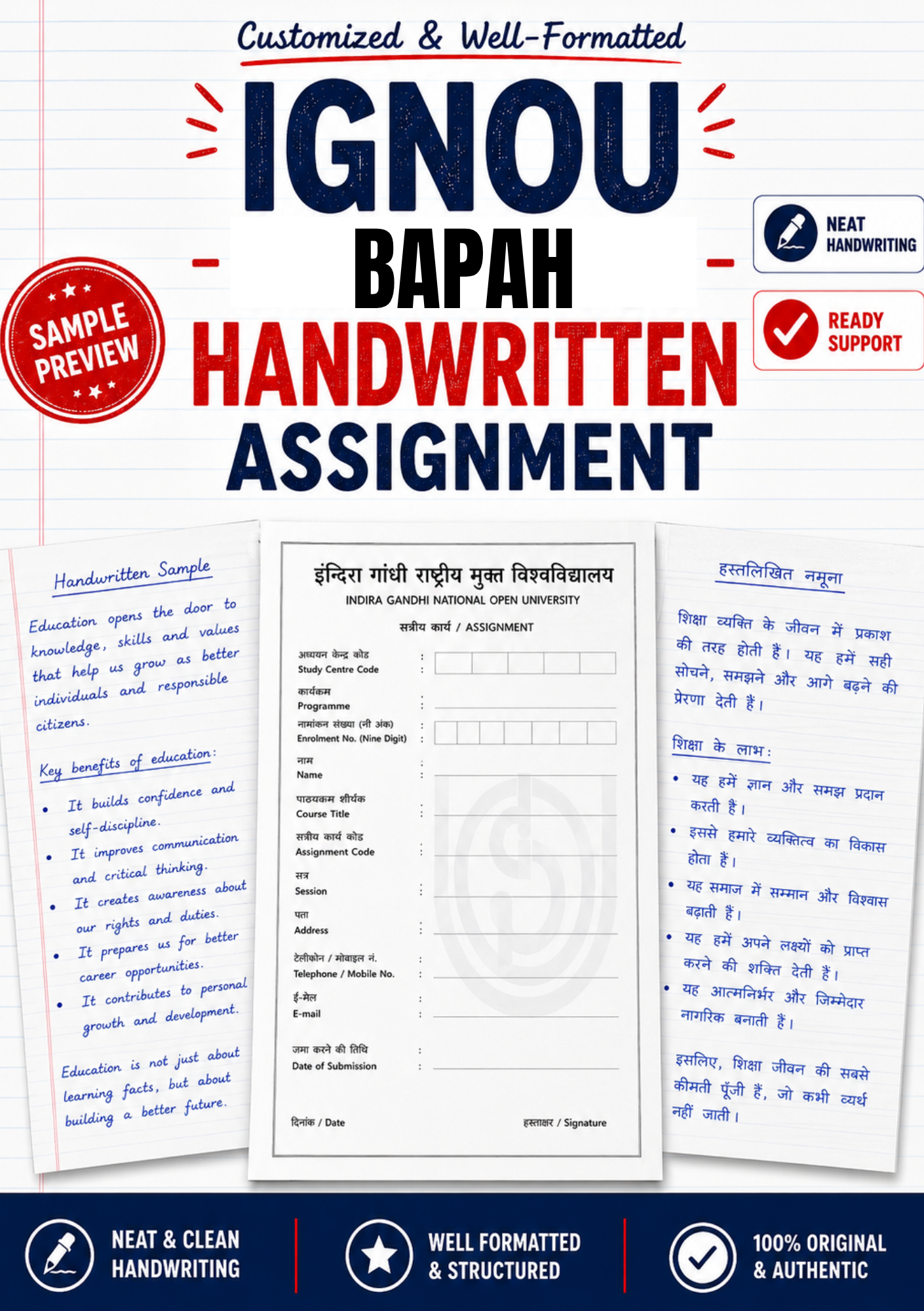


Description
In short. Shri Chakradhar Publication writes IGNOU BAPAH Tutor Marked Assignments out by hand for the Bachelor of Arts (Honours) Public Administration programme. The rate is ₹320 per subject, hard copy only, with courier included in that price and no separate shipping charge. The BAPAH structure printed in the Common Prospectus July 2026 is 148 credits over six semesters: fourteen six-credit BPAC core papers numbered 101 to 114, four six-credit BPAE discipline-specific electives numbered 141 to 144, two four-credit ability enhancement papers, two four-credit skill enhancement papers and four six-credit generic electives. The 2026-27 Public Administration booklets published on ignou.ac.in print two cut-offs, 30 April 2027 for a July 2026 enrolment and 31 October 2027 for a January 2027 enrolment, which is one calendar month later than the History Honours papers the same school issued for the same session. Every set is written against the booklet actually issued for your code and your cycle, the IGNOU-format front page and a copy of the official question paper travel with it, and the handwriting is matched to a sample page you send before anything is paid.
What a BAPAH Order Puts in Your Hands
An order is counted in papers, not in semesters. One BPAC code is one subject, one BPAE code is one subject, and a generic elective such as BPCG 173 or a skill enhancement paper such as BPAS 184 counts exactly the same way. A learner clearing the fifth semester orders four, a learner catching up on two carried-over cores orders two, and a learner who wants an entire six-semester Honours degree written out orders twenty-two papers at the identical rate.
Four physical things arrive in the envelope for each paper. The first is the answer set itself, every question on the booklet answered in longhand on loose sheets, in the hand matched from your own sample. The second is the IGNOU-format front page, already filled in with the programme name, the course code, the assignment code and the session, left unsigned because the signature has to be yours. The third is a copy of the official question paper the answers were written against, so that the study centre coordinator can see at a glance that the set matches the booklet currently in force. The fourth is the packaging and the courier, which are not billed separately.
What does not arrive is a file. No soft copy or PDF is sold. There is no download link, no emailed scan and no cloud folder, because the thing IGNOU accepts at a study centre counter is paper, and a handwritten set that exists only as an image is not a submission.
What ₹320 Buys for One BPAC Paper, and What It Leaves Out
A BPAC booklet is not a short piece of work. The 2026-27 papers are built as ten questions in three parts: two long answers of about 500 words at 20 marks each, three medium answers of about 250 words at 10 marks each, and five short answers of about 100 words at 6 marks each. That is roughly 2,300 words of considered argument per course, and the booklet instructs the learner to answer all ten questions rather than selecting among them. Multiplied across four papers in a single semester, one cycle of BAPAH assignments is close to ten thousand handwritten words.
The rate covers that writing, the sheets it is written on, the front page, the question-paper copy and the courier to your address. The rate is ₹320 per subject, hard copy only, with courier included in that price and no separate shipping charge. There is no minimum order: one subject or fourteen, same rate.
Three things sit outside the rate, and they are worth naming plainly rather than leaving a learner to discover them. The first is evaluation: what an evaluator does with the set is not within anybody’s control here. The second is submission: the set has to be carried or posted to the study centre coordinator by the learner, because IGNOU issues the receipt to the enrolled student and not to a publisher. The third is a date: delivery depends on your pin code and is confirmed for your order before you pay. No figure is promised on this page.
A Reference PDF and a Written Set Do Two Different Jobs
These two products are confused constantly, and the confusion costs people a submission window. A solved assignment is a soft-copy reference file of model answers for one course code and one session, read on a phone or a laptop and used as raw material while you write. A handwritten assignment is the answers written out by hand on loose sheets and submitted in hard copy at the study centre. The first is something you study from. The second is something you hand in.
| Question | Solved assignment | Handwritten assignment |
|---|---|---|
| What it is | Soft-copy reference file of model answers for a code and session | Answers written by hand on loose sheets for a code and session |
| How it reaches you | Downloaded and read on a screen | Couriered to your address as paper |
| What you do with it | Read it, compare it with your units, then write your own answers | Read it, check it against your understanding, sign the front page, submit it |
| Who it suits | A learner who intends to write but wants a reference point | A learner short of writing time across several BPAC codes at once |
| Rate on this store | Priced on the solved-assignment shelves, per code | ₹320 per subject, courier included |
Scroll the table sideways on a narrow screen.
IGNOU’s own instruction on the BPAC-113 booklet settles what happens at the counter: the learner is told to submit the assignment to the Coordinator of the Study Centre, to obtain a receipt and to keep it, and to insist that the evaluated assignment is returned afterwards. Nothing in that sequence can be performed with a file on a phone. A downloaded reference is never itself a submission, whatever the file is named, and any page that suggests otherwise is describing something IGNOU does not do.
If a reference file is what you actually want, the store keeps a separate shelf for it: the BAPAH solved-assignment listings are organised code by code and are the right place for that question rather than this page, which sells writing and paper.
Have your BPAC numbers already?
Send the code list, the medium and the enrolment session, and the booklet each set will be written against is confirmed back to you before anything begins. ₹320 per subject, courier included.
The BPAC Core Runs 101 to 114 With No Gaps
Fourteen core courses at six credits each account for 84 of the 148 credits in the degree. They are distributed two in the first semester, two in the second, three in the third, three in the fourth, two in the fifth and two in the sixth. The titles below are the ones the Common Prospectus July 2026 prints in its Bachelor’s Honours course list, and they are reproduced here as printed rather than tidied up.
| Semester | Code | Official title | Credits |
|---|---|---|---|
| I | BPAC 101 | Perspectives on Public Administration | 6 |
| I | BPAC 102 | Administrative Thinkers | 6 |
| II | BPAC 103 | Administrative System at Union Level | 6 |
| II | BPAC 104 | Administrative System at State and District Levels | 6 |
| III | BPAC 105 | Personnel Administration | 6 |
| III | BPAC 106 | Understanding Public Policy | 6 |
| III | BPAC 107 | Comparative Public Administration | 6 |
| IV | BPAC 108 | Public Policy and Administration in India | 6 |
| IV | BPAC 109 | Public Systems Management | 6 |
| IV | BPAC 110 | Urban Local Governance | 6 |
| V | BPAC 111 | Public Finance and Administration | 6 |
| V | BPAC 112 | Rural Local Governance | 6 |
| VI | BPAC 113 | Development Administration | 6 |
| VI | BPAC 114 | Contemporary Issues and Concerns in Indian Administration | 6 |
Scroll the table sideways on a narrow screen.
Four of those codes are the reason a BAPAH code list cannot be borrowed from anywhere else. The prospectus table for the four-year Bachelor of Arts (Public Administration) route lists ten BPAC major courses and stops: 101, 102, 103, 104, 105, 106, 108, 109, 110 and 112. BPAC 107, 111, 113 and 114 are absent from it entirely. A learner who copies a code list off the four-year public administration listing on this store will therefore be four papers short of an Honours degree, and the four missing ones sit in the third, fifth and sixth semesters where the writing load is already heaviest.
Two of the codes travel in the opposite direction. BPAC 101 and BPAC 108 are printed inside the core column of the Bachelor of Arts (Honours) Political Science structure as well, in that programme’s third and fourth semesters, which is why IGNOU’s older archive filed a BPAC 108 paper inside a folder named for political science. A Political Science Honours learner consequently writes two Public Administration assignments, and anyone ordering for the Political Science Honours programme should check which of the two sets of numbers their admission record actually carries before paying.
Four BPAE Electives That Are Not Really a Choice
The discipline-specific elective column is where most Honours programmes give the learner something to decide. The Political Science Honours table prints three BPSE options in the fifth semester and three more in the sixth, each headed with the instruction to take any two. The Public Administration table prints no such instruction and no surplus. Two codes appear in the fifth semester and two in the sixth, which is exactly the number of slots, so all four BPAE papers below are written by every BAPAH learner who completes the degree.
| Semester | Code as printed | Official title | Credits |
|---|---|---|---|
| V | BPAE 141 | Right to Information | 6 |
| V | BPAE 143 | Administrative System in BRICS | 6 |
| VI | BPAE-142 | Organizational Behaviour | 6 |
| VI | BPAE 144 | Social Policies and Administration | 6 |
Scroll the table sideways on a narrow screen.
The second column is printed exactly as the prospectus prints it, hyphen and all. In the same elective table, three of the four codes are set with a space and BPAE-142 alone is set with a hyphen. It is a typesetting slip rather than two different courses, but it matters at the moment a learner types the code into a search box or writes it on a front page, because a hyphen and a space are not interchangeable to a file index.
The AECC, SEC and Generic Elective Codes Beside Them
The remaining 40 credits come from pooled courses shared with the other Honours programmes. Two ability enhancement papers carry four credits each, two skill enhancement papers carry four credits each, and four generic electives carry six credits each. The pooled codes the prospectus lists against the BAPAH row are set out below, and a handwritten set is prepared for any of them at the same rate as a core paper.
| Category | Semester | Codes listed for BAPAH | Credits each |
|---|---|---|---|
| Ability enhancement (AECC) | I | BEVAE 181 | 4 |
| Ability enhancement (AECC) | II | BEGAE 182 or BHDAE 182 | 4 |
| Skill enhancement (SEC) | III | BANS 183, BPCS 183, BPCS 185, BHDS 183, BEGS 183 and 185, BCHS 183, BPCS 187, BCOS 183, BSSS 183 | 4 |
| Skill enhancement (SEC) | IV | BPAS 184, BANS 184, BECS 184, BPCS 184 and 186, BHDS 184, BSOS 184, BEGS 186, BPCS 188, BFDI 073, BFLS 183, BSLS 183, ONR 002 | 4 |
| Generic elective (GE) | I | BSKG 171, BSOG 171, BPCG 171, BEGG 171, BPYG 171, BABG 171, ONR 003 | 6 |
| Generic elective (GE) | II | BSKG 172, BGDG 172, BPCG 172, BEGG 172, BPYG 172 | 6 |
| Generic elective (GE) | III | BPCG 173, BSOG 173, BHDG 173, BEGG 173, BSKG 173 | 6 |
| Generic elective (GE) | IV | BPCG 174, BPCG 176, BEGG 174 | 6 |
Scroll the table sideways on a narrow screen.
One absence in that table is deliberate on IGNOU’s part and surprises people every year. The four Public Administration generic electives, BPAG 171 Disaster Management, BPAG 172 Governance: Issues and Challenges, BPAG 173 E-Governance and BPAG 174 Sustainable Development, appear in the generic elective pool printed for Economics Honours, History Honours and Political Science Honours. They appear in none of the four BAPAH semesters. The generic elective exists to push a learner outside their own discipline, so the one group barred from Disaster Management and E-Governance is the group reading Public Administration. Learners in the Economics Honours programme can order a BPAG set; a BAPAH learner cannot use one to fill a generic elective slot.
Adding the columns confirms the structure rather than assuming it. Fourteen cores at six credits is 84, four electives at six is 24, two ability enhancement papers at four is 8, two skill enhancement papers at four is 8, and four generic electives at six is 24. Those five figures total 148, and the semester totals of 22, 22, 28, 28, 24 and 24 reach the same number from the other direction.
Where the Prospectus and the Booklets Do Not Agree on BAPAH
Everything above was read off IGNOU’s own documents, and those documents do not always agree with one another. Six disagreements were found while this page was being prepared, and the last one belongs to this store rather than to the university.
Six places where BAPAH paperwork contradicts itself.
1. The title of BPAC 104 is printed two ways inside one prospectus. The undergraduate course list sets it as Administrative system at State and District Levels with a lowercase s, while the Honours course list and the four-year major table both set it as Administrative System at State and District Levels.
2. The assignment code format is not stable within one session. The 2026-27 BPAC-113 and BPAE-144 booklets print the course code inside the assignment code, as BPAC-113/Asst/TMA/July 2026 and January 2027. The 2026-27 BPAC-103 booklet prints ASST /TMA / July-2026 and January-2027 with no course code in it at all.
3. The cover label changes between papers of the same discipline and cycle. BPAC-103 and BPAC-113 are headed BACHELOR OF ARTS (BAPAH). BPAE-144 is headed Bachelor of Arts in Public Administration (BAG/BAPAH), naming the older general degree alongside the Honours one.
4. No Public Administration booklet checked for 2026-27 names the four-year major route on its cover, although ten BPAC codes are major courses of that route. By contrast the 2026-27 History booklet names both its programmes together on one cover.
5. IGNOU’s own 2026-27 file name for the BPAC 107 paper spells the medium Egnlish. The file opens normally; a search typed with the correct spelling may not reach it.
6. This store’s own four-year Public Administration page heads its deadline section with 30 September, taken from an earlier cycle. Every BPAC and BPAE booklet read for 2025-26 and for 2026-27 prints 30 April for the July cohort. The store page is being corrected, and the booklet is the document to trust.
None of these is a reason to delay a submission, and none of them changes what is written in your set. They are listed because a learner who meets one of them at eleven at night, two days before a cut-off, deserves to have read about it somewhere first.
Why Your Cut-Off Is a Month Later Than a History Honours Learner’s
Submission dates at IGNOU are set per school, and the common assumption is that one school means one date. The Public Administration papers disprove it from inside the School of Social Sciences itself. The 2026-27 BPAC-103, BPAC-113 and BPAE-144 booklets each print the same pair: a learner enrolled in July 2026 submits by 30 April 2027, and a learner enrolled in January 2027 submits by 31 October 2027. The 2025-26 BPAC-114 booklet prints the same pair shifted back one year, 30 April 2026 and 31 October 2026, so the pattern holds across cycles rather than being a one-off.
Now read the History Honours paper issued by the same school for the same 2026-27 session. BHIC-105, headed on its cover for BAHIH and the four-year history route together, prints 31 March 2027 for a July 2026 enrolment and 30 September 2027 for a January 2027 enrolment. Two disciplines, one school, one session, and a difference of one calendar month in both directions. A BAPAH learner who takes a date from a friend in the History Honours programme will be a month early, which is harmless, and a History learner who takes a date from a BAPAH friend will be a month late, which is not.
The dates circulated by news and coaching sites are a third layer again. Those pages publish a single all-India figure attached to an examination cycle rather than to an enrolment session, and they are frequently rewritten when a general extension is announced. The booklet does something different: it names the enrolment session and attaches a date to it, which is the only version that can be checked against your own admission record. Programme structures, course codes, submission dates and rules change, and only ignou.ac.in and your Regional Centre can confirm the current position for your enrolment.
The weight behind the date is the reason it matters. Assignments carry 30 per cent of the final course result and the term-end examination carries the remaining 70 per cent. A BPAC paper missed is not a deduction spread across the degree; it is thirty marks removed from one six-credit course, and submission of the assignment is also the condition on which the booklet makes eligibility for the term-end examination depend.
Two Code Lines in One Session, and What to Copy Onto the Front Page
The assignment code is the line at the top of the question paper, and it is the line the study centre reads first. For 2026-27 Public Administration papers there is no single version of it. A BPAC-113 paper prints the code with the course number built in. A BPAC-103 paper of the same session prints only the generic form, with the course number left out and the two sessions joined differently. Copy whatever your own downloaded booklet prints, character for character, rather than reconstructing it from another paper or from this page.
The parts of it are easy to read once separated. The leading element, where present, is the course code. Asst and TMA both mean the same thing, a tutor marked assignment, and IGNOU’s templates use the two interchangeably. The final element is the pair of sessions the paper is valid for, written as July 2026 and January 2027, which tells you the paper expires when that pair rolls forward.
That expiry is the part learners underestimate. A 2025-26 BPAC paper and a 2026-27 BPAC paper carry different questions, and a set written against the older one is answering a paper the study centre is no longer collecting. IGNOU moves retired papers into dated archive folders, and the discipline folder has been spelled five different ways across the recent cycles, as PUB ADMIN, PUB-AD, pub admn, pub admin and pub ad, while one 2024-25 BPAC paper was filed in the four-year undergraduate tree rather than in the public administration folder at all. The practical consequence is that an old paper is genuinely hard to find by guessing, which is why a copy of the question paper your set was written against is included in the envelope. Current papers are published on IGNOU’s own assignment download service, and the 2026-27 BPAC-113 booklet is readable there in full if you want to see the layout described above.
The Sample Page That Decides How the Set Looks
A handwritten set only works if it reads as the work of the person who signs it, and that is a question of the hand rather than of the content. Send a photo of a page you have written yourself and the handwritten set is matched to your handwriting at no extra charge. The sample is matched for letter shapes, slant, spacing and the general density of the line, and the writer assigned to your set works from it for every paper in the order so that fourteen BPAC papers do not arrive in fourteen different hands.
The sequence is deliberately the safe way round. The sample goes in first, the match is shown, and payment follows that rather than preceding it. A learner who dislikes the match has lost nothing but the time it took to photograph a page.
How to Photograph the Page You Send
Daylight near a window beats a ceiling light, which throws the shadow of your own hand across the page. Lay the sheet flat rather than holding it, shoot straight down instead of at an angle, and fill the frame with the paper. Half a page of ordinary running writing is more useful than a carefully produced showpiece, because the set has to look like your everyday hand and not like your best one. If your writing differs between English and Hindi, send one sample in each, since a BAPAH learner may be writing BPAC papers in one medium and a generic elective in the other.
Medium, Enrolment Cycle and a Paper You Left Behind
The prospectus records the medium of instruction for BAPAH as English and Hindi, and the degree can be completed in either. The service covers all mediums IGNOU issues the TMA paper in, at the same price. A point worth checking on the portal rather than assuming: the 2026-27 BPAC and BPAE files that surface most readily in search are the English ones, so a Hindi-medium learner should confirm the Hindi file for their code has been uploaded before ordering, and send that file if it has.
Enrolment cycles behave differently from the way a conventional college year does. BAPAH admits in January and in July, the minimum duration is three years and the maximum is six, and a learner who drops a semester keeps the right to clear it later. That is where carried-over papers come from, and they are the single most common reason a BAPAH order looks irregular: a learner in the sixth semester ordering BPAC 113 and BPAC 114 alongside a BPAC 107 left behind two cycles earlier. Any session is accepted, current cycle or older, including backlog courses, at the same ₹320 per subject.
The only thing an older paper changes is which booklet the set is written against. A carried-over code is written against the booklet in force for the session you are now submitting in, not the one that was current when you first registered for it, because the study centre collects against the current paper.
What to Type Into WhatsApp Before Anything Is Written
Five pieces of information settle a BAPAH order, and a message carrying all five usually needs no follow-up at all.
- The codes. Written as they appear on your admission record, for example BPAC 111 and BPAC 112, or BPAE 141 and BPAE 143. Codes rather than course names, because two Public Administration titles are close enough to be mistaken for one another.
- The medium. English or Hindi, stated per paper if you are mixing the two across cores and generic electives.
- The enrolment session. July 2026, January 2027 or an older cycle. This is what decides which booklet the set is written against and which of the two printed cut-offs applies to you.
- A sample page. One photograph of your own handwriting, as described above.
- The delivery pin code. Needed so the timing can be quoted for your address instead of guessed.
If any of the five is missing, the gap is asked about before writing begins rather than after. A learner who is unsure which BPAE codes their fifth semester actually carries can send the admission record itself and have the list read off it. Send the five details in one message and the covered codes come back confirmed.
Ordering a full semester rather than a single paper?
Four papers in one semester is the usual BAPAH load, and the rate does not change with volume. ₹320 per subject, courier included, one hand across the whole order.
From the Courier’s Hand to the Study Centre Counter
Opening the parcel is the start of the learner’s part, not the end of it. Read the answers before anything else. You sign the declaration on the assignment cover page, so you should read and review the content before submitting it, and satisfy yourself that it represents your own understanding of the course. The BPAC booklet’s own instruction is that answers are written in the learner’s own words, and reading the set through is how that instruction is honoured.
Then sign the front page. It arrives filled in and unsigned on purpose; the signature is the declaration and it has to be made by the person whose enrolment number is on the sheet.
Then submit, and take the receipt. The booklet is explicit that the set goes to the Coordinator of the Study Centre, that the learner obtains a receipt and keeps it, and that a photocopy of the submitted work is worth keeping as well. The study centre forwards the marks to the Student Evaluation Division at IGNOU, New Delhi, and returns the evaluated set afterwards, which the booklet tells the learner to insist on. The receipt is the only proof a learner holds if a mark fails to appear on the grade card later, and it costs nothing to ask for.
What happens after that is outside anyone’s hands here. No claim is made about the marks any assignment will receive, about how an evaluator will assess it, or about whether it will be accepted. Assignment evaluation is entirely a matter for IGNOU.
Where Public Administration Learners Go Next on This Store
Handwritten sets are one shelf of several, and a BAPAH learner usually needs more than one of them across a cycle. Reading material comes first for most people: the BAPAH help books and guidebooks are shelved by course code, which is the practical route when the unit material has not reached you and a cut-off is approaching.
Learners who carry Public Administration as part of the older general degree rather than the Honours one need a different shelf again, because the code sets diverge. The BPAE-144 booklet cover names that degree alongside BAPAH, and both the general-degree Public Administration books and its separate assignment shelf are kept apart from the Honours ones for that reason.
Beyond Public Administration, the pooled generic elective and skill enhancement codes mean a BAPAH order often sits next to another discipline’s. Every programme with a handwritten shelf is listed in one place, and the rest of the catalogue is browsable from the shop if books, question papers and assignment sets are being bought together. For learners who would rather write the papers themselves and only want the method explained, this publisher’s editorial site walks through doing it yourself step by step, covering front pages, formats and deadlines at no cost.
Questions That Come In About BPAC and BPAE Sets
Does a BAPAH order have to cover all fourteen BPAC papers at once?
No. There is no minimum order: one subject or fourteen, same rate. Most orders are for the two to four papers of a single semester, and single-paper orders for one carried-over code are common.
My booklet cover says BAPAH but my admission record says BAFPA, the four-year Public Administration route. Is it the right paper?
For the ten BPAC codes shared between the two routes, yes. None of the 2026-27 Public Administration booklets checked names the four-year route on its cover, so a major-route learner downloads a paper headed BAPAH and writes against it. The four codes that are not shared, BPAC 107, 111, 113 and 114, belong to the Honours structure only.
Which date applies to a July 2026 enrolment, 30 April 2027 or 31 October 2027?
30 April 2027. The 2026-27 BPAC and BPAE booklets print 30 April 2027 against the July 2026 enrolment and 31 October 2027 against the January 2027 enrolment. The two dates are not alternatives; each belongs to one cohort.
A friend in History Honours was given 31 March. Why is the Public Administration date different?
Because IGNOU sets the date on the booklet, not on the school. The 2026-27 BHIC paper prints 31 March 2027 and 30 September 2027, and the 2026-27 BPAC papers print 30 April 2027 and 31 October 2027, a month later in both cases, although both are issued by the School of Social Sciences for the same session.
Can a downloaded BAPAH solved assignment PDF be handed in at the study centre as it is?
No. A solved assignment is a soft-copy reference file of model answers; a handwritten assignment is the answers written out by hand and submitted in hard copy at the study centre. The booklet directs the learner to submit to the Coordinator of the Study Centre and to collect a receipt, which is not something a file can satisfy.
What actually changes between buying a solved reference file and buying a written set?
The work that remains with you. A reference file leaves roughly 2,300 words per course still to be written by hand, across ten questions. A written set arrives as finished sheets with the front page and a copy of the question paper, and what remains is reading it, signing it and submitting it.
Is a typed or printed BPAC answer sheet acceptable if the handwriting is poor?
The 2026-27 BPAC booklets give no permission for typed submission and describe the work as written, with the instruction to write the final version neatly. Whether a particular study centre will accept anything else is a question for that centre, and it is not a question this page can answer on their behalf.
BPAC 101 also appears in the Political Science Honours structure. Is it still my paper?
Yes, and it sits in a different semester for each programme. BPAC 101 is a first-semester core for BAPAH and a third-semester core for Political Science Honours, with BPAC 108 appearing in that programme’s fourth semester. The booklet is the same; the semester it belongs to is not.
Why can a BAPAH learner not take BPAG 171 Disaster Management as a generic elective?
The four BPAG generic electives are the Public Administration offering in the shared pool, and the prospectus lists them for Economics, History and Political Science Honours while omitting them from all four BAPAH generic elective semesters. The category exists to take a learner outside their own discipline.
The prospectus prints BPAE-142 with a hyphen and BPAE 143 without one. Which is the code?
It is one course either way. The prospectus elective table sets three of the four codes with a space and BPAE-142 alone with a hyphen. Write the code the way your own booklet prints it on the front page, since that is the version the study centre matches against.
The BPAC 107 file on ignou.ac.in is spelled Egnlish. Is that the right paper?
Yes. The misspelling is in IGNOU’s file name rather than in the paper, and the booklet opens and reads normally. It is worth knowing because a search typed with the correct spelling may not surface that file.
What paper size should a BPAC set be written on?
The 2026-27 Public Administration booklets print no paper-size instruction at all, unlike booklets from some other IGNOU schools. Sets are prepared on standard loose sheets, and if your Regional Centre or study centre has issued a size notice, say so when ordering and the set is written to it.
Is the rate different if the BPAE paper was issued in Hindi?
No. The service covers all mediums IGNOU issues the TMA paper in, at the same price. Send the Hindi file for your code and the set is written against that paper.
BPAC 111 is still pending from an older cycle. Does an old paper cost more?
No. Any session is accepted, current cycle or older, including backlog courses, at the same ₹320 per subject. The set is written against the booklet in force for the session you are submitting in.
Is there anything on this page about the marks a BAPAH set will get?
No, and there will not be. No claim is made about the marks any assignment will receive, about how an evaluator will assess it, or about whether it will be accepted. Assignment evaluation is entirely a matter for IGNOU.
Which Document Was Read for Which Statement Here
From the IGNOU Common Prospectus July 2026. The BAPAH programme code, the School of Social Sciences attribution, the English and Hindi medium, the three-year minimum and six-year maximum duration, the January and July sessions, the 148-credit total and its split into 84, 24, 8, 8 and 24, the semester loads of 22, 22, 28, 28, 24 and 24, every BPAC and BPAE code with its official title and credits, the pooled AECC, SEC and generic elective codes listed against BAPAH, the ten-code major table used for the comparison, and the two spellings of the BPAC 104 title.
From live IGNOU assignment booklets, read in October 2026. The BPAC-103, BPAC-113 and BPAE-144 papers for 2026-27 and the BPAC-114 paper for 2025-26 supplied the two submission dates, the two assignment-code formats, the three cover labels, the ten-question structure with its 20, 10 and 6 mark split and 500, 250 and 100 word guidance, the instruction to answer all questions, the absence of any paper-size instruction and the submission and receipt sequence. The BHIC-105 paper for 2026-27 supplied the History Honours dates used in the comparison.
From this publisher’s own commercial terms. The ₹320 per-subject rate, hard copy only with courier included, the free IGNOU-format front page, the copy of the official question paper, the handwriting match from a sample photo at no extra charge, the absence of a minimum order, the acceptance of any session including backlogs, and the practice of confirming delivery against a pin code rather than publishing a figure.
Important Notice
Shri Chakradhar Publication Pvt. Ltd. and shrichakradhar.com form an independent IGNOU study-support publisher. This is not the official website of Indira Gandhi National Open University, is not affiliated with, endorsed by or authorised by the university, and no page on this site should be treated as an official IGNOU communication.
You sign the declaration on the assignment cover page, so you should read and review the content before submitting it, and satisfy yourself that it represents your own understanding of the course.
No soft copy or PDF is sold. Delivery depends on your pin code and is confirmed for your order before you pay. No figure is promised on this page.
Start a BAPAH Order in One Message
₹320 per subject, hard copy, courier included, any session including backlogs, and the handwriting matched to your own sample before anything is paid.
Open WhatsApp with the code list ready
Not sure which BPAC or BPAE codes your semester carries? Send the admission record instead and have the list read off it.