

Description
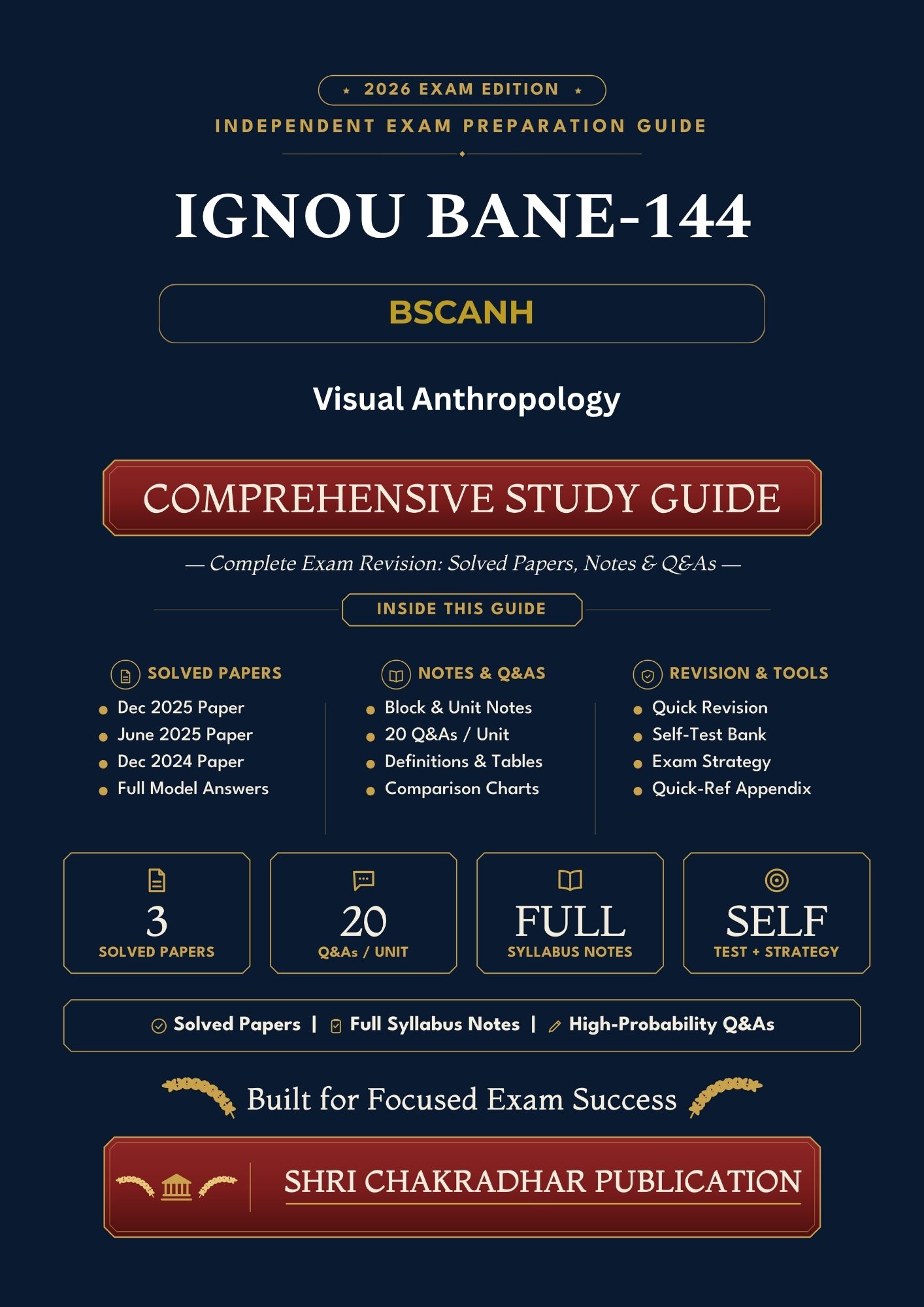
IGNOU BANE-144 Book (Visual Anthropology) is built as a working map of Visual Anthropology, not as a pile of disconnected notes. It follows 3 verified Blocks and turns the verified sequence into Unit-wise revision, written practice and a final TEE recap.
The real pressure point is not access to material but converting a broad course into a smaller set of dependable recall cues and answer frameworks. In this course, links among Introduction to Visual Anthropology, Theory and Representation and Ethnographic Photography and Films deserve particular attention because they shape both understanding and exam-ready explanation.
For more IGNOU study material, visit IGNOU Study Material. Use this independent guide alongside the latest official IGNOU study material and current examination instructions.
An Overview of the IGNOU BANE-144 Help Book
The fastest way to understand this course is to see its parts before reading them in depth. This section places Introduction to Visual Anthropology, Theory and Representation and Ethnographic Photography and Films inside the larger logic of Visual Anthropology.
Each Unit-wise theme is therefore studied twice: first for understanding and then for expression. The second pass focuses on headings, transitions, examples and the exact command word used in a question.
Use the official structure as the spine: read one Unit, note its central idea in one sentence, add two supporting points and practise one likely question before moving ahead.
This Book Is Useful For
This is designed for students who need to know what to revise next, which topics connect, and which answers still require written practice.
- BANE-144 students who want to separate strong Units from weak Units
- Learners building concept maps around Introduction to Visual Anthropology, Ethnographic Photography and Films and Introduction to Visual Anthropology
- Students practising compare, explain, discuss and critically examine questions
- Repeat learners who need a more disciplined coverage-and-recall cycle
- Anyone combining eGyanKosh reading with compact revision and question practice
What’s Inside This BANE-144 Book
The internal structure is practical: learn the idea, reduce it to recall cues, test it through a question and return to weak points before the next revision cycle.
- Course navigation: Block/Unit coverage kept in the researched order
- Key-term revision: important language drawn from Introduction to Visual Anthropology, Theory and Representation and Introduction to Visual Anthropology
- Applied explanation: ways to connect theory, text, policy, example or calculation as relevant
- Question rehearsal: outline practice before full-length answers
- Last-week planning: selective revision based on gaps rather than passive rereading
Complete Syllabus Coverage – All 3 Blocks
Syllabus coverage is tied to the researched IGNOU structure rather than marketing labels. The table below is the checklist for what must be studied.
| Official Block | Official Block Name | Revision Focus |
|---|---|---|
| Block 1 | Introduction to Visual Anthropology | Revise definitions, major arguments, examples and Unit-wise answer points linked with this Block. |
| Block 2 | Theory and Representation | Revise definitions, major arguments, examples and Unit-wise answer points linked with this Block. |
| Block 3 | Ethnographic Photography and Films | Revise definitions, major arguments, examples and Unit-wise answer points linked with this Block. |
Do not treat every segment as equally difficult. Build a three-column revision list—clear, partial and weak—and move Theory and Representation or Introduction to Visual Anthropology into the weak column whenever you cannot produce a short answer from memory.
How This Book Maps to the IGNOU BANE-144 Exam Pattern
The guide maps content to answer tasks rather than promising repeated questions. A strong response starts by identifying what the command word demands and then selecting only the most relevant course material.
For Visual Anthropology, practise a short opening definition, two or three ordered arguments, a course-relevant illustration and a closing line that answers the question directly. Give special attention to Introduction to Visual Anthropology, Theory and Representation and Ethnographic Photography and Films.
Previous-paper practice is used for rehearsal, not for claims about guaranteed repetition. Always check the latest official TEE paper for current marks, sections and instructions.
Why Students Prefer Our IGNOU BANE-144 Guide Book & Study Material
A course-specific guide is useful when it helps a learner make decisions—what to read, what to reduce into notes, what to practise and what to revisit.
For Visual Anthropology, repeated attention to Introduction to Visual Anthropology, Introduction to Visual Anthropology and Introduction to Visual Anthropology helps build a stronger conceptual network. That network makes it easier to adapt when the question combines two areas.
Compiled & Reviewed By
This independent guide is compiled and reviewed by the Shri Chakradhar Publication (SCP) Panel of Experts / BK Sahni. Editorial work focuses on verified syllabus organisation, clear study support and original practice material.
Course terminology is kept close to IGNOU sources, while explanations and practice prompts are independently prepared. Students should use the book with official self-learning material and current University notices.
How to Use the IGNOU BANE-144 Help Book for TEE and Assignments
A simple routine works better than unplanned rereading. Move from map to notes, from notes to memory, and from memory to timed writing.
- Begin with the verified Block/Unit sequence and identify the next unfinished area.
- Create a one-sentence definition for Introduction to Visual Anthropology and a two-sentence explanation for Theory and Representation.
- Add one example, text reference, case, policy point or calculation as appropriate to the course.
- Turn Ethnographic Photography and Films into a two-minute answer outline before writing in full.
- Compare the finished answer with your headings rather than memorising a fixed paragraph.
- Use the final week for weak themes, especially Introduction to Visual Anthropology and Introduction to Visual Anthropology.
Assignment responses should be prepared and submitted by the student in accordance with IGNOU guidelines; use the guide to understand and practise, not to bypass academic requirements.
High-Probability Questions from IGNOU BANE-144 (Sample)
The following prompts are revision exercises, not predictions. They sample the major concepts and question actions that a learner should be able to handle after studying the course.
- Explain Introduction to Visual Anthropology with reference to Visual Anthropology.
- Discuss the main issues connected with Introduction to Visual Anthropology and give suitable examples.
- Explain Theory and Representation with reference to Visual Anthropology.
- Discuss the main issues connected with Theory and Representation and give suitable examples.
- Explain Ethnographic Photography and Films with reference to Visual Anthropology.
- Discuss the main issues connected with Ethnographic Photography and Films and give suitable examples.
- Write a structured note on Introduction to Visual Anthropology.
- Write a structured note on Theory and Representation.
Do not memorise the sample wording. Practise changing the command word from explain to discuss, compare or critically examine and adjust the depth of the answer accordingly.
IGNOU BANE-144 Sample Question Paper (TEE Format Template)
This mock layout gives you a set of course-focused prompts under one practice session. It should be adapted to the latest official TEE pattern.
Practice instruction: Attempt the set under a self-imposed time limit and follow the latest official pattern for question choice and marks.
- Q1. Explain Introduction to Visual Anthropology with reference to Visual Anthropology.
- Q2. Discuss the main issues connected with Introduction to Visual Anthropology and give suitable examples.
- Q3. Explain Theory and Representation with reference to Visual Anthropology.
- Q4. Discuss the main issues connected with Theory and Representation and give suitable examples.
- Q5. Explain Ethnographic Photography and Films with reference to Visual Anthropology.
- Q6. Discuss the main issues connected with Ethnographic Photography and Films and give suitable examples.
- Q7. Write a structured note on Introduction to Visual Anthropology.
- Q8. Write a structured note on Theory and Representation.
After the session, review three things: whether the command word was answered, whether the course terminology was accurate, and whether the conclusion actually resolved the question.
Related IGNOU BANE-144 Additional Supports
The following four support categories can be used separately from the study guide when a learner needs more targeted practice.
- IGNOU BANE-144 Solved Assignment
- IGNOU BANE-144 Handwritten Assignment
- IGNOU BANE-144 Solved PYQs
- IGNOU BANE-144 Solved Guess Paper
Delivery, Returns & Payment Options
The printed guide is supplied as an A5 paperback through the delivery options available on the store. Serviceability and transit time depend on the destination and checkout method.
Before ordering, review the current payment, return and replacement terms. For a printing or transit issue, retain the package and order details so support can examine the case.
How Students Use This Guide
The book works best when learners write on it indirectly: after reading, create your own one-page summary and then try to reproduce that summary without looking.
In Visual Anthropology, use Introduction to Visual Anthropology as an anchor and connect Theory and Representation, Ethnographic Photography and Films and Introduction to Visual Anthropology around it. A visual link between themes often improves retrieval when a question combines areas.
Free Downloads: IGNOU BANE-144 Exam Support PDFs
Official free resources should remain the first stop for syllabus confirmation and original self-learning material. The guide is designed to sit beside those sources, not replace them.
- Official IGNOU/eGyanKosh self-learning material for BANE-144
- Current assignment booklet for the applicable session
- Available previous TEE question papers from official IGNOU channels
- Programme guide or prospectus information relevant to BSCANH
Download BANE-144 Study Material Free via eGyanKosh (Step-by-Step)
Downloading the official material first gives you a stable reference for definitions, prescribed sequence and any content that needs deeper reading.
- Open the official eGyanKosh course/resource page.
- Check that the page or PDF corresponds to BANE-144 and Visual Anthropology.
- Open the required Block, Unit or course file and verify its title before saving it.
- Store the PDFs in a folder named BANE-144 and keep the verified sequence intact.
- Use the official PDFs for detailed study and this independent guide for Unit-wise revision and answer rehearsal.
Frequently Asked Questions (FAQ)
Use these answers to distinguish revision support from official academic material and to plan the final stages of preparation.
What is the IGNOU BANE-144 book used for?
The book helps learners revise Visual Anthropology in a structured way while using official IGNOU material as the primary academic source.
How much of the BANE-144 syllabus is covered?
The guide follows the researched official structure: 3 verified Blocks. Unsupported Block headings are not added where the official hierarchy cannot be confirmed.
Is this an official IGNOU publication?
No. This is independent academic study support; IGNOU self-learning material and University notices remain the official sources.
Can I use this BANE-144 book for TEE revision?
Yes. Use it to revise Introduction to Visual Anthropology, Theory and Representation and Ethnographic Photography and Films, practise outlines and rehearse complete answers while checking the latest official exam instructions.
Does the guide include solved-question practice?
Yes, it provides guided practice and answer-structure support rather than a guarantee of repeated examination questions.
What medium is this BANE-144 guide prepared in?
This product is prepared for the English medium shown on the product page, while necessary course terminology is retained for accuracy.
Can this guide replace eGyanKosh material?
No. The guide is a companion to, not a substitute for, official IGNOU study material.
How should I revise BANE-144 in the final week?
Prioritise weak areas, especially Introduction to Visual Anthropology and Introduction to Visual Anthropology; rehearse key definitions, write short outlines and complete a few timed answers instead of rereading everything.
Where can I get order or soft-copy support?
Use the WhatsApp support link on this product page for availability and order assistance. Academic updates should still be verified through official IGNOU channels.
Conclusion
The purpose of this BANE-144 guide is disciplined preparation: cover the researched structure, condense each theme, retrieve it without prompts and practise the question forms that expose weak understanding.
To order, visit the IGNOU BANE-144 Book order page. Re-check the latest syllabus, assignment and TEE instructions through official IGNOU channels before examination.
Disclaimer: This is an independent academic study-support resource published by Shri Chakradhar Publication (Pvt.) Ltd. It is not affiliated with, endorsed by, or an official publication of IGNOU. It is designed to supplement, not replace, IGNOU’s official study material. Syllabus and exam patterns may change – please verify the latest information through official IGNOU channels. Students should prepare and submit their own work as per IGNOU guidelines. All trademarks belong to their respective owners.