Description
In short. Shri Chakradhar Publication prepares handwritten Tutor Marked Assignment sets for BAM, the three-year Bachelor of Arts (Multidisciplinary) run by IGNOU’s School of Social Sciences, covering the fifty-six discipline papers listed across its fourteen disciplines together with the interdisciplinary, ability-enhancement, skill-enhancement, vocational and value-added courses that complete the 120 credits. The rate is ₹320 per subject, hard copy only, with courier included in that price and no separate shipping charge. Because a BAM learner draws papers from three disciplines and often from four or five different schools, the submission date, the assignment code line and even the number of Tutor Marked Assignments differ from one booklet to the next, so each order is written against the codes and admission batch you actually send rather than a single programme-wide template. Any session is accepted, current cycle or older, including backlog courses, at the same ₹320 per subject, and the handwriting is matched to a sample page you photograph yourself.
Inside the Envelope That Reaches Your Address
A BAM order arrives as paper, not as a link. Each course code you name is written out as a separate set on A4 sheets in blue or black ink, following the section structure the booklet itself prints — three Tutor Marked Assignments for a six-credit discipline paper, fewer for a four-credit skill or language course — with the question number kept against every answer so an evaluator can follow it without hunting.
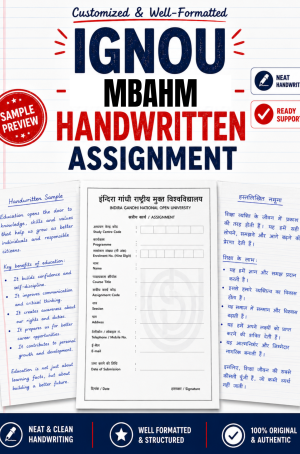
Sitting on top of each set is the IGNOU-format front page, blank in the places only you can fill: enrolment number, name, address, study centre code, signature and date. It is included free with every order because a set that arrives without one is a set you have to rebuild before you can hand it in. Alongside it goes a printed copy of the official TMA paper for that course and that batch, so the study centre coordinator can see the questions the answers respond to, and so you can check the two against each other before you sign anything.
No soft copy or PDF is sold. There is no download link, no cloud folder and no scanned file waiting in an account. That is a deliberate scope limit rather than an omission: what IGNOU accepts at the counter is written paper, and that is the only thing this product produces.
Everything Folded Into the ₹320, and the Two Things That Are Not
One number covers the writing, the paper, the front page, the printed question paper and the courier that carries all of it to your door. There is no separate packing line, no per-page charge and no premium on a discipline that happens to be long. A BEGC-133 British Literature set and a BMTE-144 Algebra set cost the same because the rate is quoted per subject, not per word.
There is no minimum order: one subject or fourteen, same rate. Learners in their fourth semester frequently order two discipline papers and leave the skill-enhancement course to write themselves; learners clearing a backlog often send a single code from a batch two years old. Both are ordinary orders.
Two things sit outside the price, and both are stated plainly rather than buried. The first is time. Delivery depends on your pin code and is confirmed for your order before you pay. No figure is promised on this page. The second is the mark. No claim is made about the marks any assignment will receive, about how an evaluator will assess it, or about whether it will be accepted. Assignment evaluation is entirely a matter for IGNOU.
Reference File or Submission Set: Telling the Two Apart
These two products get confused constantly, and the confusion costs learners a semester when it goes the wrong way. A solved assignment is a soft-copy reference file of model answers for one course code and one session — something to read, understand and write from. A handwritten assignment is the answers written out by hand on A4 and submitted in hard copy at the study centre. The first is study material. The second is the submission itself.
| Solved assignment | Handwritten assignment | |
|---|---|---|
| Format | Soft copy, read on a phone or laptop | Hard copy on A4, written in ink |
| What you do with it | Read it, check it against your study material, then write your own answer | Fill the front page, sign it, hand it in |
| Who it suits | A learner with time who wants to write the paper personally | A learner short of time, or holding several codes at once |
| Price on this store | Listed on the solved-assignment pages, per course code | ₹320 per subject, courier included |
| Can it be submitted as it stands | No — it is a reference to write from, never a submission | Yes, once your details are on the front page |
Scroll the table sideways on a narrow screen.
IGNOU settles the point in its own words. The BEGC-131 booklet for the July 2025 and January 2026 sessions, one of BAM’s Group-1 English papers, instructs the learner directly: you should submit the assignment in your own handwriting. Downloading a model answer file and handing the printout in at the counter is not what that sentence permits. The reference file is a legitimate and useful thing to own; it is simply not the thing you submit.
If a reference file is what you actually want, the store keeps BAM’s discipline codes on the course-wise solved assignment pages for the BA discipline papers, arranged by subject, and that is where a search for a model answer file belongs rather than here.
Have your codes in front of you? That is the whole order.
₹320 per subject, hard copy, courier included, IGNOU-format front page and the official question paper in the same packet.
Message the BAM code list on WhatsApp and a quote comes back with a handwriting sample.
All Fifty-Six Discipline Papers, Grouped the Way BAM Groups Them
BAM is not a fixed syllabus. The Common Prospectus for July 2026 distributes fourteen disciplines across five groups and lets you take one discipline from a group and no more, so your three disciplines must come from three different groups. Each discipline then contributes four papers of six credits across six semesters — twenty-four credits per discipline, seventy-two credits in total. That is why two BAM learners admitted on the same day can hold code sets with nothing in common.
The table below is every discipline paper the prospectus lists, by discipline. Read your own twelve off it, and order against those.
| Discipline (Group) | Code | Official title | Credits |
|---|---|---|---|
| English (Group 1) | BEGC131 | Individual and Society | 6 |
| English (Group 1) | BEGC132 | Selections From Indian Writing: Cultural Diversity | 6 |
| English (Group 1) | BEGC133 | British Literature | 6 |
| English (Group 1) | BEGC134 | Reading The Novel | 6 |
| Hindi (Group 1) | BHDC131 | Hindi Sahitya Ka Itihaas | 6 |
| Hindi (Group 1) | BHDC132 | Madhyakaleen Hindi Kavita | 6 |
| Hindi (Group 1) | BHDC133 | Modern Hindi Poetry | 6 |
| Hindi (Group 1) | BHDC134 | Hindi Prose Literature | 6 |
| Urdu (Group 1) | BUDC131 | Study of Prose and Poetic Form In Urdu | 6 |
| Urdu (Group 1) | BUDC132 | Study of Urdu Classical Ghazal | 6 |
| Urdu (Group 1) | BUDC133 | Origin & Development of Urdu Language | 6 |
| Urdu (Group 1) | BUDC134 | Study of Urdu Nazm | 6 |
| Sanskrit (Group 1) | BSKC131 | Sanskrit Padya Sahitya | 6 |
| Sanskrit (Group 1) | BSKC132 | Sanskrit Gadhya Sahitya | 6 |
| Sanskrit (Group 1) | BSKC133 | Sanskrit Natak | 6 |
| Sanskrit (Group 1) | BSKC134 | Sanskrit Vyakaran | 6 |
| Sociology (Group 2) | BSOC131 | Introduction To Sociology | 6 |
| Sociology (Group 2) | BSOC132 | Sociology of India | 6 |
| Sociology (Group 2) | BSOC133 | Sociological Theories | 6 |
| Sociology (Group 2) | BSOC134 | Methods of Sociological Enquiry | 6 |
| Education (Group 2) | BESC131 | Education: Concept, Nature and Perspective | 6 |
| Education (Group 2) | BESC132 | Structure and Management of Education | 6 |
| Education (Group 2) | BESC133 | Curriculum, Teaching-Learning and Assessment | 6 |
| Education (Group 2) | BESC134 | Education as a Practice | 6 |
| Political Science (Group 3) | BPSC101 | Understanding Political Theory | 6 |
| Political Science (Group 3) | BPSC102 | Constitutional Government and Democracy In India | 6 |
| Political Science (Group 3) | BPSC105 | Introduction to Comparative Government and Politics | 6 |
| Political Science (Group 3) | BPSC107 | Perspectives on International Relations and World History | 6 |
| Public Administration (Group 3) | BPAC101 | Perspectives on Public Administration | 6 |
| Public Administration (Group 3) | BPAC102 | Administrative Thinkers | 6 |
| Public Administration (Group 3) | BPAC103 | Administrative System at Union Level | 6 |
| Public Administration (Group 3) | BPAC104 | Administrative system at State and District Levels | 6 |
| Mathematics (Group 3) | BMTC131 | Calculus | 6 |
| Mathematics (Group 3) | BMTC132 | Differential Equations | 6 |
| Mathematics (Group 3) | BMTE141 | Linear Algebra | 6 |
| Mathematics (Group 3) | BMTE144 | Algebra | 6 |
| Philosophy (Group 3) | BPYC131 | Indian Philosophy | 6 |
| Philosophy (Group 3) | BPYC132 | Ethics | 6 |
| Philosophy (Group 3) | BPYC133 | Logic | 6 |
| Philosophy (Group 3) | BPYC134 | Western Philosophy: Modern | 6 |
| Economics (Group 4) | BECC101 | Introductory Micro Economics | 6 |
| Economics (Group 4) | BECC103 | Introductory Macro Economics | 6 |
| Economics (Group 4) | BECC107 | Statistical Methods for Economics | 6 |
| Economics (Group 4) | BECC118 | Indian Economy | 6 |
| Anthropology (Group 4) | BANC131 | Anthropology and Research Methods | 6 |
| Anthropology (Group 4) | BANC132 | Fundamentals of Biological Anthropology | 6 |
| Anthropology (Group 4) | BANC133 | Fundamentals of Social and Cultural Anthropology | 6 |
| Anthropology (Group 4) | BANC134 | Fundamentals of Archaeological Anthropology | 6 |
| History (Group 5) | BHIC131 | History of India From The Earliest Times Upto 300 CE. | 6 |
| History (Group 5) | BHIC132 | History of India From C.300 To 1206 | 6 |
| History (Group 5) | BHIC133 | History of India from c.1206 to 1707 | 6 |
| History (Group 5) | BHIC134 | History of India from c. 1707 to 1950 | 6 |
| Psychology (Group 5) | BPCC131 | Foundations of Psychology | 6 |
| Psychology (Group 5) | BPCC132 | Introduction To Social Psychology | 6 |
| Psychology (Group 5) | BPCC133 | Psychological Disorders | 6 |
| Psychology (Group 5) | BPCC134 | Statistical Methods and Psychological Research | 6 |
Scroll the table sideways on a narrow screen.
One detail on that table is worth pausing over. Thirteen of the fourteen disciplines use a C-series code throughout — BANC, BECC, BEGC and so on. Mathematics does not: its third and fourth papers are BMTE-141 and BMTE-144, carrying the E prefix that IGNOU otherwise uses for electives. The papers are compulsory for a Mathematics discipline regardless, but a learner searching the assignment portal for a BMTC-141 that does not exist will find nothing. Titles and code families for the whole programme are also stocked as discipline-wise BAM help books if you would rather read before you order.
The Language, Skill, Vocational and Value Papers Around Your Three Disciplines
Twelve discipline papers make seventy-two credits. The remaining forty-eight come from five other categories, and every one of them carries its own Tutor Marked Assignment. Learners routinely forget these when counting what they owe, then discover in the sixth semester that a four-credit skill course has been sitting unsubmitted since the third.
| Category | Courses | Credits each | Placement and codes |
|---|---|---|---|
| Value-Added Course (VAC) | 1 | 6 | First semester only. BEDSV101 Value Education. |
| Interdisciplinary Course (IDC) | 1 | 6 | First semester, from a discipline other than your three. Options printed include BEGG171, BPAG171, BPCG171, BSOG171, BHDG175, BSKG178, BABG171, BMDG171 and BDIG171. |
| Ability Enhancement Course (AEC) | 2 | 4 | BEVAE181 Environmental Studies in the second semester; then one of BEGAE182, BHDAE182, BSKAE182 or BUDAE182 in the third. |
| Skill Enhancement Course (SEC) | 4 | 4 | One in each of semesters three to six, from a list of twenty-five including BCOS183, BEGS183, BHDS183, BANS183, BPCS183, BSOS184, BFDI073 and ONR002. |
| Vocational Course (VOC) | 3 | 4 | One in each of semesters four to six. Options BHDS184, BPAS184, BECS184, BCOS185 and BCOS186. |
Scroll the table sideways on a narrow screen.
Twelve discipline papers at six credits, one interdisciplinary and one value-added course at six each, two ability-enhancement and four skill-enhancement and three vocational courses at four each: twenty-three courses and 120 credits, which is exactly the figure the prospectus states for the degree. The same document sets exit points at forty credits plus a four-credit vocational course for a UG Certificate after the first year, and eighty credits plus a four-credit vocational course for a UG Diploma after the second. Books for these categories sit under the interdisciplinary course shelf, the skill enhancement shelf, the vocational course shelf, the ability enhancement shelf and the value-added course shelf.
Four Booklets, Four Different Sets of Instructions
This section exists because three of the four booklets read for this page disagree with each other on something a learner has to act on. None of it is speculation; each line below was read off a file currently published on ignou.ac.in or off the July 2026 Common Prospectus.
| Booklet | Cover names | Last dates printed | Assignment code line |
|---|---|---|---|
| BSOC-131, School of Social Sciences, July 2025 and January 2026 | Bachelor of Arts (Multidisciplinary) – BAM | 30 April 2026 for the July 2025 batch; 31 October 2026 for the January 2026 batch | ASST/TMA / 2025-26 |
| BHIC-131, School of Social Sciences, July 2025 and January 2026 | (BAG)/ (BAM) | 31 March 2026 for the July 2025 session; 30 September 2026 for the January 2026 session | BHIC-131/ASST/TMA/2025-26 |
| BEGC-131, School of Humanities, July 2025 and January 2026 | (BAG) only | 31 March for the June examination; 30 September for the December examination, with no year printed | None printed |
| BEVAE-181, School of Sciences, 2026 | BSCG / BAG / BCOMG | Valid 1 January 2026 to 31 December 2026 | BEVAE-181/TMA/2026 |
Scroll the table sideways on a narrow screen.
Every disagreement found while researching this page, including one on this publisher’s own sites.
1. Two School of Social Sciences booklets for the same admission window print different last dates. BSOC-131 dates a July 2025 batch to 30 April 2026; BHIC-131 dates the same batch to 31 March 2026. Both are current, both are School of Social Sciences, both name BAM.
2. Three different dating systems appear across four booklets: by admission batch (BSOC-131), by examination (BEGC-131), and by calendar-year validity (BEVAE-181, valid until 31 December 2026 after which the 2027 paper is needed).
3. Cover applicability does not follow the syllabus. BEGC-131 is a Group-1 BAM discipline paper but its cover names only BAG. BEVAE-181 is the compulsory second-semester ability-enhancement course for BAM, but the School of Sciences booklet lists BSCG, BAG and BCOMG and omits BAM.
4. The assignment code line takes four forms, one of which — BSOC-131’s ASST/TMA / 2025-26 — omits the course code entirely, so two different subjects written by the same learner can carry an identical code line.
5. On the number of assignments the booklets contradict each other. BHIC-131 and BSOC-131 both state three Tutor Marked Assignments for a six-credit course and two for a four-credit course. BEGC-131, also a six-credit course in the same programme, opens by telling the learner to do one assignment.
6. Word limits diverge inside one school. Both BSOC-131 and BHIC-131 use the same three-section structure, but BHIC-131 asks for about 500 words in the descriptive section and BSOC-131 asks for about 400.
7. The prospectus gives Applied Ethics two codes. BAM’s own interdisciplinary course list prints BPYI 101 Applied Ethics, while BAM’s semester-option table and the master annexure both print BPYG 171 Applied Ethics. The same table names BHIE 143 and BSOG 173 as interdisciplinary options, and neither appears in the BAM interdisciplinary list that follows a page later.
8. BAM’s five vocational course options carry no titles in the BAM section of the prospectus. Titles for BHDS184, BPAS184, BECS184, BCOS185 and BCOS186 appear only in the annexure written for the older BA programme — twelve of the 120 credits with no titled table in the programme’s own chapter.
9. The prospectus heading reads as a list of courses for the first to sixth semesters for BAM, and the sentence directly beneath it says the list covers the first to fourth semesters and that later semesters will follow.
10. BAM appears in the fee table under a heading for four-year undergraduate programmes while its own row gives three years minimum and six years maximum, and section 4 describes it as a three-year multidisciplinary degree. The same row marks the fee as payable year-wise on a programme that is structured by semester.
11. BAM-001 to BAM-006 are not BAM courses. Those codes belong to the Diploma in Agricultural Cost Management run by the School of Agriculture, with titles such as Basic of Agriculture and Farm Cost Management. A BAM programme code and a BAM-prefixed course code are two unrelated things in the same document.
12. In-house, and disclosed rather than quietly fixed: the companion article on ignouproject.com states that School of Social Sciences BAM booklets date submission at 30 April for a July batch and 31 October for a January batch. That is correct for BSOC-131 and wrong as a generalisation, because BHIC-131 prints 31 March and 30 September. The correction has been logged against that article.
13. Also in-house: the legacy copy on this product page advertised ₹350 per subject in its page metadata, a five-to-six working day writing window and a marks assurance. All three are withdrawn. The rate is ₹320 per subject, hard copy only, with courier included in that price and no separate shipping charge.
The Cut-Off Your Sociology Paper Prints Is Not the One Your History Paper Prints
Most programmes have a submission date. BAM has a set of them, because the booklets are written by whichever discipline owns the course rather than by the programme. A learner holding Sociology, History and English in the same semester is holding three papers dated by three different rules, and the earliest of them governs how soon the work has to start.
The safest reading is the one printed on the paper you downloaded, for the batch you were admitted in. Aggregator sites circulating a single national date — 31 May, 16 August, 30 April — are reporting extension notices for particular term-end examinations, not the schedule printed in your booklet, and an extension announced for one cycle does not rewrite the table on next cycle’s paper.
Two things stay constant across all four booklets read for this page, and both are worth holding on to. Assignments carry 30 per cent of the final course result and the term-end examination carries the remaining 70 per cent. And submission is a precondition, not a formality: BEGC-131 states that a learner who does not submit on time will not be allowed to appear in the examination, and the School of Sciences booklet says the examination form for that course cannot be filled until the assignment is in.
Not sure which of your papers is dated earliest?
Send the code list and the batch. The booklet dates get read back to you alongside the quote, at ₹320 per subject with courier included.
What the Assignment Code Line Tells You Before You Post It
Every TMA paper prints a code line, and it is the fastest way to catch a set written against the wrong cycle. BHIC-131 prints BHIC-131/ASST/TMA/2025-26: course code, assignment type, tutor marked assignment, session span. BEVAE-181 from the School of Sciences prints BEVAE-181/TMA/2026, a single calendar year rather than a span, because that booklet is valid for a calendar year rather than an admission cycle. BSOC-131 prints ASST/TMA / 2025-26 and leaves the course code out altogether.
Two practical consequences follow. First, when a booklet omits the course code, the code line alone cannot tell an evaluator which subject the pages belong to, so the course code on your front page is doing all the identification work — write it carefully. Second, a code line naming an earlier span is the signal that you are holding last cycle’s paper. Papers expire and are replaced every cycle; the questions change even where the course does not, and a set written against a superseded paper answers questions nobody asked you.
Your Own Hand, Copied From a Photo You Send
A set that arrives in a hand nothing like yours is a set you have to explain. Send a photo of a page you have written yourself and the handwritten set is matched to your handwriting at no extra charge. The writer works from that sample: letter shapes, slant, spacing and the general weight of the line, so that the finished pages sit alongside anything else you have submitted without looking borrowed.
Sending a Sample Page That Is Actually Useful
A useful sample is about ten lines of ordinary continuous writing on ruled or plain paper, photographed flat in daylight with the whole page in frame. Copying a paragraph out of your study material works perfectly well. What does not help is a signature, a shopping list in capitals, or a photograph taken at an angle in poor light, because none of those show how you form joined letters at speed. The sample is requested before payment for a reason: you see the writer’s version of your hand and decide, and nothing has been spent if it is not close enough.
See the handwriting first.
A sample page comes back on WhatsApp before any payment, with the ₹320 per-subject quote against your codes.
Medium, Batch and Old Codes Nobody Else Will Write
The Common Prospectus records BAM’s medium of instruction as English and Hindi, and IGNOU publishes most discipline papers in both. The service covers all mediums IGNOU issues the TMA paper in, at the same price. A learner taking Hindi as a Group-1 discipline is not paying more because BHDC-132 is written in Devanagari, and a Sanskrit or Urdu paper is treated the same way. Where Hindi-medium study material is wanted alongside, the store lists it under the Hindi discipline books for the new BA syllabus.
Batches matter more here than in most programmes. BAM entered the prospectus recently, the semester tables have been revised, and a learner readmitted after a gap can be sitting on a code that the current table no longer prints in the same slot. Any session is accepted, current cycle or older, including backlog courses, at the same ₹320 per subject. If the code exists on the assignment portal for the batch you name, it can be written.
Six Lines on WhatsApp Settle the Whole Order
Nothing else is needed to start, and nothing that identifies you personally is asked for before you have decided.
- The course codes you want written, exactly as they appear on your admission record.
- Your medium, English or Hindi, and the language of any Group-1 discipline paper.
- The admission batch, for example July 2025 or January 2026, not the examination you are aiming at.
- The delivery pin code, which is what the delivery window is confirmed against.
- A photo of a page in your own handwriting.
- Anything your Regional Centre has told you specifically, if it differs from the booklet.
The quote comes back per subject with the handwriting sample. Delivery depends on your pin code and is confirmed for your order before you pay. No figure is promised on this page.
Everything above fits in one message.
Codes, medium, batch, pin code, sample photo. Quoted at ₹320 per subject with courier and the front page included.
From Study-Centre Receipt to Grade Card
When the packet arrives, the remaining work is short but not optional. Fill the front page for each course separately, sign it, and keep the sets tied or stapled course-wise rather than combined, because the booklets are explicit that assignments for two courses should not be handed in as one document. Hand them to the coordinator of your study centre and take the receipt. Both School of Social Sciences booklets read for this page tell you to obtain that receipt and retain it, and to keep a copy of the assignment yourself; they also say the study centre must return the evaluated assignments to you, and to insist on it.
You sign the declaration on the assignment cover page, so you should read and review the content before submitting it, and satisfy yourself that it represents your own understanding of the course. That is not a formality attached to this product; it is the thing your signature on the front page means.
After that the study centre sends the marks to the Student Evaluation Division, and they surface on the grade card in their own time. Some Regional Centres allow online submission; the booklets tell learners to check their own Regional Centre website rather than assume either way.
What BAM Learners Add to the Same Parcel
Orders rarely arrive alone. Learners writing four papers themselves and ordering two usually want the study material for the four, and the BAM book shelf linked earlier is arranged by discipline for exactly that reason. Closer to the term-end examination the solved guess papers for the BA discipline codes cover the same code families, since BAM shares its discipline papers with the older BA programme.
Learners in other programmes browse the handwritten assignment hub for the equivalent product, and the wider bachelor-degree assignment section lists every undergraduate programme the store carries. A bound reference volume covering all programmes and sessions is also sold as a single printed solved-assignment book for learners who prefer one object to a folder of files. If you would rather write the whole set yourself, the companion guide at the BAM handwritten assignment article on ignouproject.com walks through the code list and the cut-offs without selling you the writing.
What BAM Learners Want Cleared Up Before Paying
Is BAM the same thing as BAG?
No, though they share course codes. BAG is the older Bachelor of Arts under the choice-based credit system. BAM is Bachelor of Arts (Multidisciplinary), the three-year 120-credit degree introduced under the four-year undergraduate framework, in which you take three disciplines from three different groups. Several booklets carry both names on the cover because the same paper serves both, which is why BHIC-131’s cover reads BAG slash BAM.
My course code starts with BAM. Is that a BAM course?
Almost certainly not. BAM-001 to BAM-006 belong to the Diploma in Agricultural Cost Management under the School of Agriculture, with titles like Basic of Agriculture, Agripreneurship and Farm Cost Management. BAM the programme uses discipline codes such as BANC, BECC, BEGC, BHIC, BPSC and BSOC. If your codes look like the second list, you are in the degree.
How many subjects does a BAM learner actually submit?
Twenty-three courses across six semesters: twelve discipline papers of six credits, one interdisciplinary and one value-added course of six credits each, two ability-enhancement courses, four skill-enhancement courses and three vocational courses of four credits each. That comes to the 120 credits the prospectus states for the degree.
What is my last date for submission?
Whatever your own booklet prints, and it varies. The current School of Social Sciences BSOC-131 paper dates a July 2025 batch to 30 April 2026; the BHIC-131 paper from the same school and the same window dates it to 31 March 2026. Read the schedule on each paper you downloaded and work to the earliest.
Can I submit a downloaded solved assignment as it is?
No. A solved assignment is a soft-copy reference file of model answers to read and write from; it is not a submission. The BEGC-131 booklet tells learners to submit the assignment in their own handwriting, and study centres are instructed to take handwritten sets.
Typed karke submit kar sakte hain kya?
IGNOU’s own BAM-facing booklets ask for handwriting, and study centres are not set up to take a typed or printed set in place of one. That is the whole reason this product exists as paper rather than as a file.
Is a solved assignment cheaper than a handwritten one?
They are different products rather than two prices for one thing. A reference file is a study aid you write from and it is listed on the solved-assignment pages per course code. A handwritten set is the finished submission, at ₹320 per subject with courier included. Many learners buy the reference file for the papers they intend to write themselves and order the handwritten set only for the ones they cannot reach.
How many Tutor Marked Assignments come in one six-credit paper?
Usually three. Both School of Social Sciences booklets read for this page state three TMAs for a six-credit course and two for a four-credit course, with the three sections adding to 100 marks. BEGC-131 is the exception among the papers checked: it is six credits and asks for one assignment. Your booklet is the authority for your course.
Can I order a paper from a batch two years ago?
Yes. Any session is accepted, current cycle or older, including backlog courses, at the same ₹320 per subject. Send the batch along with the code so the correct paper is used, because the questions change from cycle to cycle even where the course does not.
Will the writing look like mine?
That is what the sample photo is for. Send a photo of a page you have written yourself and the handwritten set is matched to your handwriting at no extra charge, and you see the writer’s attempt before you pay anything.
Does a Hindi-medium paper cost more?
No. The service covers all mediums IGNOU issues the TMA paper in, at the same price. BAM is recorded in the prospectus as an English and Hindi programme, and a Hindi, Sanskrit or Urdu discipline paper is quoted at the same rate as an English one.
Do I have to order the whole semester?
No. There is no minimum order: one subject or fourteen, same rate. A single code is a normal order.
Is a PDF version available if I want to print it myself?
No soft copy or PDF is sold. The set is written by hand and couriered, which is the format a study centre accepts.
When will it reach me?
Delivery depends on your pin code and is confirmed for your order before you pay. No figure is promised on this page. Send your pin code with the codes and the window is confirmed in writing with the quote.
What marks will it get?
No claim is made about the marks any assignment will receive, about how an evaluator will assess it, or about whether it will be accepted. Assignment evaluation is entirely a matter for IGNOU. What can be stated is the weight. Assignments carry 30 per cent of the final course result and the term-end examination carries the remaining 70 per cent.
My vocational course has no title anywhere. Am I looking in the wrong place?
You are looking in the right place; the prospectus is the problem. BAM’s chapter names BHDS184, BPAS184, BECS184, BCOS185 and BCOS186 as vocational options without titling them. The titles appear in the annexure written for the older BA programme, where BECS184 is Data Analysis, BPAS184 is Logistics Management, BCOS185 is Entrepreneurship and BCOS186 is Personal Selling and Salesmanship. Order against the code, not the title.
Where Each Line on This Page Came From
Important Notice
Shri Chakradhar Publication Pvt. Ltd. and shrichakradhar.com form an independent IGNOU study-support publisher. This is not the official website of Indira Gandhi National Open University, is not affiliated with, endorsed by or authorised by the university, and no page on this site should be treated as an official IGNOU communication.
Programme structures, course codes, submission dates and rules change, and only ignou.ac.in and your Regional Centre can confirm the current position for your enrolment.
You sign the declaration on the assignment cover page, so you should read and review the content before submitting it, and satisfy yourself that it represents your own understanding of the course.
No claim is made about the marks any assignment will receive, about how an evaluator will assess it, or about whether it will be accepted. Assignment evaluation is entirely a matter for IGNOU.
Send Your BAM Code List
The rate is ₹320 per subject, hard copy only, with courier included in that price and no separate shipping charge.
Two ways in. Message the codes, medium and admission batch on WhatsApp and a quote comes back with a handwriting sample before anything is paid: send the BAM codes now. Or add this product to the cart once per subject you need written, and send the code list on WhatsApp straight afterwards so the correct booklets are pulled for your batch.
Delivery depends on your pin code and is confirmed for your order before you pay. No figure is promised on this page.