

Description
In short. An IGNOU BAFSK handwritten assignment is the answer set for one Tutor Marked Assignment of the Bachelor of Arts (Sanskrit), the four-year FYUP degree the School of Humanities has run in Hindi medium since the January 2024 session, written out by hand in Devanagari and handed in at your Study Centre. Shri Chakradhar Publication prepares that set one course code at a time, for the ten 6-credit major papers that the July 2026 Common Prospectus lists for BAFSK (BSKC 101 to BSKC 106, BSKC 111, BSKC 112, BSKE 150 and BSKG 172, which add up to exactly 60 credits) and for the minor, skill and language papers around them, such as BSKAE-181. The rate is ₹320 per subject, hard copy only, with courier included in that price and no separate shipping charge. The School of Humanities booklets date BAFSK work by the batch you were admitted in: 31 March for a July batch and 30 September for a January batch, so the January 2026 batch is due on 30 September 2026 and the July 2026 batch on 31 March 2027.
What the BAFSK Parcel Contains When It Arrives
Each course code you order becomes one bundle inside the parcel, and every bundle holds the same four things. The first is the answer set itself, written by hand in Hindi, which is the only medium IGNOU lists for BAFSK. Where a question calls for Sanskrit, the Sanskrit is written in Devanagari as well: the verse passages set for सप्रसंग व्याख्या (explanation with context) on BSKC-101, the sutra and term citations on BSKE-150 linguistics papers, and the names of texts, metres and schools on BSKC-102 and BSKG-172. Nothing is transliterated into Roman script unless the paper itself prints it that way.
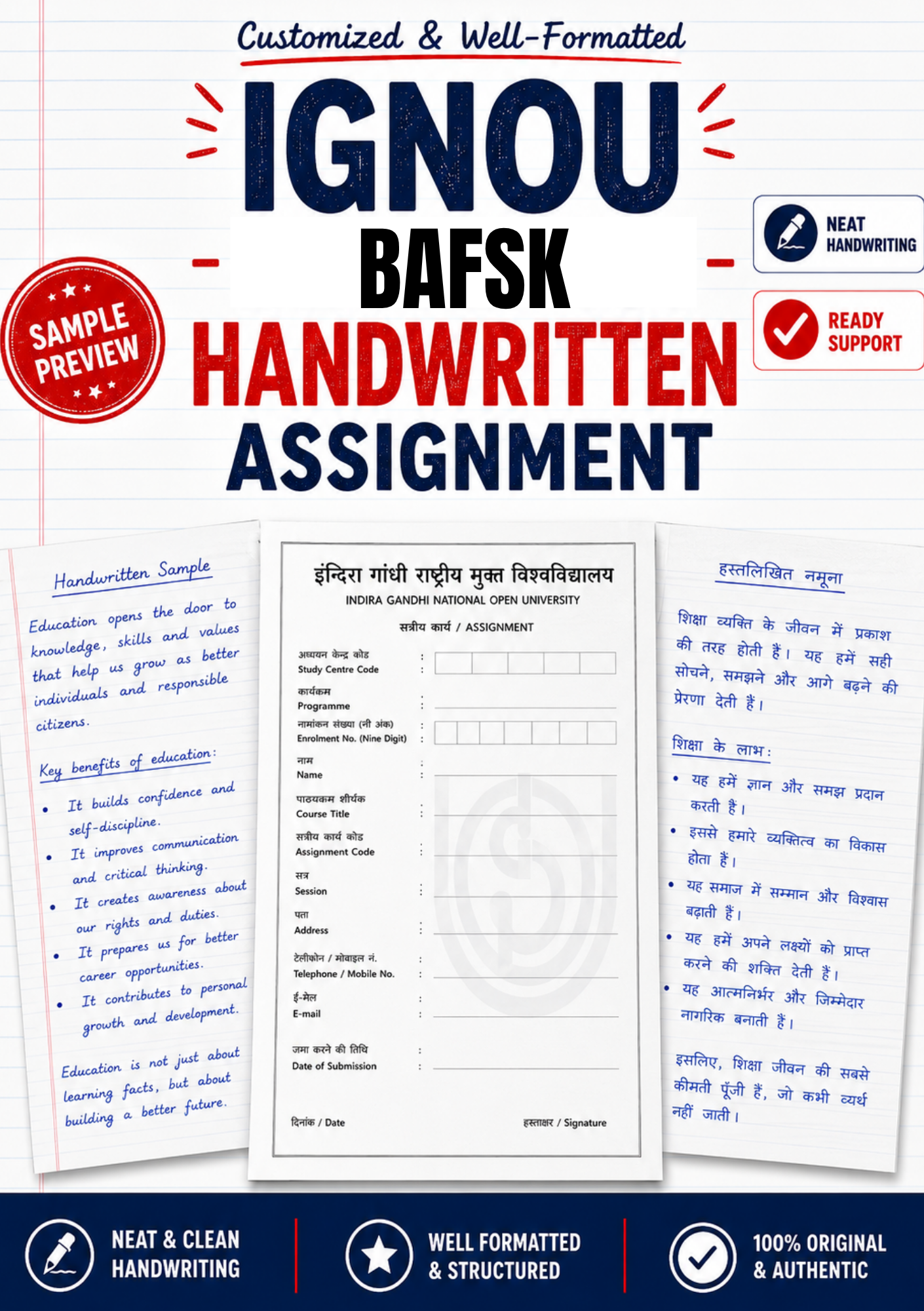
The second item is an IGNOU-format front page, free with every code. The School of Humanities booklets ask for a fixed block of details on the first page of each answer book: enrolment number, name, full address and date on the right, and course title, assignment number and Study Centre on the left, laid out as the booklet shows. The front page arrives with those fields ready, and the fields that only you can complete, above all your signature, are left for you.
The third item is a copy of the official Tutor Marked Assignment paper for that code and session, so that you can check every question number against the answers before anything leaves your hands. The fourth is the courier packing that brings it to your address. No soft copy or PDF is sold.
The sheets follow the paper the booklet asks for. BSKC-102 is explicit here: its third instruction asks for foolscap-size paper only and asks you to bind the sheets well. BSKE-150 and BSKAE-181 print no paper size at all, so for those codes the set follows the convention your Study Centre uses. That difference is covered again in the conflict box further down, because the store’s own hub page still says A4 for every course.
Inside ₹320 per Sanskrit Paper, and Outside It
One figure covers one course code: the handwritten answers, the front page, the question paper copy and the courier. A 4-credit minor such as BSKS 187 costs the same as a 6-credit major such as BSKC 111, because the work behind each is one 100-mark paper. There is no minimum order: one subject or fourteen, same rate. The ten major papers together come to ₹3,200, and a learner who is short on BSKE-150 alone pays ₹320 and nothing else.
Some things sit outside the figure because they cannot be bought. Submission is yours: the BSKC-102 booklet tells you to hand the finished assignment to the Coordinator of your own Study Centre by the fixed date, and nobody else can stand in that queue for you. The declaration is yours to sign. The marks are IGNOU’s to award. A code that carries no Tutor Marked Assignment in the booklet for your cycle is not written at all, and it is named back to you as such rather than priced.
The fourth year sits outside it too, for a plainer reason. The prospectus says the course details of the fourth BAFSK year will be provided subsequently, and its template places a 12-credit project or dissertation in the eighth semester. No fourth-year BSKC booklet was found on ignou.ac.in for this page, so none is quoted here.
Sanskrit Reference File or Hand-Written Set: Which One BAFSK Needs
Two different things get sold under similar names, and the difference decides what you can hand in. A solved assignment is a soft-copy reference file of model answers for a course code and session: something you read on a screen while you draft. A handwritten assignment is the answers written out by hand, on the paper size your booklet asks for, and submitted in hard copy at the Study Centre. The first is a study aid. The second is the thing the counter accepts.
| Point of comparison | Solved assignment (reference file) | Handwritten assignment (this product) |
|---|---|---|
| Format | Soft copy on a phone or laptop | Hand-written Hindi and Devanagari sheets, hard copy |
| What you do with it | Read it, then write your own answers | Read it, complete the front page, sign and submit |
| Who it suits | A learner with time to write every BSKC answer personally | A learner short on writing time before a School of Humanities cut-off |
| Price line | Priced per code on the solved-assignment shelves | ₹320 per subject, courier included, no PDF sold |
Scroll sideways to see all three columns on a small screen.
The booklets settle the question of submission on their own terms. BSKC-102’s fourth instruction asks that each answer begin with its question number and be written अपनी ही लिखावट में, in your own handwriting. BSKE-150 and BSKAE-181 tell you to copy the finished answer neatly into the answer book. None of the three says a printout is acceptable, and a downloaded PDF does not become a submission by being printed. That is also why the handwriting on these sets is matched to a page you send, a point the section on Devanagari handwriting explains in full.
If a reference file is what you actually came for, the store keeps those for the shared codes on the BA Sanskrit Honours solved assignment shelf, which is the page built for that search. There is no separate BAFSK shelf yet. BSKC 101 to BSKC 106, BSKC 111 and BSKC 112 carry the same codes in both BAFSK and the older BASKH honours degree, so the files there match those papers by code. Check the session printed on any file against your own booklet before you rely on it.
Send the BSKC codes printed on your registration record, not the whole semester.
₹320 per subject · hard copy only · courier included · no minimum order
The Ten BSKC, BSKE and BSKG Papers in the BAFSK Major
Section 5.3 of the IGNOU Common Prospectus July 2026 lists ten Major (Discipline Specific) courses for BAFSK, each worth 6 credits. Ten times six is 60, which is exactly the Discipline Specific credit total the prospectus sets for every Bachelor of Arts Major programme, so the table below checks out against the rule it sits under. The order is the prospectus’s own order, not numerical order.
| Code | Title as printed (Devanagari) | English gloss | Credits |
|---|---|---|---|
| BSKC 101 | लौकिक संस्कृत पद्य साहित्य | Classical Sanskrit poetry | 6 |
| BSKC 102 | संस्कृत साहित्य का आलोचनात्मक विश्लेषण | Critical analysis of Sanskrit literature | 6 |
| BSKC 103 | लौकिक संस्कृत गद्य साहित्य | Classical Sanskrit prose | 6 |
| BSKC 104 | गीता में आत्म प्रबंधन | Self-management in the Gita | 6 |
| BSKC 105 | लौकिक संस्कृत साहित्य | Classical Sanskrit literature (the programme page adds नाटक, drama) | 6 |
| BSKC 106 | काव्यशास्त्र साहित्यिक आलोचना | Poetics and literary criticism | 6 |
| BSKE 150 | संस्कृत भाषा विज्ञान | Sanskrit linguistics | 6 |
| BSKG 172 | भारतीय दर्शन के मूल सिद्धांत | Fundamental principles of Indian philosophy | 6 |
| BSKC 111 | वैदिक साहित्य | Vedic literature | 6 |
| BSKC 112 | संस्कृत व्याकरण | Sanskrit grammar | 6 |
Swipe the table to see all four columns. Credits total 60.
A word on how these titles were read. The prospectus text layer for this section breaks Devanagari conjuncts, printing लौहकक where the word is लौकिक and हवश्लेिण where it is विश्लेषण, so the titles above are cleaned readings of the prospectus, checked against the BAFSK programme page on ignou.ac.in wherever that page lists the same code. The English glosses are Shri Chakradhar Publication’s own and are not IGNOU titles.
Three details in this list trip learners up. Two of the ten major papers carry prefixes that normally mean something else: BSKE 150 has the E used for electives, and BSKG 172 has the G used for generic papers, yet both sit in the Major column. The numbering also jumps from BSKC 106 to BSKC 111, and codes such as BSKC 107 and BSKC 110 that fill the gap belong to other Sanskrit programmes, even though the ignou.ac.in BAFSK page displays them. Order against the code on your own registration record, never against a list copied from another programme.
The third detail is the one that causes wrong orders. IGNOU runs several Sanskrit undergraduate routes at once, and they share a prefix while meaning different papers. BAFSK and the older BA Sanskrit Honours (BASKH, a 148-credit degree) share BSKC 101 to BSKC 106, BSKC 111 and BSKC 112. The multidisciplinary BAM degree uses BSKC 131 to BSKC 134 instead, and a learner on that route is better served by the handwritten set for BAM discipline papers. The NSDC-linked Applied Sanskrit degree, BAASK, numbers its grammar paper BSKC-114, and its study guides sit under the BA Applied Sanskrit books shelf. Sanskrit grammar alone carries three different codes across these routes: BSKC 112, BSKC-114 and BSKC 134.
Minor, Skill and Language Codes Around the Major
The ten papers above are only half of the degree. The prospectus builds every three-year BA Major from the same blocks: 60 credits of Discipline Specific courses, 24 of Minor and Vocational courses, 8 of Ability Enhancement, 16 of Skill Enhancement, 6 of one Interdisciplinary course and 6 of one Value-Added course. Those blocks add up to 120, and the exit points follow from them: a UG Certificate at 40 credits plus a 4-credit vocational course, a UG Diploma at 80 plus 4, the Major degree at 120, and Honours at 160.
The codes a BAFSK learner meets in those other blocks come from two IGNOU sources that do not list them identically. The table shows each code with the source that prints it.
| Code | Title | Credits as printed | Where it is printed |
|---|---|---|---|
| BEVAE 181 | Environmental Studies | 4 | Prospectus, first Ability Enhancement course for all BA Major programmes |
| BSKAE 182 | संस्कृत साहित्य | 4 | Prospectus Ability Enhancement list; the programme page shows no credit value |
| BSKAE 181 | भारतीय ज्ञान परम्परा | 4 in the prospectus, 6 on the programme page | Prospectus Sanskrit minor list; programme page; live 2026-27 booklet |
| BSKS 187 | पातञ्जल योगसूत्र | 4 | Prospectus Sanskrit minor list; programme page |
| BSKS 185 | संस्कृत छन्द और संगीत | 4 in the credit line, 6 in the course introduction | Programme page only |
| BSKS 186 | अभिनय और पटकथा लेखन | 4 | Programme page, which also prints it once as BSKC-186 |
| CVG 002 | वैदिक अंकगणित (printed there as अंकगणिय) | 4 | Programme page only |
| BEDSV 101 | Value Education | 6 | Prospectus, Value-Added course |
On a phone, drag the table left to read the source column.
One rule in the prospectus narrows the choice more than learners expect. The Interdisciplinary course must be from a discipline other than your Major and your Minor, which rules out the Sanskrit interdisciplinary paper BSKG 178 for a Sanskrit major, however natural it looks on the list. Any of the codes above can be ordered at the same rate as a major paper, and each one is written against the booklet IGNOU issues for it.
Where the BAFSK Prospectus, Booklets and Programme Page Part Ways
This page was built by reading IGNOU’s documents against each other rather than copying any one of them. They do not agree on every point, and the disagreements matter when you are deciding what to write on a front page. Each one is listed below with its source, and so are the places where this store’s own pages disagree with the booklets.
Read these before you fill in a BAFSK front page. None of them is resolved by this page, and the Coordinator at your Study Centre has the final word on each.
1. BSKE-150 appears in the July 2026 prospectus only in the BAFSK major table, yet the cover of its July 2025 and January 2026 booklet names only BASKH, the older honours degree. The same booklet prints the heading 2024-25 on its instruction page directly above the code BSKE-150/2025-26.
2. The BSKC-102 booklet for the same sessions names its programme as the BA Honours Sanskrit programme and does not mention BAFSK, while the BSKAE-181 booklet for the January 2026 and July 2026 sessions names both BAFSK and BASKH and gives BAFSK as the programme code.
3. BSKAE-181 is labelled Minor on its booklet and sits in the prospectus list of Sanskrit minor courses, but the prospectus also says a discipline minor must come from a discipline other than the Major. The booklet nevertheless names BAFSK, a Sanskrit major, as its programme. Its credit value is 4 in the prospectus and 6 on the ignou.ac.in programme page.
4. On the BSKAE-181 paper, the second section asks for किन्हीं पाँच, any five answers, and prints the marks as 4×5=20. Five answers and four-times-five cannot both be right.
5. The BSKC-102, BSKE-150 and BSKAE-181 papers each open with the note that all questions are compulsory, then instruct you to answer any four questions from a longer list.
6. BSKC-102 asks for the society and culture of the Ramayana period twice, once as question 4 and again, in slightly different words, as question 6.
7. BSKC 105 is printed without the word नाटक in the BAFSK prospectus table but with it, as लौकिक संस्कृत साहित्य (नाटक), in the BASKH table of the same prospectus and on the ignou.ac.in BAFSK page. BSKC 106 loses the word और between काव्यशास्त्र and साहित्यिक आलोचना in the BAFSK table and keeps it everywhere else.
8. The prospectus and the ignou.ac.in BAFSK page both give Hindi as the only medium, while the general Bachelor of Arts statement in the same prospectus says English and Hindi. Several third-party sellers list BAFSK files in English medium or Sanskrit medium, neither of which IGNOU lists for this programme.
9. The prospectus programme table gives BAFSK a duration of three or four years with a maximum of six or eight. The ignou.ac.in programme page gives 36 months minimum and 72 months maximum, with no four-year figure.
10. The prospectus Skill Enhancement list for BA Major programmes contains no Sanskrit course, while the ignou.ac.in BAFSK page lists BSKS-185, BSKS-186, BSKS-191, CVG-002 and CVG-003. On that page BSKS-185 carries 4 credits in its header and 6 credits in its own introduction.
11. Aggregator pages circulate 31 October 2026 as the last date for July 2026 Sanskrit papers. That is the School of Management Studies pattern. The School of Humanities booklet for BSKAE-181 prints 31 March 2027 for the July 2026 session.
12. In-house: the handwritten hub on shrichakradhar.com states that every IGNOU assignment is written on A4 sheets and quotes a courier window in working days. BSKC-102 asks for foolscap, and this product promises no delivery figure at all.
13. In-house: several per-code solved assignment pages on shrichakradhar.com, including one for a Sanskrit BSKG paper, still offer handwritten sets at ₹300 or ₹350 with a fixed number of working days. The rate on this page is ₹320 per subject, and no delivery figure is promised.
Points 1 to 3 are the ones most likely to cause a wrong front page. If your BSKE-150 booklet says BASKH on the cover, or your BSKC-102 booklet names only the BA Honours Sanskrit programme, and you are enrolled in BAFSK, write your own programme code, BAFSK, in the programme field, copy the assignment code exactly as the booklet prints it with the questions, and ask your Study Centre if the counter staff query it. The course code on the paper is the same in both programmes, and that is the code the evaluator works from.
30 September and 31 March: The School of Humanities Cut-Offs
BAFSK is a School of Humanities programme, and its booklets tie the last date to the batch you were admitted in rather than to the examination you are aiming at. The live BSKC-102 and BSKE-150 booklets, issued for the July 2025 and January 2026 sessions, print 31 March 2026 for learners admitted in July 2025 and 30 September 2026 for learners admitted in January 2026. The BSKAE-181 booklet, issued for the January 2026 and July 2026 sessions, prints 30 September 2026 for the January 2026 session and 31 March 2027 for the July 2026 session. The older BSKC-101 booklet for the 2024-25 cycle follows the same rhythm, with 31 March 2025 for the July 2024 session and 30 September 2025 for the January 2025 session.
So the pattern is steady across every BAFSK paper read for this page: a July batch submits by 31 March, a January batch by 30 September. It is not the 31 October and 30 April pattern of the School of Management Studies, which is where the 31 October figure on aggregator sites comes from. As of 19 September 2026, the January 2026 batch cut-off of 30 September 2026 is the nearest one. If that is your date, send your codes and pin code before you pay anything, so the delivery estimate for your address can be checked against it.
Papers also expire. Each booklet names the sessions it serves, and a new file replaces it for the next cycle. The BSKC-102 and BSKE-150 files quoted here cover July 2025 and January 2026 only. When these IGNOU index pages were read on 19 September 2026, they carried no July 2026 file for either code, while BSKAE-181 already had its 2026-27 file. If your session’s booklet has not appeared yet, the set is written once it does, not against the previous cycle’s questions. Every booklet also carries the same warning: submit before the term-end examination, or you will not be allowed to sit it. IGNOU occasionally extends a last date by notification on ignou.ac.in, and this page does not predict one.
Three Assignment-Code Patterns on BAFSK Papers
The assignment code is the line you copy onto the front page, and BAFSK papers do not write it the same way. Some booklets print one form on the instruction page and another beside the questions. The table records what each booklet actually prints.
| Booklet | Sessions on the cover | Code on the instruction page | Code beside the questions |
|---|---|---|---|
| BSKC-102 | July 2025 and January 2026 | BSKC-102/2025-26 | BSKC-102/2025-26 |
| BSKE-150 | July 2025 and January 2026 | BSKE-150/2025-26, under a 2024-25 heading | BSKE-150/TMA/2025-26 |
| BSKAE-181 | January 2026 and July 2026 | BSKAE-181/2026-2027 | BSKAE-181/TMA/2026-2027 |
| BSKC-101 (older cycle) | July 2024 and January 2025 | BASKH/BSKC-101/2024 – 2025 | BSKC – 101/TMA/2024-2025 |
Slide the table sideways on a narrow screen to see the last column.
Three patterns come out of that table: code and a short year span with no TMA marker, code with TMA and a short span, and code with TMA and a full four-digit span. The older BSKC-101 file adds a fourth habit, a programme prefix in front of the code. The safe rule is to copy the form printed beside the questions, because that is the line that identifies the paper you actually answered, and to keep the session years exactly as printed even where they look inconsistent.
The question pattern differs as much as the codes. BSKC-102 and BSKE-150 each ask for four long answers at 15 marks and four shorter answers at 10 marks, from lists of seven and six questions respectively, for 100 marks. BSKAE-181 asks for four answers at 15 marks, the disputed five-or-four answers at 5 marks, and two short notes at 10 marks. The older BSKC-101 paper opened with explanation-with-context of four verses out of five at 10 marks each, before five essay answers and two notes. A BAFSK set is written to whichever pattern your own booklet prints, and the booklet prints no per-question word limit, so none is invented here.
Devanagari in Your Own Hand
A BAFSK answer set is almost entirely Devanagari: Hindi prose, Sanskrit verses and terms, conjuncts, halant marks and matras on every line. That makes handwriting matching a closer job than it is for an English paper, because a Devanagari hand is recognisable by details a Roman hand does not have: how the headline stroke, the shirorekha, runs across a word, how the matras in कि and की curve, how conjuncts such as क्ष and ज्ञ are formed, and whether numerals are written as 4 or ४. Send a photo of a page you have written yourself and the handwritten set is matched to your handwriting at no extra charge.
The reason this matters is in the booklet, not in any sales argument. BSKC-102 asks for answers in your own handwriting, and every front page carries a declaration that you sign. You sign the declaration on the assignment cover page, so you should read and review the content before submitting it, and satisfy yourself that it represents your own understanding of the course. A set that reads in a hand close to yours is easier to review line by line, and easier to correct in your own writing if you want to change a sentence.
The Sample Page to Photograph
Photograph one full page you have written in Hindi, flat, in daylight, with the whole sheet in frame. A page with some conjuncts and at least one line of numbers helps most. If you write Sanskrit verses differently from Hindi prose, for example with more spacing or with a danda at each line end, include a few lines of that too. Tell Shri Chakradhar Publication whether you number questions with 1, 2, 3 or with १, २, ३, since the booklets themselves mix both. The sample is used only to match the hand on your set, and you see how it has been matched before you pay.
Hindi Medium, Older Cycles and Backlog BSKC Papers
The service covers all mediums IGNOU issues the TMA paper in, at the same price. For the BAFSK major that means Hindi, because the prospectus programme table and the ignou.ac.in programme page both list Hindi as the only medium of instruction, and every BSKC, BSKE and BSKAE booklet read for this page is printed in Hindi. The answers are written in Hindi, with Sanskrit quoted in Devanagari wherever a question sets a verse or a term. Where one of your non-Sanskrit codes is issued in both English and Hindi, the set follows whichever paper you choose.
Any session is accepted, current cycle or older, including backlog courses, at the same ₹320 per subject. BAFSK only began with the January 2024 intake, so the oldest BAFSK cycle is recent, but papers from 2024-25 and 2025-26 are still live questions for learners who are clearing a backlog or who re-registered late. Which cycle’s paper you should answer is decided by IGNOU’s rules for your own re-registration or re-appearance, not by anyone selling a set, so confirm the session with your Study Centre before you ask for an older booklet to be written.
What to Put in the WhatsApp Message
An exact quote needs five things and nothing more. Everything else, including the front page and the question paper copy, is handled from those five.
- The course codes exactly as they print on your registration or re-registration record, for example BSKC 111, BSKE 150 and BSKAE 181.
- Your batch: January or July, with the year, since that decides whether your date is 30 September or 31 March.
- The medium, which is Hindi for every BSKC, BSKE and BSKAE code, plus your choice of English or Hindi for any code that IGNOU issues in both.
- Your pin code, so the delivery estimate for your address can be confirmed before you pay.
- One photo of a page in your own Hindi handwriting, as described in the sample section above.
If you are not sure which codes you still owe, send the list from your registration record anyway and say so. The reply marks each code against the booklet that governs it, names any code with no Tutor Marked Assignment for your cycle, and gives one total. Send my BSKC code list on WhatsApp.
Ten BAFSK major papers, one rate, the Devanagari hand matched to yours.
₹320 per subject · courier already counted in · front page and question paper copy included
Between Delivery and the Study Centre Counter
When the parcel arrives, work through each bundle in the same order. Match the course code on the front page to your registration record. Compare the question numbers on the answer sheets with the question paper copy, and check that the number of answers matches what the booklet asks for, taking particular care on BSKAE-181 where the booklet contradicts itself. Read the answers, and change anything you would put differently in your own words.
Then fill in the fields only you can fill, sign the declaration, and follow the BSKC-102 booklet’s last piece of advice, which applies to every code: keep a photocopy of the submitted set with you. Hand the assignment to the Coordinator of your Study Centre before your batch’s date and keep whatever receipt the centre gives. Assignments carry 30 per cent of the final course result and the term-end examination carries the remaining 70 per cent. The assignment share is recorded only once IGNOU has received and evaluated the submission, which is why the receipt and the photocopy are worth keeping until the grade appears.
Sanskrit Books, Guess Papers and Neighbouring Programmes
A handwritten set settles only the assignment share, and the term-end examination in the same codes still carries the other 70 per cent. Because BAFSK shares its BSKC core with the older honours degree, most of the matching study material on this store is catalogued under BASKH. The BASKH help books for the shared BSKC papers cover the same code numbers, and a single-course example is the BSKC 104 guide on self-management in the Gita. For revision against likely examination questions, the Sanskrit Honours solved guess papers are sorted by the same codes, including a BSKG 172 Indian philosophy guess paper in Hindi for the major paper with the generic prefix.
Two neighbouring shelves are worth knowing. Learners who took the Vedic arithmetic skill course listed on the BAFSK programme page can find study material on the Certificate in Vedic Ganit shelf, since CVG is a certificate prefix. Learners whose Sanskrit papers are BSKC 131 to BSKC 134 are on the multidisciplinary route, and their guides sit on the BAM Sanskrit discipline books page. For any other programme, or a mixed list of codes from several, the store-wide handwritten assignment hub takes orders on the same terms.
If you would rather write every BSKC answer yourself, the companion site’s free guide to writing an IGNOU assignment by hand compares the handwriting and paper instructions printed by different schools, and it costs nothing to use.
BAFSK Questions Before You Order
Is BAFSK the same programme as BASKH or BAASK?
No. BAFSK is the four-year FYUP Bachelor of Arts (Sanskrit) that started with the January 2024 session. BASKH is the older 148-credit BA Sanskrit Honours degree, and BAASK is the three-year BA in Applied Sanskrit run with NSDC. BAFSK and BASKH share the codes BSKC 101 to BSKC 106, BSKC 111 and BSKC 112, which is why some BAFSK papers arrive with BASKH printed on the cover. BAASK uses different numbers, including BSKC-114 for grammar.
Which BAFSK codes can be ordered as a handwritten set?
Any code that carries a Tutor Marked Assignment for your cycle: the ten major papers from BSKC 101 to BSKC 112, including BSKE 150 and BSKG 172, and the minor, skill and language codes around them, such as BSKAE-181, BSKAE 182, BSKS 187 and BEVAE 181. A code with no assignment in its booklet is named back to you rather than priced.
What is the last date for BAFSK assignments of the January 2026 and July 2026 sessions?
The School of Humanities booklets print 30 September 2026 for the January 2026 session and 31 March 2027 for the July 2026 session, the second date read off the live BSKAE-181 booklet. The rule behind both is that a January batch submits by 30 September and a July batch by 31 March. Check the date printed on your own booklet, and on ignou.ac.in, before relying on either.
Can I print a solved BSKC assignment PDF and submit it?
The BAFSK booklets do not provide for that. BSKC-102 asks for answers in your own handwriting, and the other Sanskrit booklets tell you to copy the finished answer neatly into the answer book. A solved assignment is a reference file for reading while you write, and a printed PDF does not become a submission.
What is the difference between a solved assignment and a handwritten assignment for BAFSK?
A solved assignment is a soft-copy file of model answers you read on a screen. A handwritten assignment is the answer set written by hand in Hindi and Devanagari, on the paper your booklet asks for, and delivered as a hard copy that you check, sign and submit at your Study Centre. This page sells only the second. No soft copy or PDF is sold.
Is a typed or computer-printed BAFSK assignment accepted?
None of the BAFSK booklets read for this page mentions typed or printed answers as an option, and BSKC-102 specifically asks for your own handwriting. The decision rests with IGNOU and your Study Centre, not with any seller, so confirm with the Coordinator if you are considering anything other than a hand-written set.
Will my BAFSK set be written in Hindi or in Sanskrit?
In Hindi, with Sanskrit quoted in Devanagari wherever the question sets a verse, a sutra or a technical term. IGNOU lists Hindi as the only medium for BAFSK, and every BSKC, BSKE and BSKAE booklet read for this page is printed in Hindi. Files sold elsewhere as English-medium or Sanskrit-medium BAFSK do not match any medium IGNOU lists for the programme.
Does a BAFSK set use A4 or foolscap sheets?
It follows your booklet. BSKC-102 asks for foolscap-size paper only, while BSKE-150 and BSKAE-181 print no paper size, and for those the set follows the convention your Study Centre uses. Say in your message if your centre has told you something specific.
My BSKAE-181 paper says any five but prints 4×5=20. How many answers are written?
The booklet contradicts itself, and no one outside IGNOU can settle it. Writing five answers satisfies the any-five instruction and still covers a four-answer reading, so tell Shri Chakradhar Publication in your message which reading your Study Centre confirms, and the set is written to that.
BSKC-102 asks about Ramayana-period society twice. Does that change anything?
Only a little. Questions 4 and 6 of the 2025-26 BSKC-102 paper cover the same topic, so the first section effectively offers six distinct topics rather than seven, and you still answer four. A set for BSKC-102 answers four different questions so that no answer repeats another.
My registration shows BSKC 131 and BSKC 132. Is this the right page?
Those codes belong to the multidisciplinary BAM route, not to the BAFSK major, whose Sanskrit core runs from BSKC 101 to BSKC 112. They can still be written at the same rate, but the BAM handwritten page explains that route’s own papers and dates.
Can I order an older BSKC-101 paper from the 2024-25 cycle?
Yes, if that is the paper you need to answer. Any session is accepted, current cycle or older, including backlog courses, at the same ₹320 per subject. Confirm with your Study Centre which cycle’s booklet applies to your re-registration before ordering an older one.
How much do all ten BAFSK major papers cost together?
₹3,200, which is ten codes at ₹320 each, with the front pages, question paper copies and courier included. A single code is ₹320. There is no minimum order: one subject or fourteen, same rate.
Why does my BSKE-150 booklet say BASKH on the cover when I am in BAFSK?
Because IGNOU issued one booklet for a code used in more than one programme and printed only the older programme on the cover, even though the July 2026 prospectus lists BSKE 150 only in the BAFSK major. Write BAFSK as your programme on the front page, copy the assignment code as printed beside the questions, and ask your Study Centre if the counter queries it.
When will the BAFSK parcel reach me?
Delivery depends on your pin code and is confirmed for your order before you pay. No figure is promised on this page. If your batch is due on 30 September 2026, mention that date in your first message so the estimate can be checked against it before any payment.
Sources Behind This BAFSK Page
From the IGNOU Common Prospectus July 2026. The programme table (BAFSK, School of Humanities, eligibility 10+2, medium Hindi, three or four years), the four-year undergraduate template with its exit points at 40, 80, 120 and 160 credits, the rule that Discipline Specific courses total 60 credits, the ten major codes and credits in section 5.3, and the common lists of Ability Enhancement, Interdisciplinary, Value-Added, Skill Enhancement and Sanskrit minor courses. The credit arithmetic was checked: ten major papers at 6 credits each make 60, and the six course blocks make 120.
From the live booklets and ignou.ac.in, read on 19 September 2026. The BSKC-102 and BSKE-150 booklets for the July 2025 and January 2026 sessions and the BSKAE-181 booklet for the January 2026 and July 2026 sessions, all listed on the IGNOU CBCS and honours assignment index and the IGNOU FYUG assignment index, plus the older BSKC-101 booklet for the 2024-25 cycle. Dates, assignment codes, question patterns, paper instructions and cover programmes were read directly off those files. The medium, duration and the extra skill courses come from the BAFSK programme page on ignou.ac.in.
From Shri Chakradhar Publication’s own commercial terms. The rate, what the parcel contains, the handwriting match, session and medium coverage, and the delivery policy. These are the publisher’s terms of sale and are not IGNOU information.
Written and reviewed by BK Sahni, Founder, Shri Chakradhar Publication Pvt. Ltd. and ignouproject.com, who has guided 5,00,000 students till date. ORCID 0009-0005-8092-459X.
Important Notice
Shri Chakradhar Publication Pvt. Ltd. and shrichakradhar.com form an independent IGNOU study-support publisher. This is not the official website of Indira Gandhi National Open University, is not affiliated with, endorsed by or authorised by the university, and no page on this site should be treated as an official IGNOU communication.
Programme structures, course codes, submission dates and rules change, and only ignou.ac.in and your Regional Centre can confirm the current position for your enrolment.
You sign the declaration on the assignment cover page, so you should read and review the content before submitting it, and satisfy yourself that it represents your own understanding of the course.
No claim is made about the marks any assignment will receive, about how an evaluator will assess it, or about whether it will be accepted. Assignment evaluation is entirely a matter for IGNOU.
Order Handwritten BAFSK Papers
The rate is ₹320 per subject, hard copy only, with courier included in that price and no separate shipping charge. Send your codes, your batch and your pin code, and the reply gives one total before anything is paid.
Order my BAFSK set on WhatsApp
Clearing an older cycle instead? Ask about a backlog BSKC paper