

Description
In short. An IGNOU BAFPY handwritten assignment is the answer set for one Bachelor of Arts (Philosophy) course, written out by hand on paper and handed in at your study centre, and Shri Chakradhar Publication prepares that set for any of the ten Major codes, BPYC-101 Introduction to Philosophy: Perspectives, Issues and Early History through BPYC-110 Epistemology, as well as the language, skill, vocational, value-added and minor papers you sit alongside them. The rate is ₹320 per subject, hard copy only, with courier included in that price and no separate shipping charge. Two things set BAFPY apart from its sister degrees: the two live BPYC papers opened for this page print no submission date and no assignment code line at all, and IGNOU files the programme under two schools at once, SOITS in the Common Prospectus programme table and SOSS in the prospectus section that lists its courses, with one BPYC paper stored in each school’s folder on ignou.ac.in.
What Comes Inside a BAFPY Handwritten Packet
Each BAFPY order leaves the Shri Chakradhar Publication desk as a paper parcel, one bundle per course code. The first item in every bundle is the answer set itself: the five questions of the BPYC paper answered in ink on loose sheets, with the question number written at the head of each answer so an evaluator can follow the order printed on the paper. For BPYC-101 and BPYC-102 that means one long answer for question one, one long answer for question two, two middle-length answers for question three, four shorter answers for question four and five brief notes for question five, because that is the pattern both papers print.
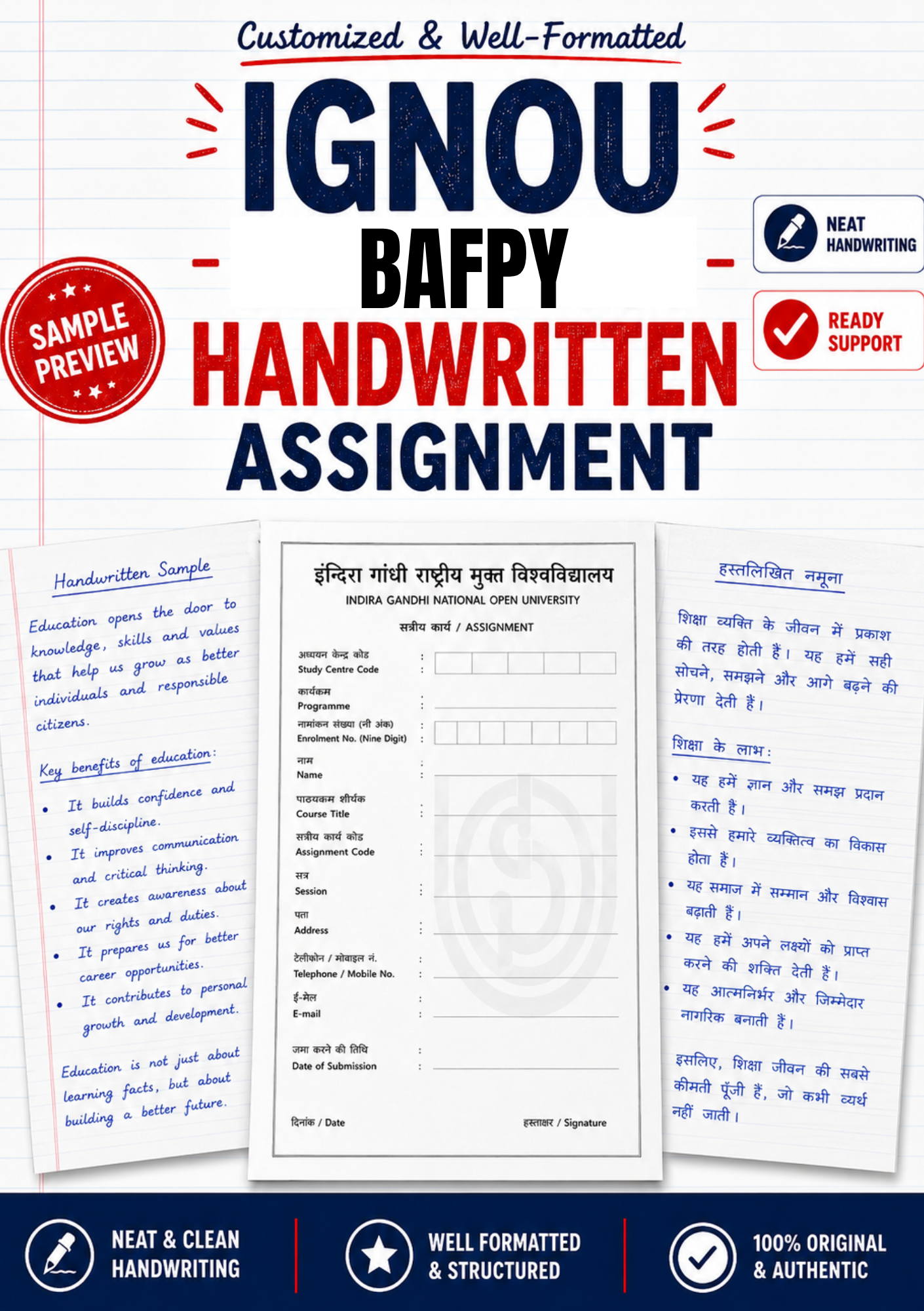
The second item is an IGNOU-format front page, supplied free with every subject. It carries labelled blanks for your name, enrolment number, programme code, course code and study centre, and you complete the personal fields yourself in your own hand before submission. The third item is a copy of the official BPYC question paper the answers were written against, so you and your study centre can match each answer to the question it responds to without searching the university website again. The fourth is the courier envelope, which travels to your address at no charge beyond the per-subject rate.
What the packet never contains is a digital file. No soft copy or PDF is sold. The answers exist as ink on paper and nowhere else, which is the form a BAFPY submission takes at the study centre counter.
Where the ₹320 per BPYC Subject Stops
The single figure covers the writing, the front page, the paper copy, the handwriting match and the courier. The rate is the same for a Major paper such as BPYC-106 Social and Political Philosophy as for a four-credit vocational paper such as BCOS 185 Entrepreneurship, because the price is set per subject rather than per credit. There is no minimum order: one subject or fourteen, same rate.
The rate does not buy anything IGNOU alone controls. It does not register you for the term-end examination, it does not pay any study-centre or examination fee, and it does not submit the set on your behalf; the counter at your study centre or the online route your Regional Centre runs is still yours to use. It also does not buy a delivery date. Delivery depends on your pin code and is confirmed for your order before you pay. No figure is promised on this page.
Older pages elsewhere on this store still show ₹300 or ₹350 for a handwritten subject, and some print fixed courier windows counted in working days. Those figures predate the current terms and are being withdrawn. The rate for a BAFPY subject is ₹320, and any delivery estimate is given for your pin code in the WhatsApp conversation, not on a web page.
BPYC Solved File or BPYC Handwritten Set: Which Does Your Study Centre Take?
Two products with similar names answer two different needs. A solved assignment, in the sense used across this store, is a model-answer file for one course code and one session, delivered as a document you read on a screen; you study it, then compose your own submission. A handwritten assignment is the physical answer set, written in ink on sheets and handed over at the study centre as the thing IGNOU records and evaluates. The first is study material. The second is the submission.
| Point of comparison | BPYC solved assignment | BPYC handwritten assignment |
|---|---|---|
| Format | Digital document, read on a phone or computer | Ink on paper, one bundle per course code |
| What you do with it | Read it, then write your own answers by hand | Check it, fill the front page, sign, and submit it |
| Who it suits | A learner with time to write five answers per code | A learner short of writing time before the cycle closes |
| Price line | Priced per code on the store’s solved shelf | ₹320 per subject, courier included |
On a narrow screen, slide the table sideways to see the handwritten column.
The BPYC papers themselves are silent on the question. Neither the BPYC-101 nor the BPYC-102 paper opened for this page says anything about handwriting, typing, paper size or where the answers go; their only instructions are to answer all five questions, that all five carry equal marks, the word counts, and that every part of a multi-part question must be attempted. The rule on handwriting comes from the Regional Centre side. The Delhi-2 Regional Centre’s assignment FAQ, in a copy circulating online, states that typed assignments cannot be submitted under any circumstances, online or by hand at the study centre, and that only hand written assignments will be accepted. Your own Regional Centre’s notice is the one that binds you, and a two-minute look at it before you order settles the point.
So the honest scope is this: a solved file is a reference to write from, and printing it does not turn it into a submission. If what you need is the reading copy, the bachelor-degree solved assignment shelf, where the BPYC reference files sit, is the right page. If what you need is the paper you hand in, this is the page.
Short on writing time for your BPYC papers this cycle?
₹320 per subject, hard copy, courier included, English or Hindi paper.
All Ten BPYC Major Codes, 101 to 110, With Official Titles
The Discipline Specific Courses are the spine of the degree: ten Philosophy papers, six credits each, that together make the 60-credit Major. Section 5.7 of the IGNOU Common Prospectus July 2026 lists them in the order below, with the titles exactly as that section prints them. The prospectus does not assign each code to a semester; the only semester label found in this research is on the BPYC-102 paper itself, which calls it a second-semester course.
| Code | Official title (Common Prospectus July 2026, section 5.7) | Credits | Live paper opened for this page |
|---|---|---|---|
| BPYC-101 | Introduction to Philosophy: Perspectives, Issues and Early History | 6 | Yes, 2025-26 file in the SOSS folder |
| BPYC-102 | Ethics | 6 | Yes, 2026 file in the SOITS folder |
| BPYC-103 | Indian Philosophy – Classical and Contemporary | 6 | Not opened |
| BPYC-104 | Modern Western Philosophy | 6 | Not opened |
| BPYC-105 | Logic | 6 | Not opened |
| BPYC-106 | Social and Political Philosophy | 6 | Not opened |
| BPYC-107 | Philosophy of Religion | 6 | Not opened |
| BPYC-108 | Contemporary Western Philosophy | 6 | Not opened |
| BPYC-109 | Metaphysics | 6 | Not opened |
| BPYC-110 | Epistemology | 6 | Not opened |
| Total | Ten Discipline Specific Courses | 60 | Two of ten |
Slide sideways on a phone to read the last column. The ten six-credit rows sum to 60, the figure the prospectus gives for this category.
Two cautions keep this table honest. First, the BPYC prefix is shared with IGNOU’s older Bachelor of Arts general and honours schemes, where Philosophy codes run in the 130s, for example BPYC 131 Indian Philosophy and BPYC 134 Western Philosophy: Modern. Those are different courses on a different scheme. A BAFPY learner’s Major codes sit between 101 and 110, and a quote or a paper for a 130-series code is not a BAFPY paper. Second, the prospectus stops at the three-year Major. The Honours year needs DSC-11 to DSC-14 and a twelve-credit dissertation or equivalent courses, and the prospectus says the fourth-year course details will be provided subsequently. If your admission record already shows a fourth-year code, send it exactly as printed; the set is prepared against the code and paper you supply, not against a list this page could not verify.
The two papers that were opened share one question pattern, which is the pattern Shri Chakradhar Publication writes to. There are five questions of twenty marks each, 100 in all. Questions one and two are long answers of about 400 words each, each offering a choice between two options. Question three asks for any two of four parts in about 200 words each, question four for any four of six parts in about 150 words each, and question five for short notes on any five of eight terms in about 100 words each. Added up, a complete BPYC set runs to roughly 2,300 words of answer text before headings, which is why most learners feel the load most sharply in the weeks before a cycle closes.
The 60 Credits Outside Philosophy: Minor, Skill, Language and Value Papers
Half the BAFPY credit load is not Philosophy at all. The prospectus template for its three-year Major/four-year Honours programmes spreads 120 credits across six semesters at 20 credits a semester, and 60 of those credits come from categories every BA (Major) learner shares. Each of them carries its own Tutor Marked Assignment, so a learner can easily be short on a skill or language paper while comfortably on track with the BPYC papers. The handwritten service covers these codes at the same per-subject rate.
| Category | Courses and credits | Codes a BAFPY learner may take |
|---|---|---|
| Discipline Specific Courses | 10 x 6 = 60 | BPYC-101 to BPYC-110, table above |
| Minor courses | 6 x 4 = 24 (three vocational, three from another discipline) | Vocational: BECS 184, BPAS 184, BHDS 184, BCOS 185, BCOS 186. Discipline minors from any subject except Philosophy, for example BPSM 161 to 163 or BPCM 161 to 163 |
| Ability Enhancement Courses | 2 x 4 = 8 | BEVAE 181 Environmental Studies, then one of BEGAE 182, BHDAE 182, BUDAE 182 or BSKAE 182 |
| Skill Enhancement Courses | 4 x 4 = 16 | From the shared list, for example BMPS 183, BEGS 183, BPCS 183, BSSS 183 |
| Interdisciplinary Course | 1 x 6 = 6 | One of BEGG 171, BHDG 175, BPAG 171, BPCG 171, BMDG 171, BABG 171, BDIG 171, BSOG 171 or BSKG 178; not BPYI 101 |
| Value-Added Course | 1 x 6 = 6 | BEDSV 101 Value Education or BNME 001 Philosophy of Swami Vivekananda |
| Total for the Major degree | 120 | Honours adds 40 more credits in the fourth year, for 160 |
Slide the table sideways on a small screen. The six category totals, 60, 24, 8, 16, 6 and 6, sum to the 120 credits the prospectus states for the Major degree.
Two exclusions matter more to a Philosophy Major than to anyone else. The prospectus requires discipline-specific minor courses to come from a discipline other than the Major, and requires the interdisciplinary course to sit outside both the Major and the Minor disciplines. That removes the three Philosophy minors, BPYM 161 Introduction to Philosophy, BPYM 162 Ethics: An Introduction and BPYM 163 Logic: An Introduction, from a BAFPY learner’s choices, and it removes BPYI 101 Applied Ethics as the interdisciplinary paper. Learners from other BA Majors see those codes in the same lists and pick them freely, which is where the confusion starts. If a study centre or a friend suggests one of them for your BAFPY record, check your admission record before ordering anything against it.
The exit points follow the same template. A learner who leaves after the first year with 40 credits plus a four-credit vocational course receives a UG Certificate; after the second year, 80 credits plus a four-credit vocational course bring a UG Diploma; 120 credits bring the degree with a Major in Philosophy; and the fourth year, at 160 credits, brings the Honours degree, or Honours with Research. The prospectus lists the programme at ₹5,500 a year, ₹16,500 for three years, with a minimum duration of three or four years and a maximum of six or eight, and admissions in both the January and July cycles. For study support on the shared papers, the skill enhancement guide books for the new BA syllabus and the ability enhancement titles such as BEVAE 181 sit on their own shelves.
Where IGNOU’s BAFPY Papers Contradict One Another
Reading the prospectus, the two live BPYC papers and IGNOU’s programme index against each other turned up disagreements that no single document reveals. None of them changes what you write in an answer, but several change where you look for a date, which school you write to, and which paper you treat as current.
Every disagreement found while researching this page, including three on this store.
1. Two schools for one programme. Row 97 of the Common Prospectus July 2026 programme table lists BAFPY under the School of Inter-disciplinary and Trans-disciplinary Studies (SOITS), yet section 5.7, the page that lists the BPYC courses, heads the programme “School of Social Science (SOSS)”. The live files follow both: the BPYC-101 paper sits in the SOSS assignments folder on ignou.ac.in and the BPYC-102 paper in the SOITS folder.
2. Four names for one degree. The BPYC-101 paper calls the programme “BAFYUP Philosophy”, the BPYC-102 paper “BAFPY Philosophy Second Semester”, IGNOU’s June 2025 term-end paper for BPYC-101 “B. A. (Major Philosophy) (BAFPY)”, and the prospectus “Bachelor of Arts (Philosophy) (Major/FYUP Hons.)”. All four point at the same programme.
3. A term-end cycle that does not exist. The BPYC-101 paper is headed as valid for “TEE December 2025 and For TEE January 2026”. IGNOU runs its term-end examinations in June and December, and the BPYC-102 paper reads “TEE June 2026 and TEE December 2026”. The January line is almost certainly a slip for June 2026; until IGNOU corrects it, confirm with your study centre which BPYC-101 paper it will accept for the December 2026 cycle.
4. An instruction that miscounts its own options. Question four of the BPYC-102 paper says to answer “any four of the following four questions” and then prints six parts, a to f. The marks line, four times five for twenty, confirms that you answer four of the six.
5. No date and no assignment code. Neither BPYC paper prints a submission date, an assignment code line or a cover sheet listing the programmes it applies to. The general Regional Centre pattern of 31 March for the June cycle and 30 September for the December cycle comes from Regional Centre FAQ sheets, and at least one widely read education site gives 31 October 2026 for the December 2026 cycle instead. Only the notice on ignou.ac.in for your cycle settles it.
6. A credit list that adds to 144 if read literally. Clause (b) of the BA (Major) rules gives 24 credits of minor courses, three vocational and three discipline-specific, while clauses (c) and (d) then describe twelve credits of “elective” courses and twelve of vocational courses as if they were separate categories. Added separately, the categories reach 144 against a stated 120. The semester template resolves it: (c) and (d) are the two halves of the 24-credit minor block.
7. A value-added course in two different semesters. Clause (h) of the BA (Major) rules says the six-credit value-added course is on offer only in the first semester, while the semester template beside it places VAC-1 in the second semester and puts the six-credit interdisciplinary course in the first. The credits are the same either way; the semester in which your record shows BEDSV 101 or BNME 001 is the one that applies to you.
8. A list that promises six semesters and delivers four. The heading reads “List of Courses for 1st To 6th Semesters” while the sentence beneath it says the list covers the first to fourth semesters, and the fourth-year Honours courses are marked as to be provided subsequently.
9. An index a cycle behind the files. IGNOU’s programme-wise assignment index for the four-year BA programmes shows an empty Philosophy (BAFPY) column for the July 2025 to January 2026 session; the newest BPYC links it carries are for July 2024 to January 2025, stored in folders spelled “philosphy” and “phioosophy”. The 2025-26 and 2026 BPYC papers are reachable on ignou.ac.in but not from that index.
10. Two codes for Applied Ethics. The four-year programme lists Applied Ethics as BPYI 101, while the same index page also carries BPYG 171 Applied Ethics from the older generic-elective scheme. Neither is an interdisciplinary option for a BAFPY learner.
11. This store’s own errors. The BAFPY book shelf on shrichakradhar.com describes itself in its search snippet as “IGNOU BAM Philosophy books”; older solved-assignment pages list BAFPY among their programmes while quoting ₹350 or ₹300 for a handwritten subject; and older handwritten pages print fixed courier windows and a second contact number. The terms on this page, ₹320 per subject with no delivery figure promised, are the current ones, and the older pages are queued for correction.
No Deadline on the BPYC Paper: Where the Cut-Off Actually Comes From
Many IGNOU booklets print two submission dates near the top. The BPYC papers do not. What they print instead is a validity line naming the term-end examinations the paper serves: the BPYC-102 paper is for the June 2026 and December 2026 examinations, and the BPYC-101 file is headed for December 2025 and a mislabelled January 2026 cycle. The date by which the handwritten set must reach the study centre therefore comes from somewhere other than the paper in your hand.
That somewhere is the university notice for each term-end cycle, published on ignou.ac.in and repeated by Regional Centres. Regional Centre FAQ sheets in circulation give the general pattern of 31 March for the June examination and 30 September for the December examination, with the proviso that IGNOU may extend it, and IGNOU has extended the cut-off in recent cycles. For the June 2026 cycle, for example, reported extension dates moved into late May and then June. For the December 2026 cycle the general pattern points to 30 September 2026, while at least one education portal has published 31 October 2026. Those two figures cannot both be the deadline, and neither is printed on the BPYC paper.
The practical rule is simple. Treat the earlier figure as your working deadline until the notice for your cycle on ignou.ac.in says otherwise, and place a handwritten order early enough that the parcel reaches you with time to check, sign and submit. Because delivery depends on your pin code, the WhatsApp reply to your order states what is realistic for your address before any payment is taken. Assignments carry 30 per cent of the final course result and the term-end examination carries the remaining 70 per cent.
A second consequence of cycle-based validity is that papers expire. A BPYC paper written for one pair of term-end examinations is replaced when IGNOU posts the next file, and answers written to an old paper do not answer the new one. If you are resubmitting a code from an earlier cycle, the set must be written against the paper valid for the examination you are now registering for, which is why the order message asks which examination you are aiming at rather than which year you were admitted.
Your BPYC Paper Has No Assignment Code Line: What to Write Instead
Learners moving from a management or humanities paper expect a line such as a course code followed by TMA and a session, which they copy on to the front page. The BPYC papers carry nothing of the kind. Each opens with the validity line, then a programme label, then the course code and title, and then the questions. There is no assignment code to copy and no separate cover sheet listing which programmes the paper applies to.
On the front page, the fields that matter are therefore the course code exactly as printed, for example BPYC-102, the course title as printed, Ethics, the programme code from your admission record, BAFPY, and, in the session or cycle field, the validity line of the paper you answered, for example TEE June 2026 and TEE December 2026. Writing the validity line lets the study centre see at a glance which paper the answers belong to. Where your study centre supplies its own format page, as some Regional Centres do, fill that one and keep the supplied front page as a guide to the fields.
The four labels on the documents, BAFYUP, BAFPY, B.A. (Major Philosophy) and the long prospectus title, all refer to the same programme. Use BAFPY, the code on your admission record, on anything you fill in, and do not copy BAFYUP from the BPYC-101 paper into the programme field.
A Sample Page of Yours Decides the Hand on Every Sheet
A handwritten set should look as though one person wrote it, and that person should be you. Send a photo of a page you have written yourself and the handwritten set is matched to your handwriting at no extra charge. The writer assigned to your order studies the slant, letter size, spacing and the way you form a handful of distinctive letters, and keeps that hand across every BPYC and non-BPYC code in the order, so a study centre that receives several of your subjects together sees one consistent hand.
Before any payment, Shri Chakradhar Publication sends back a short written sample in the matched hand. If the sample looks wrong to you, say so and ask for changes; nothing is paid before you have seen it. That step matters more on a Philosophy Major than it might elsewhere, because BPYC answers lean on proper names and transliterated terms, Brihadaranyaka, Nasadiya Sukta, Purusharthas, Parmenides, and a sample that includes a few of them shows you exactly how the set will read.
Taking the Sample Photo
Photograph a full page of ordinary writing, not a signature and not capitals. Notes from a BPYC block, a letter or a page from a diary all work. Shoot in daylight, straight above the page, with the whole sheet in frame and no shadow across it. One clear photo is enough; if you write differently in Hindi and English, and plan to order in both, send one page of each.
English or Hindi BPYC Papers, Past Cycles and Pending Codes
The Common Prospectus gives English and Hindi as the media of instruction for BAFPY, and IGNOU’s assignment index carries Hindi versions of the BPYC-101 and BPYC-102 papers alongside the English ones. The service covers all mediums IGNOU issues the TMA paper in, at the same price. If your admission record shows Hindi medium, the set is written in Hindi against the Hindi paper; if it shows English, in English. Mixing media across codes is fine when your record allows it, and the rate does not change.
Any session is accepted, current cycle or older, including backlog courses, at the same ₹320 per subject. A BAFPY learner admitted in January 2024, the first cycle of the four-year BA programmes, may now hold first-year codes that were never submitted alongside third-year codes that are current. Each is written against the paper valid for the examination you are registering for next, not the paper from your admission year.
Fourth-year Honours codes are handled the same way, with one caveat. Because the prospectus has not yet listed them, Shri Chakradhar Publication writes those sets only against a paper you forward or a code the team can locate on ignou.ac.in and confirm with you before starting. Nothing is written against a guessed title.
The Short Message That Starts a BAFPY Order
A BAFPY order needs five pieces of information, and all five fit in one WhatsApp message. First, the course codes exactly as they appear on your admission or re-registration record, BPYC and non-BPYC alike. Second, the medium for each code, English or Hindi. Third, the term-end examination you are submitting for, for example December 2026, so the correct paper is used. Fourth, your delivery pin code, which decides the delivery estimate you are quoted. Fifth, the photo of your own handwriting.
That is the whole list. You do not need to send your enrolment number, your identity card or your study-centre code to receive a quote; those details go on the front page in your own hand after the parcel arrives. If you are unsure of a code, a clear photo of your fee receipt or the course list on your student portal is enough for the team to read it off.
Want to see the matched hand before you decide?
₹320 per subject, hard copy, courier included, sample sent before any payment.
Once the BAFPY Set Is on Your Table
Open each bundle and check three things against the BPYC paper enclosed with it: that the course code on the answers matches the paper, that every question has an answer, including the right number of parts for questions three, four and five, and that the validity line on the paper matches the examination you are registering for. Then read the answers. You sign the declaration on the assignment cover page, so you should read and review the content before submitting it, and satisfy yourself that it represents your own understanding of the course.
Fill the front page by hand: your name, enrolment number, programme code BAFPY, course code, course title and study centre. Regional Centres differ on what goes behind it, but FAQ sheets from Delhi Regional Centres ask for the cover page, a copy of your IGNOU identity card and a printout of the question paper, in that order, with the handwritten answers after them. Keep a photocopy or a clear photo of the whole set and the receipt the study centre gives you, since that is your proof if the submission does not appear in your record.
After submission, the study centre forwards the set for evaluation and the marks later appear against the course on IGNOU’s assignment status service. Assignment evaluation is a matter between you and the university; Shri Chakradhar Publication’s part ends when the set reaches you.
Other Shelves BAFPY Learners Draw On
The Philosophy papers are easier to answer with a guide to hand, and the store keeps a BAFPY book shelf for the BPYC Major papers for learners preparing for the term-end examination. Learners whose shortfall is in the shared papers will find the interdisciplinary course guides such as BPCG 171 and BABG 171, the vocational minor guides from BECS 184 to BCOS 186 and the value-added course guide for BEDSV 101 on separate shelves.
For revision in the final weeks before the examination, the bachelor’s degree solved guess papers are grouped by programme; there is not yet a dedicated BAFPY shelf there, so search by BPYC code. Learners who carry Philosophy as one of three disciplines on the multidisciplinary BA rather than as a Major should use the handwritten page written for BAM learners, because their code list differs from the BAFPY list above. And learners who finish the Major and move on to postgraduate study will find the MA Philosophy guides for MPY and MPYE courses on the master’s shelf.
For any IGNOU programme not covered by a dedicated page, the handwritten assignment category for all IGNOU programmes takes the order at the same rate. If you would rather write the BPYC set yourself, the step-by-step handwritten assignment guide on ignouproject.com walks through the page layout and front page, and the official papers are on IGNOU’s assignment download service.
BAFPY Questions Before You Pay
What is the last date for the BAFPY assignment if the BPYC paper prints none?
The BPYC papers print a validity line naming the term-end examinations they serve, not a date. The cut-off comes from IGNOU’s notice for each cycle on ignou.ac.in. Regional Centre FAQ sheets give 31 March for the June examination and 30 September for the December examination as the general pattern, subject to extension, while one education portal gives 31 October 2026 for December 2026. Work to the earlier date until the notice for your cycle says otherwise.
Is BAFPY under SOITS or SOSS, and does it matter for my assignment?
IGNOU’s own documents say both. The prospectus programme table lists SOITS, the prospectus course section lists SOSS, and the two live BPYC papers sit one in each school’s folder on ignou.ac.in. It matters only when you are searching for a paper or writing to a school about one; search both folders, and ask your Regional Centre which school handles BAFPY queries for your enrolment.
Can I still use the BPYC-101 2025-26 paper for the December 2026 examination?
That file is headed for TEE December 2025 and a January 2026 cycle that IGNOU does not hold, most likely meant as June 2026. On that reading its validity has run out before December 2026. Check ignou.ac.in for a newer BPYC-101 file and confirm with your study centre before a set is written; the order message asks for your target examination for exactly this reason.
Can I print a BPYC solved assignment and submit it instead of a handwritten one?
No. A solved assignment is a reading copy of model answers. Regional Centre FAQ sheets state that typed assignments are not accepted in any form and that only handwritten work is taken. Read the solved file if it helps you, then submit answers written by hand.
What is the difference between a BPYC solved assignment and a BPYC handwritten assignment?
The solved assignment is a digital reference file you study from. The handwritten assignment is the ink-on-paper answer set you hand in at the study centre, with the front page and question paper attached. This page sells only the second, at ₹320 per subject. No soft copy or PDF is sold.
Is a typed BPYC answer set accepted if my handwriting is poor?
Regional Centre guidance says typed answers are not accepted, and the BPYC papers offer no exception. If neat writing is the difficulty, a handwritten set matched to your own sample keeps the submission in the required form and in a hand that resembles yours.
Can the BPYC answers be written in Hindi?
Yes. BAFPY runs in English and Hindi, and IGNOU posts Hindi versions of the BPYC papers. The service covers all mediums IGNOU issues the TMA paper in, at the same price. The set is written in the medium on your admission record.
Do you also write BEVAE 181, BEDSV 101 and my skill enhancement papers?
Yes. Every code on a BAFPY record carries its own assignment, and the ability enhancement, value-added, skill enhancement, vocational, minor and interdisciplinary papers are written at the same per-subject rate as the BPYC papers. Send the full list in one message.
My study centre listed BPYI 101 Applied Ethics for me. Should I order it?
Check your admission record first. The prospectus requires the interdisciplinary course to sit outside the Major discipline, so BPYI 101 is not normally an option for a Philosophy Major, and the Philosophy minors BPYM 161 to 163 are excluded for the same reason. If the code really is on your record, it can be written like any other.
How long is a complete BPYC answer set?
By the word counts the BPYC-101 and BPYC-102 papers print, about 2,300 words: two answers of about 400 words, two of about 200, four of about 150 and five short notes of about 100. The page count depends on your handwriting, which the set follows.
What goes in the assignment code field when my BPYC paper has no code?
Write the course code and title as printed, BAFPY as the programme, and the paper’s validity line, for example TEE June 2026 and TEE December 2026, in the session or cycle field. If your study centre issues its own format page, follow that page.
I am in the fourth year of BAFPY Honours. Are those codes covered?
They are, once the code and its paper can be confirmed. The prospectus has not yet published the fourth-year Honours courses, so send the code exactly as your record prints it, and forward the paper if you have it; nothing is written against an unconfirmed title.
I missed a BPYC code in an earlier cycle. Can I order it now?
Yes. Any session is accepted, current cycle or older, including backlog courses, at the same ₹320 per subject. The set is written against the paper valid for the examination you are registering for next rather than the paper from the cycle you missed.
How is the delivery time for my BAFPY order worked out?
From your pin code. Delivery depends on your pin code and is confirmed for your order before you pay. No figure is promised on this page. The WhatsApp reply gives the estimate for your address, because courier times differ widely across the country.
Three Sources Behind This BAFPY Page, Kept Apart
From the IGNOU Common Prospectus July 2026. The programme’s name, code, school entry, eligibility, media, duration and fee come from row 97 of the programme table. The ten BPYC titles and credits come from section 5.7. The credit categories, exit awards, the shared lists of ability enhancement, value-added, vocational, skill enhancement and interdisciplinary courses, and the minor-discipline rule come from the Bachelor of Arts (Major/Honours) pages that precede section 5.1. The credit sums on this page were checked against the totals those pages state: ten BPYC courses at six credits for 60, and six categories summing to 120.
From the live BPYC papers on ignou.ac.in, opened on 21 September 2026. The BPYC-101 English paper in the SOSS folder and the BPYC-102 English paper in the SOITS folder supplied the question pattern, word counts, validity lines and programme labels. IGNOU’s programme-wise assignment index for the four-year BA programmes supplied the Hindi versions and the index gaps described in the warning box. Regional Centre FAQ sheets, read in copies circulating online, supplied the handwriting rule and the general cut-off pattern; they are secondary to the notice on ignou.ac.in for your cycle.
From Shri Chakradhar Publication’s own terms. The rate, the hard-copy-only format, the courier, the free front page, the enclosed question paper, the handwriting match, the medium and backlog coverage and the absence of a minimum order are the publisher’s commercial terms, not IGNOU rules. They apply to every BAFPY code at the same ₹320 per subject.
Important Notice
Shri Chakradhar Publication Pvt. Ltd. and shrichakradhar.com form an independent IGNOU study-support publisher. This is not the official website of Indira Gandhi National Open University, is not affiliated with, endorsed by or authorised by the university, and no page on this site should be treated as an official IGNOU communication.
Programme structures, course codes, submission dates and rules change, and only ignou.ac.in and your Regional Centre can confirm the current position for your enrolment.
No claim is made about the marks any assignment will receive, about how an evaluator will assess it, or about whether it will be accepted. Assignment evaluation is entirely a matter for IGNOU.
Put Your BPYC Codes on WhatsApp
The rate is ₹320 per subject, hard copy only, with courier included in that price and no separate shipping charge. English or Hindi, current and backlog codes.
Get a BAFPY quote for your codes and pin code
Order a Hindi medium BAFPY set
WhatsApp +91 93546 37830