

Description
In short. BAFPA is IGNOU’s Bachelor of Arts (Public Administration), the three-year Major and four-year Honours degree that the School of Social Sciences runs under the four-year undergraduate framework, and its Tutor Marked Assignments for the ten BPAC major papers (BPAC-101 to BPAC-106, BPAC-108, BPAC-109, BPAC-110 and BPAC-112) plus the minor, skill, language, interdisciplinary and value-added courses on your record are what Shri Chakradhar Publication writes out by hand, one course code per set, for ₹320 per subject with courier included. The catch on this programme is the calendar: the five Public Administration booklets read for this page do not share one due date, so BPAC-102 for the January 2026 batch closes on 30 September 2026 while BPAC-103, BPAC-104 and BPAC-108 close on 31 October 2026, and the order is written against the date printed on your own booklet rather than against a date copied from a list.
The Four Things Inside a BAFPA Packet
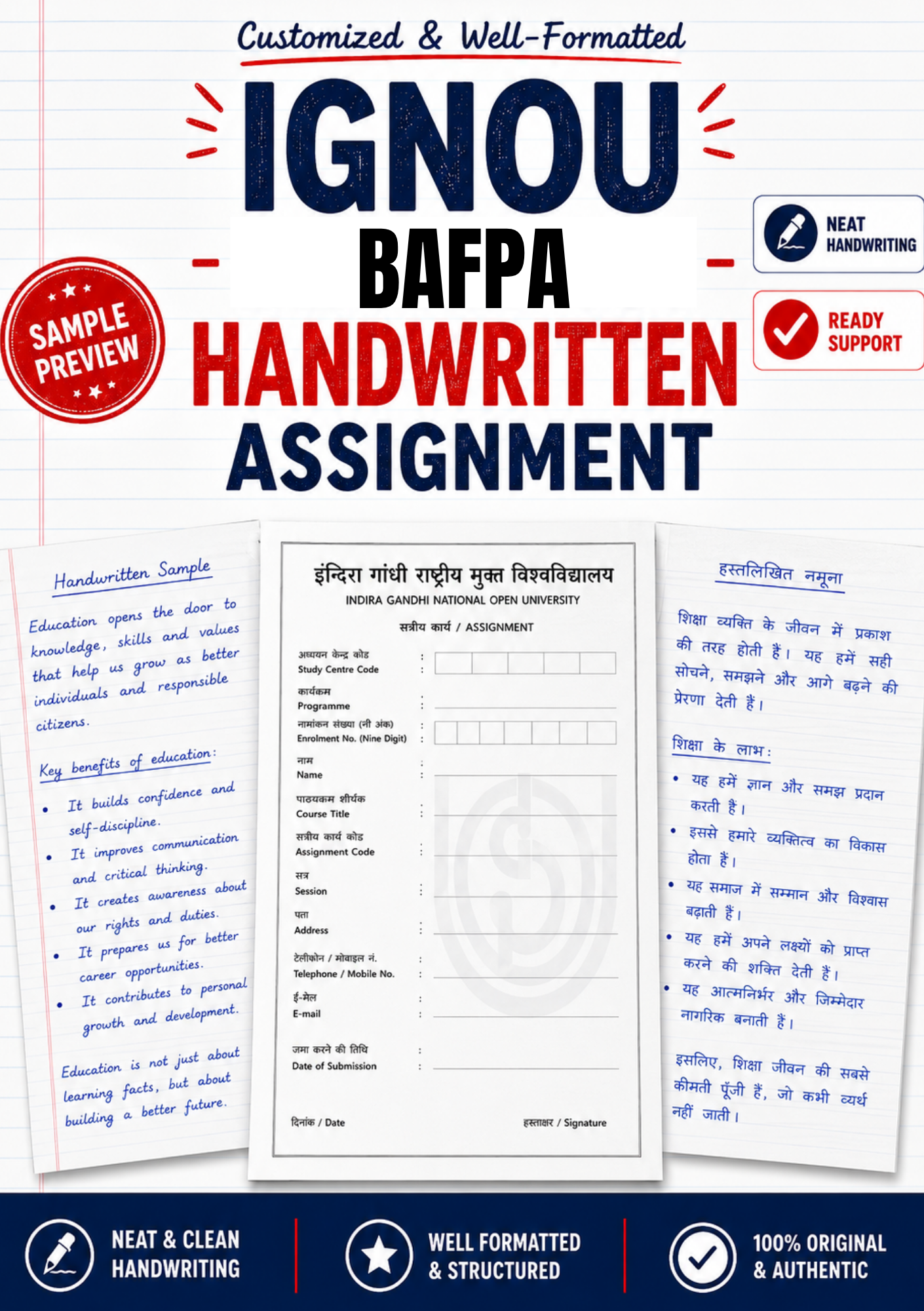
Every BAFPA set that leaves the press carries four items, packed together per course code. The first is the answer set itself, written by hand on A4 sheets in the order the questions appear on the booklet, so a BPAC-104 set runs from the essay on the State Finance Commission through to the short note on the classification of State civil services without you having to renumber anything. The second is a copy of the official question paper for that code and session, which study centres commonly ask to see attached behind the answers.
The third item is the IGNOU-format front page, left blank in the fields that only you can complete: your name, enrolment number, study centre code and signature. The fourth is the handwriting itself, which is matched to a page you have written, not to a house style. Nothing else is inside. There is no printed copy, no PDF, and no bonus material that would pad the packet and make it harder to check against the booklet.
Each code arrives as its own bundle. If you order BPAC-102, BPAC-103 and BPAS-186 together, you receive three separately stapled sets, because each one is submitted and receipted separately at the study centre and each one is evaluated against its own paper.
Where the ₹320 Starts and Stops
The rate is ₹320 per subject, hard copy only, with courier included in that price and no separate shipping charge. No soft copy or PDF is sold. There is no minimum order: one subject or fourteen, same rate.
That price does not move with credits. A six-credit BPAC major paper and a four-credit skill paper such as BPAS-186 Stress and Time Management cost the same, even though the BPAC booklets ask for three Tutor Marked Assignments totalling ten or eleven questions and a four-credit course asks for fewer. The fee also does not change for a Hindi booklet or for a backlog paper from an earlier cycle. What sits outside the ₹320 is anything that is not a hand-written TMA: IGNOU’s own examination fee, the re-registration fee, study-centre photocopying, and any rush or special courier you might arrange yourself.
Delivery depends on your pin code and is confirmed for your order before you pay. No figure is promised on this page. The practical consequence for BAFPA learners is simple: if your booklet date is close, say so in your first message, and you will be told plainly whether the set can reach you in time before any money changes hands.
Solved Assignment or Handwritten Set: Which One a BAFPA Learner Can Hand In
Two different products share the word assignment, and learners regularly confuse them. A solved assignment is a soft-copy reference file of model answers for a course code and session, meant to be read. A handwritten assignment is the answers written out by hand on A4 and submitted in hard copy at the study centre. The first helps you prepare; only the second is in the form a study centre collects.
| Point of comparison | Solved assignment (reference) | Handwritten set (this product) |
|---|---|---|
| Format | PDF or printout of model answers | Hand-written A4 sheets with front page and question paper |
| What you do with it | Read it, then write your own answers | Read it, complete the front page, sign, submit |
| Who it suits | Learners who will do the writing themselves | Learners short of time for ten or eleven questions per BPAC paper |
| Can it be handed in as it is? | No; it is typed or printed | Yes, once you have reviewed and signed it |
| Price line | Listed per code on the solved-assignment shelves | ₹320 per subject, courier included |
On a narrow screen, swipe the table left to see the third column.
What the Public Administration booklets themselves say matters here. The BPAC-103, BPAC-104 and BPAC-108 booklets each tell you to write the answers to all the TMA questions in your own words, ask you to write each answer neatly with key points underlined, and name the Coordinator of your Study Centre as the place of submission. None of the five BPAC booklets opened for this page prints a paper size, and none uses the word handwritten. The ban on typed or printed work comes from the study-centre side, where submission instructions routinely state that typed copies are not accepted, so check the notice at your own centre.
A downloaded file of model answers, printed and stapled, is therefore still a reading aid and not a submission. If what you actually want is the reference file to write from, the BPAC reference files for these same codes currently sit on the store’s BPAC solved-assignment shelf under BAPAH, because the honours programme and BAFPA use the same BPAC paper codes; no separate BAFPA solved-assignment shelf exists yet.
Start with the BPAC codes on your re-registration slip.
₹320 per subject, hard copy, courier included, no minimum.
The Ten BPAC Major Codes IGNOU Lists for BAFPA
Section 5.9 of the IGNOU Common Prospectus July 2026 lists the Discipline Specific Courses for BAFPA as ten papers of six credits each. The prospectus states that this category carries 60 credits in total, and the ten rows below sum to exactly 60, so the table was accepted as extracted rather than rebuilt from another programme’s list. Two numbers in the BPAC run are absent: BPAC-107 and BPAC-111 do not appear in the BAFPA table, although both exist in IGNOU’s older honours list for Public Administration.
| Code | Official title (prospectus) | Credits | On ignou.ac.in BAFPA page? |
|---|---|---|---|
| BPAC-101 | Perspectives on Public Administration | 6 | Yes |
| BPAC-102 | Administrative Thinkers | 6 | Yes |
| BPAC-103 | Administrative System at Union Level | 6 | No (BPAC-133 shown) |
| BPAC-104 | Administrative System at State and District Levels | 6 | Yes |
| BPAC-105 | Personnel Administration | 6 | No |
| BPAC-106 | Understanding Public Policy | 6 | No |
| BPAC-108 | Public Policy and Administration in India | 6 | Yes |
| BPAC-109 | Public Systems Management | 6 | Yes |
| BPAC-110 | Urban Local Governance | 6 | Yes |
| BPAC-112 | Rural Local Governance | 6 | Yes |
| Total | Ten Discipline Specific Courses | 60 |
Swipe sideways on a phone to read the last column.
The prospectus does not say which BPAC code falls in which semester; it gives the ten codes as a single list against the template of DSC-1 in the first semester up to DSC-10 in the sixth. The university’s own BAFPA programme page labels every course, including the four-credit skill papers, as Year 1, which cannot be right for a three-year sequence. For those reasons this page does not publish a semester map, and the order is taken from the codes printed on your admission or re-registration record. The fourth-year courses are also not in the prospectus, which says only that they will be provided subsequently, so fourth-year Honours codes are prepared from the booklet you send rather than from a list printed here.
If you would like to read the BPAC units before the set arrives, the BAFPA help books shelf carries guides against these same codes.
Minor, Skill, Interdisciplinary and Value-Added Papers Beside the BPAC Core
The BPAC major papers make up only half of a BAFPA Major degree. The other 60 credits come from categories that the prospectus lists once for every BA Major and Honours programme, and each of those courses carries its own Tutor Marked Assignment on its own booklet. The table shows how the 120 credits of the three-year Major add up and which codes the prospectus names in each category.
| Category | Courses and credits | Codes the prospectus names | BAFPA-specific note |
|---|---|---|---|
| Minor, vocational | 3 courses x 4 = 12 | BECS 184, BPAS 184, BHDS 184, BCOS 185, BCOS 186 | Needed also for the 4-credit exit award after year 1 or 2 |
| Minor, discipline | 3 courses x 4 = 12 | BHIM, BPSM, BECM, BSOM, BPCM, BEGM, BHDM, BPYM, BANM, BSKS, OULE, FUD series | Must come from one discipline other than Public Administration |
| Ability Enhancement | 2 courses x 4 = 8 | BEVAE 181, then one of BEGAE 182, BHDAE 182, BUDAE 182, BSKAE 182 | Second and third semesters |
| Skill Enhancement | 4 courses x 4 = 16 | 24 codes, including BPAS 186 and BMPS 183 | First, fourth, fifth and sixth semesters |
| Interdisciplinary | 1 course x 6 = 6 | Ten codes, BEGG 171 to BSKG 178 | BPAG 171 is the Public Administration entry, so it cannot be your interdisciplinary choice |
| Value-Added | 1 course x 6 = 6 | BEDSV 101, BNME 001 | Placed in different semesters by two parts of the same prospectus |
| Total with 60 BPAC credits | 120 | 160 for the four-year Honours |
Scroll the table sideways if the notes are cut off.
Two of these rows need a sentence each. The interdisciplinary rule in the prospectus requires that course to come from outside both your Major and your Minor discipline, and the only Public Administration entry in the interdisciplinary list is BPAG 171 Disaster Management. A BAFPA learner therefore picks one of the other nine, even though BPAG-171 appears on the university’s BAFPA web page. The discipline minor has a similar rule: the three discipline-specific minors must come from a single discipline other than your Major, so there is no BPAM minor for BAFPA learners to take.
Guides for the shared papers are grouped by category on the store: the skill enhancement guides for the new BA syllabus, the vocational minor guides, BPAS 184 among them, and the interdisciplinary course guides.
Five Places Where IGNOU’s Public Administration Papers Contradict Each Other
Reading the July 2026 prospectus, IGNOU’s BAFPA programme page and five BPAC booklets side by side turns up disagreements that affect what you submit and when. None of them is resolved here by guesswork. Each is set out so that you can check your own copy.
Read this before you fix a date or a code for any BAFPA paper. Where two IGNOU documents disagree, the booklet for your own code and session, and your study centre, decide. The points below are what the documents say as read on 22 September 2026.
1. The ignou.ac.in BAFPA programme page lists BPAC-131, BPAC-132, BPAC-133 and BPAC-134, which carry the same titles as BPAC-101, BPAC-102, BPAC-103 and BPAC-104 and do not appear anywhere in the July 2026 prospectus. The BPAC-134 booklet names BAG and BAM on its cover, not BAFPA, and prints the same ten questions as BPAC-104. The same web page leaves out BPAC-103, BPAC-105 and BPAC-106, which the prospectus lists as BAFPA majors.
2. Two submission calendars run inside one discipline for the same batch. The BPAC-102 booklet prints 31 March 2026 for the July 2025 batch and 30 September 2026 for the January 2026 batch. The BPAC-103 and BPAC-104 booklets print 30 April 2026 and 31 October 2026, and the January 2026 BPAC-108 booklet prints 31 October 2026.
3. The programme named on the cover changes from paper to paper. BPAC-102 names only BAPAH, BPAC-104 names BAPAH and BAFPA, BPAC-103 names BAG, BAM and BAFPA, and BPAC-108 names only BAFPA, although all four are BAFPA major papers in the prospectus.
4. The BPAC-102 booklet prints a total of 100 marks, yet its eleven questions carry 20, 20, 10, 10, 10, 10, 6, 6, 6, 6 and 6 marks, which add up to 110. Its introduction also calls the course Perspectives on Public Administration, the BPAC-101 title. The January 2026 BPAC-108 booklet describes Assignments A, B and C in its instructions and then labels the question sections I, II and III.
5. The prospectus contradicts itself on BA Major structure: its text says the value-added course is offered only in the first semester, while its semester template places VAC-1 in the second, and it lists BPAG 171 as an interdisciplinary option while its own rule bars a Major discipline’s course from that slot. In-house, this store has also been inconsistent: some solved-assignment product pages for BPAC and shared BA codes still quote a handwritten price of ₹350 and a working-day delivery window, the handwritten category page quotes a different working-day window and a founding year of 2012 against 2010 elsewhere, and one BPAC-101 guide describes Public Administration content as political science. This page governs wherever those pages disagree with it, and each is queued for correction.
Two Due Dates Inside One Discipline: 30 September and 31 October
For most programmes the question is which school’s date applies. For BAFPA the question is narrower, because the school is the same for every BPAC paper and still the dates differ. The table lists what each booklet read for this page prints, so you can compare it with the booklet in your hand.
| Booklet | Programmes on cover | July 2025 batch | January 2026 batch | Assignment code printed |
|---|---|---|---|---|
| BPAC-102 | BAPAH | 31 March 2026 | 30 September 2026 | ASST/TMA/ 2025 -2026 |
| BPAC-103 | BAG, BAM, BAFPA | 30 April 2026 | 31 October 2026 | ASST /TMA / July-2025 & January-2026 |
| BPAC-104 | BAPAH, BAFPA | 30 April 2026 | 31 October 2026 | ASST /TMA / July 2025 & January 2026 |
| BPAC-108 (January only) | BAFPA | Not covered | 31 October 2026 | ASST/TMA/January -2026 |
| BPAC-134 | BAG, BAM | 30 April 2026 | 31 October 2026 | ASST /TMA / July 2025 & January 2026 |
Slide the table across on mobile to see the code column.
As of 22 September 2026, a January 2026 BAFPA learner holding the BPAC-102 booklet is working to a date eight days away, while the same learner’s BPAC-103 and BPAC-104 papers run to 31 October. Treat each paper’s own date as the deadline for that paper. Do not assume the later date covers BPAC-102 unless your study centre confirms it in writing.
A second caution concerns extensions. IGNOU announces extensions by notice, tied to a term-end examination rather than to a booklet, and news sites then repeat those extended dates as if they were the printed ones. An extension, when it exists, is on ignou.ac.in and at your Regional Centre. The printed date is on your booklet. Keep the two apart when you plan an order.
Papers also expire. Each booklet states the enrolment batches it serves, and IGNOU replaces it with a new paper for the next cycle. Learners who enrolled in July 2026 answer the 2026-27 papers, which aggregator sites already quote with a July 2026 and January 2027 assignment code; those booklets were not among the five opened for this page, so for a July 2026 enrolment the set is written from the booklet you send, and the date is read off that booklet.
Decoding ASST/TMA Before the Set Leaves Your Hands
Every BPAC paper prints an assignment code under the course code, and the part after ASST/TMA tells you which batches the questions were set for. The Public Administration discipline does not use one pattern. BPAC-102 prints a year span, 2025 -2026. BPAC-103 and BPAC-104 name both months, July 2025 and January 2026, one with hyphens and one without. BPAC-108 for the January 2026 batch names a single month. An older BPAC-102 paper for the January and July 2024 batches printed the months in the opposite order.
What matters for you is not the punctuation but the match. The code written on your front page should be copied character for character from the booklet you are answering, and the questions in the set should be the questions on that booklet. If your study centre has handed you a paper whose code does not mention your enrolment batch, ask before you write or order anything, because an answer set for the wrong cycle is the most common avoidable problem with BPAC submissions.
The question pattern is steadier than the code. Every BPAC booklet read here divides the paper into three parts: two essay questions of about 500 words for 20 marks each, a middle group of about 250 words for 10 marks each, and short notes of about 100 words for 6 marks each. BPAC-103, BPAC-104 and BPAC-108 set three middle questions and five short notes. BPAC-102 sets four middle questions, which is where its 110-mark arithmetic comes from.
A Hand That Looks Like Yours
Send a photo of a page you have written yourself and the handwritten set is matched to your handwriting at no extra charge. The matching covers the things an evaluator notices across a bundle: letter slant and size, how you form numerals in the marks column, spacing between words, and how you underline the points you want to stand out, which the BPAC booklets specifically ask you to do.
Before any payment, you are sent a photo of the writer’s sample so you can compare it with your own page. If it does not look like your writing, say so and it is redone. Only once you are satisfied does the order go ahead.
What Makes a Useful Sample Photo
A useful sample is a full page of continuous prose in the medium you will submit, photographed flat in daylight, with no filter. For a Hindi-medium BAFPA learner that means a page in Devanagari, because matching an English hand does not tell the writer how you shape matras. A short paragraph copied from a BPAC unit works well, since it contains the administrative vocabulary the set will use.
English or Hindi, This Cycle or a Backlog
The service covers all mediums IGNOU issues the TMA paper in, at the same price. The prospectus records English and Hindi as the medium of instruction for BAFPA, and the BPAC booklets opened for this page are IGNOU’s English files, so say which medium your admission record shows and send that booklet.
Any session is accepted, current cycle or older, including backlog courses, at the same ₹320 per subject. BAFPA began with the January 2024 session, so a learner re-registering after a gap may hold papers from the January and July 2024 cycles, the 2025 cycles or the current one, each with a different question set and code format. A backlog order is written from the booklet valid for your pending submission, which is the one your study centre or Regional Centre tells you to answer.
Assignments carry 30 per cent of the final course result and the term-end examination carries the remaining 70 per cent. On a six-credit BPAC paper that thirty per cent is the part you control before you enter the examination hall, and a missed submission blocks the examination entry for that course altogether.
What to Put in Your First WhatsApp Message
Five details are enough to start a BAFPA order, and sending them together saves a round of questions.
- The course codes exactly as your re-registration slip shows them, for example BPAC-102, BPAC-103 and BPAS-186.
- Your enrolment batch, July or January and the year, so the right booklet is used.
- The medium, English or Hindi.
- A photo of one handwritten page, as described above.
- Your delivery pin code, so the delivery estimate can be confirmed before payment.
If you already have the booklet PDF from IGNOU’s assignment download service, attach it as well. It removes any doubt about which cycle’s questions you need.
Five details, one message, and your BPAC set is scoped.
₹320 per subject. Hindi and English booklets at the same rate.
Once the Courier Arrives
Open each bundle and check it against the booklet before anything else: the course code, the assignment code, and every question number. Then read the answers. You sign the declaration on the assignment cover page, so you should read and review the content before submitting it, and satisfy yourself that it represents your own understanding of the course.
Fill in the front page yourself, in your own hand, with your enrolment number and study centre code. Submit each code to the Coordinator of your Study Centre, as the BPAC booklets direct, and ask for a receipt for each one. The booklets also advise keeping a photocopy, and they tell you that the study centre should return the evaluated assignment; it is reasonable to ask for it.
After submission, the marks travel from the study centre to IGNOU’s Student Evaluation Division, and they show on your grade card in due course. No claim is made about the marks any assignment will receive, about how an evaluator will assess it, or about whether it will be accepted. Assignment evaluation is entirely a matter for IGNOU.
Books, Guess Papers and Sister Programmes Worth a Look
Because BAFPA shares its BPAC codes with two other programmes, some of the most useful material on the store is filed under those programmes’ names. The BAPAH Public Administration honours guides cover BPAC papers beyond the ten BAFPA majors, which helps if your fourth-year record adds them. For revision before the term-end examination, the BPAC guess papers filed under the honours programme apply to the same codes.
If your record actually reads BAM, the multidisciplinary BA in which Public Administration is one of three disciplines, the relevant product is the handwritten service built for BAM learners, and the study guides sit on the Public Administration shelf for BAM. Learners from other programmes can start at the handwritten assignments section for every IGNOU programme, and anyone whose codes span more than one programme can use the mixed-programme custom order.
If you would rather write the BPAC answers yourself, the sister site’s free guide to writing an IGNOU handwritten assignment walks through the layout, front page and submission step by step.
What BAFPA Students Ask Before Paying
Which BPAC codes does a BAFPA handwritten order cover?
All ten Discipline Specific Courses in section 5.9 of the July 2026 prospectus: BPAC-101 to BPAC-106, BPAC-108, BPAC-109, BPAC-110 and BPAC-112. Minor, skill, language, interdisciplinary and value-added codes on your record are covered too, at the same ₹320 per subject.
Is BPAC-131 the same paper as BPAC-101 for a BAFPA learner?
The titles match, but the codes are not interchangeable. BPAC-131 to BPAC-134 are the BAG and BAM codes; the BPAC-134 booklet names BAG and BAM on its cover. The prospectus lists only BPAC-101 onwards for BAFPA, so follow the code printed on your own re-registration slip.
What is the last date for BAFPA assignments in the January 2026 batch?
It depends on the paper. The BPAC-102 booklet prints 30 September 2026. The BPAC-103, BPAC-104 and January 2026 BPAC-108 booklets print 31 October 2026. Use the date on each booklet unless IGNOU notifies an extension.
The BPAC-102 booklet says BAPAH on the cover. Can a BAFPA learner still answer it?
The prospectus lists BPAC-102 as a BAFPA major and the BAPAH booklet is the one IGNOU has published for that code and cycle, so it is the paper BAFPA learners have been answering. Confirm with your study centre if you want certainty in writing.
Can a printed BAFPA solved assignment be submitted instead of a handwritten one?
No. A solved assignment is a reference file. The BPAC booklets ask for answers in your own words, submitted to your study centre coordinator, and study centres refuse typed or printed copies. Use the file to prepare, then submit a handwritten set.
What is the difference between a BAFPA solved assignment and a handwritten assignment?
A solved assignment is model answers in soft copy, for reading. A handwritten assignment is those answers written out by hand, with the front page and question paper, ready for you to review, sign and hand in. Only the second is sold here.
Why do the BPAC-102 marks add up to 110 when the paper says 100?
Its booklet sets four middle questions of 10 marks instead of three, which gives 40 plus 40 plus 30. The set answers every printed question, because leaving one out on a guess would be riskier than answering all eleven.
Is Hindi medium available for BAFPA handwritten sets?
Yes. The prospectus gives English and Hindi as the BAFPA medium, and a Hindi booklet is written in Hindi at the same ₹320 per subject. Send a Devanagari handwriting sample so the hand can be matched.
Can a BAFPA learner take BPAG-171 Disaster Management as the interdisciplinary course?
By the prospectus rule, no. The interdisciplinary course must come from outside your Major discipline, and BPAG 171 is the Public Administration entry. If it appears on your record anyway, ask your Regional Centre before writing it.
Do BAFPA learners need BPAC-107 or BPAC-111?
Not in the three-year Major as the prospectus lists it; both codes are missing from the BAFPA table and appear only in the older honours list. Fourth-year Honours codes have not been published, so send the booklet if one is issued to you.
Which paper does the set answer for a July 2026 enrolment?
The 2026-27 booklet for your code, which you should send with your order. The July 2025 and January 2026 booklets described on this page do not serve the July 2026 batch.
What does a full first year of BAFPA cost in handwritten sets?
The prospectus template puts eight courses in the first year: two BPAC majors, two vocational minors, the interdisciplinary course, one skill course, BEVAE 181 and the value-added course. If all eight on your record carry a TMA, that is 8 x ₹320 = ₹2,560.
Where exactly is a BAFPA assignment submitted?
To the Coordinator of your Study Centre, which is the place of submission every BPAC booklet read for this page prints. Collect a receipt for each code and keep a photocopy.
Is a typed BAFPA assignment accepted when handwriting is poor?
Study-centre submission instructions refuse typed work, whatever the reason for it. That is the reason a matched handwritten set exists: it is written by hand, in a hand close to yours, so the bundle reads as consistent across all your codes.
Three Sources Behind This Page, Kept Apart
From the prospectus. Programme name, school, medium, the ten BPAC codes with titles and credits, the category credits that total 120, the interdisciplinary and minor rules, and the statement that fourth-year courses will be provided later all come from the IGNOU Common Prospectus July 2026, sections 5 and 5.9, read on 22 September 2026. The 60-credit sum of the BPAC table was checked against the 60 credits the prospectus states for the category before the table was used.
From the live booklets. Dates, cover programmes, assignment codes, question patterns and the submission instruction come from five booklets opened on ignou.ac.in for this page: BPAC-102, BPAC-103, BPAC-104 and BPAC-134 for the July 2025 and January 2026 cycle, and BPAC-108 for the January 2026 batch, with the 2024 BPAC-102 code format taken from an IGNOU-hosted file seen in search results. The listing of BPAC-131 to BPAC-134 comes from the university’s BAFPA programme page on the same date.
From the publisher. The price, format, courier, sample-photo process, mediums and session coverage are Shri Chakradhar Publication’s own commercial terms, and nothing in them comes from IGNOU.
Important Notice
Shri Chakradhar Publication Pvt. Ltd. and shrichakradhar.com form an independent IGNOU study-support publisher. This is not the official website of Indira Gandhi National Open University, is not affiliated with, endorsed by or authorised by the university, and no page on this site should be treated as an official IGNOU communication.
Programme structures, course codes, submission dates and rules change, and only ignou.ac.in and your Regional Centre can confirm the current position for your enrolment.
Send Your BPAC Code List
Ten BPAC majors, the shared BA papers around them, English or Hindi, current cycle or backlog, each written by hand from the booklet you are actually answering.
₹320 per subject, courier included, no minimum order.
Ask for a BAFPA handwriting sample or order BAFPA sets for this cycle on WhatsApp +91 93546 37830.