

Description
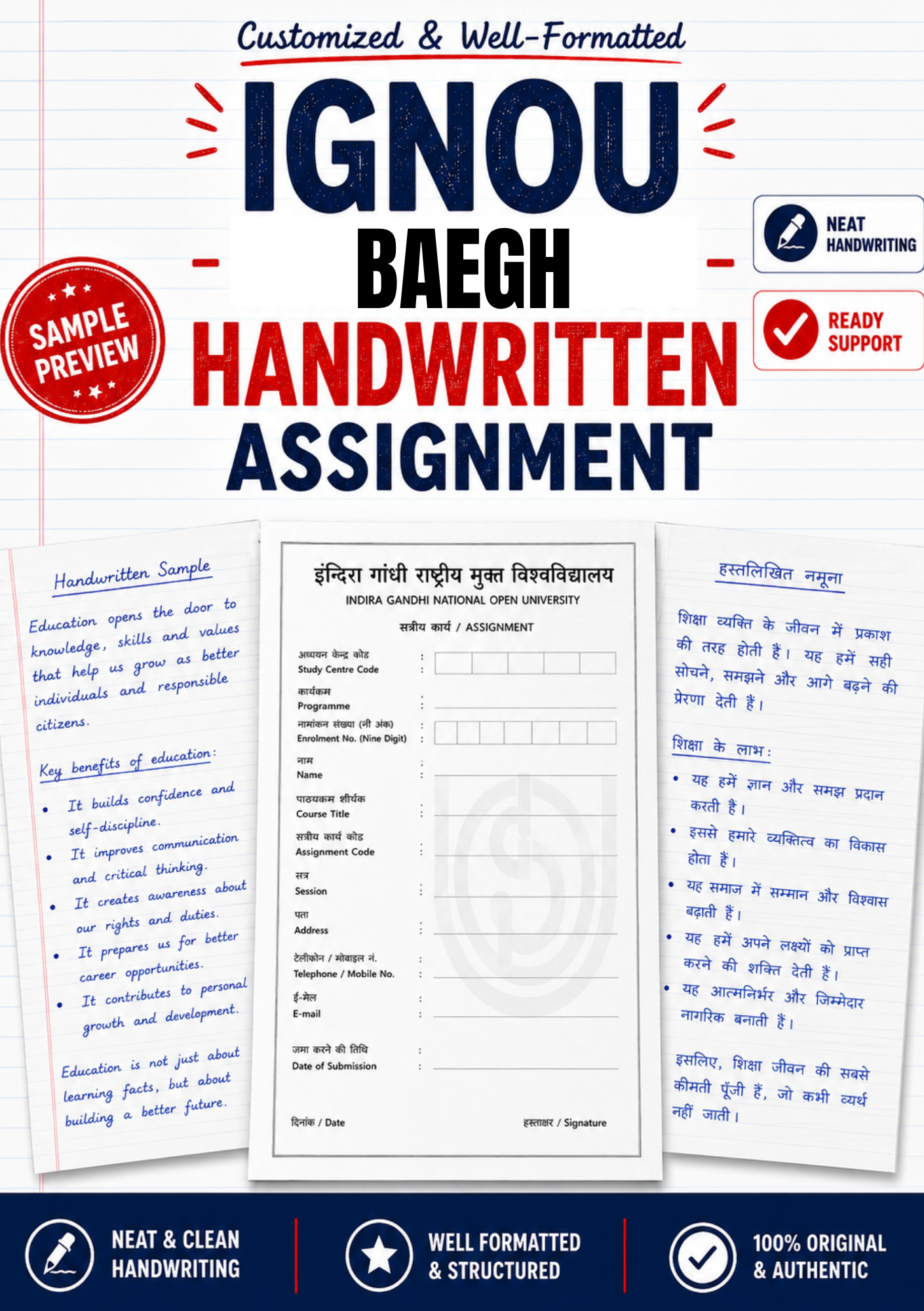
In short. BAEGH is IGNOU’s Bachelor of Arts English (Honours), a 148-credit School of Humanities degree assembled from fourteen BEGC core papers worth six credits each, four BEGE discipline electives, the two compulsory papers BEVAE 181 and BEGAE 182, one skill enhancement course in each of the third and fourth semesters, and one generic elective in each of the first four. Shri Chakradhar Publication prepares handwritten assignment sets for those codes one paper at a time, written against the question paper IGNOU has actually issued for the code and cycle you name. The rate is ₹320 per subject, hard copy only, with courier included in that price and no separate shipping charge. Each set travels with a free IGNOU-format front page and a copy of the official question paper, and the writing is matched to your own hand from a photograph you send before paying. Both BAEGH booklets read for this page print 31 March for the June term-end examination and 30 September for the December one, attach no year to either date, and print no assignment number at all, so a BAEGH paper is identified by its course code and the year span on its cover rather than by a TMA string. Any session is accepted, current cycle or older, including backlog courses, at the same ₹320 per subject.
What a BEGC Order Puts on Your Table
A BAEGH order is a physical object, not a download link, and it is worth knowing exactly what that object contains before the first sheet is written. Four things travel together in the same envelope, and they are the same four whether the order is a single BEGE elective or the entire fourteen-paper BEGC core.
The first is the answer set itself: loose sheets, written out by hand, following the numbering IGNOU printed on the paper for that code. A BEGC-111 set runs to seven answers across three sections because that is how the Women’s Writing paper is built. A BEGC-106 set runs to five across two, because Popular Literature is built differently. The sheet count follows the paper, not a template, which is why no fixed page figure is quoted anywhere on this page.
The second is the IGNOU-format front page, filled in with the programme, course code, enrolment number, study centre and session, and supplied free with every order. It is the sheet the study centre counter looks at first, and the sheet most often rejected when a learner fills in a blank template without checking it against the booklet cover.
The third is a printed copy of the official question paper the set was written against. That copy matters more on BAEGH than on most programmes, because IGNOU replaces English papers between cycles and two booklets carrying the same course code can hold entirely different questions. Having the paper in the envelope means the sheets can be checked against the questions they answer without going back to the portal.
The fourth is the courier itself. It is already inside the rate. No soft copy or PDF is sold. There is no file to download, no password to wait for and nothing to print at a cyber cafe before submission.
The ₹320 Line, Itemised for an English Honours Order
Literature assignments are long. A BAEGH learner carrying six papers in a semester is looking at several hundred handwritten sheets, and the single most common question that reaches WhatsApp is whether the headline figure holds once that volume is understood. It does, and it holds per paper rather than per page.
The rate is ₹320 per subject, hard copy only, with courier included in that price and no separate shipping charge. Inside that figure sit the writing, the paper, the IGNOU-format cover sheet, the printed question paper and the courier to your address. There is no minimum order: one subject or fourteen, same rate. A learner clearing one pending BEGE paper pays the same per-paper rate as a learner ordering a full semester.
Outside the figure sit three things, and they are named here rather than buried. The term-end examination fee is IGNOU’s, not the publisher’s. Re-registration and programme fees are IGNOU’s. And the submission itself is yours: the envelope reaches your address, and carrying it to the study centre and collecting the receipt is a step nobody else can take on your behalf.
Two further points sit outside the price in a different sense. Delivery depends on your pin code and is confirmed for your order before you pay. No figure is promised on this page. The service covers all mediums IGNOU issues the TMA paper in, at the same price. On BAEGH that is a narrower statement than it sounds, because the prospectus records the medium of instruction for this programme as English.
A Downloaded BAEGH Answer File Will Not Pass as a Submission
Two different products are sold against the same course codes, and learners who confuse them lose a cycle. The distinction is worth setting out once, in plain terms, before either is bought.
A solved assignment is a soft-copy reference file of model answers for a course code and session. It is read, studied and written from. A handwritten assignment is the answers written out by hand on paper and submitted in hard copy at the study centre. The first is study material. The second is the submission.
IGNOU’s own instruction settles which of the two the counter accepts. The BEGC-111 booklet tells the learner plainly: You should submit the assignment in your own handwriting.
Nothing in that sentence is satisfied by a printout of a model answer file, however good the answers inside it are. A downloaded PDF handed in at the counter is a printed document in somebody else’s words, submitted under a declaration you have signed in your own name.
| Question | Solved assignment (reference file) | Handwritten assignment (this product) |
|---|---|---|
| What it is | Soft-copy model answers for a BEGC or BEGE code and session | Those answers written out by hand on paper for a named code and cycle |
| What you do with it | Read it, then write your own submission from it | Check it, sign the declaration, hand it in at the study centre |
| Can it be submitted as it is | No. A printout is not handwriting | Yes. It is prepared as a submission copy |
| Who it suits | A learner with time to write and a gap in the reading | A learner short of writing hours, not of understanding |
| Rate on this store | Priced per code on the solved assignment shelves | ₹320 per subject, courier included |
Scroll the table sideways on a narrow screen.
Both have a legitimate place. A learner who intends to write the sheets personally and wants the reading condensed is better served by the BAEGH solved assignment shelf, which is priced per code and carries far more BEGC and BEGE titles than this one listing could. This page sells the written set only, and makes no claim to sell a model answer file.
Have your code list ready and the order takes one message. The rate is ₹320 per subject, hard copy only, with courier included in that price and no separate shipping charge.
Send the BEGC and BEGE numbers printed on your admission record, your session, your medium and your pin code, and the paper count and total are confirmed before any writing starts: message the codes you need written.
Fourteen BEGC Core Papers, Semester by Semester
The core is the part of BAEGH that does not vary between learners. Every BAEGH enrolment carries the same fourteen BEGC papers at six credits each, and those fourteen account for 84 of the degree’s 148 credits, which is more than half the programme in one code family. The titles below are taken from the Common Prospectus July 2026 table for this programme, not from a course-material index or a third-party list.
| Semester | Code | Official title | Credits |
|---|---|---|---|
| I | BEGC 101 | Indian Classical Literature | 6 |
| I | BEGC 102 | European Classical Literature | 6 |
| II | BEGC 103 | Indian Writing in English | 6 |
| II | BEGC 104 | British Poetry and Drama: 14th- 17th Centuries | 6 |
| III | BEGC 105 | American Literature | 6 |
| III | BEGC 106 | Popular Literature | 6 |
| III | BEGC 107 | British Poetry and Drama: 17th & 18th Centuries | 6 |
| IV | BEGC 108 | British Literature: 18th Century | 6 |
| IV | BEGC 109 | British Romantic Literature | 6 |
| IV | BEGC 110 | British Literature: 19th Century | 6 |
| V | BEGC 111 | Women’s Writing | 6 |
| V | BEGC 112 | British Literature: The Early 20th Century | 6 |
| VI | BEGC 113 | Modern European Drama | 6 |
| VI | BEGC 114 | Postcolonial Literatures | 6 |
Scroll the table sideways on a narrow screen.
Four of those fourteen are worth flagging to anyone who has been reading about IGNOU’s English degrees online. BEGC 106, BEGC 111, BEGC 113 and BEGC 114 appear in the BAEGH core table and in no major-course table for the newer four-year English programme in the same prospectus. If a page you have read says the English degree runs on ten BEGC codes, it is describing the separate BAFEG written-set listing and not this one. Read your own admission record before ordering, because the two programmes draw from one code family and part company at exactly these four papers.
Four BEGE Electives, Two Compulsory Papers and the Pooled Skill and Generic Slots
The remaining 64 credits come from four groups, and only the first is confined to English. The arithmetic is worth doing once, because it is the quickest way to tell whether a list of codes you have been handed is complete: 14 core papers at 6 credits gives 84, four discipline electives at 6 gives 24, two ability enhancement papers at 4 gives 8, two skill courses at 4 gives 8, and four generic electives at 6 gives 24. Those five figures total 148, which is the credit figure the prospectus states for BAEGH. A code list that does not reach 148 on that arithmetic is missing something.
| Group | Semester | Code | Official title | Credits |
|---|---|---|---|---|
| Discipline Specific Elective | V | BEGE 141 | Understanding Prose | 6 |
| Discipline Specific Elective | V | BEGE 143 | Understanding Poetry | 6 |
| Discipline Specific Elective | VI | BEGE 142 | Understanding Drama | 6 |
| Discipline Specific Elective | VI | BEGE 144 | Understanding The Novel | 6 |
| Ability Enhancement Compulsory | I | BEVAE 181 | Envirnoment Studies, as spelled in the BAEGH table | 4 |
| Ability Enhancement Compulsory | II | BEGAE 182 | English Communication Skills | 4 |
Scroll the table sideways on a narrow screen.
Only four BEGE codes exist in the BAEGH elective table, and all four are taken, two in the fifth semester and two in the sixth. That is unusual: on most Honours programmes the discipline elective table is a pool larger than the number of slots, so the learner chooses. On BAEGH there is nothing to choose. If somebody has told you to select your BEGE papers, the selection was made for you when you enrolled.
The skill enhancement slots are a genuine pool, one paper in the third semester and one in the fourth, and the codes run far outside English.
| Code | Official title | Credits |
|---|---|---|
| BEGS 183 | Writing and Study Skills | 4 |
| BANS 183 | Tourism Anthropology | 4 |
| BPCS 186 | Managing Stress | 4 |
| BPCS 187 | Managing Human Resources | 4 |
| BPCS 188 | Application of Social Psychology | 4 |
| BCOS 183 | Computer Application in Business | 4 |
| BCHS 183 | Laboratory Management Skills | 4 |
| BSSS 183 | Life Skills | 4 |
| BFDI 073 | Introduction to Fashion Industry | 4 |
| BSLS 183 | Elementary Spanish | 4 |
| BFLS 183 | Elementary French | 4 |
| ONR 002 | Basics of Hydrology | 4 |
Scroll the table sideways on a narrow screen.
The generic elective pool is larger again, one paper in each of the first four semesters, drawn from five disciplines plus a standalone water-harvesting course. No English code appears in it, which is consistent with the purpose of a generic elective on a single-discipline Honours degree.
| Discipline | Code | Official title | Credits |
|---|---|---|---|
| Gender and Development | BGDG 172 | Gender Sensitization: Society and Culture | 6 |
| Water Harvesting | ONR 003 | Water Harvesting, Conservation and Utilization | 6 |
| Psychology | BPCG 171 | General Psychology | 6 |
| Psychology | BPCG 172 | Youth, Gender and Identity | 6 |
| Psychology | BPCG 173 | Psychology for Health and Well-being | 6 |
| Psychology | BPCG 174 | Psychology and Media | 6 |
| Psychology | BPCG 175 | Psychology for Living | 6 |
| Psychology | BPCG 176 | Psychology of Gender | 6 |
| Public Administration | BPAG 171 | Disaster Management | 6 |
| Public Administration | BPAG 172 | Governance: Issues and Challenges | 6 |
| Public Administration | BPAG 173 | E-Governance | 6 |
| Public Administration | BPAG 174 | Sustainable Development | 6 |
| Sociology | BSOG 171 | Indian Society: Images and Realities | 6 |
| Sociology | BSOG 173 | Rethinking Development | 6 |
| Sociology | BSOG 176 | Economy and Society | 6 |
| Social Sciences | BABG 171 | Understanding Ambedkar | 6 |
| Philosophy | BPYG 171 | Applied Ethics | 6 |
| Philosophy | BPYG 172 | Philosophy of Religion | 6 |
Scroll the table sideways on a narrow screen.
Every code in all four tables is written at the same rate. A BPCG generic elective, a BFDI skill paper and a BEGC core paper are each one subject at ₹320, because the rate is set per assignment and not per discipline or per credit weight.
Nineteen Places the BAEGH Record Argues With Itself
This section exists because the alternative is to present a clean code list that quietly hides the places where IGNOU’s own documents, and this store’s own shelves, do not agree. Each item below was found by reading two sources against each other rather than by copying either one. Where the disagreement is this publisher’s, it is marked as such.
Nineteen disagreements found while sourcing this page, including three of this store’s own. Verify every code against your admission record and your Regional Centre before ordering.
1. BEGG-174 Creative Writing is listed on IGNOU’s own BAEGH programme page under Year 1, with its credit value displayed as null. It appears in no BAEGH table in the Common Prospectus July 2026, where it sits only in the shared BA Honours English generic-elective pool printed on page 232.
2. The same IGNOU programme page prints a generic elective as BPGY-172. No code beginning BPGY exists anywhere in the prospectus; the Philosophy code is BPYG 172.
3. The BAEGH elective paragraph on page 247 states that there are four discipline specific electives of six credits each, then gives the arithmetic for the same 24 credits as six courses of four credits. The elective table carries four codes at six credits.
4. BEVAE 181 is printed in the BAEGH table as Envirnoment Studies. That spelling occurs once in the whole prospectus, on this programme’s page. Every other table that carries the code prints Environmental Studies.
5. BEGC 112 is titled British Literature: The Early 20th Century on the BAEGH page and British Literature: Early 20th Century on page 167 of the same document.
6. The BAEGH semester template offers BEGS 185 and BEGS 186 as skill enhancement options. The BAEGH skill enhancement table lists neither, so a learner who picks one off the template cannot find its title on the same programme’s pages.
7. The same template offers nine further skill codes, among them BPCS 183, BPCS 184, BPCS 185, BHDS 183, BHDS 184, BSOS 184, BECS 184, BPAS 184 and BANS 184, none of which appears in the BAEGH skill enhancement table.
8. The template prints ONR 03 in the first-semester generic elective column. The generic elective table prints ONR 003.
9. BPCG 175 and BSOG 176 appear in the BAEGH generic elective table but in no semester row of the BAEGH template, so the pool and the timetable do not match.
10. The shared BA Honours pool on page 232 offers Hindi and Sanskrit generic electives to Honours learners. The BAEGH generic elective list two pages later offers neither.
11. Of the two BAEGH booklets read for this page, BEGC-106 for the July 2026 session specifies A4, while BEGC-111 for July 2025 and January 2026 requires foolscap size paper and nothing else.
12. Neither booklet prints a TMA assignment code. On BEGC-111 the assignment number field is printed and left blank, which is why no assignment-code format is asserted anywhere on this page.
13. BEGC-106 labels itself with the year span 2026-26. BEGC-111 labels itself 2025-26. The first span does not describe a session.
14. BEGC-106 is scoped to the July 2026 session alone. BEGC-111 covers the July 2025 and January 2026 sessions together, so two papers of the same programme define their validity differently.
15. BEGC-106 prints five questions in two sections. BEGC-111 prints seven in three. There is no single BAEGH question pattern to describe.
16. BEGC-106 prints the mark split for its second section as sixteen marks across five questions, totalling eighty, above four printed questions.
17. This store’s own shelves carry BEGE 145 Soft Skills products tagged to BAEGH. BEGE 145 appears in no BAEGH table, and its live assignment booklet is served from IGNOU’s School of Social Sciences folder under a BAG filename. The tagging is being corrected.
18. This store’s own shelves tag BEGM 162 and BEGM 163 guess papers as BAEGH. Both codes belong to the four-year BA English programme’s minor list in the prospectus, not to BAEGH. The tagging is being corrected.
19. This store’s handwritten assignment category page states A4 as the paper size. One of the two BAEGH booklets requires foolscap, so the category wording is wrong for at least some BEGC papers and is being corrected.
One further observation sits outside the numbered list because it is a naming inconsistency rather than a contradiction of fact. The same degree is called Bachelor of Arts English (Honours)(BAEGH) in the prospectus contents, Bachelor of Arts English (Honours) in the programme fee table, Bachelor of Arts English (Honours)(ODL) on IGNOU’s own BAEGH programme page, Bachelor of Arts (English) Honours (BAEGH) on the BEGC-111 cover, and BA English (Hons) on the BEGC-106 cover. Use whichever form your admission record uses when you fill in the front page.
Why Your BEGC Paper Dates Itself to the Examination and Not the Session
Most IGNOU programmes print two submission dates keyed to the admission session. BAEGH does something different, and copying another programme’s calendar is the single most expensive mistake a learner can make here.
Both booklets read for this page print the same pair, and both key it to the examination rather than to the session. The last date for the June term-end examination is 31 March. The last date for the December term-end examination is 30 September. Neither date carries a year on either cover. The practical reading is that the deadline follows the examination you intend to sit, so a learner admitted in July 2026 who plans to appear in June 2027 is working to 31 March, not to a date derived from the July admission.
That pair is not the national default. A management learner on the same campus works to 31 October and 30 April, and a sociology learner may be told April and October. Those are real dates for those programmes and wrong for this one. Aggregator pages that publish a single IGNOU assignment deadline are flattening a calendar that genuinely differs by school.
Two consequences follow for ordering. The first is that the papers expire: IGNOU withdraws a BEGC booklet and issues a replacement each cycle, so the questions behind a set written in 2025 are not the questions behind a set written in 2026. The second is that the paper, not the date, determines what is written. Naming the cycle when you order is how the correct question paper is pulled, and it is why a copy of that paper travels in the envelope.
What BEGC-106/2026-26 Means When No Assignment Number Is Printed
Learners arriving from other programmes expect a string of the form code, slash, TMA, slash, session, slash, year, and they expect to copy it onto the front page. On BAEGH that string does not exist on the papers read for this page, and inventing one is worse than leaving the box empty.
What the BEGC covers actually carry is a course-code label with a year span attached: BEGC-111/2025-26 on one, BEGC-106/2026-26 on the other. The second of those is a printing defect rather than a session, since a span cannot open and close in the same year, and it is reproduced here only because it is what the cover says. The assignment-number field on BEGC-111 is printed and left blank.
Read the label in three parts. The first part is the course code and is the only part that must match your admission record. The second part is the year span, and it tells you which cycle the questions belong to. There is no third part on these papers, which is the whole point: a BAEGH front page is completed from the course code, the programme title, your enrolment number, your study centre code and the session you are submitting for, and the assignment-number box is filled in only if your own booklet prints a number.
If your booklet does print a number, follow your booklet. Papers are reissued every cycle and IGNOU’s templates change between schools and between years. The instruction that holds in every case is that the front page should reproduce what is on the cover of the paper you actually downloaded, which you can pull yourself from IGNOU’s assignment download service.
One Photographed Page Sets the Hand for the Whole Set
The declaration on the front page is signed in your name, and the sheets behind it are expected to look like yours. That is the reason the matching step comes before payment rather than after delivery.
Send a photo of a page you have written yourself and the handwritten set is matched to your handwriting at no extra charge. The writer works from that page: letter shapes, slant, spacing, how the loops close, how the margin is kept. On a literature programme the match matters more than on a numerical one, because a BAEGH submission is almost entirely continuous prose and there are no tables or diagrams to break the page up and hide a mismatch.
A sample page that actually works
A usable sample is a full page, not three lines. It should be written on ruled paper in the pen you normally use, photographed flat in daylight with the whole page in frame and no shadow across the writing, and it should be ordinary everyday writing rather than a careful display hand, because the set is going to run to dozens of pages and nobody sustains a display hand that long. If the sample is not usable, you are told before anything is written, not after the envelope has been sealed.
English Medium, Older Cycles and Papers You Still Owe
Three coverage questions come up often enough on BAEGH to answer together.
On medium, the prospectus records the medium of instruction for BAEGH as English, and the two booklets read for this page are English papers that ask for answers in simple and correct English. The service covers all mediums IGNOU issues the TMA paper in, at the same price. For this programme that generally means the English paper. A learner holding a BAEGH booklet issued in another medium should send it, because the set is written against the paper supplied and not against an assumption about the programme.
On session, any session is accepted, current cycle or older, including backlog courses, at the same ₹320 per subject. A BEGC 109 paper left pending from an earlier cycle is written against the question paper of that cycle, not retrofitted to the current one, which is why the cycle is asked for at order time.
On re-registration gaps, BAEGH runs over a minimum of three years and a maximum of six, and a learner who has stopped and restarted will be carrying codes from two or three different question-paper generations at once. That is an ordinary order, not a complicated one. Each code is priced the same, and the sets are written against whichever paper belongs to each code’s cycle.
Five Lines in a WhatsApp Message Start a BAEGH Order
Nothing beyond these five is needed, and sending more slows the confirmation rather than speeding it.
- The codes. BEGC, BEGE, BEVAE, BEGAE, skill and generic elective numbers exactly as they appear on your admission record.
- The cycle. The session you are submitting for, and the term-end examination you intend to sit, because that is what the deadline follows.
- The medium. The language your booklet is printed in.
- The sample. One photographed page in your own handwriting.
- The address. A delivery address with its pin code, so the courier position can be confirmed for your order.
Enrolment number and study centre code are needed only for the front page, and are asked for separately once the order is confirmed.
A single photograph decides the handwriting before anything is paid. The rate is ₹320 per subject, hard copy only, with courier included in that price and no separate shipping charge. There is no minimum order: one subject or fourteen, same rate.
Send the paper list and that one page together and the match is confirmed first: share your paper list and one sample page.
What Happens Between the Courier and Your Grade Card
Delivery is the middle of the process, not the end, and the steps after it are yours.
Open the envelope and check three things against each other: that every code you ordered is present, that the front page carries your enrolment number and study centre correctly, and that the answers follow the question paper in the envelope. You sign the declaration on the assignment cover page, so you should read and review the content before submitting it, and satisfy yourself that it represents your own understanding of the course.
Submit at your study centre and take the receipt. The receipt is the only proof that the set was handed in, and it is the document that settles a dispute if the submission does not appear against your enrolment later. Keep a photograph of it.
After that the timeline belongs to IGNOU. Evaluation happens at the study centre, and the marks reach the grade card in the university’s own time. Assignments carry 30 per cent of the final course result and the term-end examination carries the remaining 70 per cent. No claim is made about the marks any assignment will receive, about how an evaluator will assess it, or about whether it will be accepted. Assignment evaluation is entirely a matter for IGNOU.
Where an English Honours Order Usually Goes Next
A written set clears the submission requirement. It does not prepare you for the examination that carries the larger share, and most BAEGH learners who order one are back for something else within the same cycle.
For the reading itself, the BAEGH help book list runs chapter-wise through the core texts, and a learner starting the degree often picks up a first-year combo covering BEGC 101 to BEGC 104 rather than four separate titles. Fifth-semester learners tend to look for the Women’s Writing guidebook for BEGC 111, which is the paper with the heaviest reading list in the core.
Closer to the examination, solved guess papers for BA Honours English and previous year question papers for these same BEGC codes are the two shelves that get opened most, because literature papers repeat their question shapes even when the texts set for discussion change. One caution applies to one of them: the BEGE 145 Soft Skills guess paper still filed under this programme belongs to the general BA degree rather than to BAEGH, as item 17 above records.
Learners on other programmes who have arrived here by mistake will find their own listing on the handwritten assignment shelf that covers every programme. And a learner who would rather write the sheets personally and only wants the method is better served by a step by step guide to writing an IGNOU assignment yourself, which costs nothing.
Doubts an English Honours Learner Raises First
Is a BAEGH assignment due on 31 March or on 30 September?
Both, depending on which term-end examination you are sitting. The two BAEGH booklets read for this page print 31 March as the last date for the June examination and 30 September as the last date for the December examination, with no year attached to either. The date follows the examination rather than your admission session, which is why a July-admitted learner aiming at the June paper works to 31 March.
My BEGC booklet prints no assignment number. What goes in that box on the front page?
Leave it as your booklet leaves it. Neither of the two BAEGH papers read for this page prints a TMA assignment code, and on BEGC-111 the field is printed and blank. The front page is completed from the course code, the programme title, your enrolment number, your study centre code and the session. Inventing a TMA string that your own paper does not carry creates a mismatch at the counter.
Two BEGC booklets name different paper sizes. Which one should the set follow?
Follow the booklet for the code you are submitting. BEGC-106 for the July 2026 session specifies A4 and BEGC-111 for July 2025 and January 2026 requires foolscap, so there is no single answer for the programme. Send the booklet or name the code and cycle when ordering, and the set is written on the size that paper asks for.
Is BEGE 145 Soft Skills a BAEGH paper?
Not according to the prospectus. The BAEGH discipline elective table carries four codes only, BEGE 141, BEGE 142, BEGE 143 and BEGE 144. BEGE 145 is live on ignou.ac.in, but its current assignment booklet is served from the School of Social Sciences folder under a general BA filename. If BEGE 145 is on your admission record, it is reaching you through a different programme, and the set can still be written at the same rate.
I am enrolled in BAEGH, not BAFEG. Does that change which BEGC papers I order?
Yes, at four papers. The BAEGH core carries all fourteen BEGC codes from 101 to 114. The four-year English programme’s major table in the same prospectus carries ten, leaving out BEGC 106, BEGC 111, BEGC 113 and BEGC 114. If you are on BAEGH, those four are yours and nobody else’s list will show them.
Handwritten set aur solved assignment PDF, dono mein se study centre kaunsa accept karta hai?
Study centre sirf handwritten hard copy leta hai. Solved assignment ek soft-copy reference file hai, jisse aap apna answer likhte ho. BEGC-111 booklet khud kehti hai ki assignment aapki apni handwriting mein submit hona chahiye, to printed model answer file counter par submission ke taur par kaam nahi karegi. Dono cheezein alag hain, aur yeh page sirf likha hua hard copy set bechta hai.
Can a printed BEGC answer set be handed in at the study centre?
The booklet instruction on BEGC-111 asks for the assignment in the learner’s own handwriting, and the BEGC-106 cover repeats the handwriting requirement. A printed answer set does not meet that instruction. Whether a particular counter accepts a printed submission is not something this page can promise either way, and the declaration you sign is written in the first person.
My BEGC-106 cover reads 2026-26. Is that a valid session?
No session opens and closes in the same year, so that span is a printing defect on the cover rather than a cycle you need to match. The cover also states that the paper is for the July 2026 session, and that is the usable statement. Order by course code and the session you are submitting for, and the correct paper is pulled.
Is BEGM 162 part of my BAEGH course list?
No. BEGM 161, BEGM 162 and BEGM 163 are four-credit minor courses in the four-year BA English programme’s table, and no BEGM code appears in any BAEGH table in the prospectus. Some BEGM products on this store are currently tagged to BAEGH and that tagging is being corrected, as item 18 above records.
Does a BAEGH set cost more because literature answers run long?
No. The rate is set per assignment, not per page or per word, so a six-credit BEGC essay paper and a four-credit skill course paper are both one subject at the same rate. The length difference is absorbed in the writing, which is the part of the work being bought.
BEGC 109 is still pending from a cycle I dropped. Is that paper still written?
Yes, at the same rate as a current paper, and written against the question paper IGNOU issued for that cycle rather than against the current one. Name the code and the cycle when you order, and that older paper is the one the set answers.
Can one BEGE elective be ordered on its own before I decide about the second?
Yes, and on BAEGH there is in fact nothing to decide. The elective table carries exactly four codes for four slots, two in the fifth semester and two in the sixth, so all four are eventually yours. Ordering one at a time is normal, and the per-paper rate does not change with the number ordered.
Is BAEGH taught in Hindi, and would that change the rate?
The prospectus records the medium of instruction for BAEGH as English, and both booklets read for this page are English papers. The rate would not change in any case, because all mediums IGNOU issues the paper in are covered at the same price. If you are holding a BAEGH paper in another medium, send the booklet rather than the code alone.
BEGG-174 shows on IGNOU’s BAEGH page. Should it be ordered?
Check your admission record before you do. BEGG-174 Creative Writing appears on IGNOU’s own BAEGH programme page under Year 1, with its credit value shown as null, and it appears in no BAEGH table in the prospectus, which lists it only in the shared BA Honours English generic-elective pool. If your record carries it, the set can be written. If it does not, the code is not yours and the listing is the one in error.
Does this page say anything about what a BAEGH set will score?
No, and that is deliberate. No claim is made about the marks any assignment will receive, about how an evaluator will assess it, or about whether it will be accepted. Assignment evaluation is entirely a matter for IGNOU. What is promised is a written set prepared against the question paper for your code and cycle, in handwriting matched to a sample you supplied.
Which Document Supplied Which Line Above
Important Notice
Shri Chakradhar Publication Pvt. Ltd. and shrichakradhar.com form an independent IGNOU study-support publisher. This is not the official website of Indira Gandhi National Open University, is not affiliated with, endorsed by or authorised by the university, and no page on this site should be treated as an official IGNOU communication.
Programme structures, course codes, submission dates and rules change, and only ignou.ac.in and your Regional Centre can confirm the current position for your enrolment.
You sign the declaration on the assignment cover page, so you should read and review the content before submitting it, and satisfy yourself that it represents your own understanding of the course.
No claim is made about the marks any assignment will receive, about how an evaluator will assess it, or about whether it will be accepted. Assignment evaluation is entirely a matter for IGNOU.
Name Your Papers and the Writing Begins
The rate is ₹320 per subject, hard copy only, with courier included in that price and no separate shipping charge. There is no minimum order: one subject or fourteen, same rate. Any session is accepted, current cycle or older, including backlog courses, at the same ₹320 per subject.
If you already know your list, open WhatsApp with your BAEGH numbers and the count, medium and cycle are confirmed in one exchange.
If you are clearing a single pending paper, ask what a single BEGE paper involves instead. Delivery depends on your pin code and is confirmed for your order before you pay. No figure is promised on this page.