

Description
In short. Shri Chakradhar Publication prepares handwritten assignment sets for IGNOU BAECH, the Bachelor of Arts (Honours) Economics degree run by the School of Social Sciences across 148 credits and six semesters, built from fourteen BECC core papers, four BECE discipline specific electives, two ability enhancement papers, two skill enhancement papers and four generic electives. The rate is ₹320 per subject, hard copy only, with courier included in that price and no separate shipping charge. Each set is written in a hand matched to a sample photograph the learner sends first, arrives with an IGNOU-format front page and a copy of the question paper it was written against, and is prepared for the codes and admission cycle the learner names, because the live BECC paper prints one cut-off for the July cycle and a different one for the January cycle.
Inside the Parcel That Reaches Your Door
A BAECH order is a physical object, not an account login. What leaves the press is a stack of written answer sheets for the codes you listed, held together course by course, with the cover sheet that IGNOU expects clipped to the front of each one. Nothing is emailed, nothing is uploaded to a dashboard, and nothing is waiting behind a password.
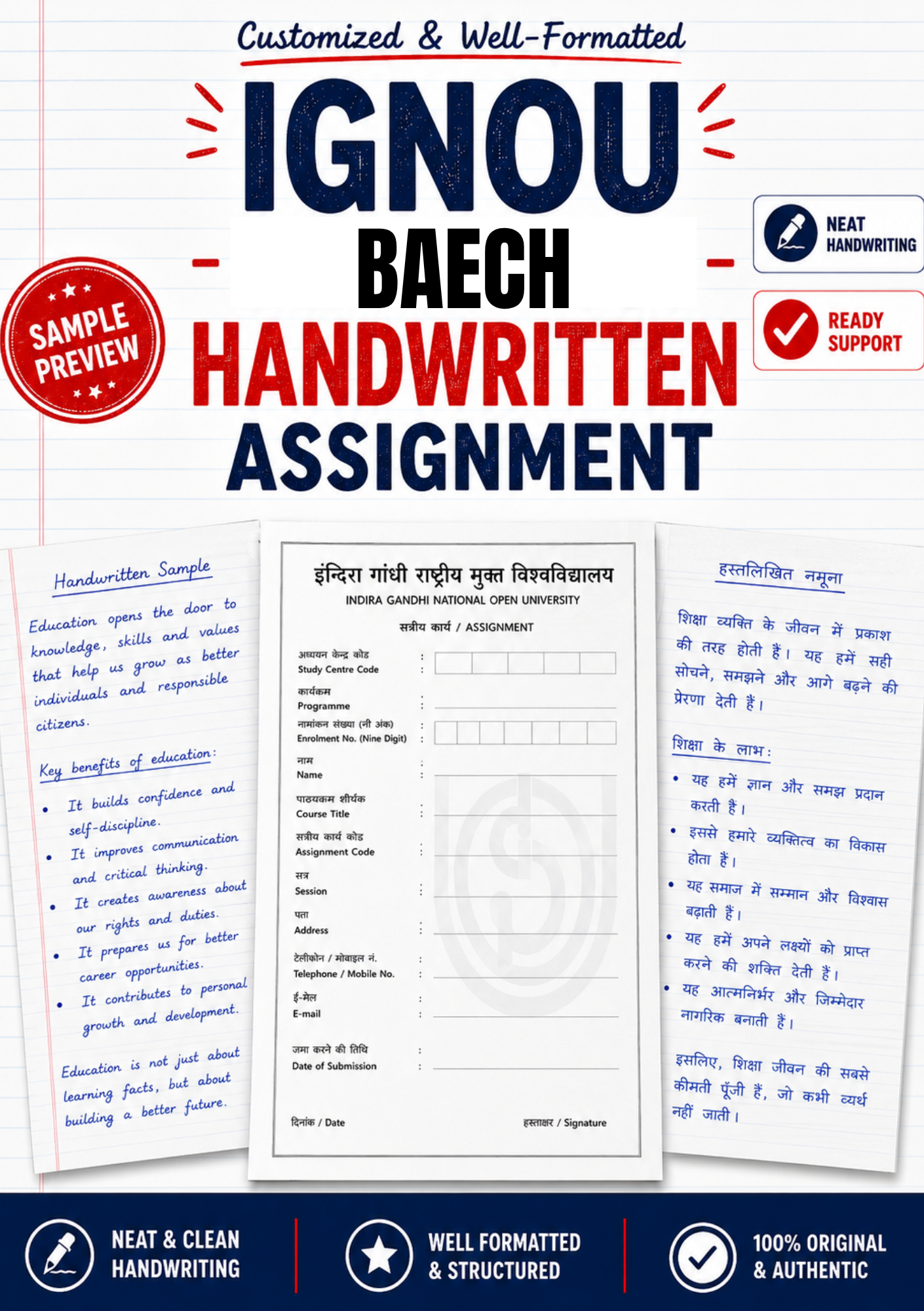
Four things sit inside every BAECH parcel. The first is the answer set itself, written out by hand against the question paper for the session you named. The second is an IGNOU-format front page for each course, carrying the fields the study centre looks at first: enrolment number, programme code, course code, assignment code, study centre and date. The third is a printed copy of the official BECC or BECE question paper your answers were written against, so the person receiving it at the counter can match answers to questions without opening a browser. The fourth is the packaging, because the rate is ₹320 per subject, hard copy only, with courier included in that price and no separate shipping charge.
The front page matters more on an economics paper than learners expect. A BECC answer set runs long: the live BECC-101 booklet for 2025-26 asks for two descriptive answers of roughly five hundred words apiece, three middle-category answers of roughly two hundred and fifty words, and five short answers of roughly a hundred words, with the word limits lifted for the numerical and application parts. That is a thick bundle of sheets per course, and the cover page is the only thing that tells a study centre which of fourteen possible BECC courses it belongs to.
What ₹320 a Subject Buys, and What It Leaves to You
The ₹320 is a per-subject rate, not a per-semester or per-year bundle. A learner in the fifth semester who wants only BECE 141 and BECE 143 pays for two subjects. A learner catching up on an entire year pays for however many courses that year contains. There is no minimum order: one subject or fourteen, same rate.
Inside the rate sit the writing, the handwriting match, the front page, the question paper copy and the courier. Outside it sit three things worth naming plainly. IGNOU’s own programme fee is separate and is paid to the university, not here: the Common Prospectus July 2026 prints BAECH at Rs 5,500 per year and Rs 16,500 in total, and that figure has nothing to do with this order. The submission itself is also outside the rate, because the completed set is handed in by you at your study centre and the receipt is issued in your name. And the academic judgement stays where it belongs: no claim is made about the marks any assignment will receive, about how an evaluator will assess it, or about whether it will be accepted. Assignment evaluation is entirely a matter for IGNOU.
Delivery depends on your pin code and is confirmed for your order before you pay. No figure is promised on this page.
Reference File or Submission Copy: Reading the Difference Before You Order
Two very different things get called an assignment in BAECH searches, and buying the wrong one wastes a cycle. A solved assignment is a soft-copy reference file of model answers for one course code and one session, read on a phone or a laptop and used as study material while you write. A handwritten assignment is the answers written out by hand on paper and submitted as a hard copy at your study centre. The first is something you read. The second is something you hand in.
| Point of difference | Solved assignment | Handwritten assignment |
|---|---|---|
| Format | Soft copy file, read on a screen | Written sheets, delivered as a parcel |
| What you do with it | Read it, then write your own answers from it | Check it, sign the declaration and hand it in |
| Who it suits | Learners who have the time to write but want the economics worked out first | Learners short of writing time across several BECC and BECE codes at once |
| Rate here | Priced on its own category shelf | ₹320 per subject, courier included |
Scroll the table sideways on a narrow screen.
IGNOU’s own instruction on the live BECC-101 booklet settles the submission question. The booklet directs the learner to give the assignments to the Coordinator of the study centre within the stipulated time and to obtain a receipt, after which the study centre returns the evaluated work and sends the marks to the Student Evaluation Division in New Delhi. A file on a screen cannot be given to a Coordinator and cannot generate a receipt, which is why a downloaded reference file is never a submission in itself, however complete its answers are.
That makes the choice straightforward rather than competitive. If you want to write the papers yourself and need the microeconomics, the macroeconomics and the econometrics worked through first, the reference files on the BAECH soft-copy answer shelf are the correct purchase and this page is not. If the writing itself is the obstacle, this page is. No soft copy or PDF is sold. The two therefore never overlap inside a single order.
Name your codes, not your semester. BAECH learners rarely sit on a clean semester block once a backlog or a re-registration gap enters the picture, so the order is built from the course codes on your record rather than from a semester label.
₹320 per subject, hard copy, courier included. There is no minimum order: one subject or fourteen, same rate.
The Fourteen BECC Papers That Carry 84 of Your 148 Credits
BAECH is unusually front-loaded with compulsory economics. Fourteen core courses at six credits each account for 84 of the 148 credits, which is more than half the degree sitting in a single code family. The Common Prospectus July 2026 places them two to a semester in the first two semesters and three to a semester in the third and fourth, then two a semester again in the fifth and sixth. Every title below is printed in the prospectus.
| Code | Official title | Credits | Semester |
|---|---|---|---|
| BECC-101 | Introductory Microeconomics | 6 | I |
| BECC-102 | Mathematical Methods for Economics I | 6 | I |
| BECC-103 | Introductory Macroeconomics | 6 | II |
| BECC-104 | Mathematical Methods for Economics II | 6 | II |
| BECC-105 | Intermediate Microeconomics I | 6 | III |
| BECC-106 | Intermediate Macroeconomics I | 6 | III |
| BECC-107 | Statistical Methods for Economics | 6 | III |
| BECC-108 | Intermediate Microeconomics II | 6 | IV |
| BECC-109 | Intermediate Macroeconomics II | 6 | IV |
| BECC-110 | Introductory Econometrics | 6 | IV |
| BECC-111 | Indian Economy I | 6 | V |
| BECC-112 | Development Economics I | 6 | V |
| BECC-113 | Indian Economy II | 6 | VI |
| BECC-114 | Development Economics II | 6 | VI |
Scroll the table sideways on a narrow screen.
One detail in that table repays a second look. The prospectus prints the fourth-semester row as BECC 108, BECC 110, BECC 109, in that order rather than in numerical order, which is harmless on paper and confusing on an order message. The three codes are the ones listed, whatever sequence they appear in.
The paired structure is worth using when you decide what to order. Microeconomics runs 101, 105, 108; macroeconomics runs 103, 106, 109; the quantitative line runs 102, 104, 107, 110; and the applied line runs 111 and 113 on the Indian economy against 112 and 114 on development. A learner who has cleared the microeconomics line and carries the quantitative one is a common pattern here, and the order is built from exactly those codes rather than from a semester.
BECE Electives and the Four Add-On Categories Around Them
The remaining 64 credits come from four categories that behave very differently from one another, and only one of them involves real choice for an economics learner.
| Category | Codes in the BAECH structure | Credits each | Total |
|---|---|---|---|
| Discipline Specific Elective (DSE) | BECE 141 Economics of Health and Education and BECE 143 Environmental Economics in semester V; BECE 142 Applied Econometrics and BECE 144 Financial Economics in semester VI | 6 | 24 |
| Ability Enhancement Compulsory Course (AECC) | BEVAE 181 Environmental Studies in semester I; BEGAE 182 English Communication Skills or BHDAE 182 Hindi Bhasha aur Sampreshan in semester II | 4 | 8 |
| Skill Enhancement Course (SEC) | One from the common pool in semester III and one in semester IV, for example BECS 184 Data Analysis, BPAS 184 Logistics Management, BEGS 186 Business Communication or ONR 002 Basics of Hydrology | 4 | 8 |
| Generic Elective (GE) | One in each of semesters I to IV, for example BPAG 171 Disaster Management, BSOG 173 Rethinking Development, BEGG 173 Academic Writing and Composition or ONR 003 Water Harvesting, Conservation and Utilization | 6 | 24 |
Scroll the table sideways on a narrow screen.
The word elective is doing very little work in the first row. The prospectus lists exactly four discipline specific electives in economics, and the BAECH structure places all four of them, two in the fifth semester and two in the sixth. A BAECH learner therefore writes BECE 141, 142, 143 and 144, in the ordinary case, with no selection to make. That is unlike several sibling honours programmes, where the sixth-semester elective slot can be filled by a dissertation instead: the prospectus notes that some honours programmes carry a dissertation as one of the discipline specific electives, and psychology’s BPCE 144 is exactly that. BAECH has no such option, which is why there is no project code anywhere in this product and no project report to commission alongside it.
The generic and skill pools are the opposite case. They are shared across the whole BA honours family, they change as the university adds courses, and two learners in the same BAECH batch can hold completely different sets. The Hindi and Sanskrit titles in those pools are printed in Devanagari in the prospectus; BHDS 183 is the translation theory and technique paper, BHDS 184 the radio writing paper, and BHDG 173 the newspaper and feature writing paper, with BSKG 171, 172 and 173 running through Indian aesthetics, the foundations of Indian philosophy and basic Sanskrit. Those papers are written in the medium of the course, not in English translation.
Where IGNOU’s Own BAECH Records Pull in Different Directions
The checks behind this page were run against three sources at once: the Common Prospectus July 2026, the live BAECH programme page on ignou.ac.in, and the assignment booklets served from ignou.ac.in itself. They do not entirely agree, and the gaps are listed here rather than smoothed over, because a learner who meets one of them at the study centre counter is better off having read it first.
Eight disagreements between IGNOU’s own records, found while checking the BAECH codes and dates in October 2026, followed by two of this publisher’s own.
1. The live BAECH page on ignou.ac.in lists BECV-120 among the programme’s courses. That code appears nowhere in the Common Prospectus July 2026, in any programme table, in any category list.
2. The same live page lists BECM-163. The prospectus does carry BECM-163 Introductory Statistics at four credits, but as a minor course for the newer four-year BA programmes, not inside the 148-credit BAECH structure.
3. The live page shows BECS-184 twice, once under semester 4 and once under semester 1. The prospectus places it only in the semester IV skill enhancement pool.
4. The programme name is spelled differently in different IGNOU documents. The prospectus and the programme page both print Bachelor of Arts (Honours) Economics. The cover of the live BECC-101 booklet prints Bachelor’s of Arts (Economics Honours) Programme.
5. BEVAE 181 sits in BAECH semester I in the prospectus, but the live BEVAE-181 booklet is issued by the School of Sciences and its cover names BSCG, BAG and BCOMG as the programmes it applies to. BAECH is not on that cover.
6. Two assignment code formats run side by side in one learner’s own set. The BECC-101 booklet prints BECC-101/2025-26. The BEVAE-181 booklet prints BEVAE-181/TMA/2026, with a TMA token the BECC paper does not use and a single calendar year in place of a session span.
7. Those two papers are also governed by two different deadline systems. The BECC-101 booklet prints 31 March 2026 for the July 2025 admission cycle and 30 September 2026 for the January 2026 cycle. The BEVAE-181 booklet prints no submission deadline at all, only a validity window from 1 January 2026 to 31 December 2026 and a note that a fresh assignment is needed for 2027 after it lapses.
8. The same BECC-101 paper for the same session is served from two different directories on ignou.ac.in. One sits under the School of Social Sciences path and carries the full cover page. The other sits under the School of Vocational Education and Training path under a misspelled file name and reaches the reader without a cover page, so it names neither the programme nor the school.
Two further points belong here because they are this publisher’s own, not IGNOU’s. The BEVAE-181 booklet asks for foolscap writing paper with a four centimetre margin, which contradicts the A4 instruction still live on this store’s handwritten assignment category page; the category page is being corrected. And the internal rulebook that governs these product pages had the School of Social Sciences deadline direction reversed until this build read it off the booklet; the booklet is the authority and the rulebook has been corrected to match.
None of that is a reason to panic about an enrolment. It is a reason to read your own codes off your admission record and your own dates off the paper you were issued, and to send both when you order, rather than relying on a list copied from any website, this one included.
The Two Dates Your BECC Paper Prints, and the Paper That Prints None
School of Social Sciences deadlines run in the opposite direction to the School of Management Studies pattern that circulates most widely, and carrying the wrong one across is the most common date error in IGNOU assignment advice. The live BECC-101 booklet for 2025-26 is explicit: the set is due by 31 March 2026 from learners admitted in the July 2025 academic cycle, and by 30 September 2026 from learners admitted in the January 2026 cycle. The cycle you were admitted in, not the calendar year you are writing in, selects the date.
The BEVAE 181 paper in the same learner’s first semester works on a different clock entirely. It prints no submission date, only a validity period running from 1 January 2026 to 31 December 2026, together with the instruction that a failed or unsubmitted assignment needs a fresh paper for the following year. It also sets a pass mark of 35 per cent on the assignment itself, which the BECC booklet does not print.
Two consequences follow for ordering. First, a BAECH learner can be simultaneously inside the window for one paper and outside it for another, so the codes and the cycle have to travel together in the order message. Second, papers expire. Each cycle IGNOU replaces the question paper, and answers written against last year’s BECC paper are answers to questions nobody is now asking. Any session is accepted, current cycle or older, including backlog courses, at the same ₹320 per subject, but the paper used is the one that matches the session you are submitting for, which is why the session is asked before anything is written.
Assignments carry 30 per cent of the final course result and the term-end examination carries the remaining 70 per cent. On a fourteen-course core that is a large standing balance to leave unclaimed, and it is claimed by submitting on time rather than by writing brilliantly late.
Decoding BECC-101/2025-26 Before the Parcel Is Packed
The string printed on the booklet is not decoration. It is the identifier the study centre uses to decide whether what you handed in belongs to the cycle it is evaluating, and it is worth reading before you order rather than after the parcel arrives.
In BECC-101/2025-26 the first segment is the course code, which must match the code on your admission record exactly. The second segment is the session span, and in the School of Social Sciences economics papers it is written as a two-year span covering both admission cycles that share the paper. The BECC booklet for 2025-26 says so in as many words on its cover, naming the July 2025 and January 2026 admission cycles together.
The BEVAE-181/TMA/2026 string on the first-semester environmental studies paper is built differently: course code, then the TMA token, then one calendar year. A learner reading the two side by side is not looking at a mistake in either. They are looking at two schools inside one university formatting their papers their own way, which is exactly why no date or code format on this page is carried across from another programme.
When an order message arrives with a code and a session that do not line up against the live paper, the mismatch is raised before writing starts. That check costs a message and saves a cycle.
Your Own Hand, Copied From a Photograph You Send
An assignment set that does not look like the learner who signed it is a problem at the counter, not an aesthetic preference. Send a photo of a page you have written yourself and the handwritten set is matched to your handwriting at no extra charge.
The match is shown to you before payment. What comes back is a short sample written in the matched hand, usually a few lines of economics prose with a worked numerical line, so you can see how the style holds up on both kinds of content a BECC answer contains. Approve it and the full set goes ahead. Decline it and nothing has been spent.
Photographing the Sample Page So the Match Holds
A usable sample is ordinary, not careful. Write half a page at the speed you normally write, on ruled paper, in the pen you actually use, and photograph it flat in daylight with the whole page in frame and no shadow across the writing. A page written slowly in a borrowed pen produces a match to a hand you do not have, which defeats the exercise. If your BAECH set spans English papers and a Hindi medium paper, send a short sample of each script, since the two are matched separately.
English, Hindi, Old Cycles and Dropped Papers
BAECH is offered in English and Hindi, as the Common Prospectus July 2026 and the live programme page both record, and the question papers are issued accordingly. The service covers all mediums IGNOU issues the TMA paper in, at the same price. A learner writing BECC-107 in Hindi and a generic elective in English is an ordinary order, not a special case, and no medium carries a surcharge.
Backlogs are equally ordinary here, and in a six-semester honours degree with a six-year outer limit they are common. A learner who stopped after the third semester and returned two years later holds a mixed set: some codes still current, some replaced, some with a paper that has since changed. Any session is accepted, current cycle or older, including backlog courses, at the same ₹320 per subject. What is needed is the code, the session you are submitting for and the medium, and the current paper for that combination is checked before writing.
There is one pairing worth getting right before you order, because it is the single most common wrong-code error in economics assignments. BAECH is not the only economics degree the School of Social Sciences runs. The newer four-year BA (Economics) programme, coded BAFEC, shares BECC-101, BECC-103, BECC-107 and BECC-110 with BAECH and shares BECE-141 and BECE-144 as well, but then diverges into BECC-115, BECC-116, BECC-117 and BECC-118, codes that do not exist in the BAECH structure at all. The prospectus does not make this easy: it calls that programme Bachelor of Arts (Economics) in its course table and Bachelor of Arts (Economics) (Major or FYUP Hons.) in its fee table, so the word honours attaches to both degrees in different places. If your record carries a BECC code in the 115 to 118 range you are on the four-year programme, and the BAFEC study material shelf is the one that matches your syllabus. A third economics code family, the BECC-131 series, belongs to the general BA programme and is served from the BAG economics answer shelf instead, with its guides kept on a separate BAG economics study guide shelf.
Five Lines of Information, Then Nothing Further
Ordering is deliberately short. Five items settle an entire BAECH order, and none of them is a password, a bank detail or a document upload.
- The course codes. Read them off your admission record or your re-registration confirmation, not off a semester chart. BECC-109 and BECC-110 sit in the same semester and are commonly transposed.
- The admission cycle. July or January, and the year. This is what selects the cut-off date on your BECC paper, and it is the item most often left out.
- The session you are submitting for. Current or older. A learner clearing a backlog may be submitting against a session two years behind the one they are studying in.
- The medium. English or Hindi, per course if they differ.
- The handwriting sample and the delivery pin code. One photograph and one pin code, which together settle the match and the courier.
Nothing else is asked for. No enrolment password, no study centre login, no scan of an identity document, and no payment before the handwriting sample has been seen and approved.
Checking a code before you commit costs one message. If you are unsure whether your economics codes belong to BAECH, to the four-year BAFEC programme or to the general BA, send the codes as they appear on your record and they will be identified against the current IGNOU tables before anything is quoted.
₹320 per subject, courier included. Any session is accepted, current cycle or older, including backlog courses, at the same ₹320 per subject.
Once the Courier Hands Over the Packet
The work left after delivery is yours, and it is short. Open the parcel and check the codes on the front pages against your record before anything else, because a transposed digit is easiest to fix on the day it arrives. Read through the answers. You sign the declaration on the assignment cover page, so you should read and review the content before submitting it, and satisfy yourself that it represents your own understanding of the course.
Then submit it the way the booklet directs: in person or by the route your study centre accepts, within the window your admission cycle sets, and take the receipt. The BECC booklet is explicit that the receipt is the learner’s to keep, and it is the only proof of submission that exists until the marks appear on the grade card months later. Keep a photograph of each front page as well; it costs nothing and settles most study centre queries without a visit.
If something in the set needs correcting, say so on WhatsApp with the course code and the question number rather than describing the problem in general terms. A specific correction is a short job. A vague one becomes a conversation.
What Economics Honours Learners Pair With This Order
Most BAECH learners who order written sets are also assembling study material for the term-end examination, and the store carries the other shelves that sit around this one. The BAECH help book shelf is where the course-by-course guides for the BECC and BECE papers sit, and those are the volumes learners use when the quantitative papers, BECC-104 and BECC-110 in particular, stop yielding to the study material alone.
For the examination itself, the bachelor’s guess paper collection carries the question-pattern material for the undergraduate programmes, although no BAECH-specific shelf exists inside it yet. Learners reading across the wider undergraduate catalogue can start from the bachelor’s degree answer collection, which lists every programme whose codes are stocked.
If you would rather write the papers yourself and only need the method, the editorial side of this publisher runs a step-by-step walkthrough of writing an IGNOU handwritten assignment, which covers the front page, the margins and the submission route without selling anything. Written sets for other programmes sit on the handwritten assignment collection, which is the place to start if you are ordering for a family member on a different degree.
Questions BAECH Learners Ask Before Paying
Can I submit a printed or typed set, or does it have to be written by hand?
The assignment is submitted as a hard copy at the study centre, and the booklets are written on the assumption that the learner has written the answers out. The BEVAE-181 paper in the BAECH first semester goes further and specifies foolscap writing paper with a four centimetre margin, which is an instruction about handwritten sheets. If your study centre has told you something different in writing, follow what it told you, because practice varies and only your centre and your Regional Centre can confirm what they will accept.
Does buying a solved assignment PDF count as having submitted?
No. A solved assignment is a soft-copy reference file of model answers. The BECC booklet directs the learner to hand the set to the study centre Coordinator and collect a receipt, and a file on a screen cannot produce a receipt. The reference file is study material you write from; the written set is the thing that gets handed in.
What is the difference between ordering here and ordering from the BAECH solved assignment category?
The soft-copy shelf sells answers to read; this page sells answers written out by hand and couriered as a parcel. No soft copy or PDF is sold here. Learners who have the writing time but not the economics usually want the first; learners carrying several BECC codes at once usually want the second.
Plain paper or ruled paper for the answers?
The BEVAE-181 booklet names foolscap writing paper of a reasonable thickness and a four centimetre margin on the left, top and bottom, and says nothing about ruling. Study centres in practice accept ruled sheets for prose answers, and the written sets prepared here follow that convention unless you ask for plain. Say which you want when you order and it is written that way.
I have not submitted anything since I enrolled. Which session’s assignment do I write now?
You write against the paper for the session you are submitting for, which is usually the current one, not the one that was live when you enrolled. IGNOU replaces the question paper each cycle, so answers written to an older BECC paper answer questions that are no longer set. Send your codes and the session your study centre has told you to submit for, and the matching current paper is checked before writing begins.
The website shows one last date and my question paper shows another. Which applies?
The date printed on the paper you were issued is the one to work to, and for School of Social Sciences economics papers it is tied to your admission cycle rather than to the calendar year. The BECC-101 booklet for 2025-26 prints 31 March 2026 for the July 2025 cycle and 30 September 2026 for the January 2026 cycle. Where a general page and your own booklet disagree, confirm with your Regional Centre before assuming the later date.
My BEVAE 181 paper has no last date on it at all. Is that normal?
It is. That paper is issued by the School of Sciences, and the School of Sciences prints a validity window instead of a deadline. The 2026 paper is valid from 1 January 2026 to 31 December 2026 and says a fresh assignment is needed for 2027 if it is not cleared inside that window. Your BECC papers from the School of Social Sciences print dated cut-offs instead, so the two run on different clocks.
My BEVAE 181 booklet lists BSCG, BAG and BCOMG on the cover but not BAECH. Is it the wrong paper?
That cover list is one of the gaps noted on this page. The prospectus places BEVAE 181 in BAECH semester I, while the booklet’s own cover names three other programmes. Learners in this position should confirm with their Regional Centre which BEVAE 181 paper applies to them before writing, since the question set can differ between the versions circulating under that code.
Do I write BECC-101 or BECC-131? Both look like first-year economics.
BECC-101 Introductory Microeconomics belongs to BAECH and to the four-year BAFEC programme. The BECC-131 series belongs to the general BA programme instead. Read the code off your admission record rather than off a syllabus list, because the two programmes teach adjacent content under different codes and the assignment papers are not interchangeable.
Are BECE 141 to 144 really electives if all four are in my structure?
In practice, no. The prospectus lists exactly four discipline specific electives in economics and places all four in the BAECH structure, two in the fifth semester and two in the sixth, so a BAECH learner writes all of them. The elective label describes the category, not a choice available to you.
Is there a project or dissertation to order with my BAECH set?
No. Some BA honours programmes allow a dissertation to occupy the final elective slot, and psychology’s BPCE 144 is one of them, but BAECH’s fourth elective is BECE 144 Financial Economics. There is no project code in the BAECH structure, so there is nothing of that kind to commission here.
Can I order only two or three papers rather than a full semester?
Yes. There is no minimum order: one subject or fourteen, same rate. Orders are built from course codes, which is also how learners with a backlog or a re-registration gap usually need them built.
My generic elective is a Hindi or Sanskrit paper. Can that be written too?
Yes. The service covers all mediums IGNOU issues the TMA paper in, at the same price. If your set mixes scripts, send a short handwriting sample in each script, because the match is done separately for each.
What arrives, and is anything emailed?
A parcel arrives containing the written answer sheets, an IGNOU-format front page for each course and a printed copy of the question paper the answers were written against. Nothing is emailed. The rate is ₹320 per subject, hard copy only, with courier included in that price and no separate shipping charge.
Will this get me good marks?
No claim is made about the marks any assignment will receive, about how an evaluator will assess it, or about whether it will be accepted. Assignment evaluation is entirely a matter for IGNOU. What is within this publisher’s control is that the answers address the questions on the paper for your code and session, in your own handwriting, delivered as a hard copy you can hand in.
How the Facts on This Page Were Checked
From the IGNOU Common Prospectus July 2026. The BAECH programme structure, the 148-credit total, the category split of 84 core credits, 24 discipline specific elective credits, 8 ability enhancement credits, 8 skill enhancement credits and 24 generic elective credits, the semester placement of every code, the official titles of BECC-101 to BECC-114 and BECE-141 to BECE-144, the BEVAE 181 and BEGAE 182 or BHDAE 182 pairing, the skill and generic elective pools, the three-year minimum and six-year maximum duration, the English and Hindi medium, and the Rs 5,500 per year programme fee. The credit arithmetic was recomputed before the tables above were trusted: 14 core courses at 6 credits, 4 electives at 6, 2 ability enhancement papers at 4, 2 skill enhancement papers at 4 and 4 generic electives at 6 sum to 148, matching the figure the prospectus prints.
From live IGNOU assignment booklets and the live programme page, read in October 2026. The BECC-101 cover page, its assignment code BECC-101/2025-26, its two cut-off dates, its hundred-mark three-part question pattern and its submission instruction; the BEVAE-181 booklet’s School of Sciences imprint, its BEVAE-181/TMA/2026 code, its validity window, its foolscap and margin instruction, its 35 per cent pass mark and its cover applicability list; the duplicate BECC-101 file served from a second school directory; and the BECV-120, BECM-163 and duplicated BECS-184 entries on the live BAECH programme page. Everything in the conflicts section above came from reading these against the prospectus rather than from any secondary site.
From this publisher’s own commercial terms. The ₹320 per subject rate, the hard-copy-only format, the included courier, the free front page, the included question paper copy, the handwriting match from a sample photograph, the absence of a minimum order and the acceptance of any session including backlogs. These are Shri Chakradhar Publication’s terms, not IGNOU’s, and they are stated separately here for that reason.
Important Notice
Shri Chakradhar Publication Pvt. Ltd. and shrichakradhar.com form an independent IGNOU study-support publisher. This is not the official website of Indira Gandhi National Open University, is not affiliated with, endorsed by or authorised by the university, and no page on this site should be treated as an official IGNOU communication.
Programme structures, course codes, submission dates and rules change, and only ignou.ac.in and your Regional Centre can confirm the current position for your enrolment. The current BAECH position can be checked on the university’s own BAECH programme page and the current papers on the IGNOU assignment download service.
You sign the declaration on the assignment cover page, so you should read and review the content before submitting it, and satisfy yourself that it represents your own understanding of the course.
No claim is made about the marks any assignment will receive, about how an evaluator will assess it, or about whether it will be accepted. Assignment evaluation is entirely a matter for IGNOU.
Order Your BECC and BECE Papers
Send the course codes exactly as they appear on your admission record, your admission cycle, the session you are submitting for and your medium. The codes are checked against the current BAECH paper, a handwriting sample is matched and shown to you, and only then does anything get written.
₹320 per subject, hard copy, courier included, no separate shipping charge. Delivery depends on your pin code and is confirmed for your order before you pay. No figure is promised on this page.
Start a BAECH order on WhatsApp or ask for the handwriting sample first.