IGNOU MCOM Project Guidelines: The MCOP-001 File and What Its 11 Pages Cover
The guidelines file, summed up
The IGNOU MCOM project guidelines are an 11 page MCOP-001 file from the School of Management Studies. They send the synopsis to your Regional Director and, after approval, one typed, bound A-4 report of about 60 to 80 double spaced pages to the Registrar (SED), with three annexures.
The IGNOU MCOM project guidelines are titled “MCOP-001: Project Course, Guidelines for Submission of Synopsis and Project Report”, issued by the Commerce Discipline of the School of Management Studies and hosted on eGyanKosh. This category sells printed MCOP-01 reference sets, so this page reads the guidelines from the report end: what the bound volume must hold, how it is laid out and bound, and where it goes. The synopsis stage, topics and the MCOP1 code questions are covered on our IGNOU MCOM project page.
The IGNOU MCOM project code on every paper
The IGNOU MCOM project code is MCOP-001, the form used in the course title and on both envelope labels (Annexure-I spaces it as MCOP – 001); students also type MCOP-01, MCOP 01, MCOP 1 and MCOP1. It is a six credit course in Semester 4 of the M.Com and M.Com Online (MCOMOL), and the guidelines say no additional study material is provided for it, only guidance by your guide or supervisor.
The 11 pages of the MCOP-001 guidelines, one by one
Built page by page from the MCOP-001 guidelines PDF read in October 2026.
| Page | What it covers | Read it when |
|---|---|---|
| 1 | The two addresses: synopsis to the Regional Director, report to the Registrar (SED); LMS for MCOMOL; payment of the project evaluation fee | Before you post anything |
| 2 | Six credits, Semester 4, no study material; topic areas; four study types; start from Semester 3; guide route (i) | Choosing a topic and a guide |
| 3 | Guide routes (ii) and (iii); synopsis parts (i) to (v) with sample objectives | Drafting the synopsis |
| 4 | Data analysis, implications, limitations; what goes with the synopsis; the guide’s bio-data fields; the Regional Director address; enrolment validity; Subject Area | Assembling the synopsis packet |
| 5 | Subject areas; title lock; guide details; five students per guide; rejection rules; PP number; two to three month reply; change of guide; resubmission | Waiting for approval, or redoing a synopsis |
| 6 | Report length, the ten parts, APA, and the six-item checklist for the final report | Writing and assembling the report |
| 7 | One typed copy to SED; PR number; any time of year; result windows; maximum duration; query addresses; plagiarism | Sending the report |
| 8 | Two boxes of notes: the synopsis envelope, and the report’s A-4, double space, bound volume, post or hand, envelope label and Annexure-III envelope | Packing either envelope |
| 9 | Annexure-I, the proforma for approval of the project proposal, with the office-use verdict boxes | Filling the proforma |
| 10 | Annexure-II, the Certificate of Originality | Before binding |
| 11 | Annexure-III, the remuneration bill for the guide, Rs 300 per student | When posting the report |
The IGNOU MCOM project guidelines PDF sits on eGyanKosh under the title above; the link is in the sources list at the end of this page. Copies passed around on document-sharing sites are not the official file. Whether you search for the MCOP-001 project guidelines, MCOP1 project guidelines or the IGNOU MCOP 01 project guidelines, it is this one document.
Find a clause
- The guidelines file
- Printed MCOP-01 sets
- What the rules say and leave open
- Two stages, two offices
- Topic and study type
- Who can guide
- Guide bio-data format
- Seven synopsis parts
- Annexure-I proforma
- Sending the synopsis packet
- PP number and the reply
- Comments and the approved title
- The report’s ten parts
- References and literature
- What the volume holds
- Annexure-II and originality
- Binding the volume
- The front page
- Sending the report
- Result windows and dates
- Fee and viva
- Report-stage questions
- Your own data
- Sources
Printed MCOP-01 Reference Sets in This Category
Printed MCOP-01 sets, by Annexure-I area
Each product is a printed reference set holding a synopsis and a project report on one title, so you can hold a finished MCOP-001 volume beside your own draft while you follow the IGNOU MCOM project guidelines. The Subject Area is our suggested match from the Annexure-I list.
| Subject Area | Printed set |
|---|---|
| Accounting and Finance | Hard copy Sample-4: A Study on Preferences of Investors on Various Investment Opportunities |
| Accounting and Finance | Hard copy Sample-5: Investors Perceptions and Preferences towards Indian Capital Market Instrument: A Case Study of Derivatives |
| Marketing | Hard copy Sample-3: Customer Preferences towards Life Insurance Products of LIC |
| HRM and OB | Hard copy Sample-1: Organizational Culture and Job Satisfaction of Employees Working in Call Centre |
| HRM and OB | Hard copy Sample-6: Impact of Involvement and Employee Motivation on Job Satisfaction of Male and Female Employees |
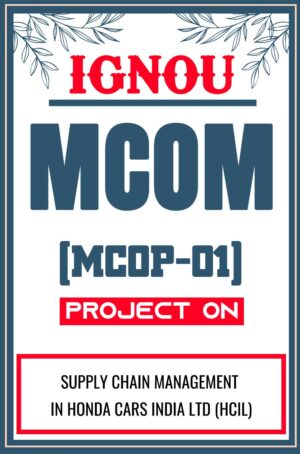
| Operations Management and Information System | Hard copy Sample-2: Supply Chain Management in Honda Cars India Ltd (HCIL) |
How a printed MCOP-001 set reaches you: we dispatch it to your postal address by speed post through Delhivery courier.
The same titles are available as PDF files in the MCOM project soft copy category. Every set is a reference to read against the guidelines; the title, data and analysis you bind must be your own.
MCOM Project Soft CopyAll Hard Copy ProjectsMCOM BooksMCOM Solved AssignmentsMCOM Guess Papers
MCOP1 Project Guidelines: What the Rules Say and What They Leave Open
Much of the advice online about the report cites rules the IGNOU MCOM project guidelines never wrote, and the table separates the two. Pages returned for a search for IGNOU MCOM project guidelines in October 2026 stated 1.5 spacing, Times New Roman 12, one inch margins, 80 to 100 pages, spiral binding, handwritten reports and the Regional Centre as the report address; none of that is in the file.
Said and not said in the MCOP-001 rules
| Question | What the guidelines say | What they leave open |
|---|---|---|
| Length | About 60 to 80 double spaced typed pages, rational variation permitted (page 6) | No word count; no synopsis length |
| Typing and paper | One typed copy, in original, A-4 size, typed in double space (pages 7 and 8) | No font, font size or margins; no rule on one-sided or two-sided printing |
| Binding | A bound volume, with the approved proposal bound in; a project with a stapled proposal is not accepted (pages 6 and 8) | No binding type and no cover colour |
| Referencing | APA style (page 6) | No other style is offered as an option |
| Copies | Send one copy, keep one; the submitted report is not returned (page 8) | Nothing else |
| Report address | The Registrar (SED), IGNOU, Maidan Garhi, New Delhi 110068, by registered post, speed post or by hand; MCOMOL through the LMS (pages 1, 7 and 8) | The study centre and the Regional Centre are not named as report addresses |
| Abstract and front matter | Cover page, table of contents with page numbers, every page numbered (page 6) | No abstract, no acknowledgement page and no page order beyond the parts |
| Viva and marks | Not mentioned | No marks split; the June 2026 portal page covers the viva (see the fee section) |
| Dates | Report any time of year within the maximum duration; two result windows (page 7) | No synopsis date; portal closing dates come from each cycle’s page |
Reports that run far past the MCOP-001 length come back to M.Com learners now and then; the measure to print against is the 60 to 80 double spaced pages on page 6.
In the MCOP-001 reports we see, most M.Com learners keep the MCOP-001 report to roughly 60 to 80 pages and print on one side of each sheet.
We still meet M.Com learners who wrote their synopsis by hand. The MCOP-001 file asks for a typed report and says nothing about typing for the synopsis, so typing both keeps the packet consistent.
Two Stages, Two Offices: Page 1 of the IGNOU MCOM Project Guidelines
The IGNOU MCOM project guidelines open with a box that settles the route. ODL learners send the synopsis to the Regional Director of their own Regional Centre, or the designated RC, and later send the project report to the Registrar (SED), IGNOU, Maidan Garhi, New Delhi 110068. MCOMOL learners use the LMS portal for both. The same box lists payment of the project evaluation fee. Project work may begin only after the written approval of the synopsis arrives (pages 2 and 6).
A common M.Com mistake: treating MCOP-001 as one handover, so the synopsis and the report go out together on one date, without the guide’s signature, and the whole lot is rejected.
Some M.Com learners are unsure whether the study centre or the Regional Centre takes the MCOP-001 synopsis, and a few hand it in at Maidan Garhi, which we have seen end in rejection. Maidan Garhi is the report address; the synopsis goes to your Regional Director.
Many M.Com learners cannot tell whether a published MCOP-001 last date belongs to the synopsis or the report. Under these two stages, the synopsis has no calendar date, and dates on the project portal concern the report.
Topic and Study Type on Page 2
On topics, the IGNOU MCOM project guidelines give areas, not titles: any topic of your choice, preferably in Marketing, Finance, Human Resource, International Business, Accounting and Taxation or a related emerging area. The title should communicate the main theme of the dissertation. The study may be a survey based field study, a case study of a single organisation or multifunctional area, an inter-organisational study, or any other research based work. The guidelines advise starting the synopsis from Semester 3.
M.Com learners often open the MCOP-001 file expecting a list of approved titles to copy. Page 2 has none; it names broad areas and leaves the title to you and your guide.
Topic selection is where M.Com learners tell us they feel most lost, and many say IGNOU holds no class on writing the synopsis or the report. For MCOP-001 the guidelines themselves are the brief, alongside your guide.
Work built from widely shared material, or from one outside source used by many M.Com learners, tends to repeat the same MCOP-001 topic, and a duplicated topic is a common reason a synopsis is returned.
Who Can Guide: The Three Routes on Pages 2 and 3
The IGNOU MCOM project guidelines recognise three kinds of guide: Commerce faculty of the School of Management Studies at Headquarters; approved academic counsellors of the M.Com programme with five years’ teaching experience at study centres; and Commerce or Management faculty with five years of postgraduate teaching, or professionals with a Master’s in Commerce or an allied discipline and at least five years of experience in the relevant area. Guides are asked to supervise in their own areas, and at most five MCOP-001 students at a time (page 5).
Most M.Com learners have not read these three MCOP-001 routes before they ask someone to sign, and the person often fits none of them.
Learners tell us the study centre coordinator gave them no MCOP-001 guide. The guidelines describe no allotment, so the search is yours, and an approved M.Com academic counsellor at a study centre is one route worth asking about.
With no guide at hand, some M.Com learners turn to a relative or an outside contact. Check that person against the MCOP-001 routes first; the proforma has a box where the evaluator can mark the supervisor Not Approved.
MCOM Project Guide Biodata Format, Field by Field
The MCOM project guide biodata format is fixed by page 4 of the IGNOU MCOM project guidelines, which spell it “bio-data”. There is no printed form to download; the guide writes a detailed bio-data, signs it in original and dates it, and it travels with the synopsis. Once approved, it is bound into the report as part of the approved proposal. A synopsis without a complete, signed bio-data “shall not be considered”. The bio-data gives:
- Name and date of birth of the guide.
- Full address and contact numbers of the residence and the current workplace.
- Educational qualifications: each degree with specialisation, the university or institution and its address, the year of award and the percentage of marks.
- Work experience in chronological order, with designation, period, and the name and contactable address of each organisation.
- Any other information relevant to the guide’s eligibility; a current business card may be attached.
We have seen MCOP-001 synopses come back when the guide’s bio-data carried no stamp or working ID. The format above asks only for the original signature, the date and those five headings, which already include the current workplace address.
Seven Synopsis Parts Named on Pages 3 and 4
The IGNOU MCOM project guidelines list seven parts the synopsis “should essentially have”: introduction, rationale, literature review, objectives, research methodology, implications and limitations. The methodology part names research design, the nature and source of data, sample and sampling technique with rationale, the tools including the questionnaire and their relevance to the objectives, the method of data collection, and data handling with statistical tools. Objectives are to be written neutrally, and the sample verbs given are examine, explore, analyse and investigate.
Many M.Com synopses miss a core MCOP-001 part such as the objectives or the methodology. The guidelines name no separate hypothesis part; if your design tests one, it belongs under the objectives or the methodology.
An M.Com synopsis without a rationale, or without its questionnaire, comes back; both sit in the MCOP-001 list, the rationale as part two and the questionnaire among the methodology tools.
Returned M.Com synopses also carry comments asking for the period of the study and a chapter scheme, neither of which appears in the seven MCOP-001 parts; adding both inside the methodology answers the comment early.
Annexure-I: The Proforma That Comes Back With the Verdict
Annexure-I is the “Proforma for Approval of Project Proposal/Synopsis for MCOP-001: Project”. In the IGNOU MCOM project guidelines it asks for your enrolment number, study centre, Regional Centre, Subject Area, name, the complete postal address where the synopsis is to be sent, email, the topic, the guide’s name and address, whether the guide is an IGNOU academic counsellor with the study centre code and courses, and the number of students being guided. You and the guide sign and date it. The office-use part records whether the synopsis and the supervisor were approved, the evaluator’s comments, and the countersignature of the Regional Director or Assistant Regional Director. This approved proforma is what you later bind into the report.
Many M.Com learners do not know which form “the proforma” means and attach the wrong form, or none. For MCOP-001 it is Annexure-I on page 9.
On the MCOP-001 proformas we see, guide details are often half filled, and some learners leave out their own name, address or email.
Synopses come back to M.Com learners because the Topic of the Project line on Annexure-I was left blank, and that line is the wording the MCOP-001 report must later carry.
Sending the Synopsis Packet
For the synopsis, the IGNOU MCOM project guidelines ask you to send one copy and keep a copy, write “MCOP-001” prominently on the envelope, and address it to the Regional Director of your Regional Centre. Inside go the synopsis, the Annexure-I proforma signed and dated by you and the guide, and the guide’s signed bio-data. You may deliver it by hand, by registered post or by courier. If your four-year maximum duration is over, seek re-admission first; an approval on the old enrolment number must be sought again for the new one.
M.Com learners ask us whether the synopsis should be spiral bound or filed. The MCOP-001 guidelines name the three enclosures above and no binding for this packet; binding is a report-stage rule.
Many M.Com learners post the MCOP-001 synopsis and keep no receipt. The guidelines set no receipt procedure, so the postal or courier slip, or a dated acknowledgement at the counter, is your record of sending it.
PP Number, the Reply and Resubmission on Page 5
Under the IGNOU MCOM project guidelines, each synopsis gets a Project Proposal (PP) number, unique to the learner, and a written approval or non-approval is sent with that number within two to three months of the proposal reaching the Regional Centre. Status queries go to that Regional Centre; RC email addresses are on ignou.ac.in. If the synopsis is not approved, you resubmit the revised synopsis with a fresh proforma, a copy of the rejected synopsis bearing the evaluator’s comments, and the PP number. A change of guide, for any reason, makes it a new proposal.
In our experience the MCOP-001 approval letter often takes the full two to three months that page 5 allows before it reaches M.Com learners.
We have seen MCOP-001 letters that did not reach the learner before the session ran out. When three months pass without one, write to the Regional Centre with your enrolment number and dispatch details rather than wait.
Most M.Com learners do not know how long MCOP-001 approval takes or whom to ask; at this stage the office is your Regional Centre, not SED.
Evaluator Comments and the Approved Title
Two rules in the IGNOU MCOM project guidelines tie the approval letter to the bound report. The final report must carry the exact title the evaluator approved, with no change at submission. And the report is a dissertation on the study “as envisaged in the approved synopsis”, so the comments on the proforma travel into the report.
Most MCOP-001 approvals that M.Com learners show us carry correction or change points.
The point we meet most often asks the M.Com learner to update the review of literature with recent studies before the MCOP-001 report is written.
When an MCOP-001 synopsis comes back not approved, many M.Com learners resubmit without the copy of the rejected synopsis that carries the evaluator’s comments, which page 5 asks for.
IGNOU MCOM Project Report: The Ten Parts on Page 6
The IGNOU MCOM project report has ten parts in the guidelines: introduction with the rationale; review of literature; research methodology, including the questionnaire and other tools, their reliability and validity, data collection and statistical tools; results and discussion in tabular or graphical form, interpreted elaborately; summary and conclusion; recommendations; implications; limitations and direction for further research (optional); references in APA style; and annexures including the questionnaire used. The IGNOU MCOM project guidelines name no abstract.
For the methodology chapter, BK Sahni’s open lesson Research Methodology for IGNOU MCom Projects (MCOP-001): Designs, Data Sources and Analysis (Zenodo, June 2026, CC BY 4.0) covers research design, primary and secondary data, and ratio and trend analysis. It contains no ready-made report.
Once approval arrives, many M.Com learners ask us what format the MCOP-001 report takes. These ten parts are it, in this order.
In many MCOP-001 reports we see, the results and discussion chapter is too thin to support the objectives, any hypothesis and the methodology the M.Com learner set out.
Evaluator comments on an approved M.Com synopsis belong in the MCOP-001 report before it goes to the binder, and many learners bind without them.
References and the Literature Review
The references part of the IGNOU MCOM project guidelines is short and firm: students should follow APA style. Every source cited in the chapters, and every source of secondary data, belongs in that list, and the review of literature should be a detailed review of existing studies on the selected topic.
In many MCOP-001 reports, the reference list is not in APA and leaves out the secondary data the M.Com learner actually used.
The literature review and the bibliography often fail to match in M.Com work, from the synopsis onwards; check that each MCOP-001 author discussed is listed, and each listed source is discussed.
Many MCOP-001 volumes we see carry a literature review with no recent studies, and in our experience that costs the M.Com learner marks.
Six Items the IGNOU MCOM Project Guidelines Want in the Volume
Page 6 of the IGNOU MCOM project guidelines lists what the final report must carry:
- A cover page with the course code and title (MCOP-001: Project), the project title, your name and enrolment number, the guide’s name, and the names of the School and the University.
- A detailed table of contents with page numbers.
- Every page numbered as the table of contents shows.
- The approved proposal (project proposal, approved proforma and the guide’s bio-data) properly bound in, and not stapled.
- The Certificate of Originality (Annexure-II), signed and dated by you and the guide.
- A copy of the project evaluation fee payment receipt.
Page 8 adds that a report received without the cover page details, the approved proforma with the approved proposal, the guide’s bio-data, the signed originality certificate or the fee receipt copy is returned to the student for compliance. The questionnaire sits in the annexures at the back. Annexure-III, the guide’s remuneration bill, stays outside the volume in its own envelope.
MCOP-001 reports come back to M.Com learners for one missing paper: the approved proforma, the approved synopsis, the guide’s bio-data, the signed originality certificate, or their own details on the first page.
Many M.Com reports we see are bound with no questionnaire or appendix at the back, though MCOP-001 lists the questionnaire among the annexures.
A few M.Com learners bind respondents’ completed questionnaires into the MCOP-001 annexures. The guidelines ask for the questionnaire used and are silent on filled copies; one blank copy is the common practice.
Annexure-II and the Plagiarism Clause
Annexure-II, the Certificate of Originality, states that the project is the student’s original work and has not been submitted earlier to IGNOU or any other university; you and the guide sign it with place and date. The printed form reads “Master’s Degree in Business Administration”, so ask the Registrar (SED) at [email protected] how that line should read for the M.Com before you sign. Page 7 of the IGNOU MCOM project guidelines adds that the report should be free from plagiarism and that a plagiarised report is dealt with under the University’s policy.
Some M.Com learners bind the MCOP-001 report with only their own signature on Annexure-II and the guide’s space left blank.
Many M.Com learners paste internet material into MCOP-001 chapters and bind the volume with no plagiarism check of their own.
Some M.Com learners bind an AI-written MCOP-001 report as the tool produced it, one more reason the same topics recur, even though Annexure-II certifies the work as their own.
Binding the Volume: A-4, Double Space, Bound, Proposal Inside
The binding rule in the IGNOU MCOM project guidelines is one line long: a bound volume, with the approved proposal bound in rather than stapled. The guidelines list what goes in but not the page order, so the order below comes from our printing desk, with each item checked against the list on page 6.
The order most M.Com learners bind their MCOP-001 volume in, as we see it: the report front page; then the original approval letter received from IGNOU with the synopsis and the guide’s bio-data; then the report front page again; then the complete report.
- Front page, with the details listed in the front page section.
- The approval papers: the approved proforma and approval letter, the synopsis and the guide’s bio-data, bound in.
- The front page a second time, which opens the report proper. This is a desk habit, not an IGNOU rule.
- Table of contents with page numbers, then the ten parts with every page numbered, ending in the annexures with the questionnaire.
- Somewhere inside the volume: the signed Certificate of Originality and a copy of the fee receipt. The guidelines do not fix where.
Most M.Com learners we deal with submit the MCOP-001 report in a black hard binding with gold lettering; IGNOU sets no colour.
Some M.Com learners send the final MCOP-001 report spiral bound. The guidelines name no binding type, only a bound volume with the proposal bound in, which a hard binding meets without question.
The Front Page: Guideline Lines and Portal Lines
The IGNOU MCOM project guidelines give the cover items but no template, logo or layout. The June 2026 online project page asked the first page of an uploaded PDF for a few more particulars. One front page can carry both lists, so the same volume works by post or by upload.
MCOP-001 front page lines to fill
| Line | Asked for by |
|---|---|
| MCOP-001: Project | Guidelines; portal (course code) |
| [Approved title, word for word] | Guidelines and portal |
| Name: [learner] | Enrolment No.: [as on the ID card, not the control number] | Guidelines; the ID card condition is the portal’s |
| Programme code: MCOM | Regional Centre code: [code] | Portal |
| Guide: [name] | Guidelines |
| Mobile: [number] | Email: [address] | Portal |
| School of Management Studies, Indira Gandhi National Open University | Guidelines (School and University) |
With the front page ready, many M.Com learners ask us the right page order for the rest of the MCOP-001 volume; IGNOU fixes none, and the binding section above gives the order most learners use.
IGNOU MCOM Project Submission: Post, Hand, Portal or LMS
For IGNOU MCOM project submission, ODL learners send one typed, bound, original copy to the Registrar (SED), IGNOU, Maidan Garhi, New Delhi 110068, by registered post, speed post or by hand, with “PROJECT REPORT-MCOP-001” on top of the envelope and Annexure-III in a separate envelope. A PR number is allotted on submission; quote it to [email protected]. MCOMOL learners use the LMS. IGNOU has also run an online project portal in recent term-end cycles; the June 2026 page asked for the original report scanned as one PDF per course, with the approved proforma, synopsis, bio-data and signed certificate inside, and removed incomplete uploads after the last date.
As things stand for the learners we serve, SED still accepts printed MCOP-001 reports from ODL M.Com learners by post or by hand at Maidan Garhi, and takes uploads on the online portal while it is open for a cycle.
Some M.Com learners email the MCOP-001 report instead of using these routes; the June 2026 portal page says reports received by email are not considered for evaluation.
How many MCOP-001 copies to print, and where each goes, is a question M.Com learners often ask us. The guidelines’ answer: one to SED, one for you, and the one you send is not returned.
When the Report Can Go In, and When the IGNOU MCOP 01 Project Result Comes
The IGNOU MCOM project guidelines let you submit the report at any time of the year within the maximum duration of the programme, four years for the M.Com; a report submitted after that is rejected for evaluation. The IGNOU MCOP 01 project result follows the window of submission: a report submitted from 1 December to 31 May is declared with the June term-end results, and one from 1 June to 30 November with the December results.
Online upload has its own closing date per cycle: the June 2026 portal page gave 15 June 2026. On 15 October 2026 IGNOU’s notices showed no December 2026 report date; the December 2026 project fee closes on 30 November 2026.
In our records, 70 to 80 percent of IGNOU project students become active only in the final month before a submission date; when that date falls in November, most begin in October. For MCOP-001, 31 May and 30 November are the ends of result windows.
Many M.Com learners count on IGNOU moving each date by a month and wait for it; the MCOP-001 file carries no such promise.
Some M.Com learners hand in or post the MCOP-001 report without a receipt; keep it with the PR number, because any query about the result starts from them.
Rs 500 Fee Receipt and the Viva Line
For learners admitted from the January 2023 cycle onwards, the project evaluation fee for MCOP-001 is Rs 500. The July 2026 Common Prospectus sets Rs 300 for project work up to 4 credits and Rs 500 above 4 credits from the January 2023 admission cycle, paid with the term-end examination form; MCOP-001 has 6 credits. For the December 2026 cycle, IGNOU’s notice sets 30 November 2026 through your Samarth login. A copy of the receipt is one of the six items bound into the report. Rs 300 also appears in the IGNOU MCOM project guidelines, on Annexure-III, as the guide’s remuneration per student; that is not your fee.
The guidelines say nothing about a viva. The June 2026 portal page said the viva-voce is conducted under certain guidelines by the concerned faculties at the Regional Centre, and asked learners to contact their Regional Centre. Our article on IGNOU MCOM project viva questions lists questions to prepare.
Many M.Com learners mix up Rs 300 and Rs 500 when they pay; for a six credit MCOP-001 the slab is Rs 500.
Many M.Com learners cannot say whether MCOP-001 has a viva, which is understandable: the guidelines are silent and only the portal page mentions one.
For one-to-one help on your own topic and data, see our customised project service on a separate site.
Report-Stage Questions From M.Com Searches
Report-stage questions from M.Com searches
If I upload the report on the portal, do I also post a physical hard copy?
The documents read for this page do not ask for both. The IGNOU MCOM project guidelines describe one typed, bound copy sent by post or by hand, and the June 2026 portal page took a scanned PDF of the original; that page said the fee receipt goes with the hard copy or with the upload. Use the route open for your cycle.
Can I hand-deliver the report at Maidan Garhi?
Yes. The guidelines allow registered post, speed post or delivery by hand to the Registrar (SED), IGNOU, Maidan Garhi, New Delhi 110068. Ask for a dated acknowledgement.
Can a printed set from this category be submitted as my report?
No. It is reference material. Your MCOP-001 report must be your own work on your approved title, and the Certificate of Originality you and your guide sign says so.
Is the MCOP1 project result shown separately?
The guidelines tie the result to the term-end result of the window in which the report was submitted; they do not describe a separate project result. For a report already at SED, quote your PR number to [email protected].
Your Own Survey and Your Own Data in the Bound Report
The IGNOU MCOM project guidelines ask the methodology to state the nature and source of the data, the sample and the tools, with their reliability and validity, and they neither require nor bar secondary data. Whatever the source, the tables in the bound volume have to come from the study you ran.
Many M.Com learners base the whole MCOP-001 report on secondary data alone; the guidelines neither require nor bar that, so agree it with your guide and justify it in the methodology.
Some go further and fill the MCOP-001 results chapter with assumed figures and no survey behind them. The data in an M.Com report has to come from your own fieldwork or sources you can name.
Read with the IGNOU MCOM project guidelines open beside it, a printed set shows how a finished volume looks; what you bind stays yours.
IGNOU MCOM Project Guidelines PDF and Other Sources
IGNOU files behind this guidelines page
- MCOP-001: Project Course, Guidelines for Submission of Synopsis and Project Report, with Annexures I to III, Commerce Discipline, School of Management Studies, on eGyanKosh
- Online submission of final project reports, June 2026 term-end examination, IGNOU online project portal
- IGNOU Common Prospectus, July 2026, section 1.17 (project evaluation fees)
- IGNOU notices, including the December 2026 Project/Internship/Practical course fee notice
- MCOM: Master of Commerce programme page, IGNOU
- Master of Commerce (MCOMOL), IGNOU Online Programmes
shrichakradhar.com is an independent publisher, not affiliated with, authorised by or endorsed by Indira Gandhi National Open University. Course codes and programme names belong to IGNOU and identify the course only. The printed MCOP-01 sets are study reference material, not for submission as your own work: your topic, data, analysis, certificates and submission remain yours, IGNOU’s evaluator decides approval and IGNOU’s examiners decide marks. Questions: WhatsApp or call 9354637830, or use the contact page.
- Sale!

- Sale!
IGNOU MCOM Project (MCOP-01) Synopsis/Proposal & Project Report/Dissertation in Hard-Copy (Sample-5)
Original price was: ₹499.00.₹249.00Current price is: ₹249.00. - Sale!
IGNOU MCOM Project (MCOP-01) Synopsis/Proposal & Project Report/Dissertation in Hard-Copy (Sample-4)
Original price was: ₹499.00.₹249.00Current price is: ₹249.00. - Sale!
IGNOU MCOM Project (MCOP-01) Synopsis/Proposal & Project Report/Dissertation in Hard-Copy (Sample-3)
Original price was: ₹499.00.₹249.00Current price is: ₹249.00. - Sale!
IGNOU MCOM Project (MCOP-01) Synopsis/Proposal & Project Report/Dissertation in Hard-Copy (Sample-2)
Original price was: ₹499.00.₹249.00Current price is: ₹249.00. - Sale!
IGNOU MCOM Project (MCOP-01) Synopsis/Proposal & Project Report/Dissertation in Hard-Copy (Sample-1)
Original price was: ₹499.00.₹249.00Current price is: ₹249.00.