What Is an IGNOU Project, and Who Has to Do One?
IGNOU Project, the short version
An IGNOU project is the research or field study course that many IGNOU programmes include, such as MMPP-001 in the MBA or MCOP 001 in the M.Com. In most courses you get a synopsis approved first, then submit one report for evaluation, and the rules on length, guide and viva change with each course code.
Every IGNOU project sits in its programme’s credit table as a course of its own, and the weight differs widely. In the July 2026 Common Prospectus, MLIP 2 in the MLIS carries 4 credits, MCOP 001 in the M.Com carries 6 and MPAP 2 in the MPA carries 8; the MMPP-001 guidelines treat the MBA project as one course of eight credits, equivalent to two courses; and the MCA_NEW programme guide describes MCSP-232 as a 12-credit course in the fourth semester. Under the credit transfer rules in the same prospectus, credits earned for a project or internship are not transferred. The IGNOU project details that matter most, from credits and guide to the synopsis office, length and viva, are set by your own course.
IGNOU project work has the same purpose across schools. You pick a real question from your own subject, plan how to study it, collect or analyse data, and write up what you found under a guide’s supervision. IGNOU’s prospectus says a project guide booklet is provided with the study material for courses that have project work, and that booklet is the first document to open, because it, and not a website, decides your rules.
Not every programme makes the project compulsory. The MPA prospectus entry treats MPAP 2 as a choice (“Learners who opt for Project Work”) and sets a dissertation of 10000-15000 words, while for the Geography project MGGP 001 the prospectus asks for the synopsis and topic in the 3rd semester and project registration in the 4th.
Learners tell us, whether their course is MMPP-001 or MLIP 2, that choosing a topic is where they feel most lost, and many say IGNOU gave them no class on how a synopsis or project report is written. That gap is the reason this page exists.
Parts of this guide (tap to open)
- What an IGNOU project is
- Buying online: PDF or printed set
- Programme list, A to Z
- Six courses, six rules
- Topics
- Who can be your guide
- Proforma, bio-data and the packet
- What a synopsis must contain
- Synopsis format and front page
- Where the synopsis goes
- Approval time
- When a synopsis comes back
- Last dates and result windows
- Report format
- Data, literature and references
- Duplicate topics
- AI drafts and your own data
- Report documents and first page
- Printing and binding
- Submission
- Fee and viva
- Sample PDFs and free files
- Help with your own draft
- Other IGNOU material
- Questions students search
- A ten-line plan
- IGNOU documents consulted
IGNOU Project Buy Online: PDF Set or Printed Set?
When you buy an IGNOU project from this store, you get a reference set for one course: a sample synopsis and a sample project report that show how a finished piece of work is planned, ordered and written. Each set comes in one of two formats. The soft copy is a PDF you read on a phone or laptop; the hard copy is the same kind of set printed on paper and sent to your address. Both are study references. Neither is meant to be submitted as your own work, and the topic, data and writing in your final report must be yours.
Choose the PDF when you want to study the structure quickly or compare several samples before you settle on a topic. Choose the printed set when you prefer to mark up pages with a pen, or when you want a paper model beside you while you write. The product grid at the top of this category shows every set with its price; the list in the next section takes you straight to your programme.
Many students ask us how many copies of the report IGNOU wants, and where. The answer depends on the course: the MMPP-001 guidelines ask for one typed copy to the Registrar (SED), and the June 2026 portal took one PDF per course.
All printed IGNOU project setsAsk which set matches your course code
IGNOU Projects by Programme, A to Z
Programme list: main category and hard copy category
Every IGNOU project category in this store is listed below; find your programme code in the first column. The main category holds that programme’s reference sets and, for rebuilt programmes, its guide page; the hard copy category holds the printed sets. A dash means we do not stock that format for the programme yet. The codes are the ones printed on our sets; where the July 2026 Common Prospectus prints a newer code (MECP 301 for MAEC, MTTMP 119 for MTTM, MRDP 205 for PGDRD), the row shows it.
My programme is not in this list
Six Courses, Six Different Rules
IGNOU project guidelines are written course by course, and the most common mistake on the pages returned in our searches is a single rule for every course. Rules on where the synopsis goes, how long the report runs and whether a viva follows are set course by course, and they do not agree. The table compares six courses whose official documents we read in October 2026.
Same word, six different rules
Built from the course guidelines and the July 2026 Common Prospectus read in October 2026. A blank means the document we read does not say.
| Course | Credits | Synopsis goes to | Report, as the guideline prints it | Length | Viva |
|---|---|---|---|---|---|
| MMPP-001 (MBA) | 8 | Regional Director of your own Regional Centre (MBA Online: LMS portal) | One typed copy to the Registrar (SED), Maidan Garhi (MBA Online: LMS portal) | About 50 to 60 double-spaced pages, approximately 18,000 words excluding appendices | Only if the evaluator recommends it |
| BMPP-001 (BBA) | 8, in the 5th semester | Regional Director of your own or designated Regional Centre | Registrar (SED), Maidan Garhi | About 60 to 80 double-spaced pages | Not mentioned in the guidelines |
| MLIP-002 (MLIS) | 4 | Programme Coordinator, MLIS, SOSS, IGNOU, Maidan Garhi | One copy to the Registrar (SED) | ||
| MCSP-232 (MCA_NEW) | 12 | Regional Director of your Regional Centre, never SOCIS | Regional Director of your Regional Centre, by registered post | About 100 to 125 pages, excluding coding | Compulsory: report 150 marks, viva 50 marks |
| MPAP 2 (MPA) | 8, optional | Dissertation of 10000-15000 words | |||
| MESP135 (PGDET) | 8 | Guide and synopsis submission not required; follow the project manual |
Two things follow from the table. A synopsis address copied from a friend in another programme can send your packet to the wrong office, and a page count that is right for the MCA can be twice what an MBA evaluator expects. The report column shows what each course guideline prints; for the June 2026 cycle, IGNOU’s online portal took final reports for every course except DECE04, so the route that applies to you is the one in the notice for your session. The same comparison, with the guide and format rules, is in our free guidelines overview PDF.
Learners often reach us unsure whether the synopsis is meant for their study centre or for the Regional Centre; a few even carry it straight to Maidan Garhi. For MMPP-001 that is the wrong office, because the guidelines name the Regional Director; for MLIP-002 Maidan Garhi is right, because the MLIS guide names the Programme Coordinator at SOSS.
Longer is not safer. Some synopses and reports we see run well past the length their course sets, roughly 18,000 words for the MMPP-001 report, and they come back for it.
Students regularly ask us whether the synopsis and the report go in together on the last date. In MMPP-001, BMPP-001 and MCSP-232 they are two separate stages, with the report written only after the synopsis is approved; sending both at once, without the guide’s signature, gets the whole submission refused.
IGNOU Project Topics: Start From Your Course and Your City
Good IGNOU project topics come from three places at once: a course you studied in the programme, a place you can reach for data, and a question small enough to answer in the length your course sets. A topic that misses one of these tends to stall once the fieldwork starts. Search results for topic lists show the same pattern: students search topics course by course, so the most useful lists sit on the programme pages linked above.
Starting points by programme, most of them kept from our earlier guide, for narrowing an idea:
- MBA project topics (MMPP-001): digital marketing impact, customer satisfaction in one service firm, financial performance of small firms, training needs in one company.
- M.Com project topics (MCOP 001): banking services, e-commerce adoption, taxation practice, financial statement analysis.
- MCA and BCA: a small software system, a mobile app, a website, a management information system or a data analysis project.
- MAEDU (MESP 1): teaching methods, digital tools in classrooms, teacher training needs, inclusive education practice.
- MAAN: cultural studies, ethnographic fieldwork topics, human development issues.
- MSCENV project areas (MEVP 11): solid waste, air or water quality, climate awareness, renewable energy use.
- DNHE project topics (DNHE 4) and MSCDFSM: diet surveys, nutrition education, food safety in canteens or hospitals.
- MARD project topics (MRDP 1): rural schemes, self-help groups, livelihood studies in one block or district.
A learner who works in a firm, school, hospital or NGO can often use that place as the field area, which settles the data question before the synopsis is written.
One evaluator comment we keep seeing on returned synopses, MMPP-001 and DNHE 4 alike, is a request to base the study on the student’s own city or district. A topic set where you live is easier to defend and easier to collect data for.
The IGNOU Project Guide List Question: Who Can Supervise You
Students search for an IGNOU project guide list expecting IGNOU to publish names. What the guidelines publish instead is a set of eligibility rules, and each course writes its own. Read your course’s rule before you approach anyone, because the guide’s bio-data travels with your synopsis, and under MMPP-001 a synopsis without it is not entertained.
- MMPP-001 (MBA): Management faculty of the School of Management Studies at headquarters; approved academic counsellors of the Management Programme at study centres; management faculty with 5 years of PG teaching; or professionals with a master’s in management or an allied discipline and at least 5 years of experience in the relevant area. A guide may not guide more than five students at a time.
- MCSP-232 (MCA_NEW): A Ph.D. or M.Tech in Computer Science with one year of experience, or a B.E./B.Tech (Computer Science), MCA or M.Sc. (Computer Science) with two years of experience; not more than 5 MCA students of IGNOU at a time.
- MLIP-002 (MLIS): A Ph.D. in Library and Information Science, or a master’s in the subject with library work or LIS teaching, in either case at Assistant Professor scale or Pay Level 10.
- BMPP-001 (BBA): A supervisor guides five students at most at any one time.
Most of the guide problems we hear about start with one fact: the student had not read the eligibility list, so the guide named on an MMPP-001 synopsis meets none of the routes the guidelines set out.
Many students tell us they were given no guide by IGNOU and could find nobody, so they turned to a relative or an office contact. Check that person against your course’s list first; for MCSP-232, for example, the degree and the years of experience are both written down.
Many students ask the coordinator at their study centre to allot a guide and come back without one. For MMPP-001 the guidelines recognise approved academic counsellors of the Management Programme at study centres as supervisors, so ask the centre who among them guides projects before you look further.
Proforma, Bio-data and the Synopsis Packet
The synopsis of an IGNOU project rarely travels alone. For MMPP-001 the guidelines refuse to entertain a synopsis that arrives without the signed proforma and the guide’s bio-data, signed in original and dated, and they waive the bio-data only when the guide is an approved counsellor. The proforma is the form on which the title, your details and the guide’s details are entered and signed; the bio-data is the guide’s own record of qualifications and experience.
Many students ask us what the proforma actually is. Some leave it out of the MMPP-001 packet, and others attach a form meant for a different course.
The proformas we look over often have the guide’s details half filled, and now and then the student’s own name, address or email is blank. Check each box on the MMPP-001 proforma before you and your guide sign it.
Whether the synopsis should be bound or kept in a file is another question we answer often. The MMPP-001 guidelines list what goes with it, the proposal, the signed proforma and the guide’s signed bio-data, and we found no binding rule for the synopsis itself in them, so we tell students to follow that list and not a rumour.
IGNOU Project Synopsis: What the Evaluator Reads For
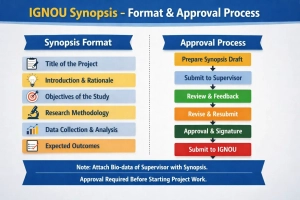
An IGNOU project synopsis is a plan, not a short report. The MMPP-001 guidelines spell out its parts, and the same logic serves most programmes:
- Introduction: the problem and its setting.
- Rationale: why the study is worth doing.
- Objectives: the guidelines call this the most important part of any project; write them so that they do not assume the answer.
- Research methodology: research design, sample and sampling technique, tools and techniques for data collection, and how the data will be organised and analysed.
- Limitations of the proposed project, if any.
Other courses add or rename parts, so set the list above beside your own course booklet. MCSP-232, for example, expects a synopsis of 15 to 20 pages in one section of its guidelines and 14 to 18 pages in its checklist, which shows why the booklet, read in full, matters more than any summary.
Synopses reach us with the research methodology or the objectives missing altogether, often because the student had not seen the structure. For MMPP-001 the five parts are listed in the guidelines; hypotheses belong only where your design tests one.
Two gaps we see behind returned synopses are a missing rationale and a missing questionnaire. Both sit inside the MMPP-001 structure: the rationale has its own heading, and the tools for data collection belong in the methodology.
Returns also come when the synopsis gives no period of study or no chapter plan. In an MMPP-001 synopsis both fit naturally under research design.
IGNOU Synopsis Format, Front Page and Typing
A workable IGNOU synopsis format is a typed document that opens with a front page, follows the parts your course lists, and closes with the references you used to frame the idea. An IGNOU synopsis front page that works carries the title exactly as it will appear on the proforma, then your name, enrolment number, programme code, course code, Regional Centre and study centre, and the guide’s name. It also shows at a glance that the papers in the packet belong together. For the IGNOU project synopsis format of your own course, the course booklet wins over any template, including ours.
Students searching for an IGNOU synopsis sample PDF will find our free blank synopsis template in the sample files section below; full sample synopses come with each course’s reference set. A synopsis sample shows layout and order. It does not give you a topic or data that you may submit.
In many synopses we read, the studies discussed in the literature review do not appear in the references at the end. Match the two lists before an MMPP-001 or MCOP 001 synopsis goes out.
Plenty of the synopses we see rely on secondary data alone. The MMPP-001 methodology part asks you to state your sample and your tools for data collection, so whatever your source is, name it there and show that it answers your objectives.
A blank title box on the proforma is one of the plainest reasons for return we come across. Write the MMPP-001 title on the proforma exactly as it stands on the synopsis front page.
Where Does the IGNOU Synopsis Go?
The IGNOU synopsis goes to the office your course guideline names, and that office differs. For MMPP-001 and BMPP-001 it is the Regional Director of your Regional Centre; for MCSP-232 it is also the Regional Director, and the guidelines say it must never be sent to SOCIS; for MLIP-002 it is the Programme Coordinator, MLIS, at SOSS in Maidan Garhi. Online learners of the MBA and BBA send it through the LMS. The final project upload portal is not a route for it: the June 2026 portal page said in capitals that candidates should not upload a synopsis there.
Timing is course-specific too. The MMPP-001 guidelines let you send the proposal after you register for MMPP-001, so that you have about 8 to 9 months for the work. MCSP-232 fixes two windows for proposals, 1st April to 30th June and 1st October to 31st December.
Students who hand in an MMPP-001 synopsis at the Regional Centre often walk out without a receipt, and later have nothing to show when they ask about it. Take a dated receipt, or keep the postal slip.
We have seen synopses come back because the guide’s bio-data had no stamp or no working ID. For MMPP-001 the guidelines ask for bio-data signed in original and dated, except for approved counsellors; check yours before the packet leaves your hands.
Now and then a student sends a handwritten synopsis. The MMPP-001 guidelines ask for a typed report in double space, and a typed synopsis is the safe course unless your own course booklet says otherwise.
Approval Can Take Two to Three Months
Waiting is built into every IGNOU project timetable. The MMPP-001 and BMPP-001 guidelines both say approval or non-approval is communicated in writing within two to three months of the proposal reaching the Regional Centre, and that the project work starts after that written approval. The MLIS guide uses the same order: approval first, then the work. Plan the report around that wait, not around the day you posted the synopsis.
In our experience the approval letter often reaches students late, and two to three months is a realistic wait. For MMPP-001 that matches the period the guidelines themselves give.
Most approval letters we see, for MMPP-001 and other courses, carry correction or modification points along with the approval. Read them as part of the approval, not as a footnote.
The correction we see most often asks for an updated review of literature. If your MMPP-001 approval says so, add recent studies before you write the report chapters.
When a Synopsis Comes Back Unapproved
A returned synopsis is not the end of the project. The MMPP-001 guidelines say the evaluator’s comments for reformulating the proposal are sent to you, and the revised proposal goes back with a fresh project proposal proforma, a copy of the rejected proposal and proforma bearing the evaluator’s comments, and the Project Proposal Number (PP. No) the Regional Centre allotted.
The reasons our old guide listed still hold as a self-check before you resend: a topic that is too broad, objectives that do not match the method, blank boxes on the proforma, a guide who does not meet the course’s eligibility rule, and text copied from the internet or from earlier projects.
When students resubmit, the paper they forget most often is the original rejected synopsis. The MMPP-001 guidelines ask for it, with the evaluator’s comments on it, so keep that copy safe from the day it arrives.
We have met students whose approval letter did not arrive and whose session ran out while they waited. If three months pass after you sent an MMPP-001 synopsis, write to your Regional Centre.
Most students do not know whom to ask when a month or two passes without news. For MMPP-001 synopsis approval the office is your Regional Centre; for a final report already uploaded, the June 2026 portal named [email protected] for queries.
Last Dates, Extensions and Result Windows
Two kinds of IGNOU project date get mixed up. The first is the portal’s last date for uploading final reports, set for each term-end examination: the page for June 2026 showed 15-Jun-2026, the June 2025 page showed 31-May-2025, and the December 2024 page showed 30-Nov-2024. On 15 October 2026 no December 2026 upload page could be found or read, so no report date for that cycle is given here. The second kind is a result window. The MMPP-001 and BMPP-001 guidelines say a report submitted between 1st December and 31st May has its result declared with the June term-end examinations, and one submitted between 1st June and 30th November with the December examinations.
Treat any site that calls 31 May and 30 November fixed deadlines for every course with care; for these two courses they are result windows, and the portal dates have moved from cycle to cycle.
Our records show that 70 to 80 percent of the students we deal with start work only in the final month before a submission date; with a November date, most of them get going in October. For MMPP-001 that rush is avoidable, because 31 May and 30 November mark result windows, not a single deadline.
Many students assume IGNOU will push each last date back by a month and hold off until the later date. The June 2026 portal showed 15-Jun-2026, yet nobody can promise an extension for any cycle, and waiting for one costs the weeks you need.
Many students we deal with send the synopsis in the final week before a date they believe is the last one. For MCSP-232 the proposal windows really do close on 30th June and 31st December; for MMPP-001 the proposal can go after you register for the course, though the guidelines warn that the Regional Centre is not responsible for timely disposal of proposals received more than six months after registration.
IGNOU Project Report Format: Length, Spacing, Page Order
The IGNOU project report format is set by your course, and the course documents agree on less than most websites suggest. The MMPP-001 and BMPP-001 guidelines ask for A-4 size, typed in double space and bound; MLIS asks for double space on A4 in bound form. The MMPP-001 guidelines name no font and no margin, and the BMPP-001 guidelines give no font rule. A page that insists on Times New Roman 12 and 1.5 spacing as “IGNOU rules” is repeating habit, and for these courses double spacing is the written rule.
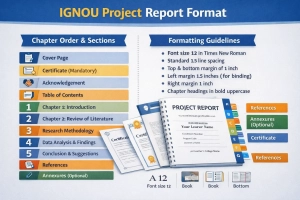
A page order that works for most IGNOU project report formats, as common practice and not an IGNOU rule:
- Cover page with programme name, course code, title, your name, enrolment number, Regional Centre and study centre
- Approved proposal proforma, synopsis and guide’s bio-data, bound in where your course requires them
- Certificate of originality, signed and dated by you and your guide
- Acknowledgement and table of contents, with lists of tables and figures
- Chapter 1, introduction: problem, background, need for the study, objectives
- Chapter 2, review of literature
- Chapter 3, research methodology: design, tools, sample, data collection, analysis plan
- Chapter 4, data analysis and interpretation, with tables and charts
- Chapter 5, findings, suggestions and conclusion
- References, then annexures such as the blank questionnaire
This order, with a short list of checks before printing, is also in the free report structure guide PDF.
The question that follows most approvals we hear about is “what format do I write the report in?” For MMPP-001 the guidelines answer it: about 50 to 60 double-spaced pages, A-4, bound, on the approved title.
Page order is the second question. Many students who bring us MMPP-001 and MCOP 001 drafts are unsure of it, and the list above sets out a common order to check against.
In many reports the references follow no single style and leave out the secondary sources the chapters quote. MMPP-001 sets no referencing style, so pick one consistent format and list each source you used.
Data, Literature and References in the Chapters
Evaluators read the chapters against the approved synopsis. Your objectives, the method you promised and the analysis you present have to line up, and the review of literature should be current enough to show what is already known about your question. If you want a worked explanation of research design, objectives, sampling and analysis for a management or commerce project, BK Sahni’s two open methodology lessons on Zenodo cover them: Research Methodology for IGNOU MBA Projects (MMPP-001) and Research Methodology for IGNOU MCom Projects (MCOP-001). Both are CC BY 4.0 lessons and say plainly that they are not ready-made reports.
The weakest chapter in many reports we read is the data analysis. It does not support the objectives and method the MMPP-001 synopsis promised, and anyone reading both documents sees the gap.
An out-of-date literature review shows up in many reports that reach us, and in our experience it costs marks. Add the recent studies for your MCOP 001 or MMPP-001 topic before the final draft.
The approval letter’s comments are meant to be worked into the report, and many students skip them. For MMPP-001, where the report must carry the approved title, those comments are part of what the evaluator approved.
Duplicate Topics and Shared Material
The same title on two students’ synopses is one of the few problems a careful student can avoid entirely. A topic tied to your own organisation, district and period is close to impossible to duplicate, and it gives your guide something specific to supervise.
When a synopsis is put together from material many people share, or from one common outside source, its topic tends to match other students’ synopses, and in the MMPP-001 and MCOP 001 returns we hear about, a duplicate topic is a common reason.
Time pressure often sits behind it. Many students start an MMPP-001 synopsis so close to the date that writing it themselves is no longer possible in the time left, which is why the eight to nine months the guidelines aim to give you are worth protecting.
We also see AI-generated synopses and reports handed in exactly as the tool produced them, and that is another reason identical topics keep turning up in MMPP-001 and MCSP-232 work. A draft you have not rewritten around your own study is not your work.
AI Drafts, Internet Text and Your Own Data
The originality certificate that goes into the report is signed and dated by both you and your guide; the June 2026 portal listed it among the documents a report must carry. That signature is a statement that the work, the data and the writing are yours, and it is the reason our sets are study references and nothing more.
A growing number of students let ChatGPT or a similar AI tool produce the first synopsis draft before they have opened the course guidelines, and the plan that comes out does not match what MMPP-001 or MLIP-002 asks for. Read the booklet first; then use any tool only to check your own wording.
We often see material lifted from websites and submitted without any plagiarism check. Run your MMPP-001 or MLIP-002 draft through a checker and rewrite what it flags; no checker can promise a clean result.
The most serious problem we come across is a data analysis chapter written on assumed figures, with no survey ever run. The data in an MMPP-001 or MCOP 001 report has to come from your own fieldwork or from sources you name.
IGNOU Project Report Documents and the First Page
The papers bound or scanned into the IGNOU project report matter as much as its chapters. The June 2026 portal instructions listed what the uploaded report must contain: the proposal proforma duly approved, in original, with the synopsis and the bio-data of the project guide, and the originality certificate signed and dated by both student and guide, wherever applicable. Incomplete submissions were not considered, and were removed from the portal once the last date passed, so the student had to upload again for the next session.
First page lines the June 2026 portal asked for
| Line on the first page | Fill in |
|---|---|
| Title of the project report or dissertation | ________________ (same as the approved title) |
| Name of the learner | ________________ |
| Programme code | ________________ |
| Enrolment number, as on the ID card (not the control or registration number) | ________________ |
| Regional Centre code | ________________ |
| Course code of the project | ________________ |
| Mobile number and email ID | ________________ |
To print these lines, download the free first page template PDF, which also has a synopsis front page.
Reports come back to students we know because one paper was missing: the approved proforma, the synopsis, the guide’s bio-data, the signed originality certificate or the particulars on the first page. Those are the items the June 2026 portal listed, and for MMPP-001 the guidelines want the approved proposal bound in.
A certificate of originality without the guide’s signature is something we still see on finished MMPP-001 and MCOP 001 reports. The portal asked for both signatures, with the date.
The questionnaire or appendix is the part students most often leave out of the final file. If your MMPP-001 study used a questionnaire, put a copy in the annexures.
Printing and Binding the Final Copy
Where your course asks for a paper copy of the IGNOU project report, the binding rule is short. The MMPP-001 and BMPP-001 guidelines ask for a bound volume, with the approved proposal “properly bound in the project and not just stapled”, and MLIS asks for a bound form. MCSP-232 sends the report to the Regional Director by registered post.
Our press prints and binds a student’s own final report on request; the price is quoted on WhatsApp, and the printed copy is dispatched to the address you give. That is a print job on your file, separate from the reference sets in this category.
Some students still submit the final report spiral bound. For MMPP-001 the guidelines ask for a bound volume with the proposal bound in, so we suggest a proper bound copy for that course.
Some students attach the filled-in questionnaires at the end of the MMPP-001 report. A blank copy in the annexures is the common practice, unless your course booklet asks for more.
IGNOU Project Submission: Portal, Post and Proof
IGNOU project submission for the June 2026 term-end examination ran through the online portal at onlineproject.ignou.ac.in. The page set out these rules: the original report scanned as a single PDF file for one course, pages clear and in sequence, all in the same orientation; reports received through email not considered for evaluation; the fee receipt submitted with the report; and DECE04 handled through a separate link. Queries went to [email protected], and the viva, where held, was arranged through the Regional Centre.
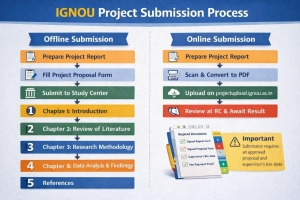
Before you press upload, check the IGNOU project file against this list: the approved title on the first page, the first-page particulars above, the approved proforma, synopsis and guide’s bio-data, the signed originality certificate, the fee receipt, and one PDF per course. Keep a screenshot of any confirmation the portal shows. The same checks, with tick boxes, are in our free submission checklist PDF.
Some students tell us they emailed their report. The June 2026 portal said in plain words that emailed reports are not considered, and the MMPP-001 guidelines name the Registrar (SED) or, for MBA Online, the LMS; use the route your course and session give.
Students who submit a report on paper sometimes leave without a receipt. For an MCSP-232 report sent by registered post, the postal receipt is your proof; for an upload, keep a screenshot of any confirmation the portal shows.
Many students ask us whether a published last date is for the synopsis or the report. The date on the June 2026 portal was for final project, dissertation and internship reports only; MMPP-001 synopses go to the Regional Centre on their own timetable.
Rs 300 or Rs 500: The Evaluation Fee, and the Viva
The July 2026 Common Prospectus sets the project evaluation fee from the January 2023 admission cycle: Rs 300 for project work of up to 4 credits and Rs 500 for project work above 4 credits, submitted with the term-end examination form. The June 2026 portal added that a report whose fee was not paid with the examination form would not be considered for evaluation, and the prospectus says an examination fee once paid is neither refundable nor adjustable. For the December 2026 cycle, the Student Evaluation Division’s notice “Submission of Project/Internship/Practical course fee for term-end examination (TEE). December 2026”, listed in IGNOU’s announcements with the date 18-09-2026, says the online fee submission has commenced, that the last date is 30 November 2026 and that no fee will be accepted after it, and that the fee is paid only through your own login on the IGNOU Samarth Portal.
The 300 and 500 rupee amounts confuse many students we speak to. The slab follows credits: MLIP 2 at 4 credits falls in the Rs 300 slab, while MMPP-001 at 8 credits and MCOP 001 at 6 fall in the Rs 500 slab.
Is there a viva for every IGNOU project?
No single rule covers it. The MMPP-001 guidelines hold a viva only if the evaluator recommends it; MCSP-232 makes the viva compulsory and part of evaluation, with the report evaluated for 150 marks and the viva for 50; the BMPP-001 guidelines do not mention one. The June 2026 portal said the viva would be conducted under certain guidelines and asked students to contact the Regional Centre.
If a viva applies to you, prepare for these questions, which our earlier guide listed: why you chose the topic, your main objectives, how and from whom you collected the data, which tools or tests you used, your key findings and suggestions, the problems you faced, and what you would change with more time. Read your report again, make a one-page summary of topic, objectives, method and findings, and practise explaining every table in plain words. More examples for one course are in our M.Com project viva questions.
Whether a viva applies is a question we answer from the course document each time. For an MMPP-001 student the honest answer is “only if the evaluator recommends it”; for an MCSP-232 student it is “yes”.
IGNOU Project Sample PDFs and Free Study Files
An IGNOU project sample is most useful when you read it for structure, not for content. These free files from our desk are open to download; the paid reference sets for each course are in the programme list above.
Free PDFs to open now
- Guidelines overview by course PDF, October 2026: the six-course comparison, guide rules, format rules, fee and dates on two pages.
- Report structure guide PDF, October 2026: what each course sets for length and format, a common page order and the checks before you print or scan.
- Submission checklist PDF, October 2026: the June 2026 portal checks with tick boxes, the December 2026 fee route and the course routes.
- First page template PDF: fill-in lines for the report first page and the synopsis front page.
- IGNOU project report sample PDF, demo pages: cover page, declarations, contents and chapter excerpts from an illustrative MBA report.
- Blank synopsis template PDF: headings for title, background, objectives, methodology, chapter scheme and references.
- Programme-wise project topics list PDF: starting ideas for MBA, M.Com, MAEDU, MA Psychology, MCA and more.
- Viva preparation notes PDF: common questions and a revision checklist.
- Plagiarism and originality guide PDF: citing, paraphrasing and a pre-submission check.
Two longer lessons by BK Sahni explain research methodology for management and commerce projects, and both are free on Zenodo: the MMPP-001 lesson (DOI 10.5281/zenodo.20748477) and the MCOP-001 lesson (DOI 10.5281/zenodo.20748782). For a video overview, watch About IGNOU Project on our YouTube channel. Older articles on this site that go deeper on one course: 8 must requirements for the IGNOU synopsis, IGNOU MBA project guideline, MBA project format PDF, steps toward MBA synopsis approval, M.Com project guidelines, role of an M.Com project supervisor, BTS project research and a step-by-step project outline.
Help With Your Own Draft, at Fixed Prices
Some students want a second pair of eyes on their own IGNOU project rather than another sample. These services run on WhatsApp at 9354637830, at the same prices as on our service charges page, and the price is the same for every programme. In each one you remain the author: we mark, explain and suggest, and you make the changes.
Help with your own draft, priced
| Service | What you send and get back | Price |
|---|---|---|
| Synopsis correction | You send the synopsis you drafted, with the proforma and the documents your course asks for; it comes back by email with corrections and comments the next day after payment. | Rs 1,000 |
| Project report or dissertation correction | Checked chapter by chapter against your approved synopsis and your course’s report format; the timeline is confirmed on WhatsApp by the length of your draft. | Rs 2,000 |
| Topic and methodology consultation | Help narrowing a broad idea into a researchable title, design and sample; the final choices are yours. | Quoted on WhatsApp |
| Literature review support | Pointers to relevant studies and feedback on the review chapter you wrote. | Quoted on WhatsApp |
| Data analysis and statistics help | A check of the analysis you ran on your own data, and what the output means; you collect the data and write the findings. | Quoted on WhatsApp |
| Questionnaire support | Your draft questionnaire checked item by item against your objectives. | Quoted on WhatsApp |
| Guide eligibility and paperwork guidance | Who can be a guide for your programme and how to approach one; you choose the guide, and the guide fills and signs their own documents. | Quoted on WhatsApp |
| Formatting, page order and citation | Your report set in the page order and format your course prescribes; the content stays as you wrote it. | Quoted on WhatsApp |
| Printing, binding and dispatch | Your own final report printed and bound at our press and sent to the address you give. | Quoted on WhatsApp |
| Sample synopsis and report format templates | Watermarked samples that show layout and order; study reference only, not for submission. | Free samples; others on WhatsApp |
None of these services promises approval or marks: IGNOU’s evaluator decides approval and its examiners decide marks. The project evaluation fee of Rs 300 or Rs 500 is paid to IGNOU, separately.
Build a few weeks into your plan for the guide’s own rounds of changes. When an MMPP-001 or MCOP 001 guide asks for several revisions, we see the synopsis slip by weeks, and a correction from us cannot shorten that.
Other IGNOU Material in Our Store
The same press that prints our IGNOU project sets also publishes study material for the theory courses in your programme:
- IGNOU books, study material and help books
- IGNOU solved assignments
- IGNOU handwritten assignments
- IGNOU solved guess papers
- IGNOU previous year solved question papers
- IGNOU practical and internship work
IGNOU Project Questions Students Search
Searched often, answered from IGNOU files
Can I start the final report before my synopsis is approved?
Not under the MMPP-001 and BMPP-001 guidelines, which start the project work after the written approval reaches you, and the MLIS guide follows the same order. Draft your literature notes while you wait, but write the chapters on the approved title and the approval comments.
Is a project compulsory in every IGNOU programme?
No. Many programmes carry one, but the IGNOU project is optional in some, such as MPAP 2 in the MPA, and some programmes have none. Your programme’s table in the Common Prospectus shows whether a project course is listed and how many credits it carries.
Do I need a guide and a synopsis for every IGNOU project?
Not always. The prospectus entry for MESP135 in the PGDET says a guide for the project and synopsis submission are not required, and the project manual is followed instead. Courses such as MMPP-001, MLIP-002 and MCSP-232 do require an eligible guide.
Does synopsis approval mean the project is approved?
No. Approval clears your plan. The report is evaluated separately, and for MMPP-001 the evaluator may also recommend a viva.
Can I upload my synopsis on the final project portal?
No. The June 2026 portal page told candidates not to upload synopses or assignments there. The synopsis goes to the office your course names.
Can I submit a project bought from the market as my own?
No. The report carries an originality certificate that you and your guide sign and date, and the topic, data and writing have to be yours. Every set in this category is a study reference for structure and method, not a report to submit.
A Ten-Line Plan From Topic to Result
An IGNOU project goes smoothly when you use every waiting period for the next stage’s preparation. In order:
- Open your course’s project guide booklet and the programme table in the Common Prospectus.
- Pick a topic from your own course, place and period.
- Check your guide against the course’s eligibility rule.
- Write the synopsis in the parts your course lists, with objectives that do not assume the answer.
- Fill every box on the proforma; attach the guide’s signed bio-data where required.
- Send the packet to the office your course names, and keep the receipt.
- While approval is pending, read recent studies and prepare your questionnaire or tools; collect data after the written approval arrives.
- Write the report on the approved title, working in every approval comment.
- Pay the Rs 300 or Rs 500 fee by the route and date in your session’s fee notice, and keep the receipt.
- Submit by the route and date in your session’s notice, then prepare for a viva if your course holds one.
IGNOU Documents Consulted for This Page
IGNOU documents consulted
- IGNOU Common Prospectus, July 2026 (Student Registration Division): project credits, evaluation fee, credit transfer rule
- Guidelines for submission of final project, dissertation and internship reports through online mode, June 2026 TEE (SED, Project Section)
- Online project submission page, December 2024 TEE (SED)
- IGNOU News and Announcements: SED notice on the December 2026 project, internship and practical course fee (Samarth, last date 30 November 2026)
- MMPP-001 Project Course: Guidelines for Submission of Synopsis and Project Report (School of Management Studies)
- BMPP-001 BBA Project Guidelines (School of Management Studies)
- MLIS Programme Guide, July 2022, Annexure III (Faculty of Library and Information Science, SOSS)
- MCSP-232 Project Guidelines, MCA_NEW, July 2023 and January 2024 sessions (SOCIS)
shrichakradhar.com is an independent publisher and is not affiliated with, authorised by or endorsed by IGNOU. The project sets in this category are study reference material and are not for submission as your own work; you remain the author of your synopsis and report, IGNOU’s evaluator decides approval and its examiners decide marks.
- Sale!

- Sale!
IGNOU PGDFSQM Project (MVPP 001) Synopsis/Proposal & Project Report/Dissertation in Soft-Copy (Sample-4)
Original price was: ₹499.00.₹149.00Current price is: ₹149.00. - Sale!
IGNOU PGDFSQM Project (MVPP 001) Synopsis/Proposal & Project Report/Dissertation in Soft-Copy (Sample-3)
Original price was: ₹499.00.₹149.00Current price is: ₹149.00. - Sale!
IGNOU PGDFSQM Project (MVPP 001) Synopsis/Proposal & Project Report/Dissertation in Soft-Copy (Sample-2)
Original price was: ₹499.00.₹149.00Current price is: ₹149.00. - Sale!
IGNOU PGDFSQM Project (MVPP 001) Synopsis/Proposal & Project Report/Dissertation in Soft-Copy (Sample-1)
Original price was: ₹499.00.₹149.00Current price is: ₹149.00. - Sale!
IGNOU PGDEOH Project (MEVP 001) Synopsis/Proposal & Project Report/Dissertation in Soft-Copy (Sample-5)
Original price was: ₹499.00.₹149.00Current price is: ₹149.00. - Sale!
IGNOU PGDEOH Project (MEVP 001) Synopsis/Proposal & Project Report/Dissertation in Soft-Copy (Sample-4)
Original price was: ₹499.00.₹149.00Current price is: ₹149.00. - Sale!
IGNOU PGDEOH Project (MEVP 001) Synopsis/Proposal & Project Report/Dissertation in Soft-Copy (Sample-3)
Original price was: ₹499.00.₹149.00Current price is: ₹149.00. - Sale!
IGNOU PGDEOH Project (MEVP 001) Synopsis/Proposal & Project Report/Dissertation in Soft-Copy (Sample-2)
Original price was: ₹499.00.₹149.00Current price is: ₹149.00. - Sale!
IGNOU PGDEOH Project (MEVP 001) Synopsis/Proposal & Project Report/Dissertation in Soft-Copy (Sample-1)
Original price was: ₹499.00.₹149.00Current price is: ₹149.00. - Sale!
IGNOU PGDCJ Project (MLEP 17) Synopsis/Proposal & Project Report/Dissertation in Soft-Copy (Sample-5)
Original price was: ₹499.00.₹149.00Current price is: ₹149.00. - Sale!
IGNOU PGDCJ Project (MLEP 17) Synopsis/Proposal & Project Report/Dissertation in Soft-Copy (Sample-4)
Original price was: ₹499.00.₹149.00Current price is: ₹149.00. - Sale!
IGNOU PGDCJ Project (MLEP 17) Synopsis/Proposal & Project Report/Dissertation in Soft-Copy (Sample-3)
Original price was: ₹499.00.₹149.00Current price is: ₹149.00. - Sale!
IGNOU PGDCJ Project (MLEP 17) Synopsis/Proposal & Project Report/Dissertation in Soft-Copy (Sample-2)
Original price was: ₹499.00.₹149.00Current price is: ₹149.00. - Sale!
IGNOU PGDCJ Project (MLEP 17) Synopsis/Proposal & Project Report/Dissertation in Soft-Copy (Sample-1)
Original price was: ₹499.00.₹149.00Current price is: ₹149.00. - Sale!
IGNOU MSCIDS Project (MISP 021/031) Synopsis/Proposal & Project Report/Dissertation in Soft-Copy (Sample-3)
Original price was: ₹499.00.₹149.00Current price is: ₹149.00. - Sale!
IGNOU MSCIDS Project (MISP 021/031) Synopsis/Proposal & Project Report/Dissertation in Soft-Copy (Sample-2)
Original price was: ₹499.00.₹149.00Current price is: ₹149.00. - Sale!
IGNOU MSCIDS Project (MISP 021/031) Synopsis/Proposal & Project Report/Dissertation in Soft-Copy (Sample-1)
Original price was: ₹499.00.₹149.00Current price is: ₹149.00. - Sale!
IGNOU MSCFSQM Project (MVPP 003) Synopsis/Proposal & Project Report/Dissertation in Soft-Copy (Sample-5)
Original price was: ₹499.00.₹149.00Current price is: ₹149.00. - Sale!
IGNOU MSCFSQM Project (MVPP 003) Synopsis/Proposal & Project Report/Dissertation in Soft-Copy (Sample-4)
Original price was: ₹499.00.₹149.00Current price is: ₹149.00. - Sale!
IGNOU MSCFSQM Project (MVPP 003) Synopsis/Proposal & Project Report/Dissertation in Soft-Copy (Sample-3)
Original price was: ₹499.00.₹149.00Current price is: ₹149.00. - Sale!
IGNOU MSCFSQM Project (MVPP 003) Synopsis/Proposal & Project Report/Dissertation in Soft-Copy (Sample-2)
Original price was: ₹499.00.₹149.00Current price is: ₹149.00. - Sale!
IGNOU MSCFSQM Project (MVPP 003) Synopsis/Proposal & Project Report/Dissertation in Soft-Copy (Sample-1)
Original price was: ₹499.00.₹149.00Current price is: ₹149.00. - Sale!
IGNOU MAPFHS Project (MEDSP 071) Synopsis/Proposal & Project Report/Dissertation in Soft-Copy (Sample-3)
Original price was: ₹499.00.₹149.00Current price is: ₹149.00. - Sale!
IGNOU MAPFHS Project (MEDSP 071) Synopsis/Proposal & Project Report/Dissertation in Soft-Copy (Sample-2)
Original price was: ₹499.00.₹149.00Current price is: ₹149.00. - Sale!
IGNOU MAPFHS Project (MEDSP 071) Synopsis/Proposal & Project Report/Dissertation in Soft-Copy (Sample-1)
Original price was: ₹499.00.₹149.00Current price is: ₹149.00. - Sale!
IGNOU MAER Project (MERP 001/002) Synopsis/Proposal & Project Report/Dissertation in Soft-Copy (Sample-3)
Original price was: ₹499.00.₹149.00Current price is: ₹149.00. - Sale!
IGNOU MAER Project (MERP 001/002) Synopsis/Proposal & Project Report/Dissertation in Soft-Copy (Sample-2)
Original price was: ₹499.00.₹149.00Current price is: ₹149.00. - Sale!
IGNOU MAER Project (MERP 001/002) Synopsis/Proposal & Project Report/Dissertation in Soft-Copy (Sample-1)
Original price was: ₹499.00.₹149.00Current price is: ₹149.00. - Sale!
IGNOU DAPMER Project (BHCP 009) Synopsis/Proposal & Project Report/Dissertation in Soft-Copy (Sample-5)
Original price was: ₹499.00.₹149.00Current price is: ₹149.00.