

Description
In short. Shri Chakradhar Publication prepares the assignments of IGNOU’s Diploma in Creative Writing in English (DCE) as handwritten hard copies at ₹320 per course code, with courier inside that price: DCE 1, which every DCE learner must submit, plus whichever three of DCE 2, DCE 3, DCE 4 and DCE 5 you chose at admission. A complete DCE year is therefore four handwritten sets, never five or six, because DCE 6 Guided Project Work carries no Tutor Marked Assignment at all. Every set is written on foolscap paper, which is what the School of Humanities booklet asks for, in a hand matched to a sample photo you send, and it travels with a free IGNOU-format front page and a copy of the question paper for that course. The most recent DCE booklet that can actually be read on ignou.ac.in covers the July 2025 and January 2026 sessions, with cut-offs of 31 March 2026 and 30 September 2026, and older sessions and backlog codes are written at the same rate.
Four Foolscap Sets, and What Travels With Each One
A DCE order is counted in course codes, and for this diploma the count is fixed. The School of Humanities booklet tells learners that it holds five assignments and that four of them must be submitted: the one for DCE 1 without exception, and three chosen from DCE 2, DCE 3, DCE 4 and DCE 5. So a learner who is starting from nothing receives four separate sets, one per course code, and each set is complete in itself. Nothing is merged into a single combined file, because the booklet also asks that every assignment begin on a fresh sheet.
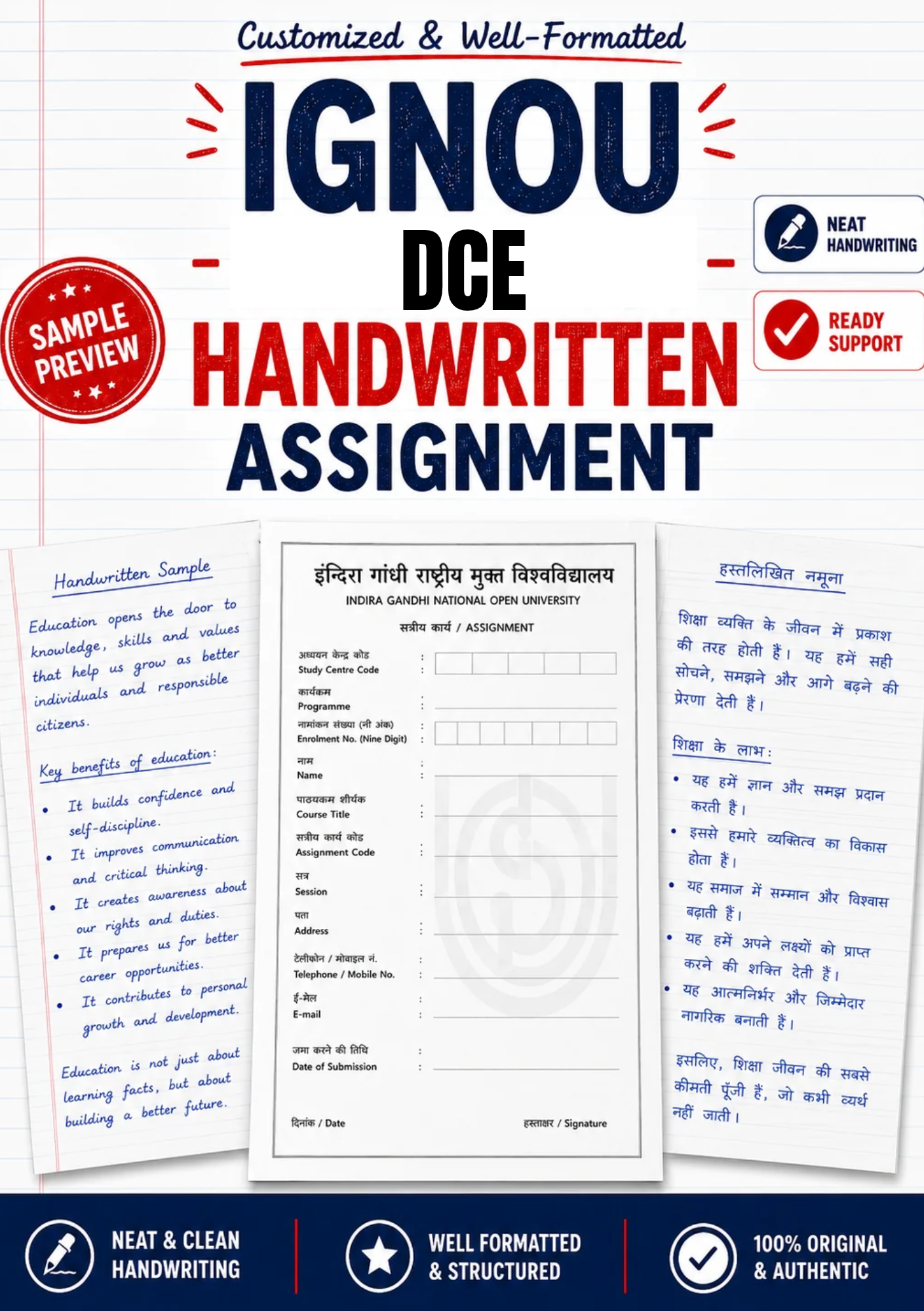
Inside each set you will find the answers written out by hand on foolscap writing paper, with the 5 cm margin on the left, top and bottom that the booklet’s fourth instruction specifies. That margin is not decoration: it is where the evaluator writes comments, and a page written edge to edge leaves no room for them. The set also carries an IGNOU-format front page, completed with the enrolment number, course code, course title and study centre details you supply, and a printed copy of the question paper for that course and session, so that anyone checking the set can see exactly which paper was answered.
Creative writing assignments differ from most IGNOU papers in one practical way: a large share of the marks sits on original pieces rather than on explained theory. In the 2025-26 booklet, DCE 1 asks for a detective story of roughly 750 to 1,000 words, DCE 3 asks for five separate stories, DCE 4 asks for a radio documentary, a radio play, a television public service announcement, a television documentary and a talk, and DCE 5 asks for a rewritten poem among its ten questions. A handwritten DCE set is consequently longer and more varied than a set built on short definitions, and the page count follows what the paper demands rather than a fixed number.
The booklet’s seventh instruction asks you to write “ASSIGNMENT FOR DIPLOMA IN CREATIVE WRITING IN ENGLISH” on top of the cover in which the answer sheets are handed over. Study centres differ on whether that means an envelope or a file cover, so ask yours before you submit and add the heading in your own hand. No soft copy or PDF is sold. What reaches you is paper, and only paper.
Where ₹320 Begins and Ends on a Creative Writing Paper
The rate is ₹320 per subject, hard copy only, with courier included in that price and no separate shipping charge. On this programme a subject means one DCE course code, so the usual full order of DCE 1 plus three electives comes to four times ₹320, which is ₹1,280, and a learner who has already submitted DCE 1 and needs only two electives pays for two. There is no minimum order: one subject or fourteen, same rate.
Inside the price sit the handwriting, the foolscap paper, the matched hand, the front page, the copy of the question paper and the courier to your address. Outside it sit four things. The first is DCE 6, the Guided Project Work, which is not an assignment and is not prepared here in any form. The second is the act of submission: you hand the sets in at your study centre or through whatever route your Regional Centre has announced. The third is any paper IGNOU has not yet published, because a set can only answer a question paper that exists. The fourth is any statement about results. Delivery depends on your pin code and is confirmed for your order before you pay. No figure is promised on this page.
Model Answers or Your Own Pages: The Solved and Handwritten Split for DCE
Two products with similar names do two different jobs. A solved assignment is a digital file of model answers prepared for one course code and one session, meant to be read and then written from. A handwritten assignment is the answers written out by hand and submitted in hard copy at the study centre; for DCE that means foolscap sheets, not the A4 paper that many general guides assume. Learners often search for one when they need the other, so the difference is set out below.
| Point of comparison | DCE solved assignment | DCE handwritten assignment |
|---|---|---|
| Format | Digital reference file of model answers | Physical foolscap pages written by hand |
| What you do with it | Read it, then write your own answers | Review it, sign the front page, submit it |
| Who it suits | Learners with time to write four sets themselves | Learners who need the written sets prepared |
| Price line | Listed on the solved-assignment shelf | ₹320 per course code, courier included |
On a narrow screen, swipe the table sideways to see every column.
IGNOU’s own wording settles which of the two can be handed in. The sixth instruction in every 2025-26 DCE file reads: “You should not send printed articles as your answers to assignments.” A printout of a downloaded file is a printed article in exactly that sense, and the third instruction, which asks for “foolscap-size writing paper (but not of very thin variety)”, assumes the answers are written onto paper, not printed onto it. A solved assignment is therefore a reference to write from. It is not a submission, and nothing on this page suggests it can be used as one.
If a reference file is what you want, the store keeps IGNOU DCE solved assignment PDFs for reference on a separate shelf, and that shelf is where questions about solved files belong. This product exists for the other case, where the four sets have to arrive as written paper.
Ready to hand over DCE 1 and your three electives as written foolscap sets?
The rate is ₹320 per subject, hard copy only, with courier included in that price and no separate shipping charge.
DCE 1 Plus Three Electives: The Codes This Set Covers
The Common Prospectus July 2026 lists the Diploma in Creative Writing in English in section 9.6 under the School of Humanities. It gives eligibility as 10+2, or for anyone without 10+2, an age of 20 years or above; English as the only medium of instruction; a minimum duration of one year and a maximum of three; and a programme fee of Rs. 4,000. Its course table is reproduced below with the official titles exactly as the prospectus prints them, plus a column showing which codes actually carry an assignment.
| Code | Official title (prospectus) | Credits | Group | Assignment in the booklet |
|---|---|---|---|---|
| DCE 1 | General Principles of Writing | 4 | Compulsory | Yes, always submitted |
| DCE 6 | Guided Project Work | 4 | Compulsory | No Tutor Marked Assignment |
| DCE 2 | Feature Writing | 4 | Elective | Yes, if chosen |
| DCE 3 | Short Story | 4 | Elective | Yes, if chosen |
| DCE 4 | Writing for Media: Radio and Television | 4 | Elective | Yes, if chosen |
| DCE 5 | Writing Poetry | 4 | Elective | Yes, if chosen |
Swipe sideways on a phone to read the last two columns.
The six rows add up to 24 credits, which matches the “Total Credits 24” printed beneath the table, so the extraction is clean and no neighbouring programme has bled into it. The arithmetic that matters to a learner is different, though. The same table instructs applicants to choose any three of the four electives, and the admission form in the prospectus repeats that DCE applicants pick any three courses from DCE 2, DCE 3, DCE 4 and DCE 5. A learner who completes the diploma therefore studies DCE 1, DCE 6 and three electives, which is 20 credits, not 24. The 24 describes the menu; the 20 describes the meal.
For this product the 20 shrinks again to 16, because DCE 6 is a project with no assignment. Four of the five courses you study, each worth 4 credits, carry a handwritten assignment, and those four are what a DCE order covers. If you are unsure which three electives you registered for, the answer is on your admission record and your identity card, not on a booklet, because the booklet prints all four elective papers for everyone.
Choosing Three of DCE 2, 3, 4 and 5 Before You Order
The four elective papers ask for very different kinds of writing, and the difference shows up directly in what a handwritten set contains. The table below is read from the 2025-26 booklet files on ignou.ac.in. It gives the assignment code exactly as each file prints it, including the inconsistent spacing, because that is the string your front page has to carry.
| Course | Code as printed | Questions | Kind of writing asked for |
|---|---|---|---|
| DCE 1 | DCE 1/ TMA/1/2025-2026 | 9 (eight of 10 marks, one of 20) | Short notes, passage analysis, dialogue rewrite, detective story |
| DCE 2 | DCE 2/ TMA/1/2025-2026 | 5 of 20 marks | Features and reviews, with a choice of topic in the last question |
| DCE 3 | DCE 3/TMA/1/2025-2026 | 5 of 20 marks | Five complete short stories, including one for children |
| DCE 4 | DCE 4/ TMA/1/2025-2026 | 5 of 20 marks | Radio documentary, radio play, TV announcement, TV documentary, talk |
| DCE 5 | DCE 5/ TMA/1/2025-2026 | 10 of 10 marks | Poem rewriting, endings, imagery, metre, structure |
The code column keeps IGNOU’s own spacing; swipe to see the final column on mobile.
None of the five 2025-26 papers prints a word limit, and only DCE 1 changed its instruction line from the year before. The 2024-25 DCE 1 paper said to answer any five questions, choosing at least two from each section, with most questions worth 20 marks. The 2025-26 paper drops the sections and the choice, says simply “Answer the following”, and sets nine questions that add up to 100. A learner reusing advice written for the earlier paper would attempt five questions where nine are now expected.
Your electives were fixed at admission, so a set is written only for the three codes on your record. If you once registered for DCE 4 and later asked your Regional Centre to change it, send the updated record rather than the original form, because the front page has to match what IGNOU holds against your enrolment number.
Fifteen Places Where DCE Paperwork Contradicts Itself
Reading the prospectus, the programme page on ignou.ac.in, six cycles of DCE booklets and the term-end papers against one another produced the list below. None of these is a reason to delay submitting, but several of them change what you write on a front page, and two of them concern this store’s own pages.
Every disagreement found while building this page, including two on shrichakradhar.com itself.
1. Credits. The prospectus prints “Total Credits 24” under a table that lists six 4-credit courses, yet tells applicants to choose three of the four electives, so a finished DCE carries 20 credits.
2. Course count. The prospectus introduction says the programme “consists of two compulsory courses and four elective courses”, while the same table limits each learner to three electives.
3. Time allowed. Four figures exist: three years maximum in the prospectus, 24 months maximum on IGNOU’s DCE programme page, three years to submit in the 2024-25 booklet, and “1+4 years” (2026 to 2030) in the 2025-26 booklet.
4. DCE 1 title. The 2020-21 and 2021-22 booklets call the course “Fundamentals of Writing”; the prospectus and later booklets say “General Principles of Writing”; a BA English Major booklet cover says “General Principle of Writing”.
5. DCE 4 title. The prospectus says “Writing for Media: Radio and Television”, the 2025-26 booklet prints “WRITING FOR MEDIA: RADIO TELEVISION”, and the June 2020 term-end paper printed “WRITING FOR RADIO AND TELEVISION”.
6. Course code form. The same course appears as DCE 1 (prospectus), DCE-01 (programme page and booklet file names), DCE 01 (booklet heading), DCE-1 (several term-end papers from 2019 to 2022) and DCE-001 (June 2026 term-end paper).
7. TMA number. The 2022-23 and 2023-24 booklets print codes such as DCE 1/ TMA/2023-2024 with no TMA number; the 2024-25 booklet adds “/1/” to DCE 1 only and leaves DCE 2 to DCE 5 without it; the 2025-26 booklet adds it to all five.
8. Spacing. Within the 2025-26 booklet, DCE 1, 2, 4 and 5 print a space after the slash (“DCE 1/ TMA/1/2025-2026”) and DCE 3 prints none (“DCE 3/TMA/1/2025-2026”).
9. DCE 1 question pattern. The 2024-25 paper offers a choice of five questions across two sections; the 2025-26 paper removes the choice and sets nine questions.
10. BA English Major reuse. IGNOU issues DCE 01 and DCE-02 to BAFEG learners under separate booklets for the January and July 2024 sessions, one printing the code “DCE 01/ TMA/1/2024” with “Programme: BAFEG”, while the DCE table in the prospectus mentions no such sharing.
11. Blank instruction. Every 2025-26 DCE file numbers its instructions 1 to 8 and prints nothing after “8.”, and the fifth instruction speaks of “separate sets for each block” where each course is meant.
12. Current cycle. As of 19 November 2026 no readable 2026-27 DCE booklet was found; a file at the 2026-27 address on ignou.ac.in returned no machine-readable text, and both dates on the latest readable booklet have passed.
13. Online variant. The prospectus lists a separate online programme, DCEOL, and the June 2023 DCEOL term-end papers were 50-mark multiple-choice tests of 90 minutes, unlike the 100-mark, three-hour DCE papers.
14. In-house, guess papers. The DCE guess-paper category on shrichakradhar.com still carries a “90+ marks” line in its description. This page makes no marks claim of any kind, and that line is in the correction queue.
15. In-house, delivery. The handwritten category hub on shrichakradhar.com still states a delivery window in working days in its meta description. This page states none, for the reason given in the delivery sentence above.
Where these sources disagree, the safest reading for a learner is the one printed on the booklet for the session you are submitting, checked against your own admission record. Programme structures, course codes, submission dates and rules change, and only ignou.ac.in and your Regional Centre can confirm the current position for your enrolment.
31 March and 30 September: The SOH Dates on a DCE Booklet
DCE is a School of Humanities programme, and its booklet prints dates in the School of Humanities pattern, not the 31 October and 30 April pair that management programmes use. The 2025-26 booklet gives the last date of submission as 31st March 2026 for the July 2025 session and 30th September 2026 for the January 2026 session. The 2024-25 booklet followed the same shape one year earlier: 31st March 2025 for the July 2024 session and 30th September 2025 for the January 2025 session. In both, the July intake submits in the following March and the January intake submits in the following September.
Two points follow. First, a DCE learner should not plan around the dates that circulate on general news and aggregator pages for “IGNOU assignments”, which in 2026 were mostly 30 April and 31 October. Neither appears on any DCE booklet read for this page. Second, the booklet prints one block of dates for the whole programme rather than one per course, and it adds that all assignments must be submitted on or before the date set and that the assignments of any course go in one batch, with no piecemeal submission.
The difficult point is the present cycle. On 19 November 2026 the newest DCE booklet that could be read on ignou.ac.in was the 2025-26 one, and both of its dates had passed. A file sitting at the 2026-27 address returned no readable text, so its dates could not be checked and none is quoted here. If you were admitted in July 2026, read the dates off the paper your study centre or the IGNOU download page gives you, and send that paper with your order. Papers expire and are replaced each cycle, and a set is always written against the paper you name, never against a guess at the next one.
Why DCE 1 Carries a /1/ and DCE 3 Has No Space
The assignment code is the line an evaluator uses to match your set to a course and a cycle, so it is worth copying exactly. On the 2025-26 booklet it has four parts: the course code (for example “DCE 1”), the letters “TMA” for Tutor Marked Assignment, the assignment number “1”, and the academic span “2025-2026” written with all four digits of both years. That four-digit span is itself a School of Humanities habit; management papers print a single year with the session name instead.
The number in the middle has not always been there. The booklets for 2022-23 and 2023-24 print codes such as “DCE 1/ TMA/2023-2024”, with no assignment number at all. The 2024-25 booklet adds “/1/” to DCE 1 but leaves DCE 2, DCE 3, DCE 4 and DCE 5 without it, and only the 2025-26 booklet applies it to all five. If you are submitting a backlog against an older booklet, copy the code as that booklet prints it rather than updating it to the current shape.
The space after the slash is a smaller matter but a real one. Four of the five 2025-26 papers print “DCE 1/ TMA”, with a space, and the DCE 3 paper prints “DCE 3/TMA” without one. Front pages prepared by Shri Chakradhar Publication copy the string from the paper you send, character for character, so whichever form your paper uses is the form that appears on your set. The term-end paper code is a different thing again: the June 2026 examination paper printed DCE-001, and that form belongs to examination documents, not to your assignment.
A Hand That Matches Your Own, Written on Foolscap Instead of A4
Send a photo of a page you have written yourself and the handwritten set is matched to your handwriting at no extra charge. The sample tells the writer how you form letters, how much you slant, how wide your lines run and how you lay out a heading, and the four DCE sets are written to follow it. It is reviewed before you pay, so the decision to go ahead is made after you have seen that the match is acceptable to you.
Paper size is where DCE differs from the assumption built into most advice online. The third instruction in the School of Humanities booklet asks for foolscap-size writing paper that is not of a very thin variety, and the fourth asks for a 5 cm margin on the left, top and bottom. Foolscap is longer than A4, so a hand that fits a certain number of words on an A4 line spreads differently down a foolscap page. The writer keeps your letter forms and spacing and lets the page length follow from the longer sheet, which is why page counts on a DCE set run lower than the same text on A4.
Choosing the page you photograph for a creative writing set
Pick a page of continuous prose rather than a list or a form, because DCE answers are long passages, stories and scripts. Two or three paragraphs in your normal pen and at your normal speed show far more than a single neat line written carefully for the camera. Photograph it flat, in daylight, with the whole page in frame. If you write dialogue differently from narration, for example by starting each speaker on a new line, include a few lines of dialogue too, since DCE 1, DCE 3 and DCE 4 all ask for it.
English Only, a Five-Year Window, and Older Booklets
The prospectus names English as the only medium of instruction for DCE, and every DCE booklet read for this page is in English, which makes sense for a diploma whose subject is writing in English. The service covers all mediums IGNOU issues the TMA paper in, at the same price. For DCE that is one medium, and a Hindi DCE set is not something IGNOU’s papers allow for.
Older cycles are a common reason to order. The 2025-26 booklet tells a learner who misses the first year that the assignments can be submitted in any of the next four years, up to 2030, and asks that the booklet for the year of submission be used. The 2024-25 booklet allowed three years. Any session is accepted, current cycle or older, including backlog courses, at the same ₹320 per subject. Tell the publisher which booklet year you are answering, because the questions changed substantially between 2024-25 and 2025-26, and a set written against the wrong paper is a set written against the wrong questions.
If you study the online variant, DCEOL, check with your learner support portal before ordering, because online programmes run their own submission arrangements. This product follows the open and distance learning booklet described throughout this page.
What to Type in Your First DCE Message
Five pieces of information are enough to start, and nothing else is needed at the first message:
- Your enrolment number, exactly as it appears on your identity card.
- The four codes you owe, normally DCE 1 plus your three electives, or fewer if some are already submitted.
- The booklet year, such as 2025-26, or a photo of the paper itself if a newer one has reached you.
- Your study centre code and your pin code, so that the front page can be completed and the courier quoted.
- A photo of one page in your own handwriting, chosen as described above.
Name and address details for delivery follow once the sample has been approved. Payment is taken only after you have seen the handwriting sample and the delivery position for your pin code, so nothing is paid on the strength of a promise.
Your three electives and DCE 1, matched to your hand and written on foolscap.
The rate is ₹320 per subject, hard copy only, with courier included in that price and no separate shipping charge. Delivery depends on your pin code and is confirmed for your order before you pay. No figure is promised on this page.
Checking the Bundles Against the Booklet When They Arrive
When the packet reaches you, lay each set beside its question paper and run three checks. First, the code: the assignment code on the front page should match the paper character for character, including the space after the slash or its absence. Second, the coverage: DCE 1 on the 2025-26 paper has nine questions, the electives have five or ten, and every one should be answered, because the booklet asks you to answer all the questions in an assignment before submitting it. Third, the creative pieces: read the stories, scripts and poems as a reader would, since they carry a large share of the marks and they are the parts most worth knowing well before the term-end examination.
You sign the declaration on the assignment cover page, so you should read and review the content before submitting it, and satisfy yourself that it represents your own understanding of the course. Keep a photocopy of every set and any acknowledgement the study centre gives you. Submit each course’s assignment in one batch, as the booklet requires, and do so before the date printed on your paper. Assignments carry 30 per cent of the final course result and the term-end examination carries the remaining 70 per cent. That weighting is why the booklet also warns against sitting a course’s examination before its assignment is in.
No claim is made about the marks any assignment will receive, about how an evaluator will assess it, or about whether it will be accepted. Assignment evaluation is entirely a matter for IGNOU.
Other Shelves a Creative Writing Learner Uses
Most DCE learners need more than the four sets. For the term-end examination, the store’s DCE solved guess papers for the June and December examinations sit on their own shelf, inside the wider collection of diploma-level guess papers. Printed study support for one-year programmes is grouped under IGNOU diploma help books; at the time of writing that shelf had no separate DCE category, which is noted in the correction queue rather than worked around with a misleading link.
The handwritten service as a whole, across every programme the store covers, is described on the IGNOU handwritten assignment hub, and a general explanation of how ordering works is on the handwritten assignments information page. If your paper comes from a cycle or a combination that does not fit a single programme, such as a DCE backlog combined with codes from another enrolment, the customised handwritten order for any session takes mixed lists.
Two acronyms are easy to confuse. If the diploma on your identity card is early childhood care and education rather than creative writing, your codes begin with DECE, not DCE, and the relevant material starts from the DECE early childhood books shelf instead. Solved files for every diploma, not only DCE, are collected under diploma solved assignments across all programmes. And if you would rather write the four sets yourself, the sister site ignouproject.com keeps a programme guide to the DCE diploma and its courses that explains the structure in more depth.
What Creative Writing Diploma Learners Ask First
How many DCE assignments do I actually have to submit?
Four. The booklet holds five assignment papers, for DCE 1 to DCE 5, and asks for four of them: DCE 1, which is compulsory for everyone, and the three electives you chose from DCE 2, DCE 3, DCE 4 and DCE 5. DCE 6 is a project and has no assignment, so a full DCE order is four handwritten sets at ₹320 each.
Is the DCE 6 Guided Project Work part of this order?
No. DCE 6 carries 4 credits but no Tutor Marked Assignment, and it is not prepared here in any form. The four handwritten sets cover DCE 1 and your three electives only. Project work follows the guidance IGNOU issues for that course and is a separate matter between you and the university.
Foolscap ya A4, DCE assignment kis paper pe likhna hai?
Foolscap. The School of Humanities booklet asks for foolscap-size writing paper that is not very thin, with a 5 cm margin on the left, top and bottom. Many general guides say A4 because some other schools allow it, but the DCE booklet does not, and every DCE set from this publisher is written on foolscap for that reason.
What is the last date for the DCE assignment in 2026?
The latest readable DCE booklet gives 31 March 2026 for the July 2025 session and 30 September 2026 for the January 2026 session. Both have passed. As of 19 November 2026 no readable 2026-27 DCE booklet had been found, so if you joined in July 2026, use the dates printed on the paper you hold and send that paper with your order.
Can I print a DCE solved assignment PDF and submit it?
No. Every 2025-26 DCE paper instructs learners not to send printed articles as answers, and asks for answers written on foolscap writing paper. A solved file is a reference to read and write from. The handwritten set exists for the case where written pages are what you need to hand in.
DCE solved assignment aur handwritten assignment mein kya farak hai?
A solved assignment is a digital file of model answers that you read and then write from yourself. A handwritten assignment is the finished foolscap pages in a hand matched to yours, with a front page and the question paper, ready for you to review, sign and submit. One is study material and the other is a written set.
Is a typed or computer-printed DCE assignment allowed?
The DCE booklet does not invite it. Its instructions are written around writing paper of a set size and margin, and the sixth instruction rules out printed articles as answers. If your study centre has issued a different instruction for your batch, follow the centre, and tell the publisher before ordering.
I only chose DCE 3 and DCE 5 and have submitted DCE 1 already. Can I order just two?
Yes. There is no minimum order: one subject or fourteen, same rate. Send the two codes, the booklet year and a handwriting sample, and the two sets are written alone. Remember that each course’s assignment has to go in as one batch, so do not split a single course across two submissions.
My June 2026 exam paper said DCE-001 but my assignment says DCE 1. Which is right?
Both, for different documents. IGNOU printed DCE-001 on the June 2026 term-end paper and DCE-01 on earlier ones, while the assignment booklet uses the form “DCE 1/ TMA/1/2025-2026”. Copy the assignment code from the assignment paper onto your front page, and use the examination code only for examination purposes.
Which assignment code should I copy, with the space or without it?
Copy the paper you are answering exactly. In the 2025-26 booklet, DCE 3 prints “DCE 3/TMA/1/2025-2026” with no space after the slash, and the other four print a space. Front pages prepared here follow the string on your paper character for character, so the set matches whatever your evaluator has in front of them.
I am in BA English Major (BAFEG) and my paper says DCE 01. Is this the right product?
Not quite. IGNOU issues DCE 01 and DCE-02 to BAFEG learners under their own booklets, with “Programme: BAFEG” and a different code form such as “DCE 01/ TMA/1/2024”. The questions and dates can differ from the DCE diploma paper. Send a photo of your BAFEG paper and the set is written against that paper, not this one.
My DCE admission was in 2024. Can the 2024-25 questions still be written?
Yes, if that is the booklet you are allowed to submit against. The 2024-25 booklet gave three years to submit and the 2025-26 booklet gives 1+4 years, so check with your Regional Centre which paper applies to you now. Any session is accepted, current cycle or older, including backlog courses, at the same ₹320 per subject.
DCE ka assignment Hindi mein mil sakta hai?
No. DCE is taught only in English, according to the prospectus, and its papers are issued only in English. A Hindi set would answer a paper that does not exist. If your programme is a Hindi-medium diploma with a similar-sounding code, check the code on your identity card first.
DCE 1 asks for a 750 to 1,000 word detective story. How is that handled?
It is written in full, in the length the paper asks for, as part of the DCE 1 set. Because creative pieces carry a large share of the marks and also come up in the term-end examination, read every story, script and poem in your sets carefully before you sign the front page and hand it in.
Prospectus, Booklet, Publisher: How Each Line Was Checked
This page draws on three kinds of source, and each claim above belongs to exactly one of them. They are kept apart here so that you can see which statements come from IGNOU and which come from the publisher.
What comes from the Common Prospectus July 2026
The course table, the official titles, the 4 credits per course, the “Total Credits 24” line, the instruction to choose any three electives, eligibility, English as the medium, the one-year minimum and three-year maximum, the Rs. 4,000 fee and the listing of DCEOL among online programmes are all read from the Common Prospectus July 2026, sections 9.6 and the online-programme list, with the six credit rows summed against the printed total before the table was used.
What comes from the DCE booklets on ignou.ac.in
The submission dates, the four-of-five rule, foolscap paper and margins, the printed-articles instruction, the one-batch rule, the assignment codes, the question patterns and the “1+4 years” window come from the 2025-26 DCE booklet files for DCE 1, DCE 2, DCE 3, DCE 4 and DCE 5 on ignou.ac.in, read on 19 November 2026. The comparisons with earlier years come from the 2024-25, 2023-24, 2022-23, 2021-22 and 2020-21 DCE booklets on IGNOU’s webservices archive, and the BAFEG and term-end details from IGNOU’s own question-paper and assignment files. The IGNOU assignment download service is where the current paper for your enrolment should be checked.
What comes from Shri Chakradhar Publication alone
The ₹320 rate, the courier arrangement, the free front page, the copy of the question paper, the matched handwriting, the absence of a minimum order and the handling of older sessions are the publisher’s own commercial terms. They are not IGNOU rules and IGNOU has no part in them.
Important Notice
Shri Chakradhar Publication Pvt. Ltd. and shrichakradhar.com form an independent IGNOU study-support publisher. This is not the official website of Indira Gandhi National Open University, is not affiliated with, endorsed by or authorised by the university, and no page on this site should be treated as an official IGNOU communication.
Programme structures, course codes, submission dates and rules change, and only ignou.ac.in and your Regional Centre can confirm the current position for your enrolment.
You sign the declaration on the assignment cover page, so you should read and review the content before submitting it, and satisfy yourself that it represents your own understanding of the course.
No claim is made about the marks any assignment will receive, about how an evaluator will assess it, or about whether it will be accepted. Assignment evaluation is entirely a matter for IGNOU.
Your DCE 1 and Three Electives, Written Out by Hand
The rate is ₹320 per subject, hard copy only, with courier included in that price and no separate shipping charge. No soft copy or PDF is sold.
Send your enrolment number, your four DCE codes and a photo of your handwriting, and the sample comes back for approval before anything is paid.