

Description
In short. A DNHE handwritten assignment from Shri Chakradhar Publication is the Diploma in Nutrition and Health Education Tutor Marked Assignment written out by hand on A4 ruled sheets, one bundle for each of the three paper codes that carry a TMA, which are DNHE 1 Nutrition for the Community, DNHE 2 Public Health and Hygiene and DNHE 3 Nutrition and Health Education, each worth 8 credits and each assignment carrying 100 marks of which Section A accounts for 60 and Section B practical activities account for 40. The rate is ₹320 per subject, hard copy only, with courier included in that price and no separate shipping charge. The fourth course, DNHE 4, is project work and is not part of this order. Unusually for IGNOU, the three DNHE papers do not share a deadline: the 2026 booklets print 30 May 2026, 30 July 2026 and 30 September 2026 for the January session and 30 December 2026, 30 January 2027 and 31 March 2027 for the July session, one pair per paper, so the date that applies to you depends on which code you are writing as much as which session you joined.
The Physical Things a DNHE Order Puts in Your Hands
Everything in a DNHE order is paper. Shri Chakradhar Publication prepares one bundle for each course code you name, and each bundle leaves the press as a set of A4 ruled sheets carrying the answers to that paper in a single consistent hand, written in one ink, with the question number set against each answer the way the DNHE booklet asks for it. The sheets are tied rather than loose, because the DNHE-1 booklet tells learners to use foolscape paper and tie the pages together, and the DNHE-2 booklet asks for each assignment to sit on separate sheets pinned properly. Both instructions are reproduced as printed, including IGNOU’s own spelling.
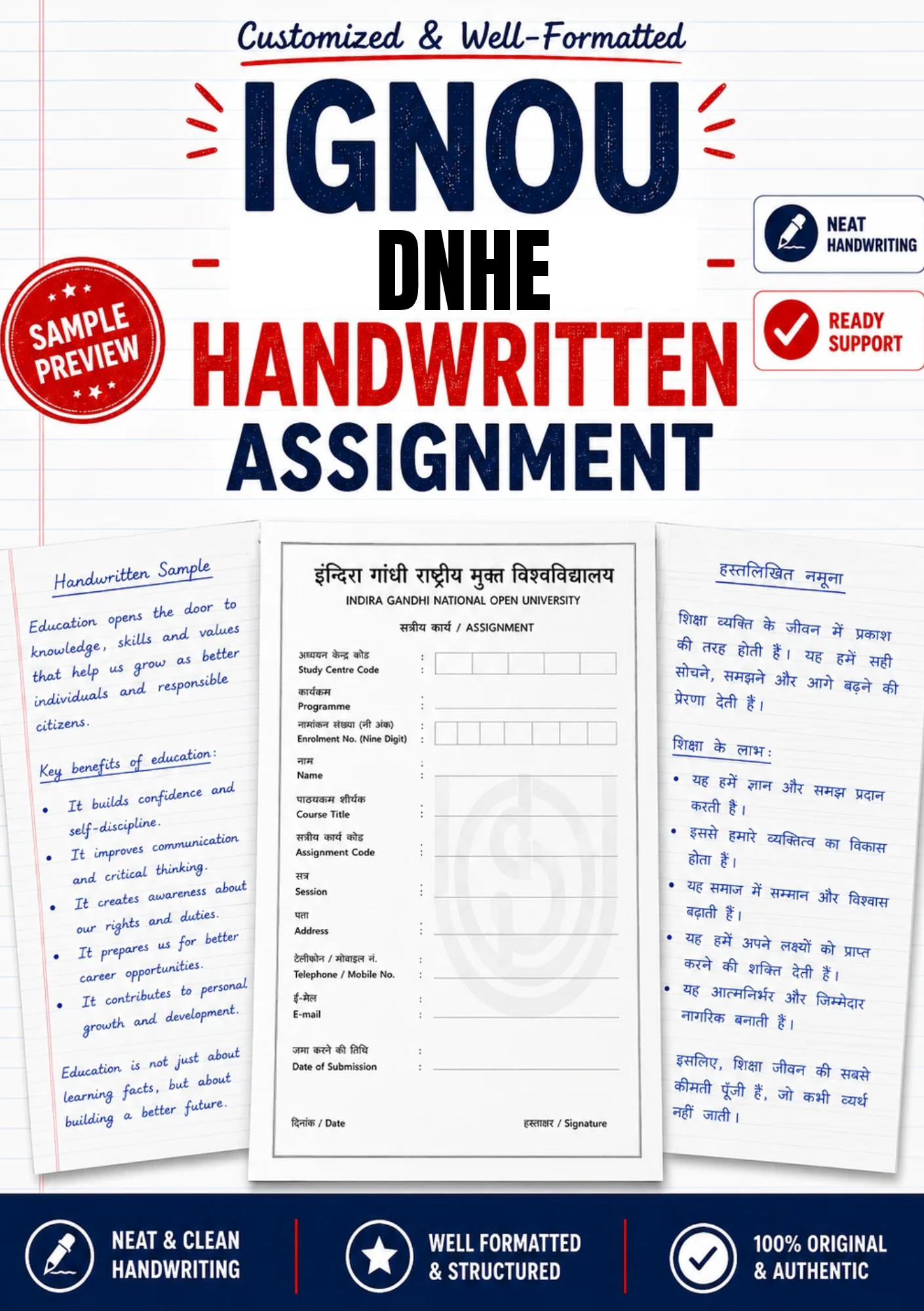
On top of the answer sheets each bundle carries an IGNOU-format front page, free with every order, left unsigned. The front page is the sheet that carries your enrolment number, your name, your programme and course code, your study centre and the session, and it is also the sheet that carries the declaration. That declaration is yours to sign and nobody else’s, which is why it arrives blank.
A copy of the official TMA paper for that code and session travels with the bundle as well. This matters more on DNHE than on a purely theoretical programme, because a DNHE evaluator reading Section B needs to see which activity the answer is responding to, and because the paper is the only document that fixes your own cut-off date in writing. No soft copy or PDF is sold. Delivery depends on your pin code and is confirmed for your order before you pay. No figure is promised on this page.
What ₹320 Settles Per Paper, and What It Leaves With You
The rate is counted per course code, not per programme and not per semester, because a DNHE learner can be carrying one open paper or all three. There is no minimum order: one subject or fourteen, same rate. Inside the ₹320 sit the writing of Section A, the paper and ink, the IGNOU-format front page, the copy of the question paper, the handwriting match, and the courier to your address. Nothing in that list is quoted separately and nothing is added at dispatch.
Three things sit outside it, and saying so plainly is more useful than a longer list of inclusions. The first is the Section B field data, which is dealt with in its own section below. The second is DNHE 4, the 8-credit project course, which IGNOU records as a project report rather than a Tutor Marked Assignment and which the prospectus describes as the learner experiencing the feel of working as a nutrition and health educator in community settings. Project work is a different service and lives on the DNHE 4 project and synopsis shelf rather than here. The third is anything to do with how the work is marked. No claim is made about the marks any assignment will receive, about how an evaluator will assess it, or about whether it will be accepted. Assignment evaluation is entirely a matter for IGNOU.
What the rate buys you in practical terms is the thirty per cent. Assignments carry 30 per cent of the final course result and the term-end examination carries the remaining 70 per cent. The DNHE programme guide states the figure from its own side, recording that the assignments of a course in DNHE carry 30 per cent weightage, although it prints no matching percentage for the examination. On a 32-credit diploma where three of the four courses carry a TMA, that is a substantial share of the qualification decided before you sit a single paper, and the guide adds a harder consequence: no hall ticket is issued for a course whose assignment has not been submitted.
A File You Read Against a Bundle the Study Centre Keeps
Two products are sold under names that sound alike, and DNHE learners run into the confusion more often than most because the store carries both for the same codes. A solved assignment is a soft-copy reference file of model answers for one course code and one session, read on screen or printed out and used as study material while you compose your own version. A handwritten assignment is those answers written out by hand on paper, tied per course code, and submitted in hard copy at the study centre allotted to you.
| What differs | Solved assignment (soft copy) | Handwritten assignment (hard copy) |
|---|---|---|
| Format | A PDF file for one code and session | Tied A4 ruled sheets in one hand, per code |
| What you do with it | Read it, then write your own version | Review it, sign the front page, hand it in |
| What the DNHE booklet asks for | Nothing: the booklet asks you to write in your own handwriting | Written in a single hand, question numbers marked, pages tied |
| Who it suits | A learner who has the time to write but not the content | A learner short of writing time before a dated cut-off |
| Section B field readings | Shows the method and the table layout | Writes out the readings you supply, never invented ones |
| Price on this store | From ₹19 per code | ₹320 per subject, courier included |
The table scrolls sideways on a narrow screen.
The scoping line that matters: a solved assignment is a reference to write from, not a submission. A downloaded PDF printed out and handed over is typed work, and the DNHE booklets ask for answers in your own handwriting. If the soft-copy route is what you actually want for DNHE 1, DNHE 2 or DNHE 3, the store keeps a worked shelf for exactly that and the DNHE solved assignment files by code and session are the right place to go, not this page. This page sells the written bundle.
Start with whichever DNHE paper is closest to its date. Each bundle is ₹320 per subject with courier included, and the papers do not share a deadline, so the order usually begins with the code whose cut-off falls first rather than with DNHE 1 by default.
Sixty Marks of Writing Across DNHE 1, DNHE 2 and DNHE 3
DNHE is a four-course diploma and the Common Prospectus July 2026 sets it out plainly: four courses at 8 credits each, 32 credits in total, taught in English and Hindi from the School of Continuing Education. Three of those four courses carry a Tutor Marked Assignment. The DNHE-2 booklet states the split in its own words, that you will have to do three assignments in all and that Assignment 1 is based on DNHE-1, Assignment 2 on DNHE-2 and Assignment 3 on DNHE-3. The fourth course has no TMA because it is project work.
The credits are not evenly theory. The DNHE programme guide breaks each of the three taught courses into 6 theory credits and 2 practical credits, which is why the practical half of each assignment is worth so much: a quarter of each course’s credit load is practical, and 40 of each assignment’s 100 marks follow it. The same guide records the printed material as 70 units across 18 blocks, counted as 25 units for DNHE-1, 24 for DNHE-2 and 21 for DNHE-3, plus three practical manuals and one book on project work.
| Code | Official title | Credits | TMA | Assignment code on the 2026 paper | January 2026 session | July 2026 session |
|---|---|---|---|---|---|---|
| DNHE 1 | Nutrition for the Community | 8 (6 theory, 2 practical) | Yes, Assignment 1 | DNHE-1/AST-1/TMA-1 /26 | 30 May 2026 | 30 December 2026 |
| DNHE 2 | Public Health and Hygiene | 8 (6 theory, 2 practical) | Yes, Assignment 2 | DNHE-2/AST-2/TMA-2/26 | 30 July 2026 | 30 January 2027 |
| DNHE 3 | Nutrition and Health Education | 8 (6 theory, 2 practical) | Yes, Assignment 3 | DNHE-3/AST-3/TMA-3/26 | 30 September 2026 | 31 March 2027 |
| DNHE 4 | Project Work : Nutrition and Health Education | 8 (project report) | No TMA | Not applicable | Project timetable, not a TMA date | Project timetable, not a TMA date |
The table scrolls sideways on a narrow screen.
The credits add up as IGNOU states them: 8 plus 8 plus 8 plus 8 gives the 32 the prospectus prints, which is the arithmetic worth checking before trusting any course table copied off a listing site. Note the code column as well. The prospectus writes these courses as DNHE 1, DNHE 2, DNHE 3 and DNHE 4 with a space; the assignment booklets write DNHE-1, DNHE-2 and DNHE-3 with a hyphen; and IGNOU’s own file names and the Diploma in Value Education course table write DNHE-01 and DNHE 01 with a leading zero. All three forms refer to the same courses, and the one your study centre expects on the front page is the one printed on the paper you downloaded.
DNHE 3 deserves one extra line because its official title, Nutrition and Health Education, is word for word the name of the programme itself and also the tail of DNHE 4’s project title. A learner searching for the programme and a learner searching for the third paper produce the same phrase, which is why it is worth naming the code rather than the title when you order. The DNHE 3 reading list is also where the DNHE help books and guide sets earn their place, since the communication and campaign-planning blocks are the ones learners most often find thin in the original material.
Where the Other Forty Marks Have to Come From You
This is the section that decides whether a DNHE handwritten order is the right purchase, and it is the one most sellers leave out. Each DNHE assignment is 100 marks. Section A is ten compulsory descriptive questions worth 60 marks, the kind of content a writer can prepare from the blocks and the previous papers. Section B is worth 40 marks across four questions of 10 each, and the 2026 papers do not ask you to describe a method. They ask you to go and do something, then record what happened.
| Paper | Section A | Section B | What Section B asks you to actually do in 2026 |
|---|---|---|---|
| DNHE-1 | 60 marks, 10 questions | 40 marks, 4 questions | Design a poster or handout on iron-deficiency anaemia; build a seven-day low-cost diet with daily costs; measure the mid-upper arm circumference (MUAC) of ten children aged one to five and classify them by colour zone; sun-dry a vegetable over three days recording weight, colour, texture and moisture |
| DNHE-2 | 60 marks, 10 questions | 40 marks, 4 questions | Survey five diabetic people nearby on diet and symptoms; survey five respondents on home diarrhoea control and teach them oral rehydration; visit an anganwadi and record ten immunisation beneficiaries against the national schedule; write five elderly home-safety messages |
| DNHE-3 | 60 marks, 10 questions | 40 marks, 4 questions | Prepare flash cards on food groups, protein energy malnutrition or complementary feeding; develop two puzzles for school children; write a story about a deficiency disorder and make rod puppets for it, then present it to children and record their reactions and what they took from it |
The table scrolls sideways on a narrow screen.
Read that column once and the commercial position follows on its own. Nobody can measure ten children in your locality for you, and no honest service will pretend to. What Shri Chakradhar Publication can do is take Section A off you completely, set out the Section B recording tables in the matched hand exactly as the paper lays them out, and write up your own readings and observations in that same hand once you send them. The numbers stay yours. You sign the declaration on the assignment cover page, so you should read and review the content before submitting it, and satisfy yourself that it represents your own understanding of the course.
There is a second reason to take Section B seriously. The DNHE programme guide records that re-evaluation is not permissible for projects, practicals and assignments, printed in the guide as “Re-evaluation i not permissible for Projects, Practicals and Assignment”, and it adds that once an assignment is passed it cannot be resubmitted for a better grade. There is no second attempt at a DNHE assignment you have already passed, which makes reviewing the bundle before you hand it in the only safeguard available.
One footnote on where Section B is supposed to come from, because IGNOU’s own paper is not consistent about it. The guidelines block at the front of each 2026 booklet says you will be required to submit responses to activities given in Practical Manuals 1, 2 and 3 respectively. The Section B questions actually printed further down cite course block units instead, naming DNHE-1 Units 5, 18, 7, 15 and Unit 25 of Volume 2, DNHE-2 Volume 1 Units 9, 11 and 7 with Volume 2 Unit 22, and DNHE-3 Units 10 and 14. Not one of them names a manual activity number. The guide also describes Practical Manual Part I as six sections running from Weights and Measures to Planning Diets-II rather than numbered activities, while Parts II and III hold eight activities each, so the instruction cannot map cleanly onto all three manuals even in principle.
The DNHE Documents Contradict Each Other at Twenty-Three Points
These came out of reading IGNOU’s own documents against each other rather than from any single source, and they are listed because a learner who hits one of them mid-order loses days. Three of the twenty-three are this publisher’s own errors and are named with the rest.
Where the DNHE documents fail to agree.
1. Three code forms for the same courses: DNHE 1 with a space in the prospectus, DNHE-1 with a hyphen on the booklets, DNHE-01 and DNHE 01 with a leading zero in IGNOU’s file names and in the Diploma in Value Education table.
2. Four names for the programme: Diploma in Nutrition & Health Education in the prospectus contents and admission table, Diploma in Nutrition and Health Education in the prospectus body and the online-mode list, Diploma Programme in Nutrition and Health Education on the booklet covers, and Diploma in Nutrition and Health Nutrition on the programme guide cover.
3. Maximum duration is 3 years in the prospectus admission table, 2 Years on the Regional Centre programme pages at Kolkata, Bhubaneswar, Ahmedabad and Delhi-3, and 03 Years on the online-mode programme portal.
4. Programme fee is Rs. 4,000 in the July 2026 prospectus and Rs. 3,500 in the January 2026 prospectus for the same diploma.
5. The sentence “The Diploma in Nutrition and Health Educations a 32 credit programme consisting of four courses” appears with the same missing words in the prospectus and on IGNOU’s own programme page, so the error has been copied rather than caught.
6. Each 2026 booklet’s guidelines say Section B responses come from activities given in Practical Manuals 1, 2 and 3, but the Section B questions printed in the same file cite course block units and name no manual activity at all.
7. The programme guide describes Practical Manual Part I as six sections rather than numbered activities, while Parts II and III hold eight activities each, so the manual instruction cannot apply evenly across the three.
8. The 2026 DNHE-1 paper prints its code with a stray space, as DNHE-1/AST-1/TMA-1 /26, while the 2026 DNHE-2 paper prints DNHE-2/AST-2/TMA-2/26 without one.
9. In the 2022 edition the stray space sat in the other file: that year’s DNHE-2 paper printed DNHE-2/AST-2/TMA-2 /22, so the artefact has moved between codes rather than being fixed.
10. The 2022 DNHE booklet printed a single shared pair of dates for all three papers, 30 March 2022 and 30 September 2022. The 2026 papers print three different pairs. Anyone working from an older file has the wrong deadline for at least two of their three codes.
11. The 2022 assignments were published as one combined file covering Assignments 1 to 3; the 2026 assignments are published as three separate files.
12. DNHE-3’s July-session date falls on the 31st, as 31 March 2027, while DNHE-1 and DNHE-2 both use the 30th of their months.
13. DECE, the other School of Continuing Education diploma of the same session, prints 30 March for its July session where DNHE-3 prints 31 March, so the two SOCE diplomas differ by a day on the same month.
14. IGNOU Regional Centre Delhi-2’s own assignment guideline sheet for December 2026 prints a blanket pair, 31st March for the June examination and 30th September for the December examination, which matches none of the three pairs on the DNHE papers.
15. Listing sites circulate 30 April 2027 and 31 October 2026 as the DNHE July-2026 date. IGNOU’s own files print 30 December 2026, 30 January 2027 and 31 March 2027 depending on the code.
16. The programme guide gives assignments 30 per cent weightage in DNHE but prints no matching percentage for the term-end examination, so the remaining 70 per cent is stated here from IGNOU’s general rule rather than from the DNHE guide.
17. CNCC 1 in the Certificate in Nutrition and Child Care carries DNHE 1’s exact official title, Nutrition for the Community, at the same 8 credits, but prints a shorter code, CNCC-1/AST-1/26, and different dates, 15 May 2026 and 15 November 2026. A search on the course title can land you on the wrong deadline.
18. The 2026 CNCC-1 paper prints Section A at 40 marks and Section B at 40 marks while also stating that each assignment carries 100 marks.
19. DNHE 01 and DNHE 02 appear as elective options inside the Diploma in Value Education, a 40-credit School of Extension and Development Studies programme, so a learner who is not enrolled in DNHE can still be submitting a DNHE paper.
20. The programme guide titles DNHE-1’s Block 2 as Macronutrients I : Vitamins and Macronutrients II: Minerals, although vitamins and minerals are micronutrients.
21. The programme guide prints DNHE-3’s title as NUATRITIONAND HEALTH EDUCATION in the detailed outline and as Nutrition and Health Education in its own summary table.
22. DNHE-3’s Unit 14 is printed as Modem Approaches where Modern is meant.
23. In-house, and ours to fix: legacy DNHE pages on this store still offer handwritten work at 300 rupees per subject with an 8 to 10 working-day delivery line, the handwritten category page still promises 7 to 9 working days, legacy product meta still carries 350, the marketplace listing shows a different figure again alongside an unsupportable “India’s first” and “premium quality” claim, and two DNHE previous-year-paper products still carry a “score 90+ marks” line. The correct position is the one on this page: ₹320 per subject, no delivery figure promised, and no claim about marks.
Six Dates on Three DNHE Papers, and Not One Pair Shared
Most IGNOU programmes give a learner one date to remember per session. DNHE gives three. The 2026 papers, read directly off the School of Continuing Education assignment files, print the January-session cut-offs as 30 May 2026 for DNHE-1, 30 July 2026 for DNHE-2 and 30 September 2026 for DNHE-3, and the July-session cut-offs as 30 December 2026 for DNHE-1, 30 January 2027 for DNHE-2 and 31 March 2027 for DNHE-3. The wording on each file is the plain “For January 2026 session last date of Submission” and “For July 2026 session last date of Submission”, one pair per paper.
The January ladder is evenly spaced at two months a step. The July ladder is not: one month separates DNHE-1 from DNHE-2, then two months separate DNHE-2 from DNHE-3. That irregularity is worth knowing because it breaks the natural assumption that the gaps repeat, and because the second step is the short one. A learner who clears DNHE-1 on 30 December and then relaxes has four weeks, not eight, before the next paper is due.
This also settles what to do with an older file. In 2022 the same programme printed one pair of dates for all three papers, 30 March and 30 September, which is how the blanket SOCE dates still circulating on listing sites came about. Those dates are now wrong for DNHE-1 and DNHE-2 in both sessions. Programme structures, course codes, submission dates and rules change, and only ignou.ac.in and your Regional Centre can confirm the current position for your enrolment, which is why every order is checked against the booklet IGNOU is publishing today rather than against the one that was true last cycle.
Separately from the printed cut-offs, IGNOU issues extensions and submission notices for the term-end examination as a whole, and for the December 2026 examination it opened an Online Assignment Management System for course-wise uploads through the learner’s Samarth account. An extension notice overrides the date printed on your paper for that examination cycle only; it never changes which code the date belongs to. The IGNOU assignment download service is the place to confirm both the current paper and the current notice for your own enrolment.
Reading the AST and TMA Halves of Your DNHE Code
The DNHE assignment code has four segments where most IGNOU programmes use three, and knowing what each one does prevents the commonest front-page error. Take DNHE-1/AST-1/TMA-1 /26. The first segment is the course code. The second, AST-1, is the assignment serial for that course. The third, TMA-1, marks it as the first Tutor Marked Assignment. The fourth is the year in two digits, so 26 means the 2026 cycle covering both the January 2026 and July 2026 intakes rather than a particular session.
Two practical consequences follow. First, because the year is two digits and the same file serves both sessions, the code string alone cannot tell your evaluator which session you are submitting for. That is what the session line on the front page is for, and leaving it blank is the error that most often sends a bundle back. Second, the AST and TMA numbers always match the course number on DNHE, so an Assignment 2 answer sheet headed AST-1 is a copying mistake rather than an IGNOU variant.
Unlike some other School of Continuing Education programmes, the DNHE code does not change with the medium. The Hindi 2026 papers carry the same DNHE-1, DNHE-2 and DNHE-3 prefixes and the same AST and TMA segments as the English papers, and the Hindi DNHE-1 paper prints the same 30 December 2026 July-session date. Only the question text changes. The English files were opened directly for this page; the Hindi position is reported from indexed extracts of the Hindi papers rather than from a full retrieval, and is flagged here as such.
Matching the Hand to the Sample You Send First
The risk in buying a written assignment is that it arrives in handwriting nobody would believe is yours. Send a photo of a page you have written yourself and the handwritten set is matched to your handwriting at no extra charge. The sample comes first and the payment comes after, which removes the only part of this transaction a learner genuinely cannot judge in advance.
Choosing the sample page to photograph
A page of ordinary continuous writing works better than a careful specimen. Half a page of notes in the pen you normally use, photographed flat in daylight with the whole sheet in frame, gives the writer the slant, the letter spacing and the line discipline to work from. A neat alphabet written out slowly does not, because it shows how you can write rather than how you do. If you write DNHE answers in Hindi, send a Hindi sample; the Devanagari hand is matched the same way and at the same rate.
Two Mediums, One Code String, and Any Session Including Backlogs
The service covers all mediums IGNOU issues the TMA paper in, at the same price. For DNHE that means English and Hindi, which is what both the prospectus admission table and the programme section state, and it is a narrower list than its sibling diploma: DECE is issued in four mediums while DNHE is issued in two. If you have seen a DNHE paper advertised in Tamil or Odia, that is DECE’s medium list being applied to the wrong programme.
Any session is accepted, current cycle or older, including backlog courses, at the same ₹320 per subject. Backlogs matter more than usual on DNHE because the dates are staggered: a learner carrying DNHE-2 from a previous cycle and DNHE-3 from the current one is working against two unrelated deadlines, and those get confirmed separately. The DNHE programme is also offered in both open distance learning and online mode, listed in the prospectus as DNHE and DNHEOL, and the handwritten service covers the paper either way because the TMA paper is the same document.
If your medium or session is the open question rather than the price, ask which DNHE paper applies to your enrolment before any order is opened, because the wrong medium wastes a whole bundle.
If the honest answer for your situation is that you have time to write but not to prepare, the writing-it-yourself route is set out in full on the sister site, and the free handwritten assignment method and front-page format there costs nothing to follow.
What to Put in the First Message, and What Can Follow
Five things settle a DNHE order, and nothing else is needed to start.
- The course codes you still owe, written as they appear on your paper: DNHE-1, DNHE-2, DNHE-3, or any combination of them.
- Your session, given as January or July with the year, because the cut-off depends on it as much as on the code.
- Your medium, English or Hindi.
- A photo of a page in your own handwriting, which is what the match is built from.
- Your delivery address with the pin code, which is what the courier timeline is confirmed against.
Your Section B readings do not have to be in that first message. The order can start, Section A can be written and the recording tables can be set out while you are still measuring, surveying or drying. Sending the readings later costs nothing extra and does not restart the order.
Send the sample page and the codes together and the rest follows. ₹320 per subject covers the writing, the IGNOU-format front page, the question paper copy, the handwriting match and the courier, with nothing added at dispatch and nothing paid before you have seen the hand.
What Happens at the Counter After the Bundle Arrives
The bundle reaches you unsigned, and three things are yours to do before it becomes a submission. Fill in the front page, including the session line, and sign the declaration. Read the answers through, because the declaration says the work is yours and because the DNHE programme guide bars re-evaluation on assignments. Add your Section B readings if they were not sent in time to be written up, in the same hand and on the same sheets.
Then it goes to the Coordinator of the study centre allotted to you, which is the instruction printed on each DNHE paper rather than a general rule. Ask for a stamped receipt or an acknowledgement, because that receipt is the only proof you hold between submission and the grade card appearing. Where your centre runs online submission instead, the pages are scanned into a PDF and uploaded course-wise; the writing still has to be handwriting, which is the whole point of the format.
After that the wait is IGNOU’s. Assignment grades appear on the grade card rather than coming back to you directly, and the gap between submission and a visible grade routinely runs into months. The programme guide sets the standard you are aiming at: a D grade, which IGNOU puts at 35 per cent, is the minimum in each course, and the project report needs at least a D as well before the diploma is awarded.
What Else a DNHE Enrolment Usually Needs
A DNHE learner rarely needs only one thing, and the rest of the programme is already stocked. For reading rather than submitting, the three-book DNHE guide set covering all three taught papers is the usual starting point, and the single DNHE 1 help book now in its fifth edition suits a learner carrying one paper. Closer to the examination, the DNHE guess paper sets by code and medium and the solved previous-year diploma question papers are what most learners work through, since the DNHE term-end pattern has been stable for years.
For the fourth course, the project and synopsis work sits on its own shelf and the DNHE 4 project format, approval chain and topic guidance is written out in full on the sister site before anything is bought. If you came here from a different programme, the handwritten assignment sets for every programme on this store list is the place to start, and a close parallel built the same way is the PGDGI set written against the MGY booklets. Soft-copy answers for other diplomas sit under the diploma solved assignment shelves.
What DNHE Learners Ask Once the Field Activities Sink In
How many DNHE papers can be ordered as handwritten sets?
Three. DNHE 1, DNHE 2 and DNHE 3 each carry a Tutor Marked Assignment, and the DNHE-2 booklet states that you will have to do three assignments in all. DNHE 4 is project work with no TMA, so it is not sold on this page.
Can a DNHE solved assignment PDF be submitted the way it downloads?
No. A solved assignment is a soft-copy reference file of model answers to read while you write your own version. The DNHE booklets ask for answers in your own handwriting, so a printout of a PDF is typed work however accurate it is. The handwritten set is the submission format.
Who does the Section B field activities on a DNHE assignment?
You do. Section B is worth 40 of the 100 marks and the 2026 papers ask you to measure ten children, survey households, visit an anganwadi or present a story to a group and record what happened. Your readings get written out in the matched hand once you send them, but they are never invented for you.
Is a typed DNHE assignment accepted at the study centre?
The DNHE papers instruct learners to write in their own handwriting, and IGNOU Regional Centre guidance for the current cycle states that assignments must be handwritten and that typed assignments will not be accepted. Confirm with your own centre, since centres differ on online submission, but the handwritten format is the safe one.
Are the three DNHE papers due on the same date?
No, and this is the single most useful thing to know about DNHE. The 2026 papers print 30 May 2026, 30 July 2026 and 30 September 2026 for the January session and 30 December 2026, 30 January 2027 and 31 March 2027 for the July session, one pair for each of DNHE-1, DNHE-2 and DNHE-3 in that order.
My older DNHE file says 30 March and 30 September. Is that still my date?
Not for DNHE-1 or DNHE-2. The 2022 DNHE booklet did print one shared pair, 30 March 2022 and 30 September 2022, for all three papers. The 2026 papers stagger them, so an old file now gives the wrong date for two of your three codes.
What does DNHE-1/AST-1/TMA-1 /26 mean on my front page?
Course code, then the assignment serial for that course, then the Tutor Marked Assignment number, then the two-digit year of the cycle. The 26 covers both the January 2026 and July 2026 intakes, which is why the session line on the front page still has to be filled in separately.
Why does my paper print a space before the 26 in the code?
Because IGNOU’s template carries one. The 2026 DNHE-1 file prints DNHE-1/AST-1/TMA-1 /26 with a space while the 2026 DNHE-2 file prints DNHE-2/AST-2/TMA-2/26 without one, and in 2022 the space sat in the DNHE-2 file instead. Copy whatever your own paper shows.
Is DNHE 4 project work part of this order?
No. DNHE 4 is an 8-credit project course recorded as a project report, which the programme guide puts at 240 study hours, and it needs a counsellor, an approved proposal and community fieldwork. It is a separate service on the DNHE project shelf.
I am enrolled in DPVE, not DNHE, but my paper says DNHE 01. Is this the right product?
Yes, if the paper you downloaded is the DNHE one. The Diploma in Value Education offers DNHE 01 Nutrition for the Community and DNHE 02 Public Health and Hygiene as electives inside its 40 credits, so a DPVE learner can be writing a DNHE paper. Send the code exactly as your own paper prints it and the right paper gets written.
Is CNCC-1 the same as DNHE-1, since the title is identical?
The title is identical, Nutrition for the Community at 8 credits, but the assignment is not. CNCC-1 prints a shorter code, CNCC-1/AST-1/26, and different dates, 15 May 2026 and 15 November 2026. Searching on the course title rather than the code is how learners end up with the wrong deadline.
Can a DNHE set be written for a 2023 or 2024 backlog?
Yes. Any session is accepted, current cycle or older, including backlog courses, at the same ₹320 per subject. Send the session along with the code, because on DNHE the cut-off follows both.
Is the DNHE paper issued in Tamil or Odia?
No. The prospectus gives DNHE’s medium of instruction as English and Hindi only. The four-medium list including Tamil and Odia belongs to DECE, the other School of Continuing Education diploma, and gets applied to DNHE by mistake on listing sites.
Can a DNHE assignment be re-evaluated if the grade is low?
The DNHE programme guide states that re-evaluation is not permissible for projects, practicals and assignments, and that once an assignment is passed it cannot be resubmitted for a better grade. Reading the bundle through before you sign and submit it is the only check available.
How is the handwriting matched, and does it cost extra?
Send a photo of a page you have written yourself and the handwritten set is matched to your handwriting at no extra charge. Ordinary continuous writing in your usual pen works better than a careful specimen, and a Hindi sample is matched the same way.
What does ₹320 cover for one DNHE paper?
The rate is ₹320 per subject, hard copy only, with courier included in that price and no separate shipping charge. That covers the Section A writing, the paper and ink, the IGNOU-format front page, a copy of the official TMA paper and the handwriting match. There is no minimum order: one subject or fourteen, same rate.
Every File Read to Build This Page, and What Each Settled
Three kinds of source sit behind this page and they are kept apart on purpose, because they carry different authority and go stale at different speeds.
The two IGNOU files that fix the structure
The IGNOU Common Prospectus July 2026 is the authority for the programme shape: section 9.2 gives DNHE as a 32-credit diploma of four courses from the School of Continuing Education, taught in English and Hindi, with DNHE 1 at 8 credits, DNHE 2 at 8, DNHE 3 at 8 and DNHE 4 Project Work : Nutrition and Health Education at 8. The credits were summed against the stated total before the table above was trusted. The DNHE programme guide published by the school supplies the theory and practical split of 6 and 2 credits per taught course, the 70 units across 18 blocks, the three practical manuals, the 30 per cent assignment weightage, the D-grade minimum and the bar on re-evaluation.
Which DNHE papers were opened, and in what form
Three live 2026 assignment files were opened in full from the School of Continuing Education: DNHE-01-ENGLISH-2026, DNHE-02-ENGLISH-2026 and DNHE-03-ENGLISH-2026. Every date, code string, mark split and Section B activity on this page comes off those three. The 2022 combined DNHE file and the 2026 CNCC-01 English file were also opened, which is how the change from one shared date pair to three, and the look-alike course title, were established. The Hindi 2026 papers were read through indexed extracts rather than full retrieval, so the statement that the Hindi code and dates match the English is reported at that lower confidence and labelled here as such. The current paper for your own code sits on the DNHE-1 assignment file as IGNOU publishes it and alongside it on the download service.
Terms that come from this publisher and nowhere else
The price, the inclusions, the sample-first sequence, the no-minimum-order position and the refusal to quote a delivery figure are Shri Chakradhar Publication’s own commercial terms. They are not IGNOU rules and should never be read as such. Where a legacy page on this store contradicts them, this page is correct and the legacy page is queued for correction, which is why three of the twenty-three disagreements above are ours.
Important Notice
Tell Us Which DNHE Papers Are Still Open
₹320 per subject, hard copy only, courier included, IGNOU-format front page free, official question paper in the packet, handwriting matched from your own sample before anything is paid. Three papers carry a TMA and each one has its own date, so the useful first message is the list of codes you still owe and the session they belong to.
List the DNHE codes you still owe
Not sure which of the three is closest to its cut-off, or whether an extension notice applies to your cycle? Ask first and order afterwards.