

Description
In short. An IGNOU DECE handwritten assignment set from Shri Chakradhar Publication covers DECE-1 Organizing Child Care Services, DECE-2 Child Health and Nutrition and DECE-3 Services and Programmes for Children, the only three of the diploma’s four courses for which IGNOU publishes a Tutor Marked Assignment, at ₹320 per subject in hard copy with courier included, a free IGNOU-format front page and a copy of the paper your pages answer. Each DECE assignment is marked out of 100: Section A is 60 marks of theory that can be written out in full, and Sections B and C are 20 marks each of Practical Manual exercises you carry out yourself with children, which are then copied into the same handwriting from the observation records you send. The School of Continuing Education prints two cut-offs on the 2026 papers, 30 September 2026 for the January 2026 session and 30 March 2027 for the July 2026 session, and the fourth course, DECE 4, is thirty working days of project work that no written service can supply.
Everything Physical That Reaches You on a DECE Order
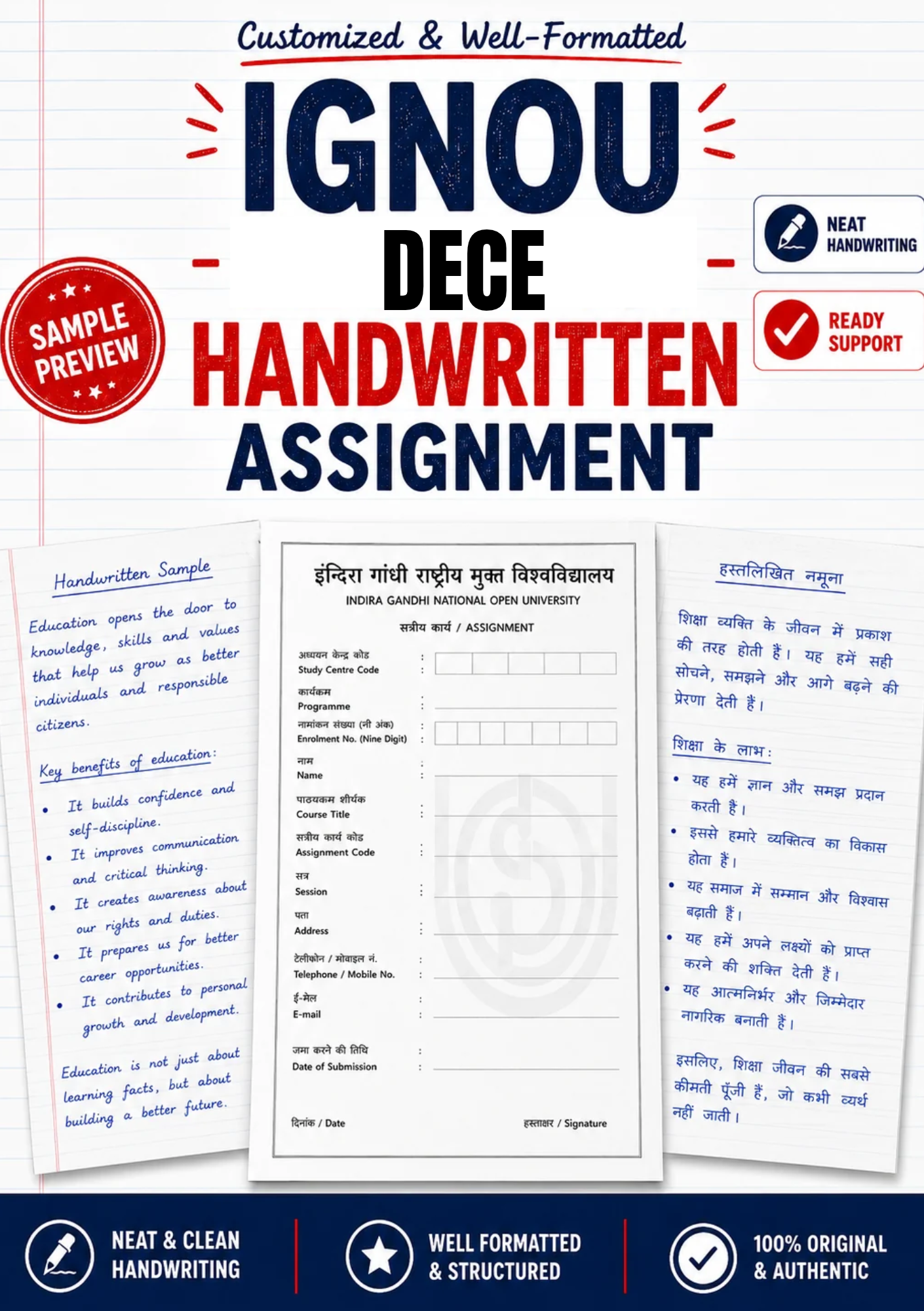
Four physical things arrive, and nothing else. The first is the written script itself, one bundle per course code, with Sections A, B and C of that assignment stapled as a single unit because IGNOU returns a DECE script unevaluated when the three parts turn up separately. The second is an IGNOU-format front page for each bundle, already laid out with the fields the booklet insists on: enrolment number, name, full address and date at the top right, and course title, assignment number and study centre name centred below. The DECE booklet warns in plain words that a script which does not follow that format will be sent back for re-submission, so the cover sheet is not decoration.
The third item is a photocopy of the question paper your answers were written against, which matters more on DECE than on most programmes because the paper is issued per medium and the code line printed on it is not the same in English and in Hindi. The fourth is the practical material: where you have sent your own observation notes and exercise sheets, those are returned written out in the matching hand, with the mark break-up headings the Practical Manual uses kept in place.
No soft copy or PDF is sold. There is no download link, no emailed scan and no shared drive folder, because the thing being sold is paper that a counter clerk can stamp and a counsellor can mark.
What ₹320 Buys Per Course Code, and What It Cannot Buy
The rate is ₹320 per subject, hard copy only, with courier included in that price and no separate shipping charge. On a DECE order that figure is per course code, so a learner clearing all three written papers is looking at three subjects, not one bundled diploma fee, and a learner who has already passed DECE-1 and owes only DECE-2 pays for one.
Inside the rate: the writing of Section A in full against your own medium’s paper, the writing up of your Sections B and C records, the IGNOU-format front page, the question paper copy, the handwriting match, and the courier. There is no minimum order: one subject or fourteen, same rate. Any session is accepted, current cycle or older, including backlog courses, at the same ₹320 per subject.
Outside the rate, and this is the part worth reading twice: the thirty working days of DECE 4 project work, the observation of real children that Sections B and C require, and the term-end examination itself. Nothing on this page buys those. Shri Chakradhar Publication also makes no claim about what the script will score. No claim is made about the marks any assignment will receive, about how an evaluator will assess it, or about whether it will be accepted. Assignment evaluation is entirely a matter for IGNOU.
Delivery depends on your pin code and is confirmed for your order before you pay. No figure is promised on this page.
Why a DECE Download Stops at Sixty of the Hundred Marks
These are two different products and the difference is sharper on DECE than almost anywhere else in the IGNOU catalogue. A solved assignment is a soft-copy reference file of model answers for a course code and session, downloaded and read. A handwritten assignment is the answers written out by hand on A4 and submitted in hard copy at the study centre. The first is something to write from. The second is something to hand in. A downloaded file has never been a submission and printing it does not make it one.
What makes DECE unusual is that a model-answer file can only ever reach 60 of the 100 marks. The booklet is explicit that it contains Section A only: “The assignments printed in this booklet contain section A of the three assignments,” and the exercises for Sections B and C sit in the Practical Manual that came with your study material, which IGNOU does not publish on its assignment download page at all. Section B of DECE-1 asks you to pick one of Exercises 4, 6 and 7 and observe a child; Section C asks you to pick one of Exercises 5, 8 and 9 and plan and run an activity. Those are 40 of the 100 marks, and they are records of something you did. No PDF of model answers contains them, and anyone who sells you forty marks of pre-written child observation is selling you a fiction.
So the honest division of labour runs like this. If you want the reference text and will do the writing, DECE model-answer files for a single code are stocked separately and that is the page to use. If you want the pages written, this is the page, and the practical sections are written up from what you observed rather than invented.
| Point of difference | DECE solved assignment | DECE handwritten assignment |
|---|---|---|
| Format | Soft copy file of model answers for one code and session | Pages written by hand on A4, delivered as hard copy |
| What you do with it | Read it, then write your own script from it | Check it, sign the declaration, hand it in |
| Section A, 60 marks | Covered as model answers | Written out against your own medium’s paper |
| Sections B and C, 40 marks | Not covered; these are your own observations of children | Copied out from the observation records you send |
| Front page and question paper | Not included | Included with every bundle |
| Who it suits | Learners who will write the pages themselves | Learners short of writing time who have done the practicals |
| Price here | Listed per code on the DECE solved assignment shelf | ₹320 per subject, courier included |
Scroll the table sideways on a narrow screen.
Three codes, ₹320 each, sample page before payment.
DECE-1, DECE-2 and DECE-3 at ₹320 per subject, hard copy with courier included. Tell us which codes you still owe, your session and your medium, and send one photograph of your own handwriting.
DECE-1, DECE-2 and DECE-3: Sixty Marks Each That Can Be Written
The Common Prospectus July 2026 sets out the diploma in four courses at eight credits apiece, and the credits sum to the stated total of 32. Three of those four carry a Tutor Marked Assignment. The table below keeps the prospectus title against the assignment code each paper actually prints, and the code column is split because the English and Hindi editions of the same 2026 booklet do not print the same string.
| Code | Official title, Common Prospectus July 2026 | Credits | Assignment code on the English paper | Assignment code on the Hindi paper |
|---|---|---|---|---|
| DECE 1 | Organizing Child Care Services | 8 | DECE-1/TMA-1/2026 | Hindi DECE-1 file not opened for this page |
| DECE 2 | Child Health and Nutrition | 8 | DECE-2/TMA-2/2026 | DECE-1/TMA-2/2026 |
| DECE 3 | Services and Programmes for Children | 8 | DECE-3/TMA-3/2026 | DECE-1/TMA-3/2026 |
| DECE 4 | Project Work: Working with Young Children in a Child Care Setting | 8 | No Tutor Marked Assignment published | No Tutor Marked Assignment published |
Scroll the table sideways on a narrow screen.
Every one of the three written papers is marked out of 100 and splits the same way: Section A at 60 marks, Section B at 20 and Section C at 20. Section A of DECE-1 runs to seven numbered questions with word limits printed against each one, from 200 words up to 500, and a final question asking you to differentiate three pairs of terms in about 250 words each. The Hindi DECE-3 paper numbers its Section A the same way, seven questions with sub-parts on the first, fifth, sixth and seventh, so the writing load is comparable across the three courses and across both mediums. The quantity of writing is therefore fixed by the paper rather than estimated: a Section A answered to its own word limits is a long afternoon’s work per course, which is the whole reason this service exists.
Sections B and C are a different animal. The booklet states that there are 9 to 10 exercises in each Practical Manual and that you must do two of them per assignment, one from the group named in Section B and one from the group named in Section C, and that the chosen exercise goes to the counsellor for evaluation. The groups are fixed per course and are set out below.
| Paper | Section A | Section B, 20 marks, choose one | Section C, 20 marks, choose one |
|---|---|---|---|
| DECE-1 | 60 marks, seven questions | Exercise 4, 6 or 7, observing children | Exercise 5, 8 or 9, planning and conducting activities |
| DECE-2 | 60 marks | Exercise 2 or 3 | Exercise 5, 6 or 7 |
| DECE-3 | 60 marks, seven questions | Exercise 1, 2, 9 or 10 | Exercise 6, 7 or 8 |
Scroll the table sideways on a narrow screen.
The booklet prints a mark break-up inside each exercise, not just a total. DECE-1 Exercise 4 is worth 20 and divides into observing the child and the parents and recording the observation, then analysing the observation and drawing conclusions. That structure is why a written set reproduces your records under those same headings rather than rewriting them into an essay: the counsellor is marking the recording and the analysis as separate things. If your codes differ from the three above because you are clearing an older intake, the safest move is to read them off your admission record and off the paper you downloaded, not off any website. IGNOU’s own assignment download service is where the current file lives, and the university’s live DECE course listing is where the course titles and credit values are published.
DECE 4 Is Thirty Working Days With Children, and It Is Not Sold Here
This section exists because the commonest DECE search is for help with the fourth course, and the honest answer is that help is not something a publisher can hand over.
The prospectus describes DECE 4 as a vital component of the programme and sets out what it requires: you identify a preschool centre that follows a play-based pedagogy, and you organise play activities and learning experiences with the children there for a period of thirty working days, as described in the Project Manual. A preschool centre, the prospectus adds, is one catering to children between 3+ to 5+ years or 3+ to 6+ years, before they join class 1. IGNOU’s own Regional Centre guidance breaks the thirty days into phases, beginning with five days observing the guide and writing reports on what was observed.
Then the prospectus says this, in two short sentences: do original project work, and copied project work or work bought from the market will be rejected. That sentence is printed in the university’s own admission document, and it settles the question. A handwritten assignment service can copy out your Section A answers and your own observation records in a matching hand. It cannot spend thirty working days in a creche on your behalf, and a bought project file is, by IGNOU’s own statement, a rejected project file.
Two further details are worth knowing because they trip people up. First, IGNOU’s June 2026 online submission portal for projects, dissertations and internship reports carries an explicit carve-out: the guidelines apply to every project course except DECE04, for which the portal says a link will be displayed separately. DECE 4 does not go through the route every other project course uses. Second, the practical exercises in Sections B and C of DECE-1, DECE-2 and DECE-3 are not the project. IGNOU’s own project guidance states the distinction outright, and a learner who thinks finishing the exercises has finished the project is in for a bad surprise in the grade card. If you want the fourth course explained step by step rather than sold, the sister editorial site carries a step-by-step walk through the DECE 4 project, and the DECE 4 project shelf on this store is where binding and hard-copy questions are handled.
Twenty-Two Mismatches Between DECE’s Own Published Files
Reading the Common Prospectus, the live DECE programme page, five SOCE assignment files and this store’s own pages against one another turns up twenty-two disagreements. They are listed because a learner copying a code or a date off the wrong document loses marks for it, and because two of the twenty-two are this publisher’s own and are being corrected.
Every disagreement found while this page was built, including the ones on this store.
1. The assignment code depends on your medium. The English DECE-2 paper prints Assignment Code: DECE-2/TMA-2/2026 and the English DECE-3 paper prints DECE-3/TMA-3/2026, while the Hindi editions of the same 2026 booklet print DECE-1/TMA-2/2026 and DECE-1/TMA-3/2026. Both learners are copying their own paper correctly and will write different strings on the cover page.
2. The course code is printed three ways. The prospectus writes DECE 1 with a space, the assignment booklets write DECE-1 with a hyphen, and the live programme page writes DECE-01 with a leading zero.
3. The English DECE-1 file dated January 2026 and July 2026 on its cover carries an inner header reading January 2024/ July 2024.
4. Every 2026 DECE paper examined prints “Late date of submission of assignment to the study centre” where “Last date” is plainly meant. The same wording appears across more than one file, so it is a template error rather than a slip.
5. The booklet explains that the dates of assignment submission have been distributed over a period of three months instead of giving one date for all assignments, and then prints the identical pair of dates on all three papers.
6. MCDP-002, titled Project Work -1/ Internship 2 and worth 4 credits, is listed among the courses on IGNOU’s live DECE page, where the text calls it “the eighth Course of this Post Graduate Diploma”. DECE is a four-course diploma of 32 credits. With MCDP-002 included the listed credits total 36.
7. The medium is stated three ways. Prospectus section 9.1 says English, Hindi, Tamil and Oria. The prospectus programme table says English, Hindi, oria and Tamil. The live programme page says English, Hindi, Tamil, with no Odia at all.
8. Odia and Tamil are offered in the prospectus but no Odia or Tamil DECE assignment file was found on the SOCE assignment pages, which carry English and Hindi only.
9. Maximum duration is three years in the prospectus programme table and 24 months on the live programme page.
10. The fourth course has two titles. The prospectus prints “Project Work: Working with Young Children in a Child Care Setting” and the live page prints “Project Work-Working WithYoung Children in a Child Care Setting”, with the space missing from WithYoung.
11. The 2026 CNCC-002 assignment file, a certificate course whose title Organizing Child Care Services is word for word the DECE-1 title, instructs the learner in Section B to use “the practical Manual of this Course i.e., DECE-1” while its Section C correctly names CNCC-2.
12. Those two look-alike courses have different cut-offs. The CNCC-2 paper prints 15 May 2026 for the January 2026 session and 15 November for the July 2026 session. The DECE papers print 30 September 2026 and 30 March 2027. A DECE learner following CNCC guidance found online is four and a half months out.
13. Question 7 of DECE-1 Section A is marked 4 x 3 = 12 and its parts are labelled (a), (b) and (d). There is no part (c).
14. No assignment weightage percentage is printed anywhere in the DECE booklet. The university-wide position is that assignments carry 30 per cent of the final course result and the term-end examination carries the remaining 70 per cent, and that sentence is repeated verbatim on this page because it is the published rule. The DECE booklet instead states that all three assignments must be passed for the Diploma to be awarded, and that failing to submit by the due date bars you from the term-end examination for that course. Those are stricter conditions than a percentage, not looser ones.
15. IGNOU’s June 2026 online project submission guidelines apply to all project courses “EXCEPT DECE04 OF DECE PROGRAMME”, with a note that a separate link will be displayed for it.
16. The SOCE assignment archive at webservices.ignou.ac.in lists DECE papers only as far as the January and July 2022 cycle, four cycles behind the file currently live.
17. SOCE publishes the same English paper under two filenames. DECE-1 is served as both DECE-1-English.pdf and DECE-1-2026.pdf, and DECE-3 as both DECE-3-English.pdf and DECE-3-2026.pdf. A learner who downloads one may reasonably think there is another paper they have missed.
18. The prospectus DECE entry contains two typographical errors in the text that matters most: settings are described as “a screches” where “such as creches” is meant, and the warning against buying project work reads “bought from maket”.
19. Four acronyms collide. DECE is this diploma. DCE is IGNOU’s Diploma in Creative Writing in English, whose papers print a wholly different code format such as DCE 2/ TMA/2023-2024. DECCE is a different university’s Diploma in Early Child Care Education. DECE LE is a polytechnic lateral-entry entrance examination in Bihar. Searching the bare acronym returns all four.
20. On this store’s own DECE solved assignment product pages, the cross-sell line reads “Get IGNOU DECE 3 Handwritten Assignment for ₹350”. The handwritten rate is ₹320, and ₹350 is the list price before the standing reduction. Those lines are being corrected.
21. Also on this store, the DECE solved assignment pages print “Delivery time: 8 to10 working days after payment”, and the handwritten category page carries three further figures that contradict it and each other: 7 to 9 working days, 5 to 7 working days, and a courier transit of 2 to 4 working days. None of those four figures is a commitment this publisher stands behind. No delivery figure is promised on this page, and the conflicting lines elsewhere are being removed.
22. The prospectus states that project work bought from the market will be rejected, while a DECE 4 project category is listed on this store. That category is being reviewed against the prospectus sentence, and nothing on this page sells DECE 4.
A Cut-Off That Reads “Late Date” and Falls on 30 March
Submission dates at IGNOU are set per school, and carrying one programme’s dates to another is the most expensive mistake a learner can make with a free download. The School of Continuing Education prints two dates on the 2026 DECE papers, and they are not the dates most IGNOU learners are used to:
- 30 September 2026 for the January 2026 session.
- 30 March 2027 for the July 2026 session.
Note the day. It is 30 March, not 31 March, which is what several other schools print, and the 2024 DECE edition printed 30 September 2024 and 30 March 2025 in exactly the same pattern, so this is the School’s settled practice rather than a one-off. Note also the wording, which is “Late date of submission of assignment to the study centre” on the live 2026 files. It means last date.
Two consequences follow from the booklet’s own instructions rather than from general advice. The first is that submission is a gate on the examination: the booklet states that if you do not submit an assignment by its due date you cannot sit the term-end examination for that course. The second is that passing matters, not merely submitting. All three assignments are compulsory and all three must be passed before the Diploma is awarded. Assignments carry 30 per cent of the final course result and the term-end examination carries the remaining 70 per cent, which is the university-wide rule, but on DECE the booklet layers a pass requirement on top of it.
Papers expire. The 2026 file is replaced each cycle, question numbers move, and the exercise numbers offered in Sections B and C can change between editions. Write against the paper for your own session, and nothing else. Programme structures, course codes, submission dates and rules change, and only ignou.ac.in and your Regional Centre can confirm the current position for your enrolment.
Why Your Hindi Paper Prints DECE-1 and Your English Paper Does Not
The assignment code is the string you copy onto the cover page, and on DECE it rewards a careful look. The English 2026 papers print a code whose prefix tracks the course: DECE-1/TMA-1/2026 on the first paper, DECE-2/TMA-2/2026 on the second, DECE-3/TMA-3/2026 on the third. The Hindi 2026 papers print DECE-1 as the prefix on every one of them, so the second paper reads DECE-1/TMA-2/2026 and the third reads DECE-1/TMA-3/2026, with only the TMA number telling the courses apart.
Read the parts and it makes sense either way. The prefix names the course or, in the Hindi files, the assignment series. TMA stands for Tutor Marked Assignment and the number after it is the assignment number within the diploma, which on DECE happens to run in step with the course number. The year is a single calendar year with no session name attached, which is why the same 2026 file serves both the January 2026 and July 2026 intakes.
The practical rule is simple and it is not the rule most guides give. Copy the string your own paper prints, in the script your own paper prints it in, and do not correct it to match what a website or a friend in the English batch has. A clerk at the counter is matching your cover page against the paper in your hand. If you are on the Hindi paper and want the line checked before anything is written, ask which code line your Hindi paper carries and send a photograph of the cover.
Settling the Hand Before the First Rupee Is Paid
Send a photo of a page you have written yourself and the handwritten set is matched to your handwriting at no extra charge. On DECE this step carries more weight than usual, because Sections B and C are presented as your own observations of children and a counsellor who knows your hand from your practical sheets will be reading them.
Photographing a page of your own writing
Any page of your own continuous writing will do, and half a page is enough. Write a few sentences in the medium you will submit in, in the pen you normally use, on ruled or plain paper, and photograph it flat in daylight with the whole sheet in frame and no shadow across the middle. What is being read is letter shape, slant, spacing, how you join letters and how you break a line, not neatness. A Hindi-medium learner should send Devanagari rather than a roman sample, because the matching is done on the script you will actually submit.
The sample comes before payment, and that order is deliberate. You see what the writing looks like against your own hand first, and only then decide. Nothing is written until the hand is agreed.
Four Mediums on Paper, Two on the Download Page
The service covers all mediums IGNOU issues the TMA paper in, at the same price. On DECE that sentence needs unpacking, because what IGNOU promises and what IGNOU publishes are not the same list.
The prospectus offers DECE in English, Hindi, Tamil and Odia, printing Odia as “Oria” in both places it appears. The live programme page drops Odia and lists English, Hindi and Tamil. The SOCE assignment pages, which is where the actual papers live, serve English and Hindi files. If your medium is Tamil or Odia, that gap is worth raising with your Regional Centre before the cut-off rather than after, because the paper you are entitled to may have to be asked for.
Session coverage is broader than medium coverage. Any session is accepted, current cycle or older, including backlog courses, at the same ₹320 per subject. A learner who registered in an earlier cycle, failed one of the three assignments and has to repeat it is in the commonest DECE situation there is, since the Diploma is not awarded until all three are passed. The question in those cases is never the price, it is which edition of the paper your repeat is assessed against, and that is settled by looking at your own file before anything is written.
What Goes in the Opening Message, and What Follows Separately
Everything needed to quote a DECE order fits in one message:
- Your enrolment number.
- The codes you still owe, written as your paper writes them: DECE-1, DECE-2, DECE-3, or whichever subset.
- Your session, January or July, and the year.
- Your medium, and whether your paper is the English or the Hindi file.
- One photograph of your own handwriting.
Then, separately, the practical material: photographs or scans of your filled Practical Manual exercise sheets, your observation notes, and a note of which exercise number you chose in Section B and in Section C for each course. Those are what Sections B and C are written up from. If they have not been done yet, Section A can be written first and the practical sections added when your records exist.
Nothing else is needed. Not your password, not your study-centre login, not your identity documents, and not a scan of your grade card.
Section A now, practical sections when your records are ready.
₹320 per subject covers both. The writing of Section A can begin as soon as the hand is agreed, and your Sections B and C are added from the exercise sheets you send.
What a Counsellor Does With Your Practical Pages Next
When the parcel reaches you, do three things before it goes anywhere near a study centre. Read the script. You sign the declaration on the assignment cover page, so you should read and review the content before submitting it, and satisfy yourself that it represents your own understanding of the course. Check that each bundle has its Sections A, B and C together, because that is the one assembly error that gets a DECE script returned unmarked. Check the first-page format against what the booklet prescribes, since the booklet promises to send back a script that does not follow it.
Then submit at your study centre and take a receipt or an acknowledgement entry. Sections B and C go to the counsellor for evaluation, which on DECE means the practical pages are read by someone who is assessing your observation and your analysis as separate components with their own marks. Keep a record of what you sent and when, which is advice the booklet itself gives, and keep the corrected scripts when they come back, because you may need them until the course is closed.
After that, nothing happens quickly and nothing is in a publisher’s hands. The counsellor marks, the centre forwards, and the result appears against the course code on your grade card in its own time. Shri Chakradhar Publication has no visibility into that process and no influence over it. No claim is made about the marks any assignment will receive, about how an evaluator will assess it, or about whether it will be accepted. Assignment evaluation is entirely a matter for IGNOU.
The Other DECE Shelves on This Store
A DECE learner usually needs more than written pages. Where the blocks themselves are missing, perhaps because an older registration arrived incomplete, the DECE block books stocked here cover the three theory courses, and they are also the only reliable route back to a Practical Manual if yours never turned up. For the December and June papers, guess papers built for the DECE term-end papers sit alongside earlier DECE question papers worked out, which between them show how the same Block content gets examined across cycles.
Learners who move on from DECE into the postgraduate early childhood route tend to look next at the MCD papers of the early childhood PG diploma, where the submission regime and the paper size are both different, or at the MES 81 to MES 84 pre-primary set, which is the closest PG equivalent to this diploma’s subject matter. If your enrolment includes a code from outside DECE entirely, a written set for a code outside this programme is quoted the same way, and the store’s wider handwritten catalogue lists the programmes already built out. For the mechanics of assembling a script before you submit it, the sister editorial site explains how a handwritten script is put together from the download to the counter.
What DECE Learners Ask When the Practical Sections Come Up
How many DECE papers can actually be written by hand?
Three. IGNOU publishes a Tutor Marked Assignment for DECE-1, DECE-2 and DECE-3 only. The fourth course, DECE 4, is thirty working days of project work with children in a preschool centre, and no written service covers it.
Can a DECE solved assignment PDF be submitted as it is?
No. A solved assignment is a soft-copy reference file of model answers, meant to be read and written from. A submission is pages written by hand on A4 and handed in at the study centre. Printing a PDF does not convert one into the other, and on DECE a PDF cannot cover Sections B and C at all because those are records of your own observation of children.
Who does Sections B and C of a DECE assignment?
You do. Each of the three papers requires one Practical Manual exercise in Section B and one in Section C, worth 20 marks each, and those exercises involve observing a child or planning and running an activity with children. Once you have done them and have your notes, the records are written out in the matching hand as part of the same ₹320 per subject. Nobody can supply the observation itself.
Is a typed DECE assignment accepted?
IGNOU’s assignment instructions require handwritten submission, and the DECE booklet’s first-page format and declaration are built around a written script. A typed set is not what the counter expects. That is the whole reason a handwritten service exists rather than a printing service.
Why does my Hindi DECE-2 paper print DECE-1/TMA-2/2026?
Because that is what the Hindi edition of the 2026 booklet prints. The English DECE-2 paper prints DECE-2/TMA-2/2026 instead. The prefix on the Hindi files stays at DECE-1 across all three papers and only the TMA number changes. Copy the string from your own paper and do not correct it to match the other medium.
What are the last dates on the 2026 DECE papers?
30 September 2026 for the January 2026 session and 30 March 2027 for the July 2026 session, printed on the papers themselves. The day is the 30th in March, not the 31st. Check your own file each cycle, because dates move and only ignou.ac.in and your Regional Centre can confirm the current position for your enrolment.
Do I have to pass all three DECE assignments, or just submit them?
Pass all three. The booklet states that all three assignments are compulsory and that you have to pass in all three in order to be awarded the Diploma. That is a stricter condition than the general IGNOU position, under which assignments carry 30 per cent of the final course result and the term-end examination carries the remaining 70 per cent.
What happens if I send Section A without Sections B and C?
The booklet says the assignment will not be considered complete, will be returned to you, and will have to be repeated. All three sections of one course code must travel together as a single script. That is why each bundle is assembled and stapled per code rather than per section.
Is DECE 4 project work included in this order?
No. The prospectus requires original project work and states that copied project work, or project work bought from the market, will be rejected. It also sets the duration at thirty working days in a preschool centre with a play-based pedagogy. Nothing on this page sells that, and IGNOU’s June 2026 online submission portal even routes DECE04 separately from every other project course.
My paper says “Late date of submission”. Is that a different deadline?
No, it is a typing error in IGNOU’s own template and it means last date. The same wording appears on more than one 2026 DECE file. The dates it introduces are the real ones.
The exercises are in a Practical Manual I never received. What now?
The booklet assumes the Practical Manual came with your study material, and it is not published on the assignment download page, so a missing manual cannot be downloaded. Raise it with your Regional Centre, and in the meantime the printed block set for your course is the practical route to the exercise text.
Can a DECE set be written for the 2023 or 2024 session?
Yes. Any session is accepted, current cycle or older, including backlog courses, at the same ₹320 per subject. Send the paper you are being assessed against, because the question numbers and the exercise numbers offered in Sections B and C differ between editions.
Is the DECE paper available in Tamil or Odia?
The prospectus lists Tamil and Odia as mediums of instruction, printing Odia as “Oria”, and the live programme page lists Tamil but not Odia. The SOCE assignment pages carry English and Hindi files. If your medium is Tamil or Odia, ask your Regional Centre for the paper well before the cut-off. The service covers all mediums IGNOU issues the TMA paper in, at the same price.
Is DECE the same as DCE, DECCE or DECE LE?
No, and the confusion is common enough to be worth stating. DECE is IGNOU’s Diploma in Early Childhood Care and Education. DCE is IGNOU’s Diploma in Creative Writing in English and its papers print an entirely different code format. DECCE is a Diploma in Early Child Care Education offered by a different university. DECE LE is a polytechnic lateral-entry entrance examination in Bihar. Only the first is covered here.
How is the handwriting matched, and does it cost extra?
Send a photo of a page you have written yourself and the handwritten set is matched to your handwriting at no extra charge. The sample is seen and agreed before any payment, and Hindi-medium learners should send a Devanagari sample rather than a roman one.
What does ₹320 include, and is there a courier charge?
The rate is ₹320 per subject, hard copy only, with courier included in that price and no separate shipping charge. That covers the written Section A, the write-up of your Sections B and C records, the IGNOU-format front page and the question paper copy. No soft copy or PDF is sold.
The Reading Behind This Page, File by File
Three kinds of source sit behind the statements above and they are not interchangeable. Keeping them apart is the point.
The two IGNOU documents that define the structure
The course codes, the official titles, the eight-credit values, the 32-credit total, the eligibility, the mediums of instruction and the thirty-working-day project requirement come from the IGNOU Common Prospectus July 2026, section 9.1 on page 314, and from the programme table row for DECE. The credits were added independently and came to 32, matching the figure the prospectus prints. The code forms DECE-01 to DECE-04, the three-medium list, the 12-month and 24-month durations and the MCDP-002 entry come from IGNOU’s live DECE programme page. Where those two documents disagree, both readings are given above rather than one being silently preferred.
Which DECE papers were actually read, and how
Four files were retrieved and read in full: the English DECE-1 paper at DECE-1-English.pdf, the Hindi DECE-2 paper, the Hindi DECE-3 paper, and the 2026 CNCC-002 paper, which is where the misdirected DECE-1 Practical Manual instruction turned up. Four more were read through indexed extracts of the same PDFs rather than a full retrieval, and are flagged here as such: DECE-1-2026.pdf, the English DECE-2 paper, the English DECE-3 paper and DECE-3-2026.pdf. The 2024 combined DECE booklet was read the same way, and it confirms that the 30 September and 30 March pattern is the School’s settled practice rather than a 2026 accident. IGNOU’s June 2026 online project submission notice and the SOCE assignment archive index were both opened directly. Every date, assignment code, section split, mark figure, exercise number and instruction quoted above came off one of those sources rather than from another programme, and the Hindi DECE-1 file was not opened, which is why its code line is left blank in the table above instead of being inferred. The 2026 papers print no assignment weightage percentage at all, and that gap is recorded in the warning box rather than filled with a guess.
Commercial terms that come from this publisher alone
The ₹320 per subject rate, the hard-copy-only format, the included courier, the free front page, the included question paper copy, the no-minimum-order position, the handwriting match from a sample photo at no extra charge, the acceptance of any session including backlogs, and the refusal to print a delivery figure are all commercial terms set by Shri Chakradhar Publication Pvt. Ltd. IGNOU neither sets nor endorses any of them.
Important Notice
Shri Chakradhar Publication Pvt. Ltd. and shrichakradhar.com form an independent IGNOU study-support publisher. This is not the official website of Indira Gandhi National Open University, is not affiliated with, endorsed by or authorised by the university, and no page on this site should be treated as an official IGNOU communication.
Programme structures, course codes, submission dates and rules change, and only ignou.ac.in and your Regional Centre can confirm the current position for your enrolment.
You sign the declaration on the assignment cover page, so you should read and review the content before submitting it, and satisfy yourself that it represents your own understanding of the course.
No claim is made about the marks any assignment will receive, about how an evaluator will assess it, or about whether it will be accepted. Assignment evaluation is entirely a matter for IGNOU.
Tell Us Which of the Three You Still Owe
₹320 per subject, hard copy with courier included, no soft copy or PDF, and a sample of the writing against your own hand before anything is paid.
Start a DECE order on WhatsApp
Clearing a repeat from an older intake, or not sure which edition of the paper your resubmission is assessed against? Check an older DECE intake before you pay.