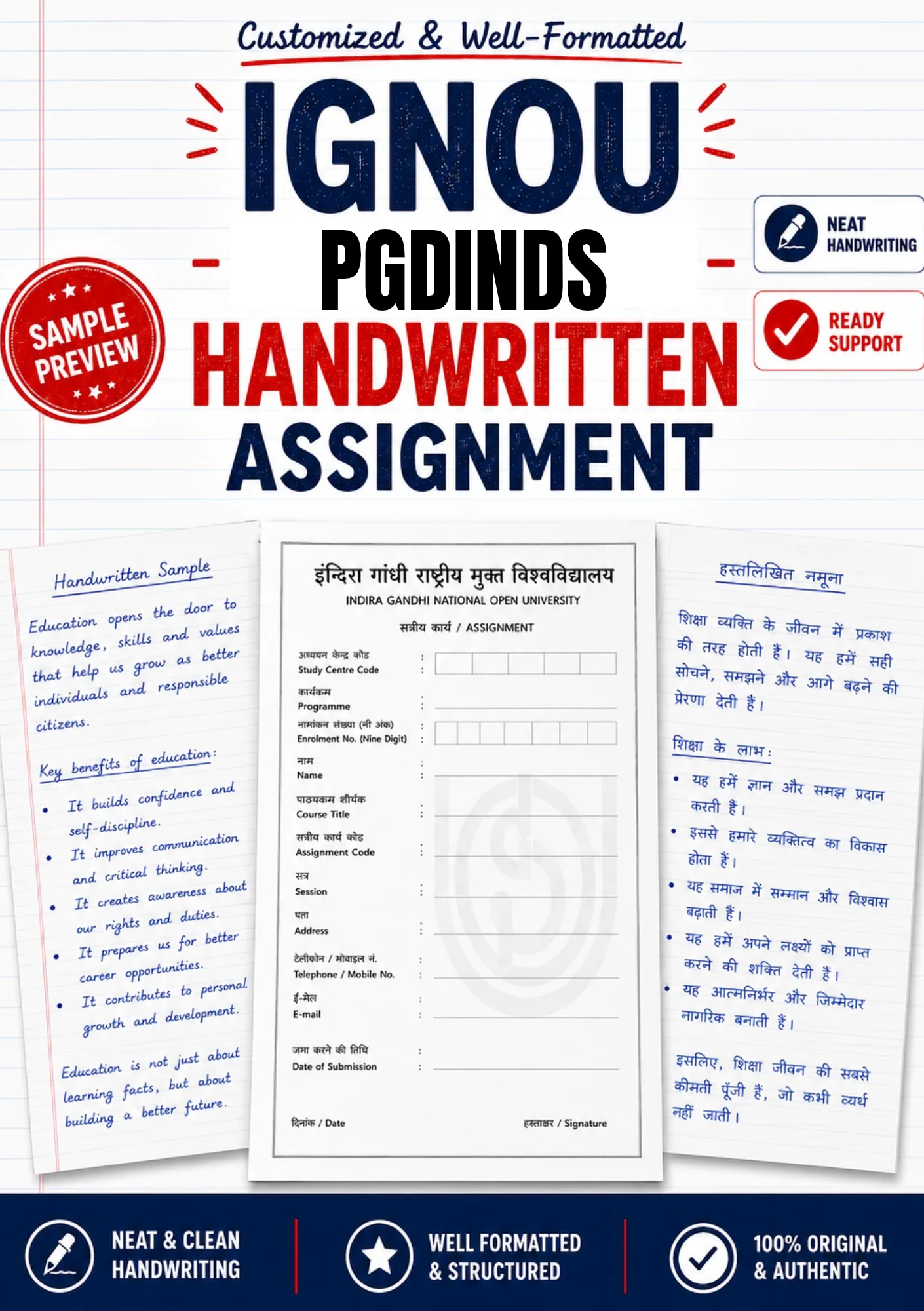


Description
In short. Shri Chakradhar Publication prepares handwritten tutor-marked assignments for the nine Post Graduate Diploma in Industrial Safety courses that actually set one: the four Semester I papers MIS-021, MIS-022, MIS-023 and MIS-024, and the five Semester II papers MIS-025, MIS-026, MEV-001, MEV-002 and MEV-005. The rate is ₹320 per subject, hard copy only, with courier included in that price and no separate shipping charge. Each code arrives as its own 100-mark set written on full-size writing paper, which is the wording the School of Engineering and Technology booklets use rather than A4 or foolscap, together with a free IGNOU-format front page and a copy of the paper it was written against. MISP-021, the diploma’s six-credit project, sets no tutor-marked assignment and is not part of this order. Send a photo of a page you have written yourself and the handwritten set is matched to your handwriting at no extra charge. Any session is accepted, current cycle or older, including backlog courses, at the same ₹320 per subject. Assignments carry 30 per cent of the final course result and the term-end examination carries the remaining 70 per cent.
Nine Bundles, Four Items in Each, and One Thing Deliberately Absent
One PGDINDS order is not one parcel of loose paper. It is a stack of discrete, code-labelled bundles, because the School of Engineering and Technology sets one tutor-marked assignment per course and marks each out of 100 on its own. A learner ordering the whole diploma receives nine bundles. A learner who entered by lateral entry after the certificate receives five. A learner clearing two backlog papers receives two. The bundle is the unit, and ₹320 buys one of them.
Inside each bundle there are four physical things. The first is the written answer sheets themselves, in longhand, on full-size writing paper that is not very thin, which is the exact specification the SOET booklets print. Note what that is not: it is not the A4 instruction that circulates on almost every third-party IGNOU guide, and it is not the foolscap instruction that the School of Health Sciences prints for its own diplomas. The second is the IGNOU-format front page, filled in against the field list on your own booklet. The third is a photocopy of the official tutor-marked paper the answers were written against, which matters because the booklet itself says to retain a copy of your response and, if possible, to append a photocopy of the booklet to it. The fourth is nothing at all: there is no soft copy or PDF in the parcel, and none is emailed afterwards.
The sheets are written on one hand throughout a code, and on the same hand across every code in the order, which is the point of the sample photograph described further down this page. A set that arrives in three visibly different hands is a set that invites a question at the counter, and IGNOU’s own practice in other distance systems has been to compare handwriting against earlier submissions. Consistency across the nine bundles is therefore treated as part of the specification rather than a nicety.
What does not arrive is anything to do with registration, re-registration, examination forms or the project. Those are university transactions, and no publisher can perform them. Delivery depends on your pin code and is confirmed for your order before you pay. No figure is promised on this page.
Nine Codes at ₹320 Each, and the Project Credits No Rate Covers
PGDINDS carries 36 credits. The Common Prospectus July 2026 splits them 16 in Semester I and 20 in Semester II, and the arithmetic holds: four plus two plus two plus two plus six is 16, and five papers of four credits each is 20, which sums to the 36 the prospectus prints. Of those 36 credits, 30 belong to the nine theory courses that set a tutor-marked assignment. The remaining six belong to MISP-021, the project, and no handwriting rate can reach them.
That is not a commercial decision, it is what SOET’s own project documentation requires. The project route runs on a synopsis sent to the programme coordinator at the School of Engineering and Technology, a report of roughly 40 to 60 double-spaced pages, deadlines of 31 May and 30 November rather than the assignment dates, and two typed copies submitted to the Registrar at the Student Evaluation Division. A typed report submitted in duplicate to a different office on a different calendar is a different product class from a handwritten tutor-marked assignment, and this page does not pretend otherwise. Learners who need help on that side are looking at the diploma’s project shelf, not at this one.
So the honest arithmetic of a full PGDINDS order is nine codes at ₹320. Fewer codes cost proportionally less, and there is no bundle discount and no bundle penalty, because there is no minimum order: one subject or fourteen, same rate. The WooCommerce price field shows a regular figure above the sale figure, which is how the store expresses the saving; the body of this page carries no countdown, no scarcity line and no discount language, because the only legitimate deadline on a PGDINDS order is the one IGNOU printed on your own booklet.
Three things the rate explicitly does not buy, stated plainly so that nothing is implied by silence. It does not buy a mark, a grade or an outcome. No claim is made about the marks any assignment will receive, about how an evaluator will assess it, or about whether it will be accepted. Assignment evaluation is entirely a matter for IGNOU. It does not buy a submission: the set is written and couriered to you, and you carry it to the counter yourself. And it does not buy certainty about a date, because as the dates section below shows, IGNOU has printed the PGDINDS July cut-off four different ways in four years.
Reference File or Submission: Which of the Two You Are Actually Buying
Two different things are sold under names that sound alike, and PGDINDS learners routinely order the wrong one. A solved assignment is a soft-copy reference file, a PDF of model answers prepared for one course code and one session, which you read and then write from in your own words. A handwritten assignment is the answers written out by hand on paper and submitted in hard copy, which is what this product is. The first is study material. The second is a submission.
The distinction is not a matter of preference on this diploma, because the PGDINDS booklets settle it. The January 2026 SOET booklet for MEV-001 prints that only hand written answers are acceptable and that typed or photocopied answers must not be submitted. The January 2024 Semester II booklet prints the same rule as instruction five: only hand written assignments are acceptable, no typed assignments. A printed PDF is, physically, a typed and photocopied answer. That is the whole of the argument, and it comes from the paper in your own download folder rather than from anybody’s sales copy.
| What differs | Solved assignment (soft copy) | Handwritten assignment (this product) |
|---|---|---|
| Format | PDF file for one code and session, read on a screen or printed | Longhand answer sheets on full-size writing paper, hard copy |
| What you do with it | Read it, then write the answers out yourself | Check it, sign the declaration, carry it to the counter |
| Front page | Usually not included; you prepare one | IGNOU-format cover sheet included free with every code |
| Question paper | You download the booklet yourself | A copy of the paper it was written against travels with the set |
| Who it suits | Learners who intend to write the nine papers themselves and want a reference | Learners short of writing time across several PGDINDS codes at once |
| Rate on this store | Priced per code on the soft-copy shelf | ₹320 per subject, courier included |
Scroll the table sideways on a narrow screen to read every column.
If the reference file is what you actually wanted, it is one click away and it is not on this page. The store keeps soft-copy model answers filed against the diploma’s own code list, which is where a search for a PGDINDS answer PDF should land rather than here. This page sells a written submission and nothing else. It is worth adding that the same shelf currently holds fewer entries than the diploma has assignable courses, so a missing code there means the file has not been built yet rather than that it does not exist.
One further boundary, because learners ask it in exactly these words. Reading a model answer and then writing it out verbatim is not what the booklet asks of you either. You sign the declaration on the assignment cover page, so you should read and review the content before submitting it, and satisfy yourself that it represents your own understanding of the course. That sentence applies as much to a set written by this publisher as to a PDF bought anywhere.
Nine PGDINDS codes, or only the ones still open on your record.
₹320 per subject, hard copy, courier included. Nothing is paid until the handwriting sample has been seen and the code list confirmed.
Send your Semester I and II code list for a ₹320-per-code quote
The Four Semester I Codes, and the Row That Sets No Assignment
Semester I of PGDINDS prints five rows in the prospectus and sets four assignments. The credit weights are uneven in a way that surprises learners used to a four-credit-per-paper degree: MIS-021 carries four credits, MIS-022, MIS-023 and MIS-024 carry two each, and MISP-021 carries six. The booklets then ignore the credit weighting entirely. Every one of the four theory papers is marked out of 100, and the January 2026 first-semester booklet requires 40 out of 100 on each. A two-credit course and a four-credit course therefore demand the same 100-mark paper, which is why the handwriting rate is per code rather than per credit.
| Code | Title as printed in the PGDINDS table | Credits | Tutor-marked assignment |
|---|---|---|---|
| MIS 021 | Safety Philosophy and Principles of Accident Prevention | 4 | Yes, 100 marks, ten questions of 10 |
| MIS 022 | Industrial Safety : Rules and Acts | 2 | Yes, 100 marks |
| MIS 023 | Safety in Construction Industry | 2 | Yes, 100 marks |
| MIS 024 | Mechanical and Electrical Safety Management | 2 | Yes, 100 marks |
| MISP 021 | Project | 6 | No. Typed report, separate deadlines |
Scroll the table sideways on a narrow screen to read every column.
Two details on this table are worth the reader’s attention before ordering. First, the spacing. The prospectus prints these codes as MIS 021 with a space and a leading zero, the booklets print them as MIS-021 with a hyphen, and the Dear Student letter inside the January 2026 first-semester booklet prints them as MIS021 with neither. All three refer to the same course. The string that goes above your first answer is the booklet’s own, which is the hyphenated form.
Second, and more consequentially, these same four courses plus the same project are the entire Post Graduate Certificate in Industrial Safety. The certificate’s prospectus entry prints them as MIS 21, MIS 22, MIS 23, MIS 24 and MISP 21, without the leading zero, and totals them at 16 credits, exactly the figure Semester I of this diploma carries. A learner holding the certificate enters PGDINDS by lateral entry directly into Semester II, which the prospectus confirms and prices separately. A learner who does not hold it writes all nine. Working out which of those two you are is the single most useful thing to settle before placing an order, and the answer is on your admission record rather than on any website. The certificate has its own four-course book list on this store if that is the route you are on.
Semester II: Two MIS Codes and Three Papers on Loan From SOITS
Semester II is where PGDINDS stops looking like a single-school diploma. Two of its five papers are SOET’s own industrial-safety courses. The other three are MEV codes, and MEV is the environmental-studies prefix of the School of Interdisciplinary and Transdisciplinary Studies. MEV-001, MEV-002 and MEV-005 appear as compulsory courses in four separate prospectus tables: this diploma, the Master of Science in Industrial Safety under SOET, and both the Post Graduate Diploma and the Master of Arts in Environmental and Occupational Health under SOITS. Twelve of this semester’s 20 credits are therefore courses that another school also owns, and that fact produces the single most expensive mistake a PGDINDS learner can make on a download page. It is set out in full two sections below.
| Code | Title in the PGDINDS prospectus table | Title on the live SOET booklet | Credits | Question pattern printed |
|---|---|---|---|---|
| MIS 025 | Industrial Project Management and Control Strategies | Industrial Project Management & Control Strategies | 4 | Attempt all questions, equal marks |
| MIS 026 | Communication Skills for Industrial Safety Personnel | Communication Skills for Industrial Safety | 4 | Attempt all questions, equal marks |
| MEV 001 | Indroduction to Environmental Health | Introduction to Environmental Health | 4 | Attempt any five questions, 5 x 20 |
| MEV 002 | Environmental and Occupational Hazards | Environmental and Occupational Hazards | 4 | Attempt any five questions, 5 x 20 |
| MEV 005 | Occupational Health and Safety | Occupational Health and Safety | 4 | Attempt any five questions, 5 x 20 |
Scroll the table sideways on a narrow screen to read every column.
Read that question-pattern column before you order, because it changes what a ₹320 code actually involves. The two MIS papers in this semester ask for every question, which on the first-semester pattern means ten answers of ten marks each. The three MEV papers ask for any five of the seven or so printed, at twenty marks each. A twenty-mark answer is a longer piece of writing than a ten-mark one. The rate does not change, and neither does the 40-out-of-100 pass requirement, but a learner budgeting their own time should know that the MEV half of this semester is weighted towards fewer, longer answers.
The title column is not a typographical curiosity either. MEV 001 is printed as Indroduction to Environmental Health in the PGDINDS table of the Common Prospectus July 2026, with the letter transposed, while the same document spells it correctly in three other tables. MIS 026 is printed with the word Personnel in the prospectus and on the December 2025 term-end question paper, and without it on every assignment booklet fetched for this page. MIS 025 is printed with the word and in the prospectus and with an ampersand on the booklets. Where the two disagree, the string that belongs above your answer is the booklet’s, because the booklet is the document your evaluator is holding.
Where the Diploma, the Certificate and the Degree Describe the Same Course Differently
Industrial safety at IGNOU runs as a nested ladder of three awards sharing one pool of course codes: a 16-credit certificate, this 36-credit diploma whose Semester I is the certificate, and an 80-credit master’s degree whose first two semesters are this diploma. Lateral entry runs up the ladder, from the certificate into Semester II of the diploma and from the diploma into Semester III of the degree. The codes are shared, the documents are not, and they disagree. Nothing below is an opinion or an inference. Each item is a difference between two documents that are live right now, and the last three are this publisher’s own faults, disclosed because a page that hides its own errors is a worse page.
Twenty differences found between live IGNOU documents, plus three of this store’s own. Check your own booklet and admission record before writing anything.
1. MIS 021 appears under four titles. Safety Philosophy and Principles of Accident Prevention in the PGDINDS and PGCINDS prospectus tables and on the January 2026 booklet; Safety Policy and Principles of Accident Prevention in the MSCIDS table of the same prospectus; and Safety Philosophy and Principles of Accident Preventions, plural, on the June 2024 certificate term-end paper.
2. MEV 001 is printed Indroduction to Environmental Health in the PGDINDS table and Introduction to Environmental Health in the MSCIDS, PGDENOH and MAENOH tables of the same prospectus.
3. MIS 024 is Mechanical and Electrical Safety Management in the diploma and certificate tables, and Mechanical and Electrical Safety in the master’s table.
4. MIS 026 is Communication Skills for Industrial Safety Personnel in the prospectus and on the December 2025 term-end paper, and Communication Skills for Industrial Safety on every assignment booklet checked.
5. MIS 025 is printed with the word and in the prospectus and with an ampersand on the booklets.
6. The same five Semester I courses are coded MIS 021 to MIS 024 and MISP 021 in the diploma table and MIS 21 to MIS 24 and MISP 21 in the certificate table, while the booklets hyphenate them and the Dear Student letter inside the January 2026 booklet drops the hyphen altogether.
7. The certificate’s own prospectus entry carries the sentence about lateral entry into the second semester of the programme for those who have completed the certificate. The certificate is a single-semester, 16-credit award. The sentence belongs to this diploma and has been copied onto the award it describes the entry route from.
8. The July cut-off date has been printed four ways. 15 October for July 2022, 30 September for July 2023, 31 October for July 2025, and in the 2026 set two different October dates appear in one school’s own files.
9. Within the January 2026 and July 2026 SOET files, one first-semester booklet prints 30th October for the July 2026 session while a third-semester booklet of the same programme family prints 31st October 2026 for the same session.
10. Two live editions of MEV-001 exist on ignou.ac.in at the same time, issued by two schools. The SOET edition carries the assignment code MEV-001/TMA/2026, a last date of 30 April 2026, and an instruction to submit at the Regional Centre. The SOITS edition carries MEV-001/TMA-01/2026-2027, prints no last date at all, and directs the learner to the Coordinator of the Study Centre.
11. That SOITS edition names Introduction to Environmental Health on its cover and Introduction to Environmental and Occupational Health in its own tutor-marked-assignment header.
12. It also carries a validity note naming the January 2019 and July 2019 sessions inside a booklet whose cover reads 2026-2027.
13. Template carry-over on assignment codes. The certificate’s January 2025 booklet prints MIS-021/TMA/2024 through MIS-024/TMA/2024 with last dates of 30 April 2025. A July 2025 master’s booklet prints MIS-021/TMA/2024 with a last date of 31 October 2025.
14. Cover-page applicability has drifted. The 2023 and January 2024 Semester II booklets name PGDINDS alone. The 2026 set names PGDINDS and MSCIDS jointly. The certificate appears on neither 2026 cover even though MIS-021 to MIS-024 are its entire course list, yet the June 2025 MIS-021 term-end paper names the certificate and the diploma together.
15. Per-code files are forked inside one directory for one session. A joint PGDINDS and MSCIDS edition of MIS-025 for 2026 sits alongside a master’s-only edition of the same code and session, the second routing queries to the master’s mailbox only.
16. Margin instructions differ. The January 2026 first-semester booklet asks for a 2 cm margin on the left, top and bottom. The 2023 and January 2024 Semester II booklets ask for 4 cm.
17. Question patterns differ inside one semester. The MIS papers say attempt all questions. The MEV papers say attempt any five, at twenty marks each.
18. The cover-sheet field list changed between editions. The older Semester II blocks ask for course code, course title, assignment number, study centre and date. The 2026 MEV-005 block adds an e-mail field and a programme field.
19. Submission destination differs by school for the same course code. SOET says Regional Centre. The SOITS edition of MEV-001 says Coordinator of the Study Centre. A competitor page selling against these codes tells learners to submit to the coordinator of the learner support centre.
20. Paper stock. The booklets specify full-size writing paper that is not very thin. They name neither A4 nor foolscap, while third-party guides almost uniformly instruct A4 and other IGNOU schools print foolscap for their own diplomas. Third-party date guidance drifts the same way: 31 March and 30 September circulate widely as the universal pair, which is not what any PGDINDS booklet prints.
21. This store’s own fault. The MIS-021 study-guide product is titled with the master’s spelling, Safety Policy and Principles of Accident Prevention, rather than the diploma’s Safety Philosophy. The MIS-024 study-guide product drops the word Management the same way. Both are queued for correction.
22. This store’s own fault. The certificate’s answer-file shelf sits inside the diploma branch of the catalogue while its guess-paper shelf sits inside the certificate branch, so one award is filed in two places.
23. This store’s own fault. Older handwritten product pages elsewhere on this site still carry a marks assurance, an acceptance claim, working-day delivery promises and a superlative, and one legacy page still quotes a third price for the same handwriting service. None of those claims is made here, and all of them are in the correction queue.
Four July Dates in Four Years, and the One January Date That Never Moved
Most IGNOU programmes have two submission dates, one per admission cycle, and the honest position on PGDINDS is that only one of its two has held still. January has been 30 April on every booklet checked for this page, across 2023, 2024, 2025 and 2026. July has moved repeatedly.
| Session as printed | Last date printed on the booklet | Where it appears |
|---|---|---|
| July 2022 | 15th October | MIS-025 Semester II booklet for July 2022 |
| January 2023 | 30th April | Semester II booklet, January 2023 |
| July 2023 | 30th September | Semester II booklet, July 2023 |
| January 2024 | 30th April | Semester II booklet, January 2024 |
| January 2025 | 30th April | Certificate booklet, January 2025 |
| July 2025 | 31st October | Semester II booklet, July 2025 |
| January 2026 | 30th April | First and second semester booklets, January 2026 |
| July 2026 | 30th October on one file, 31st October 2026 on another | Two 2026 SOET booklets in the same programme family |
Scroll the table sideways on a narrow screen to read every column.
Four distinct July dates in four years, and two of them inside the same year’s file set, is a genuine reason not to take a date from any website, this one included. What the table is for is the opposite of urgency: it is evidence that the only date worth acting on is the one printed on the booklet you yourself downloaded for your own session, and that a learner who writes to the date a news site circulated may be writing to a date that was never on their paper. Third-party reporting has separately described an extension of a December 2026 submission date from 30 September to 31 October, which is a fourth figure again and is not something this publisher can confirm.
Two things about those dates are stable enough to rely on, because they appear on every booklet rather than on some. The first is that late work is refused: answer sheets received after the due date shall not be accepted, in the booklets’ own words. The second is the weighting. Assignments carry 30 per cent of the final course result and the term-end examination carries the remaining 70 per cent. Programme structures, course codes, submission dates and rules change, and only ignou.ac.in and your Regional Centre can confirm the current position for your enrolment. The university’s own assignment download service is where the current booklet comes from, and the diploma’s own programme page at ignou.ac.in is where its structure is stated officially.
MEV-001/TMA/2026 Against MEV-001/TMA-01/2026-2027: Which School Issued Your Paper
This is the section that earns this page its place, because it describes a mistake that costs a learner an entire submission and that no general IGNOU guide warns about.
Read a PGDINDS assignment code left to right. The first element is the course code, hyphenated, with its leading zero: MEV-001. The second is TMA, for tutor-marked assignment. The third, on a SOET paper, is a bare calendar year: 2026. There is no session word in it. That is worth noting on its own, because the School of Management Studies writes its codes with the session spelled out, as in a code carrying the word JULY before the year, and a learner moving between programmes may expect a format PGDINDS does not use.
Now the consequential part. MEV-001, MEV-002 and MEV-005 are compulsory on this diploma and also compulsory on two SOITS programmes in environmental and occupational health. Both schools publish an assignment booklet for the same course code, in the same year, in different directories of the same university website. They are not the same paper. The SOET edition names PGDINDS and MSCIDS on its cover, prints the assignment code as MEV-001/TMA/2026, prints a last date of 30 April 2026, and tells the learner to submit at the Regional Centre. The SOITS edition names the environmental-health diploma and master’s on its cover, prints the assignment code as MEV-001/TMA-01/2026-2027 with a sub-number and a two-year span, prints no last date at all, directs the learner to the Coordinator of the Study Centre, and carries a leftover validity line naming two 2019 sessions.
The practical test is therefore not the course code, which is identical on both. It is the programme names on the cover and the shape of the code string. If the cover of your MEV paper does not say Post Graduate Diploma in Industrial Safety, and if the code string carries a sub-number or a two-year span rather than a bare year, you are holding the environmental-health school’s edition and the questions you are about to answer are not the ones your evaluator is expecting. Checking three characters saves a cycle. When a PGDINDS order is placed here, the code string and the cover programme names are read back before writing starts, precisely because of this.
Two smaller reading notes from the same document family. Assignment codes do not always refresh when the booklet does: a certificate booklet dated January 2025 prints 2024 codes, and a July 2025 master’s booklet does the same. A 2024 string inside a 2025 booklet is IGNOU’s template carry-over, not evidence that you downloaded an expired file, and the booklet’s own printed last date is the figure that governs. And within SOET, per-code files are forked for the same session, so a joint diploma-and-degree edition and a degree-only edition of one code can both be live at once.
One Page of Your Writing Sets the Whole Order’s Hand
Send a photo of a page you have written yourself and the handwritten set is matched to your handwriting at no extra charge. On a nine-code order that single photograph governs roughly nine hundred marks’ worth of paper, so it is the step worth spending two minutes on rather than thirty seconds.
The sequence is deliberately sample-first. The photograph is sent, the match is agreed, the code list and session are confirmed, and only then does payment arise. Nothing about the handwriting is a surprise after money has moved, which is the point of ordering it in that order.
Choosing and shooting the sample page
A usable sample is ordinary, recent and unperformed. A page from your own rough notes on a safety audit, a filled-in form, a letter, any continuous paragraph in your normal hand will do. What does not help is a page written slowly and carefully for the purpose, because the resulting set will match a hand you do not actually write in, and a mismatch between your cover-page signature and your answer sheets is the opposite of what the exercise is for. Photograph it flat, in daylight, with the whole page in frame and the text legible at full zoom. One page is enough; two is better if your capitals and your lower case diverge.
One Medium, Two Semesters, and Every Cycle Still Outstanding
The service covers all mediums IGNOU issues the TMA paper in, at the same price. For this diploma that is a short list. The Common Prospectus July 2026 gives the medium of instruction for PGDINDS as English, and so does the certificate entry and the master’s entry above and below it. Every PGDINDS and SOET industrial-safety booklet opened for this page is in English. So the medium question, which is a live complication on several other IGNOU diplomas, resolves cleanly here: the papers are English and the written sets are English. If a Devanagari edition of a MIS or MEV paper ever reaches your download folder, send the file itself rather than a description of it, and it will be read before anything is quoted.
Session coverage is the opposite of narrow. Any session is accepted, current cycle or older, including backlog courses, at the same ₹320 per subject. That matters more on PGDINDS than on a one-year programme with a single cohort, for three structural reasons. The diploma runs semester-wise with January and July entry, so two learners a year apart hold different code sets. Lateral entry from the certificate means a learner may legitimately owe only the five Semester II codes and none of Semester I. And the maximum duration is three years against a minimum of one, so a learner finishing in year three is writing against booklets issued well after the ones they first downloaded, which is exactly the case the booklets address when they say to submit the latest assignment uploaded for the relevant session rather than the one that came with your original kit.
Five Items From Your Record, and What Nobody at the Desk Will Ask For
Five pieces of information settle a PGDINDS order completely, and a sixth is usually unnecessary. Sending more than this slows the quote rather than speeding it.
- The codes on your own record. Not the full nine unless you owe the full nine. A lateral-entry learner typically lists MIS-025, MIS-026, MEV-001, MEV-002 and MEV-005 and nothing else.
- The session printed on your booklet. January or July, with the year, read off the cover rather than remembered.
- One photograph of a page in your own handwriting. As described in the section above.
- The delivery pin code. This is what the courier estimate is built from, and it is confirmed to you before payment rather than promised on a web page.
- Your enrolment number and name as they appear on the record. These go on the front page of every set, so a transposed digit is worth checking twice.
What nobody at the writing desk needs is your password, your Samarth login, a scan of an identity document, or a payment before the sample has been agreed. If any of those is asked for in a conversation that claims to be this store, it is not this store.
The sample photograph comes first, the quote second, the payment third.
₹320 per subject including courier. Your codes, your session and your pin code are confirmed back to you before anything is written.
Four Tasks That Remain Yours Once the Parcel Is Open
The parcel arriving is not the end of the task, and the booklets are explicit about the parts that remain yours. Four of them.
Check each bundle against your own booklet first. The course code and the assignment code on the top sheet should match the paper you downloaded character for character, which on a SOET paper means the hyphenated code, TMA, and the bare year. Then confirm that the number of answers matches the instruction on your edition, because the MIS papers in this diploma ask for all questions and the MEV papers ask for any five. A set written to the wrong instruction is a set written against the wrong edition.
Complete and sign the front page. The IGNOU-format cover sheet travels with each code already formatted, but the enrolment number, name, address, study centre and date are yours to enter, and the field list is the one on your own booklet, which gained an e-mail field and a programme field in the 2026 edition. You sign the declaration on the assignment cover page, so you should read and review the content before submitting it, and satisfy yourself that it represents your own understanding of the course.
Read the answers. This is not a formality. The declaration you are signing is about your own understanding, and reading nine sets takes an evening that is well spent whatever else is true.
Then submit where your own booklet says. Every PGDINDS and SOET industrial-safety booklet read for this page says to submit at your respective Regional Centre, which is not the instruction every IGNOU school gives and is not the instruction the environmental-health edition of MEV-001 gives. Retain a photocopy of your response before it leaves your hands, which the booklets also recommend, and keep the booklet photocopy with it. After that the process is IGNOU’s: evaluation, the status record, the grade card. No claim is made about the marks any assignment will receive, about how an evaluator will assess it, or about whether it will be accepted. Assignment evaluation is entirely a matter for IGNOU.
Where PGDINDS Learners Go for the Rest of the Shelf
A handwritten set answers one need. Industrial-safety learners on this diploma usually reach for three or four other things across a year, and they sit in different parts of this catalogue rather than on this page.
For reading rather than submitting, the diploma’s printed study guides for its own MIS and MEV codes are the companion to the blocks, and guess papers aimed at the term-end paper rather than the assignment address the other 70 per cent of the course result, which is a genuinely different task: the term-end papers for these codes run to 70 marks over three hours with their own question patterns, where the assignment runs to 100.
If you came to PGDINDS through the certificate, its answer files are shelved against the certificate codes and its guess papers sit one branch away in the certificate section, a split in this catalogue’s own filing that is noted in the conflict box above and queued for repair.
If you are going up the ladder rather than finishing here, the master’s degree in industrial safety shares every PGDINDS code and adds eight more. Its eighteen-title book list spans all four semesters, the master’s guess-paper set covers the third and fourth semesters this diploma never reaches, and there is a separate written set built for all eighteen master’s codes for learners who have already transferred across. Order that one rather than this one if your record says MSCIDS, because the two orders are not interchangeable even though their first nine codes are identical.
Learners on other programmes entirely will find the rest of the written sets on the handwritten shelf covering the store’s programme-wise sets. And if you would rather write the nine papers yourself, the editorial side of this publisher keeps a step-by-step guide to writing an IGNOU handwritten assignment at ignouproject.com, which costs nothing and is the better page for that.
The Nine-Code Questions Learners Send First
I entered by lateral entry after the certificate. Which codes do I still owe?
On the prospectus structure, lateral entry from the Post Graduate Certificate in Industrial Safety places you in Semester II, which is MIS-025, MIS-026, MEV-001, MEV-002 and MEV-005. The four Semester I theory codes and the MISP-021 project are the certificate you already hold. Five written sets rather than nine, therefore, at the same rate each. Your admission record is the authority on this, not this page, and a lateral-entry admission is also priced separately by the university.
My booklet cover names PGDINDS and MSCIDS together. Did I download a master’s paper by mistake?
No. From the 2026 session SOET issues one booklet jointly to the diploma and the master’s degree for the shared first and second semester codes, so a cover naming both is the correct cover for a diploma learner. The 2023 and January 2024 editions named the diploma alone, which is why the joint cover looks unfamiliar. What would be a wrong file is a master’s-only edition of the same code, which also exists in the same directory and routes queries to the master’s mailbox only.
There are two MEV-001 files on ignou.ac.in. Which one belongs to this diploma?
The one whose cover names Post Graduate Diploma in Industrial Safety and whose assignment code reads MEV-001/TMA/2026, with a bare year and no sub-number. The other edition is issued by the School of Interdisciplinary and Transdisciplinary Studies for its environmental and occupational health programmes, codes its paper MEV-001/TMA-01/2026-2027, prints no last date, and sends the learner to a Study Centre coordinator rather than a Regional Centre. The questions differ. This is the single most common wrong download on these three shared codes.
Does a typed PGDINDS set get refused outright, or only sometimes?
The booklets answer this directly rather than leaving it to interpretation. The January 2026 MEV-001 edition prints that only hand written answers are acceptable and that typed or photocopied answers are not to be submitted, and the January 2024 Semester II booklet prints the same rule. A printout of a PDF is a typed answer by any reading. A solved file is a reference to write from, and this page does not suggest otherwise.
Where do the soft-copy PGDINDS answers sit, if this page does not sell one?
On the diploma’s own answer-file shelf in the solved-assignment branch of this catalogue, linked in the comparison section above. That shelf is the right destination for anyone searching for a PGDINDS answer PDF. It currently lists fewer entries than the diploma has assignable codes, so a code you cannot find there has not been built rather than been withdrawn.
The prospectus spells my course Indroduction to Environmental Health. Do I copy that onto the front page?
No. Copy what your booklet prints, which spells it Introduction to Environmental Health. The transposed spelling appears in the PGDINDS table of the Common Prospectus July 2026 and nowhere else in that document; the same prospectus spells the course correctly in three other tables. The front page should match the paper your evaluator is holding.
My MIS-021 paper is headed Safety Philosophy, the master’s table says Safety Policy. Which title goes above my answers?
Safety Philosophy and Principles of Accident Prevention, because that is what the diploma table, the certificate table and the January 2026 booklet all print. Safety Policy is the master’s table’s wording for the same code, and a plural Preventions appears on one 2024 term-end paper. Four printed forms, one course. The booklet wins for anything you write on paper.
Is the PGDINDS July deadline 30 September, 30 October or 31 October?
All three have been printed, in different years and in one case in the same year. July 2022 was 15 October, July 2023 was 30 September, July 2025 was 31 October, and the 2026 SOET files carry both 30 October and 31 October 2026 for the July 2026 session. January has been 30 April on every booklet checked. The only date to act on is the one on the booklet you downloaded for your own session, and the Regional Centre is the place to confirm an extension.
Does MISP-021 come written by hand with this order?
No, and it could not. MISP-021 is the diploma’s six-credit project and it sets no tutor-marked assignment. SOET’s project route runs on a synopsis approved by the programme coordinator, a report of roughly 40 to 60 double-spaced pages, deadlines of 31 May and 30 November rather than the assignment dates, and two typed copies lodged with the Registrar at the Student Evaluation Division. A typed report is a different product class and it sits on the projects side of this catalogue.
One booklet says a 2 cm margin and another says 4 cm. Which do your writers use?
Whichever your own edition prints, which is why the booklet is read before writing begins rather than assumed. The January 2026 first-semester edition asks for 2 cm on the left, top and bottom. The 2023 and January 2024 Semester II editions ask for 4 cm. Tell the desk which booklet you are submitting against and the sets are ruled to it.
My booklet says full-size paper and every guide online says A4. What arrives?
Full-size writing paper that is not very thin, which is the booklet’s own phrase and is what the sets are written on. The A4 instruction circulating on third-party guides is not what any PGDINDS booklet checked for this page prints, and the foolscap instruction some other IGNOU schools print is not either. If your Regional Centre has told you something different in writing, send that instruction and the sets will follow it.
My MIS papers say attempt all questions and my MEV papers say attempt any five. Is the rate different?
The rate is the same. The work is not identical, though, and it is fair to say so: the MIS papers in this diploma run to ten answers of ten marks, while the MEV papers ask for five answers of twenty marks, which are longer pieces of writing. Both are marked out of 100 and both require 40 to pass on the booklets’ own instruction. ₹320 per subject either way.
I have just three backlog codes outstanding. Will the desk write that few?
There is no minimum order: one subject or fourteen, same rate. Three backlog codes from an older cycle is an ordinary order on this diploma, given a maximum duration of three years against a minimum of one.
The diploma is listed as English medium. Is a Hindi set possible at all?
The service covers all mediums IGNOU issues the TMA paper in, at the same price, and for this diploma IGNOU issues English. The prospectus gives the medium of instruction as English for the diploma, the certificate and the master’s degree alike, and every industrial-safety booklet opened for this page is in English. If a Devanagari edition of a MIS or MEV paper does reach you, send the file itself and it will be read before anything is quoted.
Is payment taken before or after the handwriting is agreed?
After the handwriting sample has been seen and agreed, after the code list and session have been read back to you, and after the courier position for your pin code has been confirmed. Delivery depends on your pin code and is confirmed for your order before you pay. No figure is promised on this page.
Can you say how an evaluator will mark these nine papers?
No, and any page that does is telling you something it cannot know. No claim is made about the marks any assignment will receive, about how an evaluator will assess it, or about whether it will be accepted. Assignment evaluation is entirely a matter for IGNOU. What can be said is structural: the assignment carries 30 per cent of the course result, the booklets require 40 out of 100 on each response, and late sheets are refused.
Prospectus, Booklet and Publisher: Separating What Each One Settles
Three classes of source sit behind this page and they are kept apart deliberately, because they carry different authority and they disagree with each other in the ways the conflict box lists.
The Common Prospectus, July 2026. Section 8.64, page 312, is the authority used here for the diploma’s structure: the ten printed rows, their titles, their credits, the 16 and 20 credit split, the 36-credit total, the English medium, the eligibility list, and the lateral-entry route from the certificate into Semester II. Section 10.6 supplied the certificate’s structure and section 3.71 the master’s, both of which were read against 8.64 rather than instead of it, which is how the title and code-spacing differences surfaced. Section 8.36 supplied the environmental-health diploma’s MEV code list. Credits were summed before the table was trusted: four plus two plus two plus two plus six, then five fours, giving 36 against the printed 36.
Live assignment booklets on ignou.ac.in and webservices.ignou.ac.in. The submission dates, the assignment-code strings, the 100-mark and 40-mark figures, the question patterns, the margin instructions, the paper description, the cover-sheet field lists, the Regional Centre instruction and the cover-page programme lists on this page are read off booklets, not carried from another programme. The editions opened were the January 2026 first-semester and second-semester SOET booklets, the July 2025 second-semester booklet, the January 2024 and July 2023 second-semester booklets, the January 2025 certificate booklet, the July 2022 MIS-025 booklet, the SOITS edition of MEV-001 for 2026-2027, and two term-end question papers for MIS-021 and MIS-026. The project requirements came from SOET’s own project guidance for this programme family.
This publisher’s own commercial terms. The ₹320 rate, hard copy only, courier inside the price, the free IGNOU-format front page, the included copy of the question paper, the handwriting match from a sample photograph at no extra charge, the absence of a minimum order, the acceptance of any session including backlogs, and the refusal to promise a delivery figure are Shri Chakradhar Publication’s terms and are not IGNOU’s. They are set by the publisher and can be changed by the publisher, unlike anything in the two classes above.
Important Notice
Shri Chakradhar Publication Pvt. Ltd. and shrichakradhar.com form an independent IGNOU study-support publisher. This is not the official website of Indira Gandhi National Open University, is not affiliated with, endorsed by or authorised by the university, and no page on this site should be treated as an official IGNOU communication.
Programme structures, course codes, submission dates and rules change, and only ignou.ac.in and your Regional Centre can confirm the current position for your enrolment.
You sign the declaration on the assignment cover page, so you should read and review the content before submitting it, and satisfy yourself that it represents your own understanding of the course.
No claim is made about the marks any assignment will receive, about how an evaluator will assess it, or about whether it will be accepted. Assignment evaluation is entirely a matter for IGNOU.
No soft copy or PDF is sold. Delivery depends on your pin code and is confirmed for your order before you pay. No figure is promised on this page.
Start the PGDINDS Order From Your Own Course List
The rate is ₹320 per subject, hard copy only, with courier included in that price and no separate shipping charge. There is no minimum order: one subject or fourteen, same rate.
Open your admission record, read off the MIS and MEV codes still outstanding and the session on your booklet cover, and send those with one photograph of your own handwriting. Nine codes if you joined at Semester I, five if you came across from the certificate.
List the PGDINDS codes on your record and ask for the total
Unsure which school issued your MEV paper, or which semester you are actually writing against? Ask the desk to check your booklet edition before ordering, and send the cover page with the question.