

Description
In short. Shri Chakradhar Publication Pvt. Ltd. prepares handwritten assignment sets for the IGNOU Post Graduate Diploma in Human Resource Management, programme code PGDIHRM, covering the two compulsory papers MMPC 011 and MMPC 002 and all eight MMPH electives printed in the Common Prospectus July 2026, which are MMPH 001, MMPH 002, MMPH 003, MMPH 004, MMPH 005, MMPH 006, MMPH 007 and MMPH 009. The rate is ₹320 per subject, hard copy only, with courier included in that price and no separate shipping charge. No soft copy or PDF is sold. The diploma is a 36-credit, two-semester School of Management Studies programme, and because its printed table lists ten courses while the credit total allows only nine, the page below sets out which paper comes off the list and on whose authority. Any session is accepted, current cycle or older, including backlog courses, at the same ₹320 per subject. PGDIHRM should not be confused with PGDHRM, the older School of Management Studies diploma of the same English name that still runs on MS series codes and still has live assignment booklets, and the differences between the two are itemised further down.
Opening the PGDIHRM Parcel: What Is Inside and What Is Not
A PGDIHRM order is a physical consignment, not a download link. For every course code on the order, four things travel together inside one courier packet, and one thing that learners often expect is deliberately absent.
- The written answer set. Every question on the tutor marked assignment paper for that code, answered by hand on ruled sheets, in the handwriting matched to the sample page sent in before writing starts.
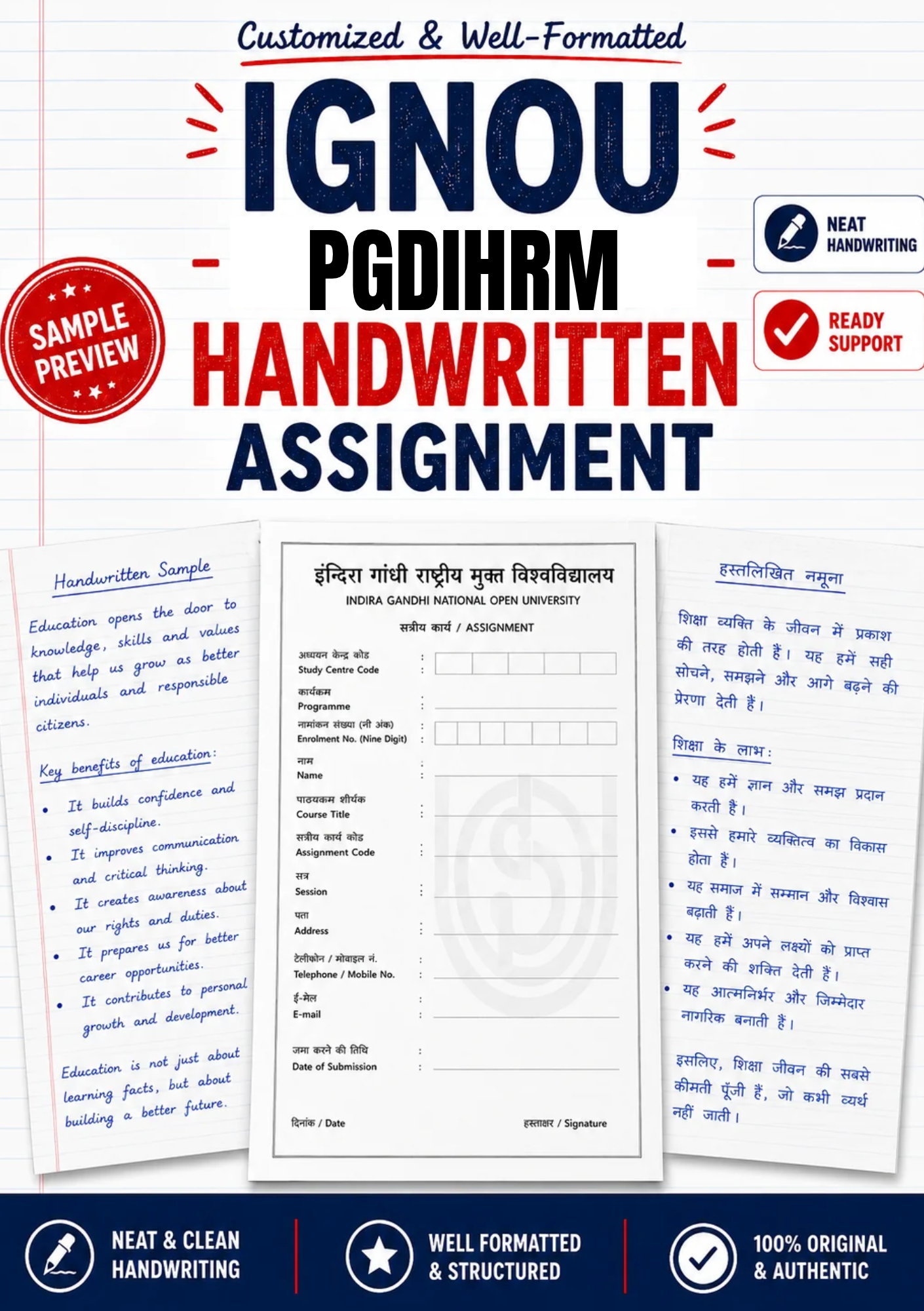
- The IGNOU format cover sheet. One front page per code, laid out in the format the university expects, with the enrolment number, programme code PGDIHRM, course code, course title, assignment code and study centre fields filled in from the details supplied. This is included free with every order.
- A copy of the official question paper. The tutor marked assignment paper for that code and that cycle, printed and tagged with the set, because most study centres want the question paper attached behind the cover sheet before the counter will accept the submission.
- The declaration left unsigned. The signature block on the cover page is left blank. The learner signs it, which is the point of the next paragraph and of the Important Notice at the foot of this page.
What is not inside: a scan, a PDF, an emailed file or a printable copy. No soft copy or PDF is sold. A PGDIHRM learner who wants a reference file of model answers to write from is looking at a different product class, and the difference between the two is set out below so that nobody buys the wrong thing.
What the Per-Subject Rate Already Includes for a PGDIHRM Order
PGDIHRM is a 36-credit diploma built from nine four-credit courses, so a learner who orders every paper they are registered against in a semester is usually ordering between four and six sets at a time, not ten. Pricing is per subject rather than per semester for that reason: electives differ between learners, backlogs differ again, and two people admitted in the same July cycle can hold different code lists.
The rate is ₹320 per subject, hard copy only, with courier included in that price and no separate shipping charge. There is no minimum order: one subject or fourteen, same rate. The IGNOU format front page is free with every order, the official question paper copy is included, and the handwriting match carries no surcharge.
Two things sit outside the rate, and both are named rather than buried. First, the university’s own fees: the programme fee, the examination form fee and any re-registration charge are paid to IGNOU and have nothing to do with this order. Second, a delivery date. Delivery depends on your pin code and is confirmed for your order before you pay. No figure is promised on this page.
| Item | Inside the ₹320 per subject | Outside it |
|---|---|---|
| Handwritten answer set for one PGDIHRM course code | Yes | |
| IGNOU format front page for that code | Yes, free with every order | |
| Printed copy of the official tutor marked assignment paper | Yes | |
| Handwriting matched to the learner’s own sample page | Yes, no extra charge | |
| Courier anywhere the service reaches | Yes, included | |
| Hindi or English edition of the same code | Yes, same rate | |
| Backlog code from an earlier PGDIHRM cycle | Yes, same rate | |
| Soft copy, scan or PDF of the written set | Not sold at any price | |
| IGNOU programme fee, examination fee, re-registration fee | Paid to the university | |
| A promised number of days to delivery | Confirmed per pin code, never promised here |
Scroll the table sideways on a narrow screen to see all three columns.
An MMPH-002 Answer PDF and an MMPH-002 Submission Are Not the Same Purchase
Two different products circulate under similar names, and PGDIHRM learners mix them up more often than most because the MMPH codes are shared with the MBA human resource management specialisation, so search results pull in material written for a different enrolment.
A solved assignment is a soft-copy reference file of model answers for one course code and one session, delivered as a PDF, read on a phone or a laptop, and used as source material while the learner writes. A handwritten assignment is the answers written out by hand on A4 sheets and submitted in hard copy at the study centre, with the cover page and the question paper attached. The first is study material. The second is the artefact the counter accepts.
The instruction on the paper itself settles which is which. The MMPH 002 booklet for the July 2026 and January 2027 semesters prints, under the heading Note, that all the questions are to be attempted and the assignment submitted to the Coordinator of the study centre. A file on a phone cannot be handed to a coordinator. Separately, the submission rules circulated by IGNOU study centres state that assignments are to be handwritten only and that typed or printed copies are not accepted, which is why a downloaded reference file, however good, is a step on the way rather than the thing submitted.
| Question | Solved assignment | Handwritten assignment |
|---|---|---|
| What arrives | A soft-copy PDF of model answers for one code and session | A written answer set on paper, couriered to the address given |
| What the learner does with it | Reads it, then writes the answers out personally | Checks it, signs the declaration, submits it at the counter |
| Can it be handed in as it stands | No. Printing a PDF produces a printed assignment, which study centre rules do not accept | Yes, that is what it is prepared to be |
| Who it suits | A learner who has writing time and wants material to write from | A learner who is short of writing time before 31 October or 30 April |
| Handwriting | Not applicable | Matched to the learner’s own sample page at no extra charge |
| Rate on this store | Priced separately on the solved assignment shelves | ₹320 per subject, courier included |
Scroll the table sideways on a narrow screen to compare both columns.
Learners who want the reference file rather than the written set should go to the store’s own shelf for the diploma, and here the naming of the two diplomas matters again: the diploma solved assignment shelf that carries HRM material is filed under the PGDHRM solved assignment listing, which is stocked against the MS series codes, while PGDIHRM learners holding MMPH codes will usually need to search the wider diploma assignment section, where all five hundred and thirty-two diploma titles sit together. That gap is an open item on this store and is named again in the warning box below.
Ten codes, one rate, no bundle required. Order only the PGDIHRM papers you are actually registered against this semester, at ₹320 per subject, hard copy with courier included.
The Compulsory Pair That Is Not MMPC-001, and Why That Matters
Nine of the ten courses in the PGDIHRM table are chosen; two are not. The Common Prospectus July 2026 marks MMPC 011 and MMPC 002 as Compulsory, and every other paper in the table as Elective. That pairing is unusual within the School of Management Studies, because the two MMPC papers most management programmes build on, MMPC 001 Management Functions and Organisational Processes and MMPC 006 Marketing Management, appear in no PGDIHRM course table in the prospectus at all.
This is worth stating plainly because IGNOU’s own live programme page disagrees. The page at ignou.ac.in for PGDIHRM lists MMPC 001 in the first semester and does not list MMPC 002 anywhere, which is the exact reverse of the prospectus. The assignment booklets side with the prospectus: the MMPC 002 cover names the Post Graduate Diploma in Human Resource Management among the programmes the paper applies to, while the MMPC 001 cover for the same session names the marketing and services diplomas and not the human resource one. A learner who reads only the live page could order against a paper whose own cover sheet does not mention their programme.
| Course code | Title of the course, as printed | Type | Credits |
|---|---|---|---|
| Semester I | |||
| MMPC 011 | Social Processes and Behavioral Issues | Compulsory | 4 |
| MMPC 002 | Human Resource Management | Compulsory | 4 |
| MMPH 001 | Organizational Theory and Design | Elective | 4 |
| MMPH 002 | Human Resource Development | Elective | 4 |
| MMPH 004 | Industrial and Employment Relations | Elective | 4 |
| MMPH 007 | Compensation and Rewards Management | Elective | 4 |
| Semester II | |||
| MMPH 003 | Human Resource Planning | Elective | 4 |
| MMPH 005 | Organizational Development and Change | Elective | 4 |
| MMPH 006 | Organizational Dynamics | Elective | 4 |
| MMPH 009 | International Human Resource Management | Elective | 4 |
| Total credits printed under the table | 36 | ||
Scroll the table sideways on a narrow screen to see the type and credit columns.
The titles in that table are reproduced exactly as the prospectus prints them, including the American spellings. The booklets, the programme guide and the live programme page all print Behavioural for MMPC 011 and Organisational for MMPH 001, MMPH 005 and MMPH 006. The spelling on the front page should follow whichever document the learner’s own study centre works from, and in practice the booklet wording is the safer copy because it is the paper being answered.
There is no project, dissertation or field-work code anywhere in the PGDIHRM structure. All 36 credits are theory courses with one tutor marked assignment each, which is why a complete PGDIHRM order is a stack of written sets and never includes a bound report. Learners who need an HRM project report are on the MBA specialisation route rather than this diploma, and the store keeps that material on a separate shelf.
Why One of the Eight MMPH Papers Comes Off Your List
Here is the arithmetic problem a PGDIHRM learner meets on page 309 of the Common Prospectus and cannot solve from that page. The table lists ten courses. Every one of them carries four credits. Ten fours make forty. The line printed immediately under the table reads Total Credits 36. Nothing on that page reconciles the two numbers.
The reconciliation is printed on the next page. At the top of page 310, above the programme coordinator line, the prospectus carries a single footnote asterisk: choose any seven courses from the electives. Two compulsory papers at four credits each, plus seven electives at four credits each, give 8 plus 28, which is 36. The arithmetic resolves, and so does the structure: eight MMPH electives are printed, seven are taken, one is dropped.
Which one is dropped, the prospectus does not say. The School of Management Studies programme guide for its post graduate diplomas does, and it is the only one of the documents read for this page that does. It sets out the load semester by semester: two compulsory courses and three electives in the first semester, four electives in the second. Since the prospectus prints four MMPH electives against Semester I, that split means the paper that comes off the list is one of the four first-semester electives, MMPH 001, MMPH 002, MMPH 004 or MMPH 007, and all four second-semester electives are taken.
That footnote is also a fingerprint. The string instructing a learner to choose any seven courses from the electives occurs exactly four times in the whole Common Prospectus July 2026, under PGDIHRM, PGDIFM, PGDIMM and PGDIOM. The fifth School of Management Studies post graduate diploma, PGDISM, carries no such footnote, because its table prints only seven electives and all seven are required. PGDIHRM is therefore one of the diplomas where the elective choice is real rather than nominal, and a learner who assumes all ten papers are compulsory will order one set more than the record requires.
One more absence is worth recording, because learners see the gap and assume a missing page. The MMPH series as IGNOU prints it runs 001, 002, 003, 004, 005, 006, 007 and then 009. MMPH 008 appears nowhere: not in the PGDIHRM table, not on the live PGDIHRM programme page, and not anywhere else in the prospectus. The string MMPH occurs exactly nine times in the entire 1.15 megabyte document, eight of them inside the PGDIHRM table and the ninth as MMPH 002 inside the PGDISM table, which makes the PGDIHRM table the only MMPH course list the Common Prospectus carries at all. The MBA human resource management specialisation that issues against the same codes has no MMPH table of its own in that document. Learners comparing the two will find the diploma documented and the specialisation deferred elsewhere, and the store’s MBAHM handwritten assignment product covers that twenty-paper specialisation route separately.
One Diploma, Two Names, Two Code Sets: Reading IGNOU’s HRM Documents Against Each Other
Five documents were read to build this page, and they do not tell one story. The most consequential disagreement is not about a credit or a date. It is about which diploma a learner is enrolled in, because IGNOU currently runs two School of Management Studies diplomas with the same English name.
| Point of difference | PGDIHRM | PGDHRM |
|---|---|---|
| Code set on the assignment booklets | MMPC 011, MMPC 002 and the MMPH series | MS series, read on MS-02, MS-22, MS-23, MS-24 and MS-29 covers |
| Presence in the Common Prospectus July 2026 | Section 8.60, page 309, with a full course table | The string PGDHRM occurs zero times in the document |
| Live assignment booklets | MMPH 001 to MMPH 007 and MMPH 009, plus MMPC 002 and MMPC 011 | MS series booklets live for the January 2026 and July 2026 sessions |
| Live programme page on ignou.ac.in | Headed Post Graduate Diploma in Human Resources Management (ODL) | Headed Post Graduate Diploma in Human Resource Management |
| Credits shown on the live page | Four per course, 36 in total | The credit cell renders a null value against Theory courses |
| Maximum duration shown on the live page | 36 months | 24 months |
Scroll the table sideways on a narrow screen to compare both diplomas.
The two code sets are not only similar in purpose, they carry near-identical course titles, which is how the wrong set gets ordered. MS-22 and MMPH 002 are both titled Human Resource Development. MS-23 and MMPH 003 are both titled Human Resource Planning. MS-29 and MMPH 009 are both titled International Human Resource Management. MS-21 and MMPC 011 are both titled Social Processes and Behavioural Issues. A learner who asks for a written set for Human Resource Planning without quoting the code could be sent either paper, and only one of them matches their enrolment.
Where the PGDIHRM record disagrees with itself. Every item below was read off a live IGNOU document or off this store, and nothing has been smoothed over.
1. Two diplomas, one English name. PGDIHRM sits in the Common Prospectus July 2026 at section 8.60. PGDHRM appears in that prospectus zero times, yet its MS series assignment booklets are live for the January 2026 and July 2026 sessions, and ignou.ac.in carries a separate programme page for it.
2. The compulsory pair is not agreed. The prospectus marks MMPC 011 and MMPC 002 as Compulsory. The live PGDIHRM programme page lists MMPC 001 instead and omits MMPC 002 entirely.
3. The booklet covers back the prospectus, not the page. The MMPC 002 paper names PGDIHRM on its cover. The MMPC 001 paper for the same session names the marketing and services diplomas and does not name PGDIHRM.
4. Two electives change semester between documents. The prospectus places MMPH 007 in Semester I and MMPH 009 in Semester II. The live programme page places MMPH 007 in the second semester and MMPH 009 in the first.
5. The printed table does not add up on its own page. Ten courses at four credits each make forty, against a printed total of 36. The footnote that resolves it, instructing the learner to choose any seven courses from the electives, is printed on the following page rather than beside the table.
6. Only the programme guide states how the seven are split. Two compulsory courses and three electives in the first semester, four electives in the second. Neither the prospectus nor the live page carries that rule, so the dropped paper being a first-semester elective rests on the programme guide alone.
7. Two assignment cycles run inside one programme. MMPC 002, MMPH 001, MMPH 002, MMPH 003, MMPH 004 and MMPH 007 print July 2026 and January 2027. MMPC 011, MMPH 005, MMPH 006 and MMPH 009 print January 2026 and July 2026.
8. The two compulsory papers are on different cycles. MMPC 002 prints its code as MMPC-002/TMA/JULY/2026. MMPC 011 prints MMPC-011/TMA/JAN/2026.
9. Three code spacings coexist. MMPH-002/TMA/JULY/2026 has no spaces. MMPH 003 prints MMPH – 003/TMA/ JULY/2026, with spaces around the dash and before the session. MMPH 006 prints MMPH-006/TMA/Jan/2026 in title case.
10. A stray code sits above the programme list. The MMPC 011 and MMPH 005 booklets for the January and July 2026 sessions both print MS-65 at the head of the cover, which belongs to neither paper.
11. Hindi papers exist for a declared English-medium programme. The prospectus gives the medium of instruction as English, and Hindi editions of MMPH 001, MMPH 002, MMPH 003, MMPH 004 and MMPH 007 are live on the portal.
12. The Hindi assignment code is dated differently. The Hindi MMPH 001 paper prints its code with a two-year span ending 2026-27, where the English twin prints a single year, 2026.
13. The Hindi MMPH 001 paper prints the wrong course title. Against the MMPH 001 code it prints the Devanagari for Management Functions and Organisational Processes, which is the title of MMPC 001. The English MMPH 001 paper prints Organisational Theory and Design.
14. Titles are spelled two ways inside one document. The prospectus prints MMPC 011 as Behavioral in the PGDIHRM table and as Behavioural in other tables, and prints MMPH 001, MMPH 005 and MMPH 006 with a z where the booklets and the live page use an s.
15. The programme name has three forms. The prospectus says Human Resource Management. The programme guide cover and the live page say Human Resources Management. The published list of open and distance learning post graduate diplomas puts the specialisation in brackets instead.
16. Availability outside India is stated both ways. The prospectus salient features say the programme is offered across India and in selected countries outside India. The live programme page states it is not offered to international students.
17. The coordinator entry is incomplete in one place. The prospectus prints the coordinator’s name with no email and no telephone number, alone among the five School of Management Studies post graduate diplomas. The programme guide supplies both.
18. The programme guide contradicts itself on assignment validity, with one section giving one year and the guidelines giving two semesters.
19. This store’s own listings are not clean. Two category shelves carry the identical display name Post Graduate Diploma in Human Resource Management, one slugged for PGDHRM with fourteen titles and one slugged for PGDIHRM with thirteen.
20. This store has no PGDIHRM solved assignment shelf and no PGDIHRM project shelf. The only diploma HRM solved assignment shelf is the PGDHRM one, stocked against MS series codes, so a PGDIHRM learner looking for MMPH reference files currently lands on the wrong code set.
Programme structures, course codes, submission dates and rules change, and only ignou.ac.in and your Regional Centre can confirm the current position for your enrolment.
31 October 2026 Either Way, and Two Different January Dates
PGDIHRM is a School of Management Studies programme, and the dates printed on its papers follow that school rather than any general rule: 31 October for the July semester and 30 April for the January semester. The useful part is not the pair of dates. It is that PGDIHRM’s ten codes are currently split across two cycles, so two papers sitting side by side on the same desk print different years.
Six of the ten codes are on the newer cycle. Their covers read July 2026 and January 2027, and they print 31 October 2026 for the July semester and 30 April 2027 for the January semester. Four are still on the previous cycle. Their covers read January 2026 and July 2026, and they print 30 April 2026 for the January session and 31 October 2026 for the July session.
For a learner submitting against the July 2026 semester the practical consequence is small and worth saying clearly: both regimes give 31 October 2026. The consequence shows up in the January column, where one group points at 30 April 2027 and the other at 30 April 2026, a date already past. It shows up again in the assignment code string, which is the line a study centre reads first.
| Code | Session line on the live booklet | Assignment code as printed | July submission | January submission |
|---|---|---|---|---|
| MMPC 002 | July 2026 and January 2027 Semesters | MMPC-002/TMA/JULY/2026 | 31 October 2026 | 30 April 2027 |
| MMPC 011 | January 2026 and July 2026 Sessions | MMPC-011/TMA/JAN/2026 | 31 October 2026 | 30 April 2026 |
| MMPH 001 | July 2026 and January 2027 Semesters | MMPH-001/TMA/JULY/2026 | 31 October 2026 | 30 April 2027 |
| MMPH 002 | July 2026 and January 2027 Semesters | MMPH-002/TMA/JULY/2026 | 31 October 2026 | 30 April 2027 |
| MMPH 003 | July 2026 and January 2027 Semester | MMPH – 003/TMA/ JULY/2026 | 31 October 2026 | 30 April 2027 |
| MMPH 004 | July 2026 and January 2027 Semesters | MMPH-004/TMA/JULY/2026 | 31 October 2026 | 30 April 2027 |
| MMPH 005 | January 2026 and July 2026 Sessions | MMPH-005/TMA/Jan/2026 | 31 October 2026 | 30 April 2026 |
| MMPH 006 | January 2026 and July 2026 Sessions | MMPH-006/TMA/Jan/2026 | 31 October 2026 | 30 April 2026 |
| MMPH 007 | July 2026 and January 2027 Semesters | MMPH-007/TMA/JULY/2026 | 31 October 2026 | 30 April 2027 |
| MMPH 009 | January 2026 and July 2026 Sessions | Code line not legible in the file read; dates read off the note | 31 October 2026 | 30 April 2026 |
Scroll the table sideways on a narrow screen to see the code and date columns.
Papers expire and are replaced. The older PGDIHRM files for the 2025-26 cycle are still reachable on the portal under their own filenames, and a learner who downloaded a paper a year ago may well be holding questions that have since been swapped out. The questions themselves change: MMPH 003 on the 2025-26 cycle opened with a question on aligning human resource planning with business strategy, and the current paper opens on the aims and objectives of career planning. Ordering against the paper actually downloaded this cycle, rather than against a code alone, is the only way to be sure the answers match the questions the evaluator holds.
One figure does not move. Assignments carry 30 per cent of the final course result and the term-end examination carries the remaining 70 per cent. On a 36-credit diploma with nine assignments and no project, that 30 per cent is the whole of the continuous assessment, and a paper not submitted is a course the learner cannot sit the examination for.
Ordering against the July 2026 semester. Quote the codes and the cycle printed on the papers downloaded, and the sets are written to those questions. ₹320 per subject, courier included, no minimum order.
JULY/2026 or Jan/2026: Which String Belongs Above Your First Answer
The assignment code is the line a study centre uses to decide which cycle a submission belongs to, and on PGDIHRM papers it is not written the same way twice. It has to be copied character for character off the paper in hand, not reconstructed from a pattern.
Read left to right, the string is the course code, then TMA for tutor marked assignment, then the session, then the year. MMPH-002/TMA/JULY/2026 is the clean form. MMPH 003 prints MMPH – 003/TMA/ JULY/2026, with spaces around the dash in the code and a space before the session name. MMPH 006 and MMPH 005 print the session in title case as Jan rather than JAN, while MMPC 011 prints it in capitals. The Hindi editions do something different again: the code is set in Devanagari and ends in a two-year span, 2026-27, where the English paper ends in a single 2026.
None of this is a format rule a learner can derive. It is a set of typographic accidents in IGNOU’s own templates, and the only safe instruction is the dull one: copy what the cover prints. The front pages supplied with a PGDIHRM order reproduce the string as it appears on the paper copied for that order, which is one of the reasons the official question paper travels with the set rather than being left behind.
The Sample Page Comes Before the Payment
A handwritten set that does not look like the learner’s writing is a problem at the counter and a worse one later. Send a photo of a page you have written yourself and the handwritten set is matched to your handwriting at no extra charge.
The sequence is deliberately front-loaded with the risk on this side of the transaction. The sample arrives first, the match is shown, and payment follows. Nothing is charged for seeing whether the hand is right.
Choosing which page of your own writing to photograph
Any page of continuous prose in the learner’s ordinary hand works better than a specimen written carefully for the purpose. A page from a notebook, a filled-in form, a rough answer written at speed: what matters is that it shows the natural letter shapes, the slant, the spacing and the way lines sit against the rule, not the best writing the learner can produce on request. For a PGDIHRM order the sample should be in the medium the papers will be answered in, because a learner who writes Devanagari for the Hindi MMPH editions and roman script for English ones has two different hands and the match has to be made against the right one.
Nothing is paid before the hand is matched. Send one photographed page of your own writing and see the match on your PGDIHRM codes first. ₹320 per subject once you are satisfied.
An English-Medium Diploma With Five Hindi Papers on the Portal
The Common Prospectus gives the medium of instruction for PGDIHRM as English, with a full stop and no qualification. The assignment portal tells a different story. Hindi editions of MMPH 001, MMPH 002, MMPH 003, MMPH 004 and MMPH 007 are live under their own filenames, with the cover, the questions and the assignment code all set in Devanagari. Learners who were admitted to an English-medium programme and then found a Hindi paper for their code are not misreading anything.
The service covers all mediums IGNOU issues the TMA paper in, at the same price. A Hindi MMPH set and an English MMPH set are both ₹320 per subject. Where the two editions differ in substance, which happens on MMPH 001, the set is written to the paper the learner actually holds and submits, and the discrepancy is flagged rather than silently resolved.
Session coverage is equally unrestricted. Any session is accepted, current cycle or older, including backlog courses, at the same ₹320 per subject. On a two-semester diploma with a three-year maximum duration, backlogs are ordinary rather than exceptional: a learner who dropped MMPH 005 in an earlier cycle and is clearing it alongside current second-semester papers is a routine order, not a special case. The paper that governs such a set is the one that was current for the cycle being cleared, which is why the cycle, not just the code, belongs in the first message.
What Your First Message Has to Contain
Five pieces of information are enough to price and start a PGDIHRM order. Anything beyond them is unnecessary, and some of it should not be sent at all.
- The course codes. Read off the admission record or the re-registration confirmation, not from a syllabus found online. MMPH 001 through MMPH 009 and the two MMPC codes all look alike at a glance and a single digit decides which paper gets written.
- The cycle printed on the papers. July 2026 and January 2027, or January 2026 and July 2026. PGDIHRM has both in circulation, so naming the cycle removes the one ambiguity this programme reliably produces.
- The medium. English or Hindi, per code, because the two are not interchangeable on MMPH 001 and the handwriting match depends on the script.
- The handwriting sample. One photographed page, as described above.
- The delivery pin code. Delivery depends on your pin code and is confirmed for your order before you pay. No figure is promised on this page.
What not to send: enrolment passwords, examination form logins, payment card details or scans of identity documents. None of those are needed to write an assignment set. The enrolment number itself is needed only for the front page, and it can be given at the point the cover sheets are prepared rather than in the first message.
Clearing an older MMPH paper. Backlog codes from a closed cycle are written to the paper that was current for that cycle, at the same ₹320 per subject with courier included.
Checking the Set Before You Sign the Declaration
The packet arriving is not the end of the process; it is the point at which responsibility transfers. Four checks take a few minutes each and are worth doing before anything is carried to a study centre.
First, match the code on every cover sheet against the code on the paper behind it and against the admission record. On a programme where MMPH 001 and MMPC 001 can both be claimed by different IGNOU documents, this is not a formality. Second, read the assignment code string on the cover against the string printed on the question paper: they should be identical, spaces included. Third, count the answers against the questions on the paper. The current MMPH papers print five questions each and the instruction is to attempt all of them, with no marks shown against individual questions, so a set with four answers is short regardless of how long those four are. Fourth, read the content.
That last one is the substantive step. You sign the declaration on the assignment cover page, so you should read and review the content before submitting it, and satisfy yourself that it represents your own understanding of the course. A learner who has read the set can answer a counter query about it and will recognise their own argument in a viva or a counselling session. A learner who has not, cannot.
After that, submission is a study centre matter. The MMPH booklets direct the set to the Coordinator of the learner’s own study centre, and the programme guide adds that assignments go to the assigned Learner Support Centre and not to headquarters. Obtaining a receipt at the counter and keeping a photocopy is the standard precaution, because the status page updates later and a receipt is the only evidence in the interval.
The Rest of the PGDIHRM Shelf on This Store
A written set answers one requirement. The rest of a PGDIHRM semester needs other material, and the store keeps it on separate shelves, with the caution that the PGDIHRM and PGDHRM shelves are currently named identically and have to be told apart by their contents.
For reading and revision, the help books stocked against the PGDIHRM code set run to thirteen titles, while the older shelf built around the MS series carries fourteen and belongs to the other diploma. Before a term-end examination, the PGDIHRM guess paper shelf holds seven titles.
Learners who hold MMPH codes through the MBA route rather than the diploma have a parallel set of shelves: MBAHM help books, reference files for the HRM specialisation assignments, specialisation guess papers and thirteen previous-year solved papers. One MMPH code, MMPH 002, is also an elective on the services diploma, so learners on that programme will find it covered by the PGDISM written-set product instead.
Written sets for other programmes sit together on the handwritten assignment hub, which now carries one hundred and seventy-nine titles across IGNOU’s programme list. Learners who would rather write the set themselves will find the general method, the cover-page format and the free tools on the sister site’s step-by-step guide to writing an IGNOU handwritten assignment, and the current papers themselves should always be taken from IGNOU’s own assignment download service rather than from any third party.
Questions That Come In From HRM Diploma Learners
Is PGDIHRM the same diploma as PGDHRM?
No. They are two School of Management Studies diplomas with the same English name and different code sets. PGDIHRM is the one in the Common Prospectus July 2026 at section 8.60, built from MMPC 011, MMPC 002 and the MMPH series. PGDHRM runs on MS series codes, does not appear in that prospectus at all, and still has live assignment booklets for the January 2026 and July 2026 sessions. The programme code on the admission record settles which one applies, and the code set on the downloaded papers confirms it.
My admission record shows MMPC-001 but the prospectus table for PGDIHRM does not. Which one gets written?
Whatever the admission record and the downloaded paper agree on. IGNOU’s live PGDIHRM programme page does list MMPC 001 and omits MMPC 002, which is the reverse of the prospectus, so a record showing MMPC 001 is not necessarily an error. The tie-breaker is the booklet cover: the MMPC 002 paper names PGDIHRM among the programmes it applies to, and the MMPC 001 paper for the same session does not. If the record says MMPC 001, that should be confirmed with the Regional Centre before a set is written, because the paper itself does not acknowledge the programme.
Which of the eight MMPH papers am I allowed to leave out?
The prospectus footnote says to choose any seven courses from the electives without naming the one dropped. The School of Management Studies programme guide is the only document that gives the split: two compulsory courses and three electives in the first semester, four electives in the second. Since the prospectus puts four MMPH electives in Semester I, the paper that comes off the list is one of MMPH 001, MMPH 002, MMPH 004 and MMPH 007, and the four second-semester electives are all taken. Which of the four is dropped is the learner’s own registration choice and shows on the re-registration record.
MMPH-007 is in Semester I on one IGNOU page and Semester II on another. Does that change what I order?
It changes when, not what. The prospectus places MMPH 007 in Semester I and MMPH 009 in Semester II; the live programme page swaps both. The paper itself is the same either way and the submission dates on its cover are the same either way, so an order placed against MMPH 007 for the July 2026 semester is unaffected. The semester placement matters for planning which papers to register for, and the re-registration record rather than either page is what governs that.
My MMPC-011 paper says January 2026 and my MMPC-002 paper says July 2026. Are both current?
Yes, and that pairing is normal for PGDIHRM right now. The two compulsory papers are on different cycles: MMPC 002 is on the July 2026 and January 2027 cycle with its code ending JULY/2026, and MMPC 011 is still on the January 2026 and July 2026 cycle with its code ending JAN/2026. Both print 31 October 2026 as the last date for a July 2026 submission, so a learner submitting this semester works to the same date for both. Only the code string and the January date differ.
Solved assignment aur handwritten assignment mein PGDIHRM ke liye kya farak hai?
Solved assignment ek soft-copy PDF hai, ek code aur ek session ke model answers, jise padh kar aap khud likhte hain. Handwritten assignment woh likha hua set hai jo haath se A4 par likha jata hai aur study centre par hard copy mein jama hota hai, cover page aur question paper ke saath. PGDIHRM ke dus codes par dono available hain, lekin counter sirf likha hua set leta hai. Is page par sirf handwritten set hai, ₹320 per subject, courier included. No soft copy or PDF is sold.
Can a downloaded MMPH-003 answer PDF be submitted at the study centre?
No. The MMPH 003 paper directs the completed assignment to the Coordinator of the study centre, and the submission rules circulated by IGNOU study centres state that assignments are to be handwritten only and that typed or printed copies are not accepted. Printing a downloaded PDF produces a printed assignment, which is the thing those rules exclude. A reference file is useful material to write from and is not a submission.
Does PGDIHRM need a project report alongside the ten papers?
No. The PGDIHRM structure in the Common Prospectus July 2026 is nine four-credit theory courses totalling 36 credits, with no project, dissertation or field-work code anywhere in it. Each course carries one tutor marked assignment and nothing else by way of continuous assessment. Learners who need an HRM project report are on the MBA specialisation route, where a separate project course applies, and that material is kept on its own shelf on this store.
The store lists two Human Resource Management diploma shelves. Which one has my books?
Both shelves carry the display name Post Graduate Diploma in Human Resource Management, and they have to be told apart by what is stocked on them. The shelf slugged for PGDIHRM holds thirteen titles against the MMPC and MMPH code set. The shelf slugged for PGDHRM holds fourteen against the MS series. PGDIHRM learners want the first. The duplicate naming is an open item on this store and is listed in the warning box above rather than left for buyers to discover.
Is there a Hindi MMPH paper, and does it cost more?
Hindi editions of MMPH 001, MMPH 002, MMPH 003, MMPH 004 and MMPH 007 are live on the assignment portal, with the cover, the questions and the assignment code in Devanagari, even though the prospectus records the medium of instruction for PGDIHRM as English. The service covers all mediums IGNOU issues the TMA paper in, at the same price. A Hindi set and an English set of the same code are both ₹320 per subject.
My MMPH-001 Hindi paper prints a different course title from the English one. Which title goes on the front page?
The Hindi MMPH 001 paper prints the Devanagari for Management Functions and Organisational Processes, which is the title of MMPC 001, while the English MMPH 001 paper prints Organisational Theory and Design. This looks like a template carry-over in IGNOU’s own file rather than a course change. The front page supplied with an order reproduces the title as printed on the paper actually being submitted, because the evaluator is holding that paper, and the discrepancy is worth raising with the study centre coordinator at the counter.
Why does MS-65 appear at the top of my MMPC-011 paper?
It appears on the MMPH 005 paper for the same cycle too. MS-65 is a code from the older MS series and belongs to neither paper; it sits above the programme list as a leftover from the template those files were built from. It is not an instruction and nothing needs to be written against it. The code that matters is the one on the Assignment Code line further down the same page.
Does the assignment code on a Hindi MMPH paper really end in 2026-27?
Yes. The Hindi editions print the code in Devanagari with a two-year span ending 2026-27, where the English editions of the same codes print a single year, 2026. Both refer to the same July 2026 and January 2027 cycle. The string should be copied exactly as it appears on the paper being submitted rather than converted to match the other edition.
I am clearing an MMPH backlog from an earlier cycle. Is that still written?
Yes, at the same rate. Any session is accepted, current cycle or older, including backlog courses, at the same ₹320 per subject. The set is written against the paper that was current for the cycle being cleared, not against the current paper, because the questions changed between cycles. On MMPH 003 for instance the earlier paper opened on aligning human resource planning with business strategy and the current one opens on career planning. Name the cycle along with the code and the right paper is used.
How much of a PGDIHRM course result does the assignment carry?
Assignments carry 30 per cent of the final course result and the term-end examination carries the remaining 70 per cent. The programme guide adds that the assignment has to be submitted before the learner can sit the term-end examination for that course. With nine assignments and no project in the 36-credit structure, that 30 per cent is the entirety of the continuous assessment on a PGDIHRM course.
Is any claim made about how the PGDIHRM set will be marked?
No claim is made about the marks any assignment will receive, about how an evaluator will assess it, or about whether it will be accepted. Assignment evaluation is entirely a matter for IGNOU. What is undertaken is narrower and checkable: every question on the paper answered, in the handwriting matched to the sample sent in, on the IGNOU format front page, with the official question paper copy attached, couriered as a hard copy at ₹320 per subject.
Separating the Prospectus From the Booklet From the Price List
Important Notice
Shri Chakradhar Publication Pvt. Ltd. and shrichakradhar.com form an independent IGNOU study-support publisher. This is not the official website of Indira Gandhi National Open University, is not affiliated with, endorsed by or authorised by the university, and no page on this site should be treated as an official IGNOU communication.
Programme structures, course codes, submission dates and rules change, and only ignou.ac.in and your Regional Centre can confirm the current position for your enrolment. Every code, title, date and discrepancy on this page should be verified against the papers in your own account before you order.
You sign the declaration on the assignment cover page, so you should read and review the content before submitting it, and satisfy yourself that it represents your own understanding of the course.
No claim is made about the marks any assignment will receive, about how an evaluator will assess it, or about whether it will be accepted. Assignment evaluation is entirely a matter for IGNOU.
Which Ten Codes, and in Which Medium
PGDIHRM orders are priced per subject, so the first thing needed is the list: which of MMPC 011, MMPC 002, MMPH 001, MMPH 002, MMPH 003, MMPH 004, MMPH 005, MMPH 006, MMPH 007 and MMPH 009 are on the record this semester, which cycle their papers print, and whether each is to be answered in English or Hindi.
The rate is ₹320 per subject, hard copy only, with courier included in that price and no separate shipping charge. There is no minimum order: one subject or fourteen, same rate. Delivery depends on your pin code and is confirmed for your order before you pay. No figure is promised on this page.
Ask for a PGDIHRM quote on WhatsApp, or add this product to the cart and send the code list afterwards.