

Description
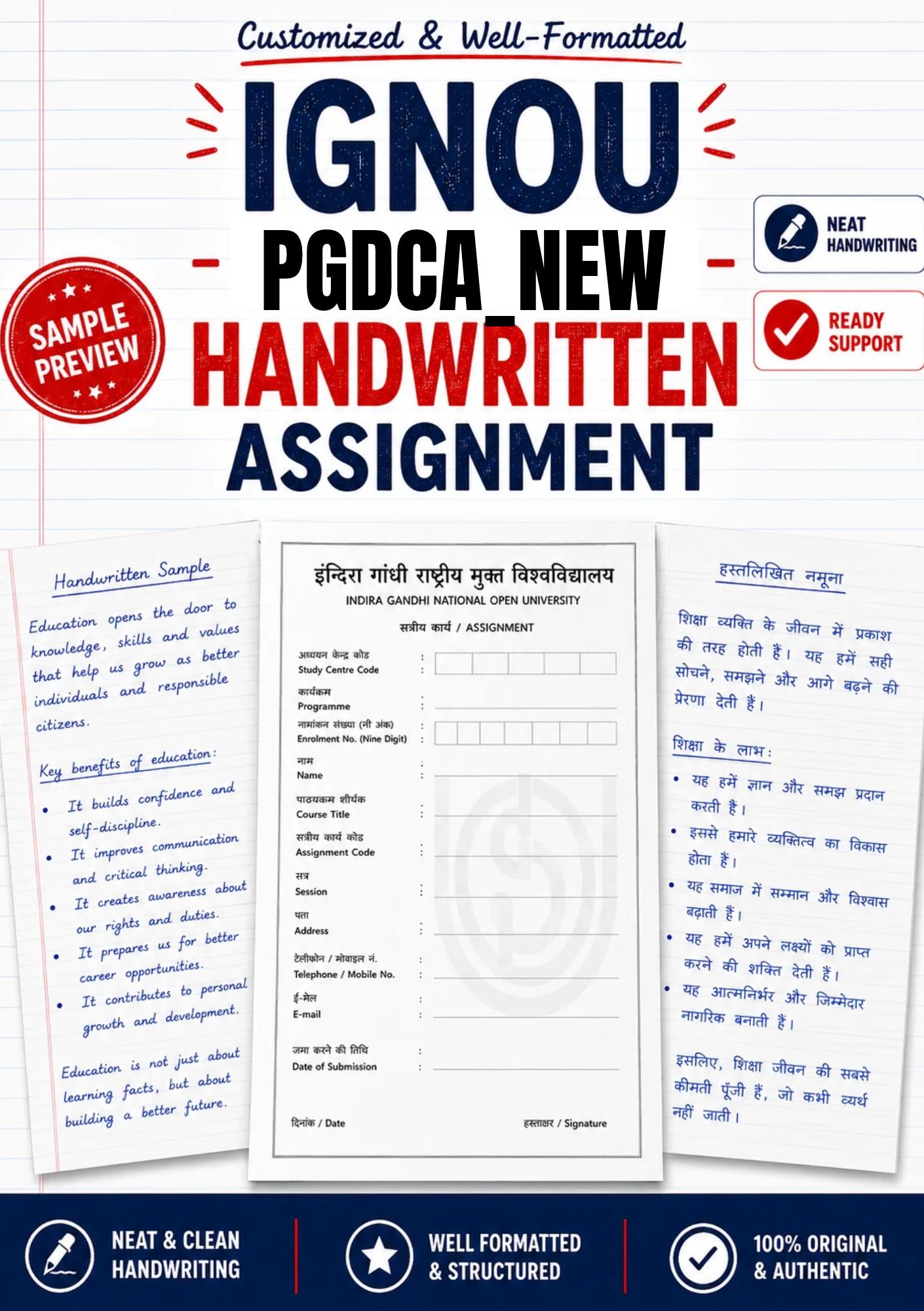
In short. This product supplies handwritten answer sets for the IGNOU PGDCA_NEW programme, the one-year Post Graduate Diploma in Computer Applications run by the School of Computer and Information Sciences, covering any of its ten codes: MCS-201, MCS-202, MCS-203, MCSL-204 and MCSL-205 in Semester I, and MCS-206, MCS-207, MCS-208, MCSL-209 and MCSL-210 in Semester II. The rate is ₹320 per subject, hard copy only, with courier included in that price and no separate shipping charge. Every set is written out by hand, in handwriting matched to a sample page you photograph and send, against the question paper IGNOU has actually published for your cycle, and it arrives with a free IGNOU-format front page and a copy of that question paper. The two cut-off dates SOCIS prints on a PGDCA_NEW paper are 30 April for the January to June semester and 31 October for the July to December semester, and submitting on time is what makes you eligible to sit the matching term-end examination. Two things the written sheets cannot cover are stated plainly on this page rather than buried: the viva voce, which SOCIS makes compulsory and scores at 20 of the 100 marks, and on the four MCSL lab codes the lab record, which carries a further 40. Any session is accepted, current cycle or older, including backlog courses, at the same ₹320 per subject.
Ten Codes, One Writing Desk: What a PGDCA_NEW Parcel Holds
A PGDCA_NEW order is physical from end to end. For each code you name, a separate handwritten answer set is prepared on A4, tagged, and packed for the counter at your Learner Support Centre. There is nothing to print, nothing to reformat and nothing to convert, because nothing in the parcel is a file.
Four things travel with every code you order. The first is the written answer set itself, in ink, in handwriting matched to the sample you sent. The second is an IGNOU-format front page, filled in with your enrolment number, programme code, course code, assignment number and study centre, supplied free with every order. The third is a photocopy of the official question paper for that code and session, which several Regional Centres insist on seeing attached to the file. The fourth is a short sheet listing exactly which paper each set was written from, by file name and session, so that if your Learner Support Centre queries the wording you can point at the source rather than argue from memory.
What does not travel with it is a PDF. No soft copy or PDF is sold. That is a deliberate scope decision rather than an oversight: a PGDCA_NEW submission is handed over as paper, and a store that sells a downloadable file and calls it a submission is selling the wrong object.
₹320 Against a 100-Mark PGDCA_NEW Paper: The Arithmetic
Every PGDCA_NEW assignment, theory or lab, is printed by SOCIS out of a maximum of 100 marks. The ₹320 does not buy all 100, and the honest version of this page says so before the order block rather than after it.
On a theory paper the written questions carry 80 marks and the viva voce carries 20. MCS-201 for the January 2026 and July 2026 cycle prints ten questions at 8 marks each across a Section A on C programming and a Section B on Python; MCS-202 for the same programme prints four questions over the same 80 marks. Those 80 marks are what a handwritten set addresses.
On the four lab codes the split moves again. MCSL-204 and MCSL-205 for 2026 each print two questions carrying 40 marks between them, with the lab record carrying a further 40 and the viva the remaining 20. MCSL-210 for the 2025-26 cycle prints two sections, a DBMS lab section and a Java lab section, on the same 40 and 40 and 20 basis. So on a lab code the written pages are 40 per cent of the paper. The lab record is built from work you execute yourself at the terminal, and no publisher can manufacture it for you.
Inside the ₹320 sit the writing itself, the handwriting match, the front page, the question-paper copy and the courier. Outside it sit the lab record, the viva voce, the counter receipt you should always collect, and any examination fee. There is no minimum order: one subject or fourteen, same rate.
Downloading MCS-207 Answers and Submitting Them Are Two Different Acts
Two products on this store are routinely confused, and the confusion costs learners a whole session. A solved assignment is a soft-copy reference file of model answers for one course code and one session, bought to read from and to study against. A handwritten assignment is the answers written out by hand on A4 and submitted in hard copy at the study centre. The first is study material. The second is the thing that goes across the counter.
| Point of difference | Solved assignment for an MCS code | Handwritten set for an MCS code |
|---|---|---|
| Format | Soft copy, read on a phone or laptop | Hard copy, written in ink on A4 |
| What you do with it | Read it, understand the method, then write your own answer | Review it, sign the declaration, hand it in |
| Who it suits | A learner who has time to write but is stuck on the SQL or the Java logic | A learner who understands the course but has no writing time before the cut-off |
| Covers the lab record? | No | No |
| Covers the viva voce? | No | No |
| Price on this store | Priced per code on the solved-assignment pages | ₹320 per subject, courier included |
Scroll the table sideways on a narrow screen.
IGNOU’s own instruction settles which of the two is a submission. The Semester I booklet for the January 2026 and July 2026 cycle opens its notes with the direction to submit your assignments to the Coordinator of your Study Centre on or before the due date, and makes that submission a precondition of appearing in the corresponding term-end examination. A file sitting in your downloads folder has not been submitted to anybody. If what you actually want is the reference file to write from yourself, the store keeps a worked set of model answers on its PGDCA_NEW solved-assignment pages, code by code and session by session, and that is the correct page for that need, not this one.
Start with the codes, not the semester. Electives do not exist in PGDCA_NEW, but pending papers do, and most orders are a subset rather than a full five.
₹320 per subject, hard copy, courier included. One code or ten, same rate.
Semester I: MCS-201, MCS-202, MCS-203 and the Two Lab Codes
Semester I of PGDCA_NEW carries 16 credits across five codes, three theory at 4 credits each and two labs at 2 credits each. The titles below are reproduced from the Common Prospectus July 2026, section 8.58, and the assignment numbers are read off the Semester I booklet IGNOU has published for the January 2026 and July 2026 cycle. The last column matters more than it looks: nine of the ten PGDCA_NEW codes are also issued to learners on other SOCIS programmes, which is why a classmate’s booklet can print a different prefix above an identical question.
| Code | Title as printed in the prospectus | Credits | Assignment number on the 2026 paper | Also issued under |
|---|---|---|---|---|
| MCS-201 | Programming in C and Python | 4 | PGDCA_NEW(I)/201/Assignment/2026 | BCA_NEW, BCA_NEWOL, MCA_NEW bridge |
| MCS-202 | Computer Organisation | 4 | PGDCA_NEW(I)/202/Assign/26 | BCA_NEW, BCA_NEWOL |
| MCS-203 | Operating Systems | 4 | PGDCA_NEW(I)/203/Assign/26 | BCA_NEW, BCA_NEWOL |
| MCSL-204 | WINDOWS and LINUX Lab | 2 | PGDCA_NEW(I)/L-204/Lab_Assignment/2026 | BCA_NEW, BCA_NEWOL |
| MCSL-205 | C and Python Lab | 2 | PGDCA_NEW(I)/L-205/Assign/26 | BCA_NEW, BCA_NEWOL |
| Semester I total | 16 | Both dates printed on every row | ||
Scroll the table sideways on a narrow screen.
Semester II: MCS-206 to MCS-208, Plus MCSL-209 and MCSL-210
Semester II repeats the shape exactly, three theory papers at 4 credits and two labs at 2, for another 16 credits. One row in it is unlike anything else in the programme. MCSL-210 is the only one of the ten PGDCA_NEW codes that appears nowhere else in the Common Prospectus July 2026: a search of the whole document returns it once, inside the PGDCA_NEW table. Every other code in this diploma is shared with BCA_NEW, and MCS-207, MCS-208 and MCSL-209 are shared further still with the postgraduate artificial-intelligence and data-science tables. If you are looking for MCSL-210 material, PGDCA_NEW is the only place the prospectus puts it.
| Code | Title as printed in the prospectus | Credits | Assignment number on the 2025-26 paper | Also issued under |
|---|---|---|---|---|
| MCS-206 | Object Oriented Programming Using Java | 4 | PGDCA(II)/206/Assignment/25-26 | BCA_NEW |
| MCS-207 | Database Management Systems | 4 | PGDCA_NEW(II)/207/Assignment/2025-26 | BCA_NEW, PG data-science and AI tables |
| MCS-208 | Data Structures and Algorithms | 4 | PGDCA(II)/208/Assignment/25-26 | BCA_NEW, MCA_NEW bridge, PG AI tables |
| MCSL-209 | Data Structures and Algorithms Lab | 2 | PGDCA(II)/L-209/Assignment/25-26 | BCA_NEW, PG AI tables |
| MCSL-210 | DBMS and Java Lab | 2 | PGDCA_NEW(II)/L-210/Assignment/2025-26 | PGDCA_NEW only |
| Semester II total | 16 | Programme total 32 credits | ||
Scroll the table sideways on a narrow screen.
Two rows of these tables are worth reading against each other before you order. MCS-206 and MCSL-210 sit in the same booklet for the same session, yet one is printed with a PGDCA prefix in the contents table and the other with PGDCA_NEW in its course block. Neither is wrong on your sheet. The next section sets out why.
Twelve Courses or Ten, 36 Credits or 32: Where the PGDCA_NEW Record Splits
The research behind this page compared the Common Prospectus July 2026 against six years of live SOCIS booklets and against this store’s own category list. These are the disagreements that turned up. They are published because a learner who meets one of them mid-submission is better off having read it here first.
Ten places the PGDCA_NEW record does not agree with itself, including three that are this store’s own fault.
1. The prospectus contradicts itself inside one section. Section 8.58 states in prose that the diploma consists of 12 courses worth 36 credits. The table directly beneath it lists 10 courses and prints a total of 32 credits, and the credits do sum to 32. Adding the 4-credit BCS-012 bridge course reconciles the 36 but still leaves 11 courses, not 12.
2. The assignment weightage is not uniform across the programme. MCS-201 and MCSL-204 for 2026 and MCSL-210 for 2025-26 each print a weightage of 30 per cent. MCS-202 for 2025 and MCS-207 for 2025-26 each print 25 per cent. Same programme, same school, same cycle, two different figures.
3. The programme code is printed four ways. The prospectus and the 2026 cover use PGDCA_NEW. The Semester II cover for 2025-26 uses PGDCA-(NEW). The internal document reference uses PGDCA-NEW. The SOCIS programme guide title page reads simply PGDCA, with PGDCA_NEW given beneath it as the programme code.
4. The assignment number is printed two ways inside one PDF. The Semester I contents table for 2026 abbreviates MCS-201 to PGDCA_NEW(I)/201/Assign/26 while the course block on page 3 of the same file writes PGDCA_NEW(I)/201/Assignment/2026 in full.
5. The prefix has flipped between cycles. The 2024 and 2025 Semester I papers print PGDCA(I); the 2026 paper prints PGDCA_NEW(I). The 2021-22 Semester II paper used an Arabic numeral, PGDCA(2)/206; the 2023-24 paper used PGDCA_NEW(2)/206; the 2025-26 contents table uses PGDCA(II)/206.
6. The two cut-off dates have moved. The 2021-22 Semester II paper printed 15 November 2021 and 15 April 2022. From 2023-24 onward the pair has been 31 October and 30 April. Any date list older than 2023 is stale for this programme.
7. The two booklets order their date columns in opposite directions. The Semester I file puts the January to June column first and the July to December column second; the Semester II file reverses them. Reading the first date column out of habit will give a learner the wrong deadline by six months.
8. An MCA_NEW bridge-course booklet prints a PGDCA_NEW assignment number. The 2025 bridge paper for MCS-201 and MCS-208 is titled for the Master of Computer Applications yet instructs the learner to write PGDCA_NEW(I)/201/Assignment/25 above the first answer.
9. The prospectus and the booklets punctuate the codes differently. Section 8.58 prints them unhyphenated, as MCS 201 and MCSL 204, while every SOCIS assignment paper and every entry on your grade card prints MCS-201 and MCSL-204. The code column of the two tables above follows the booklet form because that is what you write on your file; the title column follows the prospectus.
10. This store’s own pages are not consistent either, and three faults are logged here rather than hidden. A books category carrying the PGDCA_NEW code is titled for a PG Diploma in Services Management, which is a different programme entirely. Three separate book categories, two solved-assignment categories and two guess-paper categories exist for this one diploma. And the handwritten category page still advertises a delivery window in working days, which contradicts the rule stated on this page that no delivery figure is promised. All three are in the correction queue.
None of the first nine items is a reason to delay a submission. The rule that resolves every one of them is the same: the authority for your file is the paper you downloaded for your own code and your own cycle, and where this page and that paper differ, the paper wins. Programme structures, course codes, submission dates and rules change, and only ignou.ac.in and your Regional Centre can confirm the current position for your enrolment.
30 April or 31 October: Your Column Depends on Which Semester Booklet You Hold
PGDCA_NEW runs on semesters, not years. The prospectus divides it into a January to June semester and a July to December semester, with a term-end examination in June for the first and in December for the second. The assignment calendar follows that division, and the current pair of dates is fixed across every row of both booklets.
For the January to June semester the last date is 30 April. For the July to December semester it is 31 October. Every one of the five rows in the Semester I booklet for the 2026 cycle carries both of those dates, and so does every row in the Semester II booklet for 2025-26. There is no staggering between a theory code and a lab code, and no separate date for MCSL-210.
Two traps sit in that simplicity. The first is column order. The Semester I file lists the January to June column on the left and the July to December column on the right; the Semester II file does the reverse. A learner glancing at the leftmost date in whichever file is open will be six months out half the time. The second trap is age. These are not the dates this programme has always used: the 2021-22 Semester II paper printed 15 November and 15 April, so a date list copied from an older blog or an older booklet is simply wrong now.
The consequence of missing the date is not a lower mark, it is an exclusion. The SOCIS note makes submission before the due date compulsory to become eligible for appearing in the corresponding term-end examination, and for the four MCSL codes adds a minimum-attendance condition on top of it before you may sit the term-end practical examination. That is the only legitimate urgency on this page, and it is IGNOU’s, not this store’s.
PGDCA(I), PGDCA_NEW(II), Assign or Assignment: Four Spellings of One Code
The line printed above the first question of your paper is the assignment number, and it is what the evaluator matches your file against. On PGDCA_NEW it has four moving parts, and all four have moved within the last three cycles.
Read PGDCA_NEW(I)/201/Assignment/2026 from the left. The first element is the programme, either PGDCA or PGDCA_NEW depending on the year the paper was issued. The second is the semester, in Roman numerals on recent papers and in Arabic on the 2021-22 set. The third is the course number, with the letter L prefixed on the four lab codes, so MCSL-204 becomes L-204. The fourth is the word Assignment, sometimes shortened to Assign in a contents table and extended to Lab_Assignment on the 2026 MCSL-204 paper. The last element is the session, written as a two-digit year on a Semester I paper and as a two-year span on a Semester II paper.
The practical instruction is short. Copy the string from the course block of your own downloaded paper, not from the contents table, not from this page, and not from a classmate on a different programme. If your enrolment is on BCA_NEW rather than this diploma the string begins BCA_NEW even though the questions are identical, and if you are clearing an MCA_NEW bridge requirement the string will begin PGDCA_NEW even though your programme does not. Every set prepared here is labelled with the string from the paper you supply.
The Hand That Writes the C Programs Has to Look Like Yours
The signature at the bottom of a PGDCA_NEW cover page is yours, and a file in a stranger’s handwriting makes that signature awkward to put down. That is why the handwriting match is part of the service rather than an upgrade. Send a photo of a page you have written yourself and the handwritten set is matched to your handwriting at no extra charge.
PGDCA_NEW makes this harder than an essay programme does, and the writing desk plans for it. An MCS-201 answer runs ordinary prose into a C function and then into Python, with indentation that has to survive being copied by hand. An MCS-207 answer carries entity-relationship diagrams, normalised table structures and a dozen SQL statements. An MCSL-210 answer moves between a database section and a JavaFX and JDBC section on the same sheet. Keywords, operators and identifiers are copied character by character, because a transcription slip in a SELECT statement is not a style problem, it is a wrong answer.
A sample page that shows your braces as well as your letters
One page is enough, in daylight, flat on a table, shot straight down rather than at an angle. The most useful page is one that already mixes registers: a few lines of your normal prose, then a few lines of code or a labelled diagram, so the desk can see how your digits, braces, semicolons and capitals behave as well as your letters. A page of pure prose matches your handwriting but says nothing about how you write a loop. If you write in block capitals, or switch to capitals for code and lower case for explanation, send a sample that shows both and say so in the message.
One Medium Only, and Why a 2022-23 MCSL Code Is Still Accepted
The prospectus is unambiguous about language for this diploma: the medium of instruction is English. Unlike several SOH and SOSS programmes, PGDCA_NEW issues no Hindi TMA paper, so there is no Hindi set to order and no price difference between mediums to explain. The service covers all mediums IGNOU issues the TMA paper in, at the same price. For PGDCA_NEW that list has one entry.
Session coverage is wider than medium coverage. Any session is accepted, current cycle or older, including backlog courses, at the same ₹320 per subject. That matters on a semester programme with a three-year maximum duration, where a learner who registered in a January cycle two years ago may still be clearing one Semester II lab code while a current cohort works through Semester I. PGDCA_NEW question wording is rewritten every cycle, so a pending MCSL-209 from 2022-23 is written against the 2022-23 paper, not against the current one, and the set is labelled with that session. If your code is older than anything the portal still lists, the customised handwritten order for any session is the route, and the rate does not change.
One structural note for learners who did not take Mathematics at 10+2 or graduation level. The prospectus requires those candidates to complete BCS-012 Basic Mathematics as a bridge course, at an additional fee in the first semester. BCS-012 is a bachelor-level code that the prospectus prints as a 4-credit skill-enhancement paper inside the BCA_NEW table, so a PGDCA_NEW learner on that route holds one assignment that is not an MCS code at all. It can be ordered on the same terms; name it separately when you send your list, because it is issued on a different booklet with its own dates.
Enrolment Number, Semester, Codes, Session, Sample Photo
Orders stall on missing information rather than on anything complicated. Five things settle a PGDCA_NEW quote in one exchange.
- Your enrolment number, so the programme and cycle can be confirmed rather than assumed.
- The semester you are submitting for, first or second, and whether any code is a backlog from an earlier cycle.
- The exact code list, written out: MCS-201, MCSL-205, and so on, rather than a count of subjects.
- The session printed on your paper, for example January 2026 or 2025-26, since the questions differ between them.
- One photograph of a page in your own handwriting, as described above.
What can wait is the delivery address, which is needed only once the quote is agreed, and the pin code, which is used to confirm the courier position for your order rather than to promise a date. What is never needed is a payment before the sample has been reviewed and the available codes confirmed.
One message is usually enough to close the question. Codes, session, enrolment number, sample photo.
₹320 per subject, courier included, no soft copy. Backlog codes at the same rate.
Sign the Declaration, Then Two More Things Only You Can Do
When the parcel reaches you, the sequence is short and the last two steps are not transferable.
Check first that every code you ordered is present as its own tagged set, that the assignment number on each front page matches the string on your own downloaded paper, and that the question-paper photocopy attached to each set is the one for your session. Then read the answers. You sign the declaration on the assignment cover page, so you should read and review the content before submitting it, and satisfy yourself that it represents your own understanding of the course. Then submit to the Coordinator of your Study Centre on or before the due date, as the booklet directs, and collect a receipt.
The first thing nobody can do for you is the lab record. On MCSL-204, MCSL-205, MCSL-209 and MCSL-210 the lab record carries 40 of the 100 marks, and it is the evidence that you executed the programs, created the database, ran the queries and built the interface yourself. The written answer set addresses the printed questions; the record is your own work at the terminal.
The second is the viva voce. SOCIS states it plainly and this page repeats it without softening: the viva voce is compulsory for the assignments, and for any course where a student has submitted the assignment and not attended the viva-voce, the assignment is treated as not successfully completed and is marked as ZERO. Twenty of the hundred marks sit there. A learner who orders a handwritten set, submits it, and skips the viva has bought nothing. Read the answers you submit closely enough to discuss them, because the counsellor will ask about them.
Guide Books, Guess Papers and the Sibling Programmes That Share Your Codes
Most PGDCA_NEW orders are part of a wider shop, and the store keeps separate pages for each need rather than one page that claims to serve all of them. For reading matter on the theory codes there are PGDCA help books and study guides arranged chapter by chapter, with a second, older diploma-level books listing for the same programme that predates it. Closer to the examination, the PGDCA_NEW guess papers covering the most repeated questions per subject and the solved previous-year term-end papers for this diploma are the two pages that get used, and MCS-208 is the code whose past papers are asked for most.
On the assignment side, model-answer files live on two parallel pages, the current per-code solved assignment listing for the computer applications diploma and the newer one linked earlier in this page. Because nine of your ten codes are shared, the handwritten products for the neighbouring SOCIS programmes are genuinely useful to compare against: the BCA_NEW written-assignment product, which carries the same MCS codes across six schools, the MCA written sets covering the MCS and MCSL papers beyond this diploma, and the artificial-intelligence and machine-learning masters sets that reuse MCS-207 and MCS-208. Everything the store writes by hand across every programme is collected on the main handwritten-assignment counter.
If you would rather write the file yourself and only want the format rules, the editorial side of this publisher keeps a free walkthrough of front page, margins, ink and submission rules on ignouproject.com, and the papers themselves are always free from the IGNOU assignment download service.
The Viva, the Lab Record, the Dates: Doubts Learners Raise First
Is PGDCA_NEW the same programme as the older PGDCA?
They are related but not identical, and the code matters when you download a paper. PGDCA_NEW is the one-year, two-semester diploma that IGNOU has offered from the January 2021 admission cycle onward, built on MCS-201 to MCSL-210. The older PGDCA offering, which used a different code set, closed to new admissions. The SOCIS programme guide adds to the confusion by printing PGDCA on its title page with PGDCA_NEW given beneath as the programme code. Check the code on your admission record, not the title on a guide.
How much does one MCS or MCSL written set cost?
The rate is ₹320 per subject, hard copy only, with courier included in that price and no separate shipping charge. A lab code costs the same as a theory code even though it is worth 2 credits rather than 4, because the price is per subject rather than per credit, and a single code can be ordered on its own.
Can I hand in a printed copy of an MCS-207 answer file instead?
No. PGDCA_NEW assignments are submitted as a handwritten hard copy at the study centre, which is the whole reason this product exists as paper rather than as a download. No soft copy or PDF is sold here. A model-answer file is something to read and write from, and it has not been submitted to anyone while it sits on your phone.
Which of the two dates on my booklet applies to me?
30 April if you are submitting for the January to June semester, and 31 October if you are submitting for the July to December semester. Both dates appear on every row of both PGDCA_NEW booklets, but the two files order the columns differently, so read the column heading rather than the position. If your paper is older than the 2023-24 cycle it may print a different pair entirely.
Why does MCS-207 say 25 per cent when MCSL-210 says 30 per cent?
Because the SOCIS papers themselves differ. The 2025-26 MCS-207 paper prints a weightage of 25 per cent and the 2025-26 MCSL-210 paper prints 30 per cent, as do MCS-201 and MCSL-204 for 2026, while MCS-202 for 2025 prints 25. Assignments carry 30 per cent of the final course result and the term-end examination carries the remaining 70 per cent. That is the general IGNOU rule. On this programme the printed figure varies by course, so trust the line on your own paper rather than the rule.
Does ordering MCSL-209 written sheets finish that course for me?
No, and this is the single most important thing on this page for a lab code. The written questions on MCSL-209 carry 40 of the 100 marks. Your lab record carries another 40 and the viva voce carries 20. The record has to come from work you execute yourself, so a written set covers under half the paper. Order it for the written component and plan the record separately.
What happens if I skip the viva after submitting?
The assignment is treated as not successfully completed and is marked as ZERO. That is the SOCIS wording, printed in the notes of both PGDCA_NEW booklets, and it applies whether or not the written file was any good. Attend the viva at your Learner Support Centre and be ready to talk through the answers in your file.
Does PGDCA_NEW issue a Hindi question paper at all?
No. The prospectus gives the medium of instruction for this diploma as English, and IGNOU issues no Hindi TMA paper for the MCS and MCSL codes in it. The service covers all mediums IGNOU issues the TMA paper in, at the same price. For this diploma that means English only.
My friend on BCA_NEW has the same MCS-202 questions. Can we submit the same file?
No, and not because the questions differ. Nine of the ten PGDCA_NEW codes are also issued on BCA_NEW, so the questions can be word for word identical, but the assignment number above them is not: theirs begins BCA_NEW and yours begins PGDCA_NEW or PGDCA. Each file is labelled and evaluated against its own programme, and a set prepared here is labelled from the paper you send.
Can I order a pending MCSL-210 from an old cycle on its own?
Yes. Any session is accepted, current cycle or older, including backlog courses, at the same ₹320 per subject, and there is no minimum order. MCSL-210 is also the one code in this diploma that no other programme in the prospectus issues, so an old paper for it has to be written from the PGDCA_NEW booklet of that session rather than borrowed from a sibling programme.
Do I have to register for BCS-012 as well?
Only if you did not take Mathematics at 10+2 or graduation level, in which case the prospectus requires BCS-012 Basic Mathematics as a bridge course with an additional fee in the first semester. It is a bachelor-level 4-credit paper issued on its own booklet, so if you need it written, list it separately from your MCS codes and the desk will quote it on the same per-subject terms.
Is the programme really 36 credits, as some pages say?
The prospectus says both things in one section. Its prose for section 8.58 describes 12 courses worth 36 credits; the table under that prose lists 10 courses and totals 32, and the credits do add up to 32. The 36 reconciles only if the 4-credit BCS-012 bridge course is counted in, and even then the course count does not. Treat your own admission record and the table as the operative figures.
How is the handwriting matched, and what does that cost?
You photograph one page you have written yourself and send it before anything is paid. Send a photo of a page you have written yourself and the handwritten set is matched to your handwriting at no extra charge. For this programme the useful sample mixes prose with code or a diagram, because digits, braces and capitals matter as much as letters on an MCS answer.
When will my parcel arrive?
Delivery depends on your pin code and is confirmed for your order before you pay. No figure is promised on this page. If you are close to 30 April or 31 October, say so in your first message so that the position for your pin code can be confirmed before you commit rather than after.
Will the set get me a particular grade?
No such claim is made anywhere on this page. No claim is made about the marks any assignment will receive, about how an evaluator will assess it, or about whether it will be accepted. Assignment evaluation is entirely a matter for IGNOU. What is promised is the writing, the handwriting match, the front page, the question-paper copy and the courier, for ₹320 per subject.
Pages 307 and 308, Two SOCIS PDFs, and a Walk Through Our Own Catalogue
Important Notice
Shri Chakradhar Publication Pvt. Ltd. and shrichakradhar.com form an independent IGNOU study-support publisher. This is not the official website of Indira Gandhi National Open University, is not affiliated with, endorsed by or authorised by the university, and no page on this site should be treated as an official IGNOU communication.
Programme structures, course codes, submission dates and rules change, and only ignou.ac.in and your Regional Centre can confirm the current position for your enrolment.
You sign the declaration on the assignment cover page, so you should read and review the content before submitting it, and satisfy yourself that it represents your own understanding of the course.
No claim is made about the marks any assignment will receive, about how an evaluator will assess it, or about whether it will be accepted. Assignment evaluation is entirely a matter for IGNOU.
Send the PGDCA_NEW Codes You Are Registered For
The rate is ₹320 per subject, hard copy only, with courier included in that price and no separate shipping charge. Backlog codes from earlier cycles are quoted on exactly the same terms.
Two routes, both ending at the same writing desk. Quote me for the MCS and MCSL papers in my semester, or if you are unsure which papers are still pending, photograph the record and have the pending list worked out.
Keep the viva and the lab record in your own diary while the writing is handled here. Send your handwriting sample and settle the match first.