

Description
In short. The IGNOU Post Graduate Diploma in Geriatric Medicine (PGDGM) is a one-year, 36-credit programme for MBBS doctors in which only the three theory courses, MME-104 Basic Geriatrics, MME-105 Clinical Geriatrics I and MME-106 Clinical Geriatrics II, carry written assignments: three for MME-104 and two each for the other two, seven in all in the 2026 booklets, each marked out of 100 and each with its own due date between 15 August and 30 November. Shri Chakradhar Publication writes those assignments by hand on foolscap, in a hand matched from your own sample photo, and couriers them with an IGNOU-format front page and a copy of the official question paper, at ₹320 per subject with courier included and no soft copy sold.
Seven Answer Books, Seven Front Pages: What a PGDGM Parcel Holds
A PGDGM order is assembled assignment by assignment, because that is how the School of Health Sciences sets the diploma. Each assignment code on your booklet becomes its own answer book, written on foolscap sheets, numbered and tied, so that it can be handed in separately on its own date. A learner who orders the full theory side therefore receives seven answer books, not three.
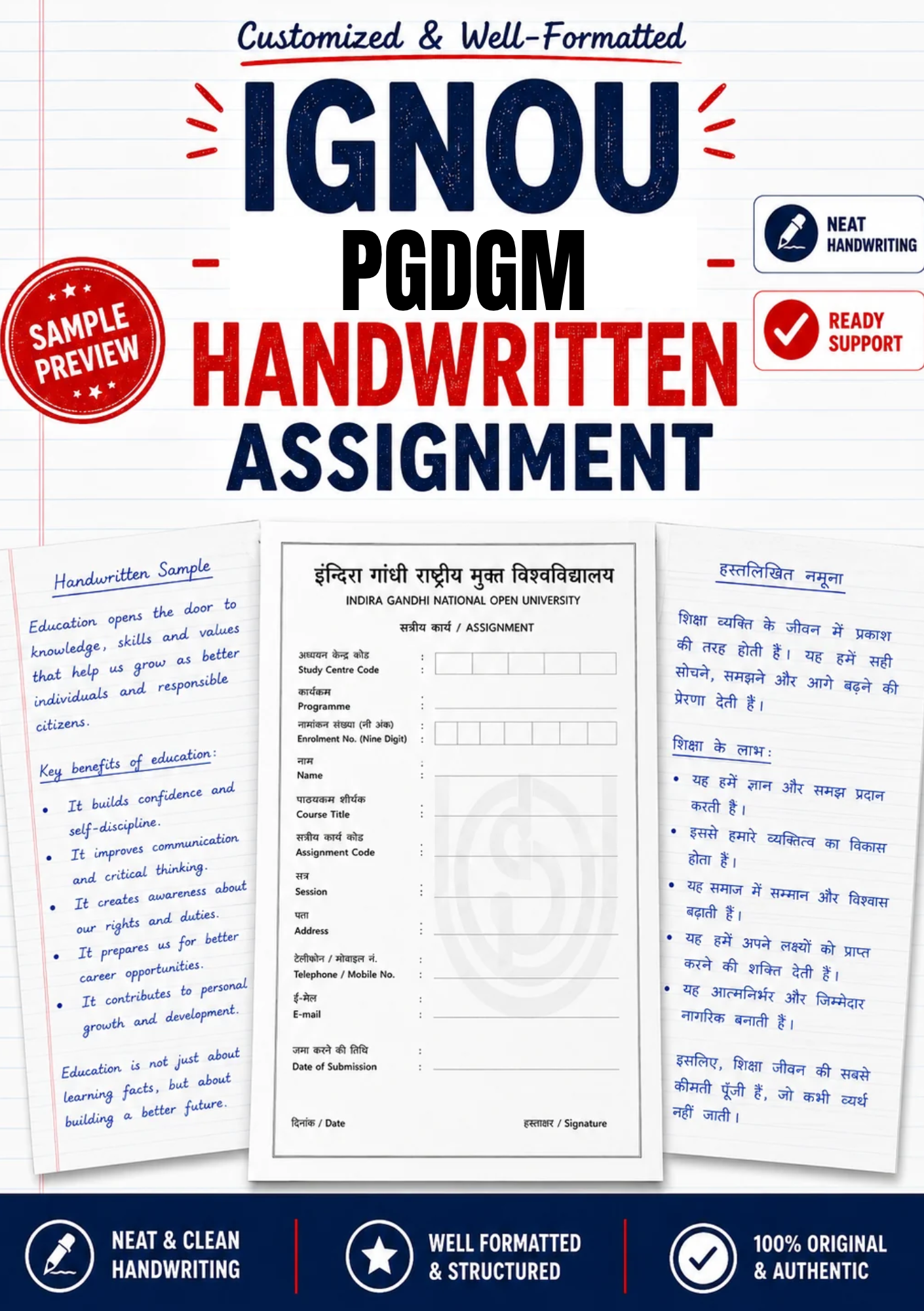
Alongside each answer book sits an IGNOU-format front page, supplied free with every order and laid out with the fields the PGDGM booklet itself asks for: course code, course title, assignment code, roll number, name, address, PSC and date of submission. The booklet wants the roll number, name and full address in the top right corner of the first page, and the front page follows that placement rather than a generic template.
The third item is a copy of the official question paper for each course, so that every answer book can be checked against the exact case and short-note list it was written to. On this diploma that matters more than usual, because the same course code carries different blocks in different assignments: MME-104/AS-1 covers Blocks 1 and 2, AS-2 covers Blocks 3 and 4, and AS-3 covers Blocks 5 and 6.
The fourth thing is what is absent. No soft copy or PDF is sold. Nothing is emailed, nothing is uploaded on your behalf, and no scan of the written pages is kept as a product. What reaches you is paper, because the booklets for all three courses state that only handwritten assignments will be accepted and that typed or printed copies will not.
₹320 Against a Course That Sets Three Separate Assignments
The rate is ₹320 per subject, hard copy only, with courier included in that price and no separate shipping charge. Inside that figure sit the handwriting, the foolscap paper, the free front page, the copy of the official question paper and the courier to your address. There is no packing charge and no surcharge for the handwriting match.
PGDGM is the unusual case where a subject and an assignment are not the same thing. MME-104 is one course with three assignments due on three different dates, while MME-105 and MME-106 each carry two. Because of that, every PGDGM quote on WhatsApp lists the individual assignment codes it covers, MME-104/AS-1 through MME-106/AS-2, so the figure you agree to and the answer books you receive line up code for code before anything is paid.
The size of the writing explains why that clarity is worth having. Every 2026 assignment read for this page asks for two long answers within 750 words each and six shorter answers within 300 words each. That is an upper limit of 3,300 words per assignment, and across the seven assignments it comes to as much as 23,100 words of clinical and public-health writing in a diploma that most learners take while in full-time practice.
What the rate does not cover is equally specific. IGNOU’s programme fee, the practical courses MMEL-104 to MMEL-106, the hands-on training at the Skill Development Centre and the practical examination all sit outside it. So does the result. No claim is made about the marks any assignment will receive, about how an evaluator will assess it, or about whether it will be accepted. Assignment evaluation is entirely a matter for IGNOU.
Delivery depends on your pin code and is confirmed for your order before you pay. No figure is promised on this page.
A Geriatrics Model-Answer PDF or Pages in Your Own Hand
Two different products are searched for with nearly the same words, and on a diploma with seven due dates, buying the wrong one can cost a cycle. A solved assignment is a set of model answers for one course code and one session, supplied as a digital file that you read before writing your own. A handwritten assignment is the answers themselves written out by hand on paper and submitted in hard copy, which on PGDGM means foolscap handed to your LSC or PSC Coordinator.
| What a doctor is deciding | Soft-copy MME reference file | Hand-written MME answer book |
|---|---|---|
| Form it arrives in | A digital file to read on a screen | Foolscap sheets, numbered and tied, with a front page |
| What you do with it | Study it, then write your own answers by hand | Read and review it, sign the declaration, hand it in |
| What the 2026 booklet says | Typed or printed copies will not be accepted | Only handwritten assignments will be accepted |
| Who it suits | A doctor with time to write seven assignments personally | A doctor whose clinical hours leave no room for 23,100 words |
| Price line on this store | Sold on separate solved-assignment shelves, not here | ₹320 per subject, courier included |
Swipe the table sideways on a phone to read all three columns.
The instruction IGNOU prints is short and does not leave room for interpretation. All three 2026 PGDGM booklets tell the learner to use only foolscap size paper, state that only handwritten assignments will be accepted, and add that typed or printed copies will not be. A downloaded file of model answers, printed and stapled, is therefore not a PGDGM submission under the university’s own wording, however accurate its contents.
Put plainly, a model-answer file prepares you to write the MME pages; it never stands in for them at the LSC counter. If a reference file is genuinely what you want, this page is the wrong shelf. PGDGM has no solved-assignment category of its own on this store yet, so the place to look is the store’s diploma solved-assignment section, where the SOHS diplomas would be filed, and this page says so plainly rather than inventing a link.
Seven assignment codes, one written quote, before any money moves.
The rate is ₹320 per subject, hard copy only, with courier included in that price and no separate shipping charge.
List your MME assignment codes on WhatsApp for a code-by-code quote
MME-104, MME-105 and MME-106: Fourteen Theory Credits That Carry Every Assignment
The IGNOU Common Prospectus for July 2026 sets out PGDGM in section 8.56, under the School of Health Sciences, as six courses: three theory and three practical. The programme is open only to MBBS graduates who have completed internship, its medium of instruction is English, and admission is merit-based through the university’s FLIP portal, with a ceiling of 30 learners at each Learner Support Centre.
| MME code as the booklet prints it | Title in prospectus section 8.56 | Theory or practical | Credits out of 36 | Assignments in the 2026 booklet |
|---|---|---|---|---|
| MME-104 | Basic Geriatrics | Theory | 6 | 3 (AS-1, AS-2, AS-3) |
| MME-105 | Clinical Geriatrics I | Theory | 4 | 2 (AS-1, AS-2) |
| MME-106 | Clinical Geriatrics II | Theory | 4 | 2 (AS-1, AS-2) |
| MMEL-104 | Basic Geriatrics Practical | Practical | 6 | None |
| MMEL-105 | Clinical Geriatrics I Practical | Practical | 12 | None |
| MMEL-106 | Orthopaedics Practical | Practical | 4 | None |
On a narrow screen the last two columns sit off to the right; swipe to see them.
The arithmetic checks against the stated total. Theory is 6 + 4 + 4 = 14 credits, practical is 6 + 12 + 4 = 22 credits, and 14 + 22 = 36, which is the figure the prospectus prints for the programme and the figure IGNOU’s own PGDGM programme page repeats as 14 theory and 22 practical credits. The extracted table can therefore be trusted.
Two features of that structure shape a PGDGM order. The first is that the credit weight and the assignment count do not move together. MME-104 is the heaviest theory course at six credits and also the one with three assignments, but MME-105 and MME-106 each carry four credits and two assignments, so a learner owing all three courses owes seven assignments rather than six or nine.
The second is where the course titles come from. The booklets ask for a course title on the response sheet but print none against their own course codes, so the titles in the table above are taken from the prospectus. Basic Geriatrics, Clinical Geriatrics I and Clinical Geriatrics II are the forms written on the front pages in this set.
The content of the 2026 papers shows why the writing is substantial. MME-104 moves from a population pyramid for a forty-year period and an elderly woman with a reduced eGFR, through sleep hygiene, falls, the National Programme for Health Care of the Elderly and disaster needs, to rehabilitation, ageism in India, beneficence against non-maleficence and a practitioner’s duty of confidentiality under Indian law. MME-105 sets an elderly patient with seizure and low sodium, a suspected sleep-disordered breathing case, thrombolysis in acute ischaemic stroke and a CSF picture to interpret. MME-106 runs from heart failure with hypokalaemia and SIADH against cerebral salt wasting to herpes zoster, prostate screening, poisoning and lower gastrointestinal bleeding.
MMEL-104 to MMEL-106: Twenty-Two Practical Credits With No Assignment Paper
Close to two thirds of the diploma, 22 of its 36 credits, never produces an assignment at all. The three practical courses are completed through counselling sessions at the Learner Support Centre, hands-on training at identified district hospitals that IGNOU calls Skill Development Centres, and a practical examination, as the prospectus describes the programme’s implementation. No booklet on ignou.ac.in sets a tutor-marked assignment for MMEL-104, MMEL-105 or MMEL-106.
That has two practical consequences. A learner searching for an MMEL assignment to buy is searching for something IGNOU does not issue, and this product does not offer one. And the one-year minimum duration is driven as much by the clinical postings as by the written work, so settling the seven answer books early leaves the hospital rotations free for the clinical work they exist for.
This store keeps a separate shelf for each practical course: the MMEL-104 Basic Geriatrics practical and log book shelf, the MMEL-105 shelf for the clinical log book and SDC posting and the MMEL-106 orthopaedics practical shelf. All three held no products when this page was written, a gap recorded below rather than hidden.
Eighteen Places the PGDGM Paper Trail Contradicts Itself
Everything in the box below was found by reading IGNOU’s own PGDGM documents against one another for this page: the Common Prospectus July 2026, the three 2026 course booklets on ignou.ac.in, the combined 2025 booklet and the 2023 and 2024 files on IGNOU’s assignment server. Items marked in-house were found on this store and are listed against this publisher.
Check these against your own admission record before you fill in a single PGDGM front page.
1. The 2024, 2025 and 2026 booklets tell the learner that there are nine assignments in total. The three 2026 course booklets contain seven: three for MME-104 and two each for MME-105 and MME-106. The sister diploma PGDMCH does run AS-1 to AS-9 across its three courses, so a carried-over template sentence is one plausible explanation, though no IGNOU document says so.
2. The 2023 MME-104 booklet gave a third figure, stating that there are three assignments in total. Two stated totals, three and nine, now sit against an actual count of seven.
3. The MME-105 assignments are headed Assignment-4 and Assignment-5 while their codes read MME-105/AS-1 and MME-105/AS-2. MME-106 then restarts at Assignment-1 and Assignment-2, so there is no continuous one-to-seven sequence anywhere in the set.
4. Each cover prints a file label such as PGDGM/MME 104/AS1-3, with a space inside the course code and no hyphen, while the inner pages print MME-104/AS-1. The cover string is a booklet label, not an assignment code.
5. The submission instruction changed between cycles. The 2025 booklet says to submit to your Programme-in-charge only; the 2026 booklets say to your LSC/PSC Coordinator only.
6. The 2025 MME-106/AS-2 page prints its due date as November 30,2022, while the date table in the same booklet gives November 30, 2025.
7. Marks splits are not printed consistently. MME-104/AS-1 and MME-106/AS-2 print no split for their long-answer section, while the other assignments print 2 x 20 = 40 in variously garbled notation.
8. The date table on every booklet is headed Last Date of Submission with an asterisk that no footnote ever explains.
9. MME-106 is due in November while MME-104 and MME-105 are due from August to October. No other School of Health Sciences pattern read for this page uses November.
10. A widely indexed aggregator lists all three PGDGM courses with one due date, 15 October 2026. IGNOU’s booklets print 15 September 2026 as the last MME-105 date and 30 November 2026 as the last MME-106 date.
11. The prospectus writes the codes as MME 104, MME105 and MME- 104 in a single paragraph and table, while every booklet writes MME-104. The hyphenated form is the one to copy.
12. An earlier code series is still live. IGNOU’s question-paper archive carries term-end papers for MME-004 Basic Geriatrics up to June 2026 and for MME-005 Clinical Geriatrics, yet neither code appears in the PGDGM table of the July 2026 prospectus.
13. The prospectus still states eligibility as an MBBS recognised by the Medical Council of India, a body the National Medical Commission replaced in 2020.
14. In-house: this store’s handwritten assignment hub describes its standard set as A4 ruled sheets. Every PGDGM booklet requires foolscap, and every PGDGM set is written on foolscap.
15. In-house: the hub also states a working-day delivery figure. This page does not repeat it, because delivery depends on pin code and is confirmed per order.
16. In-house: three MMEL practical categories exist and hold no products, and the MMEL-105 category title does not use the prospectus title Clinical Geriatrics I Practical.
17. In-house: the PGDGM guess-paper category lists two separate MME 104 products under an identical title, beside legacy MME 4 and MME 5 products, and its description calls the contents solved past-year papers.
18. In-house: PGDGM has no solved-assignment category and no books category on this store.
The working rule that follows is simple: copy the assignment code from the inner page of your own booklet, take the date from that same page, and treat the cover label, the heading number and the stated total as unreliable.
Seven Due Dates From 15 August to 30 November, None of Them 31 March
Submission deadlines at IGNOU are set per School, and PGDGM shows they can be set per course and per assignment as well. The diploma does not use the paired January and July dates that most programmes print. Instead each booklet is labelled with a single calendar year, 2026, and gives every assignment code its own last date.
| Assignment code on the 2026 page | Blocks it covers | 2026 due date | 2025 due date for the same code |
|---|---|---|---|
| MME-104/AS-1 | 1 and 2 | 15 August 2026 | 15 August 2025 |
| MME-104/AS-2 | 3 and 4 | 15 September 2026 | 15 September 2025 |
| MME-104/AS-3 | 5 and 6 | 15 October 2026 | 15 October 2025 |
| MME-105/AS-1 | 1 and 2 | 15 August 2026 | 15 August 2025 |
| MME-105/AS-2 | 3 and 4 | 15 September 2026 | 15 September 2025 |
| MME-106/AS-1 | 1 and 2 | 15 November 2026 | 15 November 2025 |
| MME-106/AS-2 | 3 and 4 | 30 November 2026 | 30 November 2025 |
Swipe sideways to compare the 2026 and 2025 columns.
The day and month have held steady. The 2023 MME-105 and MME-106 files print the same 15 August, 15 September, 15 November and 30 November pattern, so the dates are a feature of the programme rather than a one-year anomaly. What changes each cycle is the year and the questions.
Three things follow for a PGDGM learner. First, the January intake is the only one: the prospectus lists January as the programme’s sole session, so there is no July date to look for. Second, the early dates arrive while the year’s clinical postings are under way, and the August pair falls only seven months after admission. Third, papers expire. Each booklet is valid for its calendar year and is replaced when IGNOU publishes the next one, so a 2027 learner writes against the 2027 booklet and not against these questions.
The deadlines are also not the end of the story. The booklets make submission of the related assignments a prerequisite for appearing in the theory term-end examination for that course. Missing a date is therefore not only lost marks; it can mean the theory examination for that course cannot be taken in that cycle. Whether a late PGDGM assignment is accepted is a question only your LSC or PSC Coordinator can answer, and the answer should be in writing before anything is written for a passed date.
As of the date of this page, the MME-104 and MME-105 dates for 2026 have passed and both MME-106 dates fall within the month. Delivery depends on your pin code and is confirmed for your order before you pay. No figure is promised on this page. Nobody should therefore assume that a parcel ordered today reaches a study centre counter before 15 November.
If you are not certain which year’s booklet your record sits against, send your admission year and roll number for a booklet check before ordering.
MME-105/AS-1 Under a Heading That Says Assignment-4
The assignment code is the field a study centre uses to file an answer book against the right course and the right assignment, and PGDGM prints it in a format no other School shares. There is no TMA marker, no session name and no year inside the code. It is the course code, a slash, the letters AS, a hyphen and a number: MME-104/AS-1, MME-104/AS-2, MME-104/AS-3, then MME-105/AS-1 and AS-2, then MME-106/AS-1 and AS-2.
The trap sits one line above the code. On the MME-105 pages the headings read Assignment-4 and Assignment-5, apparently counting on from MME-104’s three, while the codes printed beneath them restart at AS-1. A learner who copies the heading number writes MME-105/AS-4 on the front page, a code that does not exist. Every front page in this set carries the code exactly as the inner page prints it, never the heading number and never the cover label.
The same care applies to the other fields. The booklet gives Course Code, Course Title, Assignment Code, Roll No., Name, Address, PSC and Date of Submission, with roll number, name and address in the top right corner. The course title comes from the prospectus because the booklet does not print one, and the PSC is the programme study centre shown on your own admission record.
Each assignment is answered on its own sheets, with the question number written against every answer, the pages numbered and then tied. Those four instructions appear in the 2023, 2024, 2025 and 2026 booklets alike, which makes them the most stable rules in the whole PGDGM record.
A Physician’s Handwriting Reproduced From One Photographed Page
Send a photo of a page you have written yourself and the handwritten set is matched to your handwriting at no extra charge. The writer works from the features that make a hand recognisable: letter forms, slant, spacing between words, the height of capitals and the way numbers are written.
The sample comes before the money. A short passage in the matched hand is returned to you for approval, and only once you are satisfied that it reads as yours is the order confirmed. If the match is not right, it is corrected against your sample before the full answer books are written.
Choosing a page that shows how you write doses, units and abbreviations
For a geriatric medicine set, the most useful sample is a page of your own continuous clinical writing that includes numbers with units, a drug name or two and some standard abbreviations, because PGDGM answers are full of them: eGFR in ml/min, serum sodium, HbA1c, MMSE scores and drug dosages. A page of ward notes or a case summary works better than a page written slowly for the purpose. Remove or cover any patient identifiers before you photograph it.
The handwriting is yours to own as well. You sign the declaration on the assignment cover page, so you should read and review the content before submitting it, and satisfy yourself that it represents your own understanding of the course.
English Only, January Intake Only, and the Older MME-004 Series
The service covers all mediums IGNOU issues the TMA paper in, at the same price. For PGDGM that is one medium: the prospectus gives English as the medium of instruction, and every booklet read for this page is in English, so every set is written in English.
Any session is accepted, current cycle or older, including backlog courses, at the same ₹320 per subject. On PGDGM, session means admission year, because the January intake is the only one, and the booklet you write against is the one IGNOU tells you applies to that year. Which year’s booklet a re-attempting learner should use is set by the university, not by this store, so the code list you send should come from the booklet your LSC has confirmed.
Learners from earlier batches may hold the older MME-004 and MME-005 codes rather than MME-104 and MME-105. IGNOU still sets term-end papers under MME-004, so that series is live for the learners who hold it, even though the July 2026 prospectus prints only the newer codes. Sets for the older series are written against whichever booklet IGNOU has issued for it; send the code exactly as your admission record shows it.
There is no minimum order: one subject or fourteen, same rate. A doctor who owes only MME-106/AS-2 can order that single assignment.
Five Lines That Start a Geriatric Medicine Order
A PGDGM quote needs very little, and none of it is sensitive. One WhatsApp message with five lines is enough:
- The assignment codes you still owe, written the way the inner page prints them, for example MME-104/AS-3.
- Your admission year, and the year printed on the booklet you hold.
- Your roll number and your LSC or PSC, for the front page.
- One photograph of a page in your own handwriting, chosen as described above.
- Your delivery address with its pin code.
What is not asked for matters as much. No portal password, no payment detail at the first message and no patient record of any kind is needed. The quote comes back listing each assignment code and the total, and the handwriting sample is approved before you pay.
Name the assignments you owe, approve the handwriting, then pay.
Any session is accepted, current cycle or older, including backlog courses, at the same ₹320 per subject.
Foolscap, Tied, Numbered: From Parcel to the LSC Coordinator’s Desk
When the parcel arrives, the remaining work is yours and it should not be rushed. Count the answer books against your quote first: each assignment code should have its own set of tied foolscap pages and its own front page, and each course should have its copy of the question paper.
Then read every answer against its question. A geriatric medicine assignment is clinical writing, and you are the doctor whose name and signature go on it. Correct anything that does not reflect how you would manage the case, complete the date of submission on each front page, and sign the declaration only once you are satisfied.
Keep a photocopy of every answer book, which the booklets themselves recommend, and submit each assignment to your LSC/PSC Coordinator, the recipient the 2026 booklets name. Ask for an acknowledgement for each assignment code, not one receipt for the bundle, because seven separately dated submissions are easier to trace one by one.
After submission, the position is IGNOU’s. Assignments carry 30 per cent of the final course result and the term-end examination carries the remaining 70 per cent. On PGDGM that 30 per cent belongs to the theory component of each of the three MME courses.
Geriatric Medicine Shelves on This Store, Three of Them Still Empty
The written assignments are one part of a PGDGM year, and the rest of the store’s geriatric medicine material is thinner than for most programmes, which is better said than disguised. For term-end revision, the PGDGM solved guess-paper category holds six products across the MME codes, including a single listing for the MME 106 guess paper that matches the November assignments.
Learners from the older batches will find the legacy MME 4 Basic Geriatrics guess paper still listed, which is the right shelf for anyone sitting the MME-004 term-end paper. Other School of Health Sciences diplomas and certificates are grouped on the diploma guess-paper listing across all programmes.
The practical side has its three MMEL shelves, linked in the practicals section above and currently empty. PGDGM has no books category here at all, so for study material the IGNOU course blocks remain the primary source.
For codes that span more than one programme, or an assignment from a year this page does not cover, the customised handwritten order for any code and session takes the same details. Every programme-wise set the store writes, 175 at the time of this page, sits in the IGNOU handwritten assignment catalogue.
If you would rather write the seven assignments yourself, the publisher’s editorial site carries an overview of the PGDGM programme on ignouproject.com, and the booklets themselves are free on IGNOU’s assignment download page.
What MBBS Doctors Ask Before Ordering PGDGM Pages
PGDGM booklet mein nine assignments likha hai, par mujhe sirf seven dikh rahe hain. Sahi kya hai?
Seven is what the 2026 booklets actually contain: MME-104/AS-1 to AS-3, MME-105/AS-1 and AS-2, and MME-106/AS-1 and AS-2. The nine appears as a sentence on every booklet from 2024 to 2026, and the 2023 MME-104 booklet said three. Count the assignment codes on the inner pages of your own booklets; that count is the one that governs.
What is the last date for the MME-106 assignments in 2026?
The 2026 MME-106 booklet prints 15 November 2026 for MME-106/AS-1 and 30 November 2026 for MME-106/AS-2. These are later than the MME-104 and MME-105 dates, which run from 15 August to 15 October 2026, and they are not the single 15 October date that some aggregator tables give for the whole diploma.
My MME-105 page says Assignment-4. Do I write MME-105/AS-4 on the front page?
No. The heading says Assignment-4 but the code printed beneath it is MME-105/AS-1, and the code is what the study centre files your work under. Write the code exactly as the inner page prints it, and ignore both the heading number and the cover label.
MME-104 solved assignment aur haath se likhe set mein kya farq hai?
A solved assignment for MME-104 is a soft-copy reference file of model answers that you study and then write from yourself. The handwritten set is the three MME-104 answer books already written on foolscap, with front pages and the question paper, ready for you to review, sign and submit.
Can a downloaded MME-104 solved assignment be printed and submitted?
Not under IGNOU’s wording. The 2026 PGDGM booklets state that only handwritten assignments will be accepted and that typed or printed copies will not, so a printout of any file, however good, does not meet the instruction.
Are typed PGDGM answers accepted if the study centre is busy with clinical batches?
The booklets do not leave that open. All three 2026 papers tell you to use foolscap, accept handwritten assignments only and refuse typed or printed copies. A busy LSC does not change the instruction printed on the paper.
Should PGDGM assignments be written on A4 or foolscap?
Foolscap. Every PGDGM booklet read for this page, from 2023 to 2026, says to use only foolscap size paper, and every set on this page is written on foolscap even though the store’s general handwritten hub describes A4 as its standard.
Do MMEL-104, MMEL-105 and MMEL-106 have assignments to order?
No. The three practical courses carry 22 of the diploma’s 36 credits and are completed through counselling, hands-on training at the Skill Development Centre and a practical examination. IGNOU issues no assignment booklet for them, and this product does not sell one.
Does ₹320 cover all three MME-104 assignments or just one?
The rate is ₹320 per subject, and because MME-104 carries three separately dated assignments, the WhatsApp quote lists each assignment code it covers and the total before you pay. Nothing is charged until that list, the total and your handwriting sample are agreed.
Where do I hand in PGDGM assignments: the Programme-in-charge or the LSC Coordinator?
The 2026 booklets say to your LSC/PSC Coordinator only. The 2025 booklet said Programme-in-charge only. Follow the instruction on the booklet for your own year, and if your centre tells you otherwise, ask for it in writing.
The August and September dates for 2026 have already passed. Can I still order those assignments?
An older or missed assignment can be written at the same rate, but whether IGNOU will accept it after its printed date is not this store’s decision. Ask your LSC or PSC Coordinator first, and order once you know which booklet and which date apply to you.
My admission record shows MME-004, not MME-104. Is this the right page?
Yes, older-series codes are written too. IGNOU still sets term-end papers under MME-004, so learners from earlier batches remain on that series. Send the code exactly as your record shows it, together with the booklet IGNOU has issued for it.
Is a Hindi-medium PGDGM set available?
PGDGM is taught in English only according to the prospectus, and every booklet read for this page is in English. Sets are written in the medium IGNOU issues the paper in, which for this diploma is English.
How long does each PGDGM assignment need to be?
Each 2026 assignment asks for two long answers within 750 words and six shorter answers within 300 words, out of 100 marks. That is an upper limit of 3,300 words per assignment and as much as 23,100 words across all seven.
Will the LSC accept the set, and what will it score?
No claim is made about the marks any assignment will receive, about how an evaluator will assess it, or about whether it will be accepted. Assignment evaluation is entirely a matter for IGNOU.
Prospectus, Seven Booklets and the Publisher’s Terms, Each Labelled
Three kinds of source sit behind this page and they carry different authority, so they are kept apart.
From the IGNOU Common Prospectus July 2026. Section 8.56 on pages 305 to 306 gives the six courses, their titles, types and credits, the 36-credit total, English as the medium, MBBS with internship as eligibility, the 30-learner ceiling per Learner Support Centre and the FLIP application route. The annexure entry for PGDGM, serial 180, gives a one-year minimum and three-year maximum duration, a programme fee of ₹27,200 with a separate ₹500 registration fee, and January as the session.
From IGNOU’s assignment files, read on 14 November 2026. The live 2026 booklets for MME-104 with its three 2026 assignments, MME-105 with AS-1 and AS-2 and the November-dated MME-106 paper supplied the codes, dates, question pattern, paper size and submission instruction. The combined 2025 PGDGM booklet supplied the earlier dates, the Programme-in-charge wording and the 2022 misprint, and the 2023 and 2024 files on the same server supplied the older assignment counts. The 14 and 22 credit split was confirmed on IGNOU’s PGDGM programme page.
From this publisher’s own commercial terms. The ₹320 rate, hard copy only, courier inclusion, the free front page, the copy of the question paper, the handwriting match from a sample, the absence of any minimum order and the per-order delivery confirmation are the terms of Shri Chakradhar Publication Pvt. Ltd., not statements by IGNOU.
Important Notice
Shri Chakradhar Publication Pvt. Ltd. and shrichakradhar.com form an independent IGNOU study-support publisher. This is not the official website of Indira Gandhi National Open University, is not affiliated with, endorsed by or authorised by the university, and no page on this site should be treated as an official IGNOU communication.
Programme structures, course codes, submission dates and rules change, and only ignou.ac.in and your Regional Centre can confirm the current position for your enrolment.
You sign the declaration on the assignment cover page, so you should read and review the content before submitting it, and satisfy yourself that it represents your own understanding of the course.
No claim is made about the marks any assignment will receive, about how an evaluator will assess it, or about whether it will be accepted. Assignment evaluation is entirely a matter for IGNOU.
Name Your MME Assignment Codes and Get a Written Quote
One assignment or all seven, from the current booklet or an older one, the arithmetic is the same and it is settled before you pay.
The rate is ₹320 per subject, hard copy only, with courier included in that price and no separate shipping charge.
Open a WhatsApp chat about your PGDGM assignment codes, or save +91 93546 37830 and send the five lines whenever your booklet is confirmed.