

Description
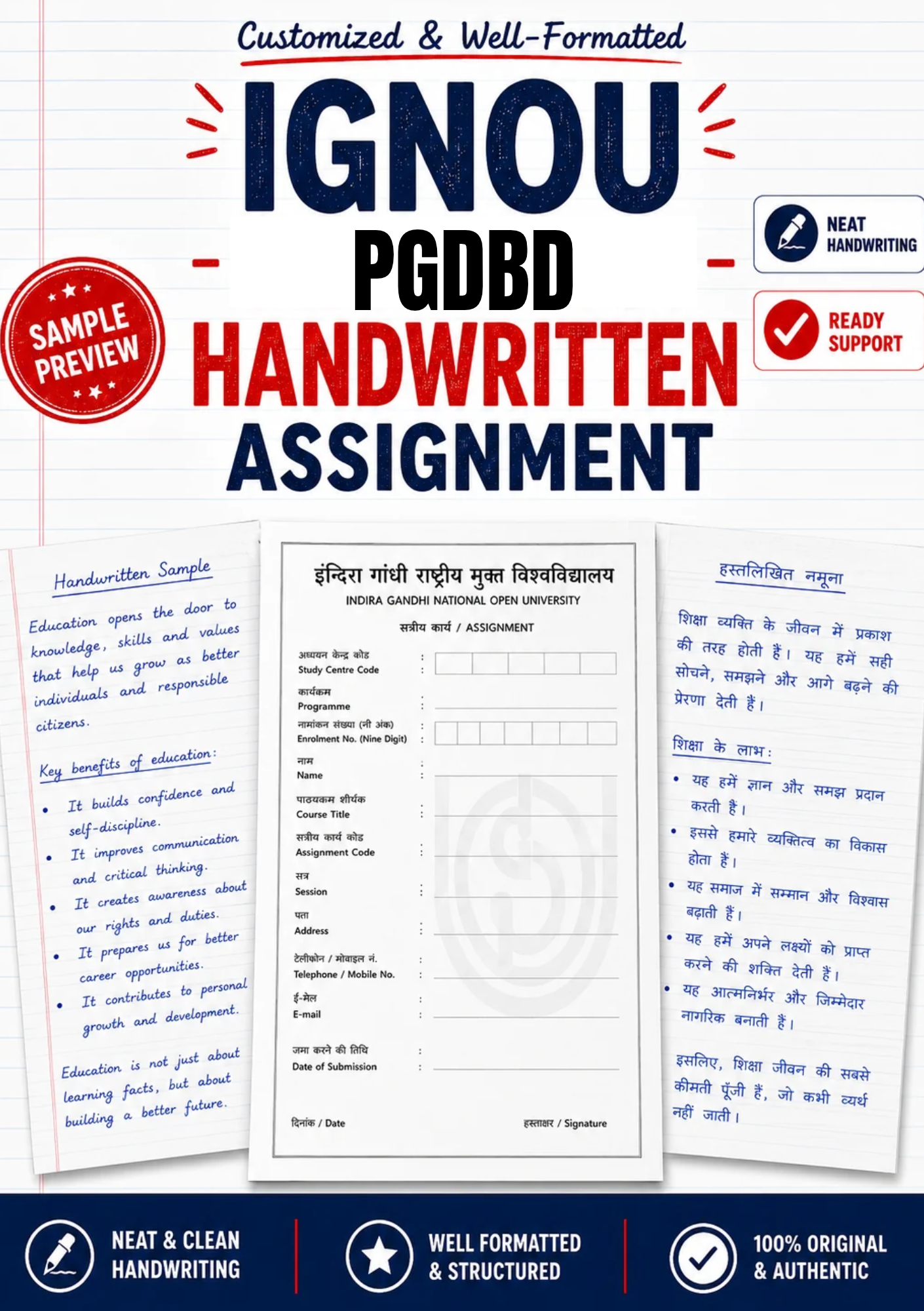
In short. This order produces the handwritten answer sheets for IGNOU’s Post Graduate Diploma in Bharatiya Darshan, a five-course Hindi-medium diploma of the School of Humanities whose papers are numbered MSK-031 to MSK-035 and carry eight credits each, forty in total; the rate is ₹320 per subject, hard copy only, with courier included in that price and no separate shipping charge, and the set arrives with a free IGNOU-format front page and a copy of the official question paper, matched to your own handwriting from a sample photograph, for the January 2026 session whose booklets print 31 October 2026 and the July 2026 session whose booklets print 31 March 2027, with any older cycle and any backlog paper accepted at the same rate.
What Lands on Your Desk When a PGDBD Order Arrives
Four physical things come out of the envelope, and knowing what they are in advance saves a round of questions. The first is the answer set itself: your chosen MSK papers written out in longhand on A4 sheets, one paper per bundle, numbered and ordered so the bundle can go across a study-centre counter without being taken apart and rebuilt.
The second is the IGNOU-format front page, filled in for each paper and included at no cost. Every MSK booklet in this diploma asks for the same set of entries on the first sheet of the response: serial number, name, full address, date, the course title, the course code, the assignment code and the study centre name and code. Those fields are filled from the details you send, which is why the enquiry asks for them before any writing starts.
Third in the envelope sits the printed paper those answers were drafted against. This matters more on PGDBD than on most programmes because the papers are reissued per cycle and the code stamped on the booklet changes with the cycle; keeping the paper with the answers is how you and a counsellor can both see which cycle the set belongs to.
The fourth is nothing at all, and it is deliberate. No soft copy or PDF is sold. There is no download link in the packet, no scan emailed afterwards and no editable file, because what the counter takes is paper.
The ₹320 Line on a Forty-Credit Darshan Diploma, and Where It Stops
The rate is ₹320 per subject, hard copy only, with courier included in that price and no separate shipping charge. On a diploma built from five papers that is the whole arithmetic: a learner taking one paper pays for one paper, a learner clearing all five pays five times the same figure, and nothing changes in between.
Inside the figure sit the writing, the paper, the IGNOU-format front page, the copy of the question paper and the courier. Also inside it, and worth naming because other sellers charge for both, are the handwriting match and the Devanagari script. There is no minimum order: one subject or fourteen, same rate.
Outside the figure sits everything to do with the university. The programme fee itself is IGNOU’s, not this store’s, and the two figures IGNOU prints for it do not agree: the Common Prospectus for July 2026 gives ₹6,900 for PGDBD while the programme guide on ignou.ac.in gives ₹6,700. Examination fees, re-registration and any late submission arrangement are between you and your Regional Centre.
Delivery depends on your pin code and is confirmed for your order before you pay. No figure is promised on this page. That is a deliberate refusal rather than an omission: a courier window that holds for a Delhi pin code does not hold for a Regional Centre in the north-east, and a page that prints one number for both is wrong for one of them.
No claim is made about the marks any assignment will receive, about how an evaluator will assess it, or about whether it will be accepted. Assignment evaluation is entirely a matter for IGNOU.
A Darshan PDF You Study From Against a Darshan Set You Submit
Two different things circulate under similar names and learners lose money by confusing them, so both are worth defining plainly at first mention. A solved assignment is a soft-copy reference file of model answers for a course code and a session: you read it, you decide what to keep, and you write your own response from it. A handwritten assignment is the answers written out by hand on A4 and submitted in hard copy at the study centre. The first is study material. The second is the submission.
| Where the two diverge | Darshan solved file | Darshan handwritten set |
|---|---|---|
| Physical form | A PDF you open on a phone or laptop | Longhand A4 sheets delivered by courier |
| What you do with it | Read it, then write your own answers from it | Check it, sign the declaration, hand it in |
| Who it suits | A learner who has time to write and wants a reference while writing | A learner who is short of writing time across five eight-credit papers |
| Script question | Typed Devanagari, uniform throughout | Devanagari in a hand matched to your own sample |
| Rate on this store | Priced per code on the solved-assignment shelves | ₹320 per subject, courier included |
The table scrolls sideways on a narrow screen.
The honest scope of a solved file is the part most listings leave out: it is a reference to write from, not a submission. A downloaded PDF printed and handed in at a counter is not what either MSK booklet describes. Both booklets fetched for this page ask for answers written out in the response booklet, legibly, with the points you want to stress underlined, each answer opening with a short statement of the question, running through an organised middle and closing with a summary. That instruction describes a person writing, not a file being printed.
If a reference file is what you actually want for your Darshan codes, the store’s own solved-assignment shelving is the place to look rather than this page, and a learner can browse the PG diploma solved-assignment shelf where the Sanskrit-stream diplomas are filed to see what exists for a given code. PGDBD has no shelf of its own there yet, which is stated here rather than hidden: the nearest filed neighbour is the Sanskrit diploma, and the correction queue at the end of this build records the gap.
Send the five codes, get the writing started.
The rate is ₹320 per subject, hard copy only, with courier included in that price and no separate shipping charge.
List your MSK papers and session on WhatsApp and a sample page will be asked for before any sheet is written.
The Five MSK Codes a PGDBD Enrolment Actually Carries
PGDBD is unusually simple to map and unusually easy to mis-order, for the same reason: it has five courses, no electives, no project and no practical, and all five carry eight credits. Nothing varies between two learners in the same cycle, so a code list for this diploma is the same list every time. The titles below are printed in Devanagari in IGNOU’s own documents, because the Common Prospectus sets this programme out in Hindi only; the English readings beside them are glosses offered for navigation, not official titles.
| Darshan paper | Title as section 8.54 prints it | Reading in English | Credits on this paper |
|---|---|---|---|
| MSK-031 | भारतीय दर्शन: स्वरूप, अवधारणा एवं अनुप्रयोग | Bharatiya Darshan: nature, concepts and applications | 8 |
| MSK-032 | न्याय, वैशेषिक एवं चार्वाक दर्शन: स्वरूप एवं परिचय | Nyaya, Vaisheshika and Charvaka schools: nature and introduction | 8 |
| MSK-033 | सांख्य, योग एवं बौद्ध दर्शन: स्वरूप एवं परिचय | Samkhya, Yoga and Bauddha schools: nature and introduction | 8 |
| MSK-034 | मीमांसा, वेदान्त एवं जैन दर्शन: स्वरूप एवं परिचय | Mimamsa, Vedanta and Jain schools: nature and introduction | 8 |
| MSK-035 | शैव, शाक्त एवं वैष्णव दर्शन: स्वरूप एवं परिचय | Shaiva, Shakta and Vaishnava schools: nature and introduction | 8 |
The table scrolls sideways on a narrow screen.
Five papers at eight credits each is forty credits, and forty is the figure the prospectus states for the programme, so the extracted table and the stated total agree. That check is worth running rather than assuming, because this diploma sits directly beneath another forty-credit Sanskrit-stream diploma in the same document and a column slipping between two adjacent tables is the ordinary way such a list goes wrong.
The eight-credit weight is the part learners underestimate. Most IGNOU postgraduate courses are four or six credits with a proportionate assignment. Here each of the five booklets carries 100 marks and asks for any five answers out of eight at 20 marks apiece, which means a full PGDBD submission is twenty-five extended Devanagari answers, not five short ones. Assignments carry 30 per cent of the final course result and the term-end examination carries the remaining 70 per cent.
Why MSK-031 Is Not an MA Sanskrit Code
This diploma has no course prefix of its own. Its papers are numbered in the MSK series, and MSK is already doing two other jobs at IGNOU: it is the programme code for the MA in Sanskrit, and it is the course prefix for the Post Graduate Diploma in the sciences within Sanskrit literature. Three programmes, one prefix, three different number blocks. A learner who searches a bare code without the block in mind lands on the wrong paper, and a seller who does the same writes the wrong answers.
| Programme on the record | Number block in use | Grammar printed on its assignment | Where its paper is published |
|---|---|---|---|
| PGDBD, Bharatiya Darshan | MSK-031 to MSK-035 | MSK-034/TMA/2026, one calendar year | The School of Humanities file path on ignou.ac.in |
| PGSKT, the Sanskrit sciences diploma | MSK-021 to MSK-025 | MSK-021/2025-26, with TMA dropped entirely | The PG diploma folder on the webservices host |
| MA Sanskrit, including its online variant | MSK-001 upward, plus MSKOL codes | MSK – 006/TMA/2025-26, a two-year span | The School of Humanities file path on ignou.ac.in |
The table scrolls sideways on a narrow screen.
Read across that middle column and the point lands. Three programmes under one prefix in one School print three different assignment-code grammars: PGDBD keeps the letters TMA and stamps a single calendar year, the Sanskrit sciences diploma removes TMA and stamps a two-year span, and the MA keeps TMA and stamps a span. None of the three is a mistake. They are three house styles that happen to share a prefix, and copying any one of them onto a PGDBD sheet produces a code that does not match the booklet it answers.
If your record is the MA rather than the diploma, the codes are a different block and the paper is a different document; the store keeps that programme apart on its MA Sanskrit assignment shelf, and the handwritten product for it is a separate listing. If your record is the sciences diploma, its own PGSKT handwritten listing covers the MSK-021 block and prints that programme’s own dates, which are not the dates on this page.
Where IGNOU’s Own PGDBD Paper Trail Disagrees With Itself
Everything below was found by reading IGNOU’s own documents against each other for this build. It is published rather than quietly smoothed over, because a learner who meets one of these contradictions later is better served by having seen it here first.
Thirteen places where the record on this diploma does not line up.
1. The programme is named three ways in IGNOU’s own material. The programme guide prints Post Graduate Diploma in Bharatiya Darshan. Both assignment booklets print P.G. Diploma in Bharatiya Darshan on the cover. IGNOU’s own list of ODL postgraduate diploma programmes prints it at entry 70 as Post Graduate Diploma (Bharatiya Darshan), with the subject in brackets and no preposition.
2. The Common Prospectus for July 2026 does not print an English title for this programme at all. Section 8.54 is set entirely in Devanagari, so every roman rendering of the name, including the one on this page, is sourced from the programme guide and the ODL list rather than from the prospectus.
3. The programme fee is printed twice and differs. The July 2026 Common Prospectus gives ₹6,900. The programme guide on ignou.ac.in gives ₹6,700.
4. The examination-medium rule exists in one document and not the other. The prospectus states that the examination may be written in Sanskrit, Hindi or English, but in only one of them. The programme guide states the medium of instruction and gives no examination-medium rule whatever.
5. Two IGNOU hosts disagree about whether this diploma has assignments at all. The PG diploma assignment index on the webservices host does not list PGDBD among its programmes. The School of Humanities file path on ignou.ac.in carries live PGDBD booklets for the January 2026 and July 2026 sessions. A learner who checks the index concludes no paper exists; a learner who checks the School path downloads it.
6. The MSK prefix is shared by three programmes with three different number blocks, and no IGNOU document sets the three out together in one place.
7. The three programmes sharing that prefix print three different assignment-code grammars, as the table above sets out.
8. The January-session cut-off differs between two programmes under the same prefix in the same School. The MA Sanskrit booklet for the January 2026 session prints 30 September 2026. The PGDBD booklets for the same session print 31 October 2026.
9. PGDBD pairs its sessions differently from its own siblings. Its booklets cover January 2026 together with July 2026, two sessions inside one calendar year. The MA Sanskrit and Sanskrit-sciences booklets of the same period pair July 2025 with January 2026, across an academic year.
10. The MSK-035 booklet prints its July-session date with a garbled repetition in the Devanagari, so the date string reads imperfectly in the source file even though the intended date, 31 March 2027, is unambiguous from the MSK-034 booklet of the same session.
11. IGNOU’s own file name for the programme guide misspells the word programme, which is why a correctly spelled guess at that address returns nothing.
12. Third-party assignment aggregators circulate universal IGNOU dates, commonly 31 March for the June examination and 30 September for the December examination, and at least one 2026 list prints 31 March 2026 against every programme it covers. Neither pattern matches what the PGDBD booklets print.
13. In-house, and recorded against this publisher rather than IGNOU: an internal build note from 14 November 2026 states that PGDBD has no assignment folder at all. That is true of the PG diploma index and false of the School of Humanities path, so the note overstated the position and is corrected by this build. Separately, this store lists the neighbouring Sanskrit diploma under three different names across its books, solved-assignment and guess-paper shelves, and carries no PGDBD shelf of any kind.
The Two Dates Printed on Your MSK Booklet, and Why Neither Is September
Submission deadlines at IGNOU are set per School and, as this diploma shows, sometimes per programme inside a School. The two dates below were read off the live MSK-034 and MSK-035 booklets on 14 November 2026 and are not carried across from any other programme.
| Record held | Paper consulted | Date for the January intake | Date for the July intake |
|---|---|---|---|
| PGDBD, Bharatiya Darshan | MSK-034 and MSK-035, January 2026 and July 2026 | 31 October 2026 | 31 March 2027 |
| MA Sanskrit | MSK-006, July 2025 and January 2026 | 30 September 2026 | Not printed on that booklet |
| PGSKT, Sanskrit sciences | MSK-021, July 2025 and January 2026 | 31 October 2026 | 30 April 2026 for the July 2025 intake |
The table scrolls sideways on a narrow screen.
Three consequences follow, and all three cost money when missed. The first is that 30 September, the date most widely repeated online as the December-examination deadline, is not the PGDBD date; its January-session papers are due a month later. The second is that the July-session date falls in the following calendar year, so a learner admitted in July 2026 is working to 31 March 2027 and a diary note made in 2026 has to carry across the year boundary. The third is that both dates sit on the booklet itself, which is the document to trust: a date circulating on an aggregator, including the dates in the table above for the neighbouring programmes, is only as current as the booklet it was copied from.
Both booklets also state the consequence of not submitting, and it is not a marks consequence. Submission before the term-end examination is compulsory, and a learner who has not submitted is not permitted to sit the examination for that course. Programme structures, course codes, submission dates and rules change, and only ignou.ac.in and your Regional Centre can confirm the current position for your enrolment.
If you are unsure which of the two cut-offs your record sits against, send your enrolment year and session for a check before ordering, so the set answers the right cycle’s paper.
Copying MSK-034/TMA/2026 Onto the Page Without a Year Span
The assignment code is a small field on the front page and a common place to lose a submission, because a mismatched code sends an otherwise complete set to the wrong pile. On this diploma the string is built in three parts: the course code, the letters TMA, and a single calendar year. MSK-034/TMA/2026 is the live example, read off the booklet rather than reconstructed.
Two details are worth holding on to. The first is that the year is one year, not a span. Learners who have previously studied in the MA Sanskrit stream will have written codes like MSK – 006/TMA/2025-26 and will reach for the same shape here; on a PGDBD sheet that shape is wrong. The second is that the booklet prints the course code separately from the assignment code, as MSK-034/2026, and the two are not interchangeable. The front page has a field for each.
Where the booklet leaves a field blank, it stays blank. The response form on the MSK-035 paper prints an empty assignment-code box for the learner to complete rather than a pre-filled string, and no figure is invented to fill it. The sets prepared here copy the code exactly as the booklet for your cycle prints it, which is also why the copy of the question paper travels with the answers.
A Devanagari Hand Matched From One Sample Page
Send a photo of a page you have written yourself and the handwritten set is matched to your handwriting at no extra charge. The sample does the work that a long description of your writing cannot: it fixes the letter shapes, the slope, the spacing and the pen weight before a single answer sheet is started.
Devanagari asks slightly more of a sample than roman script does, and it is worth knowing which features are being read off your page. The matras above and below the line, the length and weight of the shirorekha running across the top of each word, the way conjunct consonants are formed and how far descenders drop are all habits that vary between writers and all visible in a few lines. A sample of a dozen lines carries them. A sample of three words does not.
Both PGDBD booklets ask for answers that are legible and that underline the points the learner wants to stress, and they ask for care with matras and with grammar. That instruction is about the reader at the other end rather than about appearance, which is the standard the writing is held to here: a hand that resembles yours but cannot be read quickly has solved the wrong problem.
You sign the declaration on the assignment cover page, so you should read and review the content before submitting it, and satisfy yourself that it represents your own understanding of the course.
Hindi on the Booklet, Three Languages in the Examination Rule
The service covers all mediums IGNOU issues the TMA paper in, at the same price. On this diploma that sentence resolves to one language, and the reason is worth setting out because the prospectus and the booklets say different amounts about it.
PGDBD is a Hindi-medium programme. The prospectus states the medium of instruction as Hindi, the programme guide states the same, and both live booklets are set in Hindi with their questions in Devanagari. No English counterpart of either booklet was found on the School of Humanities path, unlike several other IGNOU papers which publish an English file alongside the Hindi one. So for this diploma the paper you download is a Hindi paper, and the answers written against it are Devanagari answers.
The examination is a separate matter, and here the prospectus carries a rule the programme guide omits entirely. It states that the examination for this programme may be written in Sanskrit, Hindi or English, and that whichever is chosen, the medium must be one and the same throughout. Three languages are available at the examination for a programme taught and assigned in one.
If your examination language and your assignment language are not the same
A learner who intends to sit the examination in English or in Sanskrit still has a Hindi assignment booklet in front of them, because the assignment medium follows the paper IGNOU issued rather than the examination choice. That is not a conflict to resolve, only a sequence to expect: the set prepared here answers the booklet as issued, and any question about which language your examination script may use is a matter for your Regional Centre, which holds your record. Nothing on this page changes an examination-medium entitlement either way.
Five Things to Send Before Any Writing Begins
The enquiry is short on purpose. Five items settle an order and nothing beyond them is required.
- Which MSK papers you need. Any of MSK-031 to MSK-035, in any combination. The full diploma is five.
- Your session. January 2026, July 2026 or an older cycle. Backlog papers are ordered the same way as current ones.
- A photograph of a page in your own handwriting. A dozen lines of Devanagari on ruled paper, photographed straight on in daylight, is enough to match from.
- The front-page details. Enrolment number, name as it appears on your record, full postal address, and the study centre name and code, because every MSK response sheet asks for all of them.
- Your delivery pin code. This sets the courier route and is confirmed back to you before payment.
What is not asked for is also worth stating. No payment is taken before the sample hand is shown and agreed, no scanned copy of your identity document is needed to start, and no figure for a delivery date is quoted at the enquiry stage because it is not known at the enquiry stage.
Five papers, one rate, confirmed before you pay.
Any session is accepted, current cycle or older, including backlog courses, at the same ₹320 per subject.
Share your sample page and front-page details and the matched hand comes back to you for approval first.
Checking the Parcel Against Your Own Enrolment Record
When the envelope arrives, four checks take a few minutes and prevent the two failures that actually happen at a study-centre counter.
Check the codes first. The papers in the bundle should be the MSK numbers on your own enrolment record, and because this prefix is shared three ways, a set of MSK-021 papers is a different programme’s work however correct it looks. Then check the cycle: the assignment code on each front page should carry the single calendar year that matches the booklet in the packet, not a two-year span borrowed from the MA stream.
Third, read the answers. This is the step the declaration on the front page is about, and it is not a formality: your signature on that sheet is what the counter accepts, so the content needs to be content you are willing to stand behind as your own understanding of the course. Fourth, keep the copy of the question paper with the bundle until the submission is recorded, so that any query about which cycle you answered can be settled from the paper itself.
After submission, the position is IGNOU’s. Evaluated assignments and their marks appear through the university’s own channels in the university’s own time, and the publisher has no visibility into, and no part in, that process.
The Sanskrit and Darshan Shelves This Store Does Carry
PGDBD is new enough that its own shelving does not exist here yet, which is said plainly rather than papered over with a plausible-looking link. What does exist is the surrounding Sanskrit-stream material, and for most PGDBD learners one of these is the next useful page.
The complete range of programme-wise handwritten sets, 172 of them at the time of writing, sits on the handwritten assignment hub, which is the place to start if your record is not PGDBD at all. Reading material for the Darshan papers draws on the same literature as the wider Sanskrit catalogue, so the Sanskrit study-guide shelf and the narrower Vedic studies titles are both worth a look while the diploma’s own shelf is being built.
Learners who hold the neighbouring diploma rather than this one will want its Sanskrit sciences guide books and its guess papers for that programme. Those on the MA route have a separate handwritten listing for the MA Sanskrit codes. And where a code does not match any listing on the store, the customised order for any session exists precisely for that case.
For learners who would rather write the five papers themselves, the editorial side of the same publisher sets out the process end to end in its step-by-step guide to writing an IGNOU handwritten assignment, and the booklets themselves are free to download from IGNOU’s own assignment download service.
What PGDBD Learners Ask Before They Pay
PGDBD is a Hindi-medium diploma. Can the assignment be written in English instead?
Not against these booklets. Both live MSK papers are issued in Hindi with their questions in Devanagari, and no English-language counterpart of either file was found on the School of Humanities path, so the assignment follows the paper as IGNOU issued it. The examination is a separate decision: the prospectus states it may be written in Sanskrit, Hindi or English, in one of them only. Your Regional Centre holds your record and is the place to confirm an examination-medium choice.
What exactly is the difference between a PGDBD solved assignment and this handwritten set?
One is a reference file of model Darshan answers in soft copy, tied to a code and a cycle, which you read and then draft from. The other is longhand sheets in a bundle that physically travels to your centre and is handed in. One stays on your laptop, the other leaves your hands at a counter. This page sells the second; no soft copy or PDF is sold here.
Can a downloaded Darshan solved assignment be printed and handed in?
That is not what either MSK booklet describes. Both ask for answers written out in the response booklet, legibly, with emphasised points underlined and each answer built as a short opening, an organised middle and a closing summary. A printed file is not a written response, and whether any particular submission is accepted is in every case a matter for IGNOU rather than for this publisher.
Is a typed Devanagari answer sheet acceptable for MSK papers?
The PGDBD booklets do not print an explicit instruction banning typed work, which is worth stating accurately rather than overstating. What they do print is a set of instructions addressed to a person writing: legible handwriting, underlining for emphasis, and attention to matras and grammar. The service supplied here is longhand on paper for that reason, and no claim is made about how a study centre will treat anything else.
Which five course codes does a PGDBD enrolment cover?
MSK-031, MSK-032, MSK-033, MSK-034 and MSK-035, at eight credits each for a forty-credit total. There are no electives, no project and no practical component, so every learner in a cycle holds the same five codes. The titles are printed in Devanagari in IGNOU’s own documents; the table higher up this page sets them out with English readings alongside.
Why does my PGDBD deadline say 31 October when most sites say 30 September?
Because 30 September is a widely repeated general figure and not this programme’s date. The MSK-034 and MSK-035 booklets for the January 2026 session print 31 October 2026. The MA Sanskrit booklet for the same session, under the same prefix and the same School, prints 30 September 2026, which is where much of the confusion starts. The booklet for your own cycle is the document that governs.
My booklet is marked for January 2026 and July 2026 together. Which date is mine?
The one tied to your intake. A learner admitted in the January 2026 session works to 31 October 2026; a learner admitted in July 2026 works to 31 March 2027, which falls in the following calendar year. PGDBD pairs two sessions of one calendar year on a single booklet, where its MSK siblings pair across an academic year, so the pairing itself is worth reading carefully.
What assignment code should go on the front page for MSK-034?
MSK-034/TMA/2026 is what that booklet prints: course code, the letters TMA, and a single calendar year. The booklet separately prints the course code as MSK-034/2026, and the front page has a field for each, so the two are not interchangeable. Where a booklet leaves the assignment-code box blank for the learner, as the MSK-035 response form does, the code is copied from the booklet rather than invented.
I previously studied MA Sanskrit. Can I reuse that code format here?
No, and this is a common and expensive habit. MA Sanskrit prints a two-year span, as in MSK – 006/TMA/2025-26. The Sanskrit sciences diploma drops the letters TMA altogether. PGDBD keeps TMA and uses one year. Three programmes share the MSK prefix and print three different grammars, so a format carried across from another MSK record will not match a PGDBD booklet.
Does PGDBD include a project or a dissertation to submit?
No. The programme guide lists five theory courses and no project or practical component, so there is no project report, no synopsis and no field work attached to this diploma. The entire internal-assessment requirement is the five assignments, which is also why the thirty per cent weighting matters as much as it does here.
How many answers does each MSK booklet actually require?
Each of the two booklets fetched for this page carries 100 marks and instructs the learner to answer any five of the eight questions listed, at 20 marks each. Across the five papers that is twenty-five extended answers for the full diploma. No per-question split beyond the twenty-mark figure is printed, and none is invented here.
PGDBD does not appear on IGNOU’s assignment index. Does a paper exist at all?
It does. The PG diploma assignment index on IGNOU’s webservices host does not list this programme, while the School of Humanities file path on ignou.ac.in carries live PGDBD booklets for January 2026 and July 2026. Two IGNOU hosts give different answers to the same question, which is recorded in the conflict box above. The School of Humanities files are the ones that exist.
Can backlog MSK papers from an older cycle still be ordered?
Yes. Any session is accepted, current cycle or older, including backlog courses, at the same ₹320 per subject. Send the cycle along with the codes, because the questions and the stamped year change between cycles and the set has to answer the paper your record is held against rather than the newest one published.
What does ₹320 cover on a Darshan paper, and what sits outside it?
Inside: the longhand answers, the paper, the IGNOU-format front page, a copy of the official question paper, the handwriting match from your sample, the Devanagari script and the courier. Outside: IGNOU’s own programme fee, which the prospectus and the programme guide print differently at ₹6,900 and ₹6,700, along with examination fees and anything arranged directly with your Regional Centre.
Is there a PGDBD books or solved-assignment section on this store yet?
Not yet, and no link on this page pretends otherwise. The diploma is new and its shelving has not been built, so the nearest filed material is the Sanskrit-stream catalogue and the PG diploma solved-assignment shelf, both linked above. The gap is listed in this build’s own correction queue rather than left for a learner to discover from a dead end.
Separating the Prospectus, the Booklet and the Publisher’s Own Terms
Important Notice
Shri Chakradhar Publication Pvt. Ltd. and shrichakradhar.com form an independent IGNOU study-support publisher. This is not the official website of Indira Gandhi National Open University, is not affiliated with, endorsed by or authorised by the university, and no page on this site should be treated as an official IGNOU communication.
Programme structures, course codes, submission dates and rules change, and only ignou.ac.in and your Regional Centre can confirm the current position for your enrolment.
You sign the declaration on the assignment cover page, so you should read and review the content before submitting it, and satisfy yourself that it represents your own understanding of the course.
No claim is made about the marks any assignment will receive, about how an evaluator will assess it, or about whether it will be accepted. Assignment evaluation is entirely a matter for IGNOU.
Order Your MSK-031 to MSK-035 Set
The rate is ₹320 per subject, hard copy only, with courier included in that price and no separate shipping charge. There is no minimum order: one subject or fourteen, same rate.
Two ways in. Open a WhatsApp thread for your Darshan papers, or add this product to the cart and send the sample page afterwards. Either route asks for the five details above before writing begins, and the matched hand is shown to you before payment.