

Description
In short. The IGNOU PGDWGSR handwritten assignment is a hard-copy set of the five papers listed in section 8.44 of the Common Prospectus July 2026: MWG 101, MWG 102, MWG 103, MWG 104 and MANE 4, the last printed as MANE 004 everywhere else in the same prospectus. Each paper carries eight credits, forty in all, and each is written by hand at ₹320 per subject, which makes ₹1,600 for the whole diploma, with courier, a free IGNOU-format front page and a copy of the question paper included. Of the 2025-26 SOGDS files read for these five codes, only the MWG 104 paper prints dates, 31 October for the July admission cycle and 30 April for the January cycle; the others print none, and the only 2026-27 file found for these codes, MWG-102, carries no programme name and no date at all, so your cut-off has to be confirmed with your Regional Centre. The diploma has no project course, and its forty credits count towards lateral entry into the second year of MAWGSR.
Opening a PGDWGSR Courier: Four MWG Sets, One MANE 004 Set, Five Question Papers
A full PGDWGSR order arrives as five separate bundles, one for each code on your admission record. Shri Chakradhar Publication keeps them apart on purpose. The 2025-26 MWG 104 paper from the School of Gender and Development Studies instructs that each assignment be submitted as a separate single document, and that two assignments must not be combined; the MWG 101 and MWG 110 papers of the same school carry the same instruction. A diploma set stapled into one block would therefore break the instruction printed on your own paper before an evaluator read a word of it.
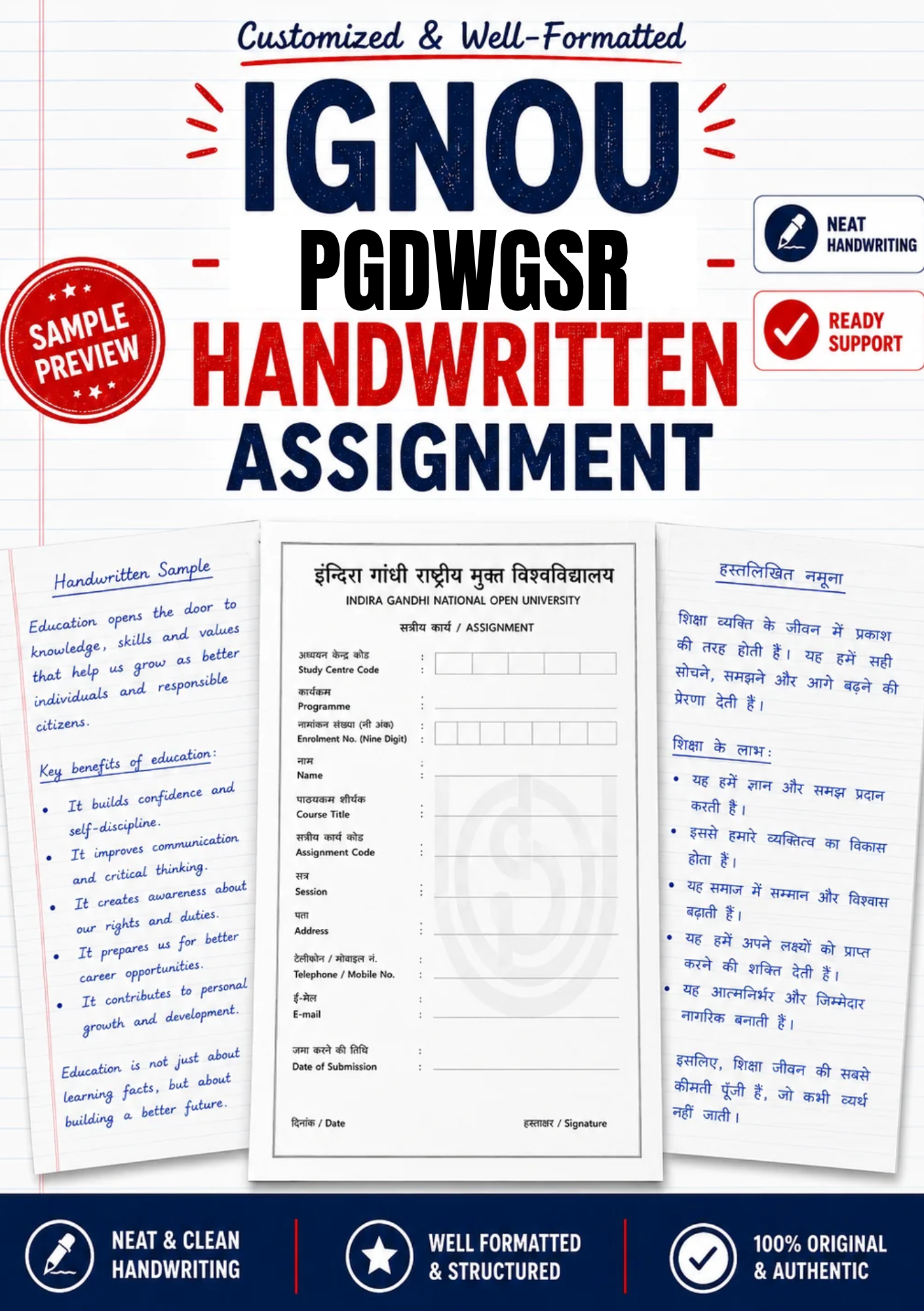
Each bundle holds the answers written by hand, a front page laid out in the IGNOU format with the fields filled from the details you send, and a copy of the question paper the answers respond to. The SOGDS papers ask every learner to put their name, enrolment number, programme code, course code and email ID on each assignment, and the front page is built around exactly those five fields, so the email ID line is not left for you to squeeze in later. The question paper copy is there because a paper headed MAWGSR, a paper with no heading at all and a paper headed PGDWGSR can all sit in the same order, and the copy shows which one each bundle was written to.
The rate is ₹320 per subject, hard copy only, with courier included in that price and no separate shipping charge. No soft copy or PDF is sold. What the parcel does not contain is a typed version, a scan of the finished set, or any document that claims to come from IGNOU; the front page is a format, not an official form issued by the university.
Delivery depends on your pin code and is confirmed for your order before you pay. No figure is promised on this page. If your Regional Centre has given you a date, say so in your first message, because that date and your pin code together decide whether a hard-copy route is still practical for that cycle.
Five Papers at ₹320 Each: The ₹1,600 PGDWGSR Total and the Costs It Does Not Touch
The diploma’s arithmetic is simpler than most. Section 8.44 lists five courses and no electives, no project, no practical and no lab, so the price of a complete PGDWGSR year is five times the per-subject rate: ₹1,600. There is no minimum order: one subject or fourteen, same rate. A learner who has already submitted MWG 101 and MWG 102 in the July cycle and owes only the three second-semester papers pays ₹960, and a learner who owes a single MANE 004 paper from an earlier year pays ₹320.
That rate already contains the writing, the handwriting match from your sample, the front page, the question paper copy and the courier. It contains every medium in which IGNOU has issued the paper and every session, current or older. It does not change with the length of the paper, which matters on this diploma more than on most: the MWG 102 paper asks for roughly twice the written volume of the MWG 101 paper, as the pattern table further down shows, and both are charged the same ₹320.
Outside the rate sit the things only IGNOU or you can pay for: the programme fee (the prospectus annexure lists Rs. 8,000 for PGDWGSR), the term-end examination form and any late fee on it, re-registration, and any postage or scanning your Regional Centre asks of you when you hand the set in. Nothing on this page is a discount, a countdown or a bundle offer, and no figure here changes with the day you order.
One cost a PGDWGSR learner is sometimes sold by mistake is a project. The older PGDWGS programme carried a project course, MWGP-001, and this store still lists bound MWGP-001 samples under that older code. The revised diploma printed in section 8.44 has no project at all. If your admission record says PGDWGSR, there is nothing to buy on that front.
Downloaded MWG Model Answers Versus Ink on Paper: Which One the PGDWGSR Declaration Covers
Learners searching for an MWG paper usually meet two kinds of product and are not always told they do different jobs. A solved assignment is a soft-copy reference file of model answers for a course code and session, something you read on a screen and learn from. A handwritten assignment is the answers written out by hand on paper and handed in as hard copy in the way your Regional Centre directs. The PGDWGSR papers do not print a paper size, so ask your centre if it has a preference; plain A4 is what most centres take.
IGNOU’s own wording settles which of the two can be submitted. The 2025-26 MWG 104 paper says: “Assignments need to be handwritten and each assignment should be submitted as a separate single document.” The MWG 101 paper of the same year adds a plagiarism statement asking learners to write all answers in their own words, and it says that material copied directly from course books or other external sources will not be accepted. A downloaded file, printed, fails the first rule; copied out word for word by hand, it can still fail the second.
| Question a PGDWGSR learner is asking | Model-answer file for an MWG or MANE code | PGDWGSR set written in ink |
|---|---|---|
| What form does it take? | A soft copy you open on a phone or laptop | Pages written by hand, one bundle per code, with front page and question paper |
| What is it for? | Reading, revision and working out an answer structure | Reading, signing and handing in to your Regional Centre or study centre |
| What does the SOGDS paper say about it? | Nothing that allows a printout; the papers ask for handwritten work | Matches the handwritten, separate-document instruction |
| Who tends to want it? | Learners writing their own answers who want a reference | Learners who need the submission copy itself |
| How it is priced here | Sold on the store’s solved shelves, priced per code | ₹320 per subject, courier included |
Swipe sideways on a phone to see all three columns.
The honest scope of a solved file is that it is a reference to write from, not a submission. It cannot be handed in as it is, and nothing on this page suggests otherwise. Learners who would rather write every word themselves will find solved MWG reference files kept on the MA Women and Gender Studies shelf, because the store has no shelf filed under PGDWGSR itself and the diploma’s five codes are the first year of that degree. Whichever route you take, you sign the declaration, and the content has to be yours to sign.
Five codes make up the whole diploma, and each one is priced the same.
₹320 per subject, hard copy, courier included. ₹1,600 for all five PGDWGSR papers.
MWG 101 to MWG 104 Plus MANE 4: The Forty Credits in Section 8.44
Section 8.44 of the Common Prospectus July 2026, on pages 298 and 299, is the whole of the PGDWGSR syllabus. It names the School of Gender and Development Studies, sets eligibility at a Bachelor’s degree from any recognised university, gives English as the medium of instruction, and says learners are being offered the “Revised PGDWGSR programme with increased credit weightage as per the NEP requirements”. The table below reproduces the five rows and sets the MAWGSR first-year table from section 3.50 beside them, because the two tables print the same courses with small differences.
| Code in section 8.44 | Title in section 8.44 | Same course in section 3.50 | Credits printed | MAWGSR semester |
|---|---|---|---|---|
| MWG 101 | Theories of Women’s & Gender Studies | MWG 101, same title | 8 | I |
| MWG 102 | Gender & Power | MWG 102, “Gender and Power” | 8 | I |
| MWG 103 | Constructing Gender Through Arts & Media | MWG 103, “through” in lower case | 8 | II |
| MWG 104 | Gendered Bodies & Sexualities | MWG 104, same title | 8 | II |
| MANE 4 | Gender and Society | MANE 004, same title | 8 | II |
| Total printed in section 8.44 | 40 | Five courses | ||
The table scrolls sideways on narrow screens.
The credits were checked before the table was trusted: five courses at eight credits each come to 40, which is the total section 8.44 prints. That check matters because the PGDWGSR rows fall across a page break, with MWG 101 and MWG 102 at the foot of page 298 and the other three at the top of page 299, the point at which a neighbouring table most easily bleeds in. Nothing did here.
The prospectus annexure, row 169, records a one-year minimum and three-year maximum duration, a fee of Rs. 8,000, admission in January and July, and an examination mode of “Semester wise”. IGNOU’s own PGDWGSR programme page lists every course as Year 1. In practice the semester labels come from the MAWGSR table: MWG 101 and MWG 102 sit in the first semester, MWG 103, MWG 104 and MANE 004 in the second, and the SOGDS index of PGDWGSR papers on webservices.ignou.ac.in sorts its links under “Ist Semester / IInd Semester” in the same way.
MANE is an anthropology prefix, not a gender-studies one, and that is the first thing a new PGDWGSR learner tends to ask about. MANE 004 Gender and Society is an optional course in the second year of the MA in Anthropology run by the School of Social Sciences, it is a compulsory first-year course in MAWGSR, and it is an elective in MAPFHS. PGDWGSR borrows it whole. That shared ownership is why its paperwork looks unlike the four MWG papers, as the next sections show.
Two structural facts complete the picture. There is no elective to choose and no project, so every PGDWGSR learner writes the same five papers. And section 8.44 says the credits can be carried by lateral entry into the second year of the MA in Women’s and Gender Studies; section 3.50 says the same from the other side, and describes the diploma as the exit award for a MAWGSR learner who completes the 40-credit first year. The section 8.44 coordinator is Prof. Himadri Roy.
Same Eight Credits, Very Different Workloads: The Question Pattern on Each PGDWGSR Paper
All five courses carry eight credits and every assignment is marked out of 100, yet the papers ask for very different amounts of writing. The table sets out what each file read for this page actually asks for. Where a paper prints no word limit, the table says so rather than inventing one.
| Paper | File read | Assignment code as printed | What the paper asks for | Rough written length |
|---|---|---|---|---|
| MWG 101 | 2025-26 English file, headed MAWGSR | MWG-101/AST/TMA-2025-2026 | Any two of three essay questions, 50 marks each, about 1,000 words each | About 2,000 words |
| MWG 102 | 2025-26 file and the 2026-27 English and Hindi files | MWG-102 / AST/2025-26 and MWG-102 / AST/2026-27 | All seven: two Section A answers at 20 marks (about 700 words), five Section B answers at 12 marks (about 500 words) | About 3,900 words |
| MWG 103 | 2025-26 file on the PGDWGSR index, headed PGDWGSR | MWG103/AST/TMA-2025 | Any two of three questions, 50 marks each | Two long answers; no limit printed |
| MWG 104 | 2025-26 English file, headed PGDWGSR | MWG 104/AST/TMA-2025-26 | Any ten of twelve questions, 10 marks each | Ten short answers; no limit printed |
| MANE 004 | SOGDS file, headed PGDWGSR/MAWGSR | MANI-004/ASST/TMA/2024-2025 | Five of ten, at least two from each section; 500 words for a 20-mark answer, 125 words for a 5-mark note | About 2,500 words |
Swipe left on a phone to read the last two columns.
The gap between MWG 101 and MWG 102 is the point to notice. A learner who has written the two MWG 101 essays and assumes the next paper is similar will find MWG 102 asks for seven answers and close to twice the words. The set is written to the length each paper sets, not to a house average, and the price stays at ₹320 either way.
Several MWG 104 questions ask for something more than an essay. One asks you to analyse a dance performance from the perspective of gender identities, one asks you to prepare a journal on gender issues, and one asks you to download and read a recent report and respond to it. Because the paper asks for any ten of twelve, a set can be built from questions that do not depend on something only you have seen or done; if you would rather answer one of those activity questions yourself, say which, and the remaining nine are written. The same care applies to MWG 103, whose earlier papers have set questions around an image printed in the booklet, and to MWG 102, whose 2024-25 paper sent learners to a video before answering.
Where IGNOU’s PGDWGSR Documents Disagree: Seventeen University Conflicts and Four of the Store’s Own
Reading the prospectus, the programme page, the assignment index and the papers themselves against each other produces a long list of places where they do not agree. None of them is a reason to panic, and most are template carry-overs from MAWGSR, but each one can change what you copy onto a cover sheet or which date you work to. The last four items are mistakes or gaps on this store, listed because a learner deserves to know them before trusting anything else here.
Twenty-one discrepancies found while preparing this page, checked on 9 November 2026. Items 1 to 17 are in IGNOU’s own documents; items 18 to 21 are on shrichakradhar.com.
1. Two 2025-26 papers from the same school disagree about which programme they belong to. The MWG 104 file is headed “PG Diploma in Women’s and Gender Studies (PGDWGSR)”, while the MWG 101 file for the same academic year is headed “Masters in Women’s and Gender Studies (MAWGSR)”. Both are the papers a PGDWGSR learner answers.
2. Only one of the 2025-26 SOGDS files for these codes prints dates. MWG 104 prints 31 October 2025 for the July admission cycle and 30 April 2026 for the January cycle. MWG 101 and MWG 103 say only that deadlines should be checked on the IGNOU website or with the Regional Centre, and the MWG 102 file prints no submission line of any kind.
3. The MWG 101 paper prints its own code two ways: MWG-101/AST/TMA2025-2026 on the cover and MWG-101/AST/TMA-2025-2026 above the questions, a hyphen apart.
4. Five codes, four code shapes. The 2025-26 strings are MWG-101/AST/TMA-2025-2026, MWG-102 / AST/2025-26 (no TMA, spaces around the slash), MWG103/AST/TMA-2025 (no hyphen, a single year) and MWG 104/AST/TMA-2025-26 (a space instead of a hyphen, a short year span).
5. The MANE 004 paper posted by SOGDS gives the course code as MANE-004 and the assignment code as MANI-004/ASST/TMA/2024-2025: a different prefix, a different abbreviation (ASST rather than AST) and an older year. Its cover says PGDWGSR/MAWGSR while its text names the Faculty of Anthropology, School of Social Sciences.
6. The same course has a second date regime. The School of Social Sciences MAAN file for MANE 004, July 2025 and January 2026 cycles, prints 30 April 2026 for the July 2025 cycle and 30 September 2026 for the January 2026 cycle, and sends submissions to the Learner Support Centre coordinator, under the code MANI-004/ASST/TMA/2025-2026. The SOGDS MANE 004 file prints no date at all.
7. The prospectus writes the code three ways for one course: MANE 4 in section 8.44, MANE 004 in the MAWGSR table at section 3.50 and in the MAPFHS table. IGNOU’s live PGDWGSR page prints it as “MANE-004: Gender and Socitey” with an asterisk that nothing explains.
8. Course titles shift between the two prospectus tables: “Gender & Power” in section 8.44 against “Gender and Power” in section 3.50, and “Constructing Gender Through Arts & Media” against “through” in lower case.
9. The career-options paragraph in section 8.44 begins “Students completing the Master’s Degree”, a sentence carried over from the MAWGSR entry into the entry for a one-year diploma.
10. Three coordinator names appear. Section 8.44 names Prof. Himadri Roy; section 3.50 names Dr. Smita M. Patil and Dr. Sunita Dhal for MAWGSR; the 2025-26 MWG 104 paper sends academic queries to Dr. Sunita Dhal.
11. Annexure row 169 gives a one-year diploma an examination mode of “Semester wise”, while IGNOU’s programme page tags all five courses Year 1.
12. IGNOU’s live PGDWGSR programme page lists MWG-104 twice, once after MWG-103 and again after MANE-004.
13. The prospectus gives English as the only medium, yet SOGDS has posted a Hindi MWG-102 paper for 2026-27, coded MWG-102 / AST/2026-27, alongside the English one.
14. The webservices.ignou.ac.in index page for PGDWGSR is titled “MA(Philosophy)”. Its July 2025 to January 2026 row links only MWG-103 and leaves MWG-101, MWG-102, MWG-104 and MANE-004 as plain text, and its 2024-25 MANE-004 link opens a file named for the MA Anthropology second year.
15. The 2023 MWG-104 file, issued under the label PGDWGS-R, prints the course title “Theories of Women’s & Gender Studies”, which belongs to MWG-101, above the MWG-104 assignment.
16. The 2024-25 MWG 102 English file lists MWG-101/AST/TMA-2024 in its submission table, then codes the paper itself MWG 102/AST/TMA-2024-25.
17. The programme code itself has three forms on IGNOU’s own sites: PGDWGS for the older programme with MWG-001 to MWG-004 and a project, PGDWGS-R on the 2023 files, and PGDWGSR in the prospectus. eGyanKosh still keeps separate PGDWGS and PGDWGSR collections, and the assignment index still links both.
18. This store’s MAWGSR handwritten product tells learners that the SOGDS paper prints no cut-off. The 2025-26 MWG 104 and MWG 109 papers do print one, 31 October and 30 April, so that page needs correcting.
19. The same MAWGSR product says no Hindi MWG paper exists. That was accurate for the files available when it was written, but 2026-27 Hindi papers for MWG-102 and MWG-111 are now on ignou.ac.in.
20. The store has no books or solved-assignment shelf filed under PGDWGSR. Diploma-labelled guess papers exist for MWG 101, 102 and 103 only, and the PGDWGS guess-paper category appears twice, once with seven products and once empty, with a broken apostrophe in one of the names.
21. The store lists bound project samples for MWGP-001 under the older PGDWGS code. The revised diploma in section 8.44 has no project, so those samples are relevant only to learners still on the older programme.
Two practical rules follow from that list. Copy the assignment code exactly as the paper in your hand prints it, including its spacing and its MANI prefix, because that string is what the evaluator matches against. And treat any date on this page as a reading of a document, not a ruling. Programme structures, course codes, submission dates and rules change, and only ignou.ac.in and your Regional Centre can confirm the current position for your enrolment.
31 October, 30 April, or No Date at All: Working Out Your PGDWGSR Cut-Off
Most product pages on this store can print two dates and stop. PGDWGSR cannot, because the files disagree with each other and the current cycle’s files have not all appeared. The table lists every place a date was looked for on 9 November 2026 and what each one says.
| Where the date was looked for | July admission cycle | January admission cycle | Date is tied to |
|---|---|---|---|
| MWG 104, 2025-26, headed PGDWGSR | 31 October 2025 | 30 April 2026 | Admission cycle |
| MWG 101 and MWG 103, 2025-26 | Not printed; check website or Regional Centre | Not printed | Not stated |
| MWG 102, 2025-26 and 2026-27 | No submission line at all | No submission line at all | Not stated |
| MANE 004, SOGDS file | Not printed | Not printed | Not stated |
| MANE 004, SOSS MAAN file, 2025-26 | 30 April 2026 | 30 September 2026 | Admission cycle, Learner Support Centre |
| MAGD 2026-27 papers, same school, for comparison only | 31 October 2026, for the December 2026 examination | 30 April 2027, for the June 2027 examination | Term-end examination |
Scroll the table sideways on a small screen.
Three readings come out of it. First, where SOGDS does print PGDWGSR dates, the pattern is 31 October and 30 April, and the MWG 104 paper ties them to the admission cycle: July cycle learners by 31 October, January cycle learners by 30 April. That is a different pair from the 31 March and 30 September printed by the School of Social Sciences and several other schools, and learners who have read an aggregator’s single list of IGNOU dates are often working to the wrong pair. Second, a MANE 004 learner holding the anthropology faculty’s file is looking at a third pair, 30 April and 30 September, that has nothing to do with the SOGDS pattern. Third, for the July 2026 and January 2027 cycles there is not yet a PGDWGSR-headed paper with a printed date for any of the five codes; the only 2026-27 file found, MWG-102, prints none.
For the December 2026 term-end examination, press reports published in late October 2026 state that IGNOU opened an online assignment management system, OAMS, with uploads accepted until 20 November 2026 and the examination beginning on 25 November 2026. That is a university-wide notice reported by third parties, not a date printed on any PGDWGSR paper, and it concerns online upload rather than a posted hard copy. Confirm with your Regional Centre how it applies to you before relying on it.
The practical course is to tell Shri Chakradhar Publication which cycle you were admitted in, which examination you intend to sit, and any date your Regional Centre has given you. The set is then planned to that date, and if your pin code and the date leave no realistic margin for a courier, you are told so before you pay rather than after.
MWG-101/AST/TMA-2025-2026, MWG-102 / AST/2026-27 and MANI-004: Copying the String Your Paper Prints
The assignment code is the line an evaluator checks first, and on this diploma it is the line most likely to look wrong. AST stands for assignment, TMA for tutor marked assignment, and the year that follows identifies the cycle. IGNOU does not use a single shape for these papers, so the safe habit is to copy the code exactly as the paper you are answering prints it, without tidying it into the shape a neighbouring paper uses.
For MWG 101 that means MWG-101/AST/TMA-2025-2026 from the line above the questions, since the cover’s version drops a hyphen. For MWG 102 the 2026-27 code is MWG-102 / AST/2026-27, spaces included, and the 2025-26 code differs only in its year. As far as they were compared, the opening words of all seven 2026-27 MWG 102 questions match the 2025-26 paper, so a learner can easily answer the right questions under the wrong year; the cover has to carry the year of the paper you were told to submit. MWG 103 prints MWG103/AST/TMA-2025 with no separating hyphen and a single year, and MWG 104 prints MWG 104/AST/TMA-2025-26.
MANE 004 is the awkward one. Its assignment code begins MANI-004 even though the course is MANE 004, and the SOGDS file still carries the 2024-2025 year. The course code line on your front page should read MANE-004 or MANE 004, matching your admission record; the assignment code line should carry what the paper prints. If you are unsure whether your Regional Centre wants the SOGDS file or the anthropology faculty’s MAAN file for MANE 004, ask the centre before the set is written, because the two files carry different questions and different codes.
One field is not copied from the paper at all. The programme code on the front page is the one on your admission record, PGDWGSR, even when the paper you are answering is headed MAWGSR. The papers ask you to write your programme code, and yours is the diploma’s.
Your Handwriting Sample Comes First, Then 2,000 to 3,900 Words Per Paper in That Hand
Send a photo of a page you have written yourself and the handwritten set is matched to your handwriting at no extra charge. On this diploma the match has to hold over a lot of paper: two MWG 101 essays, seven MWG 102 answers and five MANE 004 answers add up to several thousand words, and a hand that drifts between the first bundle and the fifth looks like what it is. All five codes are therefore written to the one sample you send.
The order of events protects you. The sample photo goes first, a short passage comes back written in the matched hand, and you decide whether it looks like yours before any payment is made. If it does not, say what is off, the slant, the letter size, the way you form a particular letter, and a second attempt follows. Only once you are satisfied is the order confirmed.
Pick a page with long paragraphs, because MWG answers run to essay length
The most useful sample is a full page of continuous prose written in your normal pen at your normal speed: class notes, a letter, a page of an old answer script. A page of short bullet points or a filled-in form shows how you write capitals and numbers but not how your hand behaves across a long line, and MWG answers are long lines. Photograph it flat, in daylight, with the whole page in the frame. If you write some words in Hindi as well as English, include a few lines of each.
English on the Prospectus, a Hindi MWG-102 Paper on the Portal, and Cycles You Still Owe
Section 8.44 lists English as PGDWGSR’s medium of instruction, and the four 2025-26 MWG files read for this page are all in English. The 2026-27 cycle is different: SOGDS has posted MWG-102-MAWGSR-2026-HINDI, a Hindi version of the Gender and Power paper with the same structure as the English one, and a Hindi MWG-111 paper for the MAWGSR second year. The service covers all mediums IGNOU issues the TMA paper in, at the same price. If you were admitted to PGDWGSR and your Regional Centre has accepted Hindi answers for MWG 102, the Hindi set is written to that paper; for the other four codes, no Hindi paper had been found when this page was checked.
Any session is accepted, current cycle or older, including backlog courses, at the same ₹320 per subject. That covers a learner who sat the December examination but never submitted MANE 004, a learner re-registering after a gap, and a learner on the older PGDWGS programme whose record still shows MWG-001 to MWG-004. For the older codes, use the made-to-order listing that accepts any IGNOU code and any session, and send the paper you were told to answer.
Which paper to answer is not always obvious for a backlog. The SOGDS MWG papers ask learners to attempt the latest assignment uploaded on the website, which is the same principle several IGNOU schools print: a learner who misses a cycle answers the paper current at the time of submission. For PGDWGSR that rule runs into the gap noted above: if no 2026-27 file exists for your code yet, the 2025-26 paper may be the latest one available. Confirm with your Regional Centre which year it expects, and the set is written to that year’s questions and code.
Five Facts to Type Into WhatsApp Before a PGDWGSR Set Is Started
A PGDWGSR quote needs very little, and nothing beyond these five items is asked for.
- Your codes. All five, or only the ones still pending: MWG 101, MWG 102, MWG 103, MWG 104, MANE 004. A photo of the course list on your admission record works just as well.
- Your admission cycle and the paper year. July or January, and which year’s paper your Regional Centre wants answered, 2025-26 or 2026-27, so the right questions and code are used.
- Your medium. English, or Hindi for MWG 102 if your centre has told you to use the Hindi paper.
- A handwriting photo. One full page of your own continuous writing, as described above.
- Your pin code and any date you have been given. These two together decide whether a hard copy can realistically reach you in time for that cycle.
Your enrolment number, name and email ID go on the front pages, so include them once the quote is accepted. Nothing else is needed: no fee receipt, no identity card, no login.
See your own hand on a gender studies page before paying anything.
Handwriting matched free. ₹320 per subject, courier included.
Send a handwriting photo first and get a PGDWGSR sample back
Single Documents, Separate Files: Handing In the PGDWGSR Set After It Arrives
When the parcel reaches you, the work that remains is yours, and it matters. You sign the declaration on the assignment cover page, so you should read and review the content before submitting it, and satisfy yourself that it represents your own understanding of the course. Read each bundle against the question paper copy that travels with it, check that the assignment code and year on the front page match the paper you were told to answer, and add your signature and the date in the places the front page leaves for them.
Keep the five bundles apart when you hand them in. The SOGDS instruction is one assignment per single document, and it also warns against the opposite mistake: responses to individual questions should not be split into separate documents either. If your Regional Centre takes hard copies at the counter, ask for a receipt for each code. If it directs online upload, through OAMS or a centre’s own form, scan each bundle as one file of its own, in page order, with the front page first.
The papers also remind learners that a term-end examination form is accepted only from learners who have submitted the relevant assignments, so a missing MANE 004 can hold up an examination entry even when the four MWG papers are in. Keep your receipts until the marks appear on your record. Assignments carry 30 per cent of the final course result and the term-end examination carries the remaining 70 per cent.
Where a PGDWGSR Learner Shops Next, Including the MAWGSR Year Two Set
Because PGDWGSR is the first year of MAWGSR printed as a separate diploma, most of the store’s material for its codes is filed under the master’s name, and a learner who searches only for “PGDWGSR” will miss it. For reading the course itself, the MAWGSR study guides covering MWG 101 to MWG 104 are the place to start, since the five diploma courses use the same blocks.
For the term-end paper, there are diploma-labelled guess papers filed under PGDWGS, which carry MWG 101, 102 and 103, and the MAWGSR expected-question sets that include MWG 104. The December 2025 term-end papers for MWG 101, 102 and 104 were all headed jointly for PGDWGSR and MAWGSR, and the MWG 101 and MWG 104 papers asked for any four answers of equal marks, so practice material from either label is written to the same examination. Learners who prefer to see how real sittings were answered can look at worked previous-year papers from the women’s and gender studies examinations.
If you plan to take lateral entry into the second year, the MAWGSR handwritten set for the second-year MWG and MWGP papers picks up where this diploma stops, with the two specialisations and their separate code lists. Learners on the older PGDWGS programme who still owe a project can find bound MWGP-001 samples kept under the earlier PGDWGS code; a PGDWGSR learner has no project and does not need them.
Two neighbouring programmes come from the same school. A learner considering the other SOGDS master’s can compare the written MGS and MGSE sets for Gender and Development Studies, and anyone holding codes from more than one programme can use the handwritten section that lists every IGNOU programme at one rate. If you would rather write every answer yourself, ignouproject.com, the same owner’s editorial site, has a guide to the shared MWG papers for learners writing their own answers, which covers the five diploma codes as the MAWGSR first year.
Fifteen PGDWGSR Doubts, From MANI-004 to the Missing 2026-27 Papers
PGDWGSR mein kitne assignment hote hain, aur kya project bhi likhna padta hai?
Five, one for each course in section 8.44: MWG 101, MWG 102, MWG 103, MWG 104 and MANE 004. The revised PGDWGSR has no project course at all. The MWGP-001 project belonged to the older PGDWGS programme, so a learner whose admission record reads PGDWGSR writes five assignments and nothing more.
Is ₹320 charged per paper, and what does the whole PGDWGSR year come to?
₹320 is per paper. With five papers and no electives, the full diploma comes to ₹1,600, with courier, front pages and question paper copies included. There is no minimum order: one subject or fourteen, same rate.
My MWG 101 file says MAWGSR on the cover. Is it still the paper a diploma learner answers?
Yes. MWG 101 is the same course in both programmes, and the 2025-26 English file SOGDS posted is headed for the master’s while the MWG 104 file of the same year is headed for the diploma. Answer the paper, copy its assignment code as printed, and write PGDWGSR as your programme code on the front page, because that is the code on your admission record.
Why does the MANE 004 paper print MANI-004 in its assignment code?
No IGNOU document explains it. The course is MANE 004 in every prospectus table, yet both the SOGDS file and the anthropology faculty’s MAAN file print the assignment code with a MANI prefix. Keep MANE 004 on the course code line, copy the assignment code exactly as your paper prints it, and ask your Regional Centre which of the two MANE 004 files it expects, since their questions differ.
Which last date applies to my PGDWGSR papers: 31 October, 30 April or something else?
The only PGDWGSR-headed paper that prints dates, MWG 104 for 2025-26, gives 31 October for July cycle learners and 30 April for January cycle learners. The other files print no date, the anthropology faculty’s MANE 004 file prints 30 April and 30 September, and no dated 2026-27 PGDWGSR paper had appeared by 9 November 2026. Your Regional Centre’s date is the one to work to.
December 2026 exam ke liye PGDWGSR assignment abhi bhi jama ho sakta hai kya?
Press reports from late October 2026 say IGNOU’s online assignment system is accepting uploads for the December 2026 examination until 20 November 2026, with the examination starting on 25 November. That is a reported university-wide window for online upload, not a date printed on a PGDWGSR paper. Check with your Regional Centre first, then send your pin code, so you are told honestly whether a hard copy can still reach you in time.
MWG ka solved PDF lun ya handwritten set, PGDWGSR submission mein kaunsa chalega?
A solved assignment is a soft-copy file of model answers that you read and learn from. A handwritten assignment is the set you sign and hand in. The SOGDS papers say assignments need to be handwritten, so the solved file is a reference and the handwritten set is the submission; one cannot stand in for the other.
Can a printed MWG answer PDF be handed in instead of a handwritten one?
Not according to the papers. The 2025-26 MWG 104 paper says assignments need to be handwritten, and the MWG 101 paper adds that material copied from course books or other external sources will not be accepted. A printout fails the first instruction; a word-for-word copy of a downloaded file risks the second even if written by hand.
If I buy a downloaded MWG 104 answer file and this set too, am I paying twice for the same work?
They do different jobs, so it depends on what you need. The file is useful if you want to understand an answer structure or revise for the term-end paper, which asks for four long answers rather than ten short ones. If what you need is the submission copy, the handwritten set alone covers it.
Is a Hindi PGDWGSR handwritten set available?
For MWG 102, yes: SOGDS has posted a Hindi version of the 2026-27 Gender and Power paper, and the set can be written to it at the same ₹320. The prospectus lists English as the diploma’s medium, and no Hindi paper had been found for MWG 101, 103, 104 or MANE 004, so check with your Regional Centre before choosing Hindi for MWG 102. The service covers all mediums IGNOU issues the TMA paper in, at the same price.
No 2026-27 paper for MWG 101, 103, 104 or MANE 004 is showing yet. What gets written?
The paper your Regional Centre names. SOGDS asks learners to attempt the latest assignment uploaded, and for those four codes the latest file found on 9 November 2026 is the 2025-26 one. If your centre confirms that, the set is written to the 2025-26 questions under the 2025-26 code; if a 2026-27 paper appears before writing starts, the set follows the new one.
My record says PGDWGS without the R, from an older admission. Is this the right order?
The older programme used MWG-001 to MWG-004 and a project, not the 100-series codes. Send your code list and the paper you were told to answer, and the set is written to it through the made-to-order listing. Any session is accepted, current cycle or older, including backlog courses, at the same ₹320 per subject.
I want lateral entry into MAWGSR year two. Do the diploma papers have to be written again?
No. The prospectus lets a learner who has completed PGDWGSR take admission directly into the second year of MAWGSR, and the five diploma courses are the MAWGSR first year. What you write next are the second-year papers of the specialisation you choose.
How long does each PGDWGSR answer have to be?
It depends on the paper. MWG 101 asks for about 1,000 words per essay, MWG 102 about 700 words for Section A and about 500 for Section B, and MANE 004 about 500 words for a 20-mark answer and 125 for a short note. MWG 103 and MWG 104 print no limit, so those answers are written in proportion to the marks each question carries.
Can I see the handwriting before paying, and can anyone tell me what marks the set will get?
The handwriting, yes. Send a photo of a page you have written yourself and the handwritten set is matched to your handwriting at no extra charge. The sample comes back before any payment is asked for. The marks, no. No claim is made about the marks any assignment will receive, about how an evaluator will assess it, or about whether it will be accepted. Assignment evaluation is entirely a matter for IGNOU.
Which Lines Came From Section 8.44, Which From Twelve IGNOU Files, and Which Are the Publisher’s Own
Every factual line on this page comes from one of three places, and they are kept apart so you can check each against its source rather than taking the page’s word for it.
From the Common Prospectus July 2026. The five PGDWGSR course codes, titles and credits, the 40-credit total, eligibility, medium and lateral-entry note come from section 8.44, pages 298 and 299. The MAWGSR comparison titles, the semester placement, the 40-credit exit award and the MAWGSR coordinators come from section 3.50. The duration, fee, examination mode and admission months come from annexure row 169. The MAPFHS use of MANE 004 comes from that programme’s own table. The credits were added up and matched to the printed total before the table was used.
From IGNOU’s assignment papers and pages. Seven files were opened in full: the 2025-26 MWG 104 paper headed PGDWGSR, with its two printed dates; the 2025-26 MWG 101 paper headed MAWGSR; the 2025-26 MWG 102 paper; the 2026-27 English MWG 102 paper; the 2026-27 Hindi version of the MWG 102 paper; the 2025-26 MWG 103 paper on the PGDWGSR index; and the SOGDS MANE 004 file carrying the MANI-004 code. Five more were read at search-result level: the SOSS MAAN MANE 004 file for 2025-26, the 2025-26 MWG 109 and MAWGSR MWG 103 papers, the 2023 MWG-104 file and the 2024-25 MWG 102 file. The PGDWGSR programme page on ignou.ac.in, the PGDWGSR index on webservices.ignou.ac.in, and the December 2025 term-end papers for MWG 101, 102 and 104 and the June 2026 MANE 004 paper were also read. Current papers can be downloaded from the university’s page for downloading current assignment papers.
From Shri Chakradhar Publication’s own terms. The ₹320 rate, the hard-copy-only format, the courier, the free front page, the question paper copy, the handwriting match, the medium and session coverage, the absence of a minimum order and the delivery policy are the publisher’s commercial terms. They are not IGNOU rules, and the press reports on the December 2026 online window are third-party reporting, labelled as such where they appear.
Important Notice
Shri Chakradhar Publication Pvt. Ltd. and shrichakradhar.com form an independent IGNOU study-support publisher. This is not the official website of Indira Gandhi National Open University, is not affiliated with, endorsed by or authorised by the university, and no page on this site should be treated as an official IGNOU communication.
Programme structures, course codes, submission dates and rules change, and only ignou.ac.in and your Regional Centre can confirm the current position for your enrolment.
You sign the declaration on the assignment cover page, so you should read and review the content before submitting it, and satisfy yourself that it represents your own understanding of the course.
No claim is made about the marks any assignment will receive, about how an evaluator will assess it, or about whether it will be accepted. Assignment evaluation is entirely a matter for IGNOU.
Message the PGDWGSR Papers You Still Owe and Get ₹320 Each Confirmed
All five papers, or only the ones still open on your record, each bundle with its own front page and question paper copy. The rate is ₹320 per subject, hard copy only, with courier included in that price and no separate shipping charge.
Get the pending PGDWGSR papers quoted on WhatsApp
Working to a close date? Ask whether your pin code and deadline still leave room for a PGDWGSR set, or call or message +91 93546 37830.