

Description
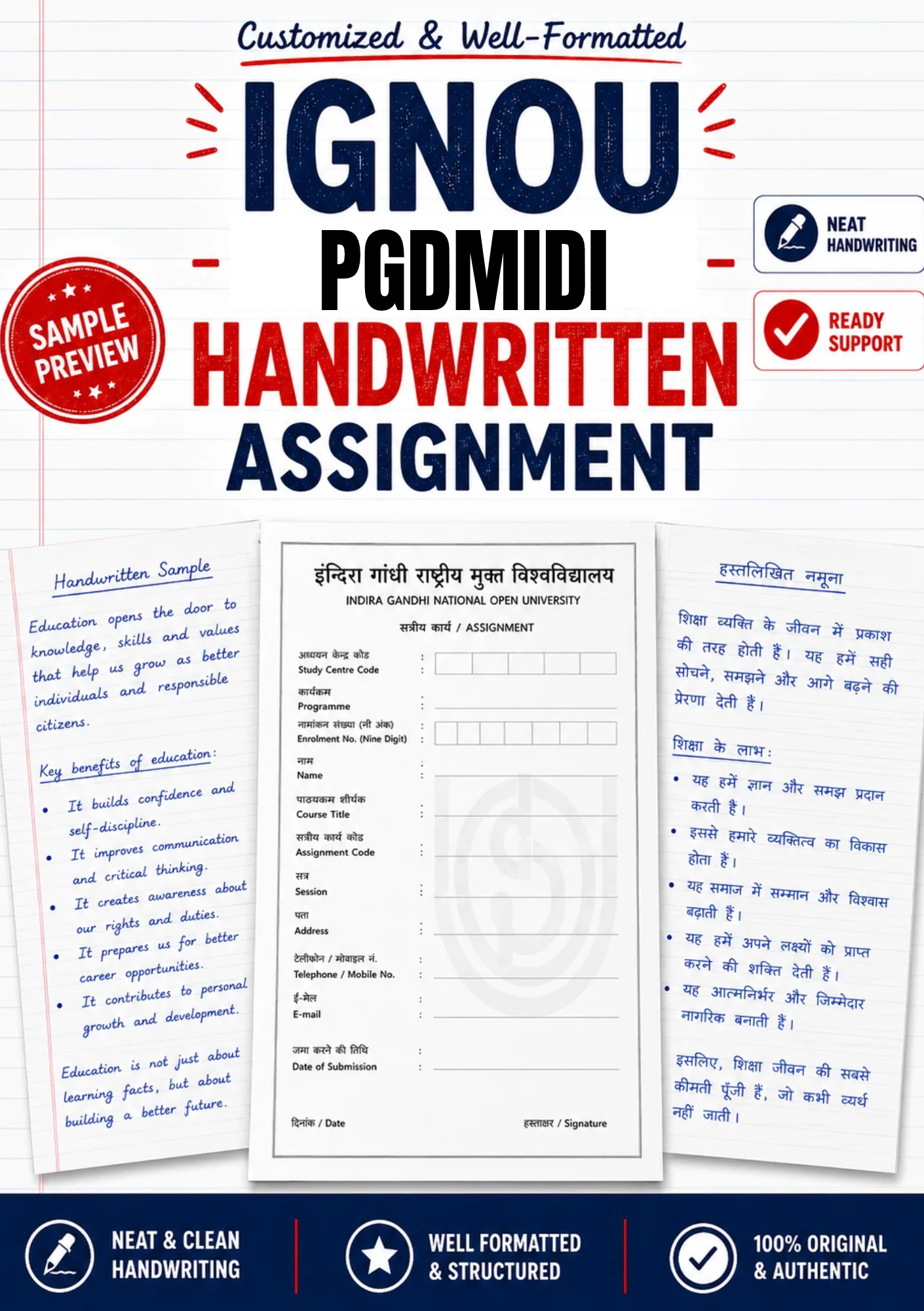
In short. Shri Chakradhar Publication writes the IGNOU PGDMIDI handwritten assignment by hand for each Migration and Diaspora paper that carries a Tutor Marked Assignment: the six core papers MDI-001 to MDI-006 and, for a learner who took the elective route instead of the project, MDIE-001 Gender and Diaspora and MDIE-002 Diasporas in India. The rate is ₹320 per subject, hard copy only, with courier included in that price and no separate shipping charge. A learner on the project route therefore owes six sets (₹1,920), a learner on the elective route owes eight (₹2,560), and a MAMIDI first-year learner leaving with the diploma owes ten once MPSE-001 and MPSE-005 are added (₹3,200). The eight-credit project, MDIP-001, has no assignment and sits outside this order. The 2025-26 MDI and MDIE files print 31 March for the June term-end examination and 30 September for the December one, and every one of those files read on 6 November 2026 names MAMIDI on its cover rather than PGDMIDI, which this page explains below so the mismatch does not stop you.
Six to Eight MDI and MDIE Sets in One Courier Envelope
A PGDMIDI order is counted by course code, so the envelope holds one separate bundle for each paper you name. Each bundle is kept apart from the others because the study centre logs a submission against a single course code, and a stapled stack covering MDI-002 and MDI-005 together creates work for the counter clerk that a learner then has to undo.
Inside each bundle are four things. The first is the written answer set itself, on A4 sheets with a margin left clear for the evaluator, answering five questions out of the seven the 2025-26 paper prints, which is what that paper tells you to do. The second is an IGNOU-format front page for that course, free with the order and filled in as far as it honestly can be before you add your own enrolment details and signature. The third is a printed copy of the official question paper the answers were written against, so anyone checking the set later can see which cycle it belongs to. The fourth is the courier packaging and the tracking reference that goes with it.
What is not in the envelope matters as much. No soft copy or PDF is sold. Nothing is emailed, nothing is uploaded to a drive, and there is no scan to forward. The only file involved in the whole process is the photograph of your own handwriting that you send at the start, and that travels one way.
Paper size is not a guess either. The two current files opened for this page, MDI-001 and MDIE-001 for 2025-26, allow foolscap or A4. The January 2023 PGDMIDI booklet allows an A4 sheet or a foolscap blank sheet and says ruled A4 is also permitted. A4 satisfies every PGDMIDI document read, which is why the set is written on it.
₹1,920 or ₹2,560: How the Diploma Route You Chose Sets the Total
The rate is ₹320 per subject, hard copy only, with courier included in that price and no separate shipping charge. The credit weight of a paper does not move the figure, so a four-credit MDI paper and a four-credit MDIE paper cost the same, and so would any paper of a different weight if your record carries one.
Where PGDMIDI differs from most diplomas is that the total is set by a choice you made at admission rather than by the programme alone. The Common Prospectus July 2026 lets a PGDMIDI learner take the two MDIE electives in place of the MDIP-001 project. Six core papers plus the two electives is eight Tutor Marked Assignments, eight times ₹320, which is ₹2,560. Six core papers plus the project is six assignments, ₹1,920, because a project is evaluated on its report and carries no TMA. A learner who reached the diploma through the first year of MAMIDI carries MPSE-001 and MPSE-005 as well, ten papers in all, ₹3,200.
There is no minimum order: one subject or fourteen, same rate. A learner who has already submitted four of the six MDI papers and still owes MDI-003 and MDI-006 orders those two and pays ₹640.
Three costs sit outside the ₹320 and are not this publisher’s to charge. The programme fee belongs to IGNOU, printed as Rs. 7,000 in the prospectus annexure, with IGNOU’s own PGDMIDI page adding a Rs. 300 registration fee. The examination form fee is also IGNOU’s. And the project, if you chose that route, is a separate piece of work with its own supervisor and synopsis stage, which this order does not touch.
Delivery depends on your pin code and is confirmed for your order before you pay. No figure is promised on this page.
Why the PGDMIDI Counter Takes Paper Written by Hand and Not a Downloaded Answer File
Learners searching for help with MDI-001 or MDIE-002 meet two products with nearly the same name, and buying the wrong one costs a cycle. They are defined here once so the rest of this page can use the words precisely.
A solved assignment is a soft-copy reference file of model answers for a course code and session, read on a screen and used as a starting point for writing your own answers. A handwritten assignment is the answers written out by hand on A4 and submitted in hard copy at the study centre, which is what this product is.
| What you are deciding for an MDI paper | Downloaded MDI answer file (soft copy) | PGDMIDI set written in ink (hard copy) |
|---|---|---|
| What you receive | A digital file of model answers | Answer sheets, a front page, the question paper, by courier |
| What you do next | Read it, then write your own answers by hand | Read it, sign the front page, hand it in |
| Who it suits | A learner with time to write five long answers per paper | A learner short of writing time across six to ten papers |
| Can it be submitted as it is | No: the MDI files require your own handwriting | It is written for submission in hand |
| Price line on this store | Priced separately on the solved-assignment shelves | ₹320 per subject, courier included |
On a phone, slide the table left to see all three columns.
The IGNOU wording settles it without interpretation. The 2025-26 MDI-001 file reads, in its guidance, “You should submit the assignment in your own handwriting.” The January 2023 PGDMIDI booklet is blunter: assignments should always be hand-written and not printed. A downloaded answer file printed out and stapled to a front page is a printed submission, and nothing on this page suggests otherwise.
That makes the honest scoping simple. An answer file is a reference you write from, not a submission. If writing the six or eight papers yourself is the plan and you want model answers to work from, the right purchase is a different one, and the store has no PGDMIDI-specific shelf for it today, so the query belongs on the store’s general IGNOU solved assignment hub, since no PGDMIDI shelf exists there yet. This page sells the written hard copy only.
Already know whether you took the electives or the project? Then the quote is a multiplication, and the only thing left to settle is the handwriting.
₹320 per subject, hard copy only, courier included in that price.
MDI-001 to MDI-006: The Six Core Diaspora Papers Every PGDMIDI Learner Writes
Whichever route a PGDMIDI learner chose for the remaining eight credits, the six MDI theory papers are fixed. Section 8.39 of the Common Prospectus July 2026, on page 295, lists them at four credits each, and IGNOU’s own PGDMIDI programme page, read on 6 November 2026, prints the same six titles. The table gives both the form the prospectus uses and the form printed on the 2025-26 assignment files, because the two differ and you will meet both.
| MDI code as section 8.39 prints it | Form on the 2025-26 file | Course title | Credits of the 32 |
|---|---|---|---|
| MDI-1 | MDI-001 | Migration and Diaspora: Theory and Methodology | 4 |
| MDI-2 | MDI-002 | Transnationalism, diaspora and citizenship | 4 |
| MDI-3 | MDI-003 | Global Diasporas: Case Studies | 4 |
| MDI-4 | MDI-004 | Indian Diaspora: An Overview | 4 |
| MDI-5 | MDI-005 | Indian Diaspora: Politico-Economic and Policy Aspects | 4 |
| MDI-6 | MDI-006 | Indian Diaspora: Socio-Cultural Facets | 4 |
On a phone, slide the table left to see the credit column.
Six papers at four credits make 24, and that sum was checked before the table was trusted. The first title is printed in section 8.39 as “Methodolog”, a letter short, which is a typesetting slip rather than a different course; the MAMIDI table in section 3.43, the live programme page and every booklet print Methodology in full.
The same six papers open the MA in Migration and Diaspora. In MAMIDI they are split across two semesters, MDI 001 to MDI 005 in the first and MDI 006 in the second, while the prospectus annexure lists PGDMIDI as a year-wise examination. IGNOU’s live PGDMIDI page nevertheless labels the papers Semester 1 and Semester 2. For ordering purposes the label makes no difference: you owe one assignment per paper per cycle, whatever the paper is grouped under.
The question pattern on the current files is uniform across the six. Each prints seven questions, asks you to attempt any five, and gives twenty marks to each; the seventh is a short-note question where any two of four parts are answered at ten marks each. A learner who studies one MDI paper therefore knows the shape of the other five before opening them.
Two MDIE Electives or One MDIP Project: The Eight Credits You Choose Between
Section 8.39 closes with a single sentence that changes what a PGDMIDI order looks like: a learner can opt for MDIE-001 and MDIE-002, four credits each, in lieu of the project MDIP-001, eight credits. That is the whole of the choice. The core is fixed at 24 credits, and the last eight come from either the elective pair or the project, giving the 32 credits the prospectus prints as the PGDMIDI total.
| Paper or line | Credit value | PGDMIDI with the electives | PGDMIDI with the project | MAMIDI year one, diploma exit |
|---|---|---|---|---|
| MDI-001 to MDI-006 | 24 | All six | All six | All six |
| MDIE-001 Gender and Diaspora | 4 | Yes | No | Yes |
| MDIE-002 Diasporas in India | 4 | Yes | No | Yes |
| MDIP-001 Project Work | 8 | No | Yes, no TMA | No (it sits in MAMIDI semester four) |
| MPSE-001 India and the World | 4 | No | No | Yes |
| MPSE-005 State and Society in Africa | 4 | No | No | Yes |
| Credits on that route | 32 | 32 | 40 | |
| Assignments to write | 8 | 6 | 10 | |
| Written order at ₹320 each | ₹2,560 | ₹1,920 | ₹3,200 |
On a phone, slide the table left to see all three routes.
The arithmetic behind each column was run separately: 24 plus 4 plus 4 is 32, 24 plus 8 is 32, and 24 plus 4 plus 4 plus 4 plus 4 is 40. Note what the section 8.39 table itself does, though. It prints all nine lines, the six cores, both electives and the project, under a single heading, and those nine lines add up to 40, not the 32 printed beneath them. The total is only correct once the in-lieu sentence is read, which is why a learner who reads the table alone can believe eight assignments and a project are all due.
MDIE-001 and MDIE-002 are labelled Elective/Theory in section 8.39. They are elective only against the project. A learner on the elective route writes both; there is no option to write one of them and drop the other.
The project itself is outside this order on every route. If MDIP-001 is your route, the store’s bound MDIP-1 project samples listed under PGDMIDI are the relevant shelf, and the publisher’s editorial site explains how the PGDMIDI project credits and the elective alternative work in more detail than a product page should.
If you are leaving MAMIDI after year one with the diploma
Section 3.43 of the prospectus says MAMIDI learners who complete the first year of study become eligible for the Post Graduate Diploma in Migration and Diaspora. MAMIDI year one is MDI 001 to MDI 006, both MDIE papers, MPSE 001 India and the World and MPSE 005 State and Society in Africa, 40 credits with no project. So the same diploma name is awarded on two different course lists: 32 credits with a project option for a direct PGDMIDI admission, and 40 credits with two Political Science papers for a MAMIDI exit. The MPSE prefix is the one the prospectus elsewhere labels a Political Science discipline course, and it carries no MDI code at all.
The only safe reading is the one on your own admission record. If MPSE-001 and MPSE-005 appear there, they are written at the same ₹320 each. If they do not, they are not part of a PGDMIDI order, whatever a listing elsewhere suggests. A learner continuing into MAMIDI year two can carry the same handwriting sample over to the MAMIDI written set, which covers the second-year MDI, MPSE and MSO papers.
Thirty-Four Places the PGDMIDI Record Does Not Line Up, Eight of Them In-House
Everything in the box below was found on 6 November 2026 by reading IGNOU’s PGDMIDI documents against each other: the Common Prospectus July 2026, IGNOU’s live PGDMIDI programme page, nine SOITS assignment files from 2022 to 2025-26 (seven opened directly, two read from their indexed text), and seven term-end question papers. The last eight items are this store’s and its sister site’s own. None of them is resolved here on your behalf; each is listed so that you check your own download before writing anything.
Thirty-four disagreements in the PGDMIDI paper trail. Only ignou.ac.in and your Regional Centre can say which reading applies to your enrolment.
1. Section 8.39 lists nine courses worth 40 credits and prints a total of 32. The total holds only after the closing sentence letting MDIE-001 and MDIE-002 replace MDIP-001 is applied.
2. The same section writes the codes two ways: MDIE-1 and MDIP-1 in the table, MDIE-001 and MDIP-001 in the sentence directly beneath it.
3. Section 3.43 awards the PGDMIDI on completing MAMIDI year one, a 40-credit list with MPSE 001 and MPSE 005 and no project, while section 8.39 defines PGDMIDI as 32 credits with a project option and no MPSE paper.
4. IGNOU’s live PGDMIDI page lists MPSE-001 and MPSE-005 as PGDMIDI courses and omits MDIP-001 altogether, so it describes the MAMIDI exit list under the diploma’s own name.
5. The same page prints MPSE-005 with its credits shown as null. The nine credit values it does print add to 36.
6. The live page gives the duration as 12 to 24 months; the prospectus annexure, row 164, gives one year minimum and three years maximum.
7. The live page labels the courses Semester 1 and Semester 2; the annexure lists the PGDMIDI examination as year-wise.
8. The school is named three ways: Interdisciplinary and Transdisciplinary (section 8.39), Interdisciplinary and Trans-disciplinary (section 3.43 and the booklets), and Inter-Disciplinary and Trans-Disciplinary (the live page).
9. The first course title is truncated to “Methodolog” in section 8.39 only.
10. Coordinator contact differs: section 8.39 gives pgdmidi@ignou.ac.in and a landline, section 3.43 gives nandini@ignou.ac.in and a mobile number, and the January 2023 PGDMIDI booklet prints PGDMIDI@ignou.ac.in while its text layer links to mamidi@ignou.ac.in.
11. Every 2025-26 MDI and MDIE file read (MDI-001, 003, 004, 005, 006, MDIE-001, MDIE-002) prints “Programme: MAMIDI” and an MA cover. None names PGDMIDI. The last booklet found under the diploma’s own name is January 2023.
12. Those files are headed “For January and July 2025 Sessions” while their assignment codes end 2025-26.
13. The MDIE-001 file prints MDI-001/TMA-01/2025-26 near the top and MDIE-1/TMA-01/2025-26 above its own questions.
14. The MDI-004 file’s covering letter gives the course code as MDI-001/2025-26, although its questions and TMA line are for MDI-004.
15. The MDI-003, MDI-004, MDIE-001 and MDIE-002 files all carry the MDI 001 Theory and Methodology heading directly above their own Tutor Marked Assignment.
16. IGNOU’s own file names transpose the elective prefix: the Gender and Diaspora file is MIDE-01-25-26.pdf and the Diasporas in India file MIDE-02-25-26.pdf, while the core files use MDI-1-25-26.pdf style names.
17. The 2025-26 guidance asks you to attempt all questions; the question page beneath it says attempt any five.
18. The 2022 and 2023 PGDMIDI booklets print 30 March for the June examination; the 2025-26 files print 31 March. The older booklets tie the date to your admission session, the newer files to the term-end examination.
19. The 2022 booklet offers three destinations: post to the Programme Coordinator at Block 15, email scans to pgdmidi@ignou.ac.in, or hand in at the allotted study centre. The 2023 booklet repeats the Block 15 address and, in its sixth guideline, the study centre. The 2025-26 files speak only of a study centre receipt.
20. Word guidance moved three times: 700 to 900 words for a long answer in 2022, 800 to 1,000 in 2023, “around 500-700” in another line of the same 2023 booklet, and no figure at all in 2025-26.
21. The 2023 booklet sets five questions at 20 marks and then a sixth section of four short answers at 5 marks each, which reads as 120 against a stated full mark of 100. Its sixth section says answer any four while most courses list five or six parts.
22. Each older booklet prints its assignment number two ways: PGDMIDI/July 2022 and PGDMIDI/2022 in 2022, PGDMIDI/January 2023 and PGDMIDI/2023 in 2023.
23. Term-end papers are headed inconsistently. MDI-001 in June 2024, MDI-003 in June 2025 and MDIE-001 in June 2026 are headed PGDMIDI alone; MDI-001 and MDI-005 in June 2025 are headed MAMIDI alone; MDI-004 and MDIE-002 in June 2026 are headed MAMIDI/PGDMIDI.
24. The June 2026 MDIE-002 paper titles the course “Diaspora in India”, singular; the prospectus, the live page and the assignment file say Diasporas in India. The June 2025 MDI-003 paper drops “Case Studies” from its title.
25. For the December 2026 examination, three dates circulate: 30 September on the files, 31 October 2026 in IGNOU’s reported extension, and 20 November 2026 in a Careers360 report that could not be matched to IGNOU’s own text.
26. No 2026-27 MDI file could be confirmed. Paths named in that pattern returned no readable text, and so did a deliberately invalid path tested the same way, so an empty response proves nothing either way. IGNOU’s assignment portal returned a server error twice during research.
27. In-house: this store sells two definitions of the PGDMIDI year side by side, an eight-code PGDMIDI book combo without MPSE and a ten-code MAMIDI/PGDMIDI first-year combo with MPSE 1 and MPSE 5. Both mirror an IGNOU document; neither says which applies to whom.
28. In-house: there is no PGDMIDI solved-assignment shelf on this store at all, so learners looking for model answers are sent to a general hub.
29. In-house: the PGDMIDI guess-paper shelf holds three products, two of them MDIE 1 under different addresses, and none for an MDI core paper.
30. In-house: every product on the PGDMIDI previous-year shelf is labelled June 2023, the only sitting it covers.
31. In-house: the MDI books are listed twice under two naming schemes, as MDI-001 Book study guides and as MDI 1 Study Material and Book products.
32. In-house: there are two MAMIDI book categories, holding 16 and 13 products, for one programme.
33. In-house: the PGDMIDI project category text speaks in the first person and prints a second WhatsApp number, 9958947060, beside +91 93546 37830.
34. Sister site: ignouproject.com has no PGDMIDI handwritten article, so the companion reading offered on this page is the MAMIDI one.
Programme structures, course codes, submission dates and rules change, and only ignou.ac.in and your Regional Centre can confirm the current position for your enrolment.
Two of these matter for an order more than the rest. Item 3 decides whether your list is eight, six or ten papers, and item 11 explains why a PGDMIDI learner downloading the current files sees an MA cover. Neither is a sign you have downloaded the wrong paper. The MDI and MDIE codes are shared, IGNOU publishes one file per code, and the file carries the master’s degree name.
31 March for June, 30 September for December: Fixing Your PGDMIDI Cut-Off
IGNOU sets submission dates per school and sometimes per booklet, and the dates widely repeated for management programmes do not apply here. The School of Interdisciplinary and Trans-disciplinary Studies prints its own pair on the MDI files, and the pair has moved slightly over four years.
| Document read on 6 November 2026 | June term-end examination | December term-end examination | What the date is keyed to |
|---|---|---|---|
| PGDMIDI booklet, July 2022 | 30 March | 30 September | Admission session (July / January) |
| PGDMIDI booklet, January 2023 | 30 March | 30 September | Admission session (July / January) |
| MDI and MDIE files, 2025-26 | 31 March | 30 September | The term-end examination |
| IGNOU extension, December 2026 (as reported) | Not applicable | 31 October 2026 | All ODL and online programmes |
| Careers360 report, 29 October 2026 | Not applicable | 20 November 2026, not matched to IGNOU text | Online submission window |
On a phone, slide the table left to see the last two columns.
Read the newer pairing carefully. A learner admitted in July sits the June examination, so the July learner’s cut-off is the March date; a January learner sits in December, so the September date applies. The 2025-26 files print the day and month and no year, which means the same file serves June 2026 and, if no newer file appears, June 2027, with 31 March 2027 as the working cut-off for the next June sitting.
For December 2026 the position on 6 November is this. The printed 30 September has passed. The 31 October 2026 extension reported by CareerIndia and Careers360’s Hindi desk has also passed. A 20 November 2026 online window has been reported by Careers360 alone, and its wording could not be matched to an IGNOU notice during research, so it is treated here as unconfirmed. The December 2026 examinations themselves are reported to run from 25 November 2026 to 13 January 2027. Only your Regional Centre can tell you whether it is still accepting a December submission.
Assignments carry 30 per cent of the final course result and the term-end examination carries the remaining 70 per cent. The MDI files also say plainly that submitting the assignment is compulsory before you can take the term-end examination, so a missed cut-off can cost more than the 30 per cent: the files tie submission to sitting the examination at all.
Papers expire, too. The questions on the 2025-26 MDI-001 file are not the questions on the January 2023 booklet, and a set written against an old paper does not answer the current one. That is why the code and cycle of your paper are part of the order, and why an older cycle is written against the paper you hold rather than a newer one.
MDI-001/TMA-01/2025-26 on a MAMIDI Cover: Copying the Code a Diploma Learner Uses
The current files print an assignment code in three parts. MDI-001 is the course. TMA-01 says it is the first and only Tutor Marked Assignment for that course. 2025-26 is the cycle the paper belongs to. The covering letter on each file also prints a shorter line, such as MDI-001/2025-26, labelled Course Code; that line identifies the course and is not the string the front page asks for.
Two things are worth knowing before you copy it. First, the PGDMIDI booklets of 2022 and 2023 did not use course-level codes at all. They printed one programme-level assignment number for every paper, PGDMIDI/January 2023 for instance, so a learner clearing an old backlog against a 2023 booklet copies that form instead. Second, four 2025-26 files carry another course’s heading or code (items 13 to 15 in the box above). The reading this page takes, and which only your study centre can confirm, is that the code printed in the box directly above the questions you are answering is the one that belongs on the front page: MDIE-1/TMA-01/2025-26 for Gender and Diaspora, MDI-004/TMA-01/2025-26 for Indian Diaspora: An Overview, and so on.
The front page asks for the programme as well, and here a PGDMIDI learner writes PGDMIDI, the programme on the admission record, even though the file says MAMIDI. The code identifies the paper; the programme identifies you.
Not sure which code your MDI file is printing? Send a photo of the top of the paper and the code is read back to you before any writing starts.
Matching Your Hand Before a Single MDI Page Is Written
Every MDI file asks for the assignment in your own handwriting, and a PGDMIDI order may run to eight or ten bundles that will all carry your signature on the front page. A set written in a hand that looks nothing like yours is a set you will hesitate to sign, so the matching comes first and payment comes after it.
Send a photo of a page you have written yourself and the handwritten set is matched to your handwriting at no extra charge. A short sample in the matched hand is returned on WhatsApp before you pay anything, and if it does not look like yours, the writing is adjusted before anything is paid.
The page of your own writing worth photographing for a diaspora paper
A full page of continuous prose works; a signature or a single line does not. Notes from an MDI study block are ideal, because they show how you write the terms that recur across these papers, words like transnationalism, remittance, indenture and citizenship, and how you lay out a heading. Photograph the page flat, in daylight, with the whole sheet in frame and the pen you normally use. A page written specially for the photo tends to look more careful than your real hand, so an ordinary page is the better reference.
English Only, January or July Intake, and MDI Papers Left From 2022 Onward
The prospectus gives PGDMIDI one medium, English, and IGNOU’s live page says the same. The term-end question papers read for this page print a Hindi rendering below the English, but every assignment file opened was in English. The service covers all mediums IGNOU issues the TMA paper in, at the same price. If a Hindi MDI assignment file is issued for your cycle, it is written at ₹320 like the rest.
Any session is accepted, current cycle or older, including backlog courses, at the same ₹320 per subject. The prospectus annexure lists both January and July admission for PGDMIDI, and a Careers360 report from 29 January 2022 dates the programme’s launch to the January 2022 session, so the oldest cycles a PGDMIDI learner can still be carrying are the 2022 ones. Their booklets differ from the current files in cover, code form and word guidance, and a backlog set is written to the paper you actually hold.
Two eligibility notes from IGNOU’s own page, because they surprise people: the PGDMIDI page says the programme is not offered to international students, and its eligibility heading is printed with no text beneath it. The prospectus fills that gap with any bachelor’s degree from a recognised university.
What a PGDMIDI Quote Needs: Route, Codes, Session, Photo, Pin Code
Five lines in one WhatsApp message price the work. Each one removes a question that would otherwise come back to you.
- Your route. Electives, project, or MAMIDI year-one exit. This fixes whether the list is eight, six or ten papers.
- The codes still open. Exactly as your admission record or paper prints them, one per line.
- The cycle and examination. Which paper you hold, 2025-26 or older, and whether you are aiming at June or December.
- A page of your handwriting. As described above, photographed flat.
- A pin code. So the courier route can be confirmed for your order before you pay.
What is not needed at this stage: your enrolment number, your study centre code, a copy of your identity card or the downloaded paper itself, unless the code on it is in doubt. Those go on the front page, which you complete yourself.
Want to see the handwriting on one paper before committing to the rest? That is the normal order of things here, not a special request.
₹320 per subject. Nothing is paid before the sample is agreed.
Reading, Signing and Handing In the Diaspora Set at Your Study Centre
The parcel arriving is the middle of the process, not the end. Three things remain that only you can do.
The first is reading. Check each bundle against your own list: the course code, the cycle on the enclosed question paper, and the five questions answered. Then read the answers themselves. You sign the declaration on the assignment cover page, so you should read and review the content before submitting it, and satisfy yourself that it represents your own understanding of the course. The term-end examination that follows is written by you alone, and the MDI papers repeat themes across cycles, so the reading also does work for the examination.
The second is completing the front page: your enrolment number, name, address, study centre code and signature, with PGDMIDI as the programme. The third is submission. Follow the instruction on the paper you are answering, which for the 2025-26 files means the study centre, and take a receipt there when you submit, as those files instruct. Keep a photocopy or scan of each bundle until your result is declared.
After that the timeline is IGNOU’s. Assignment marks appear on the status page in their own time, and nothing on this page can speed that up or influence it.
Books, Past Papers and Guess Sets for Diaspora Papers, Plus the Route Into MAMIDI
A written set answers the assignment, not the examination, and most PGDMIDI learners end up needing more than one thing in the same cycle. For reading the courses, the store keeps study guides for the PGDMIDI diploma papers, and a learner on the elective route who wants all eight titles at once can take the eight-book PGDMIDI combo from MDI 1 through MDIE 2. Learners on the MAMIDI exit route, whose list includes the two MPSE papers, can browse the rest of the first-year titles in the MA Migration and Diaspora book listings.
Closer to the examination, the picture shifts from assignments to papers. Worked PGDMIDI term-end papers from the June 2023 sitting show how the long answers are framed, and the diploma’s own guess-paper shelf currently covers only the electives, so learners preparing the six MDI cores will find wider coverage in the MAMIDI guess papers, which include the shared MDI codes, alongside the smaller PGDMIDI guess-paper set for MDIE 1 and MDIE 2.
Codes from outside this programme are handled elsewhere. The handwritten range for every other IGNOU programme lists the other products at the same rate, and a code or cycle that fits no listed product can be ordered through a customised handwritten order for any course and session.
On the editorial side, there is no PGDMIDI handwritten article on the companion site. The nearest one covers the same MDI and MDIE papers from the master’s side: the MAMIDI handwritten assignment walkthrough on ignouproject.com, which is the place to start if you would rather write the papers yourself.
Fifteen Doubts Raised by Migration and Diaspora Learners Before Ordering
Is ₹320 charged per MDI paper or for the whole PGDMIDI year?
Per paper. One course code is one subject at ₹320, courier included. A full elective-route year is eight papers, ₹2,560; a project-route year is six, ₹1,920.
The prospectus table lists nine PGDMIDI courses but says 32 credits. How many assignments do I owe?
Six or eight. The nine lines add to 40 only because the table prints both the elective pair and the project; the sentence under it lets MDIE-001 and MDIE-002 replace MDIP-001. Six MDI papers are always due. Add both MDIE papers if you took the electives. The project has no assignment.
I chose MDIP-001. Which of my papers still need a written assignment?
MDI-001 to MDI-006, nothing more from the PGDMIDI list. The project is assessed on its own report and synopsis, and it is not part of this product on any route.
IGNOU’s PGDMIDI page shows MPSE-001 and MPSE-005. Do I have to submit those as well?
Only if they are on your admission record. They belong to the MAMIDI first-year list that leads to the diploma as an exit award, not to the 32-credit PGDMIDI table in section 8.39. If your record carries them, they are written at ₹320 each like any other paper.
My MDI-001 file says Programme: MAMIDI. Have I downloaded the wrong paper?
Almost certainly not. Every 2025-26 MDI and MDIE file read on 6 November 2026 prints MAMIDI, because IGNOU now issues one file per shared code. Write PGDMIDI as your programme on the front page and the code from the paper as printed.
Handwritten set aur MDI ka solved PDF: dono mein asal farq kya hai?
Solved assignment ek soft-copy reference file hoti hai, jisme MDI paper ke model answers hote hain aur aap usse padh kar apne haath se likhte hain. Handwritten assignment woh set hai jo haath se likha hua, hard copy mein, study centre par jama karne ke liye aata hai. Yeh page sirf doosra wala bechta hai.
Can I print a downloaded MDI answer PDF and hand it in at the study centre?
No. The MDI files ask for the assignment in your own handwriting, and the January 2023 PGDMIDI booklet says assignments should always be hand-written and not printed. A printout is a printed submission.
The 2022 PGDMIDI booklet allowed emailed scans. Does that mean a typed set is fine?
No. The 2022 booklet allowed scans of handwritten assignments to be emailed, which is a change of delivery route, not of format. The handwriting requirement stayed. Check with your study centre whether it accepts any scanned submission now; the 2025-26 files mention only a study centre receipt.
For December 2026, is my last date 30 September, 31 October or 20 November?
30 September is printed on the files and has passed; the reported 31 October 2026 extension has also passed. The 20 November 2026 window has been reported by Careers360 only and was not matched to an IGNOU notice during research. Ask your Regional Centre before relying on it.
My MDIE-001 paper shows MDI-001/TMA-01/2025-26 at the top. Which code goes on the front page?
The reading taken here is the code in the box directly above the Gender and Diaspora questions, MDIE-1/TMA-01/2025-26, because the MDI-001 line is a template carry-over from the core paper. Confirm it with your study centre if you are unsure; it is IGNOU’s error, not yours.
How long should each MDI answer be when the booklets give three different word limits?
The 2025-26 files give no figure, only an instruction not to exceed what the question indicates. The older guidance ran from 500 to 1,000 words depending on the line read. The set follows the paper you hold and keeps long answers proportionate to the twenty marks each carries.
Is PGDMIDI available in Hindi medium?
The prospectus and IGNOU’s page list English only, and every assignment file opened was English, although the term-end papers print a Hindi rendering. If IGNOU issues a Hindi MDI assignment for your cycle, it is written at the same ₹320.
I still owe MDI-003 from an earlier PGDMIDI cycle. Can it be written at the same price?
Yes. Any session is accepted, current cycle or older, including backlog courses, at the same ₹320 per subject. Say which paper you hold, because a 2023 booklet and a 2025-26 file carry different questions and different code forms.
Do I have to order all eight PGDMIDI codes together?
No. There is no minimum order: one subject or fourteen, same rate.
When will the PGDMIDI parcel reach me?
Delivery depends on your pin code and is confirmed for your order before you pay. No figure is promised on this page.
Prospectus, IGNOU’s Programme Page, Nine SOITS Files and the Store’s Terms, Kept Separate
Three kinds of statement appear on this page, and they are kept apart because they carry different authority.
Taken from section 8.39, section 3.43 and annexure row 164 of the July 2026 prospectus. The PGDMIDI structure, codes, titles, credits and the in-lieu rule from section 8.39 on page 295; the MAMIDI first-year list and the exit award from section 3.43; medium, eligibility, duration, fee and admission cycles from annexure row 164. The credits were summed independently: 6 times 4 is 24, plus 8 from either route is 32, and the MAMIDI first year is 40.
Taken from IGNOU’s live pages and files on 6 November 2026. IGNOU’s own PGDMIDI programme listing; the 2025-26 MDI-001 Theory and Methodology file and the 2025-26 Gender and Diaspora file, filed as MIDE-01, with the MDI-003, MDI-004, MDI-005, MDI-006 and MDIE-002 files from the same cycle; the July 2022 PGDMIDI booklet and the January 2023 PGDMIDI booklet; and term-end papers for June 2024, June 2025 and June 2026. Current papers are published through IGNOU’s assignment download page, which returned an error during research and should be checked directly.
Commercial terms belonging to the publisher alone. The ₹320 rate, hard-copy format, courier inclusion, free front page, handwriting matching, session coverage and the absence of a minimum order. None of these is an IGNOU rule, and none of the IGNOU facts above depends on them.
Important Notice
Shri Chakradhar Publication Pvt. Ltd. and shrichakradhar.com form an independent IGNOU study-support publisher. This is not the official website of Indira Gandhi National Open University, is not affiliated with, endorsed by or authorised by the university, and no page on this site should be treated as an official IGNOU communication.
Programme structures, course codes, submission dates and rules change, and only ignou.ac.in and your Regional Centre can confirm the current position for your enrolment.
You sign the declaration on the assignment cover page, so you should read and review the content before submitting it, and satisfy yourself that it represents your own understanding of the course.
No claim is made about the marks any assignment will receive, about how an evaluator will assess it, or about whether it will be accepted. Assignment evaluation is entirely a matter for IGNOU.
Send the MDI and MDIE Numbers Still Open on Your PGDMIDI Record
Six papers on the project route, eight on the elective route, ten on the MAMIDI exit. Name your route and the codes still open, and the quote comes back with the courier route confirmed for your pin code.
The rate is ₹320 per subject, hard copy only, with courier included in that price and no separate shipping charge.
For a current-cycle paper, open a PGDMIDI order on WhatsApp. If what you owe is from an earlier cycle, price an older MDI paper carried over from a past cycle at the same rate.