

Description
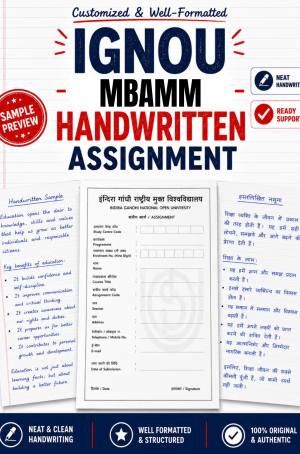
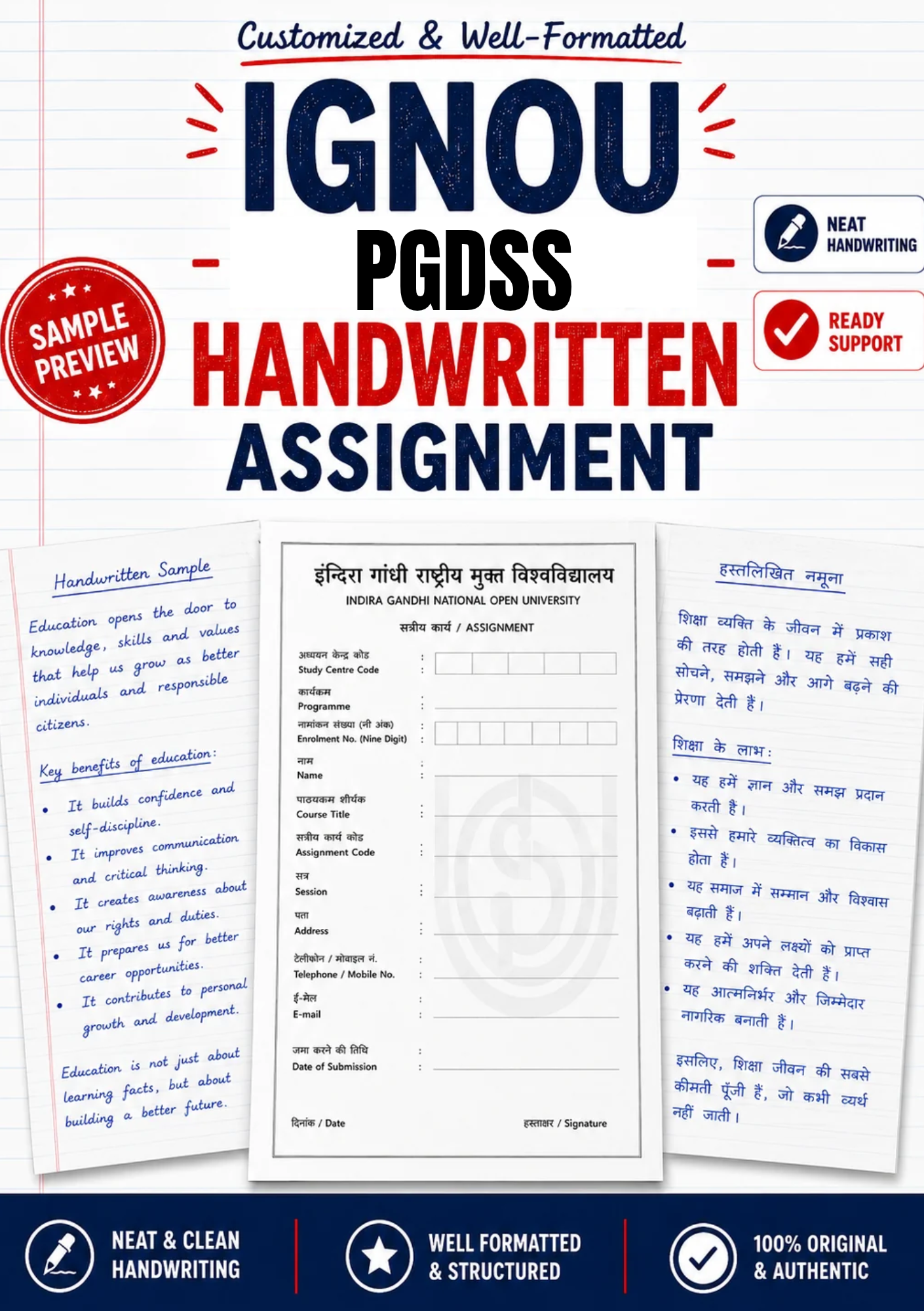
In short. An IGNOU PGDSS handwritten assignment order covers up to nine MSD papers (MSD 11 to MSD 17, MSD 19 and MSD 20), which is the whole of the Post Graduate Diploma in Sustainability Science as section 8.38 of the Common Prospectus July 2026 prints it: nine four-credit theory courses, 36 credits, and no project. IGNOU no longer issues a booklet under the diploma’s own name; the 2026 questions sit on a combined file headed MASS-1/PGDSS, valid for the June 2026 and December 2026 term-end examinations, with four questions of 25 marks per paper, a printed cut-off of 30 March for June and 30 September for December, and an instruction to send the answers to your Regional Centre with PGDSS written on the envelope. Shri Chakradhar Publication writes each paper by hand in a hand matched to your own sample, at ₹320 per subject, hard copy only, with courier, a free IGNOU-format cover sheet and a copy of the question paper included, and a full nine-paper order comes to ₹2,880.
Nine MSD Bundles, One Cover Sheet Each: Unpacking a PGDSS Delivery
A PGDSS delivery is built around the course code, not around the year. If your admission record shows nine open MSD papers, nine separate bundles arrive, each one tied and labelled with its own code, so nothing has to be sorted out of a single stack on the evening before you post it. If only MSD 17 and MSD 20 are still open, two bundles arrive and nothing else. The diploma runs as a single year, which makes this easy to picture: one bundle per code, and every code accounted for.
Inside each bundle there are four things. The first is the written answer set itself, on A-4 sheets, answering every question the 2026 paper sets for that course. The second is an IGNOU-format cover sheet, supplied free, laid out with the fields the 2026 booklet asks for on its first page: the assignment number, your name, your enrolment number, an email address (which the booklet marks as mandatory) and a phone number. The third is a printed copy of the official question paper for that code, because the 2026 booklet asks for the questions to sit as the third page of the response. The fourth is the courier packing that carries all of it to your address.
One page is deliberately missing, and it should be. The 2026 booklet asks for the second page of each response to be a copy of your IGNOU identity card, marked compulsory. That card is yours, carries your photograph and enrolment details, and is something only you can add. Keep nine photocopies of it ready if you are submitting the whole year, and slot one behind each cover sheet before the bundle goes into its envelope.
Nothing digital travels with the parcel. No soft copy or PDF is sold. That is not a limitation of the service so much as a reflection of what the booklet asks for: answers written in your own handwriting, on paper, in a physical envelope addressed to a Regional Centre.
₹2,880 Covers All Nine Sustainability Papers, and Here Is What Stays Outside It
The rate is ₹320 per subject, hard copy only, with courier included in that price and no separate shipping charge. On a nine-paper diploma the arithmetic is short: nine codes at ₹320 is ₹2,880 for the full PGDSS year, and that figure already includes the cover sheets, the question-paper copies and the courier. There is no packing line, no handwriting surcharge and no extra charge for a paper with longer answers. If you have cleared some papers already, multiply ₹320 by whatever is left; three outstanding papers come to ₹960.
The figure is the same whichever way the order is split. There is no minimum order: one subject or fourteen, same rate. A learner sending MSD 19 alone because it was missed in the last cycle pays the same per paper as a learner sending all nine on the first day of the session. Handwriting matching sits inside the rate too, as the section on the sample photo explains.
Some things are outside the figure because they are not the publisher’s to supply. Postage from your home to the Regional Centre is yours to arrange, because the 2026 booklet asks for the envelope to go to that centre, and only you know which centre your enrolment sits under. The photocopy of your IGNOU identity card is yours. Any fee IGNOU charges for re-registration, examination forms or a late examination form is IGNOU’s and has nothing to do with this order. And the outcome of evaluation is outside every figure on this page, because assignment marking belongs to the university.
Delivery depends on your pin code and is confirmed for your order before you pay. No figure is promised on this page. If a printed cut-off is close, say so in your first message, and the answer you receive will tell you plainly whether your pin code makes the date realistic, so that the decision stays with you rather than with a hopeful guess.
An MSD Answer File to Learn From, or a PGDSS Set in Your Own Hand to Post
Two products with very similar names circulate around every MSD paper, and PGDSS learners regularly pay for one when they needed the other. It helps to fix the two terms before going further. A solved assignment is a soft-copy reference file of model answers for a course code and session, meant to be read, studied and written from. A handwritten assignment is the answers written out by hand on A4 and submitted in hard copy at the study centre; for PGDSS in 2026 the booklet sends that hard copy to the Regional Centre instead, as the deadline and submission sections below explain.
The distinction is not a matter of taste. Every 2026 MSD paper read for this page carries the same instruction in its general notes: each question is to be answered in around 500 words in your own handwriting. The same notes ask you to answer in your own words and not to copy from the course material. A downloaded reference file, printed out and posted, meets neither requirement. It is not handwriting, and it is somebody else’s wording. That is why a reference file is something to learn from and never something to hand in.
| What a PGDSS learner is weighing | MSD reference file (soft copy) | Written PGDSS set (hard copy) |
|---|---|---|
| Form it arrives in | A digital file for reading on a screen or printing for study | Loose A-4 sheets written by hand, one bundle per MSD code |
| What it is for | Understanding the four questions and planning your own answers | Signing, enclosing with your identity card copy and posting to the Regional Centre |
| Fit with the 2026 instruction to write in your own handwriting | None, if printed and posted as it is | Written to the booklet’s A-4 and 500-word guidance, in a hand matched to your sample |
| Who it suits | A learner who will write the answers out personally and wants a model to work from | A learner who needs the physical submission prepared and will read it before signing |
| Where it is sold on this store | The solved-assignment shelves listed in the next sentence | This page, at ₹320 per subject with courier included |
On a narrow screen, swipe the table sideways to see every column.
If what you actually need is the reference file, the PGDSS solved-assignment shelf, which is where a reference file for an MSD paper belongs, is the right place to start, and the store’s larger set of MSD reference files is described in the shelves section further down. This page does not sell a solved file, and it does not try to rank for one.
Some learners buy both, and for a sensible reason: the reference file to study the course, and the written set to submit. That is a fair use of the two. What does not work is treating them as interchangeable. You sign the declaration on the assignment cover page, so you should read and review the content before submitting it, and satisfy yourself that it represents your own understanding of the course.
Nine MSD papers, or only the ones still open: the arithmetic is ₹320 for each.
₹320 per subject · hard copy · courier included · free IGNOU-format cover sheet · question-paper copy enclosed.
MSD 11 to MSD 20: The Nine Papers a PGDSS Year Is Made Of
Section 8.38 of the Common Prospectus July 2026 places the Post Graduate Diploma in Sustainability Science under the School of Interdisciplinary and Transdisciplinary Studies, with English as the medium of instruction and any bachelor’s degree from a recognised university as the entry requirement. The annexure row for the programme gives a minimum of one year, a maximum of three, a fee of Rs. 8,000, a year-wise examination pattern, and admission in both January and July.
The course table is short and has no options in it. Nine theory courses, each worth four credits, make up the diploma. There is no elective to choose, no practical component and, in the current table, no project. The table prints its total as 36 credits, and nine courses at four credits each come to exactly 36, so the extracted table was checked against its own total before any line of this page relied on it. Every code below therefore carries a written assignment, and every code below is within the scope of this order.
| Code as section 8.38 prints it | Code on the 2026 question page | Course title in section 8.38 | Share of the 36 credits | 2026 file found carrying its questions |
|---|---|---|---|---|
| MSD 11 | MSD-011 | Sustainability Science | 4 | MSD-011.pdf |
| MSD 12 | MSD-012 | Ecosystem and Natural Resources | 4 | MSD-011.pdf (no separate file opened) |
| MSD 13 | MSD-013 | Socio-Cultural System | 4 | Not opened for this page |
| MSD 14 | MSD-014 | Ecological Economics | 4 | Not opened for this page |
| MSD 15 | MSD-015 | Institutions, Governance and Policies | 4 | MSD-016.pdf |
| MSD 16 | MSD-016 | Strategies and models for sustainability | 4 | MSD-016.pdf |
| MSD 17 | MSD-017 | Challenges to Sustainable Development | 4 | Not opened for this page |
| MSD 19 | MSD-019 | Global Strategies to Sustainable Development | 4 | MSD-019.pdf |
| MSD 20 | MSD-020 | Population, Health and Sustainability | 4 | MSD-020.pdf |
On a narrow screen, swipe the table sideways to see every column.
Three practical points come out of that table. First, the numbering jumps from 17 to 19. There is no MSD 18 theory course in the PGDSS table, and the number belongs to a project code, MSDP 18, which sits in the second year of the master’s degree and is discussed in the next section. A learner who expects ten papers because the numbers run from 11 to 20 is counting one that does not exist.
Second, the prospectus prints two-digit codes while every 2026 question page prints three digits with a hyphen. MSD 11 and MSD-011 are the same course. On the cover sheet, copy the course code exactly as the question page prints it, because that is the document the evaluator holds next to your answers.
Third, the file names on ignou.ac.in are not a reliable index of what each file contains. The file named for MSD-011 carries the questions for both MSD-011 and MSD-012, and the file named for MSD-016 carries the questions for MSD-015 as well as MSD-016. Every file repeats the same contents list of nine codes. When you download your papers, read the heading on the question page rather than trusting the file name, and send the code from that heading. The writing desk works from the question page you name, and asks for the file if there is any doubt about which one you hold.
The same nine courses also form the first year of the Master of Arts in Sustainability Science, which section 3.41 of the same prospectus prints with an identical year-one table. That is why the 2026 booklet is shared, and why the prospectus describes PGDSS as an exit award after the first year of the master’s degree as well as a programme in its own right.
MSD 18, MSDP 018 and MEVE 016: Three Codes That Sit Near PGDSS but Outside This Order
Three codes turn up on PGDSS paperwork, on this store or in learners’ messages without belonging in a PGDSS handwritten order. Each one is worth naming so that nobody pays for a paper that does not exist or orders against the wrong programme.
| Code seen near PGDSS | Where it is printed | Why a PGDSS set is not quoted for it |
|---|---|---|
| MSD 18 | Nowhere as a theory course; the gap in the numbering is left by the project code | There is no such theory paper and no question page to answer |
| MSDP 18 / MSDP 018, Project Work | MASS second-year table in section 3.41 at 8 credits; the diploma’s own web support pages at 4 credits | A project is assessed as a report, not through a Tutor Marked Assignment, and the current PGDSS table carries no project |
| MEVE 16 / MEVE 016, Urban Environment | Lateral-entry note in section 3.41; MAEVS and PGDEVS tables; listed on the 2026 MASS-2 booklet without a question page | It is a second-year requirement for some PGDSS holders entering MASS, not a diploma course |
On a narrow screen, swipe the table sideways to see every column.
The project deserves a fuller word, because it explains a good deal of the confusion around this diploma. The PGDSS web support site that IGNOU still hosts describes the programme as eight courses: seven theory courses of four credits each, MSD 011 to MSD 017, and a project, MSDP 018, also of four credits. That adds up to 32 credits. The Common Prospectus July 2026 describes a different diploma: nine theory courses, including MSD 19 and MSD 20, and no project, adding up to 36. Both descriptions are on IGNOU properties today. The prospectus is the authority for structure, so this page follows it, but a learner who joined in the earlier years of the ODL diploma may well have been registered under the older shape.
That older shape is also why the lateral-entry note exists. Section 3.41 says that learners registered in PGDSS, in both ODL and online mode, from July 2017 to July 2022, who take lateral entry into the second year of MASS, must complete three courses in place of MSDP 018: MSD 19, MSD 20 and MEVE 16. Read against the old 32-credit structure, the logic is that those learners never studied MSD 19 or MSD 20 as diploma courses. The 2026 MASS-2 booklet lists the same three as additional courses for lateral entry but prints no questions for any of them. The MSD 19 and MSD 20 questions are on the MASS-1/PGDSS file, and no MEVE 016 page was found on either SOITS file read for this page.
If you are in that position, the two MSD papers can be ordered here like any other code, and MEVE 016 can be ordered too, at the same ₹320, against whichever paper your Regional Centre confirms. The MASS written-assignment listing for the year-two papers covers the rest of the second year, and it is the better page to read once you are formally a MASS learner.
Twenty-Six Contradictions in the PGDSS Paper Trail, Six of Them In-House
Everything in the box below was found on 6 November 2026 by reading the Common Prospectus July 2026, four 2026 MSD files on ignou.ac.in, one 2026 MASS-2 file, three earlier PGDSS and MASS booklets on webservices.ignou.ac.in, and IGNOU’s own PGDSS and MASS web support pages against one another, and then by reading this store and its sister site against those documents. None of it is a complaint about IGNOU. A diploma that was launched online in 2011, moved to ODL in 2017, gained an online twin in 2021 and was folded into the first year of a master’s degree has accumulated pages from each stage, and many of them are still live.
Twenty-six disagreements in the PGDSS record: eighteen inside IGNOU’s own documents, two from third parties and six on this store or its sister site. Check the ones that touch your own codes before you write anything on a cover sheet.
1. Two structures for one diploma. Section 8.38 prints nine theory courses and 36 credits with no project. The PGDSS web support site describes seven theory courses and MSDP 018 at four credits, which is 32.
2. Two credit values for one project. The PGDSS web support site gives MSDP 018 four credits; the MASS table in section 3.41 and the MASS web support FAQ give MSDP 18 eight.
3. The diploma’s own assignment page is four years behind. The PGDSS web support page still offers a file labelled PGDSS 2022 covering MSD 011 to MSD 017 only, so a learner who stops there never sees MSD 19 or MSD 20. Its link marked as the latest leads to a page on the MASS site.
4. Four places to send the same answers. The 2021 and 2022 PGDSS booklets and the PGDSS announcement page say Room No. 21 A, Block 1. The PGDSS assignment page says Block 15, Ground Floor, SOITS. The 2023 booklet says the Programme Coordinator of MASS at SOITS. The 2026 files and the MASS year-one page say the concerned Regional Centre.
5. An email route that has quietly gone. The 2022 booklet allowed scanned handwritten answers to be emailed to the PGDSS address, one PDF per course, named with the enrolment number followed by the course code. The 2026 files offer no email route at all.
6. Dates keyed to the intake, then to the examination. The 2021 booklet ties 30 March to the July session and 30 September to the January session. From 2023 the same two dates are tied to the June and December term-end examinations instead.
7. 30 March or 31 March. Every booklet read and the MASS year-one page print 30 March for the June examination; the PGDSS announcement page prints 31 March.
8. The diploma lost its own assignment number. The booklets read PGDSS/2021 and PGDSS/2022, then MASS/2023 marked as being for first-year MASS and PGDSS, then MASS-1/PGDSS in 2026.
9. Two years on one 2026 cover. The main heading of every 2026 MASS-1/PGDSS file reads MASS-1/PGDSS-2024, while the line beneath it reads MASS-1/PGDSS-2026 and the session line names the June 2026 and December 2026 examinations.
10. File names that do not match their contents. MSD-011.pdf carries the MSD-012 questions as well; MSD-016.pdf carries the MSD-015 questions as well; every file repeats a nine-code contents list.
11. One course, two titles on one file. The 2026 contents list prints MSD-015 as Institutions, Governance and Policies; the question page in the same file heads it Institution, Governance and Policies, as the 2021 booklet also did.
12. Capital letters that move. Section 8.38 and the 2026 contents print Strategies and models for sustainability and Socio-Cultural System; the 2021 booklet prints Strategies and Models for Sustainability and Socio-cultural System.
13. Two-digit and three-digit codes. The prospectus prints MSD 11 to MSD 20; every question page prints MSD-011 to MSD-020.
14. Two closing months for one lateral-entry window. Section 3.41 says PGDSS learners registered from July 2017 to July 2022; the MASS online support page says July 2017 to January 2022.
15. Lateral-entry papers listed without questions. The 2026 MASS-2 file lists MSD 019, MSD 020 and MEVE 016 as additional lateral-entry courses and prints no question page for any of them.
16. Four programmes in the counselling notices, two on the cover. Counselling schedules from the nodal Regional Centre group PGDSS, PGDSSOL, MASS and MASSOL together; the 2026 cover and the envelope instruction name only PGDSS and MASS.
17. A shared paper whose cover names two of its six programmes. MSD 019 sits in the PGDSS, MASS, MAEVS, PGDEVS and MSCCC tables of the prospectus and in the PGCCC table; the 2026 MSD-019 file names PGDSS and MASS only.
18. The school spelled two ways. Section 8.38 prints Interdisciplinary and Transdisciplinary; section 3.41 prints Interdisciplinary and Trans-disciplinary.
19. Third party: a different fee and a longer maximum. A widely copied student-help site gives PGDSS a fee of Rs. 7,000 and a maximum duration of four years, against Rs. 8,000 and three years in the prospectus annexure.
20. Third party: two December 2026 extension dates. One education news outlet reported the December 2026 assignment date extended to 31 October 2026; another later reported an online window to 20 November 2026, which could not be confirmed from IGNOU’s own text while preparing this page.
21. In-house: a project shelf for a diploma with no project. This store’s PGDSS project hard-copy category lists nine MSDP-018 products, and its description carries acceptance-assurance wording and a dispatch-timing promise that this page does not repeat, along with a different WhatsApp number. It is in the publisher’s correction queue.
22. In-house: the same for the online diploma. A PGDSSOL project hard-copy category lists five MSDP 18 products.
23. In-house: two book combos that disagree. The PGDSS book combo lists nine MSD codes; the PGDSSOL combo lists seven, MSD 11 to MSD 17, although both diplomas follow the same table.
24. In-house: duplicate and missing guess papers. The PGDSS guess-paper shelf holds nine products covering MSD 11 to MSD 16 only, with MSD 13, MSD 14 and MSD 16 each listed twice under different addresses and nothing for MSD 17, MSD 19 or MSD 20.
25. In-house: a near-empty solved shelf. The PGDSS solved-assignment category holds a single product, while the MSD reference files actually sit on the MASS solved shelf.
26. In-house, sister site: a project page and no written-assignment guide. ignouproject.com carries a PGDSS project page for MSDP-18 and has no PGDSS handwritten-assignment article; it does have a MASS one.
The practical reading of all twenty-six is simpler than the list suggests. For structure, follow section 8.38: nine MSD papers, no project. For dates, follow the file you are answering, and check ignou.ac.in for any extension. For the submission address, follow the 2026 file and send to your Regional Centre, unless your Regional Centre tells you otherwise. Programme structures, course codes, submission dates and rules change, and only ignou.ac.in and your Regional Centre can confirm the current position for your enrolment.
30 March, 31 March or 30 September: Which Cut-Off a PGDSS Learner Works To
Assignments carry 30 per cent of the final course result and the term-end examination carries the remaining 70 per cent. The assignment has to reach IGNOU before the cut-off for the examination you intend to sit, which makes the date the one piece of urgency on this page that is real. PGDSS has had more than one way of stating that date, and the table below lays them side by side.
| Source read on 6 November 2026 | Date for the June sitting | Date for the December sitting | What the date is tied to |
|---|---|---|---|
| PGDSS booklet, assignment number PGDSS/2021 | 30 March | 30 September | The July and January admission sessions, not the examinations |
| PGDSS announcement page on the diploma’s web support site | 31 March | 30 September, with December 2021 extended to 30 November 2021 | The term-end examinations |
| Booklet MASS/2023, for first-year MASS and PGDSS | 30 March | 30 September | The term-end examinations, with a pointer to ignou.ac.in for updates |
| 2026 MASS-1/PGDSS files (MSD-011, MSD-016, MSD-019, MSD-020) | 30 March | 30 September | The June 2026 and December 2026 examinations, with no year printed against either date |
On a narrow screen, swipe the table sideways to see every column.
Two things follow for a learner reading this in November 2026. The printed December date, 30 September 2026, has passed. A university-wide extension to 31 October 2026 was reported for the December 2026 examination and has also passed. A further online window to 20 November 2026 was reported by one news outlet but could not be confirmed from IGNOU’s own notice while this page was prepared, so do not rely on it without checking the notifications on ignou.ac.in yourself.
The second point matters more for most learners. The 2026 files state their own validity: the June 2026 and December 2026 examinations. The next sitting a new order realistically aims at is June 2027, and the pattern IGNOU has printed every year since 2023 would put that cut-off at 30 March 2027. But the 2026 booklet does not cover June 2027 on its face, and the instruction carried on the diploma’s own pages is to submit the latest assignments uploaded, whatever your year of registration. If a MASS-1/PGDSS file for 2027 appears before you post, the questions to answer are the 2027 ones. Name the file you hold when you order, and the writing desk works from that file.
No date on this page is a promise about when a parcel will arrive. Delivery depends on your pin code and is confirmed for your order before you pay. No figure is promised on this page.
From PGDSS/2021 to MASS-1/PGDSS-2026: Why the Diploma Has No Booklet of Its Own Now
Many IGNOU programmes print an assignment code built from the course code, a TMA marker and a session, one string per course. PGDSS has never worked that way. Its booklets carry a single assignment number for the whole year, printed at the top of every question page, and the course is identified by a separate line reading Course Code followed by the MSD number. The 2026 first page asks for the assignment number, your name, enrolment number, email and phone, and the course code goes on the cover alongside them.
What has changed is the number itself. In 2021 and 2022 it named the diploma alone, as PGDSS/2021 and PGDSS/2022. In 2023, after the master’s degree arrived, it became MASS/2023, with a line explaining that the booklet was for first-year MASS learners and PGDSS learners together. By 2026 it reads MASS-1/PGDSS, which names the first year of the master’s degree first and the diploma second. A PGDSS learner today does not have a booklet of their own; they share the MASS year-one booklet, and the assignment number on their cover sheet will carry the master’s degree in it. That is correct, and it is not a sign of having downloaded the wrong file.
The one awkward detail is the year. The heading on every 2026 file reads MASS-1/PGDSS-2024, while the line beneath reads MASS-1/PGDSS-2026 and the session text names the 2026 examinations. The 2026 form is the one consistent with everything else on the page, so the cover sheet supplied with your order carries MASS-1/PGDSS-2026 unless you ask for the string exactly as your Regional Centre has told you to write it. If your centre has a view, its view wins.
The envelope carries one more piece of identification. The 2026 files ask you to write the programme code on the envelope: PGDSS for PGDSS learners, MASS for MASS learners. The cover sheets cannot do that for you, because the envelope is yours, so write PGDSS clearly on the outside before it goes to the Regional Centre.
If you would rather prepare the answers yourself, the ignouproject.com walk-through of the shared MSD papers, written for learners who plan to do the writing themselves covers the same booklet from the self-preparation side.
A Sample Page From You, and the Same Hand Across All Nine MSD Sets
Send a photo of a page you have written yourself and the handwritten set is matched to your handwriting at no extra charge. The reason this matters on PGDSS is simple arithmetic. Nine papers at four questions each, with each answer running to around 500 words, is a large amount of handwriting, and all of it sits above a declaration that you sign. A set written in a hand that looks nothing like yours is harder for you to stand behind than one that reads as your own.
The matched sample comes back to you before any payment is made. You look at it, compare it with your own page, and decide. If something looks wrong, such as letters slanting the other way or numbers formed differently, say so before the writing starts, because a correction at the sample stage costs nothing and a correction after nine bundles are written would cost time you may not have.
Which page of your sustainability notes to photograph
A full page of ordinary running prose works better than anything else, ideally your own notes on one of the MSD blocks, because it shows how you join letters, space words and break lines across a page. Photograph it in daylight, flat, with the whole page in the frame and no shadow across the writing. A page with a few numbers and a heading on it is useful too, since MSD answers often refer to years, reports and goal numbers. Avoid sending a page you have copied slowly for the purpose; ordinary writing at your normal speed is what the set should match.
The handwriting is matched; the content is still yours to own. You sign the declaration on the assignment cover page, so you should read and review the content before submitting it, and satisfy yourself that it represents your own understanding of the course.
English Medium, ODL or PGDSSOL, and MSD Papers Carried Over From Earlier Years
The service covers all mediums IGNOU issues the TMA paper in, at the same price. For PGDSS that means English. Section 8.38 gives English as the only medium of instruction, the 2026 MSD files read for this page are in English, and no Hindi PGDSS question paper was found. If you hold a Hindi MSD paper, send it, and it will be priced at the same ₹320, but the expectation is English throughout.
The prospectus also lists an online version, PGDSSOL, among the programmes offered in online mode, and the online diploma has been running since its launch in July 2021. Online learners share the MSD codes and, judging by the joint counselling schedules issued for PGDSS, PGDSSOL, MASS and MASSOL, the same teaching. The submission route is a different matter. Online programmes usually take assignments through their own learning platform, and the 2026 cover and envelope instruction name only PGDSS and MASS. A hard-copy set is only useful to a PGDSSOL learner whose instructions actually ask for a hard copy, or who wants a written set to scan personally where scanning is permitted. Check your own online instructions before ordering; the order itself stays the same.
Any session is accepted, current cycle or older, including backlog courses, at the same ₹320 per subject. That covers learners who still owe one or two MSD papers from an earlier cycle, and learners re-registering after a gap. There is one IGNOU rule to keep in mind here: the diploma’s own pages tell learners to submit the latest assignments uploaded, irrespective of the year of registration, and to move to the next session’s questions if a schedule is missed. So a 2019 learner who still owes MSD 17 normally writes the current MSD-017 questions, not the 2019 ones. Send the file you have been told to answer, and that is the paper written.
What a PGDSS Quote Needs: Codes, Booklet, Exam, Photo, Pin Code
Five pieces of information settle a PGDSS order, and a short message carrying them gets a more accurate reply than a long one.
- The MSD codes still open on your enrolment. Copy them from your admission or re-registration record, not from memory, since a code you have already cleared does not need writing.
- The file you are answering. The assignment number at the top of the question page, such as MASS-1/PGDSS-2026, or the link to the file, so that the questions written match the questions printed.
- The sitting you are aiming for. June 2027 or a later one, which tells the desk which cut-off matters.
- One photographed page of your handwriting. As described in the section above.
- The delivery pin code and address. The pin code decides whether a date is realistic, so it belongs in the first message.
Anything beyond that slows the reply rather than helping it. Your enrolment number is not needed to price the work, and your identity card should never be sent to anyone; it goes into your own envelope as page two of each response. If you entered MASS laterally or are unsure whether you are on the older or the current PGDSS structure, mention it in a line and the code list will be checked against the prospectus before anything is quoted.
Send the five details once, and the PGDSS quote comes back against your own MSD list.
₹320 per MSD paper · hard copy only · courier included · matched sample before payment.
Send your MSD codes, booklet, sitting and pin code for a PGDSS quote
Start with your handwriting photo and see the PGDSS sample first
Regional Centre, Envelope Label, Receipt: After the PGDSS Parcel Arrives
When the parcel reaches you, the remaining steps are yours, and they are worth doing calmly rather than on the last day. Open every bundle and check it against your own code list. Each should carry its MSD code on the cover sheet, a written answer set for all four questions on that code’s paper, and a copy of the question page. If anything is missing or mislabelled, say so at once.
Then read each set through. This is not a formality. The 2026 booklet asks you to answer in your own words and reflect your own understanding, and the declaration on the cover is signed by you. Reading the answers is how you make sure they say what you would say, and how you prepare for the term-end paper, which carries the larger share of the result.
Assemble each response in the order the booklet asks for: the cover sheet with your details as page one, a photocopy of your IGNOU identity card as page two, the question page as page three, and the written answers after that. Secure the pages, as the booklet instructs. Keep a photocopy or a clear photograph of every set before it leaves you, since the 2026 booklet gives no acknowledgement procedure of its own and a copy is the only record you will hold.
Write PGDSS on the envelope and send it to your Regional Centre, as the 2026 files instruct. If you deliver by hand, ask for a receipt. If you post it, keep the postal receipt. After that, the record is IGNOU’s. No claim is made about the marks any assignment will receive, about how an evaluator will assess it, or about whether it will be accepted. Assignment evaluation is entirely a matter for IGNOU.
Sustainability Shelves on This Store, and the Second Year That Turns PGDSS Into MASS
A written set looks after the 30 per cent. The term-end paper, worth the other 70, needs study, and the store’s sustainability shelves are arranged around the same MSD codes. The PGDSS help books for MSD 11 to MSD 20 carry one title per course plus a combined set, and learners on the online diploma will find their own online-mode PGDSSOL book listings on a separate shelf.
For examination practice, the PGDSS guess-paper titles for the MSD term-end sittings are the diploma-level shelf, with the gaps noted in the contradictions box above, and worked term-end papers from earlier MSD sittings sit under the master’s degree, because the first-year papers are the same.
The same logic applies to reference files. Most of the store’s MSD solved files are catalogued as MSD reference files under the MA in Sustainability Science, which is where to look for a soft-copy model answer on any of the nine codes.
PGDSS is also a doorway. Section 8.38 says PGDSS holders can take lateral entry into the second year of the Master of Arts in Sustainability Science, as per university norms. If you go that way, the second-year MASS help books follow the year-two codes. MSD 19 is shared more widely than the other eight papers: it also sits in the environmental studies degree, and the MAEVS written set, which also carries MSD 019, is the page for learners who hold that paper under the other programme.
For any code not listed on this page, or a mixed order across programmes, the any-code, any-session written order takes the paper you name, and the handwritten listings for every other IGNOU programme sit on one shelf.
Sixteen PGDSS Questions Learners Send Before the First Payment
PGDSS mein kitne assignment hote hain, saat ya nau?
Nine, under the current structure. Section 8.38 of the Common Prospectus July 2026 lists nine theory courses, MSD 11 to MSD 17 plus MSD 19 and MSD 20, each with its own assignment. The figure of seven comes from the older PGDSS shape still described on the diploma’s web support site, with MSD 011 to MSD 017 and a four-credit project. If your admission record shows seven codes, order the codes on the record.
My 2026 paper says MASS-1 at the top. Is it really the PGDSS paper?
Yes. Since 2023 PGDSS has shared its booklet with the first year of the master’s degree, and the 2026 file names both programmes on its cover: Post Graduate Diploma in Sustainability Science and Master of Arts in Sustainability Science. The assignment number reads MASS-1/PGDSS because one set of questions serves both. Write PGDSS on your envelope, as the file asks.
Solved assignment aur handwritten assignment mein PGDSS ke liye kya farq hai?
A solved assignment is a soft-copy reference file of model answers for an MSD code and session, which you read and write from. A handwritten assignment is the answers written out by hand on paper and submitted in hard copy. The 2026 MSD files ask for answers in your own handwriting and your own words, so only the second is a submission. The solved file belongs on the PGDSS or MASS solved shelves; this page sells the written set.
Can a printed MSD answer file downloaded from the internet be posted to the Regional Centre?
Not as a submission that matches the booklet. Every 2026 MSD file read for this page asks for each answer to be written in your own handwriting, and asks you not to copy from the course material. A printout satisfies neither instruction, whoever wrote it. Use a downloaded file to study the questions, then write, or order a written set and read it before signing.
Typed PGDSS assignment chalega, ya haath se likhna zaroori hai?
The 2026 files say handwriting, and so did the 2021 and 2023 booklets. Even the 2022 booklet, which allowed email, asked for scans of handwritten answers rather than typed ones. No PGDSS document read for this page permits typed responses.
Is it worth buying a solved MSD file and a handwritten set for the same paper?
It can be, if you will actually use both: the reference file to study the course and prepare for the term-end paper, and the written set to submit. If you only need the submission, the written set alone is enough. If you will write the answers yourself, the reference file alone is enough. Buying both and reading neither helps nobody.
Where do I send a PGDSS assignment: study centre, Regional Centre or Maidan Garhi?
The 2026 MASS-1/PGDSS files say to submit the responses to the concerned Regional Centre. Older PGDSS documents name Room No. 21 A in Block 1, or Block 15 at SOITS, or the MASS coordinator, and those pages are still online. Follow the 2026 instruction unless your Regional Centre gives you a different one in writing.
Can I still email scanned PGDSS assignments to the programme address?
The 2022 booklet allowed it, with one PDF per course named by enrolment number and course code. The 2026 files offer no email route, and no current IGNOU document read for this page restores one. Treat email as unavailable unless your Regional Centre or a fresh IGNOU notice says otherwise.
What is the PGDSS last date for the June 2027 examination?
Every booklet from 2023 to 2026 prints 30 March for the June sitting, so 30 March 2027 is the date the pattern points to. The 2026 file covers only the June 2026 and December 2026 examinations on its face, so check ignou.ac.in for a 2027 MASS-1/PGDSS file and any revised date before you post.
December 2026 TEE ke liye PGDSS assignment ab bhi bhej sakte hain?
The printed date, 30 September 2026, has passed, and the reported extension to 31 October 2026 has passed too. One outlet reported an online window to 20 November 2026, which could not be confirmed from IGNOU’s own notice while this page was prepared. Check the notifications on ignou.ac.in and ask your Regional Centre before deciding; if neither confirms an open window, plan for June 2027.
Does PGDSS have an MSDP 018 project now?
Not in the current table. Section 8.38 lists nine theory courses and no project. MSDP 18 Project Work appears in the second year of the master’s degree at eight credits, and the older PGDSS structure on the diploma’s web support site gave MSDP 018 four credits. In any case a project is assessed as a report and carries no Tutor Marked Assignment, so it is never part of a written assignment order.
Which assignment number goes on the first page, the 2024 one or the 2026 one?
The 2026 files print both: MASS-1/PGDSS-2024 in the heading and MASS-1/PGDSS-2026 on the line below, with the session line naming the 2026 examinations. The cover sheet supplied with an order carries the 2026 form, because it matches the session line, unless you ask for the string your Regional Centre has told you to use.
I am enrolled in PGDSSOL, the online diploma. Is a hard-copy set any use to me?
Only if your online instructions ask for a hard copy, or if you want a written set to scan personally where scanning is allowed. The codes are the same as PGDSS, but the 2026 cover and envelope instruction name only PGDSS and MASS, and online programmes usually take assignments through their own platform. Check your learning platform first.
Is PGDSS available in Hindi?
Section 8.38 gives English as the only medium of instruction, and every MSD file read for this page is in English. No Hindi PGDSS question paper was found. If you are holding one, send it and it will be priced at the same ₹320.
I joined PGDSS in 2019 and still owe MSD 017. Which paper should be written?
The diploma’s own pages ask learners to submit the latest assignments uploaded, irrespective of the year of registration. That normally means the current MSD-017 questions on the MASS-1/PGDSS file, not the paper from your admission year. Confirm with your Regional Centre if your registration is still valid, and send the file you are told to answer.
Can the publisher say what marks the MSD sets will get?
No. No claim is made about the marks any assignment will receive, about how an evaluator will assess it, or about whether it will be accepted. Assignment evaluation is entirely a matter for IGNOU.
Prospectus, Four MSD Files, Four Older Booklets and the Store’s Terms, Kept Apart
Three kinds of source sit behind this page, and they do not carry the same authority, so they are kept separate here.
Taken from section 8.38 and its neighbouring entries in the Common Prospectus July 2026. The PGDSS structure, codes, titles and credits come from section 8.38, the matching first-year MASS table and the lateral-entry note from section 3.41, the fee, duration and admission cycles from the programme’s annexure row, and the online variant from the list of programmes offered in online mode. The credit total was checked by summation, nine courses at four credits each making the 36 the table prints. Where MSD 019 also appears, in the MAEVS, PGDEVS, MSCCC and PGCCC tables, those entries were read in the same document.
Read from IGNOU’s live files and web pages. Four 2026 MASS-1/PGDSS files were opened on ignou.ac.in, named MSD-011, MSD-016, MSD-019 and MSD-020, including the 2026 MSD-011 file with the MSD-012 questions inside it and the 2026 MSD-016 file, which also holds the MSD-015 questions, along with the 2026 MASS-2 file for MSD-023. The cut-off dates, the submission instruction, the envelope instruction, the paper size, the 500-word guidance and the four-question pattern all come from those files. The history comes from the 2021 PGDSS booklet, issued under the diploma’s own assignment number, the 2022 PGDSS booklet and the 2023 MASS booklet on webservices.ignou.ac.in, and from the diploma’s own web support page, still offering the 2022 file, with its announcement and project pages. A June 2024 term-end paper for MSD-011, headed with the diploma’s name, confirmed that the examination side still issues under PGDSS. Current papers for every IGNOU programme can be found on the assignment listing IGNOU keeps for current papers. The December 2026 extension dates come from education news reports and are labelled as such wherever they appear.
Set by Shri Chakradhar Publication for every PGDSS order. The ₹320 rate, hard copy only, courier included, the free cover sheet, the question-paper copy, handwriting matched from a sample, no minimum order, any session and any medium IGNOU issues, and delivery confirmed by pin code before payment are the publisher’s commercial terms. They are not IGNOU rules and IGNOU has no part in them.
Important Notice
Shri Chakradhar Publication Pvt. Ltd. and shrichakradhar.com form an independent IGNOU study-support publisher. This is not the official website of Indira Gandhi National Open University, is not affiliated with, endorsed by or authorised by the university, and no page on this site should be treated as an official IGNOU communication.
Programme structures, course codes, submission dates and rules change, and only ignou.ac.in and your Regional Centre can confirm the current position for your enrolment.
You sign the declaration on the assignment cover page, so you should read and review the content before submitting it, and satisfy yourself that it represents your own understanding of the course.
No claim is made about the marks any assignment will receive, about how an evaluator will assess it, or about whether it will be accepted. Assignment evaluation is entirely a matter for IGNOU.
Send the MSD Numbers Still Pending on Your PGDSS Record
The rate is ₹320 per subject, hard copy only, with courier included in that price and no separate shipping charge. Nine papers make ₹2,880; fewer papers cost proportionately less.
Order the pending PGDSS papers at ₹320 each on WhatsApp, or write to +91 93546 37830 with the MSD codes, the file you are answering and your pin code, and the matched handwriting sample comes back before anything is paid.