

Description
In short. Shri Chakradhar Publication writes the ten PGDENOH papers, MEV-001 to MEV-005 and MEVE-001 to MEVE-005, by hand on A4 sheets in a hand matched to a photo of your own writing, at ₹320 per paper with courier, an IGNOU-format front page and a copy of the question paper included, so the whole Post Graduate Diploma in Environmental and Occupational Health comes to ₹3,200 and a single backlog paper costs the same ₹320. The 2026-27 papers that School of Interdisciplinary and Transdisciplinary Studies has published print no last date, and one of them, MEV-001, prints no assignment code, which is why this page explains both before you order.
Ten MEV and MEVE Bundles in a PGDENOH Parcel, and What Sits in Each
A PGDENOH order is counted paper by paper. If you name all ten codes, the parcel holds ten separate bundles, one per course, each kept apart so that it can be handed to the study centre on its own. If you name two, it holds two. Nothing is grouped by year or by block, because IGNOU evaluates each course separately and a study centre logs each one against its own code.
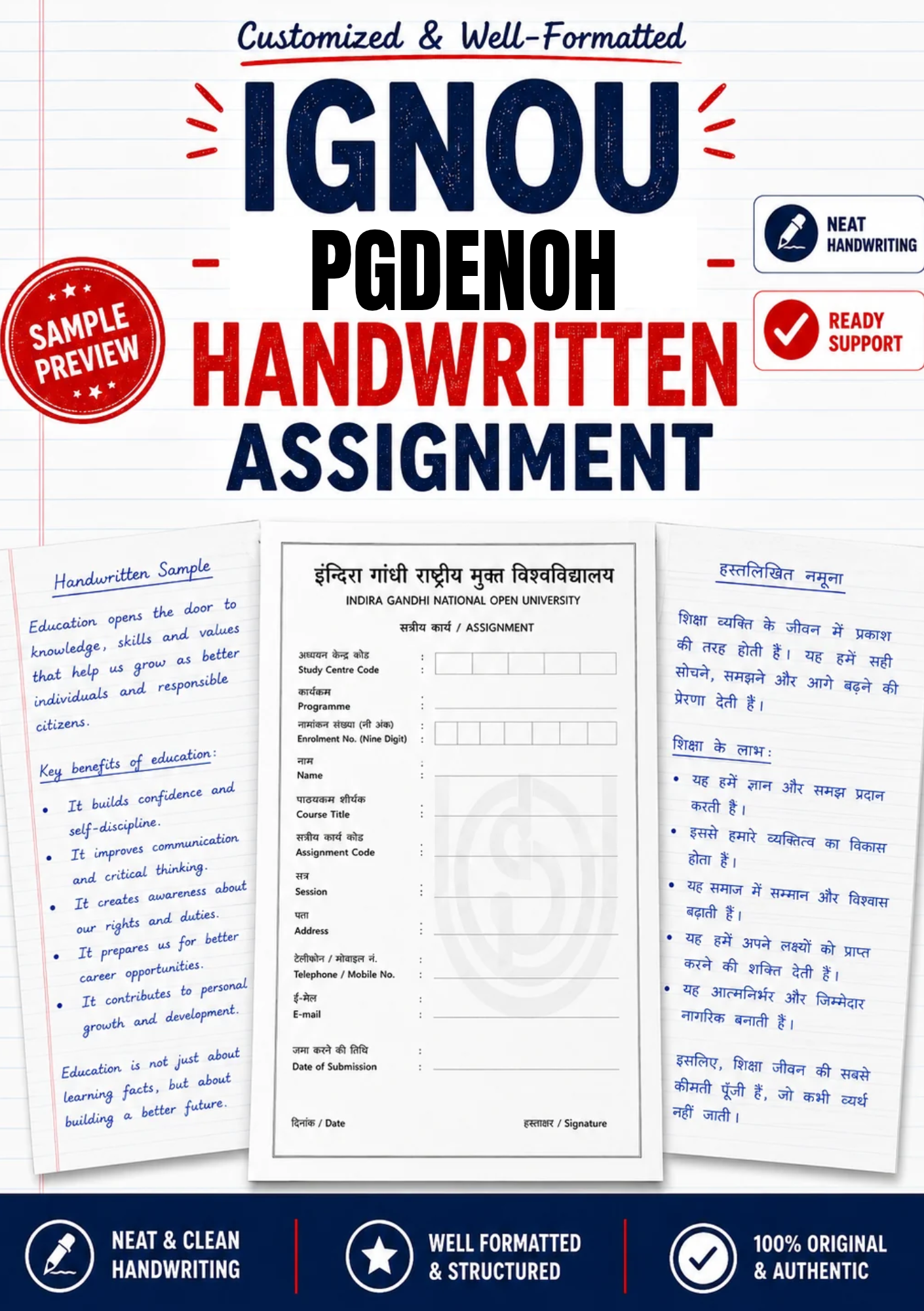
Inside every bundle there are four things. The first is the answer set itself, written by hand on loose A4 sheets, because the instruction page attached to the 2026-27 MEV and MEVE papers says to use only A4 paper and to tag the pages. The second is a front page laid out the way the PGDENOH instruction sheet asks, with your enrolment number, name, address and date in the top right corner and the course title, assignment number and study centre in the middle, left for you to sign. The third is a printed copy of the question paper for that code, so the evaluator can see which questions the answers belong to. The fourth is the courier packaging, which is already paid for.
What is not inside is just as important. There is no PDF, no scan and no typed copy, and nothing is emailed after dispatch. No soft copy or PDF is sold. A PGDENOH learner who needs to upload a scan for the university’s online assignment system makes that scan from the finished sheets after reading and signing them.
Forty Credits, Ten Papers, ₹3,200: How the PGDENOH Rate Adds Up
The rate is ₹320 per subject, hard copy only, with courier included in that price and no separate shipping charge. On PGDENOH that arithmetic is unusually clean, because the Common Prospectus July 2026 gives every one of the ten courses the same four credits and gives none of them a project, a practical or a choice. Ten papers at ₹320 is ₹3,200 for the full diploma, and the figure does not change because MEVE-005 carries seven questions while MEV-005 carries eight.
There is no minimum order: one subject or fourteen, same rate. That matters on this diploma more than on most, because a learner who cleared six papers in the first attempt and still owes MEV-004, MEVE-002, MEVE-003 and MEVE-005 needs exactly four sets, priced at ₹1,280, and nothing else. The free front page and the question-paper copy come with each of those four, not with the order as a whole.
Three costs sit outside the ₹320. The first is IGNOU’s own fees, which this publisher neither collects nor quotes beyond reporting what the university has printed, and those printed figures disagree (see the conflict box below). The second is anything you choose to do with the set after it arrives, such as photocopying it for your own file. The third is the term-end examination, which carries most of the course result and which no written set touches. Delivery depends on your pin code and is confirmed for your order before you pay. No figure is promised on this page.
Solved MEV File or Handwritten PGDENOH Set: Which One the Study Centre Takes
PGDENOH learners searching for help with an MEV paper meet two products with names that sound almost the same, and the difference decides whether the thing you buy can go to the study centre at all. A solved assignment is a soft-copy reference file of model answers for a course code and session, read on a screen or printed for study. A handwritten assignment is the answers written out by hand on A4 sheets and submitted in hard copy at the study centre.
The 2026-27 PGDENOH instruction sheet settles which of the two can be handed in. On the papers read for this page it says, in a line printed under its submission rules, “You should write the answer in your own handwriting.” It also tells you to use only A4 paper and to send the completed assignment to the coordinator of the study centre allotted to you. A printout of a downloaded answer file is typed text, so it meets neither condition, whatever cover sheet is stapled to it.
| Question a PGDENOH learner asks | MEV reference file (soft copy) | PGDENOH set in ink (hard copy) |
|---|---|---|
| What physically reaches you | A file on a phone or laptop | Loose A4 sheets, front page and question paper, couriered |
| What you do with it | Read it, then write your own answers | Read it, check it, sign the declaration, submit it |
| Does it meet the own-handwriting line on the 2026-27 sheet | No, it is typed | It is written by hand in a hand matched to your sample |
| Who it suits | Learners with time to write all ten papers themselves | Learners who owe several papers and want them ready to sign |
| Price line | Listed separately per code on the reference shelf | ₹320 per paper, courier included, no minimum |
On a phone, swipe the table sideways to see every column.
The honest scope of a reference file is that it is something to write from, not something to submit. If that is what you need, the code-by-code files are kept on the PGDEOH reference-file shelf, where each MEV and MEVE code has its own listing, filed under the diploma’s older code. This page sells only the written set.
Owe some of the ten, not all of them? Price only the codes still open.
The rate is ₹320 per subject, hard copy only, with courier included in that price and no separate shipping charge.
Send the PGDENOH codes you still owe for a quote on WhatsApp
MEV 001 to MEVE 005: The Ten PGDENOH Papers, All of Them Compulsory
Section 8.36 of the Common Prospectus July 2026 sets out the diploma under the School of Interdisciplinary and Transdisciplinary Studies, for graduates in any discipline, in English, with ten courses of four credits each. The table below copies the codes, titles and types exactly as that section prints them. Ten fours make forty, and the section foots its own table at Total Credits 40, so the arithmetic checks.
| Code (prospectus form) | Course title in section 8.36 | Type printed | Credits |
|---|---|---|---|
| MEV 001 | Introduction to Environmental Health | Compulsory | 4 |
| MEV 002 | Environmental and Occupational Hazards | Compulsory | 4 |
| MEV 003 | Environmental Law and Management | Compulsory | 4 |
| MEV 004 | Environmental Toxicology | Compulsory | 4 |
| MEV 005 | Occupational Health and Safety | Compulsory | 4 |
| MEVE 001 | Environmental Impact Assessment for Environmental Health | Compulsory | 4 |
| MEVE 002 | Health Care | Compulsory | 4 |
| MEVE 003 | Agriculture and Allied Sector | Compulsory | 4 |
| MEVE 004 | Industrial Sector | Compulsory | 4 |
| MEVE 005 | Disability Studies and Occupational Health | Compulsory | 4 |
Swipe sideways on a narrow screen. Total: 10 courses x 4 credits = 40 credits.
The detail that confuses PGDENOH learners most is the letter E. Across IGNOU’s environment programmes, an MEVE prefix normally marks an elective, and in MSc Environmental Science or MA Environmental Studies an MEVE paper is indeed one you choose. On this diploma it is not. The prospectus types all five MEVE courses as Compulsory, and so do both of IGNOU’s launch notifications for the diploma, dated 8 November 2024. There is no list to pick from, no project and no practical, so a learner who completes PGDENOH writes ten assignments, one per code, and that is the whole written side of the programme.
The same section states that the diploma runs in two modes, open and distance learning and online, and IGNOU lists the online version separately as PGDENOHOL in its online-programme list. The courses are identical in both notifications. What differs is how the assignment is handed in, which is covered under medium and mode further down.
The ten codes are also the first year of the two-year MA in Environmental and Occupational Health, and a learner who finishes the diploma may be continuing into that degree. The store’s MAENOH written set, which covers the second-year MGSE, MIS, MPA, MED and MGY papers as well, is the right listing for anyone who has already moved into year two.
Where the Ten PGDENOH Codes Turn Up in Other IGNOU Programmes
None of the ten codes belongs to PGDENOH alone. Reading the July 2026 prospectus programme by programme shows each of them borrowed somewhere else, sometimes under a different spelling. That matters for two reasons: a reference book shelved under another programme may be the same course, and a question paper downloaded under another programme’s name may still be the paper you need, or may not.
| PGDENOH code | Also carried by | How that table prints it |
|---|---|---|
| MEV 001 | MAENOH year one; PGDINDS semester II; MSCIDS semester II | PGDINDS prints the title as “Indroduction to Environmental Health” |
| MEV 002 | MAENOH; PGDINDS; MSCIDS; MAEVS second-year option list | Same title in every table |
| MEV 003 | MAENOH; PGDEML; MSCRWEE semester II | MSCRWEE prints “MEV-003 Environment law and Management” |
| MEV 004 | MAENOH year one only | Same title |
| MEV 005 | MAENOH; PGDINDS; MSCIDS | Same title |
| MEVE 001 | MAENOH; PGDEML; MSCRWEE elective list | MSCRWEE lists it as “(MEVE001)” from SOITS |
| MEVE 002 | MAENOH year one only | Same title |
| MEVE 003 | MAENOH; PGDEML | PGDEML prints “Agricultural and Allied Sector” |
| MEVE 004 | MAENOH; PGDEML | Same title |
| MEVE 005 | MAENOH year one only | MAENOH table prints no credit figure against it |
Scroll the table sideways if the third column is cut off.
Three of the ten, MEV 001, MEV 002 and MEV 005, sit inside the School of Engineering and Technology’s industrial safety programmes, which is why a learner moving between the two fields often owes the same paper twice over in name but once in substance. The store’s MSc Industrial Safety written set, which carries those three MEV papers alongside the MIS codes, is the listing for that route. For PGDENOH itself, the paper to answer is always the one whose cover names PGDENOH, which on the 2026-27 files means the SOITS paper headed PGDENOH/MAENOH.
Twenty-Six Places the PGDENOH Record Disagrees With Itself
Everything in the box below was found on 6 November 2026 by reading IGNOU’s own PGDENOH documents against each other: section 8.36 and the MAENOH section of the Common Prospectus July 2026, the two launch notifications of 8 November 2024, and the ten 2026-27 SOITS files for MEV-001 to MEVE-005. It also records what third-party sites and this store itself say where that differs. None of it is resolved silently on this page. Where two IGNOU documents disagree, your Regional Centre decides.
Twenty-six disagreements found in the PGDENOH paperwork, four of them on this store. Check the ones that touch your own codes before writing anything down.
1. Five papers carry an elective prefix and none is optional. MEVE-001 to MEVE-005 are typed Compulsory in prospectus section 8.36 and in both launch notifications. There is nothing to choose.
2. Two programme fees for one diploma. The prospectus annexure (row 161) prints Rs. 7,700 for PGDENOH. Launch notifications No. 158 (ODL) and No. 159 (online), both dated 8 November 2024, print ₹6,600.
3. Three credit figures for the same diploma exit. The MAENOH section of the prospectus says the diploma exit follows 36 credits and, one sentence later, 40 credits, then describes an existing diploma of 32 credits. The PGDENOH section and both notifications say 40.
4. A diploma section that calls itself a master’s. The objectives in section 8.36 open with “After completion of this Masters”.
5. Two modes in the prospectus, one name on the papers. Section 8.36 says the diploma runs online and in distance mode, but the 2026-27 covers name only PGDENOH and MAENOH. PGDENOHOL appears on none of them.
6. The retired code is still printed on a current paper. The 2026-27 MEVE-005 file reads “Programme: PGDEOH” while its own cover reads PGDENOH.
7. One assignment code carries an extra month. MEVE-005 prints MEVE-005/TMA-01/January 2026-2027. The other files that print a code use the shape MEV-002/TMA-01/2026-2027.
8. MEV-001 prints no assignment code at all. Its “ASSIGNMENT NO” line is left blank on the 2026-27 file.
9. The MEV-001 file shows no questions in its text. The machine-readable text of the 2026-27 MEV-001 file read for this page carries the instructions and no question list. If your downloaded copy shows questions, they were not in the text layer read here.
10. Validity years from three earlier cycles. Files labelled 2026-2027 say their questions are valid for the January and July 2019 sessions (MEV-001, MEV-003, MEVE-001), the January and July 2021 sessions (MEV-002, MEV-004, MEVE-003, MEVE-004) or the January and July 2025 sessions (MEVE-005). MEV-005 and MEVE-002 print no validity line.
11. Two papers carry another course’s heading. The MEV-004 Environmental Toxicology file is headed “MEV-002: ENVIRONMENTAL TOXICOLOGY”, and the MEVE-005 Disability Studies file is headed “MEV-002: ENVIRONMENTAL AND OCCUPATIONAL HAZARDS”.
12. No last date on any of the ten. None of the 2026-27 PGDENOH files prints a submission date; the date field on the response template is blank.
13. A word limit that no question sets. The guidelines tell you not to exceed the number of words indicated in the question, and no question on the files read indicates one.
14. Seven questions on most papers, eight on two. MEV-005 and MEVE-002 set eight; the others with readable questions set seven. Every one says attempt any five at 20 marks each, and some questions are split into parts (a) and (b).
15. A misspelt cover. The MEVE-001 cover reads “Environnemental Impact Assessment for Environmental Health”.
16. One course, two titles in one prospectus. MEVE 003 is “Agriculture and Allied Sector” in the PGDENOH table and “Agricultural and Allied Sector” in the PGDEML table.
17. A misspelt title in another school’s table. The PGDINDS table prints MEV 001 as “Indroduction to Environmental Health”.
18. A missing credit figure. The MAENOH year-one table prints MEVE 005 with no credits, so that table cannot be summed without the PGDENOH table beside it.
19. Borrowed codes, unnamed borrowers. PGDEML, PGDINDS, MSCIDS, MSCRWEE and MAEVS all carry some of these codes, and no 2026-27 PGDENOH cover names any of them.
20. An older structure under the older code. A third-party copy of the 2019-20 PGDEOH MEV-001 paper describes five courses, a project paper and two electives chosen from four. The current diploma has ten compulsory courses and no project.
21. Third-party: programmes added that the covers do not name. An aggregator’s 2026 table lists PGDENOHOL against all ten codes and PGDEML against four, says the papers are valid for January 2026 and July 2026 where the files say 2026-2027, and places 30 September 2026 under a June examination column and 31 March 2027 under a December one.
22. Third-party: two December 2026 cut-offs. One set of reports gives 31 October 2026 for hard and soft copies under an IGNOU notice dated 1 October 2026; reports dated 28 October 2026 describe an online upload window to 20 November 2026. This page has not read the second notice at source.
23. In-house: the store sells under the old code. Every PGDENOH shelf on shrichakradhar.com is named PGDEOH or PGDEOHOL, and the master’s shelves MAEOH, where IGNOU now prints PGDENOH, PGDENOHOL and MAENOH.
24. In-house: four occupational-health book shelves. The store has a PGDEOH books shelf, a PGDEOHOL books shelf, and two near-identical shelves named “IGNOU Environmental & Occupational Health Books” and “IGNOU Environmental and Occupational Health Books”. Merging the last two is in the correction queue.
25. In-house: guarantee text on two PGDEOH shelves. The PGDEOH books shelf and the PGDEOH reference-file shelf both describe a guide book as the “greatest” and promise that a minimum share of examination questions will come from the books. Neither claim belongs on this store, and both are flagged for removal.
26. In-house: the hub page and the MAENOH page are out of step. The handwritten hub still prints working-day delivery windows and says booklets give fixed last dates, which the PGDENOH papers do not. The MAENOH product decodes MEV-001/TMA-01/2025, a code the 2026-27 MEV-001 file no longer prints. Both are queued for correction.
No Cut-Off on Any 2026-27 PGDENOH Paper: Where the Date Comes From Instead
Many IGNOU schools print a pair of dates on the assignment itself, one for each intake. The School of Management Studies prints 31 October and 30 April, for instance, and several other schools print their own pairs. SOITS does not do this for PGDENOH. Not one of the ten 2026-27 files read for this page carries a submission date, and the date box on the response template is left for you to fill in. A date you see attached to a PGDENOH code on a listing site has therefore come from somewhere other than the paper.
Where it comes from is the university’s Student Evaluation Division, which announces a cut-off for each term-end examination and frequently extends it. For the December 2026 examination, reports of an IGNOU notice dated 1 October 2026 put the last date for hard and soft copies at 31 October 2026, and reports dated 28 October 2026 describe an online upload window through the university’s assignment management system running to 20 November 2026 for eligible distance and online learners. The December 2026 examination itself is reported to begin on 25 November 2026. On the date this page was written, 6 November 2026, the hard-copy date in the first set of reports had passed. If you were admitted in January 2026 and have not yet submitted, check your study centre and the IGNOU notice board before ordering, because what you need may be a scan uploaded online rather than a parcel.
If you were admitted in July 2026 you are writing for the June 2027 examination. IGNOU’s usual opening cut-off for a June examination is 31 March, and an aggregator lists 31 March 2027 against all ten PGDENOH codes, but that date is not printed on any PGDENOH paper and has not yet been notified by the university. Treat it as the date to plan around and the notice as the date to obey. Extensions are common, and their absence in a given year is not something anyone can know in advance.
The 2026-27 papers expire and are replaced each cycle. A set written against them is written for the cycle they serve, and the publisher will ask which cycle you are submitting for before writing anything.
MEVE-005/TMA-01/January 2026-2027 and a Blank Line on MEV-001: Copying the PGDENOH Code
The front page asks for an assignment number, and the study centre uses it to match your sheets to the right course and cycle. On most of the 2026-27 PGDENOH files that number is printed in one consistent shape: the course code, then TMA-01, then the two-year span, as in MEV-002/TMA-01/2026-2027 or MEVE-004/TMA-01/2026-2027. TMA-01 simply means the first and only tutor-marked assignment for that course, and the span 2026-2027 is the cycle the file belongs to. The course code line on the same file adds the span as well, printed as MEV-002/2026-2027.
Two papers break the pattern. MEVE-005 prints MEVE-005/TMA-01/January 2026-2027, with a month that none of the others carries, and it is the same file that still reads “Programme: PGDEOH”. MEV-001 prints no assignment number at all; its line is blank. The set copies each code exactly as your own downloaded paper prints it, including the odd month on MEVE-005, because the person checking it at the counter compares the front page with the paper attached behind it. For MEV-001, the front page follows the same pattern as the other nine, MEV-001/TMA-01/2026-2027, and you should confirm that wording with your study centre before you sign, since IGNOU has not printed it.
For the online diploma, the code on the paper is the same and the course is the same. What changes is the route by which the finished assignment reaches IGNOU, which is set by the online learner portal rather than by the paper.
One Photographed Page Fixes the Hand on All Ten PGDENOH Papers
Send a photo of a page you have written yourself and the handwritten set is matched to your handwriting at no extra charge. On a ten-paper diploma that single photo matters more than it does on a shorter programme, because ten bundles in one hand are compared, at some point, with a term-end answer script in yours. The writer works from the slant, the letter shapes, the spacing between words and the way you number answers, and keeps those the same across every paper in the order.
Nothing is paid before you see it. A short sample in the matched hand comes back on WhatsApp first, and the order goes ahead only after you are satisfied that it reads like your own page.
The page worth photographing for an environmental health order
Choose a page with ordinary running sentences rather than a list, ideally one with a heading and a numbered point, since every PGDENOH answer is numbered by question. If your own notes include chemical names, units or abbreviations such as ppm or PPE, a page showing how you write those helps, because MEV-004 and MEVE-004 call for them. Photograph it flat, in daylight, with the whole page in frame and no shadow across the lines.
English Medium, ODL or Online Mode, and PGDEOH Papers From Before 2025
The service covers all mediums IGNOU issues the TMA paper in, at the same price. For PGDENOH that means English, because section 8.36 gives English as the only medium of instruction and both launch notifications say the same. The ten 2026-27 files read for this page are English papers, and the searches run for it turned up no Hindi edition, so a set is written in English.
Any session is accepted, current cycle or older, including backlog courses, at the same ₹320 per subject. That includes papers from before the diploma was relaunched under its current code in January 2025. A learner enrolled under the older PGDEOH code who still owes, say, MEV-003 from an earlier cycle can order that one paper. The set is written against whichever year’s paper your study centre tells you to answer, so send that paper, or its year, with the order.
Mode needs one check before you order. The distance-mode diploma and the online diploma use the same ten codes, but an online learner may be told to upload a scan through the learner portal rather than hand a hard copy to a study centre. Shri Chakradhar Publication sells only the hard copy, so if your route is online, confirm first whether a handwritten original is wanted at all, and make the scan from the signed sheets if it is.
What a PGDENOH Quote Needs From You, in Five Lines
A PGDENOH quote needs very little, because there are only ten possible codes and none of them is optional. Five lines are enough:
- The MEV and MEVE codes you still owe. Read them off your admission or re-registration record, not off a listing site.
- The cycle you are submitting for. January 2026 intake, July 2026 intake, or an older year for a backlog paper.
- Your mode. Distance (PGDENOH) or online (PGDENOHOL), so the hard-copy question is settled before writing starts.
- A photo of a page in your own hand. As described above.
- Where the parcel should go, pin code included. So the delivery estimate can be given before you pay.
Name, enrolment number and study centre code go on the front page, and you can send those with the order or write them in yourself afterwards. Nothing else is needed, and sending more tends to slow the reply.
One photo and a code list start the writing.
There is no minimum order: one subject or fourteen, same rate. Any session is accepted, current cycle or older, including backlog courses, at the same ₹320 per subject.
After the PGDENOH Parcel Arrives: Reading, Signing and Handing In
The parcel is the start of your part of the work, not the end of it. Open each bundle and read every answer against its question. You sign the declaration on the assignment cover page, so you should read and review the content before submitting it, and satisfy yourself that it represents your own understanding of the course. On PGDENOH this reading doubles as revision, since the term-end examination draws on the same blocks.
Then check three details against your own downloaded paper: that the course title matches, which matters most on MEV-004 and MEVE-005 because their files carry another course’s heading; that the assignment number on the front page matches the paper, including the extra month on MEVE-005; and that your name, enrolment number and study centre are correct. Fill in anything left blank, sign, and keep a photocopy.
Hand each course to the coordinator of the study centre allotted to you, as the PGDENOH instruction sheet asks, and get a receipt that lists the codes. Do not combine two courses in one file. If your study centre has moved to online collection, scan each signed course as its own file. Once evaluated, the marks appear on IGNOU’s assignment status service under your enrolment number, and the time that takes is the university’s, not the publisher’s. Assignments carry 30 per cent of the final course result and the term-end examination carries the remaining 70 per cent.
No claim is made about the marks any assignment will receive, about how an evaluator will assess it, or about whether it will be accepted. Assignment evaluation is entirely a matter for IGNOU.
Other PGDEOH Shelves on This Store, and the MAENOH Second Year
Every PGDENOH shelf on this store still carries the diploma’s older code, PGDEOH, which is worth knowing when you search. For the term-end examination, the PGDEOH help books arranged by MEV and MEVE course cover the distance-mode diploma, and the online diploma has its own PGDEOHOL book listings for online-mode learners, carrying the same ten titles.
Revision before the examination usually means past questions. The store keeps guess papers built around the recurring PGDEOH examination questions, and separately a set of earlier PGDEOH term-end papers with worked answers.
A learner continuing into the second year of the MA will want the MAEOH study guides for the master’s courses. For a code or a cycle not covered by any programme listing, the customised written order that takes any course code and any session is the fallback, and the store’s full list of programme-wise handwritten sets shows every other diploma and degree written this way.
If you would rather write the ten papers yourself, the sister site’s walkthrough of the MEV and MEVE papers on ignouproject.com covers the same first-year codes from the writing side, without anything to buy.
Fifteen PGDENOH Questions Answered Before You Pay
PGDENOH ke kitne assignment likhne padte hain, aur kya koi optional hai?
Ten, one for each code from MEV-001 to MEV-005 and MEVE-001 to MEVE-005. Section 8.36 of the Common Prospectus July 2026 types all ten as Compulsory, including the five with the MEVE prefix, and the diploma has no project or practical. At ₹320 per paper the full set is ₹3,200.
The MEVE papers look like electives. Can I skip some of them?
No. On MSc Environmental Science and MA Environmental Studies an MEVE paper is chosen from a list, but on PGDENOH all five are compulsory in the prospectus and in both launch notifications of 8 November 2024. You need all five to complete the forty credits.
Solved file aur haath se likha PGDENOH set, in dono mein asli farq kya hai?
A solved assignment is a soft-copy reference file of model answers that you read and then write from. A handwritten assignment is the answers written out on A4 sheets in hard copy for submission. The 2026-27 PGDENOH instruction sheet asks for the answers in your own handwriting, so only the second can be handed in.
Can I print a downloaded MEV-003 answer file and submit it at the study centre?
A printout is typed text, and the PGDENOH instruction sheet asks for answers in your own handwriting on A4 paper. A printed file meets neither condition. Use a reference file to write from, not as the submission.
Is it worth buying both a reference file and the written set for the same MEV code?
Only if you want to compare answers while revising for the term-end examination. The written set already contains full answers to the questions on your paper, so for submission alone one product is enough. Buying both doubles the cost for the same course.
What is the last date for the PGDENOH assignment if I joined in July 2026?
No date is printed on any 2026-27 PGDENOH paper. A July 2026 learner writes for the June 2027 examination, for which IGNOU’s usual cut-off is 31 March, and an aggregator lists 31 March 2027, but the university has not yet notified it. Check the IGNOU notice for the June 2027 examination before you plan around it.
Mera January 2026 session hai. December 2026 ke liye ab bhi jama ho sakta hai?
Reports of IGNOU’s notice of 1 October 2026 gave 31 October 2026 for hard and soft copies, and later reports describe an online upload window to 20 November 2026. This page has not read that later notice itself. Ask your study centre which route is still open before ordering a hard copy.
What do I write as the assignment code for MEV-001, when the paper leaves it blank?
The 2026-27 MEV-001 file prints no assignment number. The front page follows the shape the other nine files use, MEV-001/TMA-01/2026-2027, and you should confirm that wording with your study centre before you sign, because IGNOU has not printed it.
My MEVE-005 paper says Programme: PGDEOH. Have I downloaded the wrong file?
Probably not. The 2026-27 MEVE-005 file reads PGDENOH/MAENOH on its cover and PGDEOH, the diploma’s older code, a few lines below, and it is headed with the MEV-002 course name. The questions inside are on disability studies and occupational health, which is the MEVE-005 course. The set copies the codes exactly as your paper prints them.
I am in the online diploma, PGDENOHOL. Do I need a hard copy?
The ten codes are the same, but the 2026-27 papers name only PGDENOH and MAENOH, and online learners may be asked to upload through the learner portal. Confirm the route there first. If a handwritten original is wanted, the set is the same ₹320 per paper.
Is a Hindi PGDENOH handwritten set available?
The prospectus and both launch notifications give English as the only medium for PGDENOH, and no Hindi edition of the ten papers was found for this page. The set is written in English. The service covers all mediums IGNOU issues the TMA paper in, at the same price.
Purane PGDEOH code wala backlog paper bhi likhwa sakte hain?
Yes. Any session is accepted, current cycle or older, including backlog courses, at the same ₹320 per subject. Send the paper your study centre has told you to answer, or its year, so the set is written against the right questions.
How many questions does each PGDENOH set answer?
Five per paper, because every 2026-27 file with readable questions says attempt any five at 20 marks each. Most papers set seven questions and MEV-005 and MEVE-002 set eight. Where a question is split into parts (a) and (b), both parts are answered.
Do I pay before seeing the handwriting for my PGDENOH order?
No. A short sample in the hand matched to your photo comes back on WhatsApp first, and payment follows only once you are satisfied with it. Delivery depends on your pin code and is confirmed for your order before you pay. No figure is promised on this page.
Can the publisher say what marks the PGDENOH set will get?
No. No claim is made about the marks any assignment will receive, about how an evaluator will assess it, or about whether it will be accepted. Assignment evaluation is entirely a matter for IGNOU.
Prospectus, Launch Notices, Ten Papers and Store Terms Behind This PGDENOH Page
Four kinds of source sit behind this page, and they carry different weight, so they are kept apart rather than blended.
Read from the Common Prospectus July 2026. Section 8.36 supplied the programme name, school, eligibility, English medium, the two modes, the ten codes with their titles, types and credits, and the forty-credit total, which was summed and checked. The MAENOH section supplied the 36, 40 and 32 credit statements and the year-one table without a credit figure for MEVE 005. The annexure, row 161, supplied the Rs. 7,700 fee and the one-year minimum and three-year maximum. The PGDINDS, MSCIDS, PGDEML, MSCRWEE and MAEVS tables supplied the shared-code detail.
Read from IGNOU’s two launch notifications. Launch notification No. 158 for the distance-mode diploma and its companion No. 159 for the online diploma, both issued by the Planning and Development Division on 8 November 2024, supplied the ₹6,600 fee, annual examination mode, the course list and its compulsory typing.
Read from the ten 2026-27 SOITS papers. The files for MEV-001 to MEV-005 and MEVE-001 to MEVE-005 were opened on 6 November 2026 from IGNOU’s assignment download service; the MEVE-005 file for 2026-27 is the one with the PGDEOH line and the extra month in its code. They supplied the cover wording, the assignment codes, the validity lines, the absence of dates, the A4 and own-handwriting instructions, the study-centre route and the question patterns. December 2026 cut-off dates come from news reports of IGNOU notices, not from the papers, and are labelled that way above.
Set by Shri Chakradhar Publication, not by IGNOU. The ₹320 rate, courier, front page, question-paper copy, handwriting match, the sample before payment, the absence of a minimum order and the refusal to promise a delivery figure or a mark are the publisher’s own terms.
Important Notice
Shri Chakradhar Publication Pvt. Ltd. and shrichakradhar.com form an independent IGNOU study-support publisher. This is not the official website of Indira Gandhi National Open University, is not affiliated with, endorsed by or authorised by the university, and no page on this site should be treated as an official IGNOU communication.
Programme structures, course codes, submission dates and rules change, and only ignou.ac.in and your Regional Centre can confirm the current position for your enrolment.
You sign the declaration on the assignment cover page, so you should read and review the content before submitting it, and satisfy yourself that it represents your own understanding of the course.
No claim is made about the marks any assignment will receive, about how an evaluator will assess it, or about whether it will be accepted. Assignment evaluation is entirely a matter for IGNOU.
Name the PGDENOH Papers You Still Owe and the Quote Follows
The rate is ₹320 per subject, hard copy only, with courier included in that price and no separate shipping charge. No soft copy or PDF is sold.
Send the MEV and MEVE codes on your record, your cycle and mode, a photographed page and your pin code, and the price for ten papers or one comes back in the same reply.
Order PGDENOH papers on WhatsApp at +91 93546 37830
Unsure which 2026-27 papers apply to you, or whether your mode needs a hard copy at all? Ask for a PGDENOH code check before ordering