

Description
In short. Shri Chakradhar Publication prepares handwritten Tutor Marked Assignment sets for the IGNOU Post Graduate Diploma in Criminal Justice at ₹320 per subject, hard copy only, courier included, written against the six School of Law papers a PGDCJ learner actually downloads: MLE-011 Criminal Justice System, MLE-012 Indian Penal Code, MLE-013 Criminal Justice Processes, MLE-014 Criminal Justice Administration, MLE-015 Challenges to Criminal Justice System and MLE-016 Criminal Justice Research and Advocacy, each worth 100 marks and split into a Part-A of four short notes at 10 marks and a Part-B of four longer answers at 15 marks; all six 2026 papers print 30 September 2026 as the cut-off for a January 2026 learner and 31 March 2027 for a July 2026 learner, they carry an assignment code that names both intakes at once and contains no TMA string, and the Common Prospectus July 2026 describes the same diploma under a different code set entirely, MLE 111 to MLE 116 with a 40-credit total, which no booklet on ignou.ac.in uses, so a complete six-paper order is ₹1,920 and the eight-credit MLEP project is assessed separately and is not an assignment.
What Lands on Your Desk When an MLE Order Is Delivered
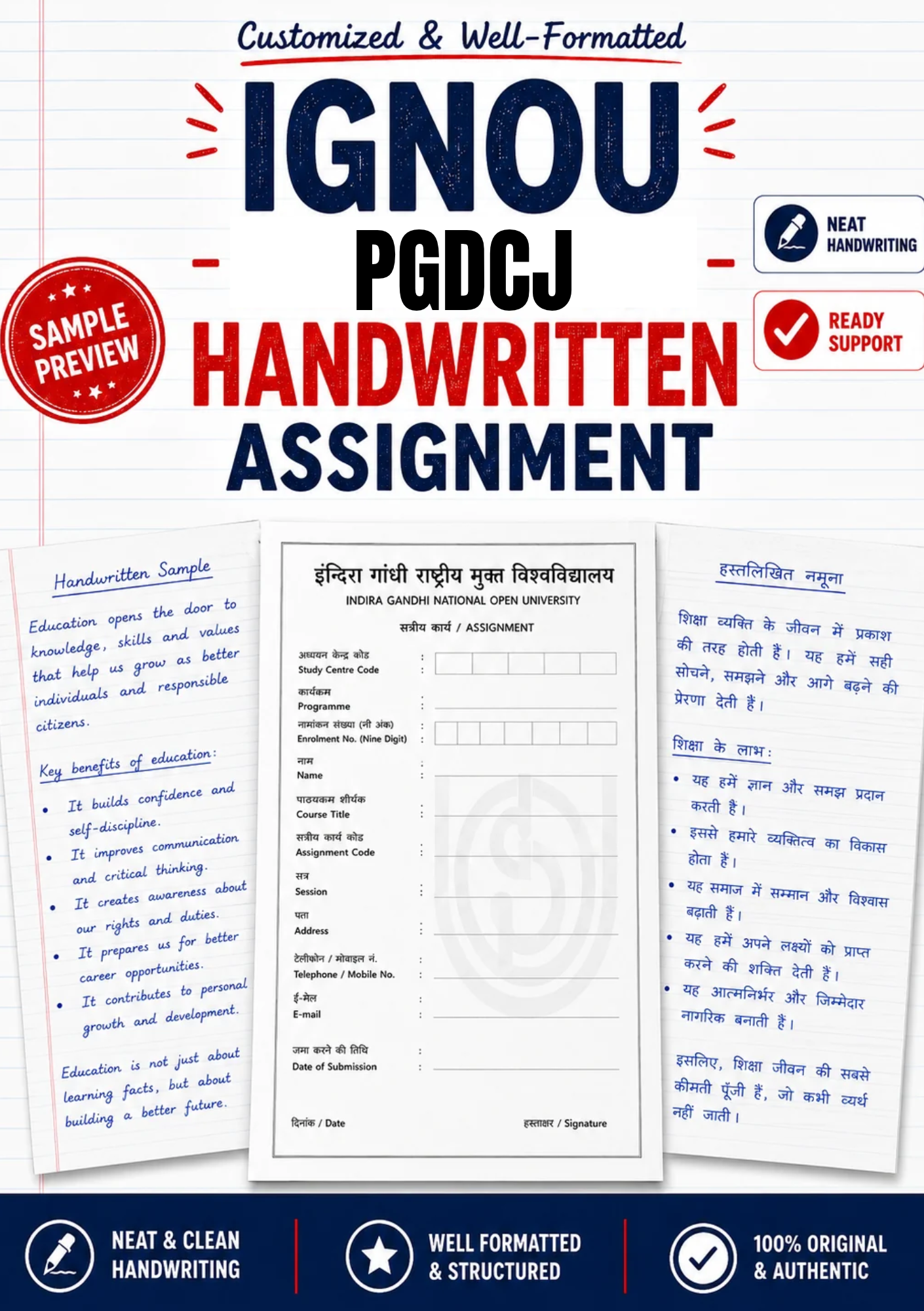
A PGDCJ order is physical paperwork. For each MLE code you name, the packet holds one answer book written out by hand on loose sheets, carrying the Part-A short notes and the Part-B answers in the serial order IGNOU printed them, because the booklet instructs learners to retain that order rather than rearranging the questions. On top of each answer book sits an IGNOU-format front page filled in for that course, free with every order, and behind it a printed copy of the official question paper for the same code, so the evaluator can read the question alongside the answer without the learner hunting for a download.
The rate is ₹320 per subject, hard copy only, with courier included in that price and no separate shipping charge. No soft copy or PDF is sold. That is a deliberate boundary rather than an omission: the School of Law booklet is explicit that handwriting is mandatory for anything handed in at a study centre or regional centre, and a file cannot satisfy that instruction.
What the packet does not contain is the project. The eight-credit MLEP component is assessed through a separate submission with its own synopsis and report, it carries no Tutor Marked Assignment paper, and nothing in a handwritten order substitutes for it. Six codes carry assignments. The seventh component does not.
Where Each Rupee of the ₹320 Goes on an MLE Paper
Six things sit inside the ₹320 for one PGDCJ subject: the writing itself, the loose sheets it is written on, the IGNOU-format cover sheet for that course, the printed question paper, the handwriting match taken from your own sample, and the courier that brings it to your address. There is no minimum order: one subject or fourteen, same rate. A learner who owes only MLE-015 after clearing the other five pays ₹320, not a package price.
Two things sit outside it. The first is anything the university charges you directly, which includes the examination fee per course and the project fee if your admission year attracts one; those are paid to IGNOU and have nothing to do with this order. The second is the act of submission. The set is written for you and delivered to you, and you are the person who signs it in at the counter or sends it on. You sign the declaration on the assignment cover page, so you should read and review the content before submitting it, and satisfy yourself that it represents your own understanding of the course.
Delivery depends on your pin code and is confirmed for your order before you pay. No figure is promised on this page. A criminal justice learner in a district town and one in central Delhi are not quoted the same transit time, and inventing a single number for both would be a promise this publisher could not keep on either.
Reference Reading or Submission Paperwork: Sorting the Two for MLE Codes
PGDCJ learners search for both things with almost the same words, and the two are not interchangeable. A solved assignment is a soft-copy reference file of model answers for a course code and session, read on a phone or a laptop and used to understand how an answer for that question might be built. A handwritten assignment is the answers written out by hand on A4 and submitted in hard copy at the study centre. The first is study material. The second is the document that goes across the counter with your signature on it.
The School of Law instruction sheet settles which one IGNOU will take. It states that It is mandatory to write all assignments neatly in your own handwriting
where the submission is going to a study centre or a regional centre, and it adds that typed answers will not be accepted there at all. PGDCJ then does something unusual, and a learner deciding between the two should know it: the same instruction sheet offers a typed route, telling learners who type their answers to send them to the Programme Coordinator by email or by post instead, and stating that a learner who emails them in that way does not then need to submit a hard copy to the regional centre or the School of Law. That concession is printed on PGDCJ papers and is not printed on most IGNOU booklets. It does not make a downloaded model-answer PDF submittable, because a reference file is somebody else’s answer rather than your typed work, but it does mean a PGDCJ learner has a choice other IGNOU learners do not, and it is worth reading your own download before deciding.
| Point you are weighing up | A model-answer PDF | An MLE set written in ink |
|---|---|---|
| What reaches you | A file to open on a screen | Loose sheets, a cover page and the question paper, by courier |
| What you then do | Read it, then write your own answers from it | Check it, sign the declaration and hand it in |
| Who it suits | A learner with time to write but short of material | A learner short of writing time, or with papers carried over |
| Accepted at the counter as it stands | No, it is reference reading | Yes, it is handwritten paperwork |
| Price on this store | Priced per code on the solved shelf | ₹320 per subject, courier included |
Scroll the table sideways on a narrow screen to see all three columns.
If what you actually want is the reading material rather than the paperwork, the store keeps model answers for each MLE code on a shelf of its own, and that is the right place for it. This page sells the written set, not the reference file, and the two are priced and delivered differently.
Name the MLE codes and the arithmetic is already done.
₹320 per subject, courier included. One MLE paper is ₹320, three are ₹960, and all six carrying a Tutor Marked Assignment come to ₹1,920. Any session is accepted, current cycle or older, including backlog courses, at the same ₹320 per subject.
Send your MLE numbers on WhatsApp and the quote returns with the session and the pin code confirmed.
The Six MLE Papers Your Study Centre Expects, Numbered 011 to 016
These are the codes on the papers IGNOU is publishing for the January 2026 and July 2026 PGDCJ cycle, read off all six files on the School of Law assignment directory. Every one is a single assignment worth 100 marks, divided into a Part-A of five short-note questions from which four are attempted at 10 marks each, and a Part-B of five longer questions from which four are attempted at 15 marks each. A written set covers any of them, in any combination.
| Code as the 2026 booklet prints it | Course name on that paper | Marks on the paper | Assignment code string |
|---|---|---|---|
| MLE-011 | Criminal Justice System | 100 | MLE-011/January 2026 and July 2026 |
| MLE-012 | Indian Penal Code | 100 | MLE-012 /January 2026 and July 2026 |
| MLE-013 | Criminal Justice Processes | 100 | MLE-013/January 2026 and July 2026 |
| MLE-014 | Criminal Justice Administration | 100 | MLE-014/January 2026 and July 2026 |
| MLE-015 | Challenges to Criminal Justice System | 100 | MLE-015/January 2026 and July 2026 |
| MLE-016 | Criminal Justice Research and Advocacy | 100 | MLE-016 /January 2026 and July 2026 |
Four columns here; scroll sideways on a phone to reach the assignment code.
The spacing in the last column is reproduced as printed, because it is not consistent. MLE-012 and MLE-016 put a space before the slash and the other four do not, and the same wobble appears in older cycles, where one 2021 paper ran the year and the word together. None of it changes what you write; all of it matters if you are copying the string by hand onto a cover sheet and wondering whether you have made an error. You have not. The paper did.
Two further details are worth knowing before you download. The six 2026 files carry no session in their filenames, where the 2025 files did, so the filename alone will not tell you which cycle you have opened and the Tutor Marked Assignment line inside the paper is the only reliable check. And IGNOU publishes PGDCJ twice over: as these six separate per-course files, and as one combined programme booklet holding every course together on a different server. Download the current PGDCJ papers from the university before ordering, so the set is written against the exact sheet you will hand in.
MLE 111 to MLE 116: The Forty-Credit Table No Booklet Follows
Here the PGDCJ record divides cleanly in two, and a learner comparing their admission paperwork with a syllabus page online will hit it immediately. The Common Prospectus July 2026 sets out this diploma in section 8.35 under a completely different code series, with four of the six theory papers carrying six credits rather than four, and a stated total of 40 credits. IGNOU’s own live course listing for the same programme sets out the older series at four credits each, which sums to 32. The prospectus total is internally consistent, since 4 plus 6 plus 6 plus 6 plus 4 plus 6 plus 8 does come to the 40 it claims. It simply does not match what the university is publishing anywhere else.
| Code in Common Prospectus section 8.35 | Title the prospectus gives it | Credits in the prospectus | Credits on IGNOU’s programme listing |
|---|---|---|---|
| MLE 111 | Criminal Justice System | 4 | 4 (as MLE-011) |
| MLE 112 | Bhartiya Nyaya Sanhita | 6 | 4 (as MLE-012, Indian Penal Code) |
| MLE 113 | Criminal Justice Processes | 6 | 4 (as MLE-013) |
| MLE 114 | Criminal Justice Administration | 6 | 4 (as MLE-014) |
| MLE 115 | Challenges to Criminal Justice System | 4 | 4 (as MLE-015) |
| MLE 116 | Criminal Justice Research and Advocacy | 6 | 4 (as MLE-016) |
| MLEP 117 | Project | 8 | 8 (as MLEP-017) |
| Stated total | Forty credits | 40 | 32 by addition |
Scroll right on a small screen for the two credit columns side by side.
The sharpest line in that table is MLE 112. The prospectus titles it Bhartiya Nyaya Sanhita, the 2023 statute that replaced the Indian Penal Code, and the phrase Indian Penal Code does not appear anywhere in the Common Prospectus July 2026. The paper a PGDCJ learner downloads for that slot in 2026 is MLE-012, and it is still titled Indian Penal Code. That is not a numbering quirk. It is the difference between two bodies of criminal law, and it is the single strongest reason to write from your own download rather than from a syllabus page. A written set here follows the booklet, and the booklet for this cycle is the Indian Penal Code paper. If your study centre later issues a Bhartiya Nyaya Sanhita paper under a 1xx code, that is a different paper and the set is written to it instead, at the same rate.
The prospectus sourcing is disclosed rather than smoothed over, because a table that looks authoritative and is not would be worse than a disagreement stated plainly. Both figures above came from IGNOU, read on 4 November 2026, from two of its own publications. Only IGNOU’s own PGDCJ course listing and your Regional Centre can tell you which set your enrolment is assessed against.
Two Code Sets, Two Credit Totals and Twenty-One Further Disagreements
Everything below was found by reading IGNOU’s own PGDCJ documents against each other on 4 November 2026: the Common Prospectus July 2026, the university’s live programme listing, the six School of Law assignment papers for the January and July 2026 cycle, older PGDCJ booklets from 2021 to 2025, and the university’s digital repository. Three of the items are this store’s own errors, and they are listed with the rest rather than quietly fixed, because a learner who can see which claims are contested is better placed than one who cannot.
Twenty-three disagreements found in the PGDCJ record. Read your own download before you write anything.
1. Two code series are live at the same time. The prospectus prints MLE 111 to MLE 116 and MLEP 117. The programme listing and all six 2026 assignment papers print MLE-011 to MLE-016 and MLEP-017. No assignment paper anywhere on ignou.ac.in uses a 1xx code.
2. Two credit totals follow from that. The prospectus states 40 credits. The programme listing’s own figures add up to 32.
3. Four papers carry two different credit weights. The prospectus gives MLE 112, 113, 114 and 116 six credits each; the programme listing gives their 0xx equivalents four each.
4. The prospectus titles MLE 112 Bhartiya Nyaya Sanhita. The live paper for that slot is MLE-012, Indian Penal Code. The phrase Indian Penal Code occurs nowhere in the Common Prospectus July 2026.
5. The string MLE 016 does appear in the prospectus, exactly once, and not in the PGDCJ table. It sits in the Certificate in Criminal Justice Social Work under the School of Social Work, at four credits, carrying the same course title the PGDCJ table assigns to MLE 116 at six credits.
6. The project component has three identities. The prospectus calls it MLEP 117 Project. The programme listing calls it MLEP-017: Project. The university’s digital repository files it as MLEP-017 Clinical Course.
7. No PGDCJ assignment code contains a TMA string, although TMA appears in the heading immediately above it on the same page.
8. One assignment code names both intakes at once, so a January learner and a July learner copy an identical string onto papers submitted six months apart.
9. The code is typeset inconsistently across papers of the same session. MLE-012 and MLE-016 put a space before the slash; MLE-011, MLE-013, MLE-014 and MLE-015 do not.
10. The 2021 printing ran a year and a conjunction together in the MLE-012 code string, so the inconsistency is long-standing rather than new.
11. Handwriting is mandatory only conditionally. The instruction binds learners submitting to a study centre or regional centre, and the same sheet then offers a typed route by email or post to the Programme Coordinator.
12. The booklet goes further and tells a learner who emails the Programme Coordinator that no hard copy need be submitted to the regional centre or the School of Law at all. No other School of Law or vocational booklet in this publisher’s reading says that.
13. The same instruction sheet says assignments may be sent to the study centre or regional centre by email or speed post, and separately says the study centre will not accept typed answers. Both statements sit on one page.
14. The question architecture changed between cycles. The 2021 papers printed Section-I and Section-II with all fifteen questions compulsory at fifty marks each. The 2025 and 2026 papers print Part-A and Part-B with four questions attempted from five in each part.
15. A word-count instruction survives from the older structure. The 2026 sheet still tells learners their answers run to about 200 words and about 350 words, which mapped onto Section-I and Section-II and does not map onto the current 10-mark and 15-mark split.
16. MLE-011 prints a Part-B instruction reading Answers any four, where the other five papers print Answer any four.
17. The 2026 files carry no session in their filenames. The 2025 files did. A learner cannot tell the cycle from the filename and has to open the paper.
18. IGNOU publishes PGDCJ assignments on two different servers in two different shapes: six per-course files, and one combined programme booklet. The latest combined booklet available is the 2025 one.
19. No PGDCJ paper prints a paper size, a margin width, or the 30 and 70 per cent weightage line, although IGNOU’s general assignment rules state all three.
20. The 2025 cover sheet describes two intakes as one Session, in the singular.
21. Third-party and study-centre pages circulate a programme fee of ₹10,800 against the ₹11,000 printed in the prospectus annexure, and several of them repeat the 32-credit figure rather than the prospectus total of 40.
22. This store’s own error. The PGDCJ books shelf and the PGDCJ solved-assignment shelf both carry a claim that a minimum of 60 to 80 per cent of examination questions will come from those books. That is an unverifiable guarantee about an externally set paper and it is being removed.
23. This store’s own error, twice over. The project products on this site are titled MLEP 17, and the companion article on ignouproject.com uses the same form, where IGNOU prints MLEP 117 in the prospectus and MLEP-017 on the programme listing. Both are being corrected to carry IGNOU’s own spellings.
Programme structures, course codes, submission dates and rules change, and only ignou.ac.in and your Regional Centre can confirm the current position for your enrolment.
Your January Intake Closes in September and Your July Intake in March
All six PGDCJ papers for this cycle print the same pair of dates. A learner admitted in the January 2026 session submits by 30 September 2026. A learner admitted in the July 2026 session submits by 31 March 2027. The dates are printed on the instruction sheet of each paper, not inferred from a university calendar, and they were read off the files rather than carried across from another programme. One timing point follows from when this page was written, on 4 November 2026: the January 2026 date has already gone, so a January learner still holding those papers is writing towards a later examination sitting, while a July 2026 learner has until the end of March.
That pairing is worth pausing on, because it is close to the opposite of the one most widely repeated. The School of Management Studies prints 31 October and 30 April, and a great deal of general advice about IGNOU deadlines is written from management papers. A PGDCJ learner who takes 31 October as their January-intake date is working to a deadline a month past the one on their own paper. The School of Law, on these papers, runs September and March.
Two further points follow from the booklet’s own instructions. It warns that an assignment arriving after the last date, whether by email or by post, is held over to the next term-end examination rather than being marked for the current one, so the cut-off closes a sitting and not merely a submission window. And it advises posting around ten days before the last date, and checking for an acknowledgement a few days after emailing, which is practical advice a learner ordering a written set should build into their own timing. Assignments carry 30 per cent of the final course result and the term-end examination carries the remaining 70 per cent.
The Cover Line Names Both Intakes and Omits TMA Entirely
On most IGNOU papers the assignment code is a compact string with the letters TMA in the middle of it. PGDCJ does not work that way. The line on your paper reads as the course code, a slash, then January and the year, the word and, then July and the same year, for example MLE-013/January 2026 and July 2026. There is no TMA token, no month abbreviation, and no separate session identifier, even though the heading directly above it calls the paper a Tutor Marked Assignment.
Copy it as printed, including the spacing on your own paper, and copy it onto the front page for each course separately. The booklet asks for your name, enrolment number, programme code, course code, mobile number and email identifier on the first page of each assignment, which is more than the generic front-page template collects, and a set written without those fields filled in is a set you will have to complete by hand before handing it in. Every set this publisher sends out already carries them.
Because the one string covers both intakes, it cannot tell an evaluator which session you belong to. That is what the submission date and your enrolment number do. A learner writing a backlog paper from an older cycle should also keep the old paper rather than substituting the current one, since the questions change every year even where the code does not.
Your Sample Photo Comes First, and Nothing Is Paid Before It
Send a photo of a page you have written yourself and the handwritten set is matched to your handwriting at no extra charge. The sequence matters more than the feature. You send the sample, you see the match, and only then does payment come into it, which means the risk of a set arriving in a hand nothing like your own sits with the publisher rather than with you.
Which page of your own writing to send for a law paper
Photograph a full page of continuous prose in the pen you normally use, in daylight, flat, with the whole sheet in frame. A page of law notes is more useful than a page of calculations, because PGDCJ answers are discursive: a Part-B answer at 15 marks runs to paragraphs, and what has to be matched is how your letters behave across a long run of sentences rather than across a formula. Avoid a page of headings and bullet fragments for the same reason. If your writing has changed since your last submission, send the current version, since the evaluator will be comparing against what you write now.
One Medium on Record, Both Intakes Accepted, Old Cycles Included
The service covers all mediums IGNOU issues the TMA paper in, at the same price. For PGDCJ that resolves to a single medium. The prospectus records the medium of instruction for this diploma as English, the annexure row repeats it, and every School of Law paper read for this page is in English. There is no Hindi PGDCJ assignment paper to write against, so a learner asking for one is asking for something IGNOU does not issue, and the honest answer is that it does not exist rather than that it costs more.
Session coverage is wider than medium coverage. Any session is accepted, current cycle or older, including backlog courses, at the same ₹320 per subject. Because PGDCJ allows up to three years against a one-year minimum, carried-over papers are ordinary rather than exceptional here, and a learner in their third year may be writing one paper from the current cycle alongside two from 2024. Each is written against its own paper, at the same rate, in the same hand.
The Short List That Turns a Query Into a PGDCJ Quote
Five lines are enough to price the work, and anything beyond them slows the reply down rather than speeding it up.
- The MLE codes you want written, in the form your paper prints them.
- Your admission session, January or July, and the year.
- Your delivery address with the pin code, since that is what settles transit.
- One photographed page of your own handwriting.
- Whether the paper is from the current cycle or an earlier one you still owe.
What is not needed: your enrolment number before you order, your study centre code, scans of your identity card, or the question paper itself, which this publisher downloads from the university directly. Those are collected once the order is confirmed, where they belong on the front page.
From a photographed page to a signed set, in one conversation.
₹320 per subject for PGDCJ, courier included in that price. Six papers carry an assignment, so the widest possible single-year order is ₹1,920. Send a photo of a page you have written yourself and the handwritten set is matched to your handwriting at no extra charge.
Confirm a PGDCJ set and send your sample page, and the match is agreed before anything is paid.
What a Law Learner Does With the Set After Signing for It
The packet arrives, and from that point the paperwork is yours. Open it against your own download and check three things: that the course codes on the cover pages are the codes you owe, that each answer book is the paper for the right cycle, and that the question paper stapled behind it is the one your study centre will recognise. Then read the answers. You sign the declaration on the assignment cover page, so you should read and review the content before submitting it, and satisfy yourself that it represents your own understanding of the course.
Submission for PGDCJ has more than one legitimate route, which is unusual, and the booklet names them. The ordinary route is handing the hard copy in at your study centre or regional centre and taking an acknowledgement receipt, which is the document that protects you if a mark does not appear later. The booklet also allows speed post, and advises sending it well before the last date. Keep the postal receipt until the marks show on your grade card, and keep a photocopy of what you submitted, both of which the instruction sheet asks for directly.
After that the timeline is the university’s. The regional centre forwards evaluated marks to the Student Evaluation Division, the marks appear against each MLE code on your grade card, and a paper that reached the counter after the cut-off is counted towards the following term-end examination instead. No claim is made about the marks any assignment will receive, about how an evaluator will assess it, or about whether it will be accepted. Assignment evaluation is entirely a matter for IGNOU.
The Rest of the PGDCJ Catalogue, and What Each Shelf Is For
A criminal justice learner usually needs more than one thing at once, and the shelves do different jobs. For reading through a block before writing anything, the PGDCJ help-book shelf carries a title per course, and learners taking all six papers in one year tend to buy all six MLE titles bought together rather than one at a time.
Closer to the examination, the picture shifts from assignments to papers. Past PGDCJ term-end question papers show how the three-hour examination differs from the assignment, which matters here because an MLE assignment is 100 marks of written answers while the examination is a separate sitting with its own pattern, and the PGDCJ guess-paper sets are built for the revision week rather than for submission.
The eight-credit project sits outside all of this and needs its own work. The store carries an MLEP project synopsis and report in soft copy for learners who will prepare and print their own, and the same project work bound as a hard copy where a bound submission is wanted. If you would rather understand the project requirement and write it yourself, the companion article covering the MLEP 17 project walkthrough on ignouproject.com sets out topics, format and submission in detail, and it is free to read.
Two further routes exist for cases this page does not cover. PGDCJ is one of two School of Law post-graduate diplomas written to order here, and a learner holding both can see the other School of Law diploma written to order on its own page. For a cycle or a combination the listed options do not reach, an order placed against a session that is not listed takes the same rate, and the full list of every programme this service writes for sits on the parent shelf.
Sixteen Questions That Come Up Before an MLE Order Is Placed
Is ₹320 the price for one MLE paper or for the whole PGDCJ year?
Per paper. The rate is ₹320 per subject, hard copy only, with courier included in that price and no separate shipping charge. Six MLE codes carry a Tutor Marked Assignment, so the widest single-year order is ₹1,920, and three papers would be ₹960.
My booklet says MLE-012 but a syllabus page says MLE 112. Which one do I write?
The one on the paper you downloaded. Every School of Law assignment file published for the January and July 2026 cycle uses MLE-011 to MLE-016, and no assignment paper on ignou.ac.in uses a 1xx code. The MLE 111 to MLE 116 series appears in the Common Prospectus July 2026 and on nothing you submit against. Your set is written to your download.
PGDCJ ka solved assignment aur handwritten assignment mein kya farq hai?
Solved assignment ek soft-copy reference file hai, jisme model answers hote hain aur aap usse padhkar apne answers likhte hain. Handwritten assignment woh answers hain jo haath se A4 par likhe gaye hain aur hard copy mein study centre par jama kiye jaate hain. Pehli cheez padhne ke liye hai, doosri submit karne ke liye. Yeh page doosri cheez bechta hai.
Can I print a model-answer PDF and submit that at the study centre?
No. The School of Law instruction sheet requires assignments handed in at a study centre or regional centre to be written in your own handwriting, and a printed file is neither handwritten nor your own work. A model-answer file is reference reading. The written set is the submission.
The paper says I can type my answers and email them. So why order a written set?
Because the typed route is narrower than it looks. The concession applies to answers you have typed yourself and sent to the Programme Coordinator by email or post, and the same sheet says the study centre and regional centre will not accept typed answers at all. If you are submitting at the counter, which most PGDCJ learners do, the set has to be handwritten. The typed route also does not make somebody else’s PDF submittable.
Kya MLE-012 Indian Penal Code hai ya Bhartiya Nyaya Sanhita?
Jo paper aap 2026 cycle mein download karenge, uska title Indian Penal Code hai, code MLE-012. Common Prospectus July 2026 isi slot ko MLE 112, Bhartiya Nyaya Sanhita kehta hai, aur poore prospectus mein Indian Penal Code shabd kahin nahi aata. Set usi paper se likha jaata hai jo aapke paas hai. Agar aapka study centre 1xx code wala naya paper de, to set usi par likha jayega, same rate par.
What is my last date if I was admitted in the January 2026 session?
30 September 2026, printed on all six PGDCJ papers for this cycle. A July 2026 learner submits by 31 March 2027. Note that these are not the 31 October and 30 April dates widely quoted from management programmes, so a PGDCJ learner working to those is a month late on the January side.
Does PGDCJ carry 32 credits or 40 credits?
IGNOU currently publishes both. The Common Prospectus July 2026 states 40, and its own table adds up to 40. The university’s live programme listing gives every theory course four credits, which totals 32. This page reports both figures rather than choosing one, and your Regional Centre is the only authority on which applies to your enrolment.
If I order all six MLE papers, is the project included?
No. The eight-credit MLEP component is a separate submission with its own synopsis and report, and it carries no Tutor Marked Assignment paper, so there is nothing for a handwritten set to write against. Six codes carry assignments and the project is handled on its own.
Are the Part-B answers written longer than the Part-A ones?
Yes, in proportion to the marks. Each PGDCJ paper is 100 marks: Part-A is four short notes at 10 marks each, and Part-B is four answers at 15 marks each. The booklet also carries an older instruction about answers of roughly 200 and 350 words, which was written for a different question structure and no longer maps cleanly onto the current split, so the set is written to the marks rather than to that line.
I only owe MLE-015 and MLE-016. Is there a minimum order?
There is no minimum order: one subject or fourteen, same rate. Two papers is ₹640 and a single paper is ₹320, with courier included either way.
Mujhe 2024 ka backlog paper likhwana hai. Rate badhega?
Nahi. Any session is accepted, current cycle or older, including backlog courses, at the same ₹320 per subject. PGDCJ mein maximum duration teen saal hai, to carried-over papers aam baat hai. Sirf ek baat dhyan rakhein: purana paper hi bhejein, kyunki questions har cycle mein badalte hain even jab code wahi rehta hai.
Is a Hindi PGDCJ handwritten set available?
The service covers all mediums IGNOU issues the TMA paper in, at the same price. For PGDCJ that is English only. The prospectus records the medium of instruction as English, and every School of Law paper read for this page is in English, so there is no Hindi PGDCJ assignment paper in existence to write against.
Apart from the written answers, what arrives for each subject?
An IGNOU-format front page filled in for that course, free with every order, and a printed copy of the official question paper for the same code, so the evaluator reads the question beside the answer. No soft copy or PDF is sold, so nothing in the packet is a file.
Pin code ke hisaab se PGDCJ parcel ka time kya rahega?
Delivery depends on your pin code and is confirmed for your order before you pay. No figure is promised on this page. Aapka pin code bhejein aur order confirm hone se pehle hi aapko transit ka andaza mil jayega. Booklet khud salah deti hai ki last date se das din pehle post kar dein, to timing plan karte waqt yeh dhyan rakhein.
Will the set guarantee passing marks or acceptance by the evaluator?
No claim is made about the marks any assignment will receive, about how an evaluator will assess it, or about whether it will be accepted. Assignment evaluation is entirely a matter for IGNOU. Any seller promising a marks figure on an externally evaluated paper is promising something they do not control.
Four Documents Were Read for This Page, and They Do Not Agree
Important Notice
Shri Chakradhar Publication Pvt. Ltd. and shrichakradhar.com form an independent IGNOU study-support publisher. This is not the official website of Indira Gandhi National Open University, is not affiliated with, endorsed by or authorised by the university, and no page on this site should be treated as an official IGNOU communication.
Programme structures, course codes, submission dates and rules change, and only ignou.ac.in and your Regional Centre can confirm the current position for your enrolment.
You sign the declaration on the assignment cover page, so you should read and review the content before submitting it, and satisfy yourself that it represents your own understanding of the course.
No claim is made about the marks any assignment will receive, about how an evaluator will assess it, or about whether it will be accepted. Assignment evaluation is entirely a matter for IGNOU.
Six Codes, or Just the Two You Missed: Both Start the Same Way
₹320 per subject, hard copy only, courier included in that price and no separate shipping charge. One MLE paper, three, or all six at ₹1,920. There is no minimum order: one subject or fourteen, same rate.
To begin a current-cycle order, open an order for this PGDCJ session with your MLE codes, your session and your pin code.
If what you owe is older, price a carried-over MLE paper instead, at the same rate as a current one.