

Description
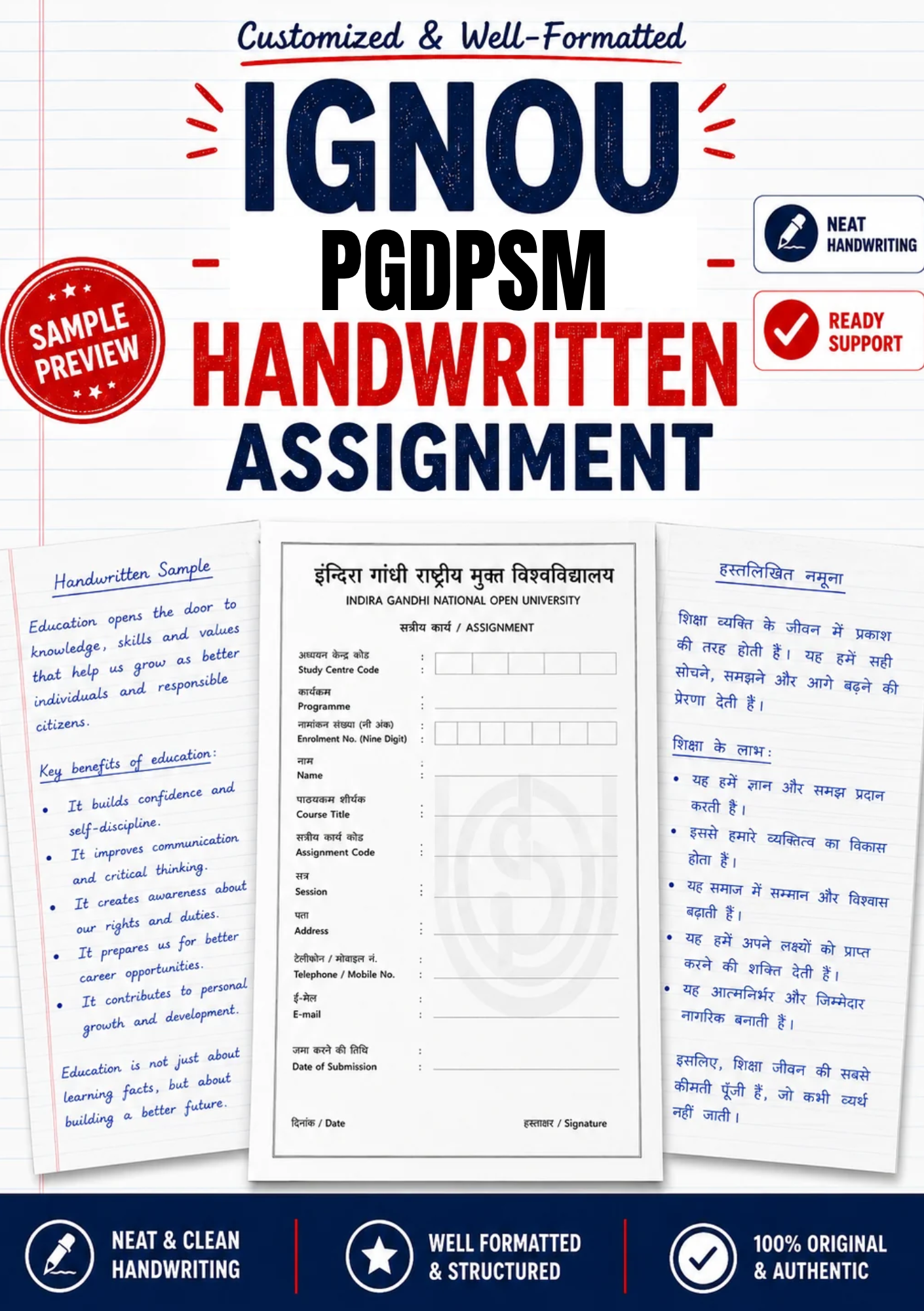
In short. The IGNOU Post Graduate Diploma in Pharmaceutical Sales Management runs on six theory papers, MVE 1 to MVE 6, worth 32 credits between them, issued by the School of Vocational Education and Training in English only, with no project and no laboratory course anywhere in the structure. Shri Chakradhar Publication writes those six papers out by hand on A4 sheets, one answer book per course code, and couriers the set to you. The rate is ₹320 per subject, hard copy only, with courier included in that price and no separate shipping charge, which puts a complete MVE 1 to MVE 6 order at ₹1,920 and a single unfinished paper at ₹320. The 2026 PGDPSM booklet set covers both intakes in one document and prints two dates on every paper, 30 April 2026 for the January 2026 session and 30 October 2026 for the July 2026 session, which are SOVET’s dates for this diploma and not the figures circulating on aggregator sites. Four of those six booklets print the assignment code with the letters MEV rather than MVE, and MEV is a real IGNOU prefix belonging to a different programme, so the cover line gets transcribed exactly as your own download prints it. Send a photo of a page you have written yourself and the handwritten set is matched to your handwriting at no extra charge. No soft copy or PDF is sold.
Six Answer Books and One Courier Bag: A PGDPSM Order, Itemised
A PGDPSM order is physical from the moment it is placed. Each course code you name becomes its own answer book, written on good-quality A4 writing paper with the 3 cm margin the SOVET instruction sheet asks for on the left, the top and the bottom. Order MVE 3 alone and one book arrives. Order the full diploma and six books arrive, separated and labelled, because the Study Centre takes them in as six separate submissions against six separate course codes rather than as one bundle for the programme.
Folded in with the answer books are the two things learners most often end up printing at a cybercafe on the morning of the deadline. The first is the IGNOU-format front page, filled in as far as the programme and course details go, leaving your enrolment number, name, signature and date for you to complete in your own hand. The second is a copy of the official PGDPSM question paper for the code concerned, because several Regional Centres ask for the question paper to travel attached to the answer sheet, and because the paper is what proves the set was written against the right cycle.
Nothing arrives electronically. No soft copy or PDF is sold. There is no download link, no cloud folder and no scanned copy held back for later, and that is a deliberate scope decision rather than an omission, because the thing a PGDPSM learner has to produce at the counter is paper. Delivery depends on your pin code and is confirmed for your order before you pay. No figure is promised on this page.
Reading the ₹320 Line Against a Six-Paper Pharmaceutical Diploma
PGDPSM is priced the same way every programme on this shelf is priced, per course code rather than per semester or per diploma. The rate is ₹320 per subject, hard copy only, with courier included in that price and no separate shipping charge. On a six-paper diploma that arithmetic is unusually simple: ₹320 multiplied by the six codes MVE 1 to MVE 6 is ₹1,920 for everything PGDPSM can ask you to submit, with no project paper and no practical to add on top.
Inside the ₹320 sit the writing itself, the A4 answer book, the IGNOU-format front page, the copy of the question paper and the courier. Also inside it, and worth naming because other sellers charge for it, is the handwriting match. Send a photo of a page you have written yourself and the handwritten set is matched to your handwriting at no extra charge.
Outside the ₹320 are exactly two things. One is any IGNOU fee, because the university’s own charges for registration, re-registration, examination forms and late submission are nothing to do with a publisher. The other is a guarantee of any kind about how the work is received, which this publisher does not offer in any wording, because an evaluator’s judgement is not a publisher’s to sell.
There is no minimum order: one subject or fourteen, same rate. That matters more on PGDPSM than on a fourteen-paper master’s degree, because the commonest PGDPSM order is not the full six. It is the one or two papers a medical representative could not finish while travelling a territory, carried forward into a later cycle.
Model Answers in a PDF, or Six Written Books the Counter Will Accept
Two different products get searched for with almost the same words, and buying the wrong one wastes a cycle. A solved assignment is a soft-copy reference file of model answers for a course code and session, downloaded and read. A handwritten assignment is the answers written out by hand on A4 and submitted in hard copy at the study centre. The first is something you study from. The second is something you sign and hand over.
PGDPSM makes the distinction unusually sharp, because the SOVET instruction sheet on the 2026 booklets states it twice over. Instruction 4 asks that answers be precise and handwritten and written in your own language rather than copied as it stands from the course material. Instruction 5 then states that answers in the form of a photocopy, or scanned from any source, will not be accepted. A downloaded PDF of model answers is not a submission under either line, and no page on this site suggests otherwise.
| Question a PGDPSM learner has | MVE model-answer file | MVE written answer book |
|---|---|---|
| What reaches you | A file to open on a phone or laptop | A4 sheets in a courier bag, one book per code |
| What you then do | Read it, then write the whole paper out yourself | Check it, complete the front page, sign and submit |
| Does the SOVET instruction sheet allow it as a submission | No. Instruction 5 refuses photocopied or scanned answers | Yes, as handwritten work you have reviewed and signed |
| Who it suits | Learners with time who want to write six papers themselves | Learners working a sales territory with a cut-off approaching |
| Rate on this store | Priced per code on the soft-copy shelves | ₹320 per subject, courier included |
Scroll the table sideways on a narrow screen.
One honest gap belongs here rather than in a sales line. This store carries no per-programme solved-assignment shelf for PGDPSM at all, so there is no stocked MVE model-answer file to send you to; learners after soft-copy reference material for a diploma code are better served browsing the store’s diploma solved-assignment listings and checking whether their own code appears. What PGDPSM does have in soft copy is exam-side material rather than assignment-side, on the PGDPSM guess-paper shelf. This page sells the written hard copy and nothing else.
Name your MVE papers and the total comes back the same day you ask.
Six papers, MVE 1 to MVE 6, comes to ₹1,920 at the per-subject rate. One carried-forward paper on its own is ₹320. Nothing at all is paid until the handwriting sample has come back to you and you are satisfied with it.
MVE 1 to MVE 6: Six Papers, Two Credit Weights, and No Project at All
The Common Prospectus July 2026 sets out PGDPSM in section 8.33 as a School of Vocational Education and Training programme, one year minimum and three years maximum, open in both the January and July intakes, English medium, with a fee of ₹8,500 and a year-wise examination mode. Two things about the course table are worth noticing before you order, because both of them change what a full set costs.
The first is that the credits are not uniform. Most IGNOU post-graduate diplomas are built from eight four-credit courses. PGDPSM is built from six courses carrying 6, 6, 4, 4, 6 and 6 credits, which sums to 32 and matches the total the prospectus prints. The second is that none of those six is a project, a dissertation or a laboratory course. Every credit in the diploma is a theory paper with a tutor-marked assignment behind it, which is why a complete PGDPSM order is six books and never five.
| As the prospectus prints it | As the booklet prints it | Course title in section 8.33 | Credits out of 32 | Assignment behind it |
|---|---|---|---|---|
| MVE 1 | MVE-001 | Introduction to Anatomy, Physiology, and Pharmaceutical Chemistry | 6 | Yes |
| MVE 2 | MVE-002 | Pharmacology and Toxicology | 6 | Yes |
| MVE 3 | MVE-003 | Pharmaceutics | 4 | Yes |
| MVE 4 | MVE-004 | Drugs Regulatory Affairs | 4 | Yes |
| MVE 5 | MVE-005 | Introduction to Management | 6 | Yes |
| MVE 6 | MVE-006 | Sales Management | 6 | Yes |
Scroll the table sideways on a narrow screen.
The two code columns are not a transcription slip. The prospectus prints single-digit codes throughout its PGDPSM table, the assignment booklets print three-digit codes throughout theirs, and both are IGNOU’s own documents describing the same six courses. This store’s PGDPSM shelves follow the prospectus form, which is why the PGDPSM help-book listings read MVE 1 to MVE 6. Order by whichever form your admission record uses and the codes will be matched to the booklets at this end.
Credits also tell you how much writing a paper is likely to need. A six-credit PGDPSM course and a four-credit one both carry a 100-mark assignment, so the mark total is no guide, but the six-credit papers in this diploma are the ones whose booklets run to ten questions rather than seven.
MEV or MVE: The Prefix Changes Between Booklets of the Same 2026 Set
This is the detail that costs PGDPSM learners the most time, and it is not discussed anywhere else that sells this programme. The six course codes are MVE. The assignment codes printed on the 2026 booklets are not consistently MVE. Four of the six print the letters in the order MEV, and two print MVE, inside one booklet set issued for one pair of sessions by one school.
| PGDPSM course code | File published on ignou.ac.in | Assignment code as the page prints it | Letters |
|---|---|---|---|
| MVE 001 | PGDPSM-MEV-001-2026.pdf | MEV 001/TMA /2026 | MEV |
| MVE 002 | PGDPSM-MEV-002-2026.pdf | MEV 002/TMA /2026 | MEV |
| MVE 003 | PGDPSM-MEV-003-2026.pdf | MVE 003/TMA/2026 | MVE |
| MVE 004 | PGDPSM-MEV-004-2026.pdf | MEV 004/TMA 2026 | MEV |
| MVE 005 | PGDPSM-MEV-005-2026.pdf | MVE 005/TMA 2026 | MVE |
| MVE 006 | PGDPSM-MEV-006-2026.pdf | MEV 006/TMA 2026 | MEV |
Scroll the table sideways on a narrow screen.
Every one of the six published file names uses MEV, including the two whose pages print MVE. The split is also stable rather than random: the January 2023 booklet prints MEV on MVE 001 and MVE 002 and MVE on MVE 003 and MVE 005, and the January 2025 booklet does the same, so the pattern has survived at least four cycles of re-issue.
What makes this worth a section of its own is that MEV is not a meaningless transposition. MEV is a live IGNOU course prefix in its own right, carried by a School of Sciences environmental science master’s programme as MEV 11 through MEV 19, with MEVL laboratory codes, MEVE electives and an MEVP dissertation alongside it. The string MEV appears in the Common Prospectus July 2026 more than a hundred times and not once against PGDPSM. The string MVE appears ten times in the entire prospectus: six of them are the PGDPSM courses and the other four are MVEI codes belonging to a certificate programme in assistive technology. If you are after written sets for the environmental codes rather than the pharmaceutical ones, the M.Sc. Environmental Science written sets are the correct shelf and this page is not, and the integrated development studies sets cover a second programme whose real code list includes MEV papers.
The practical consequence is narrow and worth stating plainly. Transcribe the assignment code exactly as your own downloaded booklet prints it, MEV or MVE, and do not tidy it. The counter clerk and the evaluator are matching your sheet against the same document you downloaded.
Twenty-One Disagreements Found by Reading the PGDPSM Documents Side by Side
This page is written from IGNOU’s own documents, and those documents do not agree with each other. The disagreements below were all found by reading the Common Prospectus July 2026 against four of the six live 2026 PGDPSM booklets and against earlier PGDPSM booklets from 2015 to 2025. Three of them are this publisher’s own errors, and they are listed here for the same reason the others are.
Where the PGDPSM record contradicts itself. Check every one of these against your own enrolment documents before you write anything on a cover sheet.
1. The six course codes are MVE. Four of the six 2026 assignment codes are printed MEV. One booklet set, two spellings.
2. The two mismatched spellings sit inside the same document family issued by the same school for the same pair of sessions, so neither can be treated as the corrected version of the other.
3. All six published file names on ignou.ac.in use MEV, including the two files whose pages print MVE inside.
4. MEV is a live prefix for a School of Sciences environmental science master’s programme. A PGDPSM cover sheet reading MEV 001 carries another programme’s prefix.
5. The prospectus prints MVE 1 to MVE 6. The booklets print MVE-001 to MVE-006. The store follows the prospectus form.
6. The MVE-003 and MVE-006 booklet pages both carry a running line naming MVE 001 Introduction to Anatomy, Physiology and Pharmaceutical Chemistry above an assignment that is not MVE 001.
7. Instruction 5 refuses answers in the form of a photocopy or scanned from any source. Instruction 9 on the same sheet offers a scan-and-email route to the Regional Centre.
8. PGDPSM 2026 prints 30 April and 30 October. PGDIS, a diploma from the same school, prints 31 March and 31 October. SOVET does not run one deadline calendar.
9. PGDPSM issues one booklet set covering January and July 2026 together. PGDIS issues a separate booklet per cycle carrying one date.
10. The PGDPSM cut-off has moved almost every cycle: 1 September 2015, 22 February 2016, 30 July 2022, 28 February 2023, 30 July 2023, 30 August 2025, then 30 April and 30 October for 2026.
11. The submission address has moved. The 2022 and 2023 booklets routed sets to the Programme Coordinator at Block 15 E, SOVET, Maidan Garhi. The 2025 and 2026 booklets route them to a Regional Centre instead.
12. That Regional Centre is named Chandigarh on the booklet and its printed postal address is in Karnal, Haryana.
13. PGDPSM asks for a 3 cm margin on the left, top and bottom. SOVET’s foolscap booklets for other programmes ask for 4 cm on the left only.
14. Each PGDPSM assignment carries 100 marks and says answer every question. The MVE-006 term-end paper carries 75 marks over three hours and says attempt any five, so the assignment is longer than the examination it feeds.
15. The question architecture is not shared across the six papers. MVE-004 is divided into a marked Section A; MVE-006 runs seven questions weighted 5, 5, 5, 20, 20, 20 and 25; MVE-001 and MVE-003 run ten questions mostly split into two five-mark halves; MVE-005 opens with fill-in-the-blanks.
16. A 2015 PGDPSM booklet printed PGDPSM itself in the course-code field of Assignment V, where the course code belongs.
17. In the text layer of the 2026 MVE-001 and MVE-003 files as fetched on 3 November 2026, question 9 renders incompletely. Read question 9 off your own download rather than off any reproduction of it.
18. Aggregator sites circulate 31 March 2026, 30 September 2026, 31 October 2026, 30 April 2026, 31 May and 15 June as the IGNOU assignment last date, one of them labelled as applying to all courses. None of those is PGDPSM’s 30 October 2026.
19. Those same sites attach 30 April 2026 to a July 2025 admission sitting the June 2026 examination. The PGDPSM booklet attaches 30 April 2026 to the January 2026 session. The date is the same and the cohort is not.
20. This store’s own doing: the PGDPSM help-book category is titled with Pharmaceutical misspelt as Pharmaceutcal. Reported for correction.
21. This store’s own doing: the PGDPSM guess-paper shelf lists nine products against six courses, two of them carrying the same MVE 6 title, and there is no PGDPSM solved-assignment shelf at all even though the site navigation lists a PGDPSM previous-year-paper shelf. Both are on the correction list.
Disclosing the last two costs this page nothing worth keeping. An errand that sends a learner to the wrong shelf or the wrong spelling is an errand either way, and a page that admits its own store’s mistakes is easier to trust on the nineteen findings it cannot be blamed for.
One Booklet, Two Cycles, Two Dates: 30 April and 30 October
Every 2026 PGDPSM paper prints the same pair of dates, because one booklet set serves both intakes. The January 2026 session date is 30 April 2026. The July 2026 session date is 30 October 2026. The sheet adds the usual rider that the University may notify otherwise from time to time on its homepage, which is the line that makes any date on any resale page provisional including this one.
Two things follow for a PGDPSM learner specifically. The first is that your date is set by your session of registration and not by the examination you are heading for, so a learner admitted in the July 2026 cycle works to 30 October 2026 even if their own examination sitting is later. The second is that PGDPSM’s dates are its own. The School of Vocational Education and Training runs its Information Security diploma on 31 March and 31 October, a full month away from PGDPSM on the spring end, and the master’s programmes in the same school run differently again. Carrying a date across from a sibling programme, or from a general article about IGNOU deadlines, is how a submission ends up a month late.
That is also the reason the historical dates matter. A learner picking PGDPSM back up after a gap will find a 2023 booklet in their downloads folder printing 30 July 2023, and a 2025 booklet printing 30 August 2025, and neither tells them anything about the cycle they are now in. Programme structures, course codes, submission dates and rules change, and only ignou.ac.in and your Regional Centre can confirm the current position for your enrolment.
There is a reason to move before the date rather than on it. Assignments carry 30 per cent of the final course result and the term-end examination carries the remaining 70 per cent. On a six-paper diploma with no project to fall back on, those six assignment components are the whole of the internal assessment for the qualification.
Copying MEV 001/TMA /2026 Onto the Sheet Exactly as Printed
The assignment code is the string the Study Centre uses to file your answer book against the right course and the right cycle, and PGDPSM prints it in a form worth decoding before you write it out. Taking MEV 001/TMA /2026 apart: the first block is the code as that booklet prints it, MEV on four of the six 2026 papers and MVE on the other two; TMA stands for tutor-marked assignment, the continuous-assessment component rather than the examination; and the single year is the session year.
Note what is absent. PGDPSM prints a single year and no session word, so the string on a January 2026 paper and the string on a July 2026 paper are identical. The only thing separating the two cycles is which of the two printed dates applies to you, which is why the front page asking for your session is doing real work on this programme rather than repeating what the code already says. Spacing is inconsistent too: some papers print TMA /2026 with a space before the slash and others print TMA/2026 without one.
The handling rule is the same either way. Copy the code character for character from your own download onto the front page and onto the first sheet of the answer book, including the letter order and the spacing, and do not normalise it. Shri Chakradhar Publication transcribes whatever the booklet you send shows, and flags it back to you if the code on your file differs from the code on the file currently published for your cycle.
The Hand That Signs the PGDPSM Declaration Is the Hand That Writes It
The SOVET instruction sheet puts the handwriting requirement in two places. Answers should be precise and handwritten and written in your own language rather than copied from the course material as it stands, and answers in the form of a photocopy or scanned from any source will not be accepted. Between them those two lines rule out a typed set, a photocopied set and a set written in a hand that bears no relation to yours.
That is why the sample photograph comes before the money on this product rather than after it. Send a photo of a page you have written yourself and the handwritten set is matched to your handwriting at no extra charge. The writer works from your letter forms, your slant, your spacing and the way you handle numerals, which on PGDPSM matters more than it might sound, because the Pharmacology and Pharmaceutics papers are full of dosage figures, chemical names and abbreviations where a careless numeral is the difference between two answers.
The set comes back to you before it goes anywhere near a counter, and the reason is procedural rather than promotional. You sign the declaration on the assignment cover page, so you should read and review the content before submitting it, and satisfy yourself that it represents your own understanding of the course.
Which page of your own writing to photograph for an MVE set
One page is enough and the choice of page changes the result. Use something you wrote at ordinary speed rather than a line copied out carefully for the purpose, because a careful line is not the hand that will appear on your front page. Fifteen to twenty lines of continuous prose in the pen you normally use works better than a page of notes or headings. If your PGDPSM papers will carry structural formulae or drug names, include a few of those in the sample, since those are the characters a writer most often has to guess at otherwise. Photograph it flat in daylight rather than under a lamp, and send the image rather than a scan of a print of it.
One Medium, Either Intake, and Papers You Still Owe From 2022
PGDPSM is an English-medium programme and the prospectus says so without qualification in section 8.33. There is no Hindi edition of the course material, no Hindi booklet set on the assignment portal and no regional-language variant, which makes PGDPSM simpler to order than the Hindi and bilingual programmes on this shelf. The service covers all mediums IGNOU issues the TMA paper in, at the same price. For PGDPSM that resolves to a single medium.
Session coverage is deliberately wide, because the PGDPSM learner profile makes it necessary. The programme is built for people already working as medical representatives or trying to become one, and the eligibility route reflects that: a graduate in any discipline with Science at 10 plus 2, or a graduate without Science at 10 plus 2 who has two years of work as a medical representative in a pharma industry. People in that second group are on the road. Papers slip.
Any session is accepted, current cycle or older, including backlog courses, at the same ₹320 per subject. A learner inside the three-year maximum duration who still owes MVE 2 and MVE 4 from an earlier intake gets the same rate and the same treatment as a learner ordering all six in their first cycle. What changes with an older paper is only which booklet the set is written against, and the rule there is firm: the set follows the paper currently published for the cycle you are submitting into, not the paper you downloaded when you first registered.
What a First Message About MVE Papers Needs to Contain
Five pieces of information settle a PGDPSM order, and sending more than five tends to slow it down rather than speed it up.
- The course codes you want written, in either form, MVE 3 or MVE-003. Six codes or one.
- Your session and year of registration, January or July, so the correct pair of dates and the correct booklet apply.
- Your enrolment number, which is what the front page needs and what identifies your cycle if the session is unclear.
- One photograph of a page in your own handwriting, chosen as described above.
- The delivery address with its pin code, because delivery depends on your pin code and is confirmed for your order before you pay.
Nothing else is needed at the start. Study Centre codes, Regional Centre names, study material scans, your term-end examination form and your marks history can all wait, and most of them are never needed at all. If your own booklet download differs from the one currently published for your cycle, send that file too and it will be read against the live one before any writing starts.
Six codes, one message, and the writing can start today.
₹320 per subject on every PGDPSM paper, hard copy with courier included, and the handwriting sample goes back to you before anything is paid. No soft copy or PDF is sold.
After the Packet Arrives: Three Routes PGDPSM Allows for Handing In
Unpack and count first. Six codes should be six separate answer books, each with its own front page and its own copy of the question paper, and each one should carry the assignment code in the form your own download prints it. Complete the front pages in your own hand, enrolment number, name, signature and date, and read the answers before you sign anything.
PGDPSM then gives you more routes than most programmes, which is itself a thing to be careful about. The ordinary route named first on the instruction sheet is your allotted Study Centre or Regional Centre, before the last date printed on the paper, and that route gives you a counter receipt. The fallback route, offered for learners who have no study centre, is a postal submission to the Regional Centre the booklet names, which prints as Regional Centre Chandigarh at an address in Karnal, Haryana, labelled for PGDPSM Assignments. The third route on the sheet is a scan emailed to that Regional Centre with a copy to the programme coordinator, and this is the route that sits awkwardly against instruction 5 refusing scanned answers. Ask your own Regional Centre which of the three they are accepting this cycle before you use anything but the first.
Whichever route you use, keep a copy. The instruction sheet asks you to retain a scanned or photocopied copy of what you submitted, and a counter receipt or a postal receipt is the only evidence you will have if the submission does not appear against your record. Marks appear on the status page in their own time, and nothing a publisher does affects that.
No claim is made about the marks any assignment will receive, about how an evaluator will assess it, or about whether it will be accepted. Assignment evaluation is entirely a matter for IGNOU.
What Else a PGDPSM Learner Buys, and the One Shelf That Is Missing
PGDPSM is a thin catalogue compared with the master’s programmes, and saying so is more useful than pretending otherwise. For exam preparation the programme has chapter-wise help books covering all six papers individually and as a combined set, and the written-assignment work on this page sits alongside them rather than replacing them. If you are comparing written sets across programmes before deciding, the full handwritten-assignment listing shows how the per-subject rate applies identically from a four-paper diploma to a twenty-six-paper honours degree.
Learners who hold a second IGNOU registration alongside PGDPSM most often hold it in the same school, and the two neighbours worth naming are the Information Security diploma, whose written sets are on the PGDIS page and whose dates differ from PGDPSM’s by a month, and the Entrepreneurship master’s, whose fifteen MER papers are on the MAER page. If your codes do not match any programme page on this store, the any-code customised order takes any code list for any session at the same rate.
The gap is on the solved side, and it is being reported rather than worked around. There is no PGDPSM solved-assignment category and no MVE solved-assignment product anywhere on this store, so a learner searching for MVE model answers in soft copy will not find them here. The two PGDPSM soft-copy shelves that do exist are the guess papers linked earlier and the previous-year question papers the navigation lists. Both are exam-side material, and both sit inside the wider diploma guess-paper listing if you want to see how thinly PGDPSM is stocked next to its neighbours.
What Medical Representatives Want Settled Before They Pay
Is ₹320 the price for the whole PGDPSM diploma or for one MVE paper?
For one paper. The rate is ₹320 per subject, hard copy only, with courier included in that price and no separate shipping charge. PGDPSM has six papers, so a complete MVE 1 to MVE 6 order is ₹1,920, and there is no bundle rate below that because the per-subject rate already applies from the first paper.
Should I write MEV or MVE on the cover page of my PGDPSM assignment?
Whichever one your own downloaded booklet prints for that course. On the 2026 set, the MVE-001, MVE-002, MVE-004 and MVE-006 pages print MEV and the MVE-003 and MVE-005 pages print MVE. The course code itself is MVE in every IGNOU document. Copy the assignment code from the booklet without correcting it, and keep MVE for the course-code field.
Mera ek paper pichle saal ka bacha hai, uska rate alag hoga?
Nahi. Any session is accepted, current cycle or older, including backlog courses, at the same ₹320 per subject. Ek bacha hua PGDPSM paper ₹320 hi hai, aur usi rate par likha jayega. Sirf itna dhyan rakhiye ki set uss booklet se likha jayega jo aapke current submission cycle ke liye publish hui hai.
What is the last date for the PGDPSM assignment in 2026?
The 2026 booklet set prints 30 April 2026 for the January 2026 session and 30 October 2026 for the July 2026 session, with the University’s usual rider that it may notify otherwise on its homepage. Those are PGDPSM’s own dates. Dates quoted for IGNOU generally, or for another programme in the same school, do not apply to this diploma.
Can I download a PGDPSM solved assignment PDF and submit the printout?
No. A solved assignment is a soft-copy reference file of model answers for a course code and session; a handwritten assignment is the answers written out by hand on A4 and submitted in hard copy at the study centre. Instruction 5 on the PGDPSM sheet states that answers in the form of a photocopy or scanned from any source will not be accepted, and a printout of a downloaded file is neither handwritten nor your own hand.
Solved assignment aur handwritten assignment mein actual farak kya hai?
Solved assignment ek soft copy file hai, padhne ke liye, aur usse aapko khud poora paper likhna padega. Handwritten assignment A4 par haath se likhi hui answer books hain, front page aur question paper ke saath, jo seedha study centre par jama ho jati hain. Pehla study material hai, doosra submission hai. Yeh page sirf doosra bechta hai.
Does PGDPSM have a project or a practical I also need written?
No. All 32 credits of PGDPSM come from the six theory papers MVE 1 to MVE 6, and the prospectus lists no project, dissertation or laboratory course in the structure. That is unlike the Information Security diploma from the same school, which carries a project paper. A complete PGDPSM set is therefore always six answer books.
How many questions does a PGDPSM paper carry, and does every paper look the same?
Every 2026 PGDPSM paper carries 100 marks and instructs you to answer all the questions, but the shape differs by paper. MVE-001 and MVE-003 run to ten questions, mostly split into two five-mark halves. MVE-006 runs seven questions weighted 5, 5, 5, 20, 20, 20 and 25. MVE-004 is divided into a marked Section A. MVE-005 opens with fill-in-the-blanks. The set is written against your own paper, not a template.
Is my PGDPSM assignment in Hindi available?
PGDPSM is English medium only. The Common Prospectus July 2026 prints English as the medium of instruction with no alternative, and the assignment portal carries no Hindi PGDPSM booklet. The service covers all mediums IGNOU issues the TMA paper in, at the same price. For this diploma that means English and nothing else.
What paper and margin does PGDPSM ask for?
Good-quality A4-size or equivalent writing paper, not very thin, with a 3 cm margin on the left, the top and the bottom. That differs from the foolscap-and-4-cm pattern SOVET prints on some other programmes, which is one reason a set written for a sibling programme is not interchangeable with a PGDPSM set.
Where do I actually submit the six answer books?
At your allotted Study Centre or Regional Centre before the printed date, which is the route the instruction sheet names first and the only one that gives you a counter receipt. Learners with no study centre are directed to post the set to the Regional Centre the booklet names, printed as Regional Centre Chandigarh with an address in Karnal, Haryana. A scan-and-email route is also printed, and it sits awkwardly against instruction 5, so confirm it with your own Regional Centre first.
Can you tell me in advance what an evaluator will give the set?
No. No claim is made about the marks any assignment will receive, about how an evaluator will assess it, or about whether it will be accepted. Assignment evaluation is entirely a matter for IGNOU. The weighting, which is a published rule rather than a prediction, is a different matter. Assignments carry 30 per cent of the final course result and the term-end examination carries the remaining 70 per cent.
Do I get a PDF copy of my written PGDPSM set as well?
No soft copy or PDF is sold. The product is the physical set, and the copy you keep for your own records is the one the instruction sheet asks you to make yourself once you have the books in hand and before you hand them in.
I only need two papers. Is there a minimum order on PGDPSM?
There is no minimum order: one subject or fourteen, same rate. Two PGDPSM papers is a normal order on this programme, and arguably the commonest one, because learners working a sales territory tend to finish four of the six and carry two forward.
Kya aap PGDPSM ka assignment mere study centre par jama kar denge?
Nahi. Set aapke address par courier se aata hai, aur submission aap khud karte hain, kyunki cover page par declaration aapke naam se sign hoti hai. Isi wajah se set pehle aapke paas aata hai: padh kar, check kar ke, phir sign kijiye aur counter par jama kijiye. Instruction sheet khud bhi kehti hai ki jama karne se pehle ek copy apne paas rakh lijiye.
Separating the Prospectus, the Booklets and the Publisher’s Own Terms
Three kinds of statement appear on this page and they do not carry equal weight, so they are kept apart rather than blended.
From the Common Prospectus July 2026, section 8.33 and annexure row 158. The programme title, the PGDPSM code, the School of Vocational Education and Training as the issuing school, the six course codes MVE 1 to MVE 6 with their official titles, the credit weights of 6, 6, 4, 4, 6 and 6 summing to the printed total of 32, the absence of any project or laboratory course, English as the medium of instruction, the one-year minimum and three-year maximum duration, the ₹8,500 fee, the year-wise examination mode, the January and July intakes and the two eligibility routes. The MEV prefix evidence in the conflict box also comes from this document, by counting where MEV and MVE each occur in it.
From the live PGDPSM booklets on ignou.ac.in. The two submission dates of 30 April 2026 and 30 October 2026, the assignment-code strings and their MEV and MVE split across the six 2026 files, the 100-mark total and the per-paper question architecture, the A4 and 3 cm margin instruction, the handwritten-only and no-photocopy instructions, the three submission routes and the Regional Centre address, and the running-header carry-over on the MVE-003 and MVE-006 pages. Four of the six 2026 booklets were read in full for this page, together with PGDPSM booklets from 2015, 2022, 2023 and 2025 for the historical dates. the university’s assignment download page is where to get your own copy, and it is the only version that governs your submission.
From this publisher’s own trading terms. The ₹320 per-subject rate and what sits inside it, the hard-copy-only scope, the included courier, the free front page and question-paper copy, the handwriting match from a sample photograph at no extra charge, the absence of a minimum order, the acceptance of any session including backlogs, and the refusal to promise a delivery figure or any outcome on marks. These are this publisher’s terms and IGNOU neither sets nor endorses them.
Important Notice
Shri Chakradhar Publication Pvt. Ltd. and shrichakradhar.com form an independent IGNOU study-support publisher. This is not the official website of Indira Gandhi National Open University, is not affiliated with, endorsed by or authorised by the university, and no page on this site should be treated as an official IGNOU communication.
Programme structures, course codes, submission dates and rules change, and only ignou.ac.in and your Regional Centre can confirm the current position for your enrolment.
You sign the declaration on the assignment cover page, so you should read and review the content before submitting it, and satisfy yourself that it represents your own understanding of the course.
No claim is made about the marks any assignment will receive, about how an evaluator will assess it, or about whether it will be accepted. Assignment evaluation is entirely a matter for IGNOU.
Put the MVE Numbers in a Message and the Rate Is Fixed
The rate is ₹320 per subject, hard copy only, with courier included in that price and no separate shipping charge. Six papers, MVE 1 to MVE 6, is ₹1,920. One carried-forward paper is ₹320. There is no minimum order: one subject or fourteen, same rate.
Send the course codes, your session, your enrolment number, one photograph of your own handwriting and a delivery pin code. The handwriting sample comes back to you before any payment, and the set is written against the booklet currently published for your cycle.
Open a WhatsApp chat about your PGDPSM papers, or save +91 93546 37830 and send the five lines whenever your codes are confirmed.
Delivery depends on your pin code and is confirmed for your order before you pay. No figure is promised on this page.