

Description
In short. A PGDAIC handwritten order covers the seven Advertising and Integrated Communication papers that IGNOU published a January and July 2026 assignment file for, MNM-021 Integrated Communication Practices, MNM-022 Consumer Behaviour, MNM-023 Advertising and MNM-024 Public Relations in the first semester, and MNM-025 Online Brand Management, MNM-026 Integrated Campaign Planning and MNM-027 Vocational Life Skills in the second. The rate is ₹320 per subject, hard copy only, with courier included in that price and no separate shipping charge. Each of those seven papers sets five compulsory questions worth 20 marks out of 100 and asks for roughly 500 words per answer, so a full diploma order is thirty-five written answers, and the first-semester four are the same four that the certificate exit, PGCAIC, is built from. Two further courses appear in the prospectus table, MNM-003 Digital Photography and Videography and MNM-038 Digital Media Economy, but their 2026 papers are published under the digital-media programmes and name PGDAIC nowhere, so nothing is quoted against them; MNMP-021 is project work and carries no assignment at all. Any session is accepted, current cycle or older, including backlog courses, at the same ₹320 per subject. Send a photo of a page you have written yourself and the handwritten set is matched to your handwriting at no extra charge.
Seven Bundles, a Cover Sheet and the Paper They Answer
A PGDAIC order is dispatched as one parcel holding one separate bundle per course code, because the study centre counter takes them one code at a time and a single stapled block of thirty-five answers is not what the register expects. Each bundle in that parcel holds four things.
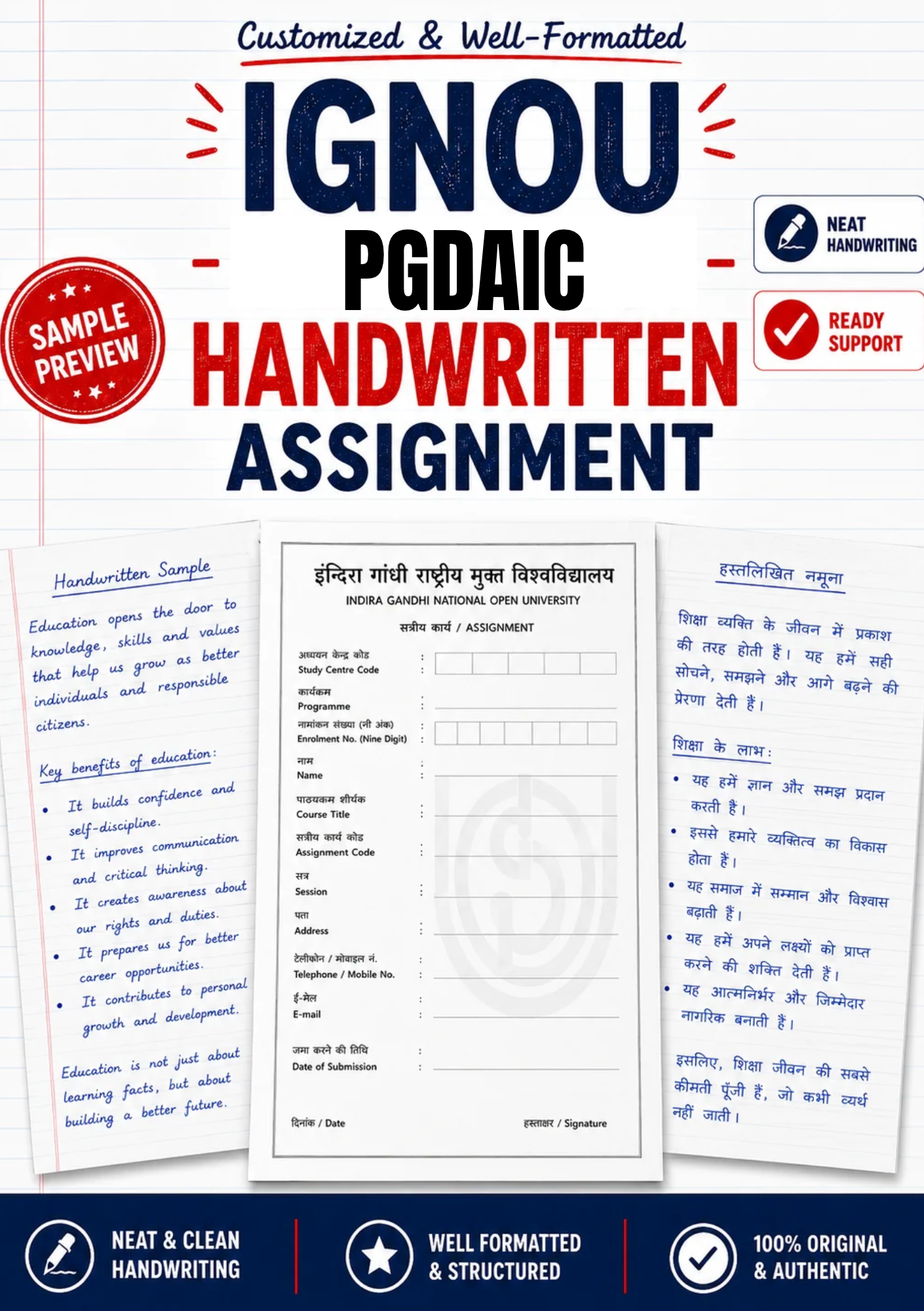
The first is the written response itself, answers to all five questions of that paper in continuous handwriting on one side of A4 sheets, with the question numbering kept exactly as the paper prints it. The second is an IGNOU-format front page, filled in with the enrolment number, name, address, assignment code and study centre code the 2026 paper asks to see on the first sheet, supplied free with every order. The third is a printed copy of the official question paper for that code and cycle, downloaded from the university’s own assignment service rather than retyped, since a handwritten copy of the questions is the thing study centres send back. The fourth is nothing: no soft copy or PDF is sold, so there is no file waiting in an inbox and no download link to misplace.
Shri Chakradhar Publication writes against the paper that is current for the code and cycle you name, not against a stored answer bank, which matters on a diploma where two of the ten prospectus courses have no PGDAIC paper at all and where the seven that do were all reissued for the January and July 2026 cycle.
Reading the ₹320 Line Across a Seven-Paper MNM Order
The rate is ₹320 per subject, hard copy only, with courier included in that price and no separate shipping charge. On a PGDAIC order a subject means one MNM course code with a live paper, so a learner clearing the whole diploma in one go is pricing seven subjects and a learner clearing a single second-semester backlog is pricing one.
Inside that figure sit the writing of all five answers, the paper and ink, the IGNOU-format front page, the printed question paper, the bundling of each code separately, and the courier to your address. Outside it sit two things only. The first is anything the university charges you directly, which is its own matter: the programme fee, examination forms, re-registration. The second is the project, MNMP-021, which is campaign production or an internship written up as a report rather than an assignment answered against a question paper, and which this product does not cover.
There is no minimum order: one subject or fourteen, same rate. The figure does not move for a Hindi response, for a 2023 paper, or for an order placed in the week a cut-off falls. Delivery depends on your pin code and is confirmed for your order before you pay. No figure is promised on this page.
A Download You Write From, and a Set You Hand In
Two different things are sold against the same course code and learners order the wrong one often enough that it is worth separating them before anything else. A solved assignment is a soft-copy reference file of model answers for one course code and session, read on a phone or a laptop and used as the thing you write from. A handwritten assignment is those answers written out by hand on A4 and submitted as hard copy, which is the artefact the counter accepts and the counsellor marks.
IGNOU’s own PGDAIC paperwork is unusually explicit on which of the two reaches the evaluator. Every one of the seven 2026 papers carries a posting instruction addressed specifically to handwritten assignments, giving the Programme Coordinator’s address for them, and the PGDAIC and PGCAIC Programme Guide states that responses are to be written out rather than typed or printed. Neither document contemplates a file being uploaded in place of sheets.
| Line of comparison | Soft-copy answer file | Hand-written submission bundle |
|---|---|---|
| What it physically is | A PDF of model answers for one MNM code and session | A4 sheets in continuous handwriting, plus front page and printed question paper |
| What you do with it | Read it, then write your own answers from it | Check it, sign the declaration on the front page, submit it |
| Who it suits | A learner who will write but wants the answers shaped first | A learner short of writing time across five answers a paper |
| Whether the counter takes it | No, a printout of a model file is not a submission | Yes, this is the form the register is set up to receive |
| What it costs here | Sold separately in the diploma solved-assignment shelves | ₹320 per subject, courier included |
The table scrolls sideways on a narrow screen.
Honest scoping matters here. A solved assignment is a reference you write from; it is not a submission, and no downloaded file can be handed in whatever its filename says. If a reference file for one or two PGDAIC codes is what you actually want, the model-answer titles for this diploma sit with the rest of the diploma material in the store’s solved-assignment shelves for IGNOU diploma programmes, and that is the right page for a soft-copy order rather than this one.
Quoting a PGDAIC order takes one message. The rate is ₹320 per subject, hard copy only, with courier included in that price and no separate shipping charge.
List the MNM codes printed on your admission record, say which cycle you are submitting for, and the reply confirms which of them have a live 2026 paper and what the total comes to. Open WhatsApp and paste your MNM code list.
The Seven MNM Papers a PGDAIC Order Can Cover
PGDAIC is a two-semester diploma and the course codes are set by the semester you are registered in, not by an elective choice, so unlike most programmes on this store there is no branching list to reconcile against your admission record. What there is instead is a gap between the course table in the Common Prospectus for July 2026 and the assignment files IGNOU actually published for the January and July 2026 cycle. Seven papers exist. The table below is built from those seven files, each one opened rather than inferred from a filename, with the titles read off the prospectus entry for the diploma.
| MNM code | Course title in the prospectus table | Credits the diploma gives it | Semester it sits in | Number printed on the 2026 paper | Code string the cover prints |
|---|---|---|---|---|---|
| MNM-021 | Integrated Communication Practices | 04 | Semester I | Assignment: 04 | MNM-021/Jan/July 2026 |
| MNM-022 | Consumer Behaviour | 04 | Semester I | Assignment: 02 | MNM-022/Jan/July 2026 |
| MNM-023 | Advertising | 04 | Semester I | Assignment: 02 | MNM-023/Jan/July 2026 |
| MNM-024 | Public Relations | 04 | Semester I | Assignment: 02 | MNM-024/Jan/July 2026 |
| MNM-025 | Online Brand Management | 04 | Semester II | Assignment: 01 | MNM-025/Jan/July 2026 |
| MNM-026 | Integrated Campaign Planning | 04 | Semester II | Assignment: 01 | MNM-026/Jan/July 2026 |
| MNM-027 | Vocational Life Skills | 02 | Semester II | Assignment: 01 | MNM-027/Jan/July 2026 |
The table scrolls sideways on a narrow screen.
Two columns of that table repay a second look. The credit column puts MNM-027 at two credits against four for every other paper, and yet its 2026 file is the same instrument as the rest: 100 marks, five questions, 20 marks each, about 500 words per answer. The two-credit course carries exactly the writing load of a four-credit one, which is why learners pricing by credit are surprised by it.
The number column is the stranger of the two. Across the seven papers IGNOU prints only four distinct assignment numbers and not one of them is unique. Three Semester-I papers are all labelled the second assignment, all three Semester-II papers are labelled the first, and MNM-021, the opening paper of the diploma, is labelled the fourth. The number is therefore not an identifier on this programme and should be copied across to the front page exactly as printed rather than corrected to match the sequence it appears to break.
The first four codes do double duty. The Semester-I cover equates the first semester with the certificate exit, so MNM-021, MNM-022, MNM-023 and MNM-024 are simultaneously the first half of the diploma and the whole of the Post Graduate Certificate in Advertising and Integrated Communications. A learner who intends to exit after one semester is ordering exactly those four and nothing further.
MNM-003, MNM-038 and MNMP-021: The Three Courses Outside the Seven
The prospectus course table for this diploma lists ten rows, not seven. Three of the ten are not orderable as PGDAIC handwritten sets, and the reasons differ in each case. Stating that plainly is more useful than quoting a price against a paper that does not exist under this programme’s name, so the three are set out below with what was actually found on opening their files.
| Course left out of the seven | Where the prospectus puts it | Credits attached | Which programme publishes its 2026 paper | Why no PGDAIC set is quoted |
|---|---|---|---|---|
| MNM-003 Digital Photography and Videography | Fifth row of Semester I | 04 | Issued on a cover reading PGDIDM and PGDIDMOL with first-year MAJDM and MAJDMOL | PGDAIC is named nowhere on the file, and the paper prints no submission date at all |
| MNM-038 Digital Media Economy | First row of Semester II | 04 | Issued on a cover reading MAJDM and MAJDMOL, second year | PGDAIC is absent from the cover, and the file titles the course Digital Media Economics instead |
| MNMP-021 Project Work | Last row of Semester II | 06 | No assignment file exists; the course is assessed as a project report | Campaign production or an internship write-up is not an assignment answered against a question paper |
The table scrolls sideways on a narrow screen.
The two digital-media papers behave differently from the seven in every respect a learner has to copy down. Their assignment codes are printed bare and unhyphenated, as MNM003 and MNM038, with no session element at all, where the seven PGDAIC papers print a hyphen and a cycle. Their covers carry a sentence directing the learner to check the university website for the current due date rather than a calendar date. Their session lines read as an examination pair and an admission pair stacked together. And both are signed by the digital-media programme coordinator rather than by the PGDAIC coordinator who signs the other seven.
What follows for an order is simple enough. If MNM-003 or MNM-038 is on your admission record, the paper you will be marked against is the digital-media file, and the written set for it is quoted on the corresponding product rather than here: the first sits with the PGDIDM written-set product, where that cover’s codes are listed in full, and the second with the second-year MAJDM written-set product that carries the Digital Media Economics paper. Naming the right product is cheaper for you than discovering after submission that the code on the front page did not match the paper underneath it.
Thirty-One Disagreements Inside the PGDAIC Paperwork
This section exists because PGDAIC is a young programme, started in 2023 by IGNOU’s own account, whose documents have not been reconciled with each other. Thirteen IGNOU files were read against one another for this page and thirty-one points of disagreement came out of it, twenty-seven in the university’s own material and four in work published by this publisher or its sister site. None of them is a reason not to study the diploma. All of them are reasons to read your own admission record rather than any single document, this one included.
The clearest of the thirty-one is also the easiest to show. Three IGNOU documents count this diploma’s courses, and they do not agree on how many there are.
| Document doing the counting | Courses it lists | Credit total it states | Total its own list produces |
|---|---|---|---|
| Common Prospectus July 2026, the course table in the diploma’s own entry | Ten, including MNM-003 and MNM-038 | 32 in the line above the table, and 32 again in the table’s exit column | 40, which is also what its own footer row prints |
| The PGDAIC and PGCAIC Programme Guide | Eight, MNM-021 to MNM-027 plus the project | 32 for the diploma and 16 for the certificate | 32 |
| IGNOU’s live programme page for the diploma | Eight course cards, matching the Programme Guide | 32 | 32 |
The table scrolls sideways on a narrow screen.
Read together, those three rows resolve the contradiction rather than merely recording it. The 32-credit figure is the eight-course structure the Programme Guide and the live page both describe. The 40-credit figure is what you get once MNM-003 and MNM-038 are added to the table. The prospectus has added the two courses to its grid without updating the sentence above it, the exit column beside it, or the two other documents that describe the same diploma, and the assignment files follow the eight-course structure rather than the ten-course one.
Every disagreement found while building this page, listed so you can check your own record against it. Twenty-seven sit in IGNOU’s documents and four in this publisher’s own material. Only ignou.ac.in and your Regional Centre can settle any of them for your enrolment.
1. The prospectus entry for the diploma states a total of 32 credits in the line introducing its course table, while the footer row of that same table prints 40.
2. The right-hand column of the same table repeats 32 as the diploma total, beside rows that sum to 40.
3. That column gives the certificate exit 16 credits, while the Semester-I rows above it sum to 20.
4. The Programme Guide lists eight courses totalling 32; the prospectus table lists ten totalling 40.
5. IGNOU’s live programme page shows eight course cards totalling 32, siding with the Programme Guide against the prospectus.
6. MNM-003 appears in the prospectus Semester-I table and in neither the Programme Guide nor the live programme page.
7. MNM-038 appears in the prospectus Semester-II table and in neither of those two documents either.
8. MNM-038 is the only row in the prospectus course table whose course-type cell is left empty.
9. MNM-038 is also printed out of numerical sequence, ahead of MNM-025, MNM-026 and MNM-027.
10. The 2026 paper for MNM-038 is published on a cover naming the second year of the digital-media master’s programme, with no mention of PGDAIC.
11. The 2026 paper for MNM-003 is published on a cover naming the digital-media diploma and the first year of the digital-media master’s, again with no mention of PGDAIC.
12. MNM-038 is titled Digital Media Economy in the prospectus and Digital Media Economics on its own assignment file.
13. The seven PGDAIC papers print the assignment code hyphenated and with a cycle, as MNM-025/Jan/July 2026; the MNM-003 and MNM-038 files print it bare, as MNM003 and MNM038.
14. The seven PGDAIC papers print a calendar due date; the MNM-003 and MNM-038 files replace it with an instruction to check the university website.
15. The 2026 papers tell learners to post handwritten assignments to the Programme Coordinator at Block 15 A in New Delhi, while the Programme Guide tells them to submit at the study centre and not to send work to the Student Evaluation Division in New Delhi.
16. The same booklet page that gives the New Delhi postal address also names the study centre coordinator as a destination, so one file carries two routes.
17. The assignment number is not unique on any PGDAIC paper: three Semester-I files print the second assignment, all three Semester-II files print the first, and MNM-021 prints the fourth.
18. The programme name is printed four ways across these documents, with and without the word and, with Communication singular and Communications plural, and once with Advertising misspelled on IGNOU’s own live page heading.
19. The Programme Guide alternates between the singular and plural forms of the name within its own sections.
20. The project code is printed three different ways inside the Programme Guide alone: as MNM-021P in one section, as MNMP-021 in the structure table, and as MNMP-001 in the submission instructions.
21. The project title differs across all three sources that give it, describing campaign production, campaign planning and production, and an internship in three different combinations.
22. Four fee figures are live: the prospectus annexure gives a per-semester amount, the live page introduction gives a lower per-semester amount and a diploma total that matches neither, and the fee block further down the same page gives a third programme total.
23. The certificate exit, PGCAIC, appears exactly once in the whole Common Prospectus and has no row of its own in the annexure of programmes, so it carries no listed fee, duration or eligibility there, although the live page gives it both a fee and a duration.
24. The Semester-I cover equates the first semester with the certificate and lists four codes, where the prospectus gives Semester I five courses.
25. The prospectus states English in both places it states a medium, while the Programme Guide permits assignments, project work and the examination in Hindi.
26. The archived first-semester paper from the 2023 cycle names a different diploma entirely on its cover line, putting the journalism diploma’s code where PGDAIC’s belongs.
27. The first-semester files for the 2025 cycle carry an extra letter in their filenames that the course codes themselves do not carry.
28. The booklets sign off as Programme Coordinator while the posting instruction on the same page uses the shorter spelling, Program Coordinator, and every coordinator field on IGNOU’s live programme page is blank although the prospectus and all seven papers name the same person.
29. In this publisher’s own material, the handwritten category page still quotes a courier window in working days. No delivery figure is promised on this product page and that category line is queued for correction.
30. This publisher’s PGDAIC guess-paper titles carry unsupported quality claims of the kind this page does not make, and they are queued for rewriting.
31. The project code is spelled two ways across the sister site’s two PGDAIC project articles and a third way on this store’s own project titles.
Two Dates on Your MNM Paper That Have Already Gone Past
All seven PGDAIC papers for the January and July 2026 cycle print the same due-date line, and it gives two dates: the thirty-first of March 2026 for the January cycle, and the thirtieth of September 2026 for the July cycle. Both are year-stamped rather than perpetual, and both have already passed. The files carrying them are nonetheless still the current papers for the cycle, which is the position a PGDAIC learner reading the cover in the last quarter of 2026 is actually in.
There is a second complication underneath the first. IGNOU’s general convention, repeated in Regional Centre notices and study centre guidelines across the university, attaches that same pair of dates to the term-end examinations: the thirty-first of March for the June examination and the thirtieth of September for the December one. The PGDAIC papers attach them instead to the admission cycle. Under the general convention a January 2026 admission would be working towards March 2027; under the wording actually printed on the paper that learner had until March 2026, roughly two months after admission. Aggregator pages circulating a different pair of dates for semester-wise programmes add a third reading that IGNOU’s own files do not support.
The practical consequence is that the date printed on your cover is not by itself a safe planning instrument on this diploma, and the examination you intend to sit is the thing to work backwards from. Your Regional Centre is the only authority on whether a window has been extended for your cycle. What is settled and does not move is the weight: assignments carry 30 per cent of the final course result and the term-end examination carries the remaining 70 per cent. The Programme Guide for this diploma adds a floor that many learners do not know about, requiring at least 40 per cent in the assignment component and at least 40 per cent in the examination separately, so a strong paper does not rescue an unsubmitted assignment and a submitted assignment does not rescue a failed paper.
Papers also expire and are replaced. A PGDAIC code is reissued each cycle, the questions change, and a set written against the 2023 questions will not answer the 2026 ones even under the identical code. That is why a quote is given against the cycle you name rather than against the code alone, and why a backlog from a closed year is written against that year’s paper, which is still retrievable from IGNOU’s own assignment download service for current and past cycles.
Copying MNM-022/Jan/July 2026 Without Dropping the Slashes
The assignment code is the line on the front page that tells the counter which paper and which cycle your sheets answer, and PGDAIC prints it in a shape that is easy to mistype. There is no TMA element in it, unlike the management and humanities programmes where learners often expect one. The code reads as the course code, then a forward slash, then the abbreviated month pair, then another forward slash, then the four-digit year with a space before it: Jan, then July, then 2026. For MNM-022 that is MNM-022/Jan/July 2026, and the pattern holds across all seven papers with only the course code changing.
Three details inside that string cause the most returned front pages. The first is the pair of slashes, which some learners replace with hyphens or drop entirely. The second is the space before the year, which is part of the printed string. The third is the hyphen in the course code itself, which the PGDAIC covers carry even though the running header above each question set prints the same code closed up, as MNM022, MNM024, MNM026 and MNM027. The hyphenated form on the cover is the one to copy.
The assignment number sits on the front page alongside the code and is where the duplication described earlier bites. Copy the number the paper prints for your code, not the number you would expect from its position in the sequence, and if your code is MNM-021 that means writing the fourth assignment on the opening paper of the diploma. Every handwritten set prepared here carries the code string and the number exactly as the fetched 2026 file prints them, which is the simplest way to keep a front page from being sent back.
The Hand That Signs the Declaration Sets the Hand That Writes
You sign the declaration on the assignment cover page, so you should read and review the content before submitting it, and satisfy yourself that it represents your own understanding of the course. That is the reason the handwriting matters rather than a stylistic preference: the signature and the script are part of the same submission, and a counsellor who has marked a programme for several cycles reads both.
Send a photo of a page you have written yourself and the handwritten set is matched to your handwriting at no extra charge. The sample comes before payment, not after, which is the point at which a learner can see the match and decide. On a seven-paper PGDAIC order that matters more than on a two-paper one, because the same hand has to hold across thirty-five answers and two semesters, and an inconsistency that would pass unnoticed in a single bundle becomes visible when seven arrive at one counter in the same week.
What the photograph of your own page has to show
A usable sample is a full page rather than a line, written at your normal speed rather than carefully, in the pen you ordinarily use, photographed flat in daylight with the whole sheet in frame and no shadow across the writing. Ruled or plain makes no difference to the matching. What does make a difference is length: a dozen lines show the letter shapes but not the rhythm, and it is the rhythm, the slant and the spacing that a set of thirty-five answers has to hold. If you write Devanagari as well as roman and intend to order in Hindi, send a page of each.
English on the Prospectus, Hindi in the Guide, Any Cycle Taken
The prospectus states the medium of instruction for this diploma as English in both places it states a medium at all, and that is the line most third-party pages repeat. The Programme Guide published by the school for PGDAIC and PGCAIC goes further and permits the university’s learners to submit assignments, project work and the examination in Hindi. The two are not in conflict about teaching, which is in English; they differ on what you may write in, and the Guide is the document that addresses submission.
The service covers all mediums IGNOU issues the TMA paper in, at the same price. In practice, for PGDAIC that means English as published, with Hindi responses written against the English paper where a learner intends to use the permission the Programme Guide grants, and the Regional Centre is the place to confirm that permission applies to your enrolment before the sheets are written.
Any session is accepted, current cycle or older, including backlog courses, at the same ₹320 per subject. A learner carrying MNM-023 from the 2023 cycle, when the first-semester cover still named the wrong diploma, is quoted at the same rate as a learner ordering all seven papers of the current cycle, and the set is written against the paper that was live for the cycle being submitted. If the codes on your record no longer match anything in the current table, the customised written-set product for closed and mixed sessions is the route for that.
Five Lines in One Message, and Nothing Further
Quoting and starting a PGDAIC order needs five things and no form. Nothing else is asked for, and in particular no enrolment password, no payment detail ahead of the sample, and no scan of your identity card.
- The MNM codes you are registered for this cycle, copied from the admission record rather than from a syllabus page, since the record is what the counter checks against.
- The semester and cycle you are submitting for, so the correct paper is pulled rather than the most recent one.
- Whether you are completing the diploma or exiting after the first semester with the certificate, which decides whether four papers or seven are in scope.
- The medium you intend to write in, English as published or Hindi under the Programme Guide’s permission.
- One photograph of a page in your own handwriting, for the match described above.
A quote comes back against that list, naming which of your codes have a live 2026 paper and which fall into the digital-media files instead. Nothing is paid before the handwriting sample has been seen and accepted.
Four papers for the certificate, seven for the diploma, same rate either way. The rate is ₹320 per subject, hard copy only, with courier included in that price and no separate shipping charge.
There is no minimum order: one subject or fourteen, same rate. Send your codes and cycle and ask for the per-paper total.
Which Counter It Goes To, and Who Signs for It
When the parcel lands, three things remain yours and none of them can be done for you. The first is reading what is inside. You sign the declaration on the assignment cover page, so you should read and review the content before submitting it, and satisfy yourself that it represents your own understanding of the course.
The second is choosing the destination, and on PGDAIC that choice is genuinely contested between IGNOU’s own documents rather than merely unclear. The 2026 papers print a postal address for handwritten assignments at the school’s block in New Delhi and add that, the programme being new, learners should send everything to the Programme Coordinator. The Programme Guide for the same diploma says to submit at the study centre and not to send work to New Delhi. Regional Centre notices, meanwhile, route some journalism and new media study centres through an online form and others through an over-the-counter deposit only. Ask your Regional Centre which of those applies to your centre code before the parcel is posted, because a bundle delivered to the wrong one of two valid-looking addresses is not evaluated and is rarely returned in time to resubmit.
The third is the receipt. Whichever route applies, get the acknowledgement signed or the online confirmation saved, and keep a photograph of the front page of each of the seven bundles with it. When the submission status for an MNM code does not appear against your enrolment some weeks later, that receipt is the only thing that reopens the question, and no claim is made about the marks any assignment will receive, about how an evaluator will assess it, or about whether it will be accepted. Assignment evaluation is entirely a matter for IGNOU.
Where a PGDAIC Learner Shops Next on This Store
Advertising and Integrated Communication is a thin shelf on this store compared with the older diplomas, and it is worth knowing what exists before hunting for something that does not. The written sets on this page sit inside the store’s full catalogue of programme-wise handwritten assignment sets, which is the place to start if you are also ordering for a second programme.
For the project, MNMP-021, which no assignment covers, the store carries sample campaign-production and internship reports in bound PGDAIC project copies written against the MNMP-021 brief. For examination preparation rather than submission, the likely-question sets built for the MNM codes of this diploma are the relevant shelf, and the wider question bank covering IGNOU’s diploma programmes generally holds the neighbouring codes.
Two shelves that exist for most diplomas do not exist for this one yet. There is no PGDAIC book category and no PGDAIC solved-assignment category on the store, so printed study guides and model-answer files for MNM-021 to MNM-027 have to be asked for by code rather than browsed; the printed guide shelves for IGNOU’s diploma programmes are the closest equivalent. Both gaps are queued for creation and are listed as such rather than papered over.
What an Advertising Diploma Learner Checks Before Paying
Is PGDAIC a 32-credit diploma or a 40-credit one?
Both figures are live in IGNOU’s own documents. The Programme Guide and IGNOU’s programme page both describe eight courses totalling 32 credits. The Common Prospectus for July 2026 states 32 in the sentence above its course table but prints ten rows that sum to 40, which is also what its own footer row shows. The assignment files follow the eight-course reading. Your grade card follows your admission record, so read the credits off that rather than off any of the three.
Which MNM papers actually have a 2026 assignment file under PGDAIC?
Seven: MNM-021, MNM-022, MNM-023 and MNM-024 on a first-semester cover, and MNM-025, MNM-026 and MNM-027 on a second-semester cover, both for the January and July 2026 cycle. All seven were opened for this page rather than assumed from a filename. Those seven are what a written set is quoted against.
Why is there no PGDAIC paper for MNM-003 and MNM-038?
Both courses exist and both have current papers, but neither paper is published under this diploma. MNM-003 is issued on a cover naming the digital-media diploma and the first year of the digital-media master’s; MNM-038 is issued on a cover naming the second year of that master’s, and under a different title. Neither cover mentions PGDAIC. If one of those codes is on your record you are marked against the digital-media file, and the written set for it is quoted on that programme’s product.
Do I hand my sheets in at the study centre or post them to New Delhi?
IGNOU’s documents disagree, which is why this is worth asking before writing. The 2026 papers give a postal address at the school’s block in New Delhi for handwritten assignments and say to send everything to the Programme Coordinator because the programme is new. The Programme Guide says to submit at the study centre and not to send work to New Delhi. The same booklet page also names the study centre coordinator. Your Regional Centre decides which applies to your centre code.
Can a typed or printed PGDAIC assignment be submitted?
The Programme Guide for this diploma states that responses are to be written out rather than typed or printed, and every 2026 paper addresses its posting instruction specifically to handwritten assignments. That is why the only format sold here is hard copy in handwriting. No soft copy or PDF is sold.
Can a downloaded solved-assignment PDF be handed in at the counter?
No. A solved assignment is a soft-copy reference file of model answers for a course code and session; it is something to write from, not something to submit. Printing it does not convert it into a submission, and nothing on this page should be read as suggesting otherwise.
What is the difference between ordering a PGDAIC solved file and a written set?
The solved file is a PDF of model answers you read and write from, bought per code and delivered digitally. The written set is the answers already written by hand on A4, bundled per code with an IGNOU-format front page and a printed copy of the question paper, and couriered to you at ₹320 per subject. Different products, different purposes, and only the second is in the form a study centre receives.
Which four codes make up the PGCAIC certificate exit?
The first-semester cover states that the first semester of the diploma is the certificate, and lists MNM-021, MNM-022, MNM-023 and MNM-024. The Programme Guide puts the certificate at 16 credits, which is exactly those four at four credits each. Note that the prospectus table places a fifth course, MNM-003, in Semester I, which would make 20; the booklets and the Programme Guide agree on four.
Why does the MNM-021 paper say Assignment: 04?
Because the assignment number is not used as an identifier on this programme. Across the seven 2026 papers only four distinct numbers appear and none is unique: three first-semester papers print the second assignment, all three second-semester papers print the first, and MNM-021 prints the fourth. Copy the number your paper prints rather than correcting it to fit the sequence.
What paper and ink does a PGDAIC written set use?
None of the seven 2026 papers specifies a paper size, an ink colour or a binding method, so there is no PGDAIC rule to quote. A4 written on one side in blue or black, with a left margin wide enough for a counsellor’s marks, is this publisher’s own default and is stated here as a default rather than as a university requirement. If your study centre has issued its own instruction, say so when ordering and the set follows that instead.
The date printed on my MNM paper has already passed. What now?
That is the ordinary position on this diploma rather than a sign that you have the wrong file. The seven 2026 papers print the thirty-first of March 2026 and the thirtieth of September 2026, both year-stamped, and both now lie in the past while the files remain the current ones for the cycle. Whether a window has been extended for your cycle is a question only your Regional Centre can answer, and the examination you intend to sit is the thing to plan backwards from.
Can one MNM paper be ordered on its own?
Yes. There is no minimum order: one subject or fourteen, same rate. A learner clearing MNM-027 alone pays the same per-paper rate as a learner ordering all seven, and the two-credit course is priced identically to the four-credit ones because its paper sets the same five questions at the same length.
Can a PGDAIC set be written in Hindi?
The Programme Guide for PGDAIC and PGCAIC permits assignments, project work and the examination in Hindi even though the prospectus gives English as the medium of instruction. The service covers all mediums IGNOU issues the TMA paper in, at the same price. Confirm with your Regional Centre that the permission applies to your enrolment before the sheets are written, and send a Devanagari sample page as well as a roman one.
Is the project, MNMP-021, part of a handwritten order?
No. MNMP-021 is assessed as campaign production or an internship written up as a report, and no assignment file exists for it, so it sits outside a handwritten assignment order entirely. It is also the course whose code IGNOU prints three different ways inside a single document, so check the exact string on your own record before ordering anything against it.
Can a backlog from the 2023 or 2024 cycle still be written?
Any session is accepted, current cycle or older, including backlog courses, at the same ₹320 per subject. The set is written against the paper that was live for the cycle you are submitting for, not against the current one, because the questions under a given MNM code change each time the paper is reissued. On a 2023 first-semester backlog expect the cover itself to name a different diploma, which is IGNOU’s own error on that file and not a sign you have downloaded the wrong paper.
Does the order include the official question paper?
Yes, a printed copy of the official paper for each code and cycle travels with the bundle, downloaded from the university’s own service rather than retyped. That matters because study centres return submissions where the questions have been copied out by hand, and because the paper is the document the front page’s assignment code has to agree with.
Which of the Thirteen Documents Supplied Which Line
Important Notice
Shri Chakradhar Publication Pvt. Ltd. and shrichakradhar.com form an independent IGNOU study-support publisher. This is not the official website of Indira Gandhi National Open University, is not affiliated with, endorsed by or authorised by the university, and no page on this site should be treated as an official IGNOU communication.
You sign the declaration on the assignment cover page, so you should read and review the content before submitting it, and satisfy yourself that it represents your own understanding of the course. No claim is made about the marks any assignment will receive, about how an evaluator will assess it, or about whether it will be accepted. Assignment evaluation is entirely a matter for IGNOU.
Name the MNM Codes Still Unwritten
The rate is ₹320 per subject, hard copy only, with courier included in that price and no separate shipping charge. Seven papers carry a 2026 PGDAIC file; the reply will tell you which of yours are among them.
If you are finishing the diploma, ask for a quote on the full seven-paper set at ₹320 each. If you are exiting after the first semester with the certificate, price the four certificate papers instead.
A handwriting sample reaches you before any payment, and nothing on the courier clock is promised here.