

Description
In short. The Post Graduate Diploma in Electronic Media runs eight courses for 40 credits, but only six of them carry a tutor marked assignment: MJM-120, MJM-124, MNM-001, MNM-002, MNM-003 and MNM-004. MNML-001 is a practical and MNMP-101 is an eight-credit project, and IGNOU’s own PGDEME Programme Guide states there are a total of 6 Assignments for the theory courses. Shri Chakradhar Publication prepares those six as written sets in the learner’s own hand. The rate is ₹320 per subject, hard copy only, with courier included in that price and no separate shipping charge. Any session is accepted, current cycle or older, including backlog courses, at the same ₹320 per subject. One subject can be ordered, or all six.
What Lands on Your Desk When a PGDEME Set Arrives
A PGDEME order is physical from start to finish. For each course code ordered, a separate written bundle arrives, answered question by question against the paper IGNOU has published for the cycle you name. Nothing is streamed, nothing is e-mailed, and nothing needs printing at your end. No soft copy or PDF is sold.
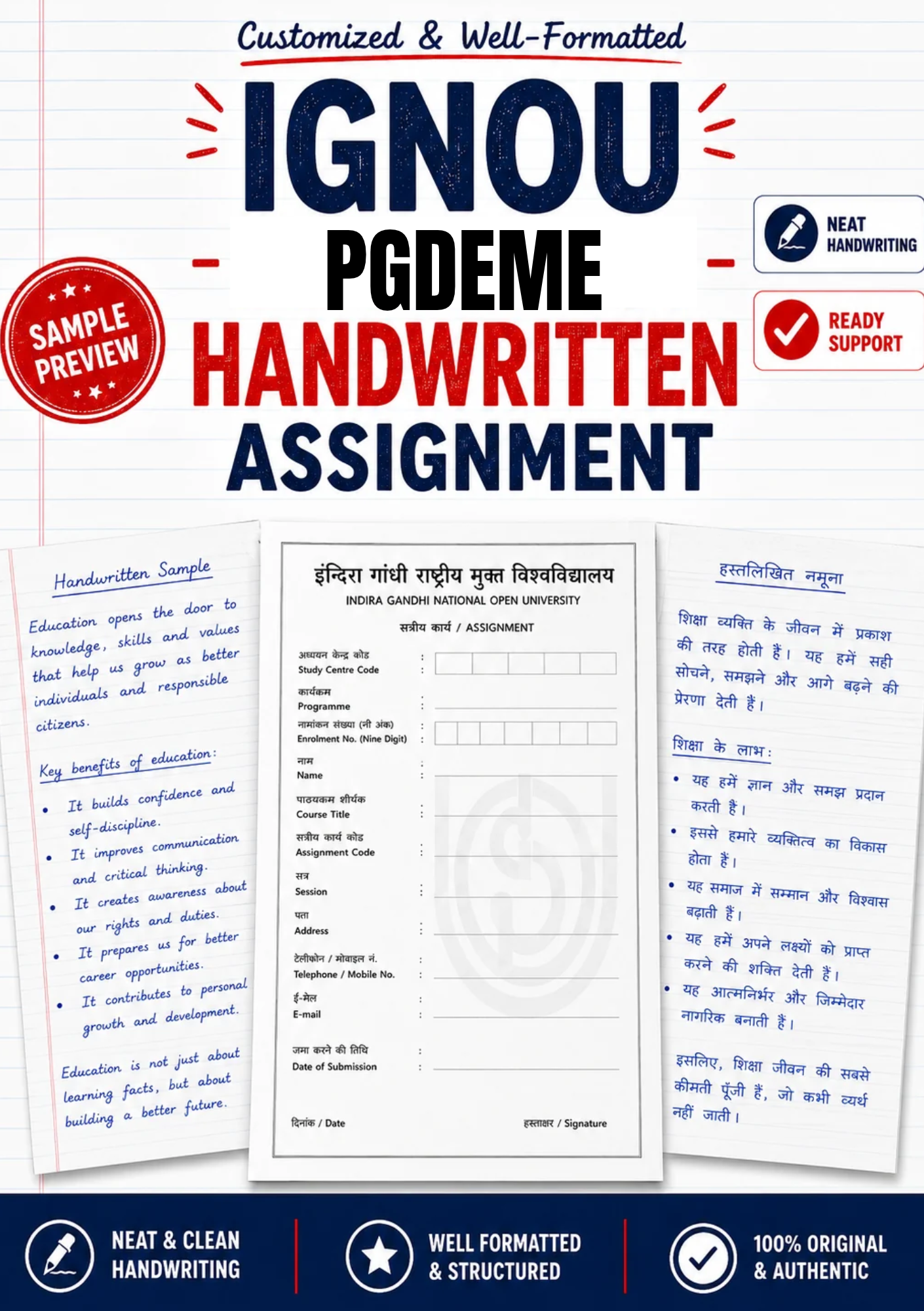
Four things travel in the packet for every paper you order. The written answers themselves, on A4 sheets, written on one side and numbered through. An IGNOU-format cover sheet, filled in with the course code and assignment code and left unsigned, because the declaration is yours to sign. A photocopy of the official assignment paper for that course, which study centres routinely ask to see attached to the set. And the bundle tied or tagged so the pages stay in sequence between the courier bag and the counter.
The cover sheet matters more on an Electronic Media order than learners expect, because five of the six PGDEME papers sit on booklets that name a different programme on the front. A learner who copies the programme name off the booklet instead of off their admission record can hand in a set headed MAJEM or PGJMC. The sheet that travels with a Shri Chakradhar set carries PGDEME and the course code taken from what you tell us you are registered for, not from the booklet header.
A4 is the house standard here, and it is worth saying plainly why rather than attributing it to the university. No 2026 PGDEME booklet specifies a paper size at all. The MNM-001 paper for the January 2026 and July 2026 cycle sets out what to write on the first page, how to obtain a receipt and what to keep a photocopy of, and says nothing about sheet dimensions. A4 is therefore the publisher’s own default, chosen because it is what study centres across the country handle without comment.
The ₹320 Line on an Electronic Media Order, Itemised
One figure covers one course code, and the figure does not move with the credit load. MJM-120 carries six credits and MNM-002 carries four, and both are written at the same rate. The rate is ₹320 per subject, hard copy only, with courier included in that price and no separate shipping charge.
Inside the figure: the writing itself, the IGNOU-format front page, the photocopy of the question paper, the tying of the bundle, and the courier to your address. Outside the figure: nothing is added at checkout, and nothing is invoiced afterwards. There is no minimum order: one subject or fourteen, same rate. A learner with one MNM-004 backlog pays the same per-paper figure as a learner starting all six.
Two things sit genuinely outside the service, and saying so is more useful than implying a wider scope. MNMP-101, the eight-credit Project Work (Electronic Media), is project work and not assignment work, and it is not priced at the ₹320 rate. MNML-001, Practical: Electronic Media, is a production portfolio assessed from recorded material, and a written answer sheet is not the instrument it is marked on. Both are dealt with further down this page.
Delivery depends on your pin code and is confirmed for your order before you pay. No figure is promised on this page. The reason for that wording is not caution for its own sake: courier timelines out of Delhi to a study centre in Imphal and to one in Faridabad are not the same number, and a page that prints one number is wrong for most of the people reading it.
If a code combination you need is not on this page, you can ask for a figure against your own code list instead of working from the catalogue.
Six Bundles for the Counter, or One PDF for the Desk
These are two different products and learners routinely buy the wrong one. A solved assignment is a soft-copy reference file of model answers for a course code and a session, read on a screen or printed out, used as material to write from. A handwritten assignment is the answers written out by hand on A4 and submitted in hard copy at the study centre. The first is study material. The second is the thing that gets handed over a counter.
| Where the two differ | Downloadable answer file | Written set in your hand |
|---|---|---|
| What you receive | A file of model answers for the code and cycle | Tied A4 bundles, one per course code, in your own handwriting |
| What you do next | Read it, then write the answers out yourself | Check it, sign the declaration, submit it |
| Who it suits | A learner who wants to write but wants the ground covered first | A learner who has the understanding but not the writing hours |
| Can it be submitted as it stands | No. A printed or typed file is not a submission | Yes, once you have read it and signed the cover page |
| Rate on this store | Priced per code on the solved-assignment shelf | ₹320 per subject, courier included |
The table scrolls sideways on a narrow screen.
The rule behind the fourth row is not inferred. It is printed on the PGDEME paper itself. The MNM-001 booklet for the January 2026 and July 2026 cycle, signed by Dr. Amit Kumar as Programme Coordinator, PGDEME, instructs the learner on writing the final version neatly and then states: Only handwritten assignments will be accepted.
That sentence is on the PGDEME-labelled paper. It is worth noting that the MNM-002 booklet of the same session carries no equivalent sentence, which is one of several places where two papers for one diploma do not say the same thing.
So a downloaded file cannot be walked into a study centre. It can be excellent raw material, and for a learner who intends to write their own six papers it is often the better purchase. Those files for this diploma live on the PGDEME model-answer shelf, which is where that query belongs rather than here. This page sells the written set, and only the written set.
One rate, six possible papers, nothing added later.
The rate is ₹320 per subject, hard copy only, with courier included in that price and no separate shipping charge. There is no minimum order: one subject or fourteen, same rate.
To begin, send the six codes and the session you are writing for on WhatsApp at +91 93546 37830.
The Six PGDEME Papers That Actually Carry a TMA
The table below is read off the Common Prospectus July 2026, section 8.28, page 286 to 287, and checked against IGNOU’s PGDEME Programme Guide and the live 2026 booklets. The credit column sums to 40 across all eight courses, matching the stated total: six plus six plus four plus four plus four plus four plus four plus eight.
| PGDEME paper | Title printed in the prospectus | PGDEME credit value | Which 2026 file carries it | Programme named on that file |
|---|---|---|---|---|
| MJM 120 | Introduction to Journalism & Mass Communication | 6 | MJM-020-120-Jan-July-26.pdf | MAJMC, MAJMCOL, PGJMC, PGJMCOL |
| MJM 124 | Media & Society | 6 | Same first-year MJM file | MAJMC, MAJMCOL, PGJMC, PGJMCOL |
| MNM 001 | Broadcast & Digital Journalism | 4 | MNM-001-Jan-26-July-26.pdf | PGDEME |
| MNM 002 | Audio Production | 4 | MNM-002-Jan-26-July-26.pdf | MAJEM |
| MNM-003 | Digital Photography & Videography | 4 | Inside the same MNM-002 file | MAJEM |
| MNM-004 | Audiovisual Production | 4 | Inside the same MNM-002 file | MAJEM |
Scroll the table sideways to reach the booklet columns.
Read the last column again, because it is the single most useful thing on this page. Of the six PGDEME papers that carry an assignment, exactly one sits on a 2026 booklet that names PGDEME. MNM-001 has its own file and its own PGDEME signature line. MNM-002, MNM-003 and MNM-004 are bundled into one MAJEM file whose opening instruction tells the learner to submit one assignment for each of MNM 002, MJM 028, MJM 031, MNM 003 and MNM 004, and MJM 028 and MJM 031 are not PGDEME courses at all. MJM-120 and MJM-124 are inside a first-year file whose cover names four programmes, none of them PGDEME.
That is why the first thing asked of a PGDEME learner ordering here is the code list from their admission record rather than from a booklet. The paper is correct; the label on the front of it is not a reliable guide to who the paper belongs to. A learner who concludes from the MJM file header that they are a PGJMC student, or from the MNM-002 file that they owe MJM 031, has been misled by IGNOU’s own publishing, not by carelessness.
The code strings themselves are also not stable. Spaces and hyphens vary inside one prospectus table: MJM 120, MJM 124, MNM 001 and MNM 002 are printed with spaces, while MNM-003, MNM-004, MNML-001 and MNMP-101 are printed with hyphens, in the same eight-row block. When you send codes, send them any way you like. MNM 3, MNM-003 and MNM003 all reach the same paper here.
| Code now in use | Code it replaced | Title carried over | Credit weight then | Credit weight now |
|---|---|---|---|---|
| MJM 120 | MJM-020 | Introduction to Journalism and Mass Communication | 4 | 6 |
| MJM 124 | MJM-024 | Media and Society | 4 | 6 |
| MNMP-101 | MNMP-001 | Project Work (Electronic Media) | 4 | 8 |
| MNM 001 to MNM-004 | Unchanged | The four MNM theory papers | 4 each | 4 each |
| MNML-001 | Unchanged | Practical: Electronic Media | 4 | 4 |
Scroll sideways for the credit columns.
This second table is the key to a contradiction that has puzzled learners for years, and it is set out in full in the next section but one. The earlier PGDEME really did run eight four-credit courses for 32 credits, on the MJM-020 and MJM-024 codes, with a four-credit MNMP-001 project. The July 2022 and January 2023 PGDEME assignment booklet lists exactly MJM-020, MJM-024, MNM-001, MNM-002, MNM-003 and MNM-004, which is that generation. Backlog papers from those cycles are written here at the same rate as current ones.
MNML-001 and MNMP-101: Two Courses No Assignment Covers
Eight courses, six assignments. The arithmetic is IGNOU’s, not an inference drawn here. Section 5.1 of the PGDEME Programme Guide states that there are a total of 6 Assignments for the theory courses, and the two courses left out are the two that are not theory.
| Non-TMA course | Assessment route for it | Its credit share | Whether a TMA exists |
|---|---|---|---|
| MNML-001 | Practical: Electronic Media, assessed from a production portfolio | 4 | No TMA. The practical manual is published only in digital form on eGyankosh |
| MNMP-101 | Project Work (Electronic Media) | 8 | No TMA. A project report with a separate submission route and its own handbook |
The table scrolls sideways on a phone.
Twelve of the forty PGDEME credits therefore sit outside assignment work entirely. For a diploma that is a large share, and it changes what a learner should expect to spend on written sets: six papers at the per-subject rate, not eight. A page that implied eight would be selling two things that do not exist.
MNMP-101 is a genuine piece of work with its own requirements. The Programme Guide notes that assignments and projects can be submitted after completion of six months and before one year, and that the project manual is available only in digital format at eGyankosh. If the project is what you are actually stuck on, the project route for the eight-credit paper is a different shelf on this store and is not priced or handled as an assignment.
There is a wrinkle on the project code that is covered in the contradiction list below, because this publisher’s own properties are part of it. The prospectus, the Programme Guide, the Samarth admission portal and IGNOU’s MAJEM course pages all print MNMP-101 at eight credits. Older third-party syllabus listings and question-paper indexes print MNMP-001, Project Work, at four credits with a 32-credit programme total. Both strings are in circulation, and a learner searching on one will miss material filed under the other.
Twenty-Seven Places the PGDEME Record Argues With Itself
This section exists because PGDEME is unusually badly documented, and because a learner who knows where the paperwork disagrees makes better decisions than one who does not. Twenty-four of the findings below are IGNOU’s. Three are this publisher’s own, and they are listed in the same box rather than quietly fixed, because disclosing them is the stronger position.
Read this before you accept any single document as settled, including this one.
1. The Common Prospectus July 2026, in the PGDEME section itself, states that the programme has eight courses each of which is of four credits. Eight four-credit courses is 32 credits. The table printed directly beneath that sentence shows 6, 6, 4, 4, 4, 4, 4 and 8, totalling the stated 40.
2. IGNOU’s own PGDEME Programme Guide repeats the error in different words: the programme consists of 40 credits, which have been equally distributed in eight courses. Forty divided by eight is five. No PGDEME course carries five credits.
3. Both sentences are survivals from the earlier structure. The pre-revision PGDEME ran MJM-020 and MJM-024 at four credits each and MNMP-001 at four, which really did make eight four-credit courses and 32 credits. The tables were revised and the sentences were not.
4. Two live codes for the project course. The prospectus, the Programme Guide, the Samarth admission portal and IGNOU’s MAJEM pages print MNMP-101 at 8 credits. Third-party syllabus and question-paper indexes print MNMP-001, Project Work, at 4 credits, with a 32-credit total for the diploma.
5. The medium is stated two ways by the university. The prospectus gives Medium of Instruction: English, and annexure row 153 gives English. Section 2.5 of the Programme Guide states that the University allows students to submit assignments, production portfolio (practical) and project work in Hindi also.
6. IGNOU’s live PGDEME programme page lists six courses, not eight. MNML-001 and MNMP-101 are absent, so the page describes 28 credits of a 40-credit diploma.
7. That same page labels all six listed courses Theory, and leaves the Coordinator field blank on every one.
8. On that page the course introductions refer to MJM-020 and MJM-024 while the codes displayed above them read MJM-120 and MJM-124.
9. That page lists MNM-001 last, after MNM-004. The prospectus lists it third, immediately after the two MJM papers.
10. Eligibility is worded three ways. The prospectus says a Bachelor’s Degree in any discipline from a recognized university. The live page says Graduate in any Discpline, with that spelling. The Samarth admission portal says a 3-year Bachelor Degree in any Discipline.
11. MJM 120 is titled Introduction to Journalism & Mass Communication in the PGDEME table and Introduction to Journalism and Mass Communication in the PGJMC and MAJEM tables of the same prospectus.
12. MJM 124 is Media & Society in the PGDEME table and Media and Society elsewhere in the same document. MNM 003 is Digital Photography & Videography in one table and Digital Photography and Videography in another.
13. Hyphenation is inconsistent inside the single eight-row PGDEME table: MJM 120, MJM 124, MNM 001 and MNM 002 with spaces, MNM-003, MNM-004, MNML-001 and MNMP-101 with hyphens.
14. The school’s own name is printed two ways in one prospectus: School of Journalism and New Media Studies in several sections, School of Journalism & New Media Studies at the head of the PGDEME section.
15. Media and Society exists at two codes and two credit values. MJM 124 is 6 credits on the SOJNMS programmes. MJM 024, titled Media and Society (SOJNMS), is offered at 4 credits as an open elective into the MA Sociology structure. A Regional Centre counselling timetable for April 2026 schedules MJM-024 and MJM-124 as one teaching slot.
16. Two booklets of one session, one school and one coordinator do not agree on who they are for. MNM-001-Jan-26-July-26.pdf is signed Programme Coordinator, PGDEME. MNM-002-Jan-26-July-26.pdf is signed Programme Coordinator, MAJEM and instructs the learner to submit one assignment for each of MNM 002, MJM 028, MJM 031, MNM 003 and MNM 004. MJM 028 and MJM 031 are not PGDEME courses.
17. The first-year MJM file, MJM-020-120-Jan-July-26.pdf, carries MJM-120 and MJM-124 and names MAJMC, MAJMCOL, PGJMC and PGJMCOL on its cover. The strings PGDEME and MAJEM do not appear anywhere in it. So five of the six PGDEME assignment papers are published under a programme name that is not PGDEME.
18. That same MJM file tells the learner to submit one assignment in each of the eight courses while listing six course codes on its cover.
19. Its cover prints Post Graduate Diploma in Journalism Mass Communication, with the word in missing from the programme title.
20. Within one school there are now three date regimes for 2026. The PGDEME-family papers print 31st March for TEE June and 30th September for TEE December, keyed to the examination. The 2026 PGJMC and PGDIDM papers print no calendar date at all and substitute a check-the-website line. The 2026 PGDDC papers print dates keyed to the admission cycle.
21. The examination paper names the diploma where the assignment paper does not. The December 2025 term-end paper for MNM-002 is headed P. G. DIPLOMA IN ELECTRONIC MEDIA/M. A. IN JOURNALISM AND ELECTRONIC MEDIA (PGDEME/MAJEM). The assignment paper for the same course names only MAJEM.
22. PGDEME shares six of its eight course codes with the two-year MAJEM, yet the prospectus states that the MAJEM exit award after one year is PGJMC, and sets out lateral entry into MAJEM year two for PGJMC holders only. No route from PGDEME into MAJEM is stated, although a PGDEME holder has cleared six MAJEM courses.
23. MNM 001, Broadcast & Digital Journalism, and MJM 023, Broadcast and Online Journalism, are near-identical titles under different prefixes in the same prospectus. MNM 001 and MNML-001 appear in no prospectus table other than PGDEME’s.
24. The two instruments for one course follow opposite rules. The 2026 MNM-002 assignment is 100 marks, five questions at 20 marks each, around 600 words per answer, all compulsory. The June 2025 term-end paper for the same course prints eight questions and asks for any four.
25. This publisher’s own properties print the project course three ways. The store lists PGDEME project products as MNMP 1. The same publisher’s Amazon listing for the same item reads MNMP-101. On ignouproject.com one article is filed for MNMP-101, a second for MNMP-1, and a MAJEM article is titled for MNMP-001. One course, four strings, one owner.
26. This store sells an IGNOU PGDEME 1st Semester Study Materials and Books Combo naming MJM 20, MJM 24, MNM 1 and MNM 2. The prospectus annexure runs PGDEME year-wise, not semester-wise, and the combo is built on the superseded MJM-020 and MJM-024 codes.
27. Legacy product copy elsewhere on this store still carries a marks assurance, a no-rejection claim, two different delivery timelines, an unsupported market-leadership superlative, a price meta value of 350 against the ₹320 advertised, a third handwritten price of ₹300 on one course page, and two different founding years for one company. None of that appears on this page, and all of it is queued for correction at source.
Nothing in that list means a PGDEME learner is in difficulty. It means the paperwork is unreliable and the admission record is the only thing worth trusting about your own enrolment. Programme structures, course codes, submission dates and rules change, and only ignou.ac.in and your Regional Centre can confirm the current position for your enrolment.
Why a PGDEME Cut-Off Is Keyed to the Examination, Not the Intake
The due-date line on the 2026 PGDEME papers reads, verbatim: 31st March for TEE June and 30th September for TEE December. Please check the website for the latest update on due date. Both the MNM-001 file and the MNM-002 file print it identically.
Notice what that sentence is pinned to. It is not pinned to your admission cycle. It is pinned to the term-end examination you intend to sit. That distinction is the part learners get wrong, and it moves the real date by up to a year.
Work it through. A learner admitted in the July 2026 cycle becomes eligible for the June 2027 examination. Their effective assignment cut-off is therefore 31 March 2027, not 31 March 2026. A learner admitted in January 2026 who plans to sit the December 2026 examination is working to 30 September 2026. Two learners holding the same booklet, printing the same sentence, have different dates, and the booklet does not spell either of them out.
This is not how the neighbouring programmes in the same school behave, which is worth knowing if you have read guidance written for one of them. The 2026 PGJMC and PGDIDM papers print no calendar date whatsoever and tell the learner to check the university website. The 2026 PGDDC papers print dates tied to the admission cycle instead. One school, three conventions, in one session. Aggregator sites that publish a single IGNOU assignment last date for all courses are flattening all of this, and a learner who relies on such a table is reading someone else’s deadline.
Both PGDEME papers also carry the escape clause in the same breath as the dates: please check the website for the latest update on due date. IGNOU has in practice extended assignment deadlines in several recent cycles. The dates above are what the papers print, and the university website is what governs.
The practical consequence for ordering is simple. Papers expire. IGNOU replaces the assignment paper each cycle, and answers written against a withdrawn paper are answers to questions nobody asked. Tell us the cycle you are submitting for and the set is written against that paper rather than the newest one on the portal.
Copying MNM-001/Jan26/July26 Without Losing the Slashes
Every PGDEME paper prints an assignment code, and it goes on the first page of your answer sheet exactly as published. The 2026 strings are MNM-001/Jan26/July26 and MNM-002/Jan26/July26. For the two MJM papers the first-year file prints the code bare, as MJM-020/120, carrying both the old and the new number in one string, with the session given separately as January 2026/ July 2026.
Three things are worth noticing in those strings. There is no TMA element. The whole SOJNMS 2026 set omits it, so a learner who has seen codes like MRD-201/AST/TMA-1/2025-2026 on another programme and expects the same shape will not find it here. The year appears twice in two-digit form, Jan26 and July26, rather than once. And the separator is a forward slash throughout, with no spaces.
The MJM-020/120 form deserves its own sentence, because it looks like a typing error and is not. It is one paper serving two code generations at once, which is why a Regional Centre timetable schedules MJM-020 and MJM-120 in a single slot with one counsellor. If your admission record says MJM-120 and the booklet says MJM-020/120, you are holding the right paper.
What this means at the point of writing: the code line is transcribed from the paper for the cycle you name, character for character, slashes included. It is a small thing that study centres do check, and a set carrying last cycle’s code string invites a question at the counter that nobody needs.
The current papers are published per course under IGNOU’s own the per-course assignment downloads IGNOU publishes itself, which is where to verify any string on this page against the live file.
The Sample Photograph, and Why It Travels Before Any Money Does
The order runs sample first, payment second. Send a photo of a page you have written yourself and the handwritten set is matched to your handwriting at no extra charge. The matching happens before you pay, which means the risk of receiving six bundles in a hand that is visibly not yours is removed from the transaction rather than absorbed by you.
The reason this matters on PGDEME more than on some diplomas is the sheer volume. Six papers at 100 marks each, five questions apiece, with most answers set at around 600 words, is a large body of writing in one hand. Inconsistency across that volume is noticeable. Matching from a sample is how a set of six reads as one person’s work rather than six.
Choosing the page, and what the camera needs to catch
One page is enough, and an ordinary one is better than a careful one. A page from any notebook, written at your normal speed, photographed flat in daylight with the whole sheet in frame and the camera square to the paper. What is being read off it is letter shape, slant, spacing, how you join letters and how you form numerals and the stray punctuation that gives a hand its character. A page written slowly in your best script is less useful, because it is not the hand you would have written the assignment in.
If something about the match is not right when you see it, say so before the set is written rather than after. That is the whole point of the sample arriving first.
English on the Prospectus, Hindi in the Programme Guide, Any Cycle Accepted
PGDEME is printed as an English-medium diploma in both places the prospectus states a medium: the programme section gives Medium of Instruction: English, and annexure row 153 gives English. IGNOU’s live programme page agrees.
Section 2.5 of the Programme Guide does not. It states that the University allows students to submit assignments, production portfolio (practical) and project work in Hindi also. So a learner who wants to write in Hindi has a sentence from the university supporting them and a prospectus line that appears to rule it out, and the only people who can settle it for a particular enrolment are the study centre and the Regional Centre. The service covers all mediums IGNOU issues the TMA paper in, at the same price. If IGNOU publishes a Hindi PGDEME paper for your cycle, it is written at the same rate; if your centre accepts Hindi against the English paper, say so when you order and that is what is written.
Session coverage carries no asterisk. Any session is accepted, current cycle or older, including backlog courses, at the same ₹320 per subject. On this diploma that genuinely reaches back into a different code generation: a learner clearing an MJM-020 or MJM-024 backlog from the 32-credit structure, or an MNMP-001 era paper, is ordering from the same page at the same figure as a learner starting MJM-120 this cycle. Say which cycle the paper belongs to if it is no longer on the portal, and the set is written against the booklet of that cycle.
The Five Details That Turn an Enquiry Into a Written Set
A quote needs five things and nothing more. Everything else can be settled afterwards.
- The course codes you are registered for. From your admission record, not from a booklet cover. Any of the six, in any format.
- The session and the examination you are writing for. January or July, and the June or December term-end sitting, because the cut-off is keyed to the examination.
- The medium you intend to submit in. English, or Hindi if your centre accepts it.
- A photograph of one page in your own handwriting. Ordinary, flat, in daylight.
- The delivery address with its pin code. This is what the courier timeline is confirmed against before you pay.
What is not needed: your password, your fee receipts, your identity documents, or a scan of your study material. If a request for any of those reaches you in the name of an assignment order, it did not come from here.
Six papers, or the one you are short of.
Assignments carry 30 per cent of the final course result and the term-end examination carries the remaining 70 per cent. No soft copy or PDF is sold. Delivery depends on your pin code and is confirmed for your order before you pay. No figure is promised on this page.
You can open a PGDEME order with your enrolment number whenever the code list is ready.
After Delivery: The Three Steps That Stay With You
The packet arriving is not the end of the process, and the remaining steps are yours by design rather than by omission.
First, read it. You sign the declaration on the assignment cover page, so you should read and review the content before submitting it, and satisfy yourself that it represents your own understanding of the course. On a six-paper PGDEME order that is a real afternoon of reading, and it is the step that makes the signature honest.
Second, sign and submit. The MNM-001 booklet directs the learner to submit the assignments to the Coordinator of their Study Centre or to the Programme Coordinator, and to write the enrolment number, name, address, assignment code and study centre code on the first page. It also tells the learner to obtain a receipt and to keep a photocopy of the assignments before handing them over. Both instructions are worth following literally: the receipt is the only evidence of submission you will hold, and the photocopy is what you fall back on if a bundle goes astray at the centre.
Third, wait and check. Assignment marks reach your grade card after the centre forwards them to the Student Evaluation Division, and the timeline for that is not something this page can promise. No claim is made about the marks any assignment will receive, about how an evaluator will assess it, or about whether it will be accepted. Assignment evaluation is entirely a matter for IGNOU.
Where Else an Electronic Media Learner Shops on This Store
A written set answers one part of a PGDEME year. The rest of the catalogue for this diploma is worth knowing about, if only to avoid buying the wrong thing twice.
Study material comes first for most learners, and there are nineteen titles on the PGDEME shelf under diploma books, which is the deepest PGDEME section on the store. Closer to the examination, guess papers built for the Electronic Media sitting work from the term-end pattern rather than the assignment pattern, which matters here because the two instruments follow opposite question rules.
Because PGDEME shares six codes with the two-year master’s, two neighbouring products overlap with this one and it is worth being clear about which you want. The MAJEM written set, covering the same six codes plus the year-two papers is the right page if you are enrolled on the master’s rather than the diploma, and MAJEM study material goes with it. The two MJM papers also sit on the journalism diploma, so the PGJMC written set is where a learner who read the MJM booklet cover and concluded they were a PGJMC student should check before ordering. MNM-003 is shared again with digital media, which is covered by the PGDIDM written set.
For anything the catalogue does not list, including an unusual mix of backlog codes across two generations, there is a made-to-order written set for any session. And every programme on the store sits under the full handwritten catalogue if you are ordering for more than one enrolment.
If you would rather write the six papers yourself, the editorial side of this publisher covers the same code family at an article on the MJM, MNM and MNMP codes, written for learners doing their own writing rather than buying a set.
What PGDEME Learners Ask Before They Order
How many assignments does PGDEME actually have?
Six. The diploma has eight courses for 40 credits, but section 5.1 of IGNOU’s PGDEME Programme Guide states that there are a total of 6 Assignments for the theory courses. MNML-001 is a practical assessed from a production portfolio and MNMP-101 is an eight-credit project, and neither carries a tutor marked assignment. The six that do are MJM-120, MJM-124, MNM-001, MNM-002, MNM-003 and MNM-004.
Why does the MNM-002 booklet say MAJEM when I am a PGDEME student?
Because IGNOU publishes that paper under the master’s programme and has not produced a separate PGDEME edition of it. MNM-002-Jan-26-July-26.pdf is signed Programme Coordinator, MAJEM and its opening instruction lists MNM 002, MJM 028, MJM 031, MNM 003 and MNM 004. MJM 028 and MJM 031 are MAJEM year-two courses and are not part of PGDEME. The questions for MNM-002, MNM-003 and MNM-004 inside that file are the ones a PGDEME learner answers. Ignore the two codes that are not on your admission record.
Which file carries the MJM-120 and MJM-124 assignments?
The first-year MJM file, published as MJM-020-120-Jan-July-26.pdf. Its cover names MAJMC, MAJMCOL, PGJMC and PGJMCOL, and the strings PGDEME and MAJEM do not appear anywhere in it. It is still the correct paper for those two PGDEME courses. The same file also tells the learner to submit one assignment in each of the eight courses while listing six codes, which is PGJMC’s structure showing through rather than yours.
Can a typed or printed PGDEME assignment be submitted?
No. The MNM-001 booklet for the January 2026 and July 2026 cycle states that only handwritten assignments will be accepted. That is the PGDEME-labelled paper for this diploma, and it is the clearest instruction IGNOU has published on the point for Electronic Media. A printed file, however good the answers, is not a submission.
What is the difference between a PGDEME solved assignment and a handwritten one?
A solved assignment is a soft-copy reference file of model answers for a course code and session, meant to be read and written from. A handwritten assignment is the answers written out by hand on A4 and submitted in hard copy at the study centre. The first is study material you work from, the second is the object that crosses the counter. Learners who only need the ground covered are better served by the model-answer shelf; learners short of writing hours are the ones this page is for.
If a solved assignment PDF is printed out, can it be handed in?
No, and this is the most expensive misunderstanding on the diploma. A printed file is a printed file whatever its source, and the PGDEME paper rules out anything that is not handwritten. Printing a model-answer file and submitting it puts the submission at risk for no saving, because the file was never sold as a submission in the first place.
Is a handwritten set or a model-answer file the better buy for six papers?
It depends entirely on whether the shortage is understanding or time. A learner who wants to engage with the material and has the hours should buy the reference file and write the six papers themselves, which is the cheaper route and the one the university intends. A learner who understands the courses but cannot find the writing hours before the cut-off is buying time here, at ₹320 per subject, hard copy only, with courier included in that price and no separate shipping charge.
What is the last date for a PGDEME assignment?
The 2026 papers print 31st March for TEE June and 30th September for TEE December, followed by an instruction to check the website for the latest update. The date is keyed to the examination you will sit, not to the cycle you were admitted in, so a July 2026 admission writing the June 2027 examination is working to 31 March 2027. Two of the neighbouring diplomas in the same school print no date at all, so guidance written for them does not transfer.
Is the project code MNMP-101 or MNMP-001?
The Common Prospectus July 2026, the PGDEME Programme Guide, the Samarth admission portal and IGNOU’s MAJEM course pages all print MNMP-101 at eight credits, so that is the current code. MNMP-001 at four credits belongs to the earlier 32-credit structure and still appears in older syllabus listings and question-paper indexes. Search under both if you are hunting for material, and go by whichever appears on your own admission record.
Do MNML-001 and MNMP-101 need written answer sheets?
No. MNML-001 is assessed from a production portfolio and its practical manual is published only in digital form on eGyankosh. MNMP-101 is project work with its own handbook and submission route, and the Programme Guide notes that assignments and projects can be submitted after completion of six months and before one year. Twelve of the forty PGDEME credits therefore sit outside assignment work, and neither course is priced at the per-subject assignment rate here.
Can PGDEME assignments be written in Hindi?
The university says two different things. The prospectus prints Medium of Instruction: English in both places it states a medium. Section 2.5 of the Programme Guide says the University allows students to submit assignments, production portfolio and project work in Hindi also. Your study centre and Regional Centre are the only parties who can settle it for your enrolment. The service covers all mediums IGNOU issues the TMA paper in, at the same price.
I have an MJM-020 backlog from the older PGDEME. Can that still be written?
Yes. Any session is accepted, current cycle or older, including backlog courses, at the same ₹320 per subject. The earlier PGDEME ran MJM-020 and MJM-024 at four credits each in a 32-credit structure, and those papers are written here against the booklet for the cycle you owe rather than the current one. Say which cycle the backlog belongs to when you send the codes.
How many questions are on a PGDEME assignment paper?
Five, all compulsory, for 100 marks at 20 marks each, carrying 30 per cent weightage. Most answers are set at around 600 words, with the final question usually splitting into four short notes of 150 to 200 words. The term-end paper follows a different rule: the June 2025 paper for MNM-002 printed eight questions and asked for any four, so the two instruments are not interchangeable practice for each other.
Will the writing actually look like mine?
That is what the sample photograph is for, and it is why it is asked for before payment rather than after. Send a photo of a page you have written yourself and the handwritten set is matched to your handwriting at no extra charge. You see the match before any money changes hands, which matters more on a six-paper order than on a single one.
Is there a minimum number of papers to order?
No. There is no minimum order: one subject or fourteen, same rate. A learner clearing a single MNM-004 backlog pays the same per-paper figure as a learner commissioning all six at once, and nothing on this page is priced as a bundle.
Is PGDEME available in an online mode with a different code?
The Common Prospectus July 2026 lists PGDEME once, at annexure row 153, as a one-year to three-year programme run year-wise with January and July intakes, at Rs 9,500, and gives no separate online-mode code for it. Its sister diplomas in the same school do have online variants. If your enrolment letter shows a code other than PGDEME, send that code rather than this one, because the course set may differ.
Four Document Families Were Read for This Page
These four are not interchangeable, and where they disagree the disagreement is printed above rather than smoothed over.
The prospectus. IGNOU Common Prospectus July 2026, section 8.28 at pages 286 to 287 for the course table, credits and medium, and annexure row 153 for duration, fee and intake pattern. The MAJEM table at section 3.64 and the PGJMC table at section 8.25 were read against it to establish which codes PGDEME shares and where titles are spelled differently. Credits were summed before the table was trusted: 6 plus 6 plus 4 plus 4 plus 4 plus 4 plus 4 plus 8 is 40, matching the stated total.
The programme guide. IGNOU’s own PGDEME Programme Guide, published by the School of Journalism and New Media Studies, supplied the count of six assignments for the theory courses, the Hindi submission line at section 2.5, the note that the practical and project manuals exist only in digital form on eGyankosh, and the six-months-to-one-year project window.
The live booklets. Two 2026 assignment papers were retrieved and read rather than assumed: MNM-001-Jan-26-July-26.pdf and MNM-002-Jan-26-July-26.pdf, both from the School of Journalism and New Media Studies for the January 2026 and July 2026 cycle. The first-year MJM file carrying MJM-120 and MJM-124 was retrieved as well. Submission dates, assignment-code strings, marks, question patterns, the handwriting instruction and the cover applicability lists in this page all come from those files. The earlier July 2022 and January 2023 PGDEME booklet was read for the superseded code set. IGNOU’s live PGDEME programme page and the Samarth admission portal entry were read for the structural discrepancies listed above.
This publisher’s commercial terms. The rate, what is included in it, the session and medium coverage, the handwriting-sample process and the order steps are Shri Chakradhar Publication’s own terms. They are not IGNOU rules and are not presented as any. Where this publisher’s own properties contradict each other, items 25 to 27 of the list above say so.
Important Notice
Shri Chakradhar Publication Pvt. Ltd. and shrichakradhar.com form an independent IGNOU study-support publisher. This is not the official website of Indira Gandhi National Open University, is not affiliated with, endorsed by or authorised by the university, and no page on this site should be treated as an official IGNOU communication.
Programme structures, course codes, submission dates and rules change, and only ignou.ac.in and your Regional Centre can confirm the current position for your enrolment.
You sign the declaration on the assignment cover page, so you should read and review the content before submitting it, and satisfy yourself that it represents your own understanding of the course.
No claim is made about the marks any assignment will receive, about how an evaluator will assess it, or about whether it will be accepted. Assignment evaluation is entirely a matter for IGNOU.
Which of the Six Are Still Unwritten?
MJM-120, MJM-124, MNM-001, MNM-002, MNM-003, MNM-004. Name the ones still open on your record and the cycle you are submitting for, and a figure comes back against that list. The rate is ₹320 per subject, hard copy only, with courier included in that price and no separate shipping charge. Any session is accepted, current cycle or older, including backlog courses, at the same ₹320 per subject.
Two ways in. Either list the codes still open on your record, or start by sending one sample page and settle the code list afterwards. WhatsApp +91 93546 37830.
No soft copy or PDF is sold. Delivery depends on your pin code and is confirmed for your order before you pay. No figure is promised on this page.