

Description
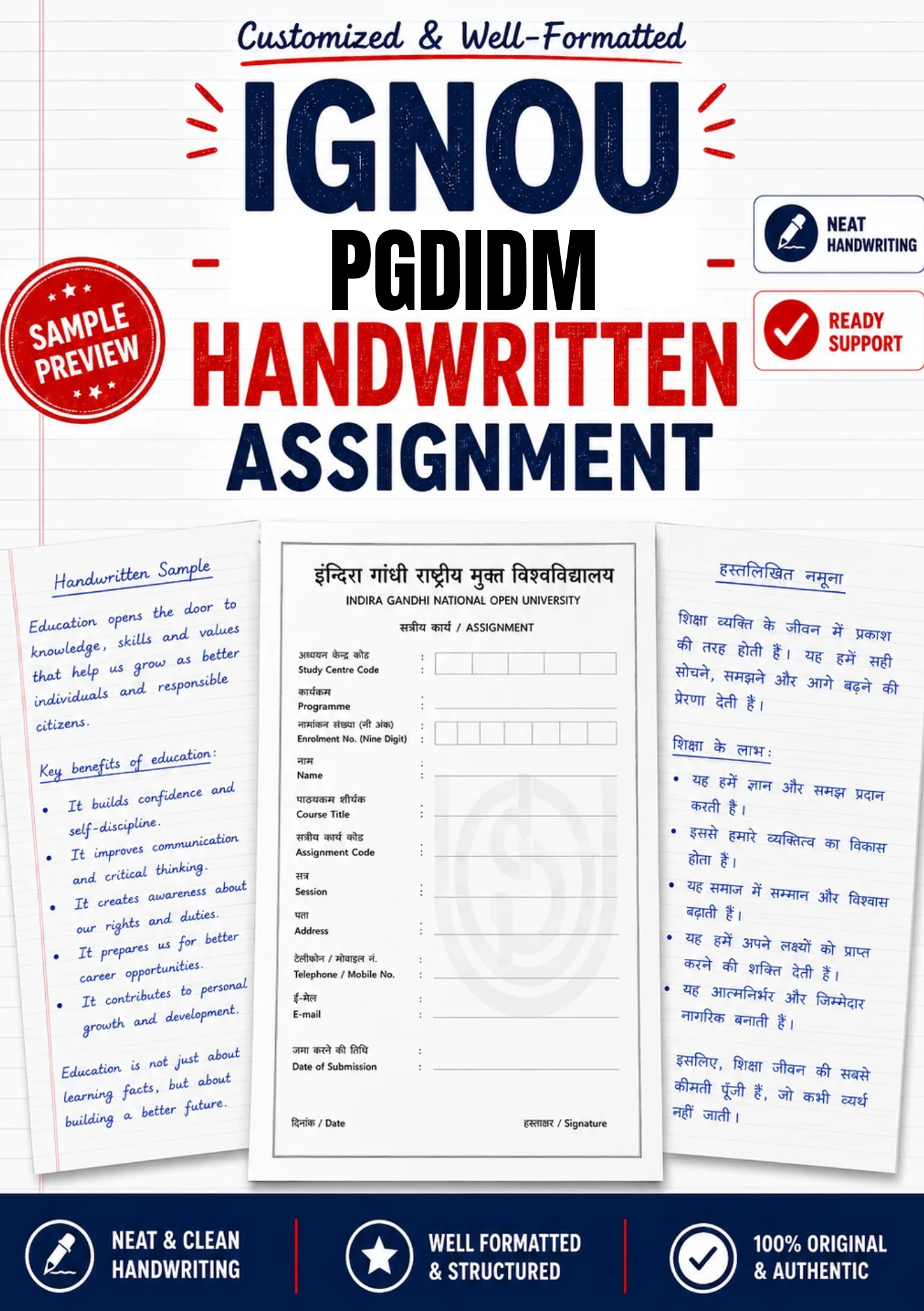
In short. Shri Chakradhar Publication prepares handwritten assignment sets for the IGNOU Post Graduate Diploma in Digital Media, written out by hand on A4 and sent as a hard copy. Seven of the nine courses on the current 40-credit PGDIDM structure have a live 2026 question paper: MNM 011, MJM 021, MNM 003, MJM 023, MNM 013, MNM 014 and MJM 025. MNM 037 Social Media and Society and the eight-credit practical MNML 012 have no 2026 paper that could be found on ignou.ac.in, so neither is priced. The five older papers MNM 011 to MNM 015, which IGNOU’s own 2025 cover line files as PGDIDM (Old) and which Regional Centre counselling timetables were still running in April 2026, are written on the same terms. The rate is ₹320 per subject, hard copy only, with courier included in that price and no separate shipping charge. No PGDIDM paper has printed a calendar submission date since 2024; every 2026 booklet substitutes a line telling the learner to check the university website, so the set is written against the paper in your hand rather than against a date circulated by an aggregator. Send the codes from your admission record to WhatsApp +91 93546 37830 for a total.
What Reaches You When a PGDIDM Order Ships
A PGDIDM order is counted in papers, not in semesters. The diploma has no semester split in the prospectus table, and because the eight theory courses are drawn from two different code families, two learners admitted in the same cycle can hold different sets depending on when they registered. So the parcel is assembled around the codes you name, and four physical things travel for each one.
- The answer sheets. Each course is written out by hand on A4, one paper per bundle, answers separated and numbered the way the booklet instruction asks. A4 is this publisher’s default rather than an IGNOU rule here, because no PGDIDM booklet specifies a paper size at all; if your study centre asks for foolscap, say so when ordering and the set is written on foolscap instead. A PGDIDM paper carries five questions at 20 marks each to a maximum of 100, with a word limit of about 500 per answer, so a single course runs to roughly 2,500 written words.
- The IGNOU-format cover page, filled in. One per paper, free with every order, with the enrolment number, name, address, assignment code and study centre code entered on the first page, which is exactly the list the MNM 2026 booklets require there.
- A copy of the official question paper. The paper the answers were written against travels with them, so the set can be checked against the questions without opening a browser, and so the correct one of the two live MJM files is on the record.
- Nothing digital. No soft copy or PDF is sold. There is no download link, no shared folder and no emailed file attached to this product.
Every page arrives unsigned. You sign the declaration on the assignment cover page, so you should read and review the content before submitting it, and satisfy yourself that it represents your own understanding of the course.
Where ₹320 Starts and Stops on a Digital Media Order
One figure covers a PGDIDM paper end to end, and it is worth being plain about which costs sit inside it and which do not exist at all.
Inside the rate: the writing itself, the paper and ink, the free IGNOU-format cover sheet, the copy of the question paper, the handwriting match taken from your own sample, and the courier. There is no separate shipping charge, no packing fee, no per-page rate and no rush tier. There is no minimum order: one subject or fourteen, same rate. A learner who needs only MNM 014 pays for one paper; a learner clearing a full PGDIDM backlog pays the same per paper on all of them.
Outside the rate, and outside anyone’s control here: IGNOU’s own examination and practical fees, which the university’s live PGDIDM page records separately from the ₹10,000 programme fee, and anything the Regional Centre charges for a change of elective or a credit transfer into MAJDM. Also outside it is any promise about time. Delivery depends on your pin code and is confirmed for your order before you pay. No figure is promised on this page.
And one thing that cannot be bought at any price. No claim is made about the marks any assignment will receive, about how an evaluator will assess it, or about whether it will be accepted. Assignment evaluation is entirely a matter for IGNOU.
A Model-Answer PDF Beside a Set Built for the Counter
These two products get searched for interchangeably and they are not interchangeable, so the distinction is worth setting out once. A solved assignment is a soft-copy reference file of model answers for a course code and session, read on a screen and written from. A handwritten assignment is the answers written out by hand on A4 and submitted in hard copy at the study centre. One is study material. The other is the artefact that crosses the counter.
| What is being compared | Model-answer soft copy | Written hard copy |
|---|---|---|
| Form it arrives in | A file on a screen | A4 sheets in a courier bag |
| What you then do | Read it and write your own answers out | Check it, sign the declaration, hand it in |
| Handwriting | Yours, after you copy it across | Matched to your sample before writing starts |
| Who it suits | A learner with time who wants the reference | A learner with the deadline closer than the time |
| Price on this store | Per code, on the solved-assignment shelves | ₹320 per subject, courier included |
Scroll the table sideways on a narrow screen.
What IGNOU’s own PGDIDM booklet asks for settles the practical question. The MNM 2026 files instruct the learner to submit each assignment to the Coordinator of the Study Centre within the stipulated time in order to be eligible for the term-end examination, to write the identifying details on the first page, and to obtain and keep a Study Centre receipt. A downloaded file satisfies none of that on its own. It is a reference to write from, and it is not a submission; nothing on this page suggests a PDF can be handed in at a counter.
There is one wrinkle specific to this diploma. The booklets add that PGDIDMOL and MAJDMOL learners submit through the LMS instead, which is a different route with different requirements. If your enrolment is the online variant rather than the ODL diploma, read the section on the LMS split below before ordering anything physical.
For the reference side, the right shelf on this store is model answers filed under MAJDM, which is where the first-year MNM and MJM codes sit. That is not a slip. There is no PGDIDM solved-assignment category on this store at all, and because PGDIDM is course for course the first year of MAJDM, the MAJDM shelf is the accurate place for those codes. The gap in the store’s own taxonomy is listed with the other in-house problems further down.
Reading your codes off the admission record is the whole setup. A PGDIDM order needs the course codes, the session, and one photographed page of your handwriting. Nothing else, and nothing paid before the sample is agreed.
The rate is ₹320 per subject, hard copy only, with courier included in that price and no separate shipping charge.
Send the PGDIDM codes and a total comes back on WhatsApp +91 93546 37830.
The Current Eight PGDIDM Papers, and Which Carry a 2026 Booklet
Section 8.26 of the IGNOU Common Prospectus July 2026 sets out PGDIDM as a 40-credit diploma, one year minimum and three years maximum, English medium, at a programme fee of ₹10,000, taken in either the January or the July cycle. Eight theory courses of four credits each come to 32, and the practical MNML 012 adds eight, which is how the table reaches the 40 credits it states. That arithmetic checks out, which is worth saying because IGNOU’s own live course page for the same diploma does not add to 40.
Three of the eight theory codes carry the MJM prefix and are shared with the journalism programmes; five carry MNM. The last column below is the one that decides what can be priced, because a paper that has not been published cannot be written against.
| Course code | Title as the prospectus prints it | Course type | Credits | 2026 booklet retrieved |
|---|---|---|---|---|
| MNM 011 | Understanding Digital Media | Theory | 4 | Yes |
| MJM 021 | Reporting Techniques | Theory | 4 | Yes |
| MNM 003 | Digital Photography and Videography | Theory | 4 | Yes |
| MJM 023 | Broadcast and Online Journalism | Theory | 4 | Yes |
| MNM 013 | Media, Information and Empowerment | Theory | 4 | Yes |
| MNM 014 | Contemporary Scenario of Digital Media | Theory | 4 | Yes |
| MJM 025 | Media Laws and Ethics | Theory | 4 | Yes |
| MNM 037 | Social Media and Society | Theory | 4 | None found |
| MNML 012 | Digital Journalism Practical | Practical | 8 | None found |
Scroll the table sideways on a narrow screen.
Seven papers can therefore be written and are priced at ₹320 each. MNM 037 is the odd one. It is a PGDIDM course in the prospectus, it appeared in the 2025 consolidated file, and a December 2025 examination paper for it exists, but no 2026 assignment booklet could be retrieved under any of eight filename patterns tried. Its neighbour MNM 036 does have a 2026 booklet, and that file is labelled for MAJDM second year, with PGDIDM named nowhere on it. MNML 012 is a different case again: the prospectus states its practical manual exists only in digital form on eGyankosh, and no assignment paper or manual for it could be opened. Eight credits, a fifth of the diploma, with no written paper to prepare.
Nothing is quoted for either code until a paper for it is in hand. If your study centre has issued you an MNM 037 or MNML 012 paper locally, send a photograph of it and the set can be written against that document instead.
MNM 012 and MNM 015: The Papers IGNOU Files Under PGDIDM (Old)
This is the part a learner usually discovers at the counter rather than beforehand. Until the 2024 cycle, PGDIDM was a five-course diploma built entirely on the MNM 011 to MNM 015 series. The structure then changed, borrowing three MJM journalism papers and adding MNM 037 and the MNML 012 practical. Both populations are still live, and IGNOU says so in writing: the 2025 consolidated assignment file carries an extra line on its cover reserving MNM 012 and MNM 015 for PGDIDM (Old), and a Regional Centre counselling timetable for April 2026 was still scheduling classes in both of those courses for PGDIDM first-year learners.
| Code | Title as published | Credits last published | Still appears in |
|---|---|---|---|
| MNM 011 | Understanding Digital Media | 4 | Both the old and the current structure |
| MNM 012 | Digital Journalism | 4 | PGDIDM (Old) cover line, 2026 counselling timetable, this store’s shelf |
| MNM 013 | Media, Information and Empowerment | 4 | Both the old and the current structure |
| MNM 014 | Contemporary Scenario of Digital Media | 4 | Both the old and the current structure |
| MNM 015 | Media Research Methods | 4 | PGDIDM (Old) cover line, 2026 counselling timetable, this store’s shelf |
Scroll the table sideways on a narrow screen.
Two things follow from this and both matter commercially. First, neither MNM 012 nor MNM 015 appears anywhere in the Common Prospectus July 2026, and neither does the string MNM 015 in any form. A learner checking the current prospectus for a paper they are registered for will not find it, and may reasonably conclude they have the code wrong. They do not. Second, the title MNM 012 Digital Journalism survives into the current structure only as MNML 012 Digital Journalism Practical, a different course type at twice the credits. The resemblance between the two is a trap, not a continuity.
Papers from the older set are written on exactly the same terms. Any session is accepted, current cycle or older, including backlog courses, at the same ₹320 per subject. If you are holding a 2022 or 2023 PGDIDM paper, send that file rather than a current one, because those were the only PGDIDM booklets that ever printed real submission dates.
For reading material on that older set, this store already stocks the PGDIDM help books written for the five older MNM titles, with a separate book listing kept under the PGDIDMOL online code, and expected-question sets built for the fifty-mark PGDIDM examination paper. All three shelves predate the structure change, which is noted below rather than hidden.
Twenty-Two Places the PGDIDM Record Disagrees With Itself
This section exists because the research for this page kept turning up contradictions, and publishing them is more useful than publishing a tidy table that pretends they are not there. Fifteen of the twenty-two are in IGNOU’s own documents. Seven are on this store or its sister site, and those are listed too, because disclosing an in-house error is a stronger position than concealing it.
Read this before copying any code or title from anywhere, including from this page.
1. MJM 025 has three different titles in live IGNOU documents. The PGDIDM and MAJDM prospectus tables print Media Laws and Ethics. The PGJMC prospectus table, IGNOU’s live PGDIDM course page and both 2026 booklets print Media Ethics and Laws. An April 2026 Regional Centre counselling timetable prints Media Ethics and Law, singular.
2. MNM 003 is printed Digital Photography and Videography in the PGDIDM and MAJDM tables, and Digital Photography & Videography in the PGDEME and PGDAIC tables of the same prospectus, on IGNOU’s live page and on the booklets.
3. The prospectus says the diploma addresses three specific domains of ICT-enabled new media. IGNOU’s live PGDIDM page says two.
4. That live page prints MJM 021, MJM 023 and MJM 025 twice each. On the duplicate rows the year field renders as the literal text null 1.
5. The same page gives MNM 037 as an eight-credit course where the prospectus gives four, omits MNML 012 altogether, and so presents eleven rows adding to 48 credits for a diploma the prospectus settles at 40.
6. Each of MJM 021, MJM 023 and MJM 025 has two live 2026 booklets. One file names PGDIDM and PGDIDMOL on the cover and is signed by the MAJDM and PGDIDM coordinator. The other names only MAJMC and PGJMC and is signed by a different coordinator. A search for an MJM code and the year returns both.
7. Inside the single 2026 PGDIDM set, same coordinator and same cycle, five assignment codes are hyphenated and two are not. MNM 003 prints as MNM003 and MJM 025 prints as MJM025.
8. The same course in the same cycle prints MJM025 on the PGDIDM booklet and MJM-025 on the PGJMC one.
9. No 2026 SOJNMS booklet contains the string TMA anywhere, and the session suffix carried the year before, in the form MNM003/Jan&July25, has been dropped entirely.
10. Every 2026 PGDIDM booklet leaves the due date blank and substitutes an instruction to check the university website, while the covering letter in the very same file states that the submission deadline is provided for each assignment.
11. The two booklet families differ by one word in that sentence. The PGDIDM file says the University website. The PGJMC file says the website.
12. MNM 037 is listed as a PGDIDM course in the prospectus and has a December 2025 examination paper, but no 2026 assignment booklet could be retrieved for it. MNM 036 next to it does have one, labelled for MAJDM second year, with PGDIDM absent from both the cover and the coordinator’s printed title, and with the session pair separated by a slash where the PGDIDM family uses an ampersand.
13. MNML 012 carries eight credits, the largest single block in the diploma, and has neither an assignment booklet nor a retrievable practical manual on ignou.ac.in. The prospectus states the manual exists only in digital form on eGyankosh.
14. Word limits contradict themselves inside individual files. The MJM 023 2026 booklet states about 500 words per answer and then sets 300 to 400 words for question three. In the 2025 consolidated file, MNM 003 sets 600 words on three questions and 200 words per short note on another, and MNM 037 lists six questions with the sixth printed blank.
15. IGNOU’s own PGDIDM assignment archive index stops at the January to July 2025 cycle and carries no 2026 entry, so the university’s own navigation leads a learner to last cycle’s paper. Separately, the prospectus MAJDM entry states that a student completing the first year of MADJM is issued PGDIDM; MADJM appears nowhere else in the document, and the programme code is MAJDM.
16. In-house: the PGDIDM shelves on this store carry only MNM 11 to MNM 15. No product exists under PGDIDM for MJM 021, MJM 023, MJM 025, MNM 003, MNM 037 or MNML 012, which is six of the nine courses on the current structure.
17. In-house: this store and ignouproject.com both carry a PGDIDM project under the code MNMP 011, written as MNMP 11 in places. That code appears zero times in the Common Prospectus July 2026, and the current PGDIDM structure contains no project course at all.
18. In-house: there is no PGDIDM solved-assignment category on this store, although MAJMC, PGJMC, MAJDM, MAJEM and BAFJDM each have one.
19. In-house: the handwritten-assignment category description carries two different delivery promises, one of five to seven working days and one of seven to nine. Both contradict each other and neither is a promise this page makes.
20. In-house: the PGDIDM books category description makes an unqualified superiority claim for the book, states that 60 to 80 per cent of examination questions come from it, names four competing publishers, and lists not one course code.
21. In-house: three programmes on this store have two live handwritten products each, and four live product titles still contain editorial build notes in the Product Name field.
22. In-house: the store’s own taxonomy names this diploma three different ways across its categories, as PG Diploma in Digital Media, Post Graduate Diploma in Digital Media and Post Graduate Diploma in Digital Media (PGDIDMOL).
Programme structures, course codes, submission dates and rules change, and only ignou.ac.in and your Regional Centre can confirm the current position for your enrolment.
Why No PGDIDM Paper Has Printed a Submission Date Since 2024
Most IGNOU programmes give a learner two cut-off dates, one for each cycle, printed on the booklet. The School of Journalism and New Media Studies does not, and PGDIDM has not carried a real date for two cycles. Instead each 2026 booklet puts an instruction where the date belongs, telling the learner to check the university website for the latest update on the due date. That is the whole of it. There is no October or April pair on a PGDIDM paper.
This matters because the figures circulating elsewhere are not PGDIDM’s. Aggregator pages variously publish 30 September, 31 October, 30 April, 31 May and 15 June as the IGNOU assignment last date, and for many schools one of those is correct. The 31 October and 30 April pair belongs to the School of Management Studies. None of them is printed on a Digital Media paper. Writing a set against a date taken from a news article rather than from your own study centre is how a learner ends up submitting against the wrong cycle.
What the paper does print is two session lines, and they are easy to mistake for deadlines. Under the course title sits a pair such as September 2026 and March 2027. Under the assignment code sits January 2026 and July 2026. The first pair is the examination cycle the paper is valid for; the second is the admission cycle it was issued against. Neither is a date for handing anything in.
| Admission cycle | Assignment code as printed | Date printed on the paper |
|---|---|---|
| July 2021 and January 2022 | MNM-011/July 21/Jan22 | 30 April and 30 September 2022, both printed |
| July 2023 | MNM-011/July23 | 31 March 2024, printed beside the check-the-website line |
| January and July 2024 | MNM-011/Jan&July24, but MNM003 and MJM025 unhyphenated | None. Check-the-website line only |
| January and July 2025 | MNM003/Jan&July25 | None. Check-the-website line only |
| January and July 2026 | Bare code, no suffix at all | None. Check-the-website line only |
Scroll the table sideways on a narrow screen.
The practical consequence is simple enough. Your submission date comes from your study centre or your Regional Centre, not from this page and not from the booklet. What the booklet does establish is the condition attached to it: the set must reach the Study Centre Coordinator within the stipulated time for you to be eligible to sit the term-end examination. Assignments carry 30 per cent of the final course result and the term-end examination carries the remaining 70 per cent. The eligibility clause is doing more work here than the marks clause.
If you want to read the booklets yourself before ordering, they sit on the university’s own assignment download service, and the structure is on IGNOU’s live PGDIDM course page, with the caveats about that page already noted above.
Two Live Booklets Per MJM Code, and Only One Names PGDIDM
Three of the eight current PGDIDM theory courses are journalism papers borrowed from the MJM series, and the School of Journalism and New Media Studies publishes each of them twice for the same cycle under two different filenames. One version is the Digital Media edition. The other is the Mass Communication edition. They are not interchangeable.
The PGDIDM edition carries the cover heading naming PGDIDM, PGDIDMOL and the first year of MAJDM and MAJDMOL, and it is signed by the coordinator whose printed title covers all four of those programmes. The Mass Communication edition carries a cover naming only MAJMC, MAJMCOL, PGJMC and PGJMCOL first year, and is signed by a different coordinator whose title names only the journalism programmes. PGDIDM is not mentioned on it anywhere.
The differences between the two go beyond the cover. The PGDIDM edition prints both session lines, the examination pair and the admission pair; the Mass Communication edition prints only the admission pair. The PGDIDM edition carries the instruction about online-mode learners submitting through the LMS; the Mass Communication edition carries no LMS instruction at all. And the assignment code itself differs, with MJM025 on one and MJM-025 on the other for the same course in the same cycle.
So when the codes are sent across for a quote, the question that gets asked back is which file you are holding. If there is any doubt, a photograph of the cover page settles it in a second, and the set is written against the paper that names your programme. The PGJMC written set, which is built from the twin Mass Communication booklets, exists separately for exactly this reason.
One Photographed Page Fixes the Hand for Every Paper
The set is not written in a generic script. Send a photo of a page you have written yourself and the handwritten set is matched to your handwriting at no extra charge. The sample is seen and the match is agreed before any payment is taken, which is the point: the risk of not liking the hand sits before the money, not after it.
One sample covers the whole order. Seven PGDIDM papers at roughly 2,500 written words each is a substantial run, and a single agreed sample governs all of it, so the set reads as one person’s work rather than as seven different hands stapled together.
Lighting, ruling and length in the photograph you send
A usable sample is about ten to fifteen lines of ordinary continuous prose, written at your normal speed on ruled or plain A4, photographed flat in daylight with the whole page in frame. Avoid writing the sample unusually neatly, because what is needed is the hand that will plausibly have written the rest of the set. Capital letters alone, a signature, a shopping list or a screenshot of typed text are no use. If your examination answers are in a visibly faster hand than your assignment work, say so, and send a line of each.
English Only on Paper, and the LMS Rule That Splits PGDIDM From PGDIDMOL
PGDIDM is an English-medium diploma. The prospectus records the medium of instruction as English in both the programme section and the annexure row, and IGNOU’s live page agrees, which makes this one of the few SOJNMS programmes with no Hindi or Tamil edition to choose between. The service covers all mediums IGNOU issues the TMA paper in, at the same price. For this diploma that currently means one medium. Worth noting as well that the 2026 SOJNMS booklets do not use the term TMA at all, which is a labelling difference rather than a difference in what is submitted.
The split that does matter here is mode, not language. PGDIDM is the Open and Distance Learning diploma; PGDIDMOL is the online variant, and the prospectus lists it separately among the online programmes. The booklets state plainly that PGDIDMOL and MAJDMOL learners submit their assignments through the LMS, while everyone else submits to the Study Centre Coordinator. A couriered hard copy is built for the second route.
If your enrolment is PGDIDMOL, a written hard copy is not what the LMS asks for, and it would be dishonest to sell one on the basis that it is. What some online-mode learners do is write by hand and upload a scan, because the LMS accepts a scanned PDF of handwritten pages; whether that is permitted for your enrolment is a question for your Regional Centre, and the answer should come from them before any order is placed rather than after. This store would rather lose that order than place it on a guess.
Session coverage runs in the other direction without any such caveat. Any session is accepted, current cycle or older, including backlog courses, at the same ₹320 per subject. That includes the five-paper PGDIDM (Old) sets and the 2022 and 2023 cycles, where the papers did still print a real date.
The Details a PGDIDM Quote Needs Before It Can Be Given
Short list, and genuinely nothing beyond it. The first message does not need a scan of your identity card, a fee receipt or your marks.
- The course codes you are registered for. Read them off the admission record rather than off a syllabus page, given that two PGDIDM code generations are live at once.
- The session. January or July, and the year. If it is a backlog paper, the year of the paper you are holding, not the current one.
- Whether your enrolment is PGDIDM or PGDIDMOL. This decides whether a hard copy is the right thing at all.
- A photograph of the booklet cover, if you have it. For the three MJM codes this is what settles which of the two live papers is yours.
- One photographed page of your handwriting. As described above.
Delivery address and pin code come later, at the point of ordering, because the pin code is what the courier timing depends on. Delivery depends on your pin code and is confirmed for your order before you pay. No figure is promised on this page.
A single paper is a perfectly normal order on this diploma. Plenty of PGDIDM learners come for one code, usually MNM 014 or MJM 025, after clearing the rest themselves. There is no minimum order: one subject or fourteen, same rate.
The rate is ₹320 per subject, hard copy only, with courier included in that price and no separate shipping charge.
Ask what a single MNM or MJM paper comes to, or check whether an older MNM 012 or MNM 015 paper can still be written.
After the Parcel Lands: Checking, Signing and Submitting
The work is not finished when the courier leaves. Four things are yours to do, and the first of them is the one that matters most.
Read the set. Every answer, not a sample. You sign the declaration on the assignment cover page, so you should read and review the content before submitting it, and satisfy yourself that it represents your own understanding of the course. On a digital media diploma this is not a formality: several PGDIDM questions ask the learner to examine named platforms, campaigns or elections, and if an example reads as unfamiliar to you it is worth raising before it goes in rather than after.
Check the cover pages against your own record. The enrolment number, the study centre code and the assignment code are filled in from what you sent, so a digit transposed in a WhatsApp message travels onto the page. Then submit to your Study Centre Coordinator and take the receipt. The 2026 booklets are explicit that a receipt should be obtained and retained, and that a photocopy of the submitted work should be kept. Keep both.
Finally, expect a wait before anything shows online. The booklet notes that the Study Centre forwards marks to the Student Evaluation Division, and the assignment status pages generally update some weeks after submission rather than immediately. A blank status a fortnight later is not evidence that anything has gone wrong.
Other PGDIDM Shelves Worth Opening Before You Order
A written set is one part of what a Digital Media learner usually needs, and several of the adjacent shelves on this store are more useful than they look, including one that should be approached with caution.
For reading, the study guides covering the MNM and MJM codes across both MAJDM years reach the current PGDIDM papers that the diploma’s own book shelf does not. For examination preparation on the second-year codes, there are question sets prepared for the MAJDM examination pattern, which is the same fifty-mark two-hour format PGDIDM sits.
If the diploma was a step towards the master’s, the eighty-credit MAJDM written set covers both years rather than just the first, and a learner moving up through credit transfer will need the second-year codes anyway. For a code that belongs to no programme listed above, an open order form accepts any course code from any cycle, and written sets for every other IGNOU programme on this store sit in one place.
The shelf to treat carefully is the project one. The project samples this store files under PGDIDM are built around a code the Common Prospectus July 2026 does not print, and the current PGDIDM structure has no project course. A learner registered on the current eight-course diploma should not be buying a PGDIDM project at all. A learner on MAJDM has a project in the second year, under a different code, and that is a different purchase. If you want the editorial background rather than a product, a free walkthrough of the same SOJNMS booklets sits on ignouproject.com; there is no PGDIDM article there yet, and the MAJDM one covers the identical first-year papers.
PGDIDM Questions That Come Up Before the First Payment
Is a downloaded PGDIDM answer file accepted at the study centre counter?
No. A model-answer file is a reference to write from, not a submission. The 2026 PGDIDM booklets ask for the assignment to be submitted to the Study Centre Coordinator with the identifying details on the first page and a receipt taken, and a PDF on a phone satisfies none of that. Nothing on this page suggests otherwise.
Why is a model-answer file priced per code while a written set is priced per subject?
Because they are different objects. A model-answer file is study material, duplicated at no marginal cost once written, and priced accordingly on the solved-assignment shelves. A written set is roughly 2,500 words of handwriting in a matched hand, plus the cover sheets, the question paper copy and the courier, which is what the ₹320 per subject covers. One is a file; the other is physical work and physical transport.
Can a PGDIDM assignment be typed and printed instead of written out?
The 2026 PGDIDM booklets do not themselves print a handwriting rule; what they say is to write down the final version with each answer neatly separated. The requirement that IGNOU assignments be handwritten comes from the submission norms published by Regional Centres and study centres, many of which state plainly that typed submissions are not accepted. Because the instruction varies by centre rather than by programme, the honest answer is to ask your own study centre, and to note that a handwritten set is accepted everywhere a typed one might be.
Which shelf holds PGDIDM model answers, given there is no PGDIDM category?
The MAJDM solved-assignment listing. PGDIDM is course for course the first year of MAJDM, so the MNM and MJM codes on your diploma sit on that shelf. The absence of a PGDIDM category of its own is a gap in this store’s taxonomy rather than a statement about your programme, and it is recorded in the conflict list above.
My code is MNM 015 but the prospectus does not list it. Am I on the wrong course?
Almost certainly not. MNM 012 and MNM 015 belong to the five-paper PGDIDM structure that ran until the syllabus changed, and IGNOU’s own 2025 consolidated assignment file reserves both codes for what it calls PGDIDM (Old) on its cover. A Regional Centre counselling timetable for April 2026 was still scheduling classes in both. The codes are real; they simply no longer appear in the current prospectus table.
How many PGDIDM papers can actually be ordered at the moment?
Seven on the current structure. From the MNM series: 011, 003, 013 and 014. From the journalism series: MJM 021, MJM 023 and MJM 025. Each of those seven has a live 2026 booklet. MNM 037 and MNML 012 are not priced because no 2026 paper for either could be retrieved. On the older structure, MNM 011 to MNM 015 can all be written from the papers that were published for them.
Why does my MJM 025 paper look different from a classmate’s?
Because there are two of them for the same cycle. One edition names PGDIDM and PGDIDMOL on the cover and is signed by the Digital Media coordinator; the other names only MAJMC and PGJMC and is signed by a different coordinator. If your classmate is on the journalism diploma, you are each holding the correct paper for your own programme. Send a photograph of the cover and the right one will be used.
Does the MJM 025 title change the content of the assignment?
No. Media Laws and Ethics, Media Ethics and Laws and Media Ethics and Law are three renderings of one course that appear in the prospectus, on IGNOU’s live page and on a counselling timetable respectively. The code is what identifies the course. Quote the code and the title inconsistency stops mattering.
What goes in the Assignment Code box on the cover page?
Whatever the booklet you are holding prints, copied exactly. For 2026 that is the bare code with no session suffix, and with the hyphen present or absent as printed, so MNM-011 and MNM-013 keep theirs while MNM003 and MJM025 do not. The word TMA appears on no 2026 SOJNMS paper and should not be added. Earlier cycles carried a suffix, as in the 2025 form MNM003/Jan&July25.
Where does the 31 October date some sites give for PGDIDM come from?
From other schools. The 31 October and 30 April pair is the School of Management Studies regime, and various aggregators publish 30 September, 31 May or 15 June as a university-wide last date. No PGDIDM booklet since the 2023 cycle has printed a calendar date at all; each one substitutes an instruction to check the university website. Your real date comes from your study centre or Regional Centre.
Is MNM 037 Social Media and Society included in the order?
Not at present. It is listed as a PGDIDM course in the prospectus and it has a December 2025 examination paper, but no 2026 assignment booklet for it could be found under any of the filename patterns this school uses. Its neighbour MNM 036 does have one, and that file is labelled for MAJDM second year with PGDIDM named nowhere on it. If your study centre has issued you an MNM 037 paper locally, send a photograph of it and the set can be written against that.
What happens about MNML 012, the eight-credit practical?
It is not priced here. No assignment booklet and no practical manual for it could be opened on ignou.ac.in, and the prospectus states the manual exists only in digital form on eGyankosh. It is also worth not confusing it with MNM 012 Digital Journalism from the older structure: similar title, different course type, half the credits.
Does one PGDIDM paper really run to about 2,500 words?
That is the usual shape of it. The 2026 booklets set five questions at 20 marks each to a maximum of 100 and ask for about 500 words per answer. Individual questions depart from that: the MJM 023 booklet sets 300 to 400 words for its third question despite the 500-word instruction on the same page, and in the 2025 file MNM 003 asked for 600 words on three questions and 200 words per short note on another. The set is written to the limits printed on your own paper.
I am enrolled in PGDIDMOL. Should I order a hard copy at all?
Ask your Regional Centre first. The booklets state that PGDIDMOL and MAJDMOL learners submit through the LMS rather than at a study centre, so a couriered hard copy is not what the online route asks for. Some online-mode learners write by hand and upload a scan, since the LMS accepts scanned handwritten pages, but whether that is permitted for your enrolment is a question for the university rather than for a publisher. No order is worth placing on a guess about it.
Is a PGDIDM paper cheaper than an MAJDM one?
No, and it is not dearer either. The rate is ₹320 per subject, hard copy only, with courier included in that price and no separate shipping charge, and that holds across every programme and every session. A PGDIDM learner ordering MNM 014 and an MAJDM first-year learner ordering the same code pay the same, because it is the same paper.
If I finish the first year of MAJDM, does the diploma arrive automatically?
The prospectus states that on completing the first year of the master’s a student is issued PGDIDM, phrasing it as an issuance rather than as an exit option the learner has to request. It also misspells the programme code as MADJM in that very sentence. What that means for your own record is a matter for your Regional Centre, and it does not change what is submitted: the papers are the same either way.
Three Document Families Were Read, and They Do Not Agree
Everything above came from one of three places, and keeping them apart is the only way a reader can judge which lines to trust.
The IGNOU Common Prospectus July 2026 supplied the structure: section 8.26 for the nine PGDIDM courses, their official titles, their course types and their credits, the English medium, the 40-credit total, and the eGyankosh note on the MNML 012 manual; the annexure row for the one-year minimum, three-year maximum, ₹10,000 fee and the January and July cycles; and section 3.63 for the MAJDM structure that the diploma’s own courses sit inside. The eight theory courses at four credits plus the eight-credit practical were added and checked against the stated total of 40 before the table above was built.
IGNOU’s live assignment files and course pages supplied everything about the papers themselves: the seven 2026 booklets that were opened and read, the cover headings, the two session lines, the printed assignment codes with their inconsistent hyphenation, the five questions at 20 marks each, the 500-word instruction, the absence of any calendar due date, the LMS instruction for online-mode learners, and the coordinator signatures. The 2021, 2023, 2024 and 2025 consolidated files supplied the code-format history and the PGDIDM (Old) cover line. The live course page supplied the duplicated rows, the credit discrepancy on MNM 037 and the two-domains wording. A Regional Centre counselling timetable for April 2026 supplied the evidence that the older codes are still being taught, and a term-end paper supplied the fifty-mark examination format. Where a booklet could not be retrieved, that is reported as not found rather than filled in.
Shri Chakradhar Publication’s own commercial terms supplied the rest: the ₹320 per subject rate, the hard-copy-only format, the included courier and cover sheet, the handwriting match from a sample, the absence of a minimum order, and the acceptance of any session including backlogs. Those are this publisher’s terms and carry no university authority. The in-house items in the conflict list above are this store’s own errors, published here rather than quietly corrected elsewhere.
Important Notice
Shri Chakradhar Publication Pvt. Ltd. and shrichakradhar.com form an independent IGNOU study-support publisher. This is not the official website of Indira Gandhi National Open University, is not affiliated with, endorsed by or authorised by the university, and no page on this site should be treated as an official IGNOU communication.
Programme structures, course codes, submission dates and rules change, and only ignou.ac.in and your Regional Centre can confirm the current position for your enrolment.
You sign the declaration on the assignment cover page, so you should read and review the content before submitting it, and satisfy yourself that it represents your own understanding of the course.
No claim is made about the marks any assignment will receive, about how an evaluator will assess it, or about whether it will be accepted. Assignment evaluation is entirely a matter for IGNOU.
Message the Course Codes You Are Registered For
Seven current PGDIDM papers and the five older MNM ones can be written now. Which of them applies to you is a question your admission record answers, and the quote follows from that rather than from a syllabus year.
The rate is ₹320 per subject, hard copy only, with courier included in that price and no separate shipping charge. There is no minimum order: one subject or fourteen, same rate. No soft copy or PDF is sold.
Open a PGDIDM order on WhatsApp, or put a question first on the same number, +91 93546 37830. Send a photographed page of your handwriting with the codes and the match is agreed before anything is paid.