

Description
In short. This product supplies handwritten Post Graduate Diploma in Tribal Studies assignment sets, written out by hand on A-4 sheets, at ₹320 per subject, for all five PGDTRBS papers: MEDS-021 Introduction to Tribal Studies and Tribes, MEDS-022 Tribal Society, Culture and Traditional Knowledge System, MEDS-023 Tribal Economy, Polity and Governance, MANE-007 Tribes in India and MANI-001 Anthropology and Methods of Research, each carrying eight credits for a programme total of forty. Three of those papers come out of the School of Extension and Development Studies under a PGDTRBS cover that prints 30th March and 30th September and no assignment code at all; the other two come out of the School of Social Sciences under a Master of Arts in Anthropology cover that prints April 30 and September 30 and a full TMA string. Both kinds are written to the sheet you actually downloaded, in your own handwriting, matched from a photograph you send before any money changes hands, with the question paper and an IGNOU-format front page packed in and courier included in the ₹320.
Opening the PGDTRBS Packet, Paper by Paper
A Tribal Studies order arrives as separate bundles, one per course code, not as a single bound volume. Each bundle holds the answers to one paper written out in longhand on A-4 sheets, written on both sides with a ruled margin, with the question number set above each answer exactly as the SOEDS instruction sheet asks. The pages are tied rather than stapled into a plastic folder, because the PGDTRBS booklet tells learners in so many words to tie the pages carefully and to avoid plastic files.
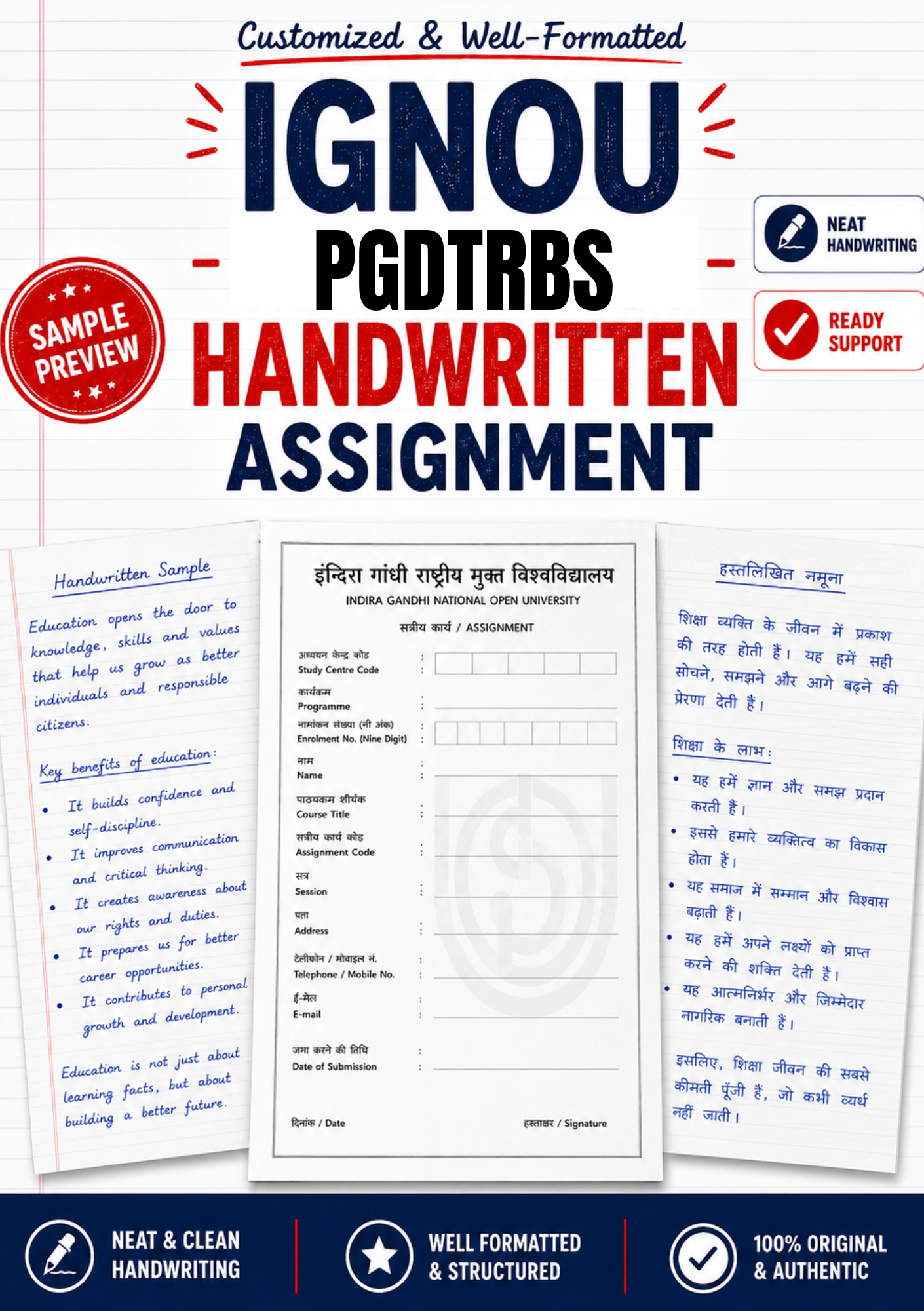
Sitting on top of each bundle is a cover sheet in the IGNOU format, with the fields the Tribal Studies paper asks for already laid out: assignment number, learner name, enrolment number, parent name, programme name and programme code, Regional Centre and its code, course title, course code, email, mobile number, course coordinator, date of submission and the space for an address and a signature. The enrolment number and the signature are left blank, because those two belong to you and to nobody else.
Behind the cover sheet sits a printed copy of the question paper the answers were written against. That matters more on this diploma than on most, because two editions of the same MEDS paper are currently downloadable from ignou.ac.in at the same time, and the wording of a question is not guaranteed to be identical between them. Having the sheet travel with the answers lets you check at a glance that the set in front of you answers the sheet your Regional Centre expects.
No soft copy or PDF is sold. The parcel is the deliverable. Nothing is emailed, nothing is shared through a drive link, and there is no downloadable version of a handwritten set, because a scan of handwriting is not what a study centre counter accepts.
The Rate Is Per Paper, Not Per Programme
PGDTRBS is priced one course code at a time. The rate is ₹320 per subject, hard copy only, with courier included in that price and no separate shipping charge. A learner taking all five papers in one cycle is buying five subjects; a learner who cleared three of them last year and owes two is buying two. Nothing about the diploma being forty credits changes the arithmetic, and nothing about a paper being an eight-credit paper rather than a four-credit one changes it either.
Inside that figure sit four things: the handwritten answer pages themselves, the IGNOU-format front page for that paper, a printed copy of the official question paper, and the courier to your address. Outside it sit two things, and they are worth naming plainly. The first is the submission itself, which only you can make, by hand or by post to the address the SOEDS sheet prints. The second is anything the university charges you directly, such as examination fees, which this store neither collects nor influences.
There is no minimum order: one subject or fourteen, same rate. A learner who only wants MEDS-022 written out is not pushed into buying the other four, and a learner who wants all five pays five times ₹320 and nothing beyond it. Delivery depends on your pin code and is confirmed for your order before you pay. No figure is promised on this page.
Why pay for any of it, when the booklet is free to download. Because of the weight the file carries. Assignments carry 30 per cent of the final course result and the term-end examination carries the remaining 70 per cent. On a forty-credit diploma made of five equal eight-credit papers, a single unattempted MEDS paper is not a small gap in a large degree; it is thirty marks in one fifth of the whole qualification.
A Model Answer File and a Postable Set Are Not the Same Object
These two things get confused constantly, and on PGDTRBS the confusion is expensive, so both are worth defining once. A solved assignment is a soft-copy reference file of model answers for a given course code and session, downloaded or bought as a PDF, read on a screen, and used as raw material for your own writing. A handwritten assignment is the answers written out by hand on A-4 sheets and submitted in hard copy, with a signed cover page, to the address the university prints on the paper.
One is a reading input. The other is the thing that gets received, logged and evaluated. They are not interchangeable, and a downloaded PDF printed on a laser printer is not a submission however good the answers inside it are.
IGNOU settles the point itself on the PGDTRBS sheet rather than leaving it to inference. The instruction block on the MEDS booklets tells learners to write the answers in their own handwriting, to include relevant references, and to attach the documents in a set order: cover page first, then a copy of the IGNOU identity card, then the assignment questions for that course, then the handwritten main text. A printout satisfies none of that, and a handwritten set that omits the ID card copy satisfies only part of it.
| What you are looking at | Solved assignment | Handwritten assignment |
|---|---|---|
| Format | Soft copy, read on a screen or printed for reference | Hard copy, longhand on A-4 sheets, tied and covered |
| What you do with it | Read it, argue with it, write your own answer from it | Check it, sign the declaration, submit it |
| Who it suits | A learner who has the weeks to write five eight-credit papers | A learner who has the cut-off and not the weeks |
| Price on this store | Sold separately by course code on the solved-assignment shelves | ₹320 per subject, courier included |
Scroll the table sideways on a narrow screen to see both columns.
If what you actually want is the reference file rather than the written set, the honest route is the other shelf. Two of the five PGDTRBS codes are MAAN papers, so their model files live on the anthropology solved-assignment shelf that carries MANE and MANI model files by code. This page does not sell a solved assignment and should not be read as offering one.
Five codes, five bundles, ₹320 each. Tell the writing desk which of MEDS-021, MEDS-022, MEDS-023, MANE-007 and MANI-001 you owe, and which session is printed on the sheets you downloaded.
₹320 per subject, hard copy, courier included, sample handwriting shown before payment.
The Three MEDS Numbers SOEDS Issues for Tribal Studies
The Common Prospectus July 2026 gives PGDTRBS a five-row course table and no elective column. Three of those rows carry the MEDS prefix, which is the School of Extension and Development Studies code family, and they are the only three papers on this diploma that IGNOU issues under a PGDTRBS cover.
| Code | Title in the Common Prospectus July 2026 | Type | Credits | Cover the booklet prints |
|---|---|---|---|---|
| MEDS-021 | Introduction to Tribal Studies and Tribes | Theory | 8 | Post Graduate Diploma in Tribal Studies (PGDTRBS) |
| MEDS-022 | Tribal Society, Culture and Traditional Knowledge System | Theory | 8 | Post Graduate Diploma in Tribal Studies (PGDTRBS) |
| MEDS-023 | Tribal Economy, Polity and Governance | Theory | 8 | Post Graduate Diploma in Tribal Studies (PGDTRBS) |
Scroll the table sideways on a narrow screen to read the full titles.
Every one of the three is a theory paper worth eight credits, which is itself unusual. Most IGNOU postgraduate courses are built in four-credit or six-credit blocks; PGDTRBS is built in eight-credit blocks throughout, so five papers rather than ten carry the entire forty-credit load. The arithmetic is five multiplied by eight, which is forty, and forty is the figure the prospectus prints as the programme total. That sum was checked against the printed total before any of these codes were used on this page.
The practical consequence is that there is no cheap paper on this diploma. On a programme with a mix of two-credit and six-credit courses, a learner can triage. Here every paper weighs the same, and every paper is compulsory, so a decision to leave one unwritten costs exactly as much as a decision to leave any other unwritten.
The Two Anthropology Papers PGDTRBS Borrows From MAAN
The remaining two rows of the PGDTRBS table do not carry a MEDS code at all. They carry MANE and MANI prefixes, which belong to the anthropology family in the School of Social Sciences, and the papers behind them are issued under a Master of Arts in Anthropology cover rather than a Tribal Studies one.
| Code | Title in the Common Prospectus July 2026 | Type | Credits | Cover the booklet prints |
|---|---|---|---|---|
| MANE-007 | Tribes in India | Theory | 8 | Master of Arts in Anthropology (MAAN) |
| MANI-001 | Anthropology and Methods of Research | Theory | 8 | Master of Arts in Anthropology (MAAN) |
Scroll the table sideways on a narrow screen to read the full titles.
This is where most PGDTRBS learners lose an afternoon. The two papers are compulsory, they are worth sixteen of the forty credits between them, and neither booklet mentions Tribal Studies anywhere on its cover. A learner who searches the assignment portal for a PGDTRBS file and finds only three will reasonably conclude the diploma has three assignments. It has five, and the missing two are filed under a different school and a different programme name.
There is a second trap underneath that one. The prefix MANI occurs exactly once in the whole Common Prospectus July 2026, in the PGDTRBS table, and the document carries no MANI course table anywhere to check it against. The prefix MANE occurs elsewhere, but the anthropology table in the same prospectus runs MANE 101 to MANE 108 at four credits each and contains no MANE-007 at all. So the two anthropology codes on this diploma cannot be verified against any other table in the document that prints them.
Eighteen Findings From Reading the PGDTRBS Documents Side by Side
The Common Prospectus July 2026, IGNOU’s live PGDTRBS programme page, five live assignment booklets and this store’s own shelves were read against each other for this page. They do not agree. The disagreements below are listed because a learner who meets them halfway through a cycle loses time, and because the honest position on a commercial page is to print them rather than to smooth them over.
Where the PGDTRBS record contradicts itself. Check your own admission record and your Regional Centre before acting on any single line of it.
1. The prospectus prints MANE-007 Tribes in India at eight credits in the PGDTRBS table, while its own Master of Arts (Anthropology) table prints Tribes in India as MAN 105 at four credits.
2. The same anthropology table prints MANE 107 as Urban Anthropology at four credits, so its MANE series runs 101 to 108 and has no MANE-007 in it.
3. The prefix MANI appears exactly once in the entire Common Prospectus July 2026, inside the PGDTRBS table, and the document contains no MANI course table at all.
4. The prospectus prints the MANE prefix three different ways: MANE 101 at four credits in the anthropology table, MANE 004 and then MANE 4 for the same Gender and Society paper at eight credits in two Women’s and Gender Studies tables, and MANE-007 with a hyphen at eight credits in the PGDTRBS table.
5. IGNOU’s live PGDTRBS programme page spells the second paper Tribal Society, Culture & Traditional Knowledge System; the prospectus spells it Tribal Society, Culture and Traditional Knowledge System.
6. That same programme page places all five courses in Semester 1, while the prospectus gives PGDTRBS a year-wise fee structure and a one-year minimum duration.
7. The two PGDTRBS booklets read for this page print the July cut-off as 30th March with no year attached. The MANE-007 booklet prints it as April 30, 2027.
8. The January cut-off differs in the same way. The MEDS sheets print 30th September with no year; the anthropology sheets print September 30, 2027.
9. The session labels disagree. The MEDS booklets print SESSION: January 2026 and July 2026. The MANE-007 booklet prints Assignments for the July 2026 and January 2027 sessions.
10. Three assignment-code conventions appear across the five papers of one diploma: no TMA string whatsoever on the MEDS sheets, MANE 007/AST/TMA/July 2026- January 2027 on one anthropology sheet, and MANI-001/ASST/TMA/2025-2026 on the other. The first prints AST where the second prints ASST.
11. Neither anthropology booklet names PGDTRBS anywhere. Both name only the Master of Arts in Anthropology, although both papers are compulsory for Tribal Studies.
12. The MANI-001 paper currently posted is the July 2025 and January 2026 edition, a full cycle behind the MEDS papers and behind MANE-007.
13. ignou.ac.in hosts an older PGDTRBS Tribal Economy paper under a filename spelling the code MESDS-023. The string MESDS does not occur once in the Common Prospectus July 2026, and the file itself opens on a PGDTRBS cover carrying course code MEDS-023.
14. The question patterns differ inside one diploma. The MEDS papers set five compulsory questions of twenty marks each with a 600-word limit. The anthropology papers set two sections, five questions chosen from ten, 500 words for a twenty-mark answer and 250 for a ten-mark one.
15. IGNOU also runs a Certificate in Tribal Studies, CTRBS, from the School of Social Work on an entirely different code set, BSW-41 to BSW-44 at four credits each for sixteen credits in total. The certificate has an online variant listed as CTRBSOL; PGDTRBS has no online variant in the prospectus list of online programmes.
16. Aggregator sites circulate 31 October as the IGNOU assignment deadline. No PGDTRBS paper read for this page prints that date.
17. In-house: this store’s own anthropology project shelf lists MANI 1 among dissertation courses, and one store product title calls it Anthropology and Methods of Research (Theory and Practical), while the prospectus prints MANI-001 for PGDTRBS as Theory at eight credits and the live booklet carries no project or practical component.
18. In-house: this store’s handwritten-assignment category page still carries a delivery-window promise in its page description. That promise is wrong, it contradicts the position taken on this page, and it is queued for removal.
Listing an in-house error alongside the university’s is deliberate. A page that corrects everybody except itself is not a trustworthy page, and the fastest way to fail a reader is to let them discover a contradiction you already knew about.
One Diploma, Two Cut-Off Calendars: 30 March and 30 April
Most IGNOU programmes have one pair of submission dates. PGDTRBS has two pairs, because its papers are issued by two schools, and the schools do not print the same calendar. The table below sets out what each booklet actually prints, transcribed from the papers themselves rather than from any summary of them.
| Papers | Cover programme | Assignment label printed | July cycle last date | January cycle last date |
|---|---|---|---|---|
| MEDS-021, MEDS-022, MEDS-023 | PGDTRBS | ASSIGNMENT – 1, no TMA string | 30th March, no year printed | 30th September, no year printed |
| MANE-007 | MAAN | MANE 007/AST/TMA/July 2026- January 2027 | April 30, 2027 | September 30, 2027 |
| MANI-001 | MAAN | MANI-001/ASST/TMA/2025-2026 | April 30, 2026 | September 30, 2026 |
Scroll the table sideways on a narrow screen to see every column.
Two things follow from that table, and both are practical. The first is that the earliest of your five deadlines, not the latest, is the one that governs planning, because three of the five papers fall due a month before the other two. The second is that the MEDS dates carry no year at all, which means the sheet cannot tell you which cycle it belongs to; only the session line at the top of the booklet can, and that line is the thing to read before you start writing.
IGNOU also prints an instruction on the Tribal Studies sheet that settles a question learners ask constantly: submit the latest assignments uploaded on the website, whatever year you registered in. A paper from a closed cycle is not the paper to answer, even if it is the one your senior gave you. That is why the question paper travels with every set sent out from here, and why the session on your sheet is asked for before writing begins rather than after.
Three Code Conventions on Five Sheets of the Same Diploma
Learners are routinely told to write the assignment code on the cover page. On PGDTRBS that instruction does not survive contact with the papers, because the five sheets print three different things.
The MEDS sheets print no assignment code in the usual sense at all. The heading above the questions reads ASSIGNMENT – 1, and the cover block carries the course code on its own line as MEDS-021, MEDS-022 or MEDS-023. There is no slash-separated TMA string anywhere on the paper. If your cover page has a box labelled assignment code, the course code and the assignment number are what go in it, and nothing is missing from your download.
The MANE-007 sheet prints a full string, and prints it as MANE 007/AST/TMA/July 2026- January 2027, with a space inside the course code and the session names spelled out rather than a numeric year span. The MANI-001 sheet prints MANI-001/ASST/TMA/2025-2026, with a hyphen inside the course code, a double S in ASST, and a numeric span. Those are the same university, the same school and the same code family, printing the same field three different ways.
The rule applied to every set written here is simple: copy what is on your sheet, character for character, including the spacing. A cover page that invents a tidy code the booklet never printed is a cover page that disagrees with the paper stapled behind it.
Matching Your Hand Across Two Schools’ Answer Sheets
Send a photo of a page you have written yourself and the handwritten set is matched to your handwriting at no extra charge. On a diploma split across two schools this matters more than it looks, because all five papers land in one submission window and a reader comparing them should not be able to tell that three came from one desk and two from another. The matching is done once, from one sample, and applied across the whole set.
What the photograph needs to show
One full page is enough, written in your usual pen on ruled or plain paper, photographed flat in daylight with the whole page in frame. Avoid a page of neat printed capitals written slowly for the camera, because that is not the hand that will be compared against your examination script later. A page of ordinary rough notes is more useful than a page written carefully to impress. If your Tribal Studies notes contain a diagram or a Devanagari term written in your own hand, a page carrying one of those is better still, because it shows how your writing behaves when it leaves plain English prose.
The sample is reviewed and a specimen of the matched hand comes back to you before you pay anything. That order of operations is the point: the risk of the handwriting not looking like yours sits with the writing desk, not with you. Send a sample page and ask for the matched specimen first, and decide after you have seen it.
English Is the Only Medium PGDTRBS Prints, and Backlogs Are Still Accepted
Both the Common Prospectus July 2026 and IGNOU’s live programme page give the medium of instruction for PGDTRBS as English, with no Hindi option listed for the diploma. That is not true of everything around it in the same school. The neighbouring Population and Family Health Studies diploma is listed in the prospectus programme table as a Hindi-medium programme, and the anthropology master’s degree that MANE-007 and MANI-001 belong to is listed as English and Hindi. So a PGDTRBS learner can legitimately find a Hindi edition of an anthropology paper circulating and wonder which one applies to them.
The service covers all mediums IGNOU issues the TMA paper in, at the same price. If the sheet you downloaded is the English PGDTRBS paper, the set is written in English against that sheet. If the anthropology paper you hold was issued in another medium, the set is written against that sheet instead. The paper in your hand decides, not the programme table.
Any session is accepted, current cycle or older, including backlog courses, at the same ₹320 per subject. A PGDTRBS learner carrying a MEDS paper from an earlier registration year, or a MANI-001 paper from the cycle before the current one, is not charged differently and is not turned away. The only thing that changes is which sheet gets written against, which is why the session line is asked for at the start.
What a Tribal Studies Order Needs From You Before Anyone Writes
Five pieces of information are enough to price and start a PGDTRBS order, and nothing further is needed at this stage.
- The course codes you owe, written exactly as they appear on your sheets: MEDS-021, MEDS-022, MEDS-023, MANE-007, MANI-001, or whichever subset of them applies.
- The session line printed at the top of each booklet you downloaded, which on the MEDS papers reads as a January and July pair and on the anthropology papers as a July and January pair.
- Your Regional Centre and its code, which the PGDTRBS cover page asks for even though the set itself is posted to Delhi.
- The delivery pin code, so the courier route and timing can be confirmed for you before you pay.
- A photograph of a page in your own handwriting.
Your enrolment number is not needed to start. It goes on the cover page, in your hand, after the parcel reaches you, and it is better that it does, because the declaration underneath it is yours to sign.
Three SOEDS papers, two anthropology papers, one quote. Send the codes and the session lines and the price comes back itemised per subject rather than as a package figure.
₹320 per subject. Courier included. Question paper and front page packed in. No payment before the sample is approved.
After the Parcel Lands: the ID Card, the Cover Page and the Post Office
What happens next is yours to do, and the PGDTRBS sheet is unusually specific about it. The booklet asks for the documents to be attached in a fixed order: the cover page first, then a copy of your IGNOU identity card, then the assignment questions for that course, then the handwritten main text. The identity card copy is not something most IGNOU programmes ask for, and it is the single item learners most often leave out of a Tribal Studies submission.
Fill in the enrolment number and the date on each cover page and sign it. Read the answers before you do. You sign the declaration on the assignment cover page, so you should read and review the content before submitting it, and satisfy yourself that it represents your own understanding of the course.
The MEDS papers direct the set to the Director, SOEDS, Block-15-F, Swami Vivekanand Bhawan, First Floor, Maidan Garhi, New Delhi 110068, by hand or by post. The anthropology papers belong to a different school and a different submission route, so check the address printed on each of your own sheets rather than assuming all five go to the same desk. Keep the posting receipt or the counter acknowledgement; it is the only evidence you will hold that the set left your hands on time.
After that the file passes out of your control entirely. No claim is made about the marks any assignment will receive, about how an evaluator will assess it, or about whether it will be accepted. Assignment evaluation is entirely a matter for IGNOU.
Tribal Studies Sits Between Two Shelves on This Store
PGDTRBS has no shelf of its own here yet, and saying so is more useful than pretending otherwise. Its materials sit in two places, because its codes do. The three MEDS papers belong to the extension and development family, and the two anthropology papers belong to the anthropology family, which is already stocked in depth.
For those two codes specifically, the model-answer files sit under the anthropology shelves, and so does almost everything else a learner tends to want alongside them. There are help books and chapter-wise study notes written to the anthropology syllabus, a set of guess papers built from the anthropology study material for examination week, and previous years’ term-end papers with worked answers for the MANE and MANI codes. Learners who go on into the anthropology master’s degree also use the dissertation and project samples stocked for that programme.
The certificate programme that shares the Tribal Studies name is stocked separately, which is the point: the certificate-level Tribal Studies shelf runs on BSW codes, not MEDS ones, and a PGDTRBS learner who orders from it will receive material for a sixteen-credit certificate rather than a forty-credit diploma.
Two neighbouring handwritten products are worth knowing about if your enrolment sits near this one. The Population and Family Health Studies diploma set, which runs on the MEDS-071 to MEDS-075 block, is the closest sibling inside the same school, and the master’s degree that carries both MEDS and MANE papers across two years is where a learner continuing past the diploma usually lands. The whole written-set range sits under the handwritten-assignment category covering every programme on this store, and the wider postgraduate solved-assignment listing, arranged programme by programme, is the place to look if a reference file rather than a written set is what you need.
If you would rather write the five papers yourself, the editorial side of this publisher keeps a step-by-step guide to writing and submitting an IGNOU handwritten assignment, including the front-page format and the submission routine. That guide sells nothing and is the better starting point for a learner who has the time.
Doubts That Come Up Between MEDS-021 and MANI-001
How many handwritten assignments does PGDTRBS actually have?
Five. One for each of MEDS-021, MEDS-022, MEDS-023, MANE-007 and MANI-001. The confusion arises because only three of them are filed under a PGDTRBS cover on the assignment portal; the other two are filed under the Master of Arts in Anthropology. All five are compulsory and all five carry eight credits.
Why do two of my five papers say MAAN on the cover instead of PGDTRBS?
Because the diploma borrows them. MANE-007 and MANI-001 are anthropology courses issued by the School of Social Sciences, and the booklets are printed for the anthropology master’s degree. Neither cover names Tribal Studies. That does not mean you have downloaded the wrong file; it means the paper serves two programmes and the cover only names one of them.
Is my last date 30 March or 30 April?
Both, on different papers. The two PGDTRBS booklets read for this page print the July cut-off as 30th March, with no year attached, and the January cut-off as 30th September. The anthropology booklets print April 30 and September 30 with full years. Plan against the earlier of the two, and confirm the current position with your Regional Centre, because dates change.
The MEDS file I downloaded is called MESDS-023. Is that the right paper?
The file opens on a Post Graduate Diploma in Tribal Studies cover and carries course code MEDS-023 inside, so the content is right and the filename is an error. Note the session line on it, though: that particular file is the January and July 2025 edition. The current edition is the January and July 2026 one, and IGNOU’s own instruction is to answer the latest paper on the website regardless of your registration year.
Where does a PGDTRBS answer set go, the study centre or Maidan Garhi?
The MEDS sheets direct the set to the Director, SOEDS, Block-15-F, Maidan Garhi, New Delhi, by hand or by post. The two anthropology papers belong to a different school with its own submission route. Read the address printed on each of your own five sheets rather than sending all five to one place.
Can a downloaded PGDTRBS model answer PDF be printed and submitted?
No. A downloaded file is a reference to write from, not a submission. The MEDS instruction block tells learners to write the answers in their own handwriting and to attach the cover page, a copy of the IGNOU identity card, the question sheet and the handwritten main text in that order. A printout meets none of that.
PGDTRBS ka solved assignment aur handwritten set mein farq kya hai?
Solved assignment ek soft copy reference file hai, jise aap padhkar apne answers likhte hain. Handwritten set wahi answers hain jo A-4 sheets par haath se likhe jaate hain aur hard copy mein jama hote hain. Pehla padhne ke liye hai, doosra jama karne ke liye. Dono ek cheez nahi hain.
Does IGNOU itself say anywhere that these answers must be handwritten?
Yes, on the Tribal Studies paper itself. The instruction block on the MEDS booklets asks learners to write in their own handwriting, with relevant references, and lists the handwritten main text as the final item in the attachment order. It is printed on the sheet, not inferred from practice.
Typed karke print nikal lein to MEDS ka paper chalega kya?
Booklet par saaf likha hai ki answers apni handwriting mein likhne hain. Typed printout us instruction ko poora nahi karta. Acceptance ka faisla IGNOU ka hai, lekin printed set bhejna uss nirdesh ke khilaaf jaata hai jo aapke apne paper par chhapa hua hai.
Why does my MEDS sheet print no TMA code when MANE-007 prints one?
Because the two schools format the field differently. The SOEDS sheets head the questions ASSIGNMENT – 1 and carry the course code separately, with no slash-separated string anywhere. The anthropology sheets print a full string, and even those two disagree with each other: MANE 007/AST/TMA/July 2026- January 2027 against MANI-001/ASST/TMA/2025-2026. Copy whatever your own sheet prints.
Is PGDTRBS available in Hindi?
The Common Prospectus July 2026 and IGNOU’s live programme page both give the medium for this diploma as English, with no Hindi option listed. The anthropology master’s degree the two borrowed papers come from is listed as English and Hindi, which is why Hindi editions of those codes circulate. The service covers all mediums IGNOU issues the TMA paper in, at the same price, so the sheet you hold decides.
My MANI-001 file is dated 2025-2026. Should I still answer it?
That is the edition currently posted for the course, a cycle behind the MEDS papers. Check the assignment portal once before you start, because IGNOU’s own instruction is to submit the latest paper uploaded to the website whatever year you registered in. Whichever sheet turns out to be current is the one a set written here is written against, and a copy of it is packed in with the answers.
Is PGDTRBS the same as the Certificate in Tribal Studies?
No, and ordering from the wrong one is a real risk. The certificate, CTRBS, is run by the School of Social Work on BSW-41 to BSW-44 at four credits each, sixteen credits in total, and it has an online variant. PGDTRBS is a forty-credit diploma from the School of Extension and Development Studies on the MEDS, MANE and MANI codes, and it has no online variant listed in the prospectus.
What does a 600-word MEDS answer look like on paper?
The MEDS booklets set five questions of twenty marks each with a 600-word limit, so one paper runs to roughly three thousand words of answer, written on both sides with a margin. The anthropology papers work differently: five questions chosen from ten, 500 words for a twenty-mark answer and 250 for a ten-mark one. Sets written here are paced to the limit printed on your own sheet rather than to a house length.
Can I order only MEDS-022 instead of all five?
Yes. There is no minimum order: one subject or fourteen, same rate. Learners carrying one backlog paper from an earlier registration order that paper alone, at ₹320, on the same terms as a learner ordering the whole set.
Can I see the handwriting before paying for a PGDTRBS set?
Yes, and that is the sequence by design. You send a sample page, a specimen in the matched hand comes back, and payment follows only if you are satisfied with it. Nothing is charged for the matching itself.
The Prospectus, the Booklets and the Price List Were Read Separately
Three kinds of source sit behind this page and they are not interchangeable. Keeping them apart is the only way a reader can tell which statements are the university’s and which are this publisher’s.
From the IGNOU Common Prospectus July 2026 and IGNOU’s live programme page: the programme name and code, the School of Extension and Development Studies as the issuing school, the five course codes and their official titles, the eight-credit value of each course, the forty-credit programme total, the medium of instruction, the one-year minimum and three-year maximum duration, the year-wise fee structure, and the comparison material on the anthropology master’s degree and the Certificate in Tribal Studies.
From live assignment booklets downloaded from ignou.ac.in: the submission dates, the session lines, the assignment labels and TMA strings, the marks and question patterns, the word limits, the A-4 paper instruction, the attachment order including the identity card copy, the submission address, the instruction to write in your own handwriting, and the instruction to answer the latest paper on the website. Five booklets were read for this page: the PGDTRBS editions of MEDS-021 and MEDS-023 for the January and July 2026 session, the older MEDS-023 edition hosted under the MESDS filename, and the anthropology papers MANE-007 and MANI-001, with MANE-004 read as a cross-check on the code format.
From this publisher’s own commercial terms: the ₹320 per subject rate, the hard-copy-only format, the inclusion of courier, the free IGNOU-format front page, the inclusion of a printed question paper, the free handwriting matching from a sample photograph, the absence of a minimum order, and the acceptance of backlog cycles. None of those come from IGNOU and none should be read as university policy.
Important Notice
Shri Chakradhar Publication Pvt. Ltd. and shrichakradhar.com form an independent IGNOU study-support publisher. This is not the official website of Indira Gandhi National Open University, is not affiliated with, endorsed by or authorised by the university, and no page on this site should be treated as an official IGNOU communication.
Programme structures, course codes, submission dates and rules change, and only ignou.ac.in and your Regional Centre can confirm the current position for your enrolment. The university’s own PGDTRBS programme page and the MEDS-021 assignment booklet as currently posted are the documents to check against, along with the MANE-007 booklet issued under the anthropology cover.
You sign the declaration on the assignment cover page, so you should read and review the content before submitting it, and satisfy yourself that it represents your own understanding of the course.
No claim is made about the marks any assignment will receive, about how an evaluator will assess it, or about whether it will be accepted. Assignment evaluation is entirely a matter for IGNOU.
Send the Five Codes and the Set Is Priced
Three MEDS papers under a Tribal Studies cover, two anthropology papers under a MAAN cover, forty credits between them and two different cut-off calendars to plan around. Name the codes you owe and the session line printed on each sheet, and the quote comes back per subject.
₹320 per subject, hard copy only, courier included, question paper and IGNOU-format front page packed in, handwriting matched from your own sample before anything is paid.
Message the writing desk about your PGDTRBS codes
If your enrolment covers codes outside this diploma as well, the customised written-set product that takes any mix of codes and sessions handles mixed orders at the same rate.