

Description
In short. The IGNOU Post Graduate Diploma in Corporate Social Responsibility (PGDCSR) is a one-year, 36-credit English-medium programme from the School of Extension and Development Studies, and every learner on it owes five handwritten assignments (MEDS-051, MEDS-052, MEDS-053, MEDS-054 and MSW-009) plus a sixth for MEDSE-046 if that elective was chosen instead of the MEDSP-051 project. For the July 2026 session the cut-off printed on the papers is 31 March 2027, and for January 2027 it is 30 September 2027. Shri Chakradhar Publication writes each paper by hand against the current PGDCSR/MACSR file at ₹320 per subject, hard copy only, with courier included, the IGNOU-format front page free, and the handwriting matched to a sample photo you send before paying anything.
The Bundles Inside a PGDCSR Courier Packet
A PGDCSR order arrives as one courier packet holding a separate bundle for each code you named. Each bundle is a complete answer set written by hand on A4 sheets, on both sides of the paper with a margin, because that is what every PGDCSR booklet read for this page, from 2021 to 2026-27, asks for. The answers follow the question order of the paper for your session, and each answer is headed with its question number so the evaluator does not have to hunt for it.
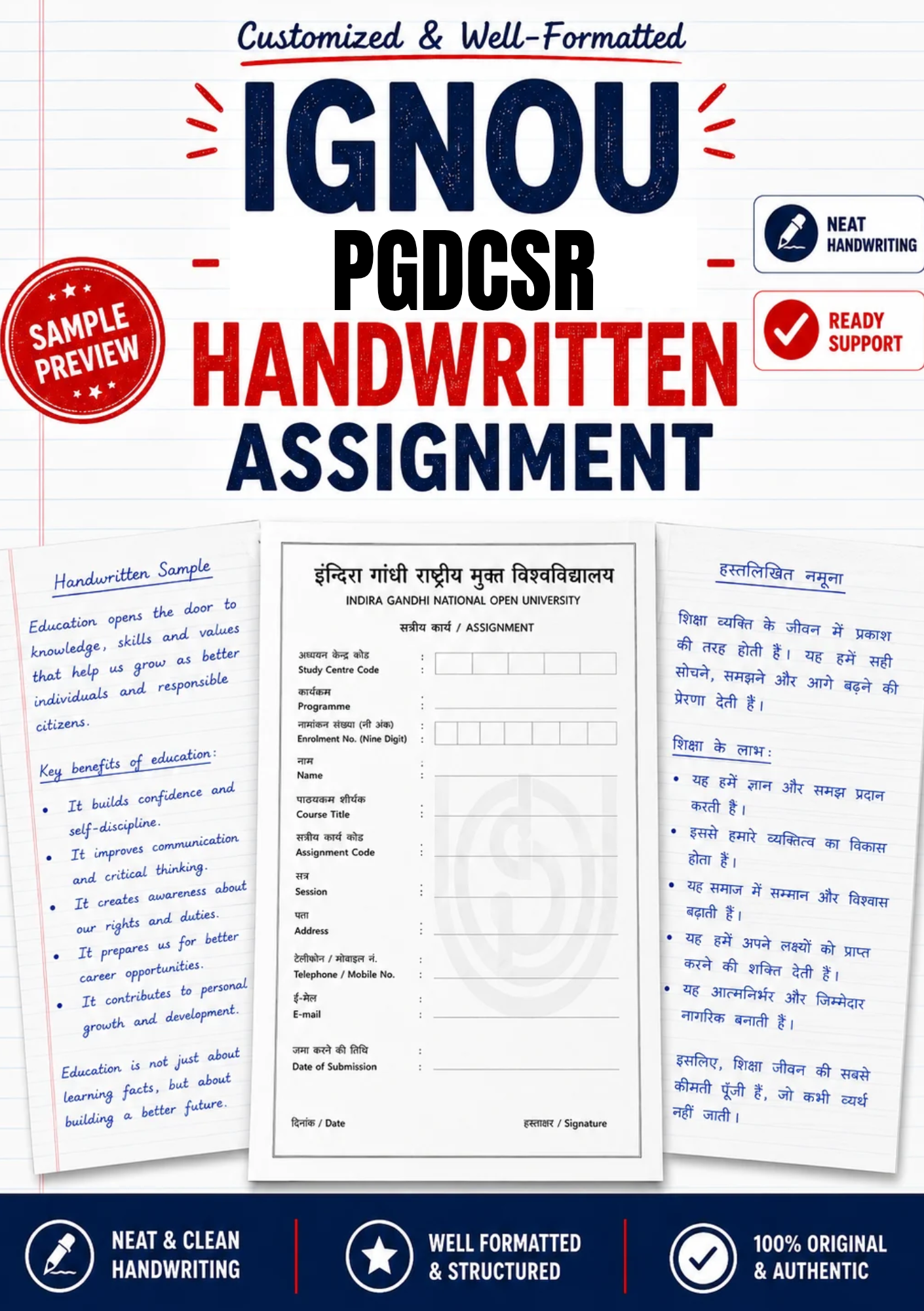
On top of each bundle sits a front page laid out in the IGNOU format, with blank spaces for your name, enrolment number, Regional Centre and the rest of the fields the 2026-27 cover asks for. It is left for you to fill in, since several of those details are yours alone and the declaration at the bottom has to carry your own signature. Behind the answers is a printed copy of the official question paper the set was written against, so you can check the questions line by line before you take anything to the counter.
The rate is ₹320 per subject, hard copy only, with courier included in that price and no separate shipping charge. No soft copy or PDF is sold. That last point matters more on a CSR diploma than it might elsewhere, because IGNOU’s own PGDCSR instruction page states that only handwritten assignments are accepted, so a typed or downloaded file has no route to the evaluator in the first place.
What the packet never contains is anything you would be asked to submit online. The PGDCSR papers ask for a physical, tied, course-wise set, and that is what is sent: paper, ink, your front page, the question paper, and nothing digital.
The ₹320 Figure Against a Thirty-Six-Credit Diploma
The diploma’s 36 credits are spread unevenly: four MEDS papers at six credits each, MSW-009 at four credits, and an eight-credit elective slot. IGNOU sets one assignment of 100 marks per course regardless of credit weight, so the four-credit MSW-009 paper is as long to write as the eight-credit MEDSE-046 paper. Pricing therefore runs per paper, not per credit, and every PGDCSR code costs the same.
In practice that gives two totals. A learner who chose MEDSE-046 owes six papers, which comes to ₹1,920 for the whole year. A learner who chose the MEDSP-051 project owes five, which comes to ₹1,600, because the project is assessed as a report and has no assignment sheet. Anyone clearing only one or two outstanding papers pays for those papers and no others. There is no minimum order: one subject or fourteen, same rate.
Inside the ₹320 are the writing, the matched handwriting, the IGNOU-format front page, the printed question paper and the courier to your address. Outside it are three things the publisher cannot supply: your signature on the declaration, the act of handing the set in at your study centre or Regional Centre, and any fee IGNOU itself charges for re-registration or the term-end examination. Delivery depends on your pin code and is confirmed for your order before you pay. No figure is promised on this page.
The store’s other handwritten programmes run at the same rate, and the full handwritten-assignment catalogue across every IGNOU programme lists them if anyone in your study group is enrolled elsewhere.
Model Answers on a Screen, or Pages in Your Own Hand: Choosing for PGDCSR
Two different products are sold under the same five or six PGDCSR codes, and learners regularly confuse them. A solved assignment is a soft-copy reference file of model answers for one course code and one session: you read it, learn from it, and then write your own answers. A handwritten assignment is the answer set itself, written out by hand on A4 and submitted in hard copy at your study centre or Regional Centre, which is the route the 2025-26 and 2026-27 PGDCSR/MACSR papers print.
| Where they part ways | Model-answer file (soft copy) | PGDCSR set written by hand |
|---|---|---|
| Format | Soft-copy file of model answers | Physical A4 sheets written by hand, both sides |
| What you do with it | Read it, then write your own set | Review it, sign the cover, hand it in |
| Who it suits | Learners with time to copy out five or six papers themselves | Learners short of writing time before 31 March or 30 September |
| Can it be submitted as it is | No. The PGDCSR booklets accept handwritten work only | It is prepared in the handwritten form the booklet asks for |
| Price line | Priced per file on the solved shelf | ₹320 per subject, courier included |
Scroll sideways to see all three columns on a narrow screen.
The deciding line is printed by IGNOU, not by either product. The PGDCSR booklet instruction reads “only handwritten assignments are accepted”, and the 2026-27 PGDCSR/MACSR files ask for the response in the learner’s own handwriting. A printed model answer, however good, cannot be handed in. It is a reference to write from, and nothing on this page suggests otherwise.
If what you actually want is the reference file, it belongs on a different shelf: the PGDCSR shelf of downloadable model-answer files currently carries 2025-26 English files for MEDS 51 to MEDS 54 and MEDSE 46. Read the gap noted later on this page before relying on it for MSW-009 or for the 2026-27 cycle.
Five papers, or six with the MEDSE-046 elective: list the ones you still owe.
The rate is ₹320 per subject, hard copy only, with courier included in that price and no separate shipping charge. A handwriting sample comes back to you before any payment is taken.
MEDS-051 to MEDS-054 and MSW-009: The Five Papers Every PGDCSR Learner Owes
Section 8.22 of the IGNOU Common Prospectus July 2026 lists seven course codes for PGDCSR, of which five are compulsory and two are alternatives for a single elective slot. The five compulsory papers are the same for every learner on the programme, whatever the admission cycle, so a PGDCSR order always starts from this list.
| PGDCSR code | Course title in the prospectus | Credits carried | Number on the 2026-27 sheet | Also taught in |
|---|---|---|---|---|
| MEDS-051 | Fundamentals of CSR | 6 | Assignment 1 | MACSR year one; MASS year two (as MEDS 51); MSCHSC elective (as MEDS 051) |
| MEDS-052 | CSR Process | 6 | Assignment 2 | MACSR year one |
| MEDS-053 | CSR Implementation | 6 | Assignment 3 | MACSR year one |
| MEDS-054 | CSR Projects and Programmes | 6 | Assignment 4 | MACSR year one |
| MSW-009 | Community Organization Management for Community Development | 4 | Assignment 5 | MACSR year one; MSW year two and MSW (Counselling) year one (as MSW 9) |
Swipe the table left on a phone to read the last two columns.
The credit arithmetic checks against the prospectus total: four MEDS papers at 6 credits make 24, MSW-009 adds 4, and the elective slot adds 8, for 36 credits. The same 36 is printed under the PGDCSR table, and the MACSR first-year table carries exactly the same seven codes, which is why a PGDCSR learner can take lateral entry into the second year of MACSR with these credits transferred.
The four MEDS papers are the CSR core proper. The 2026-27 MEDS-054 paper, for example, sets five 20-mark questions built around practical cases: a CSR needs assessment for a community near a company, appraising a rural education project before it starts, evaluation tools across a healthcare initiative, a social audit for a renewable energy company, and a Social Return on Investment framework for a women’s entrepreneurship project. Answers of that kind need applied, structured writing rather than definitions, which is the standard each set is written to.
MSW-009 is the odd one out. It is a School of Social Work course borrowed into the CSR diploma, and it carries a different mark pattern from every other PGDCSR paper: two 20-mark questions with an either-or choice, then two of four 10-mark parts, four of six 5-mark parts, and five of eight 4-mark short notes. The questions on the 2026-27 SOEDS copy open on social welfare administration, rural community structure, models of social action and PRA methods. The store’s own reference file for this code is shelved with the social work papers rather than on the CSR diploma shelf, as the MSW 9 model-answer file for 2025-26 in English shows.
The Sixth Slot: MEDSE-046 by Assignment, or MEDSP-051 by Project
The elective decides whether your PGDCSR year has five assignments or six. The prospectus footnote under the PGDCSR table says that one of the two electives has to be selected, and both carry eight credits.
| Elective code | Elective title in the prospectus | Credits it adds | What it asks of you |
|---|---|---|---|
| MEDSE-046 | Development: Issues and Perspectives | 8 | One assignment, Assignment 6 on the 2026-27 sheet, five questions of 20 marks |
| MEDSP-051 | Project Work in CSR | 8 | A project report instead; no assignment sheet is issued for it |
On small screens the table scrolls horizontally.
Each booklet that includes MEDSE-046 marks it as meant only for learners who took the course as their elective. If your admission record shows MEDSP-051 instead, do not order a MEDSE-046 set: it would not count towards anything on your record. The project route is served by a different product line, and the MEDSP-051 synopsis and report shelf in hard copy is where that work is sold.
MEDSE-046 also needs care for a second reason. The code is shared with the urban planning diploma, and IGNOU publishes a separate MEDSE-046 file for that programme with different questions. A PGDCSR learner who downloads the wrong file writes the wrong paper. The urban planning diploma’s handwritten set is written against that other file, and the PGDCSR order is written against the PGDCSR/MACSR one. The difference is set out in finding 9 below.
Twenty-Three Places the PGDCSR Paper Trail Contradicts Itself
The findings below came from reading the Common Prospectus July 2026, the live IGNOU programme page, seventeen PGDCSR, MACSR, PGDUPDL, SOSW and SOSS assignment files from the 2021 to 2026-27 cycles, and this store’s own category pages against each other. Each one is reported as found. Where IGNOU’s documents disagree, the file for your own session and your Regional Centre decide.
Read these before downloading a PGDCSR paper or submitting a set. Findings 20 to 23 are this store’s own errors, listed so that they can be corrected rather than repeated.
1. The number of PGDCSR assignments changed. The January 2021 and July 2021 booklet has five assignments and no MSW-009 at all; MEDSE-046 is Assignment 5. From the January 2022 and July 2022 booklet onward, MSW-009 appears as Assignment 5 and MEDSE-046 moves to Assignment 6.
2. The session pairing flipped. The 2021 and 2022 booklets pair a January session with the July session of the same year. From the July 2022 and January 2023 booklet onward, the pair runs July then January.
3. One booklet names the wrong session in its own instructions. The cover of the July 2022 and January 2023 booklet names those two sessions, while the date line inside refers to the January 2022 session and 30 September 2022.
4. The submission route changed three times. The 2021 booklet and the January 2022 and July 2022 booklet tell learners to speed post the set to the Programme Coordinator (PGDCSR), SOEDS, Block 15-F, Maidangarhi. The 2022-23, 2023-24 and 2024-25 booklets print no submission route. The 2025-26 and 2026-27 files say Study Centre or Regional Centre.
5. No PGDCSR-labelled paper has been published since 2024-25. The last consolidated PGDCSR booklet covers July 2024 and January 2025. The 2025-26 files are named in the form MEDS-51-July-2025 and the 2026-27 files in the form MEDS-051-MACSR-2026, all headed “PGDCSR/MACSR”.
6. The joint header changed its wording. The 2025-26 MSW-009 file reads “Post Graduate Diploma and Masters in Corporate Social Responsibility”; the 2026-27 files read “Post Graduate Diploma and Master of Arts in Corporate Social Responsibility”.
7. Cover fields are left blank. On the 2026-27 files the Name of the Programme and Programme Code fields are empty, and the Assignment No. field is empty on MEDS-051 and MEDS-053 even though the number is printed inside. The 2026-27 MSW-009 file does print Assignment Number 5; its 2025-26 file left it blank.
8. File names change format within one cycle. In 2025-26 the MEDS-051 file is named with a two-digit code (MEDS-51-July-2025) while MEDS-054 uses three digits (MEDS-054-July-2025). A search for one spelling can miss the other.
9. MEDSE-046 has two different 2026-27 papers. The PGDCSR/MACSR file numbers it Assignment 6, asks for 600 to 800 words a question and sends you to a Study Centre or Regional Centre. The PGDUPDL file, published in Hindi, numbers it Assignment 5, asks for about 800 words, names the designated study centre only, and sets entirely different questions.
10. MEDSE-046 is also published by another school under another title. The 2025-26 SOEDS MEDSE-046 questions open with the same wording as a School of Social Sciences file headed Master of Arts (Economics), which titles the course “Development: Issues and Challenges” rather than “Issues and Perspectives”, prints MEDSE 046/AST-1/2025-2026, ties its dates to the June and December term-end examinations, and asks for about 700 words an answer.
11. MSW-009 is issued by two schools with one set of questions. The 2026-27 SOEDS file and the School of Social Work file for MSW (Counselling) first year carry the same questions. SOSW says submit at the Study Centre; SOEDS says Study Centre or Regional Centre.
12. MSW-009 is spelled two ways. The PGDCSR and MACSR prospectus tables and both schools’ 2026-27 files use “Community Organization”. The MSW and MSW (Counselling) prospectus tables and the live IGNOU PGDCSR programme page use “Community Organisation”.
13. MSW-009 is coded four ways. The PGDCSR table prints MSW-009, the MACSR table prints MSW with a spaced dash before 009, the MSW tables print MSW 9, and the booklets print MSW – 009 with spaces. They are one course.
14. MSW-009 sits in three different years. It is a second-year compulsory course in MSW, a first-year course in MSW (Counselling), and part of the single year of PGDCSR.
15. MSW-009 contradicts its own word guidance. The general instruction asks for around 600 to 800 words a question, while the paper itself caps Questions 1 and 2 at 600 words each and sets about 300, 150 and 100 words for the parts of Questions 3, 4 and 5.
16. The 2026-27 MSW-009 file prints two postcodes. The header gives New Delhi 11006, a digit short, while the cover gives 110068.
17. The live programme page invents semesters. The IGNOU PGDCSR page labels five courses “Semester 1” and MEDSP-051 “Year 1”, for a programme the prospectus describes as one year with no semester grid.
18. The prospectus annexure has no PGDCSR elective row. Annexure I(e) prints elective-choice rows for PGDEMA, PGDRD and PGDUPDL, but none for PGDCSR, although PGDCSR has a two-way elective of its own.
19. A third-party listing contradicts itself on mode and fee. A widely used college-listing site describes PGDCSR as open distance learning in one table and “Full Time” in another, and presents the ₹8,000 fee both as an annual or semester fee and as a one-time charge. The prospectus gives ₹8,000 for the full programme, open and distance mode.
20. This store’s handwritten hub calls its own sets reference material. The hub category description says the handwritten sets are study reference material, not for submission, which contradicts every programme product it sits above, this one included.
21. The same hub advises single-sided sheets. It recommends writing on single-sided ruled sheets, while every PGDCSR booklet read for this page, from 2021 to 2026-27, asks for writing on both sides with a margin. The PGDCSR sets follow the booklet.
22. The same hub prints two different writing windows. It gives one working-day range in its price table and another in its ordering steps. This product page gives no delivery figure at all, because delivery depends on the pin code.
23. The PGDCSR book shelf description carries claims this page refuses. It calls the guide the greatest available, says a minimum of 60 to 80 per cent of exam questions are guaranteed to come from it, and is written in the first person. Separately, the PGDCSR solved-assignment shelf holds only five 2025-26 files, with no MSW 9 file and nothing yet for 2026-27.
None of these findings changes what a PGDCSR learner has to submit. They change which file you download, which number you copy onto the cover, and where you hand the set in. A set written against a PGDUPDL MEDSE-046 paper or a 2021 five-assignment booklet would be a set written for the wrong document, and that is the error the order process is built to avoid.
Why a July 2026 PGDCSR Learner Has Until 31 March 2027
The School of Extension and Development Studies prints two cut-offs on every PGDCSR paper, and both fall in the calendar year after the session starts. On the 2026-27 MEDS-051, MEDS-052, MEDS-053, MEDS-054, MSW-009 and MEDSE-046 files the dates are identical: 31 March 2027 for learners of the July 2026 session, and 30 September 2027 for learners of the January 2027 session.
The pattern has held across every cycle read for this page. The 2021 booklet gave 30 September 2021 for January 2021 and 31 March 2022 for July 2021. The 2023-24 booklet gave 31 March 2024 and 30 September 2024; the 2024-25 booklet gave 31 March 2025 and 30 September 2025; and the 2025-26 files gave 31 March 2026 and 30 September 2026. These are not the 31 October and 30 April dates used by the School of Management Studies, and a date circulated for an MBA or MCOM paper does not apply to a CSR diploma.
As of this page’s review on 28 October 2026, the 30 September 2026 cut-off for the January 2026 session has passed, so the next live date is 31 March 2027 for the July 2026 session. A January 2026 learner who missed September submits against the current paper in the next cycle instead, as explained under backlogs below.
These dates are the only urgency on this page, and they are IGNOU’s. Assignments carry 30 per cent of the final course result and the term-end examination carries the remaining 70 per cent. The papers themselves also expire: each cycle’s questions are replaced when the next cycle is published, which is why the session goes on every order.
Numbers Printed Inside the Sheet, Blanks Left on the Cover
PGDCSR papers carry no TMA string of the kind printed on management or humanities papers. The identifier is a plain assignment number, printed in the body of the file above the questions, together with a course code line. On the 2026-27 sheets the numbering runs MEDS-051 as Assignment 1, MEDS-052 as 2, MEDS-053 as 3, MEDS-054 as 4, MSW-009 as 5 and MEDSE-046 as 6.
That numbering is not fixed history. A learner holding the 2021 booklet sees MEDSE-046 as Assignment 5, because MSW-009 was not yet on the paper. A learner who downloaded the PGDUPDL MEDSE-046 file sees Assignment 5 again, for a different programme. Copying the number off the wrong document puts a mismatched number on your cover, so the number on your front page should always come from the PGDCSR/MACSR file for your own session.
The cover itself asks for more than older booklets did. The 2026-27 cover lists the assignment number, your name, enrolment number, Regional Centre and its code, programme name and code, course title and code, email, phone number, date of submission, address and your signature. Earlier PGDCSR booklets asked only for name, enrolment number, course title and course code at the top of the first page. Because the 2026-27 cover leaves the programme name and code blank, you write PGDCSR there yourself; the MACSR wording in the file header does not mean the paper belongs to MACSR learners alone.
Course codes should be copied exactly as your admission record shows them, MEDS-051 rather than MEDS 51 and MSW-009 rather than MSW 9, since the booklet spellings with spaces around the dash are typography, not a different code.
Matching the Script on Six Papers to One Sample Photo
Five or six PGDCSR papers add up to a substantial volume of handwriting, and it all goes into a set that you sign as your own. Send a photo of a page you have written yourself and the handwritten set is matched to your handwriting at no extra charge. The writer follows the letter shapes, slant, spacing and the way you break words at the margin, and the same hand is kept across every code in the order so that MEDS-051 and MSW-009 do not look as if two different people wrote them.
Before any payment, a short sample written in the matched hand comes back to you on WhatsApp. If the slant or the size is off, say so and it is redone. Only once you are satisfied with the sample is the order confirmed, which means the risk of a hand that looks wrong is settled while nothing has been paid.
Which page to photograph for a CSR diploma order
Choose a page of continuous running text rather than notes or a list: a paragraph from a letter, a diary or an old exam answer works well. Photograph it flat, in daylight, with the whole page in frame and no shadow across the lines. Ruled paper is helpful because it shows how your writing sits on a line. If you write differently in English and in your own language, send the English page, since every PGDCSR paper is answered in English.
English-Only Medium, and Backlog Sets From the 2021 Booklet Onward
The prospectus and the live programme page both give PGDCSR one medium of instruction: English. The service covers all mediums IGNOU issues the TMA paper in, at the same price. For PGDCSR that means English. A Hindi MEDSE-046 file exists for the urban planning diploma and Hindi MSW-009 material exists for the social work programmes, but neither is a PGDCSR paper, and a PGDCSR set is written in English against the English PGDCSR/MACSR file.
Any session is accepted, current cycle or older, including backlog courses, at the same ₹320 per subject. That covers learners who enrolled in January 2021, learners re-registering after missing a cut-off, and learners who passed some codes and still owe one or two. One instruction from IGNOU shapes how a backlog is handled: every PGDCSR booklet read for this page, from 2021 to 2026-27, tells learners to submit the latest assignments uploaded on the website, regardless of the year or session of registration. So a learner from an older batch normally submits the current paper rather than the one issued in the admission year, and the set is written against that current file unless your Regional Centre has told you otherwise in writing.
The programme’s three-year maximum duration is the practical limit here. A learner admitted in July 2024 has until the end of the period printed on the admission record to complete the diploma, and an outstanding paper can be cleared in any cycle inside that window.
What the First WhatsApp Message Should List for a PGDCSR Order
A PGDCSR order needs five pieces of information and nothing else to get started:
- The codes you owe, copied from your admission record, for example MEDS-051, MEDS-053 and MSW-009.
- Your elective, MEDSE-046 or MEDSP-051, so that a sixth paper is added only if you actually need it.
- The session you are submitting for, July 2026 or January 2027 for the current cycle, or the cycle your Regional Centre named.
- A photo of your handwriting, one page of running English text.
- Your delivery pin code, so the courier position can be confirmed before payment.
Your enrolment number, address and Regional Centre code are not needed for the writing and stay with you; they go on the front page in your own hand. If you are unsure which codes are still outstanding, the grade card and the assignment status page on IGNOU’s student service will show what has been recorded, and that is a more reliable list than memory.
Settle the handwriting first, then confirm the PGDCSR papers.
Send a photo of a page you have written yourself and the handwritten set is matched to your handwriting at no extra charge. Any session is accepted, current cycle or older, including backlog courses, at the same ₹320 per subject.
Handing the Set In at a Study Centre or Regional Centre
When the packet arrives, open each bundle and check three things before going anywhere: that the code on each set matches your record, that the questions match the printed question paper behind the answers, and that your elective has been covered correctly. Then read the answers through. You sign the declaration on the assignment cover page, so you should read and review the content before submitting it, and satisfy yourself that it represents your own understanding of the course.
Fill in the front page by hand: assignment number from the 2026-27 numbering, your name, enrolment number, Regional Centre and code, PGDCSR as the programme, the course title and code, your contact details, the date and your signature. Tie each course separately, as the booklet asks, rather than binding all five or six papers into one block.
The 2025-26 and 2026-27 files direct submission to your Study Centre or Regional Centre. Older booklets sent the set by speed post to the Programme Coordinator, but that instruction belongs to the 2021 and 2022 papers and should not be followed for a current submission unless your Regional Centre asks for it. At the counter, ask for a receipt or a signed acknowledgement listing each code, and keep a scan or photocopy of every set until the marks appear on your grade card; the urban planning file for MEDSE-046 says the same about keeping a scanned copy, and it is sound practice for every code.
After submission, marks reach the grade card only after evaluation and data entry by IGNOU, and the assignment status page is the place to watch for them. No claim is made about the marks any assignment will receive, about how an evaluator will assess it, or about whether it will be accepted. Assignment evaluation is entirely a matter for IGNOU.
Other Shelves a CSR Diploma Learner Usually Opens
Most PGDCSR learners preparing for the term-end examination want reading material for the same five or six codes. The guide books grouped for the PGDCSR diploma cover the MEDS papers individually, and the first-year CSR book combo shared by MACSR and PGDCSR bundles the core codes together.
For examination practice, the store’s CSR question sets are filed under the master’s programme because the papers are common to both: the CSR guess papers filed under the MA shelf carry the MEDS codes a PGDCSR learner sits.
A learner who finishes the diploma and takes lateral entry into the second year of the master’s moves to a different code list entirely, mainly MDV papers with MEDS-042, MPCE-031, MPCE-033, MSWE-002 and MEDS-055, and the MA in CSR handwritten order covering the second-year papers is the product for that stage. Model-answer files for other diploma programmes, useful if you are combining PGDCSR with a second IGNOU diploma, sit on the parent shelf for every IGNOU diploma’s reference files.
If you would rather write the PGDCSR papers yourself and only want to know how a handwritten IGNOU set is laid out, the sister site’s walkthrough of an IGNOU set written out by hand walks through the format, and the papers themselves are on the question papers on ignou.ac.in’s own download page.
PGDCSR Questions Asked Before the Codes Are Sent
Do I owe five PGDCSR assignments or six?
Five if your elective is MEDSP-051, the project, and six if it is MEDSE-046. MEDS-051, MEDS-052, MEDS-053, MEDS-054 and MSW-009 are compulsory for everyone, and MEDSE-046 is added only for learners who chose it. Your admission record shows which elective you hold.
The 2026-27 PGDCSR papers say MACSR in the file name. Are they the right ones?
Yes. Since 2025-26 IGNOU has published one joint file per code headed “PGDCSR/MACSR”, and no separate PGDCSR-named file exists for 2026-27. A PGDCSR learner uses those joint files and writes PGDCSR in the programme field of the cover.
By which date must a July 2026 PGDCSR learner hand the papers in?
31 March 2027, as printed on all six 2026-27 PGDCSR/MACSR files. The January 2027 session has until 30 September 2027. These are SOEDS dates and differ from the October and April dates used by management programmes.
PGDCSR ka assignment kahan jama karna hai, study centre ya speed post?
The 2025-26 and 2026-27 files say your Study Centre or Regional Centre. Speed post to the Programme Coordinator at Block 15-F appears only on the 2021 and 2022 booklets, so it is not the current route unless your Regional Centre specifically asks for it.
Will the study centre take a printed MEDS model answer in place of a written one?
No. Every PGDCSR booklet read for this page states that only handwritten assignments are accepted and that the response must be in your own handwriting. A printed model answer is something to learn from, not something to hand in.
Solved assignment se khud likhna better hai ya handwritten set lena?
If you have the time to copy out five or six papers yourself, a solved reference file and your own writing is the cheaper route. If time before 31 March or 30 September is the problem, a handwritten set in your matched hand saves the writing, and you still review and sign it yourself.
Does the soft-copy MEDS file cover MSW-009 too?
Not on the PGDCSR shelf at present. That shelf holds 2025-26 English files for MEDS 51 to MEDS 54 and MEDSE 46 only. The MSW 9 reference file is kept with the social work papers. The handwritten order covers MSW-009 like any other PGDCSR code.
I downloaded a MEDSE-046 paper in Hindi. Is that my PGDCSR paper?
Almost certainly not. The Hindi MEDSE-046 file for 2026-27 is the urban planning diploma’s paper, numbered Assignment 5 with different questions. The PGDCSR paper is the English PGDCSR/MACSR file, numbered Assignment 6.
Why do my MSW-009 questions look different from the other CSR papers?
MSW-009 is a social work course with its own pattern: two either-or questions of 20 marks, then short answers of 10, 5 and 4 marks, each with a word limit. The MEDS and MEDSE papers use five 20-mark questions instead. Each set follows the pattern of its own paper.
My batch is January 2021 and I still owe MEDS-053. Which paper should be written?
The PGDCSR booklets tell learners to submit the latest assignments on the website whatever their registration session, so the current 2026-27 MEDS-053 paper is normally the one to submit. If your Regional Centre has told you in writing to use an older paper, name that cycle when ordering.
Is a Hindi-medium PGDCSR set possible?
The service covers all mediums IGNOU issues the TMA paper in, at the same price. PGDCSR is an English-medium programme in both the prospectus and the live IGNOU listing, and the PGDCSR/MACSR files are in English, so the set is written in English.
What does a complete PGDCSR set cost?
₹1,920 for all six papers with the MEDSE-046 elective, or ₹1,600 for five papers on the project route, at ₹320 per subject with courier included. A single outstanding paper costs ₹320.
When does the courier reach a PGDCSR learner’s address?
Delivery depends on your pin code and is confirmed for your order before you pay. No figure is promised on this page. A single number could not be true for every address a PGDCSR learner orders from.
Will a handwritten PGDCSR set improve my marks?
No claim is made about the marks any assignment will receive, about how an evaluator will assess it, or about whether it will be accepted. Assignment evaluation is entirely a matter for IGNOU. What the order controls is that the right paper is answered, in the format the booklet asks for, in a hand matched to yours.
Does completing PGDCSR count towards the MA in CSR?
The prospectus says PGDCSR graduates can take lateral entry to the second year of MACSR by credit transfer of the PGDCSR courses, which is possible because the seven PGDCSR codes are identical to the MACSR first year. Admission rules for lateral entry are IGNOU’s, so confirm them with your Regional Centre.
Prospectus, Booklets and Store Terms: Who Said What on This Page
Three kinds of source sit behind this page, and they are kept apart deliberately so that a reader can tell an IGNOU fact from a commercial term.
From the IGNOU Common Prospectus July 2026. Section 8.22 supplied the PGDCSR course list, titles, credits, the 36-credit total, the elective rule, the English medium, the eligibility of graduation in any discipline, and the lateral-entry note. Section 3.47 supplied the identical MACSR first-year table; section 3.31 and the MSW (Counselling) section supplied the MSW 9 placements; the MASS and MSCHSC tables supplied the other MEDS-051 placements; the annexure row 149 supplied the one-to-three-year duration, the ₹8,000 fee and the January and July admission cycles; and Annexure I(e) supplied the elective-row gap. The live IGNOU PGDCSR programme page was read alongside it.
From the live assignment files. The PGDCSR booklets for January and July 2021, January and July 2022, July 2022 and January 2023, July 2023 and January 2024, and July 2024 and January 2025; the 2025-26 MEDS-051, MSW-009 and MEDSE-046 files; and the 2026-27 MEDS-051, MEDS-052, MEDS-053, MEDS-054, MSW-009 and MEDSE-046 files, including the 2026-27 MSW-009 paper from SOEDS. For comparison, the 2026-27 PGDUPDL MEDSE-046 file, the 2026-27 SOSW MSW-009 file for MSW (Counselling) and the 2025-26 SOSS MEDSE 046 file. These supplied the dates, numbering, mark patterns, word guidance, paper instructions and submission routes. All were opened on 28 October 2026.
From Shri Chakradhar Publication’s own commercial terms. The ₹320 rate, hard copy only with no PDF, courier inside the price, the free front page, the printed question paper, the sample-before-payment step, matched handwriting at no charge, no minimum order, all sessions including backlogs, and the policy of confirming delivery per pin code rather than promising a figure. These are the publisher’s terms and not IGNOU’s. The in-house errors in findings 20 to 23 came from reading this store’s own category pages on the same day.
Important Notice
Shri Chakradhar Publication Pvt. Ltd. and shrichakradhar.com form an independent IGNOU study-support publisher. This is not the official website of Indira Gandhi National Open University, is not affiliated with, endorsed by or authorised by the university, and no page on this site should be treated as an official IGNOU communication.
Programme structures, course codes, submission dates and rules change, and only ignou.ac.in and your Regional Centre can confirm the current position for your enrolment.
You sign the declaration on the assignment cover page, so you should read and review the content before submitting it, and satisfy yourself that it represents your own understanding of the course.
No claim is made about the marks any assignment will receive, about how an evaluator will assess it, or about whether it will be accepted. Assignment evaluation is entirely a matter for IGNOU.
Send Your Five or Six PGDCSR Codes
The rate is ₹320 per subject, hard copy only, with courier included in that price and no separate shipping charge. Name the codes, your elective and the session, add one photo of your handwriting, and the sample comes back before anything is paid.
Start a PGDCSR order on WhatsApp, +91 93546 37830
Already placed the order through the cart? Send the codes and handwriting photo after checkout so the writing can begin.