

Description
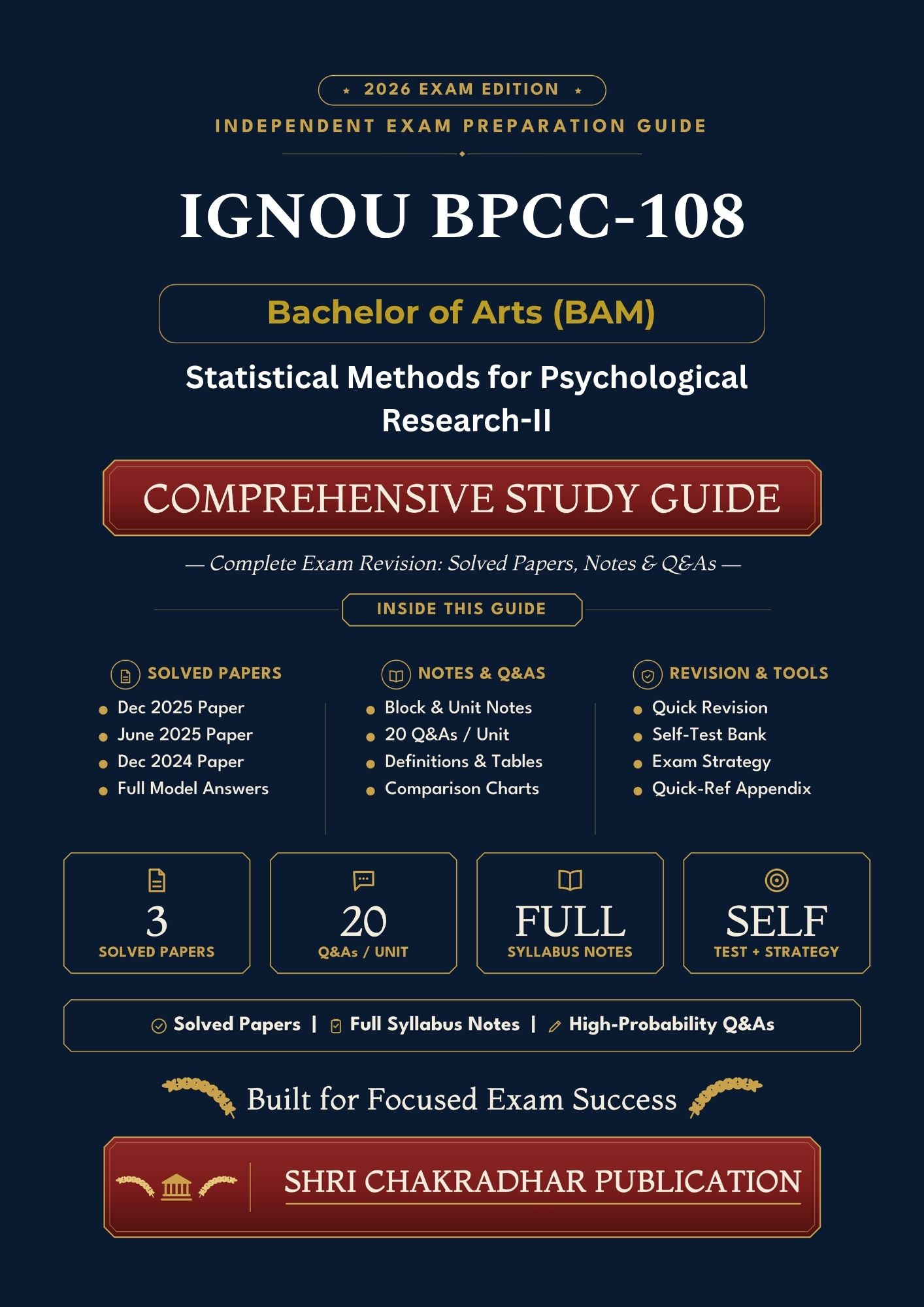
IGNOU BPCC-108 Book (Statistical Methods for Psychological Research-II) is a 2026 English-medium study guide for Bachelor of Arts (BAM) learners. It is designed around the verified official course structure and supports concept learning, Unit-wise revision, previous-year-question practice and TEE preparation across 4 Blocks.
Psychology requires careful use of concepts, processes, examples and research language; similar-sounding terms can easily be mixed up unless revision is structured around distinctions and applications. In Statistical Methods for Psychological Research-II, the challenge becomes sharper around Inferential Statistics: An Introduction, Parametric Statistics, Non-Parametric Statistics, Statistical Package for Social Sciences. This guide responds by helping you separate closely related concepts, understand processes, use suitable examples and practise application-based explanations. The layout gives the course a practical revision order, so concepts are not treated as isolated notes. The same structure supports slow first reading as well as faster second-cycle revision.
For more IGNOU study material, visit IGNOU Study Material. Use the present book alongside IGNOU’s official material, your current assignment booklet and the latest TEE instructions so that revision remains aligned with the university’s academic requirements.
An Overview of the IGNOU BPCC-108 Help Book
The BPCC-108 guide gives you a full-course revision route for Statistical Methods for Psychological Research-II without pretending to replace the official IGNOU material. It turns the syllabus into a practical sequence of reading, recall, answer planning and exam practice.
This Book Is Useful For
This book is useful for students who need one organised companion for learning, assignment-oriented understanding and TEE revision in BPCC-108. It is particularly helpful when official material is comprehensive but available study time is limited.
- Learners beginning the course who want a clear map before reading in depth.
- Working students who need short, repeatable study sessions with visible progress.
- Students revising after completing the official Blocks or Units and wanting a compact second pass.
- Learners practising previous-year questions who need topic-wise recall before attempting an answer.
- Students preparing assignments who want conceptual clarity but will write and submit their own work in accordance with IGNOU guidelines.
What’s Inside This BPCC-108 Book
Inside the BPCC-108 book you get syllabus-aligned notes, revision cues and practice material arranged around the actual subject rather than a generic exam template. The content is designed to move from understanding to retrieval and then to written practice.
- Unit-wise notes: concise explanations aligned with the full verified syllabus structure.
- Concept checkpoints: important definitions, distinctions, processes, arguments or methods that should be clear before moving ahead.
- Answer-building support: guidance on introducing a response, developing the core explanation and closing it without padding.
- Question practice: subject-specific prompts that resemble the kinds of analytical, explanatory or problem-oriented tasks students may meet in IGNOU study and examinations.
- Revision layer: quick recap material for the final study cycle, with reminders to verify current official instructions.
Complete Syllabus Coverage – All 4 Blocks
The guide covers all 4 verified Blocks of IGNOU BPCC-108. The table keeps the official Block names visible so students can cross-check their study plan against the university material.
| Official Block | Verified Block Name |
|---|---|
| Block 1 | Inferential Statistics: An Introduction |
| Block 2 | Parametric Statistics |
| Block 3 | Non-Parametric Statistics |
| Block 4 | Statistical Package for Social Sciences |
How This Book Maps to the IGNOU BPCC-108 Exam Pattern
The book maps the syllabus to common TEE study tasks—definition, explanation, comparison, application, critical discussion and, where relevant, calculation—rather than claiming a fixed or guaranteed paper pattern. Students should always check the latest official question paper and instructions for their session.
Why Students Prefer Our IGNOU BPCC-108 Guide Book & Study Material
The practical value of this guide is its combination of verified coverage, readable explanations and a repeatable revision workflow. It is designed for independent learners who want clarity without exaggerated promises.
Compiled & Reviewed By
This guide is compiled and reviewed by the SCP Panel of Experts under BK Sahni, Shri Chakradhar Publication. The editorial aim is to present BPCC-108 in clear student language while preserving the academic meaning of the verified syllabus.
How to Use the IGNOU BPCC-108 Help Book for TEE and Assignments
Use the BPCC-108 book in three cycles: understand, practise and revise. A single read-through is less effective than returning to the same topic with a different task each time.
- Cycle 1 – Understand: read the relevant official material and the matching guide section; underline only terms that carry real meaning.
- Cycle 2 – Retrieve: close the text and write a short outline from memory, including definitions, stages, arguments, examples or formulae as appropriate.
- Cycle 3 – Practise: attempt one previous-year or sample-style question under a sensible time limit.
- Assignment use: use the guide to understand the topic and locate concepts, then prepare and submit your own original assignment response.
- Final revision: revisit weak topics, not only favourite ones, and check the latest official examination instructions before the TEE.
High-Probability Questions from IGNOU BPCC-108 (Sample)
These sample questions identify high-value revision areas from the verified BPCC-108 syllabus; they are practice prompts, not predictions of the actual TEE paper. Use them to test whether you can build a complete answer without reading from notes.
- Explain Inferential Statistics: An Introduction and show how its main concepts can be distinguished and applied through an appropriate psychological example.
- Explain Parametric Statistics and show how its main concepts can be distinguished and applied through an appropriate psychological example.
- Explain Non-Parametric Statistics and show how its main concepts can be distinguished and applied through an appropriate psychological example.
- Explain Statistical Package for Social Sciences and show how its main concepts can be distinguished and applied through an appropriate psychological example.
- Compare two major ideas from Statistical Methods for Psychological Research-II and explain how they can be used together in a well-structured TEE answer.
- Compare two major ideas from Statistical Methods for Psychological Research-II and explain how they can be used together in a well-structured TEE answer.
IGNOU BPCC-108 Sample Question Paper (TEE Format Template)
This is a practice template for planning a BPCC-108 mock TEE; it is not an official IGNOU question paper. Adapt the number of questions and marks to the latest official paper available for your examination session.
Practice Section A – Core understanding
Choose short-answer prompts from Inferential Statistics: An Introduction and Parametric Statistics. Define terms precisely and add one relevant explanation, example or step.
Practice Section B – Analytical answers
Attempt questions that connect two themes, such as Parametric Statistics with Statistical Package for Social Sciences. Use headings only where they improve clarity; keep the argument continuous.
Practice Section C – Extended response/problem
Select one broad question from the course and write a complete answer under timed conditions. Where the subject is quantitative, show the full method; where it is theoretical or textual, state the argument, evidence and conclusion clearly.
Related IGNOU BPCC-108 Additional Supports
These optional supports are available for students who want separate help with assignments, handwritten work, previous-year questions or guess-paper revision for BPCC-108. They are not part of the present book unless specifically stated in your order.
- IGNOU BPCC-108 Solved Assignment
- IGNOU BPCC-108 Handwritten Assignment
- IGNOU BPCC-108 Solved PYQs
- IGNOU BPCC-108 Solved Guess Paper
Delivery, Returns & Payment Options
The paperback is supplied as a physical study guide, with ordering and fulfilment handled through Shri Chakradhar Publication’s normal store process. Check the current checkout page for the delivery serviceability, payment method and return terms applicable to your order.
How Students Use This Guide
Students can use this guide as a planning and revision tool at different stages of the BPCC-108 study cycle. The examples below describe practical study patterns and are not customer reviews or testimonials.
During first reading: keep the guide beside the official material and use it to identify the central question behind each Unit. During weekly revision: turn one theme such as Inferential Statistics: An Introduction into a recall sheet. Before assignments: revise the relevant concept, then write your own response using the assignment instructions. Before TEE: practise mixed questions across the syllabus instead of reading one topic repeatedly.
Free Downloads: IGNOU BPCC-108 Exam Support PDFs
Use official IGNOU sources first for free course material, assignments and previous question papers. These resources help you verify the current syllabus and examination context before relying on any commercial guide.
- eGyanKosh – search for BPCC-108 to locate available official study material.
- IGNOU Assignments – check the applicable session and course code before writing.
- IGNOU Previous Question Papers – use past papers to understand question wording and practise time management.
Download BPCC-108 Study Material Free via eGyanKosh (Step-by-Step)
You can look for official BPCC-108 material free on eGyanKosh by searching the exact course code and checking that the result matches Statistical Methods for Psychological Research-II. Use the official repository as the primary source for university-published learning material.
- Open eGyanKosh.
- Enter BPCC-108 in the repository search box.
- Open the course or collection whose title matches Statistical Methods for Psychological Research-II.
- Check the language and the listed Blocks or Units before downloading.
- Save the official PDFs and study them alongside this independent guide.
Frequently Asked Questions (FAQ)
These FAQs clarify BPCC-108 syllabus coverage, medium, TEE use and assignment support.
How many Blocks does IGNOU BPCC-108 have?
IGNOU BPCC-108 has 4 verified Blocks in the official eGyanKosh structure, and this guide covers all 4.
What subject does IGNOU BPCC-108 cover?
BPCC-108 covers Statistical Methods for Psychological Research-II. This 2026 guide follows the verified official syllabus structure.
What medium is this BPCC-108 book?
This listing is for English medium. Verify the medium before ordering if IGNOU offers another language version.
Can I use this BPCC-108 guide for the TEE?
Yes. Use it for Unit-wise revision and question practice, while checking the latest official TEE paper and instructions.
Does the BPCC-108 book replace IGNOU study material?
No. Official IGNOU material remains the primary source; this is an independent guide for explanation, practice and revision.
Does the guide include previous-year-question practice?
Yes, it supports PYQ-oriented revision. Any separate solved-paper product is listed only in the optional support section above.
Can I use the book for assignments?
Yes, for concept clarity and planning. Prepare and submit your own assignment work under current IGNOU instructions.
Is the sample TEE paper official?
No. It is a revision template, not an official IGNOU paper or a guarantee of questions.
How should I revise BPCC-108 in the final week?
Split the syllabus across daily sessions, practise each major theme, then finish with mixed recall and weak-topic revision.
Conclusion
The IGNOU BPCC-108 Book is intended to make Statistical Methods for Psychological Research-II easier to organise, revise and practise without hiding the official syllabus behind generic notes. Its strongest use is as a companion: learn from official IGNOU resources, use the guide to structure recall and answer practice, and keep your preparation spread across the whole course.
If your current priority is Inferential Statistics: An Introduction, begin there and build outward toward Statistical Package for Social Sciences; if you have already completed the first reading, move directly to mixed question practice and weak-topic revision. To order, visit the IGNOU BPCC-108 Book order page.
Disclaimer: This is an independent academic study-support resource published by Shri Chakradhar Publication (Pvt.) Ltd. It is not affiliated with, endorsed by, or an official publication of IGNOU. It is designed to supplement, not replace, IGNOU’s official study material. Syllabus and exam patterns may change – please verify the latest information through official IGNOU channels. Students should prepare and submit their own work as per IGNOU guidelines. All trademarks belong to their respective owners.