

Description
In short. The Post Graduate Diploma in Development Studies is a 36-credit, six-paper programme from IGNOU’s School of Extension and Development Studies, and every one of its papers carries a written assignment: MDV-101, MDV-102, MDV-103, MDV-106, MDV-109 and MDV-004, printed on the booklets as ASSIGNMENT 1 through ASSIGNMENT 6 in that order. Shri Chakradhar Publication prepares those answers by hand on A-4 sheets in writing matched to the learner’s own, at ₹320 per subject with courier included, for any session including backlogs. Each paper sets five compulsory questions worth 20 marks apiece, with guidance of roughly 800 words per answer on the 2026-27 files, and the July 2026 intake submits by 31 March 2027 while the January 2027 intake submits by 30 September 2027. The practical trap is that only MDV-004 has a booklet whose cover names PGDDVS; the other five 2026-27 papers are published under MADVS covers and MADVS file names, which is why this page lists the exact file each code sits in before it lists anything else.
Everything That Travels With a PGDDVS Order
An order placed here produces a physical parcel, not a download link, and it is worth knowing exactly what is inside it before the first code is named. For every PGDDVS paper ordered, four things are written, assembled and couriered together.
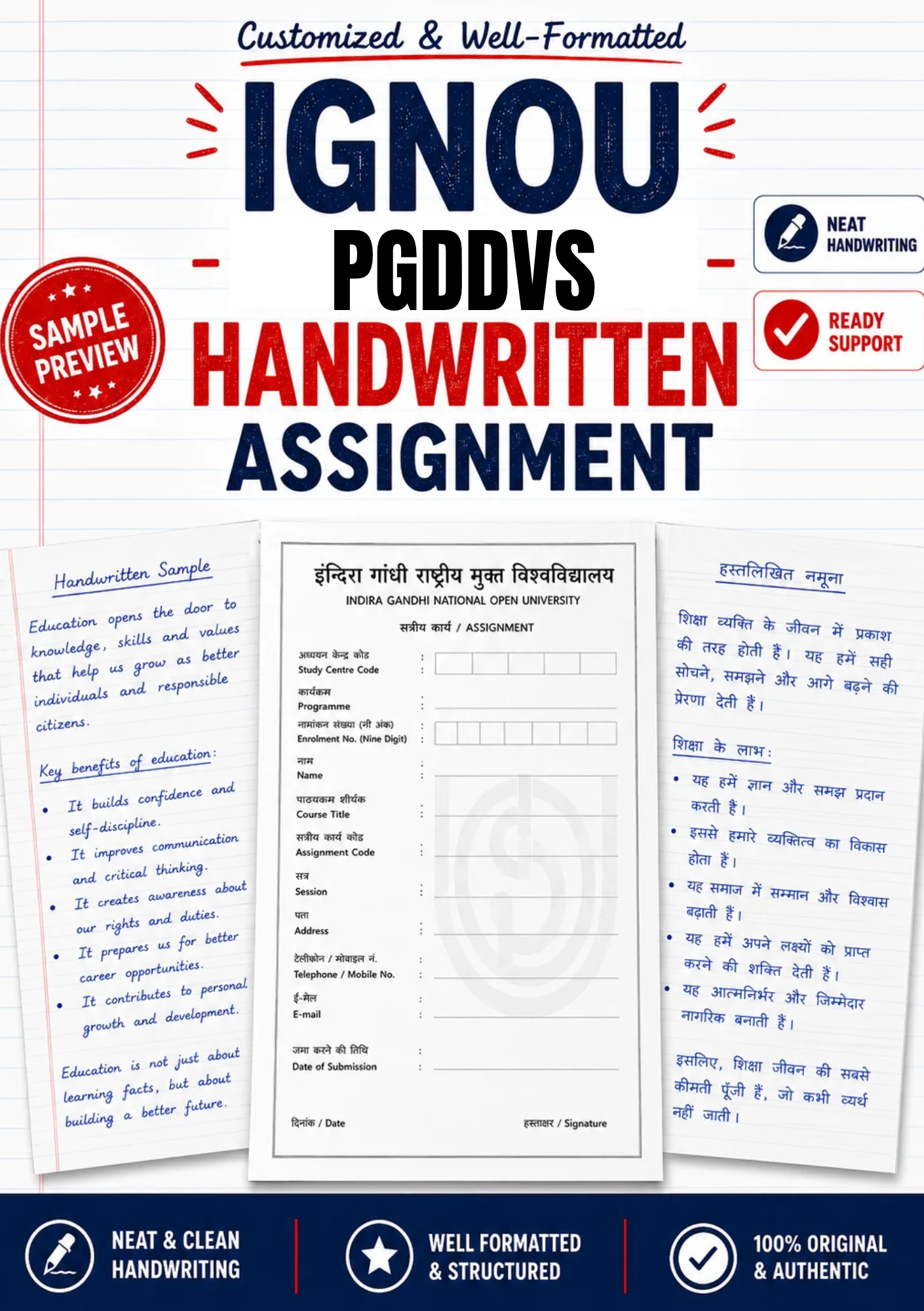
The first is the answer set itself: five answers to the five questions printed on the paper for your course, written out by hand on A-4 sheets, one side after the other with margins left clear, and the pages tied or stapled course-wise in the manner the booklet instruction describes. The second is an IGNOU-format front page, filled in with the fields the booklet cover asks for, supplied free with every order. The third is a printed copy of the question paper the answers were written against, so that a study-centre clerk comparing your submission to the current paper is looking at the same document you were. The fourth is the separation between courses: six codes ordered together arrive as six separately bound sets, because the counter accepts them course by course and a single fused bundle creates work at the window.
What does not arrive is anything readable on a screen. No soft copy or PDF is sold. That is a deliberate scope decision rather than an omission, and the section on reference files against submission sets explains why a diploma whose booklets insist on handwriting cannot be served by a file.
Itemising the ₹320 Against a Six-Paper Diploma
The rate is ₹320 per subject, hard copy only, with courier included in that price and no separate shipping charge. On a six-paper diploma that resolves to a simple arithmetic the learner can check without asking: six codes at ₹320 is the whole programme’s written work, and a learner carrying two backlog codes pays for two. There is no minimum order: one subject or fourteen, same rate.
Inside the rate sit the writing of all five answers, the sheets themselves, the IGNOU-format front page, the question-paper copy, the binding, and the courier to your address. Outside the rate sit three things, named here so that nothing is discovered later. IGNOU’s own fees are outside it, because this is a publisher and not a university counter; your programme fee, your re-registration and any late fee the university charges are paid to IGNOU. The physical act of submission is outside it, because the booklet is explicit that the set goes to the allotted study centre and nobody else can sign your name in the receipt register. And the result is outside it, for the reason given in the notice at the foot of this page.
Delivery depends on your pin code and is confirmed for your order before you pay. No figure is promised on this page. A learner in a metro and a learner in a district headquarters do not get the same journey, and quoting a single number to both would be a promise one of them has to absorb.
Two Products Answer the Same MDV Question Paper
Learners searching for help with MDV-101 or MDV-004 meet two different things that both call themselves assignments, and the difference is the difference between reading material and submittable material.
A solved assignment is a soft-copy reference file of model answers for a course code and a session. It is something to read from, argue with and rewrite in your own words. It is not a submission, and a printed copy of one is not a submission either. A handwritten assignment is the set of answers written out by hand on A-4 sheets and handed in as hard copy at the study centre, which is what this product is.
The booklets settle the question without any interpretation being required. Every MDV file fetched for this page carries the same instruction: only handwritten assignments are evaluated, and the writing must be the learner’s own. That single line is why a PDF, however good its answers, is a study aid and not a thing you can hand across a counter.
| Question | Solved assignment | Handwritten assignment |
|---|---|---|
| Format | Soft copy file of model answers | Written A-4 sheets, hard copy only |
| What you do with it | Read it, then write your own answers from it | Check it, sign the declaration, submit it |
| Who it suits | A learner who intends to write all thirty answers personally | A learner who cannot free thirty answers’ worth of hours this cycle |
| Handwriting | Not applicable, nothing is written | Matched to your own hand from a sample photo |
| Rate on this store | Priced per code on the solved-assignment shelf | ₹320 per subject, courier included |
Scroll the table sideways on a narrow screen.
If writing the papers yourself is the plan, the soft-copy route is the correct purchase and it is stocked elsewhere on this store: the model answers for the MDV codes sit on the Development Studies solved-assignment shelf, filed under MADVS because the MDV codes are shared. This page does not sell one and does not pretend to. A fuller walk through formatting, front pages and submission mechanics sits on the publisher’s editorial site in the IGNOU handwritten assignment guide for 2026-27, which is free to read.
Six codes, six numbers, one message. Send MDV-101, MDV-102, MDV-103, MDV-106, MDV-109 and MDV-004, or whichever subset you still owe, with your session.
₹320 per subject, hard copy only, courier included in that price.
Assignment 1 to Assignment 6: The Diploma’s Entire Code List
PGDDVS is unusual among IGNOU’s post-graduate diplomas in having no elective at all. Where a rural-development or an education diploma asks the learner to pick one paper from a menu, this one does not: six courses, six credits each, thirty-six credits, and the same six for everybody enrolled. Two classmates who joined in different sessions still owe an identical list.
The table below gives the codes and credits as the Common Prospectus July 2026 prints them in section 8.20, alongside the titles as the live booklets print them, which is not always the same wording.
| Assignment | Code on the booklet | Title on the booklet | Code in the prospectus | Credits |
|---|---|---|---|---|
| ASSIGNMENT 1 | MDV-101 | Introduction to Development and Development Theories | MDV 101 | 6 |
| ASSIGNMENT 2 | MDV-102 | Dynamics of Development | MDV 102 | 6 |
| ASSIGNMENT 3 | MDV-103 | Issues and Challenges in Development | MDV 103, titled “of Development” | 6 |
| ASSIGNMENT 4 | MDV-106 | Research Methodology in Development Studies | MDV 106 | 6 |
| ASSIGNMENT 5 | MDV-109 | Development in India- An Overview | MDV 109 | 6 |
| ASSIGNMENT 6 | MDV-004 | Gender and Development | MDV 4 | 6 |
| Total credits, as printed in the prospectus | 36 | |||
Scroll the table sideways on a narrow screen.
The credits were added independently before this page was written: six courses at six credits each sum to 36, which matches the figure the prospectus prints under the same table. That check matters because the diploma’s codes are interleaved with a master’s programme’s codes in the same document, and a table that extracts cleanly is not automatically a table that reads correctly.
One structural point is worth stating plainly because it changes what a learner should buy. The six PGDDVS courses are also the first year of the Master of Arts in Development Studies, and the prospectus states in three separate places that a learner who completes PGDDVS can take lateral entry to the second year of MADVS. The practical consequence is that nothing written for this diploma is wasted if the learner continues, and that a learner already holding the diploma who has entered MADVS laterally does not re-order these six: that learner’s work sits in the second-year pool and belongs on the MADVS handwritten assignment page, which covers the MDV and MEDS second-year codes instead.
Which File Name to Download for Each of Your Six Codes
This is the section most PGDDVS learners actually need, and it exists because IGNOU’s 2026-27 assignment server does not file this diploma’s papers under its own name.
Until the 2024-25 cycle, PGDDVS had a single consolidated booklet. One PDF carried the cover of the Post Graduate Diploma in Development Studies and all six assignments inside it, numbered 1 to 6. Three of those consolidated files are still reachable on IGNOU’s web services archive, for July 2022 with January 2023, for July 2023 with January 2024, and for July 2024 with January 2025. From the 2025-26 cycle onward the booklets were split into one file per course, and in that split the PGDDVS label mostly disappeared.
| Your code | File published for 2026-27 | Programme named on the cover |
|---|---|---|
| MDV-101 | MDV-101-MADVS-2026-27.pdf | Master of Arts (Development Studies). The cover’s programme fields are left blank. |
| MDV-102 | MDV-102-MADVS-2026-27.pdf | Master of Arts (Development Studies) |
| MDV-103 | MDV-103-MADVS-2026-27.pdf | Master of Arts (Development Studies) |
| MDV-106 | MDV-106-MADVS-2026-27.pdf | Master of Arts (Development Studies). PGDDVS appears nowhere on it. |
| MDV-109 | MDV-109-MADVS-2026-27.pdf | Master of Arts (Development Studies), in the page header only |
| MDV-004 | MDV-004-PGDDVS-2026-27.pdf and MDV-004-MADVS-2026-27.pdf | PG Diploma in Development Studies on the first, Master of Arts (Development Studies) on the second |
Scroll the table sideways on a narrow screen.
Two readings follow from that table, and both are reassuring rather than alarming. The first is that a MADVS cover on your MDV-103 file does not mean you have downloaded the wrong paper: the diploma’s six courses and the master’s first-year courses are the same courses, so the same questions serve both. The second is that MDV-004 existing twice for one session is a filing duplication rather than two different papers. Both 2026-27 editions of MDV-004 print ASSIGNMENT 6, the same two submission dates, and the same five questions on social construction, liberal feminism, engendering governance, women’s entrepreneurship and barriers to girls’ education. Writing against either edition produces the same submittable set, and the set supplied here is written against whichever edition the learner names.
The ordering of the assignment numbers is worth one more sentence, because it quietly settles an argument that recurs in study groups. The numbering follows the diploma’s table order, not the master’s. The prospectus lists the PGDDVS courses as 101, 102, 103, 106, 109 and then Gender and Development, and the booklets number them 1, 2, 3, 4, 5 and 6 in exactly that sequence. The MADVS first-year table lists Gender and Development fourth instead, which is why learners reading from the master’s table sometimes expect Gender and Development to be assignment 4 and find assignment 4 is Research Methodology.
What Four Years of PGDDVS Paperwork Gets Wrong
The checks below were produced by reading the Common Prospectus July 2026 against seven live assignment files and against this store’s own catalogue. None of them is fatal to an order, but a learner who meets one of them cold usually assumes a mistake has been made somewhere, and the mistake is almost always in the paperwork rather than in the enrolment.
Nineteen points where the PGDDVS record does not agree with itself. Only ignou.ac.in and your Regional Centre can resolve any of them for your enrolment.
1. The sixth course is coded three ways inside one document. The PGDDVS table in section 8.20 prints MDV 4, the MADVS table in section 3.46 prints MDV 4, and the MACSR table in section 3.47 prints MDV-004 for the same course title.
2. IGNOU’s own term-end question-paper archive is split the same way: the June 2022 paper is filed as MDV-4 while the June 2019, June 2020, June 2023 and June 2024 papers are filed as MDV-004.
3. MDV-103 is titled Issues and Challenges of Development in the prospectus and Issues and Challenges in Development on both the 2025-26 and the 2026-27 booklets.
4. MDV-109 is titled three ways in one prospectus: Development in India – An Overview in the MADVS table, Development in India- An Overview in the PGDDVS table, and Development in India (en dash) An Overview in the MACSR table. The booklet matches the PGDDVS spelling.
5. Only MDV-004 has a 2026-27 booklet whose cover names PGDDVS. The 2026-27 files for the other five courses are published under MADVS covers and MADVS file names.
6. MDV-004 is published twice for the same 2026-27 cycle, once as a PGDDVS file and once as a MADVS file, with identical assignment numbers, dates and questions.
7. Two file-naming conventions sit side by side on the same server: MDV-103-25-26.pdf for the older cycle and MDV-103-MADVS-2026-27.pdf for the current one.
8. On MDV-101, MDV-106 and MDV-109 the cover’s Name of the Programme and Programme Code fields are left blank, so nothing printed on the sheet ties the paper to a diploma enrolment.
9. The consolidated PGDDVS booklet for July 2024 and January 2025 prints 30 March 2025 as the July cut-off, where the 2025-26 and 2026-27 files print 31 March.
10. The word guidance moved between cycles. The 2024-25 consolidated booklet asks for about 600 words per answer; the 2026-27 files ask for about 800.
11. In the 2024-25 consolidated booklet, assignment 4 for MDV-106 prints a header reading Maximum Marks 10, while the five questions beneath it carry 20 marks each and total 100.
12. The PGDDVS section of the prospectus closes with a footnote marked with a hash about lateral entry, although no hash marker appears anywhere in the PGDDVS table itself; the marker sits in the MADVS table instead.
13. Third-party listing sites abbreviate this programme PGDDS. The prospectus and the booklets both print PGDDVS, and the string PGDDS does not appear in the Common Prospectus July 2026 for this programme at all.
14. The term-end question papers for these codes are archived on IGNOU’s web services under a MADVS folder, with no PGDDVS folder alongside it.
15. This store’s own PGDDVS solved-assignment category exists but currently holds zero products, while the PGDDVS books category holds eight. A learner clicking through to the diploma’s solved-assignment shelf meets an empty page.
16. This store carries no PGDDVS guess-paper shelf at all, although the equivalent MADVS shelf is stocked.
17. This store’s own book listings print MDV 4, following the prospectus wording rather than the MDV-004 the live booklet and the recent question papers use.
18. The MADVS handwritten product on this store answers a question framed around a PGDDVS-labelled cover appearing on MDV-103. The live 2026-27 files put the PGDDVS-labelled cover on MDV-004, and that MADVS page needs re-checking.
19. The publisher’s editorial site carries no PGDDVS-specific article, so the only companion reading offered here is the general handwritten assignment guide rather than a programme-specific one.
Items 15 to 19 are this publisher’s own, not IGNOU’s. They are listed here rather than quietly fixed later because a page that only catalogues other people’s errors is not being straight with the reader.
Why a July 2026 Paper Is Due in March 2027
The School of Extension and Development Studies does not use the cut-off pattern that circulates most widely in IGNOU study groups, and carrying a date across from a management or humanities programme is the single most expensive mistake available here. Every 2026-27 MDV file fetched for this page prints the same pair.
A learner admitted or re-registered in the July 2026 session submits by 31 March 2027. A learner in the January 2027 session submits by 30 September 2027. Both lines appear on the instruction page of the booklet itself, with the standard rider that the university may announce an extension on its website, which means the printed date is the floor and never the ceiling.
Two consequences follow for a learner planning an order. The first is that the gap between a session opening and its assignment falling due is roughly eight months, which is generous enough that most learners discover the deadline late rather than early. The second is that the December term-end examination sits before the March date for a July learner, so the assignment and the examination are not sequenced the way intuition suggests. Assignments carry 30 per cent of the final course result and the term-end examination carries the remaining 70 per cent, and the 30 per cent only lands on the grade card after the study centre has forwarded the set.
Papers expire. The questions printed for July 2026 and January 2027 replace the questions printed for July 2025 and January 2026, and a set written against a retired paper is a set written against the wrong questions however well it is written. The booklet instruction is blunt about this: use the latest version posted on the website irrespective of the year of registration. Any session is accepted, current cycle or older, including backlog courses, at the same ₹320 per subject, and the way a backlog is handled is by writing to the paper that was live for the cycle being cleared, which is why the session is asked for alongside the codes.
Copying ASSIGNMENT 6 Onto the Sheet Before You Submit
Many IGNOU programmes give the learner a compound assignment code to copy onto the front page, a string of the form code, slash, TMA, slash, session, slash, year. PGDDVS does not. There is no TMA string anywhere on an MDV paper. What the booklet prints instead is a plain heading: ASSIGNMENT 1, ASSIGNMENT 2, and so on to ASSIGNMENT 6.
That number is not a free choice, and it is not the order in which you happen to be writing. It is fixed by the course, and the mapping is the one in the code table above: MDV-101 is 1, MDV-102 is 2, MDV-103 is 3, MDV-106 is 4, MDV-109 is 5 and MDV-004 is 6. It is confirmed twice over, once by the consolidated PGDDVS booklet that printed all six in sequence and once by the individual 2026-27 files that each print their own.
The complication is that the cover page of the split 2026-27 files has a field labelled Assignment No. and leaves it blank, while the assignment heading inside the file carries the number. A learner filling in the cover from the cover alone has nothing to copy. The number to write is the one printed above the questions, not a number the learner invents, and every front page supplied with an order here is filled in from the paper rather than from guesswork.
The rest of the cover is ordinary and the booklet lists it: assignment number, name, enrolment number, regional centre and its code, programme name, programme code, course code, course title, email, phone, date of submission, address and signature. The programme name to write is the diploma’s, Post Graduate Diploma in Development Studies, even when the file you downloaded says Master of Arts across the top, because the cover describes your enrolment and not the file’s name.
Fixing the Handwriting Before Any Money Changes Hands
A written set that does not resemble the learner’s own writing is a set that invites a question at the counter, and the booklet gives the counter grounds to ask: the instruction is that the answers must be in the learner’s own handwriting. The sequence used here puts that problem before the payment rather than after it.
Send a photo of a page you have written yourself and the handwritten set is matched to your handwriting at no extra charge. The match is assessed and shown before an order is confirmed, which means the learner is agreeing to a sample of the actual hand rather than to a description of it. If the match is not usable, nothing has been paid and nothing is owed.
What the sample page needs to show
A usable sample is a full page rather than a signature or a line, written in the pen the learner normally uses, photographed flat in daylight with the whole sheet in frame and the camera square to the page. Ruled paper helps because it shows the natural line spacing. Ordinary continuous prose is better than a list, because the joins between words are what carry the character of a hand. A page of PGDDVS notes already in a notebook is ideal, since it shows the writing at the speed it is normally produced rather than at the speed of a careful specimen.
No Hindi Edition Exists, and No Session Is Refused
The prospectus is unambiguous that the medium of instruction for PGDDVS is English, with no second medium listed in the programme table and no Hindi edition of the MDV papers on the assignment server. Every booklet fetched for this page is set in English. That matters commercially because it removes a question that other programmes raise constantly: there is no Hindi set to ask about and no price difference to negotiate.
The underlying commitment is unchanged and broader than this programme. The service covers all mediums IGNOU issues the TMA paper in, at the same price. For PGDDVS that currently resolves to one medium, and if the university issues the paper in a second medium in a later cycle the same rate applies to it.
Session coverage runs the other way, wide rather than narrow. Any session is accepted, current cycle or older, including backlog courses, at the same ₹320 per subject. A learner clearing a 2023-24 backlog alongside a 2026-27 paper gets two sets written against two different question papers, and the older one may carry the 600-word guidance rather than the 800-word guidance, which changes the page count but not the price. The handwritten assignment hub listing every programme this service writes for carries the same terms across the catalogue.
The Short Message That Prices a PGDDVS Order
Pricing a PGDDVS order needs five lines and nothing more. Anything beyond them slows the quote down rather than improving it.
- The course codes you want written, by code: MDV-101, MDV-106 and so on. Assignment numbers alone work too, since the mapping is fixed.
- Your session, as it appears on your admission or re-registration record: July 2026, January 2027 or an older cycle you are clearing.
- Confirmation that your enrolment is PGDDVS rather than MADVS, because a MADVS learner’s second-year list is different and would be quoted differently.
- One photograph of a page in your own handwriting.
- The delivery address with its pin code, which is what the courier timing is confirmed against.
What is not needed: your enrolment number is not required to get a quote, your marksheet is not required, and the downloaded PDFs do not need to be forwarded, because the papers are read from IGNOU’s server directly. The quote comes back as a line per code at ₹320 per subject with the total stated, so there is nothing to compute at your end.
Already know which of the six you still owe? Name them with your session and the writing can be scheduled against the current paper.
₹320 per subject, courier included, no separate shipping charge, no minimum order.
Three Steps That Are Yours Alone Once the Parcel Lands
The parcel arriving is the midpoint of the process, not the end of it, and three things remain that only the learner can do.
The first is reading. You sign the declaration on the assignment cover page, so you should read and review the content before submitting it, and satisfy yourself that it represents your own understanding of the course. On a six-paper diploma that is thirty answers to read, and a learner who reads them is also a learner who can answer a question about them at the counter or in a viva.
The second is submission. The booklet instruction is narrow: the set goes to the allotted study centre and not to a regional centre, not to the school and not by post to headquarters. Take the receipt or get the counter register signed, because the receipt is the only artefact that exists between handing the set over and the marks appearing.
The third is the wait, and the booklet gives a specific piece of advice about it: keep a scanned copy of the submitted assignment until the marks appear on your grade card. That is IGNOU’s instruction rather than this publisher’s, and it is the cheapest insurance available. Assignment marks reach the grade card after the study centre forwards and the school processes, and the interval varies by centre.
Other Development Studies Material Stocked Alongside This
A written set answers the assignment, not the examination, and most PGDDVS learners end up holding more than one thing from this catalogue across a cycle.
For reading the course itself, the diploma has its own shelf: the PGDDVS help-book shelf, filed under the post-graduate diploma books section carries the chapter-wise guides for these codes. Because the same six courses run as the master’s first year, the larger Development Studies book catalogue under the MADVS heading is worth a look too, and is where a learner moving on after lateral entry will go next. The Gender and Development paper has a guide of its own at the study guide for the sixth paper, listed on the store under the older MDV 4 spelling, and the third paper at the guide for Issues and Challenges, whose listing follows the prospectus title rather than the booklet’s.
For the examination rather than the assignment, two other shelves apply. Past papers for these codes sit in the previous-year solved paper collection for Development Studies, and the Development Studies guess-paper shelf covers the term-end side, though note that no diploma-specific guess-paper shelf exists yet and the MADVS one is where the MDV codes live.
Learners who continue past the diploma split two ways. Most go to the master’s second year, whose written-set page is the one linked earlier in the code section. A smaller group moves sideways into corporate social responsibility, where MDV-004, MDV-109 and several other MDV codes reappear in the second-year basket, and the MACSR written-assignment page covering the CSR code list accounts for them.
The Doubts a Six-Paper Diploma Usually Raises
How many assignments does PGDDVS actually have?
Six. One for each of MDV-101, MDV-102, MDV-103, MDV-106, MDV-109 and MDV-004, printed as ASSIGNMENT 1 to ASSIGNMENT 6. There is no elective to choose and no project course, so every enrolled learner owes the same six.
Is the sixth course MDV 4, MDV 004 or MDV 104?
MDV-004 on the live booklet and on the recent term-end papers. The Common Prospectus July 2026 prints MDV 4 in the PGDDVS table and MDV-004 in the MACSR table for the same course, Gender and Development. MDV 104 is not used anywhere in the document. Write MDV-004 on the cover page and name it that way when ordering.
My MDV-101 file says Master of Arts across the top. Have I downloaded the wrong paper?
No. For 2026-27 IGNOU publishes MDV-101, MDV-102, MDV-103, MDV-106 and MDV-109 under MADVS covers, because the diploma’s six courses are also the master’s first year. Only MDV-004 has a file whose cover says PGDDVS. The questions are the ones your diploma is assessed on either way.
There are two MDV-004 files for 2026-27. Which one do I answer?
Either. One is filed as a PGDDVS paper and one as a MADVS paper, and both print ASSIGNMENT 6, the same two submission dates and the same five questions. Name the one you downloaded when ordering and the set is written against that edition.
What is the last date for a PGDDVS assignment?
31 March 2027 for the July 2026 session and 30 September 2027 for the January 2027 session, as printed on the 2026-27 MDV booklets. The School of Extension and Development Studies does not use the 31 October and 30 April pattern that some other schools print, so a date borrowed from a management or commerce programme will be wrong here. The university can announce an extension, so the printed date is the earliest firm figure rather than the final one.
Can I print a solved assignment PDF and hand that in instead?
No. Every MDV booklet carries the instruction that only handwritten assignments are evaluated and that the writing must be the learner’s own. A solved assignment is a soft-copy reference to write from. A PGDDVS handwritten assignment is the submittable object, which is what this product is.
PGDDVS ke liye solved PDF chalega ya haath se likha set hi dena padega?
Solved assignment ek soft copy reference file hai, jisse padh kar aap apne shabdon mein likhte hain. Handwritten assignment woh likha hua hard copy set hai jo study centre par jama hota hai. IGNOU ki booklet saaf likhti hai ki sirf handwritten assignment hi evaluate hoti hai. Yeh page handwritten set bechta hai, PDF nahin.
Why does this store’s PGDDVS solved-assignment page show nothing?
Because that category is currently empty, which is noted in the disagreements list above as this publisher’s own gap rather than IGNOU’s. The model answers for the same six MDV codes are stocked under the Development Studies shelf filed as MADVS, which is linked in the comparison section earlier on this page.
How long does one PGDDVS answer have to be?
The 2026-27 files ask for roughly 800 words per answer, five answers per paper. The consolidated 2024-25 PGDDVS booklet asked for roughly 600. A backlog set written against the older paper follows the older guidance, which changes the number of sheets and not the ₹320.
Is there a Hindi edition of the MDV papers?
Not at present. The prospectus lists English as the only medium of instruction for PGDDVS, and no Hindi MDV file is published on the assignment server. The service covers all mediums IGNOU issues the TMA paper in, at the same price, which for this diploma currently means one.
I have finished PGDDVS and taken lateral entry into MADVS. Do I order these six again?
No. The six you have written are the master’s first year, which is why the lateral entry exists. The second-year menu is a different code list with elective choices in it, and the MADVS written-assignment page linked above is where that order belongs.
Can I order just one code rather than all six?
Yes. There is no minimum order: one subject or fourteen, same rate. Learners clearing a single backlog paper are the most common case.
Is the question paper included, or do I download it myself?
A copy of the question paper the answers were written against travels with the set, alongside the IGNOU-format front page, which is free with every order. Nothing is emailed, because no soft copy or PDF is sold.
Can I see the handwriting before paying anything?
Yes, and that is the sequence here rather than an exception to it. Send a photo of a page you have written yourself and the handwritten set is matched to your handwriting at no extra charge. The match is shown before the order is confirmed.
How soon will the parcel reach me?
Delivery depends on your pin code and is confirmed for your order before you pay. No figure is promised on this page. Ask for your own pin code and a confirmed answer comes back for it.
Will a written set improve my marks?
No claim is made about the marks any assignment will receive, about how an evaluator will assess it, or about whether it will be accepted. Assignment evaluation is entirely a matter for IGNOU. What the set does is remove the writing work and the format risk, which is a different thing from an outcome.
Each Claim Above, Traced to the Document It Came From
Three kinds of statement appear on this page, and mixing them would make all three less trustworthy. They are kept apart below.
From the IGNOU Common Prospectus July 2026. The programme’s existence as a 36-credit post-graduate diploma under the School of Extension and Development Studies, the six course codes and their credit values in section 8.20, English as the medium of instruction, graduation in any discipline as the eligibility, the one-year minimum and three-year maximum duration, and the statement that a PGDDVS holder may take lateral entry to the second year of MADVS. The credit total of 36 was added independently from the six six-credit rows before the table on this page was published.
From live IGNOU assignment booklets, read on 22 October 2026. The submission dates of 31 March 2027 and 30 September 2027, the printed assignment numbers 1 to 6 and their mapping to the six codes, the five-question pattern at 20 marks each, the roughly 800-word guidance for 2026-27 and the roughly 600-word guidance in the 2024-25 consolidated booklet, the A-4 paper instruction, the write-on-both-sides and tie-course-wise instructions, the handwriting-only rule, the study-centre-only submission rule, the keep-a-scan advice, and the cover-page field list. The files read were MDV-004-PGDDVS-2026-27, MDV-004-MADVS-2026-27, MDV-101-MADVS-2026-27, MDV-103-MADVS-2026-27, MDV-106-MADVS-2026-27, MDV-109-MADVS-2026-27, MDV-102-25-26, MDV-103-25-26 and the consolidated PGDDVS booklet for July 2024 and January 2025. The current papers are reachable from the IGNOU assignment download service, and the diploma-labelled sixth paper directly at the MDV-004 PGDDVS booklet for 2026-27.
From this publisher’s own commercial terms. The ₹320 per subject rate, courier inclusion, the free IGNOU-format front page, the included question-paper copy, the no-minimum-order rule, the handwriting match from a sample photo at no extra charge, and the acceptance of any session including backlogs. These are the publisher’s terms and carry no university sanction of any kind.
Important Notice
Shri Chakradhar Publication Pvt. Ltd. and shrichakradhar.com form an independent IGNOU study-support publisher. This is not the official website of Indira Gandhi National Open University, is not affiliated with, endorsed by or authorised by the university, and no page on this site should be treated as an official IGNOU communication.
Programme structures, course codes, submission dates and rules change, and only ignou.ac.in and your Regional Centre can confirm the current position for your enrolment.
You sign the declaration on the assignment cover page, so you should read and review the content before submitting it, and satisfy yourself that it represents your own understanding of the course.
No claim is made about the marks any assignment will receive, about how an evaluator will assess it, or about whether it will be accepted. Assignment evaluation is entirely a matter for IGNOU.
Start the Order With a List of Codes
Six courses, six assignments, thirty answers. Name the ones you still owe and the session they belong to, and the writing is scheduled against the paper that is currently live for that cycle.
₹320 per subject, hard copy only, courier included in that price. There is no minimum order: one subject or fourteen, same rate. No soft copy or PDF is sold.
Route one, the fastest: message the assignment numbers you need and a line-by-line quote comes back.
Route two, if the handwriting matters most to you: send the sample page first and settle the match before any code is priced.