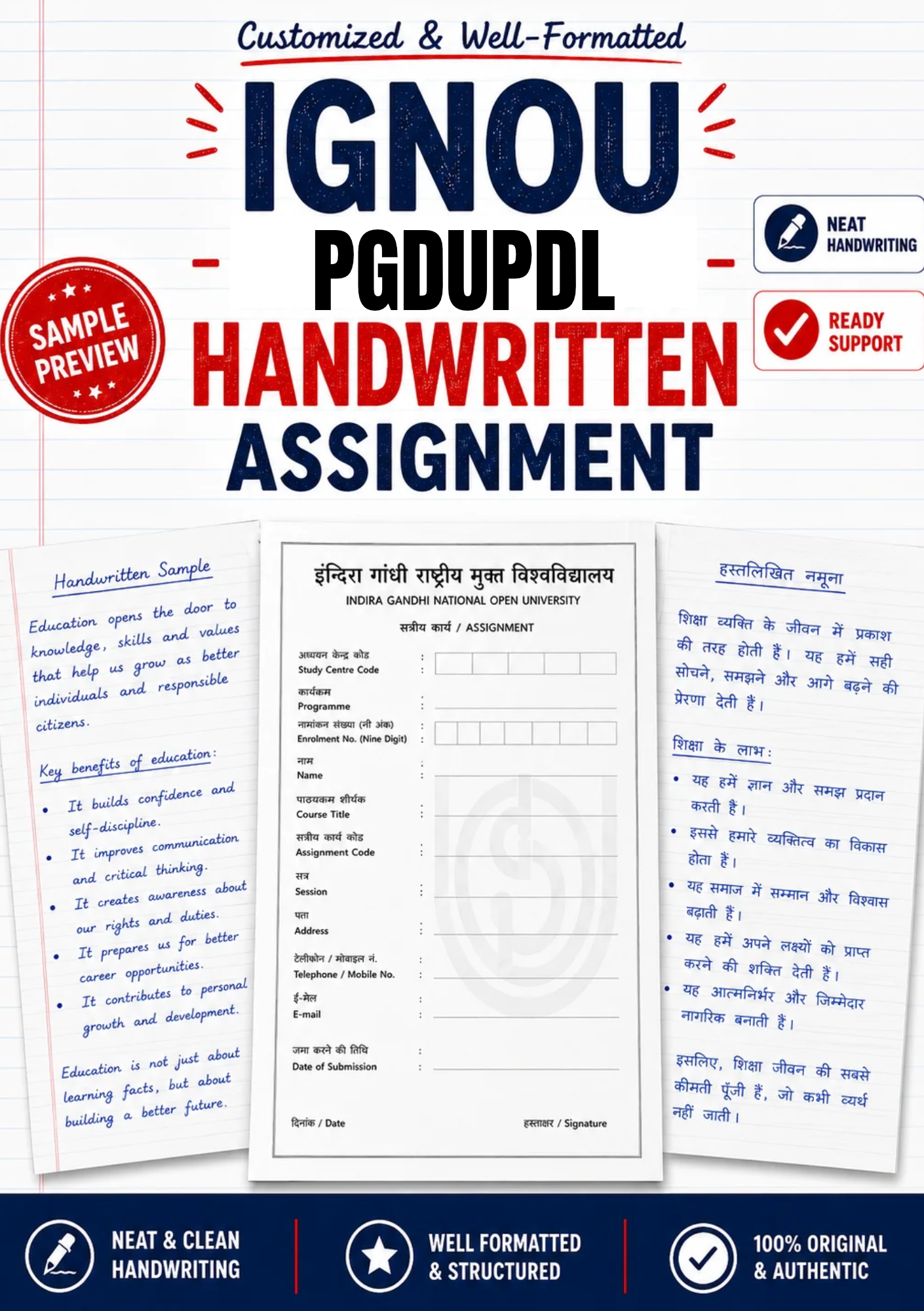


Description
In short. Shri Chakradhar Publication writes out IGNOU Post Graduate Diploma in Urban Planning and Development assignments by hand, one paper at a time, for MEDS 41, MEDS 42, MEDS 43, MEDS 44 and the elective MEDSE 46, at ₹320 per subject, hard copy only, with courier included in that price and no separate shipping charge; a PGDUPDL order is four papers if the eight-credit slot was filled with MEDSP 45 Project Work and five papers if it was filled with MEDSE 46, because the project carries no written assignment; the sheets published for the July 2026 and January 2027 sessions print 31 March 2027 and 30 September 2027 as their two cut-off dates, five questions of 20 marks each and a guide length of about 800 words an answer, and the same rate covers Hindi sheets, English sheets and papers from closed cycles that are still owed.
Four Things Travel in a PGDUPDL Packet, and Each MEDS Number Gets Its Own Set
A PGDUPDL order is counted in course codes, not in semesters or years, because the diploma runs as a single year-wise block and a learner rarely needs every paper at once. For each MEDS number named in the order, four physical items are prepared and all four go into the same courier bag.
- The written answer set. Five answers for that course code, one for each of the five questions the sheet carries, written on A-4 plain or ruled paper in the hand that the sample photograph established, written on both sides with a margin left down the side, and tied or stapled so that one course stays one bundle.
- The IGNOU-format cover sheet, filled in. Enrolment number, name, address, programme and course code, study centre and the session, written in the same hand as the answers, so the top sheet does not look posted on from somewhere else.
- A copy of the question sheet the answers were written against. PGDUPDL sheets carry no course title, only a programme header and a code line, so the paper is the only record of which version of MEDS 042 those five answers belong to.
- A note of which file the questions came from. The SOEDS folder holds more than one live sheet per code, which is covered further down, and the note records the exact one used so nothing has to be guessed later.
No soft copy or PDF is sold. Nothing is emailed, nothing is sent as a scan, and there is no download link anywhere in this order; what the price buys is paper with ink on it, arriving at the address given.
Where the ₹320 on a MEDS Paper Goes, and the Two Charges That Are Not There
The rate is ₹320 per subject, hard copy only, with courier included in that price and no separate shipping charge. One MEDS number at ₹320 means the five answers, the filled cover sheet, the question-paper copy and the courier to the pin code given, with nothing added at the door.
Two charges that other arrangements tend to add are absent here. Handwriting matching is the first. Send a photo of a page you have written yourself and the handwritten set is matched to your handwriting at no extra charge. It is not billed as a premium or a rush line. Medium is the second. The service covers all mediums IGNOU issues the TMA paper in, at the same price. A Hindi MEDS 043 set and an English MEDS 043 set are quoted identically even though they are written from two different files in the SOEDS folder.
What the rate does not cover is anything on the examination side. Assignments carry 30 per cent of the final course result and the term-end examination carries the remaining 70 per cent. The written set reaches only the first of those two. It also does not cover MEDSP 45. A project is researched, supervised and defended rather than answered in five parts, and the PGDUPDL project is sold from a different shelf of this store entirely.
There is no minimum order: one subject or fourteen, same rate. Delivery depends on your pin code and is confirmed for your order before you pay. No figure is promised on this page.
A MEDS Reference File and a MEDS Submission Are Two Different Purchases
These two things get searched for with almost the same words and they are not interchangeable, so it is worth being exact about what each one is. A solved assignment is a soft-copy reference file of model answers for a course code and a session, read on a screen or printed out, used to understand what a good answer to that question looks like. A handwritten assignment is the answers written out by hand on A-4 paper and submitted in hard copy at the study centre, which is the object the counter accepts and the evaluator marks.
IGNOU settles the distinction on the sheet itself. The English MEDS 044 paper puts it in a single line: You should write in your own handwriting and only handwritten assignments are evaluated.
The same instruction block tells the learner to use A-4 size plain or ruled paper, to write on both sides leaving a margin, to write the question number against each answer, and to submit at the allotted study centre only.
| Question | Model-answer file for a MEDS code | Written MEDS set on paper |
|---|---|---|
| What it physically is | A PDF of model answers for a MEDS code and session | Paper sheets written by hand for that MEDS code and session |
| What you do with it | Read it, learn the shape of the answer, write your own from it | Read it, check it against your own understanding, sign the cover and hand it in |
| Who it suits | A learner who will do the writing and wants a reference beside them | A learner who has the understanding but not the hours of writing |
| Whether it can be submitted | No. A printed file is not a handwritten submission | Yes. It is prepared to be what the counter takes in |
| Price position | Sold per code from the PGDUPDL assignment shelf | ₹320 per subject on this page, courier included |
Scroll the table sideways on a narrow screen.
If the reference file is what is actually wanted, it is cheaper and faster to go straight to it: the store keeps a PGDUPDL model-answer shelf arranged by MEDS code and that is where those queries belong, not here. This page does not sell a model-answer file and does not pretend that a downloaded one can be handed in.
Have the MEDS numbers in front of you? That is the whole order form.
₹320 per subject, hard copy, courier included. Four papers if MEDSP 45 was the elective, five if MEDSE 46 was.
MEDS 41 to MEDS 44: The Four Six-Credit Papers Behind Every PGDUPDL Order
The Common Prospectus July 2026 gives PGDUPDL as a School of Extension and Development Studies diploma of 32 credits, one year minimum and three years maximum, open on graduation in any discipline, taught in English and Hindi. Four six-credit papers are fixed for everyone and the remaining eight credits are a choice, which is what the next section is about.
| Code | How section 8.19 spells the course | Credits | Carries a written assignment |
|---|---|---|---|
| MEDS 41 | Introduction to Urban Development | 6 | Yes, Assignment 1 |
| MEDS 42 | Issues and Challenges in Urban Planning and Development | 6 | Yes, Assignment 2 |
| MEDS 43 | Dynamics of Urban Planning and Development | 6 | Yes, Assignment 3 |
| MEDS 44 | Monitoring and Evaluation of Projects and Programmes | 6 | Yes, Assignment 4 |
| MEDSP 45 | Project Work (elective, choose one of two) | 8 | No written assignment is issued |
| MEDSE 46 | Development: Issues and Perspectives (elective, choose one of two) | 8 | Yes, Assignment 5 |
Scroll the table sideways on a narrow screen.
The credit arithmetic only closes if the elective rule is applied: four papers at six credits is 24, one elective at eight takes the total to 32, which is the figure the prospectus prints. Count both electives and the list reaches 38, and that is exactly the shape IGNOU’s own live programme page is in, which the conflict section deals with.
What the 2026-27 sheets actually put in front of a PGDUPDL learner
Every sheet read for this page follows one pattern: five questions, all compulsory, 20 marks each to a maximum of 100, with a guide length of about 800 words an answer. The questions are essay prompts rather than short notes, which is why a five-answer set runs to a substantial number of sides. The English MEDS 042 sheet for July 2026 and January 2027, for instance, works through urban sanitation policy, the classification and statutory handling of municipal solid waste, industrial pollution from urban clusters, the urban informal economy and social security, and regional urban governance as a route to urban security. A set written against that sheet is roughly four thousand words of continuous argument in longhand, per course code.
The Eight-Credit Slot Decides Whether Your Order Is Four Papers or Five
PGDUPDL is unusual among IGNOU postgraduate diplomas in that its final eight credits can be taken either as a project or as a taught paper. The prospectus prints the pair under the heading of elective courses with the instruction to choose any one, and the admission form’s annexure repeats the same pair as the PGDUPDL elective list. Which one was ticked at admission changes what a handwritten order can even contain.
| Elective taken | What has to be produced | MEDS papers the written order then holds | Where it is handled |
|---|---|---|---|
| MEDSP 45 Project Work | A supervised project with a synopsis and a report | Four, MEDS 41 to MEDS 44 | The PGDUPDL project shelf, not this page |
| MEDSE 46 Development: Issues and Perspectives | A fifth question sheet of five essay answers | Five, MEDS 41 to MEDS 44 plus MEDSE 46 | This page, at the same ₹320 per subject |
Scroll the table sideways on a narrow screen.
Two things confirm that MEDSP 45 sits outside a written order rather than merely being a different kind of paper. The PGDUPDL sheets are numbered Assignment 1 through Assignment 5, and that run maps onto MEDS 41, 42, 43, 44 and MEDSE 46 with no number left over for the project. The 2024-25 combined PGDUPDL booklet, which carries all five assignments in one file, does not mention MEDSP 45 anywhere at all. A learner on the project route who orders five papers is ordering one they do not owe, and a learner on the taught route who orders four will be a sheet short at the counter. If which box was ticked is genuinely unclear, the admission record and the Regional Centre settle it before anything is written.
Learners on the project route are not stranded: the store keeps worked MEDSP 045 report and synopsis samples in hard copy on a separate shelf, and that is a different purchase with different rules from the per-subject rate quoted here.
Twenty-Two Places the PGDUPDL Record Argues With Itself
None of the following is a complaint about IGNOU. It is a list of the specific points at which two documents about one diploma say different things, because a learner who knows where the disagreements are will not be caught out by one. Every item was read directly off the source named, on 22 October 2026.
Disagreements found while preparing this page, including four on this store.
1. MEDSP 45 Project Work is printed at 8 credits in the Common Prospectus July 2026 and at 6 credits on IGNOU’s own live PGDUPDL programme page.
2. That live page lists all six courses without marking the elective pair as a choice, so its own list totals 38 credits against the 32 the prospectus prints.
3. The prospectus and the live page both give PGDUPDL as English and Hindi, while the MAUS entry, whose first year is the identical six-course block, gives English only.
4. Three filename patterns for current sheets sit in one SOEDS folder: the Hindi sheets as MEDS-42-PGDUPDL, the English sheets as PGDUPDL-MEDS-042-26-27, and the previous cycle’s English sheets as MEDS-044(E)(2025-2026). A learner who finds one pattern will not find the others by guessing.
5. English copies of MEDS 041 and MEDS 043 for the 2025-26 cycle are published under MAUS-suffixed filenames whose covers do not mention PGDUPDL at all.
6. The PG-Diploma assignment archive’s newest PGDUPDL set is July 2024 and January 2025, while the main assignment path carries July 2026 and January 2027. The two IGNOU servers disagree about what the current paper is.
7. The archive publishes one combined booklet per session per medium; the main path publishes one sheet per course. Same programme, two publication formats.
8. The guide length moved from about 600 words an answer in the 2024-25 booklet to about 800 in the 2025-26 and 2026-27 sheets, without the question count or the marks changing.
9. The 2024-25 booklet’s coordinator list prints MEDS 0043 alongside MEDS 041, MEDS 042, MEDS 044 and MEDSE 046.
10. No assignment code string is printed on any PGDUPDL sheet. The papers carry a programme header, a code line and the words Assignment 1 to Assignment 5, and nothing in the style other schools use.
11. MEDSE 046 is issued to PGDUPDL, MAUS and MACSR in the prospectus, yet the MEDSE 46 sheet names only PGDUPDL on its cover.
12. MEDS 42 is issued twice over by two schools. The SOEDS sheet for PGDUPDL prints 31 March 2027 and 30 September 2027; the SOITS sheet for MAEVS Second Year, same code and same title, leaves its date of submission field blank.
13. MEDS 41 and MEDS 42 are also second-year options on MADVS, and MEDS 44 is a second-year course on MASS, so three of the four PGDUPDL core codes are shared with master’s programmes.
14. PGDUPDL’s course list is exactly the MAUS first year at 32 credits, yet neither entry prints a lateral-entry or exit note, while PGDDVS, PGDCSR, PGDPFHS, PGDWGSR and PGDSS all carry one in the same prospectus.
15. On the live programme page the course coordinator fields for MEDSP 045 and MEDS 042 are blank, and those two rows are labelled Yearly 1 where the other four say Year 1.
16. The MEDSP 045 project manual path on the assignment server returns an empty placeholder with no readable text in it.
17. Aggregator sites circulate a single sitewide IGNOU assignment deadline falling in 2026 and leave PGDUPDL out of their programme tables altogether, while the PGDUPDL sheets themselves print 2027 dates.
18. Several third-party sites state flatly that typed assignments are never accepted, without citing any IGNOU circular. The instruction that exists is the one printed on the sheet, quoted earlier on this page.
19. On this store: no PGDUPDL handwritten product and no PGDUPDL handwritten shelf existed before this page, although the MADVS, MASS and MAEVS handwritten products already advertise coverage of MEDS codes.
20. On this store: two book products file MEDSE 46 under MEC, and MEDSE 046 appears in no MEC course table in the Common Prospectus July 2026.
21. On this store: the PGDUPDL model-answer shelf is frozen at session 2023-24 and lists MEDSE 46 twice, and three MEDS guess papers exist as near-duplicate pairs.
22. On this store: the handwritten category page prints two different writing and courier windows and describes its sets as study reference material not for submission, which contradicts the hard-copy position stated on this page. That wording is being corrected.
Programme structures, course codes, submission dates and rules change, and only ignou.ac.in and your Regional Centre can confirm the current position for your enrolment.
A July 2026 PGDUPDL Paper Is Due in March 2027, Not in 2026
School of Extension and Development Studies deadlines are the mirror image of the ones most learners have seen quoted, and the year moves as well as the month. Every PGDUPDL sheet read for this page prints the same pair.
| Cycle on the sheet | July session due | January session due | Sheet the dates were read off |
|---|---|---|---|
| July 2026 and January 2027 | 31 March 2027 | 30 September 2027 | MEDS 41, MEDS 42, MEDS 43, MEDS 44 and MEDSE 46 sheets, both mediums |
| July 2025 and January 2026 | 31 March 2026 | 30 September 2026 | English MEDS 044 sheet and the MAUS-suffixed MEDS 041 and MEDS 043 sheets |
| July 2024 and January 2025 | 31 March 2025 | 30 September 2025 | The combined PGDUPDL booklet on the assignment archive |
Scroll the table sideways on a narrow screen.
Two practical consequences follow. The first is that a learner admitted in July 2026 has a cut-off in the following calendar year, so a March date seen on a PGDUPDL sheet is not a stale 2026 date that someone forgot to update. The second is that the Hindi sheets add a caveat the English ones do not: that the dates may be extended and the university website should be checked. An extension, when it comes, is published by IGNOU and not by anyone selling anything, which is why no date on this page is presented as fixed.
Papers expire. Each cycle replaces the last, and the sheet a learner downloaded at admission is usually not the one being evaluated two sessions later. The archive copies stay online, which is precisely why so many PGDUPDL learners end up writing against a 2023-24 paper in 2026.
The Sheet Prints No Assignment Code, So the Cover Line Has to Be Built
Learners coming from a management or humanities background expect a string such as a course code followed by TMA and a session, printed on the paper, to be copied onto the cover sheet. PGDUPDL has no such string. What the sheets carry is a programme header naming the diploma and its code, a course code line giving MEDS-041 or MEDS-042 in roman letters, a session line naming the two sessions the paper covers, and a heading that says Assignment 1, Assignment 2 and so on up to Assignment 5.
So the code line on the cover page is assembled from the sheet rather than copied off it: the MEDS number exactly as the sheet renders it, the session the submission belongs to, and the assignment number. The renderings themselves are not stable, which is worth knowing before copying anything. Within the material read for this page the same course appears as MEDS 41, MEDS-41, MEDS 041, MEDS-041 and, once, MEDS 0043. The safest practice is to write the code the way the sheet being answered writes it, and to keep that sheet in the bundle so the evaluator can see which one it was.
One Photographed Page Fixes the Hand for Every MEDS Answer
The declaration on an IGNOU cover page is signed by the learner, which makes the handwriting on the pages underneath a matter of consistency rather than decoration. Send a photo of a page you have written yourself and the handwritten set is matched to your handwriting at no extra charge. The sample is read for slant, letter height, the shape of loops and descenders, spacing and the way numerals are formed, and the writer assigned to the order works to that.
Why a page of your own notes works better than a copied paragraph
A page copied carefully out of a textbook is written slower and straighter than anyone actually writes, so it produces a match to a hand that does not exist. A page of ordinary notes, a rough answer attempted in a notebook, a letter, anything written at natural speed, gives a far more usable sample. For PGDUPDL learners already working in a municipal office, a planning department or an NGO, a page of ordinary work notes is usually more useful than anything written out deliberately. Nothing is paid before that sample has been seen and the match confirmed, which is the point at which the risk sits with the writer rather than with the learner.
Send a sample page and see the match before anything is paid
Hindi Sheets Under One Filename, English Sheets Under Another, and Cycles Still Owed
The service covers all mediums IGNOU issues the TMA paper in, at the same price. For PGDUPDL that sentence has unusual weight, because the two mediums are not shelved together. The Hindi sheets for the current cycle are published with the programme code as a suffix, the English sheets for the same cycle with the programme code as a prefix and the year span attached, and the previous cycle’s English sheets under a third pattern again, with two of them carrying MAUS on the cover instead of PGDUPDL. A learner who finds one set and concludes their medium has not been published has usually just found the wrong pattern.
Any session is accepted, current cycle or older, including backlog courses, at the same ₹320 per subject. A MEDS 043 paper from 2023-24 that was never submitted is written at the same rate as the 2026-27 MEDSE 46 sheet, and the two can sit in the same order. What matters is naming which cycle each code is being written against, because the questions differ between cycles even where the course code does not.
Ask about an older MEDS cycle you still owe
Five Lines in the First Message, and the MEDS Numbers Do the Rest
Nothing elaborate is needed to start, and anything beyond this list slows the quote down rather than speeding it up.
- The MEDS numbers. MEDS 41, 42, 43, 44 and, only if MEDSE 46 is the elective taken, MEDSE 46. Four codes or five, written out as numbers.
- The session each code is for. July 2026, January 2027, or the older cycle a backlog paper belongs to.
- The medium. Hindi or English, which decides which of the SOEDS files the answers are written from.
- Enrolment number, full name and study centre. These go on the cover sheets, which are filled in before the packet leaves.
- Delivery address with pin code, and the handwriting sample photo. The pin code is what the delivery estimate is built from and the photo is what the hand is matched to.
Five lines is the whole intake. The quote comes back against your codes.
₹320 per subject, courier inside the price, no minimum, no advance before the handwriting sample has been matched.
Reading the Set, Signing the Declaration, Handing In Each MEDS Bundle
When the packet arrives the work is not quite finished, and the remaining steps belong to the learner rather than to the publisher. You sign the declaration on the assignment cover page, so you should read and review the content before submitting it, and satisfy yourself that it represents your own understanding of the course. For PGDUPDL that reading is worth doing with some care, because several of the questions ask for Indian policy examples and a learner working in the sector often has a better local example to hand than any general answer carries.
After that the sequence is ordinary. Each course goes in as its own tied bundle with its own cover sheet, submission is at the allotted study centre, and an acknowledgement is worth asking for and keeping. The sheets themselves advise keeping a copy until the result is declared, which is sensible given how long a one-year diploma can run with a three-year maximum attached to it. Marks appear against the course code on the grade card in due course, usually well after the submission date, and that is the point at which the 30 per cent is settled.
No claim is made about the marks any assignment will receive, about how an evaluator will assess it, or about whether it will be accepted. Assignment evaluation is entirely a matter for IGNOU.
Which PGDUPDL Shelf an Urban Planning Learner Opens Next
A written set answers one of the two things a MEDS course needs, and the other is the term-end paper. For that side, most PGDUPDL learners pick up the chapter-wise guide books built around the MEDS syllabus, or take the four core papers as a single first-year bundle rather than buying them one at a time. Closer to the examination the solved guess papers for the MEDS codes and the thin but real shelf of previous-year MEDSE 46 question papers with worked answers are the two things that get used most.
Because three of the four core codes are shared with master’s programmes, learners sometimes arrive here from a different direction entirely. MEDS 41 and MEDS 42 sit in the second year of development studies, so the MADVS written-assignment page covers the same two codes from the MDV side. MEDS 44 turns up in sustainability science, which the MASS page handles across both of its year booklets, and MEDS 42 is reissued by a second school for environmental studies, which is where the MAEVS page picks it up. If the programme is not PGDUPDL at all, the written-assignment index linked at the foot of this page lists every programme covered, and ordering questions that are not about codes are answered on the store help page.
On the editorial side, a learner who would rather write the set personally will get more out of the editorial walkthrough of the MEDS first-year block on ignouproject.com, which walks through the same MEDS first-year block from the master’s side, than out of anything on a product page. The current sheets themselves are always on the university’s own download page for current sheets, and the structure quoted above can be checked against the university’s live PGDUPDL programme page, blank coordinator fields and all.
What Urban Planning Learners Check Before Paying for a MEDS Set
How many MEDS papers does a PGDUPDL written order actually cover?
Four or five, never six. MEDS 41, MEDS 42, MEDS 43 and MEDS 44 are fixed for everyone. The fifth paper exists only if MEDSE 46 was the eight-credit elective taken; if MEDSP 45 Project Work was taken instead, there is no fifth written assignment to order.
Is there an assignment for MEDSP 45 Project Work?
No written assignment is issued for it. The PGDUPDL sheets run from Assignment 1 to Assignment 5 and that run is used up by the four core papers and MEDSE 46, and the 2024-25 combined booklet does not mention MEDSP 45 at all. A project is prepared and submitted under its own rules, which is a different purchase from the per-subject rate on this page.
Why does a PGDUPDL sheet for the July 2026 session say March 2027?
Because that is the School of Extension and Development Studies pattern. Every PGDUPDL sheet for the current cycle prints 31 March 2027 for the July 2026 session and 30 September 2027 for the January 2027 session. It is not a stale date. The Hindi sheets add that these may be extended and that the university website should be checked.
The sheet has no TMA code on it. What goes on the code line of the cover page?
The MEDS number as the sheet itself renders it, the session the submission belongs to, and the assignment number printed above the questions. PGDUPDL sheets carry no code string of the kind other schools print, so the line is assembled rather than copied. Keeping the question sheet in the bundle removes any ambiguity about which paper the answers belong to.
Is a typed or printed MEDS answer set accepted at the counter?
The instruction printed on the sheet is that answers are written in the learner’s own handwriting and that handwritten assignments are what get evaluated. Several third-party sites go further and state a blanket rejection rule without citing any IGNOU circular, so the sheet itself is the safer authority. Either way, a written set is what this page prepares.
Where is the English MEDS 042 paper for 2026-27? Only a Hindi one shows up.
Both exist, under different filename patterns in the same SOEDS folder. The Hindi sheets carry the programme code as a suffix after the course number, while the English sheets for the same cycle carry it as a prefix with the year span attached. Searching for one pattern will not surface the other, which is why so many learners conclude their medium was not published.
The sheet that downloaded is in Devanagari. Will the answers be written that way?
Yes, and at the same rate. The prospectus and IGNOU’s live programme page both give PGDUPDL as English and Hindi, and Hindi sheets for the current cycle are published for all five written papers. Say which medium at the start, because it decides which file the answers are written from.
A MEDS 42 paper found online has no submission date on it. Which one is right?
There are two MEDS 42 sheets in circulation from two different schools. The one issued for PGDUPDL by the School of Extension and Development Studies prints both cut-off dates; the one issued for the second year of environmental studies by a different school leaves the date of submission field blank. A PGDUPDL learner should be working from the first one.
Is MEDS 041 for PGDUPDL the same paper as MEDS 041 for MAUS?
The course is the same and the PGDUPDL course list is exactly the MAUS first year, but the published sheets are separate files and are not always on the same cycle. For 2025-26 the English MEDS 041 and MEDS 043 sheets appear under MAUS-suffixed filenames with no mention of PGDUPDL on the cover. The safe practice is to write against the sheet whose cycle matches the session being submitted for.
A 2023-24 MEDS paper was downloaded at admission. Does it still count?
Papers are replaced each cycle and the archived copies stay online, which is how old sheets keep getting used. The current sheet for the session being submitted is the one to answer. If an older paper is genuinely the one owed, that is a backlog and it is written at the same rate, but the cycle has to be named in the order so the right questions are used.
What is a PGDUPDL assignment written on, and how long is each answer?
A-4 plain or ruled paper, written on both sides with a margin left down the side, pages tied or stapled course-wise, the question number written against each answer. The current sheets suggest about 800 words an answer across five answers of 20 marks each; the 2024-25 booklet suggested about 600, which is one of the quieter changes between cycles.
Is a solved assignment PDF the same thing as what this page prepares?
No. A solved assignment is a soft-copy file of model answers to read and write from; a handwritten assignment is the answers on paper in hard copy, which is what the study centre takes in. This page prepares the second. No soft copy or PDF is sold here, and if the reference file is what is wanted, the PGDUPDL model-answer shelf linked above is the right place for it.
Does ordering mean committing to the whole first year?
There is no minimum order: one subject or fourteen, same rate. A single MEDS 043 set is a valid order, and so is all five papers at once. Nothing is bundled and nothing is priced differently for a larger set.
What happens after the packet reaches the study centre?
Each course goes in as its own tied bundle with its own filled cover sheet, and it is worth asking for an acknowledgement and keeping it. The sheets advise holding a copy until the result is declared. Marks appear against the MEDS code on the grade card afterwards, and that is where the 30 per cent lands.
Is anything promised about the marks a written MEDS set will get?
Nothing at all. No claim is made about the marks any assignment will receive, about how an evaluator will assess it, or about whether it will be accepted. Assignment evaluation is entirely a matter for IGNOU. What is offered here is the writing work and the paper, prepared to the format the sheet asks for.
Which Document Supplied Which Line on This PGDUPDL Page
Three kinds of source sit behind this page and they are not interchangeable, so they are kept apart here rather than blended into a single claim of authority.
Important Notice
Shri Chakradhar Publication Pvt. Ltd. and shrichakradhar.com form an independent IGNOU study-support publisher. This is not the official website of Indira Gandhi National Open University, is not affiliated with, endorsed by or authorised by the university, and no page on this site should be treated as an official IGNOU communication.
You sign the declaration on the assignment cover page, so you should read and review the content before submitting it, and satisfy yourself that it represents your own understanding of the course.
No claim is made about the marks any assignment will receive, about how an evaluator will assess it, or about whether it will be accepted. Assignment evaluation is entirely a matter for IGNOU.
Name the MEDS Numbers and the Writing Starts
The rate is ₹320 per subject, hard copy only, with courier included in that price and no separate shipping charge. Four papers on the project route, five on the taught route, one paper on its own if that is all that is owed.
Delivery depends on your pin code and is confirmed for your order before you pay. No figure is promised on this page.
Message the PGDUPDL writing desk now
Enrolled on a different programme? The index of every written-assignment page on this store is the second route in.