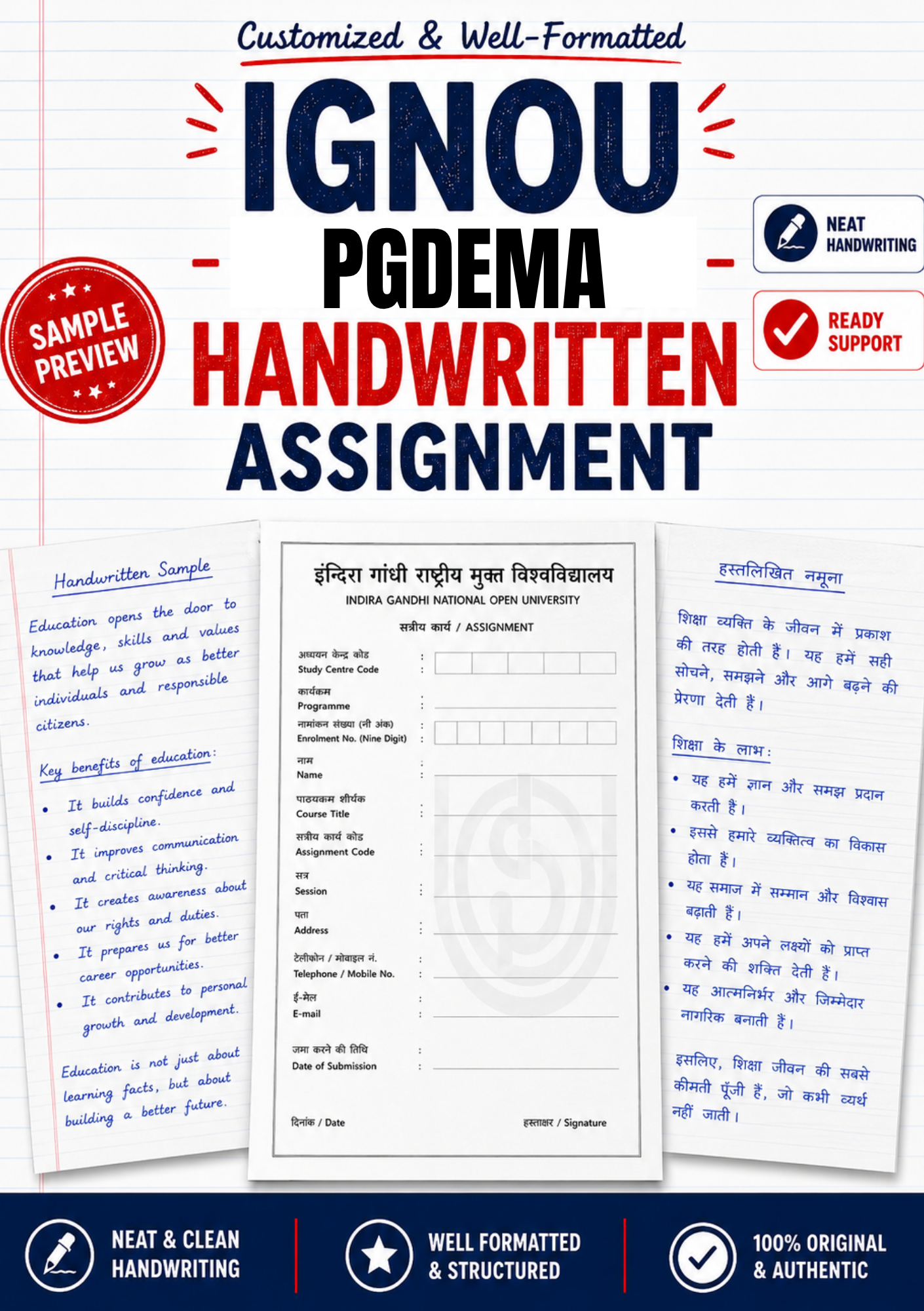


Description
In short. Shri Chakradhar Publication writes IGNOU PGDEMA assignments by hand, in a hand matched to yours, for the four compulsory Educational Management papers (MES-041 Growth and Development of Educational Management, MES-042 Dimensions of Educational Management, MES-043 Organisational Behaviour and MES-044 Institutional Management) and for the single optional paper you picked at admission from MES-045 School Education, MES-046 Higher Education, MES-047 Open and Distance Education and MES-048 Alternative Education. The rate is ₹320 per subject, hard copy only, with courier included in that price and no separate shipping charge. A full order is five papers; MESP-049 Project Work is not part of it. IGNOU’s January and July 2026 sheets for the four core codes are headed Master of Arts (Education), Second Year, and never mention PGDEMA, while the four elective sheets are headed for the PGDEMA programme, and none of the eight prints a submission date, an assignment code or marks. The cut-off for your sheet is the one IGNOU announces for the term-end examination you are sitting.
Opening the Envelope: Answer Sheets for Up to Five MES Papers
A PGDEMA order is built from the codes on your admission record, and for nearly every learner that means four core papers and one elective. Each paper is prepared separately, course by course, and three things come with every one of them.
- The handwritten answers. Three answers per paper, because every 2026 MES sheet sets three questions and asks for about 500 words for each one. The answers are written on A4 sheets with the left margin the PGDEMA programme guide asks for.
- A front page in IGNOU’s layout. The IGNOU-format cover sheet is free with every order, filled in with the enrolment number, name, address, programme, course code and title you send. Where IGNOU prints no assignment code on the sheet, the line is handled as described further down this page rather than filled with an invented string.
- A copy of the question sheet. The official TMA paper for the cycle you are submitting is included, so you can check every answer against the exact wording IGNOU set. For the four core codes that copy will carry the MAEDU Second Year heading, which is how IGNOU issued it in 2026.
What does not arrive is a file. No soft copy or PDF is sold. The set exists as paper, in one hand, so that what you sign is the only version of it.
The 2026 sheets are not short-answer papers. MES-043 asks you to imagine yourself as the head of a newly established college in a small town and to set out the changes you would make, the strategies you would use, how you would judge your own decisions and what would stand in your way. MES-045 asks how you would achieve total quality management as a school principal and which part of it you would put first. MES-042 asks how villagers sitting on a School Management Committee can make a school run better, and what a principal faces when trying to involve them. Answers of that kind are written in the first person of the learner, because that is how the question is put, and they draw on the block material for each course rather than on general management writing.
Twenty-Eight Credits of Written Work at One Flat Rate, With the Project Left Out
PGDEMA is a 34-credit diploma in the Common Prospectus July 2026, but not every credit sets a written assignment. The four core courses carry 6 credits each, the elective carries 4 and MESP-049 Project Work carries 6. The written TMAs therefore cover 28 credits, and the project’s 6 credits are settled by a proposal, a report and the Regional Centre’s assessment, not by a question sheet.
The rate is ₹320 per subject, hard copy only, with courier included in that price and no separate shipping charge. A 6-credit core paper and a 4-credit elective cost the same, because the sheet for each sets three questions of the same length and the work does not change with the credit weight. Five papers come to ₹1,600 in total.
The rate includes the writing in your matched hand, the free front page, the copy of the question sheet and the courier to your address. There is no minimum order: one subject or fourteen, same rate. If you are only re-submitting MES-044, one paper is a complete order.
The rate does not include three things. It does not include MESP-049, which is a research report with its own format and its own approval step, and which is sold separately as a project. It does not include the other three electives, because IGNOU only evaluates the one you registered for, and a set written for an elective you did not choose has no use. And it does not include a soft copy of the answers. No soft copy or PDF is sold.
Delivery depends on your pin code and is confirmed for your order before you pay. No figure is promised on this page.
Downloaded Model Answers Against a Hand-Written Submission for MES Papers
Two products with similar names sit side by side on this store, and a learner searching for help with MES-041 will meet both. A solved assignment is a soft-copy reference file of model answers for one course code and one session, meant to be read and studied. A handwritten assignment is a set of answers written out by hand on A4 sheets and submitted in hard copy at the Programme Study Centre. One is a study aid. The other is the thing that goes into the submission tray.
| Point of comparison | Solved assignment (reference file) | Handwritten assignment (this product) |
|---|---|---|
| Format | A typed soft copy of model answers | Answers written by hand on A4 sheets, hard copy |
| What you do with it | Read it, then write your own answers from it | Read it, sign the cover and submit it |
| Who it suits | A learner with time to write five papers personally | A working teacher or administrator short of writing time |
| Handwriting | None; the learner supplies it | Matched to the learner’s own sample at no extra charge |
| Price line | Priced per file on its own product page | ₹320 per subject, courier included |
On a narrow screen, swipe the table sideways to see every column.
The 2026 MES sheets themselves say nothing about how answers are to be presented. They give the session, the course code and title, and the line “Answer the following questions in about 500 words each”, and then the questions. The rule sits in the PGDEMA programme guide, which tells learners: “You have to write the answers in your own handwriting.” That one sentence is why a printed solved file is not a submission. Printing a downloaded answer file and stapling an IGNOU cover to it produces a typed document, which is exactly what the guide does not ask for.
A solved file still has a proper use. It shows how a 500-word answer on decentralised planning or on schools of thought in classroom management can be organised, which is useful to a learner who intends to write the papers personally. If that is your plan, the PGDEMA solved assignment shelf, where reference files are listed code by code is the right page, not this one. Check the session on each file before buying: when this page was prepared, that shelf held 2025-26 files for the four electives but nothing newer than 2024 for MES 41 to MES 44.
The two can also work together. Some learners buy a reference file for the one paper they want to write themselves and order the other four by hand here. The rate on this page stays at ₹320 per subject whatever mix you choose.
Five papers, three answers each, written in the hand that will sign the cover.
The rate is ₹320 per subject, hard copy only, with courier included in that price and no separate shipping charge.
MES-041 to MES-044: The Educational Management Core That PGDEMA Shares With MA Education
The four compulsory papers of PGDEMA are not exclusive to it. The same four codes form the Educational Management specialisation in the second year of the MA Education programme, which is why IGNOU publishes one question sheet per code and, in 2026, chose to head that sheet for MAEDU. A PGDEMA learner submits against the same questions as an MA Education learner in that stream. The table below takes titles and credits from the PGDEMA table in the Common Prospectus July 2026 and sets the 2026 sheet alongside.
| Code | Title in the PGDEMA prospectus table | Credits | How the 2026 sheet prints it | Programme named on the 2026 sheet |
|---|---|---|---|---|
| MES‑041 | Growth and Development of Educational Management | 6 | MES-041: GROWTH AND DEVELOPMENT OF EDUCATIONAL MANAGEMENT | Master of Arts (Education) – MAEDU, Second Year |
| MES‑042 | Dimensions of Educational Management | 6 | MES-042: DIMENSIONS OF EDUCATIONAL MANAGEMENT | Master of Arts (Education) – MAEDU, Second Year |
| MES‑043 | Organisational Behaviour | 6 | MES043: ORGANIZATIONAL BEHAVIOUR | Master of Arts (Education) – MAEDU, Second Year |
| MES‑044 | Institutional Management | 6 | MES044: INSTITUTIONAL MANAGEMENT | Master of Arts (Education) – MAEDU, Second Year |
| MESP‑049 | Project Work | 6 | No question sheet; settled by project report | Not applicable |
On a narrow screen, swipe the table sideways to see every column.
The credit arithmetic is four core papers at 6 credits, plus the project at 6, plus one elective at 4, which gives 24, 6 and 4, or 34 in total. That matches the “Total Credits 34” line printed under the PGDEMA table, so the table above can be trusted to have been read cleanly from the prospectus.
What the four core sheets ask in 2026 gives a fair sense of the writing involved. MES-041 asks for the theories of human management in organisations and how they improve educational management, the problems of managing primary education in India, and where information and communication technology can be applied to academic and administrative work. MES-042 asks how educational policy is carried out at different levels in the states, what decentralised planning is and how it has worked at the grass roots, and the School Management Committee question mentioned earlier. MES-043 asks for the basic goals of organisational behaviour, the models of decision-making and their fit with educational management, and the four-part question about leading change in a new college. MES-044 asks for the methods of costing used in educational institutions, SWOT analysis as a resource for institutional management, and the schools of thought on classroom management, with a request to say which one you consider most important and why.
Because the codes are shared, reference material filed under MA Education is often relevant to a PGDEMA learner as well. The MA Education reference files sorted by MES number include MES 41 to MES 44 under the MAEDU heading, among them MES 41 files for 2025 in English and in Hindi that the PGDEMA shelf does not carry, for anyone who wants a second worked example of the same question sheet.
Your One Optional Paper: School, Higher, Open and Distance, or Alternative Education
The prospectus lists four optional courses under the line “Optional Courses (Choose anyone)”, and Annexure I(e) of the application form repeats the rule for PGDEMA as “Choose any ONE courses”. You chose one when you applied, and that one is the only elective IGNOU will evaluate for you. The other three are not extra credit. Writing all four is a common mistake among learners who have forgotten which one they picked, and it doubles the cost of the elective without adding anything to the result.
| Code | Title | Credits | Heading on the 2026 sheet | What the 2026 questions cover |
|---|---|---|---|---|
| MES‑045 | School Education | 4 | ASSIGNMENTS FOR PGDEMA PROGRAMME, JAN. & JULY 2026 | Institutional plans for a school; school education policy since independence; quality management as a principal |
| MES‑046 | Higher Education | 4 | ASSIGNMENTS FOR PGDEMA PROGRAMME, JAN. & JULY 2026 | Staff development; managing diversity in higher education; performance appraisal of academic staff |
| MES‑047 | Open and Distance Education | 4 | ASSIGNMENTS FOR PGDEMA PROGRAMME, JAN. & JULY 2026 | Media choice in open and distance learning; managing academic programmes; the generations of distance education and where IGNOU sits |
| MES‑048 | Alternative Education | 4 | ASSIGNMENTS FOR PGDEMA PROGRAMME, JAN. & JULY 2026 | Alternative education before independence; constitutional provisions after it; the Right to Education Act, 2009 |
On a narrow screen, swipe the table sideways to see every column.
If you are unsure which elective you registered for, the course list on your admission record or your study material parcel will settle it: IGNOU dispatches blocks only for the courses you are enrolled in. The desk asks for the elective code to be confirmed before that paper is started, because a well-written MES-047 is no help to a learner registered for MES-048.
The elective sheets differ from the core sheets in one more way. Each carries a bare numeral at the top, 5 on MES-045, 6 on MES-046, 7 on MES-047 and 8 on MES-048, with no label explaining it. It is not a question number or a set number, and nothing needs to be done with it on your cover page.
Eleven IGNOU Disagreements and Five of the Publisher’s Own, Read Side by Side
The documents a PGDEMA learner is likely to meet were read against each other for this page: the Common Prospectus July 2026, IGNOU’s live programme page, the PGDEMA programme guide, the 2024 PGDEMA assignment booklet, the eight 2026 MES question sheets, the June 2026 term-end papers for MES-041 and MES-043, the tentative December 2026 date sheet, and this publisher’s own pages. The box below lists every disagreement found, including the ones on this store.
Sixteen points where the PGDEMA record does not line up. Where IGNOU’s documents disagree, your Regional Centre and ignou.ac.in decide, not this page.
1. Two programme headings in one session. The January and July 2026 sheets for MES-041, MES-042, MES-043 and MES-044 are headed “Master of Arts (Education) – MAEDU” and “Second Year”. The sheets for MES-045 to MES-048 in the same session are headed “ASSIGNMENTS FOR PGDEMA PROGRAMME”. No 2026 core sheet names PGDEMA at all.
2. A consolidated booklet in 2024, separate sheets in 2026. The 2024 paper was a single booklet titled for the Post Graduate Diploma in Educational Management and Administration (PGDEMA), “Assignments- January & July 2024”, covering all eight codes. By 2026 the core and elective papers had been split onto sheets carrying two different programme headings.
3. MES 43 has four spellings. The PGDEMA table in the prospectus and the programme guide spell it “Organisational Behaviour”. The MAEDU table in the same prospectus, and both the 2024 booklet and the 2026 sheet, spell it “Organizational Behaviour”. The June 2026 term-end paper prints “ORGANISATIONAL BEHAVIOR”. Any of these on your cover refers to the same course.
4. The code itself is punctuated five ways. The prospectus prints “MES 41” with no hyphen and no leading zero; Annexure I(e) prints “MES45” closed up; the programme guide and the 2026 sheets for MES-041 and MES-042 use “MES-041”; the 2026 sheets for MES 43 and MES 44 print “MES043” and “MES044”; and the June 2026 term-end paper uses an en-rule between letters and number on its cover.
5. The guide asks for an assignment code that no sheet supplies. The programme guide’s layout for the first page includes the assignment code above the learner’s details, but none of the 2026 sheets, and none of the 2024 booklet’s eight papers, prints an assignment code string.
6. No sheet prints a submission date. The 2026 sheets give only the session pair, January and July 2026. The guide points to a programme schedule for due dates that was not part of the guide text available.
7. Three durations. The prospectus fee table gives a minimum of 1 year and a maximum of 3 years; IGNOU’s live programme page gives 12 to 24 months; the January 2016 programme guide gives a maximum of four years.
8. Two fees. The prospectus and the live programme page give Rs. 7,200 for the programme; the 2016 programme guide gives Rs. 5,000. The guide is the older document.
9. English medium, bilingual examination. The prospectus and the live page give English as the only medium for PGDEMA. The June 2026 term-end papers for MES-041 and MES-043 both carry a full Hindi version after the English questions.
10. One coordinator or two. The prospectus names Dr. Bharti Dogra and Dr. Vandana Singh as programme coordinators; the live programme page names Prof. Bharti Dogra alone.
11. The question-paper archive files the codes in two places. IGNOU’s previous-paper archive stores MES-041 and MES-043 under an MA(EDU) folder and MES-045 under a PGDEMA folder, mirroring the split on the 2026 assignment sheets.
12. In-house: Hindi books labelled for the wrong programme. This store lists MES 211, MES 212, MES 213, MES 214 and MES 215 Hindi study material with “(PGDEMA)” in the product names. In the prospectus those codes belong to the Distance Education specialisation of MA Education. They are not PGDEMA courses.
13. In-house: three handwritten prices and printed delivery windows. The store’s MES 45 2025-26 solved-assignment page offers a handwritten set for ₹350 and states 8 to 10 working days; its MES 41 2024 page offers handwritten assignments at Rs 300 per subject with the same window; the handwritten category page gives a Rs 350 list price and 7 to 9 working days. The rate for this product is ₹320, and no delivery figure is promised.
14. In-house: the category page contradicts the product pages. The handwritten category page describes its sets as study reference material, not for submission, while this and every other programme product page describes a set the learner reviews, signs and submits.
15. In-house: the previous version of this page undercounted. The August 2026 version of this product page counted three places where IGNOU spells PGDEMA material differently and treated MES 43 as a two-spelling title. Reading the June 2026 term-end paper adds the further form given in point 3.
16. In-house: the sister site’s programme article is out of date. The PGDEMA programme article on ignouproject.com, last modified in August 2024, gives a fee of Rs. 6,600 and a maximum duration of 4 years, against Rs. 7,200 and 3 years in the July 2026 prospectus.
None of these points changes what you submit. You answer the three questions on the sheet for each of your five codes, you write the course code and title in the form your admission record or the sheet uses, and you hand the set in before the date announced for your examination. The list exists so that a learner who notices one of these mismatches knows it is IGNOU’s own, or this publisher’s, and not a sign of a wrong paper.
Neither Cover Prints a Deadline: Where the PGDEMA Cut-Off Actually Comes From
Many IGNOU schools print two submission dates on the assignment itself, one for each examination cycle. The School of Education does not do so for PGDEMA. Neither the MAEDU-headed core sheets nor the PGDEMA-headed elective sheets for 2026 carry a date, only the session pair, January and July 2026. That is the honest answer to the most common PGDEMA question: the paper does not tell you when it is due.
The operative date is the last date IGNOU announces for assignments ahead of the term-end examination you plan to sit. The programme guide makes timely submission a condition of sitting the examination, says that if the due date falls on a holiday the next working day applies, and warns that assignments received late may not be accepted. In practice the announcement comes as a university notice before each examination cycle, and Regional Centres repeat it.
For the December 2026 term-end examination, a news report published on 2 October 2026 states that IGNOU extended the assignment last date for ODL and online programmes from 30 September 2026 to 31 October 2026. This page did not locate the university’s own notice, so treat 31 October 2026 as the reported date and confirm it on ignou.ac.in or with your Regional Centre. That is a real deadline, and with it in view the only safe course is to send your codes now and agree on a delivery estimate before paying.
The tentative December 2026 date sheet, issued by IGNOU on 21 September 2026, places the PGDEMA papers as follows. A revised tentative sheet was reported on 6 October 2026 and was not read for this page, so check your hall ticket for the final dates.
| Code | Course | Tentative date | Day |
|---|---|---|---|
| MES041 | Growth and Development of Educational Management | 9 December 2026 | Wednesday |
| MES046 | Higher Education | 10 December 2026 | Thursday |
| MES045 | School Education | 11 December 2026 | Friday |
| MES047 | Open and Distance Education | 14 December 2026 | Monday |
| MES048 | Alternative Education | 15 December 2026 | Tuesday |
| MES042 | Dimensions of Educational Management | 18 December 2026 | Friday |
| MES043 | Organisational Behaviour | 19 December 2026 | Saturday |
| MES044 | Institutional Management | 21 December 2026 | Monday |
On a narrow screen, swipe the table sideways to see every column.
Each sheet is tied to a session pair, and IGNOU replaces it when the next pair is issued. The January and July 2026 sheets are the ones to answer if you are submitting for the December 2026 or June 2027 examination, unless your Regional Centre tells you otherwise. If you are clearing an older paper, say so when ordering, and the set is written against the sheet your study centre will accept.
Assignments carry 30 per cent of the final course result and the term-end examination carries the remaining 70 per cent. The June 2026 papers for MES-041 and MES-043 confirm the examination side, each printing a maximum weightage of 70% on its cover.
A Cover Line Left Blank by IGNOU: What to Write Where the TMA Code Should Be
A School of Management paper prints an assignment code such as a course code, the letters TMA and a session, and the learner copies it onto the cover. A PGDEMA learner has nothing to copy. The 2026 sheets give the course code and title, the session pair and the instruction about 500 words, and stop there.
The front page supplied with each paper is therefore filled with what IGNOU does print. The course code goes in the form your admission record uses, with the title as the sheet or the prospectus gives it. The session line reads January and July 2026, or the older pair you are submitting against. The assignment-code line is not filled with an invented TMA string, because a code that appears on no IGNOU document invites a question at the counter that you would have to answer. If your Programme Study Centre has a local practice for that line, such as repeating the course code, tell the writer and it is followed.
The programme guide also asks for the enrolment number, name, address and date at the top right of the first page. Those come from the details you send, so it is worth checking the spelling of your name against your identity card before the cover is written.
One practical point about the core sheets: because they are headed MAEDU Second Year, a learner sometimes writes “MAEDU” in the programme box by mistake. The programme on your cover is PGDEMA, whatever the question sheet’s heading says, because the cover identifies you and your enrolment, not the document IGNOU issued the questions on.
A School Administrator’s Handwriting, Copied From the Page You Photograph
Most PGDEMA learners are working teachers, heads of department or school administrators, and many write every day on registers, notices and report cards. That makes the sample easy to find. Send a photo of a page you have written yourself and the handwritten set is matched to your handwriting at no extra charge.
The writer studies the slant, letter size, spacing between words, how you form a and g, whether you join letters, and how you mark headings. The sample page is written first and sent back as a photo for you to compare with your own. Nothing is paid until you have seen it, and if the hand does not look like yours, say so before the set is started.
Which page to photograph if your own notes are mostly in tables
Administrative writing tends to be short entries in columns, which shows letter shapes but not how you run a paragraph. If you can, photograph a page where you wrote at least six or seven full lines of continuous text, such as a letter, a lesson note or a page of your own study notes for MES-042. Take it in daylight, flat, from directly above, with the whole page in the frame. A line or two of underlined headings on the same page helps the writer match how you mark the parts of a long answer.
If you are ordering papers for two learners, send two samples and say which name goes with which. Each set is matched to its own hand.
Ask for a sample page in your hand before paying for PGDEMA
English Question Sheets, a Bilingual Exam Paper, and MES Papers From Earlier Cycles
The service covers all mediums IGNOU issues the TMA paper in, at the same price. For PGDEMA the position is less tidy than for most programmes. The prospectus and the live programme page give English as the only medium, and all eight 2026 question sheets located for this page are in English. The June 2026 term-end papers for MES-041 and MES-043, by contrast, carry a complete Hindi version alongside the English. Hindi study material for MES 41 to MES 44 also circulates, including on this store, because the same codes serve MA Education.
So, by default, a PGDEMA set is written in English against the English sheet. If you hold a Hindi edition of a PGDEMA or MES question sheet issued by IGNOU, send a photo of it with your order and the set is written in Hindi against that sheet, at the same ₹320 per subject.
Any session is accepted, current cycle or older, including backlog courses, at the same ₹320 per subject. The 2024 booklet, earlier PGDEMA booklets and the 2026 sheets are all within scope. The guide’s rule on repeat submission matters here: if an assignment was not passed, you must submit it again, but an assignment you have passed cannot be resubmitted to improve the grade. Ask your study centre which session’s sheet it wants for a repeat submission before ordering, and tell the writer the answer.
A learner close to the end of the registration period should keep the duration figures in mind. The prospectus allows a maximum of 3 years and the live programme page 24 months; whichever applies to your enrolment, a backlog paper is only useful while your registration is still valid.
Your First WhatsApp Message: Elective Number, Exam Month, Name Spelling, Address
A PGDEMA order needs very little from you, and the fewer back-and-forth messages there are, the sooner the writing starts. Put these five items in your first message.
- The MES codes you need. Normally MES-041 to MES-044 plus your one elective. If you only need some of them, list just those.
- The examination you are submitting for. December 2026, June 2027 or an earlier cycle. That tells the writer which session’s sheet to answer.
- Your name, enrolment number and programme as they should appear on the cover. Write PGDEMA as the programme, even though four of the 2026 sheets say MAEDU.
- The photo of your handwriting. One clear page, as described above.
- Your delivery address with pin code. The pin code is what the delivery estimate depends on.
Your study material, your identity documents, your marks and your password for any IGNOU portal are not needed and should not be sent. The cover only needs what is printed on it.
Four core codes and one elective, quoted from a single message.
There is no minimum order: one subject or fourteen, same rate.
The rate is ₹320 per subject, hard copy only, with courier included in that price and no separate shipping charge.
From Unsealing the Parcel to the Programme Study Centre’s Receipt
When the parcel arrives, open each bundle and read it against its question sheet. Check that the three answers match the three questions in order, that the course code and title on the cover are the ones you study, and that your name and enrolment number are spelt correctly. You sign the declaration on the assignment cover page, so you should read and review the content before submitting it, and satisfy yourself that it represents your own understanding of the course.
That reading has a second use. The term-end paper for MES-041 in June 2026 set two long answers of about 600 words with an internal choice, a set of four short notes of about 150 words each from six options, and one compulsory long answer. The assignment answers cover the same block material, so reading them closely before the examination is time well spent rather than a formality.
Submit the papers to your Programme Study Centre, which the programme guide names as the place for assignments, by the date announced for your examination. Keep a photocopy or a clear photograph of every page, as the guide advises, and ask for an acknowledgement. Some study centres give a stamped receipt per course; others note the submission in a register. Either way, keep the record until the marks appear.
Assignment marks, once IGNOU has evaluated the set, appear in the university’s records and on your grade card alongside the examination result. No claim is made about the marks any assignment will receive, about how an evaluator will assess it, or about whether it will be accepted. Assignment evaluation is entirely a matter for IGNOU.
Where an Educational Management Learner Goes Next on This Store
The written set covers the assignment side of PGDEMA. The rest of the diploma has its own shelves on this store, and the links below go to the page that sells each item rather than to a summary of it.
For the term-end examination, the PGDEMA guide books, arranged by MES course follow the block structure of each paper. Learners who want to practise against the question pattern can turn to the guess paper sets prepared for the MES examinations, and those who want to see how earlier papers were actually set can use the answered previous-year PGDEMA examination papers.
The six project credits are separate work. If you need help with MESP-049, the MESP-049 synopsis and report shelf in soft copy holds sample projects, and learners who want the report printed and bound can choose the printed and bound PGDEMA project option instead.
If you are also enrolled in another IGNOU programme, the every programme’s handwritten listing in one place lists every product on the same terms, and the open-ended listing for a code or cycle not shown elsewhere takes any course code and session. Learners who plan to continue into the MA Education programme should note one rule from the prospectus: a learner who already holds a postgraduate diploma in one of the MAEDU specialisation areas must choose a different area, so a PGDEMA holder would take Higher Education, Distance Education, Educational Technology or Adult Education rather than Educational Management. The MA Education written set for the MES and MAE codes covers that programme when you reach it.
If you would rather write your PGDEMA papers yourself, the sister site’s walkthrough of writing an MES assignment by hand, code by code covers the same four Educational Management codes and the undated School of Education sheet, and is free to read.
Doubts an Aspiring Principal or Administrator Raises Before Paying
Can I hand in a printout or a typed copy of my PGDEMA assignment instead of writing it?
The PGDEMA programme guide says, “You have to write the answers in your own handwriting.” The 2026 sheets add nothing on format, so the guide’s instruction is the one to follow. A typed or printed set does not meet it, which is why this product is written by hand and matched to your own writing.
What separates a PGDEMA solved assignment from a handwritten one?
A solved assignment is a typed reference file of model answers for one MES code and one session, for reading. A handwritten assignment is the set of answers written on A4 in hard copy, which you check, sign and submit at the Programme Study Centre. The first helps you write; the second is what you hand in.
If I print a solved MES-042 file and attach an IGNOU cover, will the study centre take it?
It would be a typed document submitted against a guide that asks for answers in your own handwriting, so it does not meet the stated rule. Whether a given counter refuses it on the spot is up to that centre, and evaluation is up to IGNOU. A reference file is meant to be written from, not stapled.
Is there any reason to buy both a solved file and a handwritten set?
Some learners write one paper themselves from a reference file and order the rest by hand. That is a sensible split if you have time for one 1,500-word paper but not five. The handwritten papers stay at ₹320 per subject regardless of what else you buy.
My MES-041 sheet says MA Education Second Year. Have I downloaded the wrong paper?
No. In January and July 2026 IGNOU issued the sheets for MES-041, MES-042, MES-043 and MES-044 under a MAEDU Second Year heading, because the same four codes form the Educational Management stream of MA Education. The questions are the ones PGDEMA learners answer. Write PGDEMA as the programme on your own cover.
Do I need all four electives written or just one?
Just the one on your admission record. The prospectus says to choose one of MES-045, MES-046, MES-047 and MES-048, and only that course is evaluated for you. If you are not sure which one you picked, check your admission record or the study material IGNOU sent you before ordering.
By when must PGDEMA papers reach the study centre for the December 2026 exam?
The PGDEMA sheets print no date. For the December 2026 term-end examination, a news report dated 2 October 2026 gives 31 October 2026, extended from 30 September 2026, for ODL and online programmes. The university’s own notice was not located for this page, so confirm the date on ignou.ac.in or with your Regional Centre.
What goes in the assignment code box when the MES sheet prints no code?
IGNOU gives no code for PGDEMA papers, so the front page in this set does not invent one. The course code, title and session pair are filled in from the sheet. If your study centre wants that line filled a particular way, mention it when ordering and the cover follows it.
How long is each answer on a PGDEMA assignment?
Every 2026 MES sheet says to answer its three questions in about 500 words each. That makes roughly 1,500 words per paper, or about 7,500 across a full order of five papers.
Is the MESP-049 project included in a full PGDEMA order?
No. MESP-049 carries 6 credits but has no question sheet; it is assessed through a project proposal approved by the Regional Centre and a project report. Project help is sold separately on the PGDEMA project shelves.
My study material is in Hindi. Can my PGDEMA set be written in Hindi?
The prospectus gives English as PGDEMA’s medium and the 2026 sheets located are English, although the June 2026 examination papers also carry Hindi. If you hold an IGNOU-issued Hindi sheet for your codes, send a photo of it and the set is written in Hindi against that sheet at the same rate.
Does a 6-credit core paper cost more than the 4-credit elective?
No. Each sheet sets three questions of about 500 words regardless of the credit weight, so every paper is ₹320.
I failed MES-044 in an earlier cycle. Which year’s sheet should be answered?
The guide says an assignment that was not passed must be submitted again. Which session’s sheet your study centre accepts for a repeat is a question for that centre; ask before ordering, and the set is written against the sheet it names. Any session is accepted at the same ₹320 per subject.
Does IGNOU ask for a particular paper size or margin for PGDEMA answers?
The programme guide asks for A4 paper, a left margin of about two to three inches and at least four lines between one answer and the next. The set is written to that layout.
Can the delivery date be fixed before I pay?
Delivery depends on your pin code and is confirmed for your order before you pay. No figure is promised on this page. With the December 2026 cut-off reported as 31 October 2026, send your codes and pin code early so the estimate can be checked against that date.
Three Kinds of Evidence Behind This Page, and Which Line Came From Which
A product page that mixes the university’s rules with a publisher’s terms can leave a learner unsure which is which. This page keeps them apart.
From the Common Prospectus July 2026. The PGDEMA course list, titles and credits; the 34-credit total; the one-elective rule and Annexure I(e); the English medium; the Rs. 7,200 fee and the 1-to-3-year duration in the fee table; the coordinators’ names; and the MAEDU rule that a holder of a specialisation diploma must choose another MAEDU stream. The prospectus is the authority this page treats as final on structure and credits.
From IGNOU’s live documents, read on 15 October 2026. The eight January and July 2026 MES question sheets on ignou.ac.in, with their two headings, their question counts, the 500-word instruction and the absence of dates, codes and marks; the 2024 PGDEMA booklet on IGNOU’s assignment service; the PGDEMA programme guide dated January 2016 on ignou.ac.in, for the handwriting, A4, margin, submission and repeat rules; the live programme page for the 12-to-24-month duration and the coordinator; the June 2026 term-end papers for MES-041 and MES-043, for weightage, pattern, spelling and the Hindi version; and the tentative December 2026 date sheet of 21 September 2026. The 31 October 2026 cut-off comes from a news report, not from an IGNOU notice, and is labelled that way where it appears. Learners can open the current MES sheets on IGNOU’s download portal and read the programme details on the PGDEMA page of the IGNOU website.
From Shri Chakradhar Publication’s own terms. The rate of ₹320 per subject; hard copy only; courier included; the free front page and the copy of the question sheet; no minimum order; handwriting matched from a sample at no extra charge; any session; delivery confirmed per pin code. These are the publisher’s commercial terms and carry no IGNOU authority.
Important Notice
Shri Chakradhar Publication Pvt. Ltd. and shrichakradhar.com form an independent IGNOU study-support publisher. This is not the official website of Indira Gandhi National Open University, is not affiliated with, endorsed by or authorised by the university, and no page on this site should be treated as an official IGNOU communication.
Programme structures, course codes, submission dates and rules change, and only ignou.ac.in and your Regional Centre can confirm the current position for your enrolment.
You sign the declaration on the assignment cover page, so you should read and review the content before submitting it, and satisfy yourself that it represents your own understanding of the course.
No claim is made about the marks any assignment will receive, about how an evaluator will assess it, or about whether it will be accepted. Assignment evaluation is entirely a matter for IGNOU.
Four Core Codes, One Elective, One Photograph: Opening a PGDEMA Order
Send the MES codes on your admission record, the examination you are submitting for, a photo of your handwriting and your pin code. The sample page comes back first, and nothing is paid until you have approved it.
The rate is ₹320 per subject, hard copy only, with courier included in that price and no separate shipping charge. No soft copy or PDF is sold.