

Description
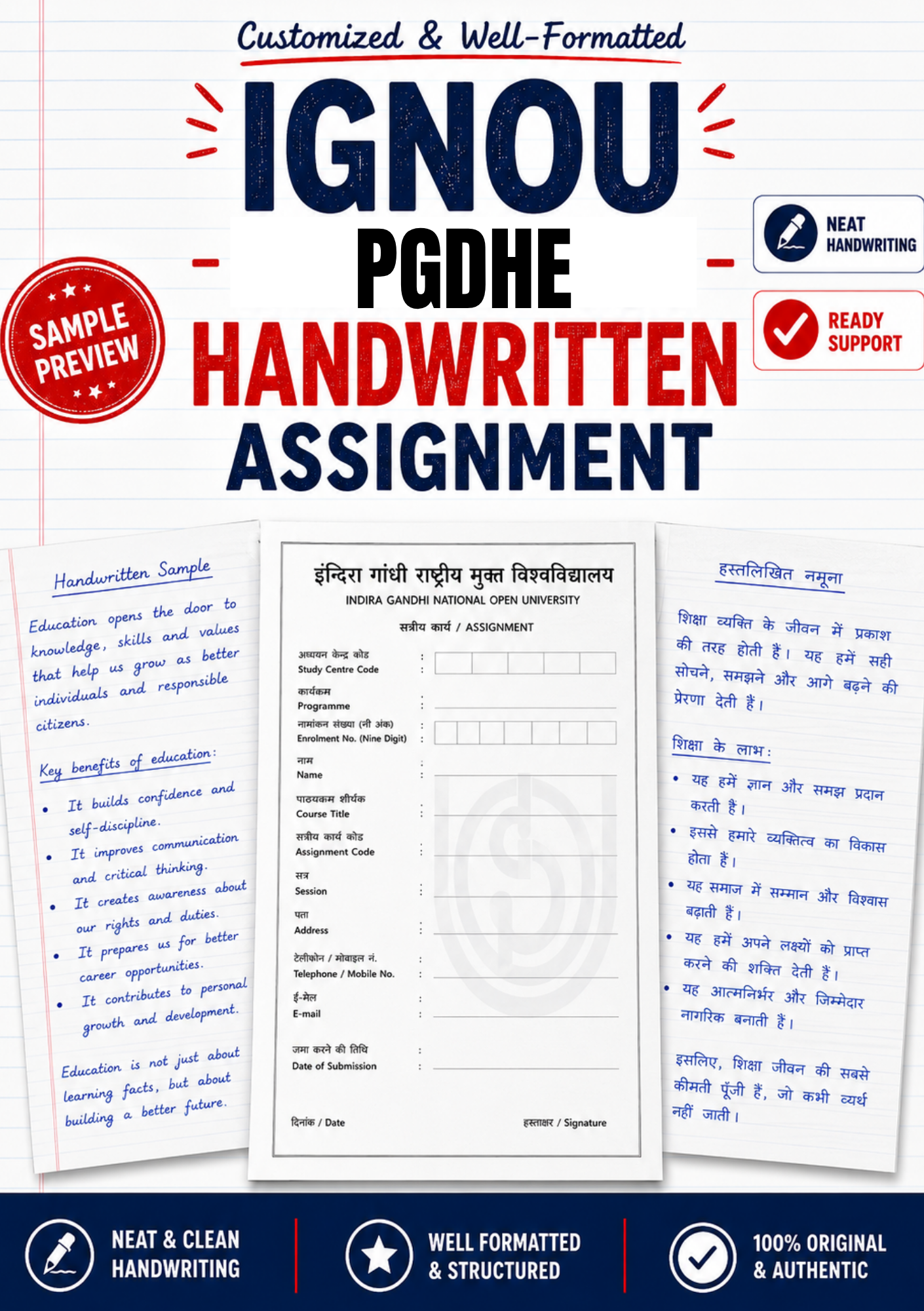
In short. The IGNOU Post Graduate Diploma in Higher Education (PGDHE) is a 34-credit, English-medium School of Education diploma in which only four courses set a tutor-marked assignment: MES 101, MES 102, MES 103 and MES 104, each a single paper of three questions answered in about 500 words apiece, which makes twelve long answers for the whole diploma. MES 105 Project Work and MES 106 Extended Contact Programme carry no assignment. Shri Chakradhar Publication writes those four papers by hand, in a hand matched to a photo of your own writing, at ₹320 per subject, hard copy only, with courier included, a free IGNOU-format front page and a copy of the question paper. Two things set this diploma apart and are explained below: since 2025 IGNOU has published the MES 101 to MES 104 papers under a Master of Arts (Education) Second Year cover that does not mention PGDHE, and none of the papers read for this page, from 2021 to 2026, prints a submission date or an assignment code line.
What a PGDHE Teacher Unpacks: Twelve Answers Across Four MES Papers
Most people who enrol in PGDHE are already teaching in a college or university, or hold a postgraduate degree and intend to. The packet is built for a reader who will check it the way an examiner would. For each MES code you order, four things arrive together in the courier envelope.
- The written answers. All three questions of that MES paper, answered by hand in full, in the order the paper sets them, at the length the paper asks for. On the January and July 2026 papers that is about 500 words per answer, so roughly 1,500 handwritten words per course.
- An IGNOU-format front page. Filled in with the programme, course code, course title and session as they appear on your paper, with blank spaces left for your enrolment number, signature and date, because those are yours to write.
- A copy of the question paper. The exact MES paper the answers respond to, so the Programme-in-Charge at your study centre and you can see at a glance that the answers match the questions.
- The handwriting itself, matched to yours. The letterforms, slant and spacing follow the photographed page you sent before writing began.
A full diploma order is four of those envelopes’ worth of material: four front pages, four question papers and twelve answers. A learner who has already submitted two papers and owes the other two orders two, and nothing is bundled that you did not ask for.
Nothing else is in the packet. There is no PDF, no scan and no typed version, because the product is the paper you hand in. The answers are written against the current course content of the MES blocks, which for a programme aimed at serving teachers means instruction, assessment, student support and university governance, the four areas the 2026 questions actually ask about.
The ₹320 Figure on a 34-Credit Diploma Where Only 24 Credits Set a Paper
The rate is ₹320 per subject, hard copy only, with courier included in that price and no separate shipping charge. No soft copy or PDF is sold. There is no minimum order: one subject or fourteen, same rate. On PGDHE the practical ceiling is four subjects, because MES 101 to MES 104 are the only courses that issue a paper, so the most a full PGDHE order can come to is four times ₹320.
All four MES papers cost the same, even though each is a six-credit course. The rate is set per paper written, not per credit, and on this diploma every assignment-bearing course happens to carry six credits anyway.
What the rate does not cover is worth stating plainly, because a teacher planning the diploma budget needs the whole picture:
- MES 105 Project Work (6 credits). This is a project, not an assignment, and it is outside this product. The store’s separate project shelves are linked further down the page.
- MES 106 Extended Contact Programme (4 credits). An older PGDHE programme guide hosted on ignou.ac.in describes it as a compulsory ten-day face-to-face programme with attendance required on every day and a separate Rs. 300 registration fee. No one can attend it for you, and nothing on this page touches it.
- IGNOU’s own fees. Programme fees, examination fees and any re-registration charge are paid to the university. The prospectus lists the PGDHE programme fee as Rs. 4,000.
- Marks. Evaluation sits with IGNOU, as the notice at the end of this page sets out.
Delivery depends on your pin code and is confirmed for your order before you pay. No figure is promised on this page.
A Reference File for Revision, or Answer Sheets for the Programme-in-Charge
Learners often search for an “IGNOU PGDHE solved assignment” when what they actually need is something to submit, and the two are different purchases. A solved assignment is a soft-copy reference file of model answers for a course code and session, meant to be read, studied and written from. A handwritten assignment is the answers written out by hand on paper and submitted in hard copy at the study centre. This page sells only the second.
| Aspect | Solved assignment (reference file) | Handwritten set (this product) |
|---|---|---|
| Form | Soft copy, read on a screen or printed | Pages written by hand, posted to you |
| What you do with it | Study it, then write your own answers | Read it, review it, sign the front page and submit it |
| Suits | A teacher with time to write twelve answers personally | A teacher who cannot fit twelve 500-word answers around a teaching timetable |
| Covers MES 105 or MES 106 | No | No |
| Price line | Listed per code on the solved-assignment shelf | ₹320 per subject, courier included |
On a narrow screen, swipe the table sideways to see every column.
What IGNOU itself says about how a PGDHE paper is handed in is short. The 2024 PGDHE booklet and the 2025 Second Year booklet both say the responses “may be submitted by hand or sent by registered post” to the Programme-in-Charge of your study centre, and both tell you to retain a copy. Neither booklet mentions handwriting, typing or paper size. The handwriting instruction comes from the older PGDHE programme guide still hosted on ignou.ac.in, which tells the learner: “Write your answers in your own hand.” That same guide asks for foolscap paper. Taken together, the IGNOU documents point to a paper submission in your own hand, and none of them describes a printed download as an acceptable response.
That is the honest scope of a reference file: it is something to write from, not something to hand in. If a reference file is what you want, the MES 101 to MES 104 reference files are listed on the MA Education solved-assignment shelf, which is where the store currently files them; the separate PGDHE solved-assignment shelf is empty at the time of writing, a store-side gap recorded in the warning box below.
Four MES papers make up the whole written side of PGDHE. Send the codes you still owe and the cycle on your fee receipt, and the desk confirms which IGNOU paper each one answers before anything is written.
The rate is ₹320 per subject, hard copy only, with courier included in that price and no separate shipping charge. The sample photo is checked before payment.
MES 101 to MES 104: The Higher Education Papers That Each Set Three Questions
The Common Prospectus July 2026 prints the PGDHE programme in section 8.14 under the School of Education, with six courses and a stated total of 34 credits. The four courses below are the ones that carry an assignment. The second title column shows how the January and July 2026 question paper prints the course, which matters for MES 103 in particular.
| Code | Title in the PGDHE prospectus table | Title on the January and July 2026 paper | Credits | Paper |
|---|---|---|---|---|
| MES 101 | Higher Education: Its Context and Linkages | HIGHER EDUCATIONS: ITS CONTEXT AND LINKAGES | 6 | 3 questions, about 500 words each |
| MES 102 | Instruction in Higher Education | INSTRUCTION IN HIGHER EDUCATION | 6 | 3 questions, about 500 words each |
| MES 103 | Higher Education: Socio-Psychological Field | HIGHER EDUCATION: THE PSYCHO-SOCIAL CONTEXT | 6 | 3 questions, about 500 words each |
| MES 104 | Planning and Management of Higher Education | PLANNING AND MANAGEMENT OF HIGHER EDUCATION | 6 | 3 questions, about 500 words each |
Swipe sideways on a phone to read the full row.
All four are compulsory, and there is no elective anywhere in PGDHE, so every learner on the diploma owes the same four papers. That simplifies the order: there is no choice of stream to confirm, only which of the four you have already submitted.
The 2026 papers are worth describing, because they show what kind of writing a PGDHE assignment asks for. The MES 101 paper asks how colonial rule shaped Indian education and what changed in higher education after independence, for a critical review of the growth of higher education and the concerns that should shape its planning, and for the teacher’s role beyond the classroom. MES 102 asks you to define teacher competence and the competencies a tertiary teacher needs, to set out the steps for preparing an undergraduate annual examination paper in your own subject, and to prepare a lesson plan on a topic from that subject. MES 103 asks about the difficulties Indian college students face and how institutions can respond, about classroom management, and about the college teacher as counsellor and mental-health facilitator. MES 104 asks about the types of universities in India and how they function, about the working of their statutory bodies, and about levels of university autonomy.
Two of those questions, the examination paper and the lesson plan in MES 102, are anchored to “your subject of expertise”. Before writing starts, the desk asks which subject you teach or intend to teach, so that the lesson plan and the sample question paper are built in your discipline rather than in a generic one. The same question is asked whenever a paper ties an answer to your own teaching context.
No mark is printed against any question on any PGDHE paper read for this page. Each paper simply says to answer the questions in about 500 words each. The answers are written to that length, not padded beyond it.
The same four codes sit in the Master of Arts (Education) as the Higher Education specialised area of its second year, with the same titles in the MAEDU table. The prospectus adds a rule that matters to anyone planning ahead: a learner who already holds a diploma in one of the MAEDU specialised areas must choose a different area in MAEDU. A PGDHE holder who later joins MAEDU therefore takes Distance Education, Educational Technology, Educational Management or Adult Education in year two, not Higher Education again. Those learners are served by the written sets for every MES and MAE code in the MA Education programme. The prospectus prints no credit-transfer or lateral-entry route from PGDHE into MAEDU, and this page does not suggest one.
MES 105 and MES 106: Ten Credits Settled by a Project and a Ten-Day Contact Programme
Ten of the diploma’s 34 credits never produce an assignment paper, and a learner who does not know this can spend time looking for an MES 105 or MES 106 question paper that does not exist.
| Code | Title | Credits | How it is completed | Assignment |
|---|---|---|---|---|
| MES 105 | Project Work | 6 | A project on a theme you choose, started only after the proposal is approved | None |
| MES 106 | Extended Contact Programme | 4 | A compulsory ten-day face-to-face programme, venue set by the Regional Director | None |
| Credits with an assignment (MES 101 to MES 104) | 24 | 4 × 6 | ||
| Programme total | 34 | 24 + 6 + 4, matching the prospectus | ||
Swipe sideways to see the last two columns.
The older programme guide states that both courses are outside the assignment and term-end examination scheme: they are excluded in so many words from both. It also says the Extended Contact Programme is held in several places, at least one in each region, as far as possible during college vacations, and that attendance on all days is required. For a serving teacher that last point is the one to plan around, because a ten-day block has to be fitted into an academic calendar.
For MES 105, the store carries PGDHE project synopsis and report samples in soft copy and, for those who need a bound document, the PGDHE project in hard copy. Both shelves label the project under codes IGNOU does not print, which the warning box below records against the store itself.
Twenty-One Findings From Reading the PGDHE Record Line by Line
This section exists because the PGDHE record does not agree with itself, and a learner who copies a code, a title or a deadline from the wrong document can end up with a front page that does not match the paper. Every finding below was checked against the document named, on 15 October 2026. Five of them are errors on this store or its sister site, and they are listed with the rest rather than left out.
Read before you fill in a front page. Fifteen findings come from IGNOU’s own documents, five from this publisher’s own catalogue, and one from a widely indexed third-party listing.
1. The 2026 papers do not name PGDHE. The 2021 and 2024 PGDHE booklets carry the diploma’s name on the cover. The 2025 consolidated booklet and all four January and July 2026 MES 101 to MES 104 files are headed Master of Arts (Education), MAEDU, Second Year, and the string PGDHE appears in none of them. A separate 2026 PGDHE-labelled file was not located on ignou.ac.in on the date of checking.
2. MES 103 has two titles in one prospectus. The PGDHE table prints “Higher Education: Socio-Psychological Field”. The MAEDU table in the same prospectus, every MES 103 paper from 2021 to 2026, and IGNOU’s live PGDHE programme page print “Higher Education: The Psycho-social Context”.
3. The 2026 MES 101 paper misprints its own title as “HIGHER EDUCATIONS: ITS CONTEXT AND LINKAGES”, plural. The 2024 and 2025 editions print the singular.
4. The course code is punctuated four ways. In a single booklet, MES 101 and MES 102 carry a spaced dash, MES 103 a plain space and MES-104 a hyphen. The 2021 booklet adds a fifth form, “MES: 103”. The prospectus spaces every code and IGNOU’s live page hyphenates every code.
5. No submission date is printed on any PGDHE paper read. Not on the 2021, 2024 or 2025 booklets, and not on any of the four 2026 files. The only date-like text is the session label, such as “January & July 2026”.
6. No assignment code line appears on the 2024, 2025 or 2026 papers. The 2021 booklet printed “Assignment: 01” under each course, and nothing has replaced it since.
7. The 2021 cover calls the diploma a “Post Graduation Diploma” and labels it “PGDHE 2nd Year”, for a programme whose minimum duration is one year.
8. The programme guide describes a different assignment scheme. It sets three tutor-marked assignments per course, twelve in all, with only the higher-scoring two of each three evaluated and four of them compulsory. Every booklet from 2021 to 2026 sets one paper per course, made of three questions.
9. The programme guide says term-end examinations are held in December every year. The prospectus admits PGDHE learners in both the January and July cycles, and IGNOU’s question-paper archive holds a June 2024 MES-101 term-end paper, three hours long and marked “Maximum Weightage : 70%”, whose header reads [M. A. (EDU.)/PGDHE]. The examination paper names PGDHE even where the 2025 and 2026 assignment files do not.
10. Maximum duration differs. The prospectus gives a minimum of 1 year and a maximum of 3 years. IGNOU’s live programme page gives 12 months and 24 months.
11. Two different coordinators are named. The prospectus names Ms. Poonam Bhushan, with a gmail.com contact address. IGNOU’s live programme page names Dr. M. Venkata Lakshmi Reddy, with an ignou.ac.in address.
12. Eligibility is stated two ways in one section. The programme description asks for a postgraduate degree with at least a second division, printed as “at leasta IInd Division”. The eligibility line immediately below, and the admission table, ask only for teachers in higher education or postgraduate degree holders, with no division condition.
13. The UGC recognition statement appears in only one document. The prospectus says a UGC letter recognises PGDHE as equivalent to one Orientation Course for teachers of various disciplines and to two Refresher Courses for teachers of Education. The live programme page does not mention it.
14. The live programme page misspells MES 105’s course type as “Projevct Work”.
15. The medium is English, but the same codes exist in Hindi. The prospectus and the live page give English as the PGDHE medium, while IGNOU publishes Hindi editions of the MAEDU second-year booklet, which carries the same MES 101 to MES 104 papers.
16. In-house: the PGDHE solved-assignment shelf on this store is empty. The MES 101 reference files for 2022-23 to 2025 exist, but they are filed only on the MA Education shelf.
17. In-house: the PGDHE previous-year solved-paper shelf on this store is also empty, while the MA Education previous-year shelf is stocked.
18. In-house: two separate PGDHE books shelves exist on this store, under two different parent categories, one holding four products and the other ten.
19. In-house: the project is filed under codes IGNOU does not use. This store’s soft-copy project listings say “MPSE 10” and its hard-copy listings say “MESP 105”, as does the sister site ignouproject.com. IGNOU prints MES 105 in the prospectus and MES-105 on its live page; neither MPSE 10 nor MESP 105 occurs anywhere in the prospectus.
20. In-house: paper size. This store’s general handwritten category page describes its standard set as written on A4 ruled sheets, while the PGDHE programme guide asks for foolscap. PGDHE sets are written on foolscap for that reason; tell the desk if your study centre has instructed otherwise.
21. Third-party: a widely indexed college-listing site describes a different diploma. It lists MES-101 to MES-105 as five theory courses, a two-credit “MESP-106” project and a “MESP-107” seminar, with a fee of about ₹3,500. None of that matches the prospectus or IGNOU’s live page.
The practical rule that follows from all of this is simple. Answer the paper IGNOU has issued for your cycle, copy the code and title exactly as that paper prints them, and treat every other list, including the ones on this store, as secondary to the question paper and your admission record.
No Date on the Sheet: How a PGDHE Cut-Off Is Actually Fixed
Many IGNOU programmes print two submission dates on the assignment itself, one for each admission cycle. PGDHE does not. The papers for the January and July 2026 cycles carry the single label “Assignments- January & July 2026” and no last date anywhere, which is why searches for a “PGDHE assignment last date” turn up nothing from the paper.
The cut-off therefore comes from the term-end examination you intend to sit, not from the paper. IGNOU sets the last date for submitting assignments centrally for each examination and announces it, and changes to it, through notices. For the December 2026 term-end examination, IGNOU’s Kolkata Regional Centre has posted a notice titled as an extension of the last date for submitting assignments for both ODL and online programmes, and press coverage dated 2 October 2026 reports the new date as 31 October 2026, moved from 30 September 2026. The full IGNOU notice could not be opened for this page, so confirm that date on ignou.ac.in or with your Regional Centre before relying on it. If you are aiming at the December 2026 examination, that is the real deadline in front of you.
The examination dates themselves are on IGNOU’s tentative date sheet for the December 2026 term-end examination, dated 21 September 2026. It lists the four PGDHE papers as follows.
| Course | Tentative examination date | Also on the same date line |
|---|---|---|
| MES 101 | 9 December 2026 | MES 111, MES 131, MES 211, MES 041 |
| MES 102 | 18 December 2026 | MES 212 and other courses |
| MES 103 | 19 December 2026 | MES 113, MES 043, MES 133, MES 213 |
| MES 104 | 21 December 2026 | MES 114, MES 134, MES 214, MES 044 |
Swipe sideways to see the third column. A tentative date sheet can change; the final one on ignou.ac.in governs.
For the June term-end examination, IGNOU announces a separate assignment cut-off. This page does not state a June 2027 date because IGNOU has not published one at the time of writing, and a guessed date is worse than none.
Papers also expire. The 2026 set serves both 2026 admission cycles and will be replaced by a new set; the 2024 edition was a PGDHE-labelled booklet, and the 2025 and 2026 editions are MAEDU-labelled files. If you are submitting late for an older cycle, ask your Programme-in-Charge or Regional Centre whether you should answer the current paper or the one issued for your own cycle, and the desk writes whichever paper you name.
The Paper Prints No Assignment Code, So the Cover Sheet Carries the Weight
On many IGNOU programmes the learner copies a string such as a course code, “TMA” and a year onto the front page. A PGDHE learner has no such string to copy: the 2024, 2025 and 2026 papers print none. The front page therefore has to identify the paper through its other fields, and the free IGNOU-format front page supplied with each set is filled in on that basis.
- Programme. PGDHE, written as on your admission record, even though the 2026 paper’s own cover names MAEDU. Your enrolment is in PGDHE and the front page records your programme, not the booklet’s heading.
- Course code. As your admission record or identity card prints it. Because IGNOU itself uses MES 101, MES-101 and a spaced-dash form, the form on your own record is the safest one to repeat.
- Course title. As the question paper prints it. For MES 103 that means “Higher Education: The Psycho-social Context”, the title on the paper you are answering, rather than the “Socio-Psychological Field” wording that appears only in the PGDHE prospectus table. For MES 101 the front page uses the correct singular “Higher Education”, not the 2026 paper’s misprint.
- Session. The session label exactly as the paper prints it, for example “January & July 2026”, together with your own admission cycle.
- Enrolment number, study centre, signature and date. Left for you to complete in your own hand.
If your study centre asks for an assignment code in a particular format, ask the Programme-in-Charge for the exact form they want and tell the desk. No code is invented on your behalf, because a code the paper does not print can only come from the study centre that will receive it.
A College Teacher’s Own Hand, Taken From One Photographed Page
Send a photo of a page you have written yourself and the handwritten set is matched to your handwriting at no extra charge. For a PGDHE learner this matters more than usual. Many teachers sign registers, mark scripts and write on boards every day, so the people around them know their handwriting, and the front page of an IGNOU assignment carries a declaration in your name.
The writer studies the sample for the things that make a hand recognisable: how you form a lower-case a and g, whether your letters lean, how much space you leave between words, how you underline a heading, how you number points. Those features are then held steady across all three answers of a paper, which for PGDHE is about 1,500 words per course and about 6,000 words if you order all four.
The sample is checked before you pay. If the match is not right, it is corrected at that stage, not after the set has been written.
Choosing a page that shows how you write headings and lists
The most useful sample for a PGDHE order is a page of your own continuous writing that also has a heading and a numbered or bulleted list on it, because the MES 102 lesson plan and examination-paper answers are naturally laid out with headings and steps. Lesson notes, a page of lecture preparation or a filled notebook page all work. Photograph it in daylight, flat, with the whole page in frame and no shadow across the lines. Avoid a page written quickly or one in capital letters only, since neither shows how you normally write.
Foolscap is used for PGDHE sets because the programme guide asks for it, and the left margin and spacing between answers are kept clear so the evaluator has room to comment.
English Medium, a Hindi MAEDU Edition, and Cycles Already Closed
The service covers all mediums IGNOU issues the TMA paper in, at the same price. For PGDHE that needs one line of explanation. The prospectus and IGNOU’s live page both give English as the medium of instruction for PGDHE. IGNOU does publish Hindi editions of the MAEDU second-year booklet, which carries the same MES 101 to MES 104 papers, and the store stocks Hindi study material for those codes. Whether a PGDHE learner may submit in Hindi is a decision for your Regional Centre, not for this store; if it permits Hindi, the set is written in Hindi at the same ₹320.
Any session is accepted, current cycle or older, including backlog courses, at the same ₹320 per subject. A learner who joined in January 2025 and still owes MES 104, or one whose registration is near the end of its validity, orders exactly the same way. IGNOU’s archive still holds the 2021 and 2024 PGDHE booklets, and the desk works from the paper that applies to you.
Because the diploma has a maximum duration, an unsubmitted paper is not something to leave indefinitely. The prospectus gives three years and IGNOU’s live page gives 24 months, which is one of the disagreements in the warning box above; check your own validity with the Regional Centre if you are close to either figure.
What the Desk Needs to Quote Your MES Papers, Listed Once
A PGDHE quote needs very little, because the diploma has only four possible papers and no electives. One WhatsApp message with the following is enough.
- The MES codes you still owe. Any of MES 101, 102, 103 and 104.
- Your admission cycle and the paper you hold. For example, “July 2026, using the January and July 2026 paper”. If you are unsure which paper applies, say so, and the desk checks against IGNOU’s current files.
- Your teaching subject. Needed for the MES 102 lesson plan and examination-paper answers, and useful for any answer that asks you to draw on your own context.
- Your medium and your pin code. The medium is normally English for PGDHE; the pin code decides delivery, which is confirmed before you pay.
- A photo of a page in your handwriting. As described above.
The desk does not need your enrolment number, your password for any IGNOU portal, or any payment detail at this stage. Payment comes after the handwriting sample has been checked and the order confirmed.
Not sure whether your 2026 MAEDU-headed paper is the right one for PGDHE? Send a photo of its first page with your codes, and the desk checks it before quoting.
₹320 per subject. One MES paper or all four, same rate, courier included.
Handing the Set to the Programme-in-Charge, by Hand or Registered Post
When the envelope arrives, the work that remains is yours, and it is not a formality. You sign the declaration on the assignment cover page, so you should read and review the content before submitting it, and satisfy yourself that it represents your own understanding of the course.
- Read each answer against its question. Check that all three questions of each MES paper are answered and that the answers follow the paper you hold.
- Complete the front page. Add your enrolment number, study centre, signature and date in your own hand.
- Keep a copy. Both the 2024 PGDHE booklet and the 2025 booklet tell learners to retain a copy of all assignments in their own interest. A photocopy or a clear phone scan of every page is enough.
- Submit to the Programme-in-Charge of your study centre. The booklets allow submission by hand or by registered post. If you post it, keep the postal receipt.
- Ask for an acknowledgement. A stamped receipt or acknowledgement from the study centre is your record that the paper was handed in on time.
- Watch for the update. Once evaluated, the assignment status and marks appear in IGNOU’s records. If a status does not update, the receipt is what the Regional Centre will ask to see.
Assignments carry 30 per cent of the final course result and the term-end examination carries the remaining 70 per cent. The PGDHE programme guide states the same split, and adds that a course is completed only with at least a D grade in both the continuous and the term-end component separately and an overall average of at least C.
PGDHE and MAEDU Shelves on This Store, Including Two That Are Empty
The written set is one part of preparing for a PGDHE term-end examination. The rest of the store’s PGDHE material sits on separate shelves, and because some PGDHE items are filed under the MA Education programme, the useful shelves are named here plainly.
For the course content itself, the PGDHE help books for MES 101 to MES 104 include English and Hindi guides and a four-book combination. For examination practice, there are PGDHE solved guess papers on a small shelf of their own.
The PGDHE previous-year paper shelf is empty, so for worked term-end papers the place to go is the MA Education previous-year solved papers, which cover the same MES codes. The empty PGDHE solved-assignment shelf is handled the same way, as the comparison section above explains.
Two other School of Education programmes share ground with PGDHE. The PGDEMA written sets, whose optional MES 46 is a four-credit Higher Education course, suit a learner moving into educational management. And for a learner whose list mixes PGDHE codes with codes from another programme or an older scheme, the customised order that accepts any code and any session is the simpler route. The full range by programme is on the store’s handwritten assignment category.
If you would rather write the four papers yourself, the step-by-step guide to preparing an IGNOU assignment by hand on ignouproject.com walks through the process from question paper to submission.
Sixteen Questions Teachers Ask Before a PGDHE Order
My 2026 MES 101 paper says Master of Arts (Education), Second Year. Am I holding the wrong paper for PGDHE?
Probably not. Since 2025, IGNOU has published the MES 101 to MES 104 papers as files headed MAEDU Second Year, and the January and July 2026 files do not mention PGDHE at all. The 2024 edition was a PGDHE-labelled booklet with the same four papers, and no separate 2026 PGDHE file was found on ignou.ac.in when this page was checked. Because the cover does not name your programme, confirm with your study centre’s Programme-in-Charge that the MAEDU-headed paper is the one they expect from PGDHE learners. The desk will also check it when you send the first page.
Is MES 103 “Socio-Psychological Field” or “The Psycho-social Context”?
Both appear in IGNOU’s own documents. The PGDHE table in the Common Prospectus July 2026 prints “Higher Education: Socio-Psychological Field”, while the MAEDU table in the same prospectus, every MES 103 paper from 2021 to 2026 and IGNOU’s live PGDHE page print “Higher Education: The Psycho-social Context”. The set uses the question paper’s title, because that is the document the answers respond to.
PGDHE assignment ki last date kya hai, jab paper par koi date likhi hi nahi hai?
PGDHE papers print no last date; the 2026 paper only says “January & July 2026”. The cut-off is set by IGNOU for each term-end examination. For the December 2026 examination, press reports dated 2 October 2026 put it at 31 October 2026 after an extension, and an IGNOU Regional Centre has posted an extension notice; confirm the date on ignou.ac.in or with your Regional Centre. The June cut-off is announced separately.
What goes in the assignment code box on the front page when the paper prints no code?
The 2024, 2025 and 2026 PGDHE papers print no assignment code line, so there is nothing to copy. The front page identifies the paper through the programme, course code, course title and session label instead. If your study centre wants a code in a specific form, ask the Programme-in-Charge for it; the desk will not invent one.
Do MES 105 Project Work or MES 106 Extended Contact Programme come with an assignment?
No. The older PGDHE programme guide excludes both from the assignment and term-end examination scheme, and no booklet from 2021 to 2026 sets a paper for either. MES 105 is a project that starts after proposal approval, and MES 106 is a compulsory ten-day face-to-face programme. Neither is part of this order.
How much writing is one MES paper, and the whole PGDHE?
Each 2026 paper sets three questions at about 500 words each, so about 1,500 words per course. All four papers come to twelve answers and roughly 6,000 handwritten words. No marks are printed against individual questions.
PGDHE ke liye MES 101 ka solved assignment download karke print nikaal ke jama kar sakte hain kya?
A solved assignment is a reference file to study and write from, not a submission. IGNOU’s PGDHE booklets describe the responses being handed in by hand or by registered post, and the PGDHE programme guide tells learners to write their answers in their own hand. A printed download meets neither description, which is why this page sells a written set instead.
In one sentence, how is a PGDHE reference file different from this written set?
A reference file is model answers in soft copy that you read and then write from yourself, while this product is the four MES papers already written by hand in a hand matched to yours, ready for you to review, sign and hand to the Programme-in-Charge.
Typed PGDHE answers study centre par lete hain ya sirf haath se likhe hue?
The current PGDHE booklets are silent on typing. The PGDHE programme guide asks for answers in your own hand on foolscap, and the scanned text of the guide is damaged at the one point where it appears to discuss typing, so it cannot be relied on. The safe course is a handwritten submission, and if your study centre has told you something different, follow the study centre.
Should PGDHE answers be on A4 or foolscap?
The PGDHE programme guide asks for foolscap, with a left margin and at least four lines between answers. The booklets themselves say nothing about paper size. PGDHE sets are written on foolscap for that reason, even though this store’s general handwritten page describes A4 as its standard, a mismatch listed in the warning box.
Is PGDHE recognised by UGC, and is it the same as an M.Ed.?
The Common Prospectus July 2026 states that a UGC letter recognises PGDHE as equivalent to one Orientation Course for teachers of various disciplines and to two Refresher Courses for teachers of Education. It does not describe PGDHE as equivalent to an M.Ed. or any degree. How your employer treats it under service rules is a question for your institution.
I finished PGDHE. Can I take the Higher Education specialisation in MAEDU later?
The prospectus says no: a learner who already holds a diploma in one of the MAEDU specialised areas must choose a different area. A PGDHE holder joining MAEDU picks from Distance Education, Educational Technology, Educational Management or Adult Education in the second year. No credit transfer from PGDHE to MAEDU is printed.
I joined PGDHE in January 2025 and still owe MES 104. Can that paper be written now?
Yes, at the same ₹320. Ask your Programme-in-Charge whether you should answer the current paper or the one issued for your cycle, and tell the desk which; both the 2024 PGDHE booklet and later MAEDU-headed files remain available to work from. Keep your registration validity in mind, since the prospectus and IGNOU’s live page give different maximum durations.
PGDHE ka assignment Hindi mein chalega, jab prospectus English medium bolta hai?
The prospectus and the live page give English as the PGDHE medium. IGNOU does publish Hindi editions of the MAEDU second-year booklet with the same MES 101 to MES 104 papers, but whether a PGDHE learner may answer in Hindi is for your Regional Centre to decide. If it allows Hindi, the set is written in Hindi at the same price.
Will the Programme-in-Charge accept this set, and what will it score?
No claim is made about the marks any assignment will receive, about how an evaluator will assess it, or about whether it will be accepted. Assignment evaluation is entirely a matter for IGNOU. What the desk does control is that the set answers the paper for your cycle, at the length the paper asks for, on the paper size the programme guide names.
When will the PGDHE parcel reach my address?
Delivery depends on your pin code and is confirmed for your order before you pay. No figure is promised on this page. If you are working to the December 2026 cut-off, say so in your first message so the desk can tell you plainly whether your pin code can be reached in time before you commit.
How the PGDHE Facts on This Page Were Checked, and Against What
Three kinds of source were used for this page, and they are kept apart here so that you can tell which statement rests on which.
From the IGNOU Common Prospectus July 2026. Section 8.14 supplied the six PGDHE courses, their titles and credits, the 34-credit total, the English medium, the eligibility wording, the UGC recognition statement and the coordinator’s name. The admission table supplied the fee of Rs. 4,000, the 1-year minimum and 3-year maximum, and the January and July cycles. The Master of Arts (Education) section supplied the second title for MES 103 and the rule on choosing a different specialised area. Credits were summed before the table was used: 4 × 6 + 6 + 4 = 34, matching the stated total.
From IGNOU’s own files, read on 15 October 2026. The four January and July 2026 papers for MES 101, MES 102, MES 103 and MES 104 on ignou.ac.in, starting with the January and July 2026 MES 102 paper; the consolidated MAEDU Second Year booklet for January and July 2025; the PGDHE booklet for January and July 2024; the 2021 PGDHE booklet; the older PGDHE programme guide on ignou.ac.in, whose scanned text is damaged in places and which describes an earlier annual scheme; IGNOU’s live PGDHE programme page; the tentative date sheet for the December 2026 term-end examination dated 21 September 2026; and the title of an IGNOU Regional Centre notice on the December 2026 assignment extension. Current papers are available from the assignment download page on ignou.ac.in. The 31 October 2026 date comes from press coverage of that extension, not from an IGNOU file this page could open, and is labelled that way wherever it appears.
From this publisher’s own commercial terms. The ₹320 rate, the hard-copy-only format, courier inclusion, the free front page, the question-paper copy, handwriting matching, session and medium coverage and the delivery policy are Shri Chakradhar Publication’s terms. They are not IGNOU rules and should not be read as IGNOU guidance.
Important Notice
Shri Chakradhar Publication Pvt. Ltd. and shrichakradhar.com form an independent IGNOU study-support publisher. This is not the official website of Indira Gandhi National Open University, is not affiliated with, endorsed by or authorised by the university, and no page on this site should be treated as an official IGNOU communication.
Programme structures, course codes, submission dates and rules change, and only ignou.ac.in and your Regional Centre can confirm the current position for your enrolment.
You sign the declaration on the assignment cover page, so you should read and review the content before submitting it, and satisfy yourself that it represents your own understanding of the course.
No claim is made about the marks any assignment will receive, about how an evaluator will assess it, or about whether it will be accepted. Assignment evaluation is entirely a matter for IGNOU.
A Higher Education Diploma Order Begins With Four Numbers: 101 to 104
Name the MES papers you owe, the cycle you are submitting for and your teaching subject, send one photographed page of your handwriting, and the desk confirms the paper, the price and whether your pin code can be reached before you pay anything.
₹320 per subject. Courier included. No soft copy or PDF is sold. There is no minimum order: one subject or fourteen, same rate.
Delivery depends on your pin code and is confirmed for your order before you pay. No figure is promised on this page.
Order PGDHE papers on WhatsApp, or if you owe a paper from an earlier cycle, ask about a PGDHE backlog paper. To see the handwriting first, send a handwriting sample before any payment.