

Description
In short. The IGNOU Post Graduate Diploma in Analytical Chemistry (PGDAC) carries four theory courses with a tutor marked assignment each, MCH-001 Basic Analytical Chemistry, MCH-002 Separation Methods, MCH-003 Spectroscopic Methods and MCH-004 Electroanalytical and Other Methods, and four laboratory courses, MCHL-001 to MCHL-004, that carry no assignment at all. Shri Chakradhar Publication writes the four theory papers by hand on foolscap, from the PGDAC booklet rather than the M.Sc. Analytical Chemistry booklet that prints the same codes with different questions. The rate is ₹320 per subject, hard copy only, with courier included in that price and no separate shipping charge. The 2026 PGDAC booklets are valid from 1 January 2026 to 31 December 2026 and print no last date, only that the set must be submitted before you fill in the examination form.
Foolscap Pages, a Front Sheet and the PGDAC Question Paper, Code by Code
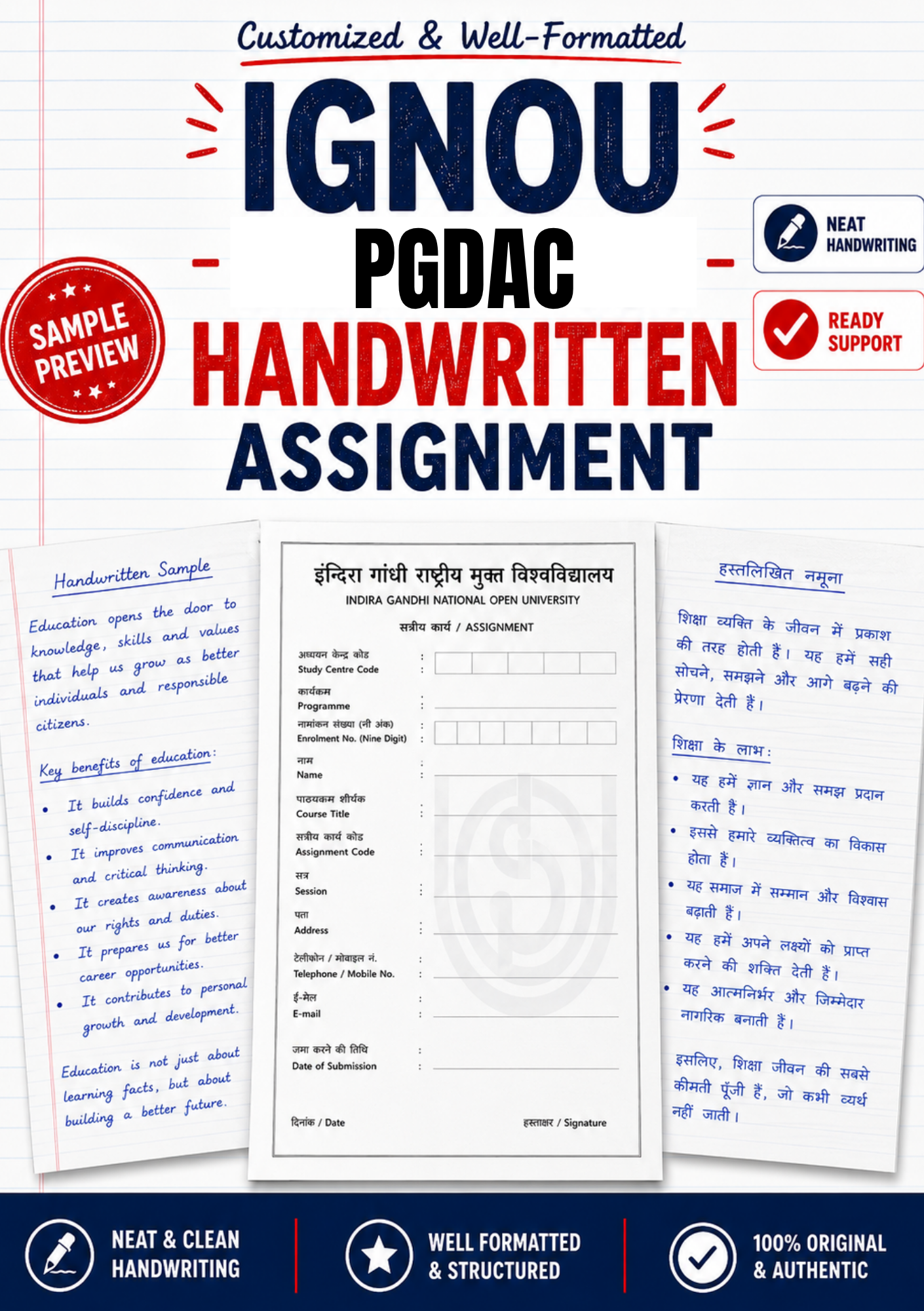
A PGDAC order is priced and packed one MCH code at a time. For each code you order, Shri Chakradhar Publication prepares four physical things and nothing else. The first is the written response itself: every question on that year’s PGDAC paper answered in ink on foolscap sheets, with the question number and part marked against each answer, because the booklet asks for exactly that. The second is a front sheet laid out in the format the booklet prints, with the eight header fields it lists: enrolment number, name, address, course code, course title, assignment number, study centre with its code, and date. You fill in the personal fields yourself so that the details match your admission record. The third is a printed copy of the official PGDAC question paper for that code and year, so you can check every answer against the question it claims to answer. The fourth is the courier packaging that carries the set to your address.
No soft copy or PDF is sold. That is deliberate rather than a gap in the service. A PGDAC response is handed in on paper at the study centre, and the booklet itself tells you to keep a copy of what you submit, so the useful thing to own is the paper set, not a file of it.
Because the four theory papers are set very differently, the packets do not look alike. An MCH-002 set answers twenty short questions at 5 marks each, so it runs as twenty compact answers on chromatography, extraction and electrophoresis. An MCH-001 set answers ten two-part questions and carries worked calculations on standard deviation, confidence intervals, buffer capacity and rate laws. An MCH-004 set carries cell notation, conductivity working and thermogravimetric curves. Each one is written to the paper you actually hold.
₹320 Across Four Six-Credit Papers, and the Eight Lab Credits It Leaves Alone
The rate is ₹320 per subject, hard copy only, with courier included in that price and no separate shipping charge. For PGDAC that arithmetic is short: the diploma has four theory courses that issue an assignment, so a learner who owes all four pays for four codes. The free IGNOU-format front sheet and the copy of the question paper are already inside the per-code rate. There is no packing line, no handling line and no surcharge for a six-credit paper, even though every PGDAC theory paper is a six-credit paper and every one of them runs to a full 100-mark set.
There is no minimum order: one subject or fourteen, same rate. A learner who has already submitted MCH-001 and MCH-002 and only owes MCH-003 and MCH-004 orders two codes. A learner who failed to submit one paper in an earlier year orders that one.
What the rate cannot buy is equally specific to this diploma. Eight of PGDAC’s 32 credits sit in the four laboratory courses, MCHL-001 to MCHL-004, at 2 credits each. None of the PGDAC booklets read for this page, from 2021, 2024, 2025 and 2026, contains an assignment for any MCHL code. Those credits are earned at a Learner Support Centre bench, through attendance and a practical examination, and no written set can stand in for them. The rate also does not cover anything IGNOU charges: the programme fee, the examination fee or any re-registration cost stays between you and the university.
Delivery depends on your pin code and is confirmed for your order before you pay. No figure is promised on this page.
Model Answers on a Screen or Foolscap in Your Own Hand: Which a PGDAC Learner Needs
Two different products sit under two similar names on this store, and the difference matters more on a chemistry diploma than on most programmes. A solved assignment is a soft-copy reference file of model answers for a course code and a session, meant to be read, worked through and learned from. A handwritten assignment is the set of answers written out by hand on the paper size the booklet asks for, which for PGDAC is foolscap, and handed in as a hard copy at your study centre.
The PGDAC booklet settles which one counts as a submission through its own instructions rather than through any rule this store invents. It tells you to use only foolscap size paper (but not of very thin variety), to leave about 4 cm of margin on the left, top and bottom, to put the header details on top of the first page and to write the answers from the second page onwards, and to send the responses to the Study Centre Coordinator. A downloaded file printed on A4 meets none of those instructions on its own, and the declaration on the cover is signed by you. A solved assignment is therefore a reference to write from. It is not a submission, and nothing on this page suggests a printed PDF can be handed in.
| Basis | Solved assignment (reference) | Handwritten assignment (this product) |
|---|---|---|
| Form | Soft-copy file of model answers | Answers written in ink on foolscap, hard copy only |
| What you do with it | Read it, check your own working against it, then write your own response | Read and review it, sign the front sheet, submit it at the study centre |
| Fit with the PGDAC booklet | Not written to the foolscap and margin instruction | Written on foolscap with the 4 cm margin and the eight-field header the booklet prints |
| Who it suits | A learner who has time to write four chemistry papers personally | A working chemist or graduate who cannot spare the writing hours before the examination form opens |
| Price line | Listed separately on the solved-assignment shelf | ₹320 per subject, courier included |
Swipe or scroll sideways to see the full table on a phone.
If what you want is a reference file to study from, the nearest place on this store is the M.Sc. Analytical Chemistry solved-assignment shelf, because no separate PGDAC shelf exists yet. When this page was written, no reference file for MCH-001, MCH-002, MCH-003 or MCH-004 was listed anywhere on the store, so check that the shelf carries your code and your year before relying on it. And read the next sections before you rely on any MSCANCHEM file for a PGDAC submission: the codes match, but for MCH-004 the questions do not.
Owe one MCH paper or all four? Start with the year printed on your PGDAC booklet.
The rate is ₹320 per subject, hard copy only, with courier included in that price and no separate shipping charge.
MCH-001 to MCH-004: The Whole Written Side of the Diploma
PGDAC is a one-year continuing education programme from the School of Sciences, built for chemists already working in industry, research and development laboratories and national laboratories, and for science graduates trying to get into those laboratories. The Common Prospectus July 2026 sets its eligibility as a science degree with chemistry, a B.Pharma or a B.Tech, and its medium as English. Its course table runs to eight courses and 32 credits, and the arithmetic checks: four theory courses at 6 credits make 24, four laboratory courses at 2 credits make 8, and 24 plus 8 is the 32 the prospectus prints as the total.
Every PGDAC learner takes all eight. There is no elective, no specialisation choice and no project. That makes the written side of the diploma unusually easy to define: it is exactly the four MCH theory codes below, each with one tutor marked assignment a year.
| Code (booklet form) | Prospectus PGDAC table | Title on the 2026 PGDAC booklet | Credits | Assignment |
|---|---|---|---|---|
| MCH-001 | MCH 1 Basic Analytical Chemistry | Basic Analytical Chemistry | 6 | MCH-001/TMA/2026 |
| MCH-002 | MCH 2 Separation Methods | Separation Methods | 6 | MCH -002/TMA/2026 |
| MCH-003 | MCH 3 Spectroscopic Methods | Spectroscopic Methods | 6 | MCH-003/TMA/2026 |
| MCH-004 | MCH 4 Electro-analytical and Other Methods | Electroanalytical &Other Methods (cover); Electroanalytical and Other Methods (assignment page) | 6 | MCH-004/TMA/2026 |
Scroll sideways for the booklet title and assignment code columns.
The prospectus prints these four codes as MCH 1, MCH 2, MCH 3 and MCH 4, with no leading zeros. The booklets and IGNOU’s live programme page print MCH-001 to MCH-004. Both describe the same four courses, and the form you copy onto your front sheet is the one on your booklet, not the one in the prospectus.
The four codes are not unique to PGDAC. The same prospectus places MCH 001 and MCH 002 in the third semester of the M.Sc. Analytical Chemistry (MSCANCHEM) table, and MCH 003 and MCH 004 in its fourth semester. A PGDAC learner therefore studies, in one year, what an MSCANCHEM learner meets in the second year of a master’s degree. That shared ownership is why the store’s handwritten set for the M.Sc. Analytical Chemistry degree lists the same four codes, and it is also the root of the most important warning on this page.
MCHL-001 to MCHL-004: Lab Courses Settled at the Bench, Not on Paper
The four laboratory courses mirror the four theory courses one for one: MCHL-001 Basic Analytical Chemistry Lab, MCHL-002 Separation Methods Lab, MCHL-003 Spectroscopic Methods Lab and MCHL-004 Electro-analytical and Other Methods Lab, at 2 credits each. They account for a quarter of the diploma’s credits and for none of its assignments.
| Lab code | Title in the prospectus PGDAC table | Credits | Written TMA in any PGDAC booklet read |
|---|---|---|---|
| MCHL-001 | Basic Analytical Chemistry Lab | 2 | None in 2021, 2024, 2025 or 2026 |
| MCHL-002 | Separation Methods Lab | 2 | None in 2021, 2024, 2025 or 2026 |
| MCHL-003 | Spectroscopic Methods Lab | 2 | None in 2021, 2024, 2025 or 2026 |
| MCHL-004 | Electro-analytical and Other Methods Lab | 2 | None in 2021, 2024, 2025 or 2026 |
Scroll sideways on a narrow screen to read the last column.
The prospectus attaches a note to the PGDAC table that IGNOU will try to run the laboratory courses at the Learner Support Centre you chose, but that you may be asked to attend them at another centre if that is not possible. A practical schedule issued by one study centre for the December 2023 PGDAC practical examination shows how these courses actually run: two full days per lab course, held months after the term-end examination they belong to, with only candidates who attended the practical classes allowed to sit the practical examination and a practical record book required at the bench. Nothing in that process is a paper you post or hand in, and nothing about it can be ordered. If a seller offers you an MCHL assignment for PGDAC, ask which booklet it was written from, because none of the PGDAC booklets read for this page prints one.
Nineteen Points Where PGDAC Paperwork Disagrees, Starting With One Code Carrying Two Papers
The findings below came from reading the Common Prospectus July 2026, four 2026 PGDAC booklets, the compiled PGDAC booklets for 2025, 2024 and 2021, two M.Sc. Analytical Chemistry booklets, IGNOU’s live PGDAC programme page and this store’s own pages against one another. None of them is a matter of opinion. Each one is a place where two documents print different things, and three of them are this store’s own.
Read item 1 before you order MCH-004 from anyone. The code on your paper does not tell you which paper it is; the programme on the booklet cover does.
1. IGNOU issues two different papers under the same assignment code, MCH-004/TMA/2026. The PGDAC booklet names only PGDAC on its cover, is valid from 1 January 2026 to 31 December 2026, and opens with a question on the cell potential of a copper and zinc ion cell. The M.Sc. Analytical Chemistry booklet names only MSCANCHEM on its cover, is valid from 1 July 2025 to 30 June 2026, and opens with a question on finding an equilibrium constant from electrode potentials. The question sets do not match. A PGDAC learner who submits the MSCANCHEM paper has answered the wrong questions.
2. The same course code is written to two different code formats by programme. The 2026 PGDAC booklet prints MCH-003/TMA/2026. The MSCANCHEM booklet for MCH-003 prints MCH-003/TMA/2025-26.
3. The MSCANCHEM booklet for MCH-004 prints a 2026 code, MCH-004/TMA/2026, on a booklet whose validity runs from July 2025 to June 2026, so its own code and its own validity line point at different years.
4. Two IGNOU file names are swapped. The file named MCH-003-2025.pdf on ignou.ac.in opens on the MCH-004 paper, and the file named MCH-004-2025.pdf opens on the MCH-003 paper. Both are MSCANCHEM booklets.
5. The 2026 PGDAC booklet for Separation Methods is filed on ignou.ac.in as PGDAC-MHC-002-2026.pdf, with MHC in place of MCH. Every code printed inside it reads MCH. MHC is a separate prefix that appears in a different school’s assignment folder on ignou.ac.in, so a search for MHC-002 can lead somewhere else entirely.
6. The MCH-002 assignment code carries a stray space, MCH -002/TMA/, in every PGDAC booklet read: 2021, 2024, 2025 and 2026. MCH-001 carried the same space in 2021 and 2024 and lost it in 2025 and 2026. MCH-003 and MCH-004 never carry it.
7. The prospectus PGDAC table prints the theory codes as MCH 1 to MCH 4 and the lab codes as MCHL 1 to MCHL 4. The prospectus MSCANCHEM table prints the same courses as MCH 001 to MCH 004. The booklets and the live programme page print MCH-001 to MCH-004.
8. MCH-004 carries four titles across IGNOU’s own documents: Electro-analytical and Other Methods in the prospectus PGDAC table; Electroanalytical and Other Analytical Methods in the prospectus MSCANCHEM table and on the MSCANCHEM booklet; Electroanalytical & Other Methods on the PGDAC booklet cover; and Electroanalytical and Other Methods on the PGDAC assignment page and IGNOU’s live programme page.
9. Inside one PGDAC booklet, the cover and the assignment page disagree on the MCH-004 title, ampersand on the cover and the word and on the assignment page, in 2021, 2024 and 2025 alike. The 2026 cover also drops the space after the ampersand, printing Electroanalytical &Other Methods.
10. MCH-003 is Spectroscopic Methods in the prospectus PGDAC table, on IGNOU’s live page and on both the PGDAC and MSCANCHEM booklets, but Spectroscopic Methods of Analysis in the prospectus MSCANCHEM table, along with its lab, MCHL 003. The MSCANCHEM table therefore disagrees with the MSCANCHEM booklet for its own course.
11. A near-identical title belongs to a different code. The prospectus MSCCHEM table prints MCH 025, Electroanalytical and Other analytical methods, at 4 credits. MCH-004 is a 6-credit course. A search for an electroanalytical paper can land on either.
12. The MSCANCHEM table that carries MCH 001 to MCH 004 also prints MCH 0023 Environmental Chemistry and MCHL 0018 Environmental Chemistry Lab with four-digit codes, where the MSCCHEM table in the same prospectus prints MCH 023 and MCHL 018.
13. The MCHL-004 lab title is Electro-analytical and Other Methods Lab in the prospectus, Electroanalytical and Other Methods Lab on IGNOU’s live page, and Electro Analytical and Other Methods Lab on a study centre’s practical schedule.
14. The fee differs between two IGNOU sources. The prospectus programme annexure prints Rs. 10,000 for PGDAC with year-wise examination. IGNOU’s live PGDAC page prints INR 9,200.00 for the full programme, with the examination fee to be decided by the university.
15. The MSCANCHEM booklet for the same MCH codes states that 40 per cent of the total marks are needed to pass the assignment. The 2025 and 2026 PGDAC booklets print the 30 per cent weightage but no pass threshold.
16. The 2024 PGDAC booklet prints MCH-001 question 2(b) without a mark. The other nineteen parts carry 5 marks each, which totals 95 against the printed maximum of 100.
17. This store has no PGDAC shelf of any kind. A search of its product categories for PGDAC returns nothing: no books, no solved-assignment, no guess-paper and no previous-year shelf. Every MCH-001 to MCH-004 product on the store is filed under MSCANCHEM.
18. This store lists study guides for MCH-011 to MCH-025, and solved assignments for several of those codes, but no study guide and no solved assignment for MCH-001, MCH-002, MCH-003 or MCH-004, the four codes a PGDAC learner actually needs. The only code-level titles it carries for them are guess papers for MCH 1 to MCH 4, all filed as MSCANCHEM.
19. The store’s M.Sc. Analytical Chemistry handwritten product states that, where a PGDAC credit is being counted towards MSCANCHEM, the two code formats describe the same content. The Common Prospectus July 2026 prints no credit route between PGDAC and MSCANCHEM, and that product does not warn that the PGDAC MCH-004 paper differs from the MSCANCHEM one. Both points are in this page’s correction list for that product.
The practical meaning of all nineteen is narrow and worth stating plainly. When you order a PGDAC set, the deciding document is the booklet whose cover names PGDAC, for the year you are submitting in. A code alone is not enough, a file name is not reliable, and a title search can return a paper from a different programme or a different course.
A Calendar-Year Booklet With No Last Date Printed on It
Most programme pages on this store carry two cut-off dates read off the booklet. PGDAC cannot, because its booklets do not print any. Every PGDAC booklet read for this page, from 2021 to 2026, gives a validity window running from 1 January to 31 December of its year, states that it is compulsory to submit the assignment before you fill in the examination form, and advises that although the assignment is valid for a year, you should submit it within 12 weeks of receiving it. That is the whole of the timing instruction.
Three practical consequences follow. First, the date that controls you is the examination form date for the term-end examination you are aiming at, which IGNOU announces separately and which can move. Second, the 12-week advice is IGNOU’s recommendation, not a cut-off, but it is worth treating as your own target, because the study centre has to receive and forward the set before your marks can appear. Third, a PGDAC booklet stops being the current paper when its calendar year ends: the 2026 papers are the papers for 2026, and since every year from 2021 to 2026 has carried its own booklet, the 2027 papers can be expected to replace them.
Do not borrow a date from a related programme. The M.Sc. Analytical Chemistry booklets for the same MCH codes run from July to June instead of January to December. IGNOU’s assignment download table lists due dates for many School of Sciences codes, including other diplomas, but no MCH row for PGDAC appeared among the four hundred rows it displayed when it was read for this page. Aggregator sites that publish a single assignment last date for every IGNOU programme are publishing a date the PGDAC booklet does not contain. If you are unsure whether your form window is still open, ask your study centre before you post or hand in anything.
Assignments carry 30 per cent of the final course result and the term-end examination carries the remaining 70 per cent.
MCH-004/TMA/2026 Exists Twice: Copying the Right One
The assignment number goes in one of the eight header fields on your front sheet, and on PGDAC it is easy to get right as long as you copy it from your own booklet. The format is the course code, then TMA, then a single four-digit year: MCH-001/TMA/2026, MCH-003/TMA/2026, MCH-004/TMA/2026. There is no session word such as JULY or JAN, no two-year span and no TMA number, which separates PGDAC from many other IGNOU programmes.
The one irregular string is Separation Methods, which the booklet prints as MCH -002/TMA/2026 with a space before the hyphen, as it has every year since at least 2021. Copy the code as your booklet prints it or write it closed up as MCH-002/TMA/2026; either is plainly the same assignment, and the written set uses the closed form unless you ask otherwise.
The trap is MCH-004. Because the MSCANCHEM booklet also prints MCH-004/TMA/2026, the assignment code on a front sheet cannot by itself show whether the answers underneath belong to the PGDAC paper or the MSCANCHEM one. The programme field and the study centre will say PGDAC; the answers need to say PGDAC as well. That is why Shri Chakradhar Publication asks which booklet you hold, not only which code, and why it writes from the file whose cover names PGDAC.
| Point | PGDAC booklet | MSCANCHEM booklet |
|---|---|---|
| Programme named on the cover | PGDAC only | MSCANCHEM only |
| Validity printed | 1 January 2026 to 31 December 2026 | 1 July 2025 to 30 June 2026 |
| Assignment code printed | MCH-004/TMA/2026 | MCH-004/TMA/2026 |
| Title printed | Electroanalytical &Other Methods (cover) | Electroanalytical and Other Analytical Methods |
| Question 1(a) asks about | Cell potential for copper and zinc ion solutions | Equilibrium constant from electrode potentials |
| Pass threshold printed | None | 40 per cent |
| File name on ignou.ac.in | PGDAC-MCH-004-2026.pdf | MCH-003-2025.pdf (name does not match content) |
Scroll sideways to compare the two columns on a phone.
The question pattern also differs code by code inside PGDAC, so never assume one paper looks like another. In 2026, MCH-001 sets ten questions each split into two 5-mark parts; MCH-002 sets twenty single questions at 5 marks; MCH-003 sets ten questions at 10 marks, mostly split 5 and 5 but with question 1 split 2, 3 and 5 and question 4 split 5, 3 and 2; and MCH-004 sets ten two-part questions at 5 marks a part. Every paper totals 100 marks and every one says to answer all the questions. The 2025 MCH-004 paper ended instead on a question of four short notes, so a backlog learner’s paper can differ from the current one even under the same code.
Chemical Equations, Structures and Your Own Letterforms
Analytical chemistry is harder to write convincingly in someone else’s hand than an essay subject, because so much of the page is notation. A PGDAC set carries subscripts and superscripts in ionic charges, Nernst equation working, pH and pKa calculations, chromatographic retention terms, labelled sketches of electrodes and cells, and thermogravimetric curves with mass-loss steps marked. The way a person writes a numeral, a Greek letter or an arrow is as personal as the way they write a word.
Send a photo of a page you have written yourself and the handwritten set is matched to your handwriting at no extra charge. The writer works from that page throughout all four papers, so the slope, spacing and letter shapes stay consistent from MCH-001 to MCH-004 rather than drifting between codes. The match is a resemblance built from one sample, not a forgery of a signature, and the signature on the declaration is always yours.
What one notebook page with a reaction scheme tells the writer
The most useful sample is a full page of your own chemistry notes rather than a line of plain text. If it holds a balanced equation, a chemical formula with charges, a number with a decimal point and a short paragraph of explanation, the writer can see how you form every kind of character the PGDAC papers need. Photograph it flat, in daylight, with the whole page in frame and no shadow across the lines. Any blue or black ink you normally use is fine; tell the desk which you want the set written in. The sample is checked before you pay anything, so a photo that is too dark or too small can be retaken without cost.
English Medium Only, Any Calendar Year, Lapsed Papers Included
The service covers all mediums IGNOU issues the TMA paper in, at the same price. For PGDAC that is a single medium. The prospectus programme entry, the programme annexure and IGNOU’s live page all give English as the medium of instruction, and every PGDAC booklet read for this page is in English. No Hindi PGDAC paper was found, so a Hindi set is not offered for this diploma.
Any session is accepted, current cycle or older, including backlog courses, at the same ₹320 per subject. For a calendar-year diploma that means any year’s booklet, not any half-year session. IGNOU still hosts the compiled PGDAC booklets for 2021, 2024 and 2025 on its assignment server, alongside the four separate 2026 files, so a learner who is still clearing a paper from an earlier year can usually have it written from that year’s questions. The presentation changed in 2026: up to 2025 all four papers came in one compiled booklet, while 2026 issues four separate files, each with a cover listing all four courses.
The one thing to settle before ordering an older paper is which year’s booklet your study centre or Regional Centre expects you to answer. That is IGNOU’s decision, not the store’s, and it can depend on when you registered and when you intend to sit the term-end examination. Once you know the year, send it with your codes.
The Message That Gets a PGDAC Quote: Codes, Booklet Year, Pin Code
A PGDAC order needs very little from you, and the list is shorter than on most programmes because there are no electives to name.
- The MCH codes you still owe. Any of MCH-001, MCH-002, MCH-003 and MCH-004. Lab codes are not needed, because they carry no assignment.
- The booklet year. 2026 for the current papers, or the earlier year your study centre has told you to answer.
- Confirmation that the booklet cover says PGDAC. A photo of the cover settles it. This is the step that keeps an MSCANCHEM MCH-004 paper out of a PGDAC set.
- A photo of one page in your own handwriting. Notes with formulae work better than plain text.
- Your delivery pin code. So the desk can tell you before payment what delivery to that address involves.
Your enrolment number, name and study centre details go on the front sheet in your own hand, so you do not need to send them unless you want the desk to check a field against your booklet. Delivery depends on your pin code and is confirmed for your order before you pay. No figure is promised on this page.
Four codes, one booklet year and a photo of your handwriting are enough to price a PGDAC set.
There is no minimum order: one subject or fourteen, same rate.
Checking Four MCH Sets Against the Booklet Before the Study Centre Counter
When the packet reaches you, open each code’s set beside its question paper and work through it question by question. You sign the declaration on the assignment cover page, so you should read and review the content before submitting it, and satisfy yourself that it represents your own understanding of the course. For a chemistry paper that review is concrete: check that each numerical answer follows from the data in the question, that the units are right, and that the sketch labels match the instrument or electrode the question names.
Then complete the header on the first page of each set: enrolment number, name, address, course code, course title, assignment number, study centre name and code, and date. The booklet asks for answers to begin on the second page, and the written set is laid out that way. Keep a photocopy or clear photos of every page before you submit, because the booklet explicitly advises you to keep a copy of your responses, and a copy is the only evidence you have if a set is later reported missing.
Submit the four sets to the Study Centre Coordinator, as the booklet directs, and ask for an acknowledgement or receipt that shows the codes you handed in. The evaluated marks then appear on IGNOU’s records in due course. If they do not, the receipt and your copy are what the study centre will ask to see. The store’s sister site has a guide to writing an IGNOU assignment by hand yourself, step by step, if you would rather write one or more of the four papers personally and only order the rest.
No claim is made about the marks any assignment will receive, about how an evaluator will assess it, or about whether it will be accepted. Assignment evaluation is entirely a matter for IGNOU.
The Analytical Chemistry Shelf This Store Actually Has, and the Gap in It
Because no PGDAC shelf exists yet, the material a PGDAC learner can use is filed under the master’s degree that shares the four codes. For textbook-style revision before the term-end examination, the M.Sc. Analytical Chemistry help-book shelf holds the store’s study guides for the programme, though as noted above it carries no guide for MCH-001 to MCH-004 yet. For examination practice, the store does carry guess papers for all four PGDAC theory codes, filed under the master’s degree: the MCH-2 guess paper with solutions covers the separation paper, and the wider collection of Analytical Chemistry guess papers holds MCH 1, MCH 3 and MCH 4 alongside the master’s codes. Guess papers are examination revision aids, not assignment answers, and they are sold as soft copies.
Two neighbouring handwritten products are worth knowing about so that you do not order from the wrong one. If you are enrolled in the master’s degree rather than the diploma, the M.Sc. Analytical Chemistry handwritten set linked earlier is the right page for you. If your codes run from MCH-011 to MCH-025, you are on the general chemistry master’s, and the M.Sc. Chemistry handwritten product covers MCH-025, the electroanalytical paper whose title sits closest to MCH-004. The store’s MCH-025 study guide belongs to that programme too, and is not a PGDAC MCH-004 guide despite the similar wording.
For a code outside this diploma, or an unusual session combination, the customised handwritten order for any course and session handles it at the same rate, and the full catalogue of handwritten sets across IGNOU programmes lists every programme with its own page.
What Analytical Chemistry Diploma Holders Write In to Ask
Which PGDAC courses can be ordered as a handwritten assignment?
Four: MCH-001 Basic Analytical Chemistry, MCH-002 Separation Methods, MCH-003 Spectroscopic Methods and MCH-004 Electroanalytical and Other Methods. They are the only PGDAC courses with a tutor marked assignment. The four lab courses, MCHL-001 to MCHL-004, have none in any PGDAC booklet from 2021 to 2026.
MSCANCHEM ka MCH-004 assignment aur PGDAC ka MCH-004 assignment same hai kya?
No. Both print the code MCH-004/TMA/2026, but they are different papers. The PGDAC booklet is valid for January to December 2026 and names only PGDAC on its cover; the MSCANCHEM booklet is valid for July 2025 to June 2026 and names only MSCANCHEM. Their questions differ from question 1 onwards. A PGDAC learner should answer the PGDAC paper.
What is the last date for the PGDAC assignment in 2026?
The 2026 PGDAC booklets print no last date. They are valid from 1 January 2026 to 31 December 2026, they say submission is compulsory before you fill in the examination form, and they advise submitting within 12 weeks of receiving the assignment. Your study centre can tell you the form window that applies to you.
Can I submit the assignments in printed form, or is only handwritten allowed for PGDAC?
The PGDAC booklet asks for foolscap paper that is not very thin, a 4 cm margin on the left, top and bottom, the header on the first page and answers from the second page. A typed or printed A4 response does not follow those instructions. Check with your study centre before submitting anything other than a handwritten foolscap set.
Is a PGDAC solved assignment the same thing as the handwritten set?
No. A solved assignment is a soft-copy reference file of model answers to read and learn from. The handwritten set is the answers written out by hand on foolscap, in a hand matched to your sample, for you to review, sign and submit. The first is a study aid; the second is the paper you hand in.
Can I print an MSCANCHEM solved file for MCH-004 and use it for my PGDAC paper?
Not safely. The MSCANCHEM MCH-004 paper and the PGDAC MCH-004 paper share a code but not their questions, so a reference file written to one does not answer the other. Even for the codes where the papers are closer, a printed file does not meet the foolscap instruction in the PGDAC booklet.
Assignment foolscap pe likhna hai ya A4 pe, PGDAC ke liye?
Foolscap. Every PGDAC booklet read for this page, 2021 to 2026, says to use only foolscap size paper and not of a very thin variety. The written sets use foolscap for that reason, even though many general guides on IGNOU assignments mention A4.
Why does the MCH-002 assignment code have a space in it?
The PGDAC booklets have printed MCH -002/TMA/ with a space before the hyphen every year since at least 2021. It is a typesetting habit in that one booklet, not a different code. Write it as printed or closed up as MCH-002/TMA/2026.
I searched for the MCH-002 booklet and could not find it. Where is it?
The 2026 PGDAC Separation Methods booklet is filed on ignou.ac.in under the name PGDAC-MHC-002-2026.pdf, with the letters swapped, so a search for MCH-002 can miss it. The paper inside prints MCH-002 correctly.
Do the lab courses MCHL-001 to MCHL-004 need any written assignment?
No assignment for any MCHL code appears in the PGDAC booklets for 2021, 2024, 2025 or 2026. Those courses are completed through laboratory sessions and a practical examination at a Learner Support Centre, where a practical record book is normally needed. Nothing about them can be ordered here.
Is there a Hindi medium PGDAC assignment?
No Hindi PGDAC paper was found. The prospectus and IGNOU’s live programme page both give English as the only medium, and every PGDAC booklet read is in English, so the written set is offered in English only.
My PGDAC paper is from 2024 and I still have not submitted it. Can it be written?
Yes, provided your study centre confirms that the 2024 paper is the one you should answer. IGNOU still hosts the compiled 2024 PGDAC booklet, and older years back to 2021 are available on its assignment server. The rate is the same as for a current paper.
How many questions does each PGDAC paper have?
It depends on the code. In 2026, MCH-001, MCH-003 and MCH-004 each set ten questions, and MCH-002 sets twenty short ones at 5 marks each. Every paper totals 100 marks and asks you to answer all the questions. MCH-003 is the only 2026 paper with uneven splits inside a question.
Does the price go up because every PGDAC paper is a six-credit course?
No. Each MCH code is charged at ₹320 per subject whatever its credit weight or length, and the courier, the front sheet and the copy of the question paper are included. Four codes cost four times the single rate.
How soon can a PGDAC set reach my address?
That depends on where the set is going. The desk confirms what delivery to your pin code involves before you pay, and no delivery figure is stated on this page. If your examination form window is close, say so in your first message.
Will the PGDAC assignment be accepted, and what marks will it get?
No claim is made about marks, evaluation or acceptance. IGNOU evaluates every assignment, and the result depends on the evaluator and on IGNOU’s own rules. Your part is to review the set, sign the declaration and submit it properly to the Study Centre Coordinator.
Four Booklets, Two Prospectus Tables and One Price List, Separated
Every statement on this page comes from one of three kinds of source, and they are kept apart here because they carry different authority.
From the IGNOU Common Prospectus July 2026. The PGDAC programme entry in section 8.8 supplied the description, the eligibility, the English medium, the eight course codes, their titles in the MCH 1 to MCHL 4 form, the credits and the total of 32, together with the note on laboratory courses at the Learner Support Centre. The programme annexure supplied the duration of one to three years, the fee of Rs. 10,000, the year-wise examination and the January and July cycles. The M.Sc. Analytical Chemistry table in section 3.60 and the M.Sc. Chemistry table in section 3.61 were read against the PGDAC table to find the code and title differences listed above. Credits were summed before the table was trusted: 4 times 6 plus 4 times 2 equals 32.
From live IGNOU booklets and pages, read on 13 October 2026. The four 2026 PGDAC booklets, PGDAC-MCH-001-2026.pdf, PGDAC-MHC-002-2026.pdf, PGDAC-MCH-003-2026.pdf and PGDAC-MCH-004-2026.pdf, supplied the validity window, the submission instruction, the 12-week advice, the foolscap and margin instructions, the eight header fields, the assignment codes and the question patterns. The compiled PGDAC booklets for 2025, 2024 and 2021 confirmed the format history, the stray space and the absence of any lab assignment. Two M.Sc. Analytical Chemistry booklets supplied the second MCH-004 paper and the second MCH-003 code format. IGNOU’s live PGDAC programme page supplied the INR 9,200 fee figure and the hyphenated code form, and the IGNOU assignment download service was checked for PGDAC rows. A practical schedule issued by one IGNOU study centre supplied the description of how PGDAC lab courses are run; it is one centre’s notice, not a university rule.
From Shri Chakradhar Publication’s own commercial terms. The rate of ₹320 per subject, the hard-copy-only format, courier inclusion, the free front sheet, the copy of the question paper, the handwriting match, the absence of a minimum order and the approach to delivery confirmation are the publisher’s own terms of sale. They are not IGNOU rules and do not appear in any IGNOU document.
Important Notice
Shri Chakradhar Publication Pvt. Ltd. and shrichakradhar.com form an independent IGNOU study-support publisher. This is not the official website of Indira Gandhi National Open University, is not affiliated with, endorsed by or authorised by the university, and no page on this site should be treated as an official IGNOU communication.
Programme structures, course codes, submission dates and rules change, and only ignou.ac.in and your Regional Centre can confirm the current position for your enrolment.
You sign the declaration on the assignment cover page, so you should read and review the content before submitting it, and satisfy yourself that it represents your own understanding of the course.
No claim is made about the marks any assignment will receive, about how an evaluator will assess it, or about whether it will be accepted. Assignment evaluation is entirely a matter for IGNOU.
Assignments carry 30 per cent of the final course result and the term-end examination carries the remaining 70 per cent.
List Your MCH Numbers and Get the PGDAC Quote
The rate is ₹320 per subject, hard copy only, with courier included in that price and no separate shipping charge.
Send a photo of a page you have written yourself and the handwritten set is matched to your handwriting at no extra charge.
Send your handwriting photo and PGDAC booklet cover on WhatsApp
Clearing a paper from 2025 or earlier? Any session is accepted, current cycle or older, including backlog courses, at the same ₹320 per subject. Ask for an older PGDAC year to be written