

Description
In short. This order covers the Post Graduate Diploma in Environment and Sustainable Development, a thirty-two credit School of Sciences programme made of eight four-credit courses numbered MED-001 to MED-008, every one of which carries a Tutor Marked Assignment because the diploma has no laboratory course, no elective and no project to absorb credits elsewhere; Shri Chakradhar Publication prepares the answers by hand on A-4 or foolscap at ₹320 per paper, in a hand matched to a sample photograph you send first, and couriers the set with an IGNOU-format cover page and a copy of the official question paper, for the January cycle, the July cycle or a backlog year, with the four cut-off dates that the 2026 MED booklets print set out below so that the half of the diploma you are sitting is matched to the date that actually governs it.
Opening a MED Parcel: Four Things Per Paper
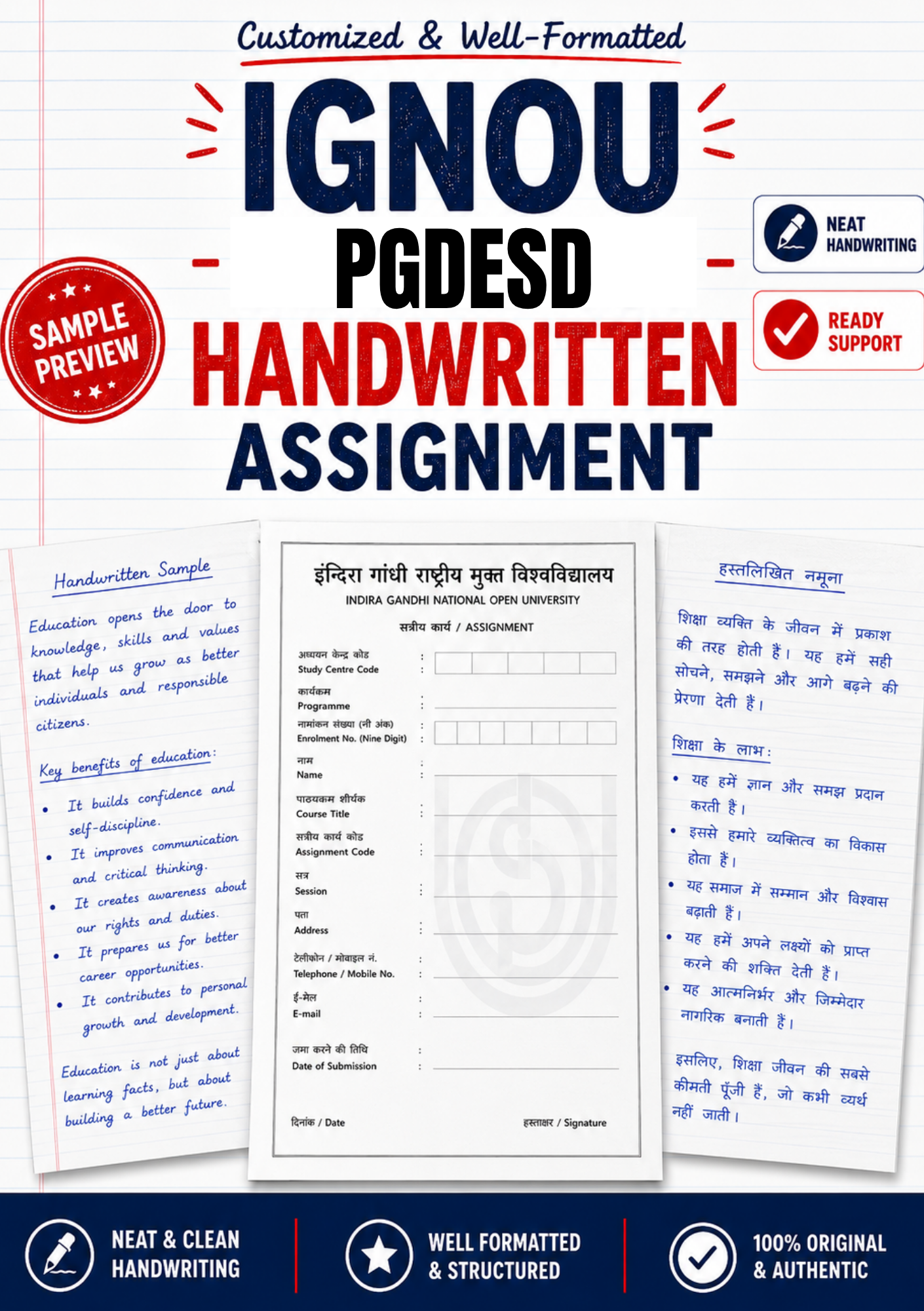
A PGDESD order arrives as paper, because paper is the only form the study centre counter will take. For each MED code you name, four physical items travel together. The first is the answer set itself, written out in longhand on A-4 or foolscap sheets, with the 4 cm margin on the left, top and bottom that the MED instruction block asks for so the evaluator has somewhere to write. The second is the IGNOU-format cover page, filled in with the fields the booklet specifies: enrolment number, name, address, course code, course title, assignment code, study centre code and date. The third is a copy of the official question paper for that code and that validity year, so you can check what was set against what was answered before anything is signed. The fourth is the whole lot packed for courier.
The rate is ₹320 per subject, hard copy only, with courier included in that price and no separate shipping charge. No soft copy or PDF is sold. That last point is not a restriction invented here, and the next section but one explains why the booklet itself forecloses the alternative.
Eight Papers at ₹320, and the Costs That Stay With IGNOU
PGDESD is unusually tidy to price because every paper weighs the same. There is no six-credit outsider, no laboratory component charged differently, no project with its own submission route. Eight courses, four credits each, thirty-two credits, one Tutor Marked Assignment apiece. A learner carrying the full first-year load is looking at eight papers; a learner clearing two backlog codes is looking at two. The arithmetic does not change per code.
What the figure does not touch is anything the university charges. The Common Prospectus July 2026 annexure prints the PGDESD programme fee at Rs. 7,200, and the examination fee sits outside that. Registration, re-registration, term-end examination fees and any late fee your Regional Centre levies are all matters between you and IGNOU, and nothing on this page reduces or replaces them. Delivery depends on your pin code and is confirmed for your order before you pay. No figure is promised on this page.
There is no minimum order: one subject or fourteen, same rate. Assignments carry 30 per cent of the final course result and the term-end examination carries the remaining 70 per cent, which is the reason a skipped MED paper costs more than the paper did.
IGNOU’s Own Booklet Says Hand-Written, Which Settles the PDF Question
Two different products circulate under similar names, and the difference matters at the counter rather than at the desk. A solved assignment is a soft-copy reference file of model answers for a course code and a session, downloaded and read on a screen or printed out for study. A handwritten assignment is the answers written out by hand on A-4 or foolscap sheets and submitted as hard copy at the study centre. The first is study material. The second is a submission.
On most IGNOU programmes the distinction has to be argued from the declaration you sign. On PGDESD it does not, because the MED booklets state the rule outright. The instruction block printed on the 2026 MED papers tells the learner that the assignment response is to be hand-written, that it should use A-4 or foolscap writing paper but not of a very thin variety, that at least a 4 cm margin is to be left on the left, top and bottom, and that answers should be brief, precise and in the learner’s own words rather than copied from the study material. A printout of a downloaded model-answer file satisfies none of that.
So the honest scope is narrow and worth stating plainly. A solved assignment is a reference to write from. It is not a submission, and no downloaded file should be handed in as though it were. Learners who want the reference material rather than the written set are better served by the store’s own PGDESD solved assignment shelf, where the MED model answers are listed code by code, and that is where a query about model answers should go rather than here.
| Where they differ | PGDESD solved assignment | PGDESD handwritten set |
|---|---|---|
| Form it takes | Soft-copy reference file of model answers for a MED code and session | Longhand answers on A-4 or foolscap sheets, posted as hard copy |
| What you do with it | Read it, compare it against the block, write your own answer from it | Check it, sign the declaration, hand it in at the study centre counter |
| Against the MED instruction block | Does not meet the hand-written requirement printed on the booklet | Written in longhand with the 4 cm margin the booklet specifies |
| Who it suits | A learner who intends to write the eight papers personally | A learner short of time before the cut-off for their half of the diploma |
| What it costs here | Listed separately on the PGDESD solved assignment shelf | ₹320 per paper, courier included |
Scroll the table sideways on a narrow screen to see all three columns.
Name your MED numbers and a paper-by-paper quote comes back.
₹320 per paper, hard copy, courier included, no minimum order. Send the codes exactly as they appear on your admission record, say whether you entered in January or July, and attach one photograph of your own handwriting.
MED-001 to MED-008: Every Code, and Every One Carries a Paper
The table below gives the eight courses with the titles the Common Prospectus July 2026 prints in the PGDESD programme table, their credits, which of the two assignment booklets issues each paper, and the cut-off group each falls into. The credit column sums to thirty-two, which is the total the prospectus states for the programme, so the extraction has been checked against the figure rather than trusted on sight.
| Code | Title as the prospectus prints it | Credits | Booklet | Cut-off group |
|---|---|---|---|---|
| MED-001 | Understanding the Environment | 4 | Assignment Booklet-1 | First four |
| MED-002 | Sustainable Development: Issues and Challenges | 4 | Assignment Booklet-1 | First four |
| MED-003 | Energy and Environment | 4 | Assignment Booklet-1 | First four |
| MED-004 | Towards Participatory Management | 4 | Assignment Booklet-1 | First four |
| MED-005 | Integrated Environment Management: Urban and Rural | 4 | Assignment Booklet-2 | Second four |
| MED-006 | Natural Resource Management: Physical and Biotic | 4 | Assignment Booklet-2 | Second four |
| MED-007 | Agriculture and Environment | 4 | Assignment Booklet-2 | Second four |
| MED-008 | Globalisation and Environment | 4 | Assignment Booklet-2 | Second four |
Scroll the table sideways on a narrow screen to reach the booklet and cut-off columns.
Two things about this table are worth pausing on. The first is that it has no elective row and no project row, which on an IGNOU diploma is rare enough to be the defining structural fact about PGDESD: there is no paper you choose and no paper that escapes the assignment requirement. The second is that the prospectus prints these codes as MED 1 through MED 8, in single digits, while the booklets and IGNOU’s live programme page both print MED-001 through MED-008. The next section but two returns to that, because it is not the only place the record disagrees with itself.
The Six Other Programmes That Issue MED Codes, and Why That Matters to You
PGDESD is a small diploma that supplies courses to a surprising number of larger programmes. Six other IGNOU programmes in the Common Prospectus July 2026 issue MED codes as compulsory or elective papers, and one of them sits in a different school altogether. If you are reading this page because a MED code appeared on your admission record, it is worth checking which programme put it there, because the paper you write is the same but the deadline that governs it may not be.
| Programme | MED code issued | Title as that table prints it | School |
|---|---|---|---|
| MA Sociology (MASO) | MED 002, MED 008 | Globalisation and Environment | SOS courses, open elective |
| MA Anthropology (MAANY) | MED 008, MED 002 | Globalisation, Environment and Development | Multidisciplinary slot |
| MA Environmental and Occupational Health (MAENOH) | MED 008 | Globalization, Environment and Development | Compulsory, Year II |
| MA Environmental Studies (MAEVS) | MED 003 | Energy and Environment | Semester III elective |
| MSc Renewable Energy and Environment (MSCRWEE) | MED 003 | Energy and Environment | SOET, Semester I |
| PG Diploma in Environmental Management and Law (PGDEML) | MED 005 | Integrated Environmental Management Urban and Rural | SOITS |
Scroll the table sideways on a narrow screen to see the school column.
Read the third column down and the problem announces itself. One course code, MED 008, carries three different titles inside a single document. The learner who searches for the paper under the title their own programme printed will not always find it. If your MED code reached you through one of these programmes rather than through PGDESD itself, the written sets for those programmes are listed separately, and the MAEVS written set covers the Environmental Studies route into MED 003 while the Renewable Energy and Environment set reaches the same code through the engineering school. For the Anthropology and Occupational Health routes into MED 008, the MAANY written set and the MAENOH written set are the matching pages, and the MSCENV set covers the adjacent Environmental Science master’s.
Twenty-Two Disagreements, Starting With a Course Code Printed Two Ways
Everything below was found by reading the Common Prospectus July 2026 against three live 2026 MED assignment booklets and against IGNOU’s own PGDESD programme page. Three of the twenty-two are defects on this store rather than IGNOU’s, and they are listed with the rest because disclosing them is the more useful thing to do.
Where the PGDESD record contradicts itself. Check your own admission record and your own booklet before ordering.
1. The prospectus PGDESD table is the only place in the entire Common Prospectus July 2026 that prints MED codes in single digits, as MED 1 to MED 8. Every one of the eight other MED occurrences in that document, across six other programmes, prints three digits as MED 002, MED 003, MED 005 or MED 008.
2. Within two consecutive sentences of the PGDESD special instructions the prospectus prints MED1, MED2 and MED3 closed up and MED 4 and MED 5 with a space.
3. The booklets and IGNOU’s live programme page both use MED-001 to MED-008, hyphenated and three-digit, so the prospectus is the outlier among the three official sources.
4. MED 008 carries three different titles in one prospectus: Globalisation and Environment in the PGDESD and Sociology tables, Globalisation, Environment and Development in the Anthropology table, and Globalization, Environment and Development with American spelling in the Environmental and Occupational Health table.
5. MED 005 carries three renderings across the documents read: Integrated Environment Management: Urban and Rural in the PGDESD table and on the live page, Integrated Environmental Management Urban and Rural in the PGDEML table, and Integrated Environmental Management: Rural and Urban on the booklet, with the two words reversed.
6. The MED-006 booklet prints its assignment code with a stray space, as MED -006/TMA/2026, where MED-005 in the same booklet and MED-004 in the other print it closed up.
7. The annexure gives the PGDESD maximum duration as 3 years. IGNOU’s live programme page gives it as 24 months.
8. The annexure gives the mode of examination as Semester wise. The live page labels all eight courses Yearly 1, and the prospectus course table carries no semester split at all.
9. The annexure eligibility reads Graduate from a recognized University/Institution. The live page reads Graduate in any Discpline, with Discipline misspelt.
10. The live page states the programme is not offered to international students, while the prospectus describes PGDESD as developed with the Open University of Sri Lanka, Bangladesh Open University, Allama Iqbal Open University in Pakistan, B.R. Ambedkar Open University and BRAC University under a South Asia Foundation Learning Initiative, for the people of those countries.
11. Four submission dates govern one diploma, split by entry cycle and by which half of the course list a code sits in, rather than the two dates most IGNOU programmes print.
12. Question patterns differ paper by paper. MED-004 sets ten questions with six at ten marks and four split into two five-mark parts; MED-006 sets ten questions all split into five-mark parts; MED-005 sets eight questions, seven at ten marks and one carrying six short notes at five marks each. All three total 100.
13. The booklet instruction block requires a hand-written response, yet names no ink colour, no sheet count and no word limit per answer.
14. A-4 and foolscap are both permitted on the MED papers, where several other IGNOU schools permit only one of the two.
15. PGDESD is named nowhere in the prospectus outside its own section, the contents list and the annexure, despite six other programmes issuing its course codes.
16. PGDEML, which issues MED 005, belongs to the School of Interdisciplinary and Transdisciplinary Studies, so a School of Sciences course code crosses schools without the prospectus remarking on it.
17. Both 2026 booklets print a validity window of 1 January 2026 to 31 December 2026 alongside the submission dates, so the paper expires as a calendar-year document independently of the cut-off that applies to you.
18. Third-party aggregator pages circulate a single universal IGNOU assignment last date for 2026. None of the dates printed on the PGDESD booklets matches the figure those pages carry.
19. The PGDESD assignment booklets name only PGDESD on the cover, so a learner reaching MED codes through one of the six borrowing programmes gets no acknowledgement on the paper itself that their programme uses it.
20. In-house: the description on this store’s PGDESD solved assignment shelf is written about books rather than assignments, in first-person voice, and carries a superlative and a claim that a minimum proportion of examination questions will come from the books. All of that is being removed.
21. In-house: the four PGDESD category shelves on this store follow four different slug conventions, and the previous-year-paper shelf slug is missing a hyphen before the programme code.
22. In-house: four written-set pages on this store already carry MED codes through their own programmes, and until now none of them pointed anywhere a PGDESD learner could land.
Four Cut-Off Dates for One Diploma, and Which Half of It You Are On
Most IGNOU programmes print two submission dates and leave it there. PGDESD prints four, because the first-year rules split the diploma in two. A January-cycle learner may sit the term-end examination in June for MED-001 to MED-004 only, and must wait until December for MED-005 to MED-008. A July-cycle learner mirrors that, sitting December for the first four and the following June for the second four. The assignment dates follow the examination, not the intake, which is why one programme ends up with four.
| Entry cycle | Course group | Submission date printed |
|---|---|---|
| January | MED-001 to MED-004 | March 31 of the same year |
| January | MED-005 to MED-008 | September 30 of the same year |
| July | MED-001 to MED-004 | September 30 of the same year |
| July | MED-005 to MED-008 | March 31 of the next year |
Scroll the table sideways on a narrow screen to read the date column.
Two dates in that table are 31 March and two are 30 September, which is exactly why the pairing is easy to get wrong. The date is not a property of the programme or of the month you are reading this in. It is a property of your entry cycle crossed with the half of the course list your code sits in. Both 2026 booklets also carry a validity line running from 1 January 2026 to 31 December 2026, so the paper itself is a calendar-year document that is withdrawn and replaced at the turn of the year whether or not your own cut-off has passed. Programme structures, course codes, submission dates and rules change, and only ignou.ac.in and your Regional Centre can confirm the current position for your enrolment.
Copying MED-004/TMA/2026 When One Booklet Prints a Stray Space
The assignment code goes on the cover page of every paper you hand in, and it is the string the counter checks first. On PGDESD it reads MED-004/TMA/2026: the course code hyphenated and three-digit, then TMA for Tutor Marked Assignment, then a single four-digit year. There is no session word, no TMA number and no two-year span, which distinguishes it from several other IGNOU schools that use all three.
One detail is worth knowing before you copy it. The MED-006 booklet prints the string as MED -006/TMA/2026, with a space after MED. Both MED-005, which sits in the same booklet, and MED-004, which sits in the other, print it closed up, so this is a typesetting slip confined to one file rather than a format variant you need to reproduce. Copy the code as it appears on the paper you actually downloaded, and if your printed copy shows the space, copying the space will not cause a problem either. What matters is that the course code, the year and the TMA marker are all present and legible.
The cover page itself asks for more than the code. The booklet lists enrolment number, name, address, course code, course title, assignment code, study centre code and date, in a prescribed format, and the IGNOU-format cover sheet supplied with every order carries those fields ready to fill.
A-4 or Foolscap, 4 cm Margins, and a Hand That Matches Yours
The MED booklet is specific about the physical object in a way that many IGNOU papers are not. The response is to be hand-written. The paper is A-4 or foolscap, but not of a very thin variety, which is the booklet’s own phrasing and a practical instruction about ink bleeding through. At least 4 cm of margin is to be left on the left, on the top and at the bottom, so the evaluator has room to write. Each answer is to be marked with its question number and part letter. Answers are to be brief, precise and in the learner’s own words rather than copied out of the block.
Shri Chakradhar Publication writes to those specifications, and writes in a hand that resembles yours rather than a professional copperplate that would look nothing like the declaration signature beside it. Send a photo of a page you have written yourself and the handwritten set is matched to your handwriting at no extra charge.
Photographing one page of your own environment notes
A usable sample is one full page rather than a line or two, photographed flat in daylight with the whole sheet in frame and the camera square to the page. A page of your own notes from any MED block works better than a sentence written out carefully for the purpose, because the natural version is what the writing desk is trying to match. If your handwriting has changed since you last wrote at length, send the current version rather than an older sheet. Send a photo of a page you have written yourself and the handwritten set is matched to your handwriting at no extra charge. The sample is looked at before anything is paid, so the matching is settled before money moves.
English Is the Only Medium, and 2017 Papers Still Get Written
PGDESD runs in English and only in English. The prospectus programme entry, the annexure row and IGNOU’s live programme page all give the medium of instruction as English, and no Hindi edition of any 2026 MED assignment booklet was located. That makes PGDESD simpler than the Hindi-and-English programmes where a learner has to work out which edition of a paper their study centre expects, but it also means a learner hoping for a Hindi MED paper should check with their Regional Centre rather than assume one exists. The service covers all mediums IGNOU issues the TMA paper in, at the same price. On PGDESD that means the English paper, because it is the only one the university issues.
Session coverage runs much wider than the current year. IGNOU’s web services archive still holds PGDESD assignment booklets from earlier cycles, including 2017, 2019 and 2025 files for the MED-001 to MED-004 group, which means a backlog code from a closed year can still be written against the paper that was actually set for it rather than against this year’s substitute. Any session is accepted, current cycle or older, including backlog courses, at the same ₹320 per subject.
Which MED Numbers, Which Cycle, One Photo: The Whole Message
A PGDESD quote needs very little. Send the MED codes you owe, exactly as they appear on your admission record rather than as you remember them. Say whether you entered in January or July, because that is half of what decides your cut-off date. Say which session the papers are for, naming the year if it is a backlog. Attach one photograph of a page of your own handwriting. Give the delivery pin code so the courier position can be confirmed for your address.
That is the whole list. There is no form to fill, no account to create and no document to upload beyond the handwriting photograph. You do not need to send your enrolment number before a quote, you do not need to download the booklets yourself, and you do not need to work out your own cut-off date first, because the codes and the cycle together settle it.
Backlog codes from a closed PGDESD year are quoted at the same rate.
₹320 per paper whether the code is from this cycle or from 2019. Name the year along with the codes and the matching archived paper is used rather than the current one.
Labelling the Envelope the Way the MED Booklet Asks
When the parcel reaches you the work is not quite finished, and the remaining steps are yours rather than the writing desk’s. Read the answers through. You sign the declaration on the assignment cover page, so you should read and review the content before submitting it, and satisfy yourself that it represents your own understanding of the course. Check the enrolment number, the study centre code and the assignment code on every cover sheet against your own record, because those are the fields that cause a set to be returned.
Then submit it the way the booklet describes. The MED instruction block asks the learner to hand the response to the Coordinator of the study centre at the relevant Regional Centre, and to label the envelope as the assignment response for the course, with the course code written on it. Ask for an acknowledgement at the counter and keep it. Submission is compulsory before the examination form is filled in, and the booklet also prints a threshold that is easy to miss: a minimum of 40 per cent in the assignment component is needed to clear continuous evaluation for the course.
The Other Four PGDESD Shelves, and When Each One Helps
The written set is one of five PGDESD product families on this store, and the other four answer different problems. If you intend to write the eight papers yourself and want the blocks in a condensed form, the PGDESD help books covering the MED syllabus are the place to start. For revision close to the term-end examination, the guess papers built around the recurring MED question areas are aimed at the examination rather than the assignment, and the archive of earlier PGDESD question papers with worked answers shows how the examiner has actually set the subject across cycles.
Learners on other programmes who have landed here because of a shared MED code will find the full index of written assignment sets across every programme more useful than this page. If you would rather write the papers in your own time and want the method set out step by step instead of buying a set, the sister site’s guide to preparing a handwritten assignment covers the process from downloading the booklet to handing it in. The booklets themselves are free, and the university’s own assignment download service is where the current MED papers are published.
Sixteen Things Environment Learners Raise Before a MED Order
Does every PGDESD course have an assignment, or do some codes have none?
All eight have one. PGDESD is thirty-two credits made of eight four-credit courses with no laboratory course, no elective and no project, so every MED code from MED-001 to MED-008 carries a Tutor Marked Assignment. This is not true of every IGNOU diploma: several have laboratory or project credits that carry no written paper at all, which means a learner there owes fewer assignments than courses. On PGDESD the two numbers are the same.
Why does the prospectus print MED 1 while my booklet prints MED-001?
Both are the same course. The Common Prospectus July 2026 prints the PGDESD course list in single digits as MED 1 to MED 8, and it is the only place in that whole document which does so; the eight other MED references in the same prospectus, belonging to six other programmes, all use three digits. The assignment booklets and IGNOU’s live PGDESD page both use the hyphenated three-digit form. Write the code the way your booklet prints it, because that is the document the counter is checking against.
My booklet shows four last dates. Which one is mine?
Two things decide it: the cycle you were admitted in, and whether your code is in the first four or the second four. A January-cycle learner submits MED-001 to MED-004 by March 31 of the same year and MED-005 to MED-008 by September 30 of the same year. A July-cycle learner submits the first four by September 30 of the same year and the second four by March 31 of the next year. Confirm against your own booklet and your Regional Centre, since dates get extended.
What does MED-004/TMA/2026 mean, and why does MED-006 print it with a space?
MED-004 is the course code, TMA marks it as a Tutor Marked Assignment, and 2026 is the validity year of the paper. There is no session word and no assignment number in the PGDESD format. The space in MED -006/TMA/2026 is a typesetting slip in that one file: MED-005 sits in the same booklet and prints the code closed up, as does MED-004 in the other booklet. Copy whatever your own downloaded paper shows.
Can a downloaded PGDESD solved assignment PDF be handed in at the study centre?
No, and on this programme the booklet says so directly rather than leaving it to be inferred. The MED instruction block states that the assignment response is to be hand-written, on A-4 or foolscap, with a 4 cm margin. A printed PDF meets none of those conditions. A solved assignment is a soft-copy reference file to write your own answers from; the submission has to be longhand on paper.
Is A4 allowed, or does PGDESD need foolscap?
Both are allowed. The MED booklets ask for A-4 or foolscap writing paper, adding that it should not be of a very thin variety, which is about ink showing through rather than about size. Some other IGNOU schools permit only foolscap, so a learner who has been told foolscap by a friend on a different programme is not wrong about their programme, just about this one. If your study centre has stated a local preference, follow it.
Is PGDESD available in Hindi medium?
The medium is English. The prospectus programme entry, the annexure row and IGNOU’s live PGDESD page all state English, and no Hindi edition of a 2026 MED assignment booklet was found during the research for this page. If your study centre has told you a Hindi paper exists, ask the Regional Centre to point you at the file before assuming it, because the three official sources read for this page agree with each other on this point.
I am on MAEVS and my elective is MED 003. Can this order cover it?
The paper is the same course, but your programme is not PGDESD and your deadline may not be the PGDESD one. MED 003 reaches learners through MA Environmental Studies, through MSc Renewable Energy and Environment and through PGDESD itself, and the governing cut-off follows the programme you are enrolled in. The written set can be prepared either way; name your programme along with the code so the right booklet and the right date are used.
How many questions does one MED paper carry?
It varies by paper, which is why no single answer is printed here. Among the 2026 booklets read for this page, MED-004 sets ten questions with six worth ten marks and four split into two five-mark parts, MED-006 sets ten questions every one of which splits into two five-mark parts, and MED-005 sets eight questions with seven at ten marks and a final question carrying six short notes at five marks each. All of them total 100 marks and all questions are compulsory.
What is the 40 per cent rule printed on the MED booklet?
The booklet states that a minimum of 40 per cent in the assignment component is needed to clear continuous evaluation for the course, separately from the weighting itself. Assignments carry 30 per cent of the final course result and the term-end examination carries the remaining 70 per cent. The two figures do different jobs. The two figures do different jobs: 30 per cent is how much the assignment counts, 40 per cent is the floor you have to clear within it.
Can I order MED papers from the 2019 or 2025 cycle?
Yes. IGNOU’s web services archive still carries PGDESD assignment booklets from earlier cycles, including files for the MED-001 to MED-004 group from 2017, 2019 and 2025, so a backlog code can be answered against the paper that was actually set for it. Name the year with the code. Any session is accepted, current cycle or older, including backlog courses, at the same ₹320 per subject.
Is PGDESD one year or three years, and does that change my assignment?
IGNOU’s own documents disagree, which is worth knowing even though it does not change the written work. The prospectus annexure gives a minimum of 1 year and a maximum of 3 years. The live PGDESD programme page gives 12 months and 24 months. Your assignment obligation is set by the booklet valid for the session you are submitting in, not by the duration figure, so the discrepancy affects your registration window rather than your papers.
Do I get the question paper along with the written set?
Yes, a copy of the official question paper for that code and validity year travels with the set, along with the IGNOU-format cover page. No soft copy or PDF is sold. That matters more on PGDESD than on some programmes, because the 2026 papers are stamped with a validity window running to 31 December 2026 and are replaced at the turn of the year. Having the paper in the parcel lets you confirm that the answers in front of you were written against the questions currently set.
Why does IGNOU’s PGDESD page say the programme is not for international students when the prospectus names SAARC universities?
That contradiction is real and is listed in the conflict box above. The prospectus describes PGDESD as developed by the School of Sciences with the Open University of Sri Lanka, Bangladesh Open University, Allama Iqbal Open University, B.R. Ambedkar Open University and BRAC University, under a South Asia Foundation Learning Initiative aimed at the region. The live programme page states the programme is not offered to international students. Only IGNOU can reconcile the two, and an applicant outside India should ask the university directly rather than rely on either page.
How should the envelope be labelled when I hand the set in?
The MED booklet asks the learner to submit the response to the Coordinator of the study centre at the relevant Regional Centre, and to mark the envelope as the assignment response for the course with the course code written on it. The cover page inside carries enrolment number, name, address, course code, course title, assignment code, study centre code and date. Ask for an acknowledgement at the counter and keep it, since that receipt is what you have if the status page lags.
Will a handwritten set improve my marks or guarantee acceptance?
No claim is made about the marks any assignment will receive, about how an evaluator will assess it, or about whether it will be accepted. Assignment evaluation is entirely a matter for IGNOU. What is offered here is the written object prepared to the specifications the MED booklet prints, in a hand matched to your own, delivered in time for you to read it before you sign the declaration.
One Prospectus, Three Booklets, One Price List: Which Said What
From the IGNOU Common Prospectus July 2026. The programme structure, the eight course codes and their official titles, the thirty-two credit total, the English medium, the Rs. 7,200 programme fee, the 1 year to 3 years duration, the Semester wise mode of examination, the eligibility wording, the collaboration with the South Asian open universities, and every one of the six other programmes listed as issuing MED codes. The credit column in the code table was summed and checked against the total the prospectus itself states before the table was trusted.
From three live 2026 MED assignment booklets. The MED-004, MED-005 and MED-006 papers published on the university’s own site supplied the four submission dates, the 1 January to 31 December 2026 validity window, the MED-004/TMA/2026 code format and the spacing slip on MED-006, the hand-written requirement, the A-4 or foolscap instruction, the 4 cm margin, the cover-page field list, the envelope labelling instruction, the 30 per cent weighting, the 40 per cent continuous-evaluation floor, and the three different question patterns. IGNOU’s live PGDESD programme page supplied the hyphenated code form, the 12 and 24 month durations, the Yearly 1 labelling and the international-student line.
From this publisher’s own commercial terms. The ₹320 per subject rate, the hard-copy-only format, courier inclusion, the free IGNOU-format cover page, the included question paper, handwriting matching from a sample photograph at no extra charge, the absence of a minimum order, and backlog session coverage. These are commercial terms set by Shri Chakradhar Publication and are not IGNOU rules; nothing in this paragraph comes from a university document.
Important Notice
Shri Chakradhar Publication Pvt. Ltd. and shrichakradhar.com form an independent IGNOU study-support publisher. This is not the official website of Indira Gandhi National Open University, is not affiliated with, endorsed by or authorised by the university, and no page on this site should be treated as an official IGNOU communication.
You sign the declaration on the assignment cover page, so you should read and review the content before submitting it, and satisfy yourself that it represents your own understanding of the course.
No claim is made about the marks any assignment will receive, about how an evaluator will assess it, or about whether it will be accepted. Assignment evaluation is entirely a matter for IGNOU.
Tell the Desk Which MED Numbers You Owe
The rate is ₹320 per subject, hard copy only, with courier included in that price and no separate shipping charge. There is no minimum order: one subject or fourteen, same rate. One MED code or all eight, current cycle or a backlog year.
Send the codes from your admission record, your entry cycle and one photograph of a page in your own hand. The quote comes back paper by paper, and nothing is paid until the handwriting sample has been looked at.
Start a PGDESD order on WhatsApp or send your handwriting sample first.