

Description
In short. A Post Graduate Diploma in Applied Statistics learner registers nine courses but owes only seven Tutor Marked Assignments, because MSTL-001 and whichever of MSTL-002 or MSTL-003 goes with the chosen specialisation carry no assignment in any IGNOU booklet; the seven that do are MST-001, MST-002, MST-003, MST-004 and MST-005 from the core, plus MSTE-001 and MSTE-002 for Industrial Statistics or MSTE-003 and MSTE-004 for Biostatistics, each one written out by hand on foolscap sheets with a 4 cm margin on the left, top and bottom exactly as the School of Sciences booklet instructs, each carrying an IGNOU-format cover sheet and a copy of the printed question paper, at ₹320 per subject with courier included, for the June term-end cycle whose papers were due by 31 March 2026 or the December cycle whose papers were due by 30 September 2026, both printed on booklets valid from 1 January 2026 to 31 December 2026.
What a Foolscap PGDAST Set Looks Like on Arrival
The parcel is sorted by course code, not by semester, because a PGDAST learner rarely submits a clean semester. Someone clearing MST-003 from a lapsed year alongside MSTE-004 from the current one gets two separate bundles in one envelope, each complete in itself.
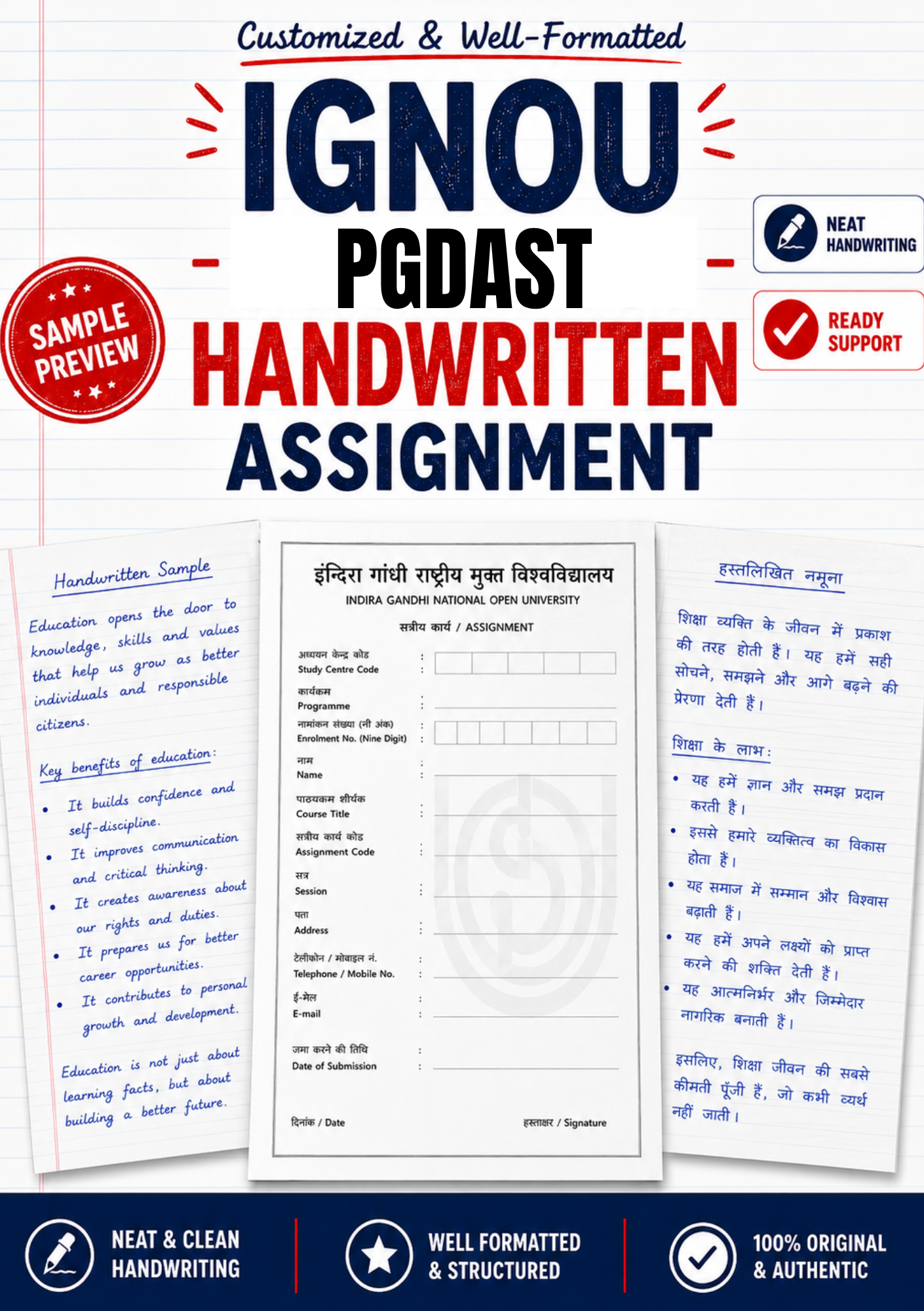
Inside each bundle there are four things. The answer sheets come first, written out by hand on foolscap sheets of the thickness the booklet asks for, with the 4 cm margin on the left, the top and the bottom that the School of Sciences prints on every PGDAST paper. The IGNOU-format cover sheet comes next, filled in with the programme code PGDAST, the course code you are genuinely submitting and the matching course title, which matters more on this diploma than on most, for reasons the specimen-header section below sets out. Third is a printed copy of the official Tutor Marked Assignment paper your answers were written against, so the person at the counter can see the question set and the answer set belong together. Fourth, the sheets are fastened and numbered within the code, so nothing has to be reassembled on a desk at the study centre.
Everything in that list sits inside the per-paper rate, courier included. None of it is a file you download.
Four Credits of PGDAST That ₹320 Cannot Touch
This diploma has an unusual shape, and the shape decides what can be bought. The Common Prospectus July 2026 lists twelve courses: nine theory courses and three laboratory courses. Five theory courses and one laboratory course are compulsory, and the remaining six sit in two specialisation groups of two theory courses and one laboratory course each, taken together and never mixed.
Not one of the three laboratory courses carries a Tutor Marked Assignment. The consolidated PGDAST assignment booklet for January to December 2024 contains nine assignments, for MST-001 through MST-005 and MSTE-001 through MSTE-004, and no assignment at all for MSTL-001, MSTL-002 or MSTL-003. The 2026 papers follow the same pattern: there is a per-course booklet for every theory code and none that opens for a laboratory code.
Work that through for a single learner. You register six core courses worth 22 credits and three specialisation courses worth 10 credits, 32 credits in all. Of those nine courses, seven are theory courses that carry an assignment. The other two are laboratory courses worth 2 credits each. Four credits of your programme, therefore, have no assignment component that anyone can write for you, and the correct price for them is nothing rather than ₹320.
What the rate does cover is every element of a submittable paper: the writing, the cover sheet, the question paper, the handwriting match and the courier. What it does not cover is your registration, your examination fee, your laboratory work, or any outcome after the parcel is signed in. One pending paper is a complete order, and so are seven.
Model Answers for Revision, or Foolscap Ready for the Counter
Two different things are sold under names that look alike, and PGDAST learners confuse them more often than most because the statistics papers reward worked numerical steps that a model answer displays very well.
A solved assignment is a soft-copy reference file of model answers for one course code and one session, read on a screen or printed out, used to understand how a question should be approached. A handwritten assignment is that work written out by hand on paper and submitted in hard copy at the study centre, which is the only form the counter accepts.
| What differs | PGDAST solved assignment | PGDAST handwritten set |
|---|---|---|
| Form it arrives in | Soft copy file, read or printed by you | Foolscap sheets, written by hand, couriered |
| What you do with it | Study the method, then write your own answers | Check it, sign the declaration, hand it in |
| Who it suits | A learner with time who wants to understand MST-004 before writing it | A learner whose term-end form is blocked until the assignment is submitted |
| Relationship to submission | A reference. It is not itself a submission | The submission itself, in the form the booklet asks for |
| What this page sells | Not sold here | ₹320 per subject, hard copy only |
Scroll the table sideways on a narrow screen.
Being blunt about the limit is better than selling past it: a downloaded file is something to write from, never something to hand over. Every PGDAST booklet read for this page instructs the learner to write answers in their own words on foolscap writing paper and to submit at the study centre, and none of them offers an upload route or a typed alternative. If a model-answer file is what you are actually after, the store keeps those on its PG Diploma in Applied Statistics assignment shelf, which is the right place for that search and not this one.
Count your pending codes first, then ask for a figure.
₹320 per subject, courier included. A learner with all seven papers pending is looking at seven units at that rate; a learner with one backlog paper is looking at one.
The Five MST Core Papers Every PGDAST Learner Submits
These five are compulsory whichever specialisation you take, and they are the five that appear on almost every order. Titles and credits below are the Common Prospectus July 2026 wording for the PGDAST programme entry.
| Code | Title in the prospectus | Credits | Carries a TMA |
|---|---|---|---|
| MST-001 | Foundation in Mathematics and Statistics | 4 | Yes |
| MST-002 | Descriptive Statistics | 4 | Yes |
| MST-003 | Probability Theory | 4 | Yes |
| MST-004 | Statistical Inference | 4 | Yes |
| MST-005 | Statistical Techniques | 4 | Yes |
| MSTL-001 | Basic Statistics Lab | 2 | No assignment exists |
| Core total | 22 | 5 of 6 orderable | |
Scroll the table sideways on a narrow screen.
The prospectus places MST-001 to MST-004 in Semester I and MST-005 with MSTL-001 in Semester II. That grouping matters for the examination you sit rather than for what you can order, because an assignment paper stays valid for the whole calendar year it is issued for, and a learner who missed MST-002 in the first cycle submits it against the same booklet in the second.
Credits in this table sum to 22, which is what the prospectus states for the compulsory block, and the sum was checked before the table was published rather than trusted from the extraction.
Industrial Statistics or Biostatistics: Two Papers, Never Four
PGDAST runs two specialisation groups, and the prospectus is explicit that the three courses in a group are taken together. A learner who picks Industrial Statistics owes MSTE-001, MSTE-002 and MSTL-002; a learner who picks Biostatistics owes MSTE-003, MSTE-004 and MSTL-003. Nobody owes both pairs, and an order that lists all four MSTE codes is almost always a learner reading the prospectus table rather than their own admission record.
| Group | Code | Title in the prospectus | Credits | Carries a TMA |
|---|---|---|---|---|
| Industrial Statistics | MSTE-001 | Industrial Statistics-I | 4 | Yes |
| Industrial Statistics | MSTE-002 | Industrial Statistics -II | 4 | Yes |
| Industrial Statistics | MSTL-002 | Industrial Statistics Lab | 2 | No assignment exists |
| Biostatistics | MSTE-003 | Biostatistics-I | 4 | Yes |
| Biostatistics | MSTE-004 | Biostatistics -II | 4 | Yes |
| Biostatistics | MSTL-003 | Biostatistics Lab | 2 | No assignment exists |
Scroll the table sideways on a narrow screen.
The spacing in those titles is copied from the prospectus rather than tidied, because the prospectus prints Industrial Statistics-I closed up and Industrial Statistics -II with a space before the hyphen, and does the same to the two Biostatistics titles. IGNOU’s own live PGDAST page prints a third version of the first pair, with an en dash and the credit figure repeated inside the title field. None of this changes which paper you submit, and all of it changes what a search engine thinks the course is called.
Either group costs the same. A specialisation choice has no effect on the rate, because both groups come down to two written theory papers at ₹320 each.
Where the Prospectus, the Portal and the Booklets Stop Agreeing
The sources used to build this page do not line up with each other. Rather than quietly pick a winner, every disagreement found is listed, including the ones that belong to this store. Twenty-three were recorded.
Twenty-three disagreements recorded while this page was built. Check your own admission record and your own booklet before you act on any of them.
1. The prospectus calls PGDAST a 42 credit programme in one sentence and states in the next that a learner earns 32 credits. Nobody earns 42: that figure is the sum of all twelve courses including both specialisations, which are mutually exclusive.
2. All three laboratory courses carry credits in the prospectus and carry no assignment in any booklet, so 4 credits of a learner’s 32 have no assignment component at all.
3. The 2026 booklets for MST-004, MSTE-001 and MSTE-003 each print a specimen answer-sheet header reading COURSE CODE: MST-001 and COURSE TITLE: FOUNDATION IN MATHEMATICS AND STATISTICS, on papers that are not MST-001. Three separate files carry the same carry-over, so this is a template fault and not a single slip.
4. MST-001 is titled Foundation in Mathematics and Statistics in the PGDAST table of the Common Prospectus July 2026 and Foundation of Mathematics and Statistics in the M.Sc. Renewable Energy and Environment table of the same document. IGNOU’s live PGDAST page uses of; the booklet covers use in.
5. The MSTE-001 and MSTE-002 titles appear in three renderings across one prospectus and the live portal, as described in the specialisation section above.
6. The PGDAST laboratory course MSTL-001 Basic Statistics Lab is printed as MSTSL 001 Basic Statistics Lab inside the B.Sc. Applied Science Energy table of the same prospectus. One lab, two prefixes, one document.
7. MSTE 001 and MSTE 002, which are elective courses in PGDAST, are printed as Compulsory, Theory courses of B.Sc. Applied Science Energy, which is also a School of Sciences programme.
8. MST 005 Statistical Techniques is also a course of the Certificate in Condition Monitoring, a 16 credit School of Engineering and Technology certificate, so one School of Sciences code sits inside another school’s programme.
9. MST-004 Statistical Inference in PGDAST and MST 016 Statistical Inference in M.Sc. Applied Statistics are the same course title on two different codes in one prospectus.
10. The 2026 PGDAST booklets print two submission deadlines and a validity window. The 2026 M.Sc. Applied Statistics booklet for MST-023, same school and same year, prints the validity window only and no last date at all, telling the learner to check the university website instead.
11. The programme-code field is filled with PGDAST on some 2026 covers and left blank on the MST-005 cover of the same session.
12. The number of questions is not standard across the diploma: MSTE-003 sets five, MST-004 and MSTE-001 set seven, MST-001 sets eight and MST-005 sets nine. All of them total 100 marks.
13. The prospectus Annexure gives the fee as Rs. 8,000 charged semester wise. IGNOU’s live PGDAST page gives INR 7,200 for the full programme. An admissions aggregator adds a Rs. 300 registration fee and a Rs. 200 development fee on top of Rs. 8,000.
14. The prospectus groups the courses into Semester I and Semester II and the Annexure says the fee is charged semester wise. IGNOU’s live PGDAST page labels all twelve courses Yearly 1.
15. PG Diploma in Statistics and Applications, PGDSA, is named exactly once in the whole Common Prospectus July 2026, as the exit award of M.Sc. Applied Statistics, with no section, no course table and no row in the programme Annexure. It is a second statistics PG diploma that is easy to mistake for this one.
16. IGNOU’s live PGDAST page prints Industial Statistics Lab for MSTL-002.
17. The PGDAST paragraphs in the prospectus carry run-together typesetting faults, including development,etc.The PG Diploma and to be taken togetherfor Industrial Statistics.
18. The 2025 PGDAST booklet filenames on ignou.ac.in carry a (PGDAST) suffix while the 2026 files do not, and M.Sc. Applied Statistics files exist under two different naming conventions for the same course.
19. News and aggregator pages circulate 30 April as the IGNOU assignment last date. The PGDAST booklets print 31 March 2026 for the June examination and 30 September 2026 for the December examination.
20. One admissions aggregator describes PGDAST as 32 credits across eight courses of 4 credits each. A learner actually registers nine courses: seven of 4 credits and two of 2 credits.
21. In house: this store already sold PGDAST books, solved assignments and guess papers, and already sold handwritten sets for two neighbouring programmes that use MST codes, while carrying no handwritten product for PGDAST itself. This page closes that gap.
22. In house: the store’s own PGDAST shelves name the programme two ways, PG Diploma in Applied Statistics on the books and assignment shelves and Post Graduate Diploma in Applied Statistics on the guess-paper shelf.
23. In house: the general handwritten assignment category page still carries a delivery time stated in working days and a Rs 350 list price line, both of which contradict this page. Correcting that page is on the publisher’s own list.
31 March, 30 September, and a Year-Long Validity Window
PGDAST runs on a School of Sciences calendar that is not the same as the management or humanities calendars circulating on aggregator sites, and it carries three dates rather than two.
Every 2026 PGDAST booklet read for this page prints the same validity line: valid from 1 January 2026 to 31 December 2026. Underneath, the instruction block keys the deadlines to the examination rather than to the intake. A learner sitting the June 2026 term-end examination was asked to submit by 31 March 2026. A learner sitting the December 2026 examination was asked to submit by 30 September 2026. The same booklet serves both, which is why a January-cycle learner and a July-cycle learner can be writing from one identical paper and still owe it on different days.
Two consequences follow. First, the question set expires. The 2026 booklet stops being the live paper on 31 December 2026, and a 2027 paper takes its place with different questions against the same course code, so an order placed for a lapsed year has to be written against the booklet of that year and not the current one. Second, the deadline is not the only clock: every PGDAST booklet states that the examination form for a course cannot be filled until that course’s assignment has been submitted, which makes the assignment a gate rather than a formality.
On a 4 credit PGDAST theory paper the assignment share is a large piece of the course to leave sitting at zero while the examination form stays blocked behind it.
Why Every 2026 PGDAST Paper Prints MST-001 in Its Specimen Header
The assignment code on a PGDAST paper is short and predictable. It is the course code, then TMA, then a single four-digit year: MST-004/TMA/2026, MSTE-001/TMA/2026, MSTE-003/TMA/2026. There is no session word, no two-year span and no TMA number, which separates PGDAST from programmes whose codes carry an AST segment or a numbered TMA. Copy it exactly as printed on the cover of the paper you downloaded, because the year in that string is what tells an evaluator which question set your answers belong to.
Then there is the header. Below the instructions, each booklet prints a specimen of the block you are supposed to reproduce at the top of your first sheet: enrolment number, name, address, programme code, course code, course title, study centre and date. On the 2026 PGDAST papers that specimen is not blank. It reads PROGRAMME CODE: PGDAST, COURSE CODE: MST-001, COURSE TITLE: FOUNDATION IN MATHEMATICS AND STATISTICS, and it reads that way on the MST-004 booklet, on the MSTE-001 booklet and on the MSTE-003 booklet alike. It is the MST-001 specimen carried across the whole set when the per-course files were generated.
A learner copying the printed example literally would put Foundation in Mathematics and Statistics at the top of a Biostatistics answer sheet. That is not a theory about what might go wrong; it is what the printed page instructs. Sets prepared here carry the code and title of the paper actually being submitted, and the specimen is treated as a layout guide rather than as content. Check your own sheets against your admission record before you sign them in, whoever wrote them.
| Booklet | Assignment code printed | Questions | Maximum marks |
|---|---|---|---|
| MST-001 Foundation in Mathematics and Statistics | MST-001/TMA/2026 | 8 | 100 |
| MST-004 Statistical Inference | MST-004/TMA/2026 | 7 | 100 |
| MST-005 Statistical Techniques | MST-005/TMA/2026 | 9 | 100 |
| MSTE-001 Industrial Statistics-I | MSTE-001/TMA/2026 | 7 | 100 |
| MSTE-003 Biostatistics-I | MSTE-003/TMA/2026 | 5 | 100 |
Scroll the table sideways on a narrow screen.
All questions on these papers are compulsory, so there is no selection to make and no short route through a paper. A five-question Biostatistics booklet is not a lighter paper than a nine-question Statistical Techniques booklet; it simply carries more marks per question, with a single question on the MSTE-003 2026 paper worth 30.
One Photograph Sets the Handwriting for All Seven Papers
Statistics answer sheets are unusually revealing, because they are full of worked steps, symbols, tables and derivations rather than continuous prose. A set that looks nothing like the rest of your file is more noticeable here than on an essay paper. That is why the match is settled first.
Send a photo of a page you have written yourself and the handwritten set is matched to your handwriting at no extra charge. One sample covers the whole order, so a learner ordering all seven papers sends one page, not seven.
Photographing a page of your own statistics working
A page of ordinary lined notes is enough, but a page with numbers on it is better than a page of prose, because the writer needs to see how you form digits, fractions, subscripts and equals signs as well as letters. Shoot it flat in daylight, keep the whole page in frame, and do not crop to a corner. Nothing is paid before the match is agreed, so the sample is the point at which you decide whether to go ahead rather than a formality after the fact.
One Medium, Two Specialisations, and Papers You Still Owe
PGDAST is an English medium programme. The Common Prospectus July 2026 states English in the programme entry and again in the Annexure, IGNOU’s live programme page repeats it, and no Hindi edition of a PGDAST booklet surfaced while this page was built. That is unusual for an IGNOU post graduate diploma and worth knowing before you ask for a Hindi set that the university does not issue a paper for.
The service covers all mediums IGNOU issues the TMA paper in, at the same price. For PGDAST, at present, that means English.
Session coverage is wider than medium coverage. Any session is accepted, current cycle or older, including backlog courses, at the same ₹320 per subject. In practice the commonest PGDAST order is not a tidy full set: it is two or three codes left over after a term-end form was blocked, mixed across cycles. Those are written against the booklet of the year they belong to, which is the only way the question set and the answer set agree.
A mixed order of old and current codes is the normal case, not an exception.
₹320 per subject whichever year the paper belongs to, courier included, with the count confirmed before anything is written.
Codes First, Specialisation Second, Sample Photo Third
Most of the delay on a PGDAST order comes from working out which paper a learner actually means, because MST codes are shared across four IGNOU programmes and two schools. Three pieces of information remove that problem entirely.
- The course codes exactly as your admission record prints them. MST-003 and MST-013 are different courses in different programmes. Reading the code off your own record beats recalling it.
- Which specialisation you took. Industrial Statistics or Biostatistics. This decides whether your elective pair is MSTE-001 and MSTE-002 or MSTE-003 and MSTE-004, and it is the single question that settles most PGDAST orders.
- The session the papers belong to. The current 2026 booklets, or an earlier year for a backlog paper.
- One photograph of a page in your handwriting. Preferably with numbers on it.
- A delivery address with a pin code. The courier position for that pin code is confirmed along with the count.
Nothing else is needed. Enrolment numbers, marksheets and identity documents are not asked for, and sending them would not speed anything up.
Your Enrolment Number Goes on Every Sheet Before It Is Handed In
The cover sheet arrives in IGNOU format with the programme code, course code and course title completed, and with the enrolment number, name, address, study centre and date left for you. That is deliberate: the declaration printed above those boxes is yours to sign, and the enrolment number beside it has to be yours as well.
Read the answers through against your own blocks before you fasten the set. On a statistics paper that means checking that the worked steps follow the method you were taught and that the figures carried from one part of a question to the next are consistent, because a numerical slip propagates in a way a prose slip does not.
Then submit at the study centre, which is what every PGDAST booklet instructs, and ask for an acknowledgement. Keep a copy of your own answer sheets, as the booklets also advise. The assignment status takes time to appear against your enrolment, and a dated receipt is the only thing that helps if it does not.
What happens to the paper after the counter stamps it sits with the evaluator and with the university, and nothing written on this page reaches into that.
What Sits Beside a Written Set on the PGDAST Shelf
A written set answers one need. Several PGDAST learners need something else at the same time, and the rest of the store is organised by that need rather than by format.
Before the examination, the course material itself does more work than anything else, and the PG Diploma in Applied Statistics book shelf carries the printed guides for the MST core; there is also a five-book combined set covering MST 1 to MST 5 for learners starting from nothing. Closer to the term-end examination, the PGDAST guess paper shelf is built around previous question patterns rather than around the assignment. A learner who wants to write the paper themselves but needs the method laid out first can start from a single-code reference such as the MST 1 model answer file for 2025-26.
Two neighbouring programmes come up constantly in PGDAST enquiries because they share the MST prefix. Learners who finished this diploma and moved up often ask about the written sets for the M.Sc. Applied Statistics codes, where the core runs MST-011 to MST-026 and the booklets print no last date at all; the master’s degree statistics book shelf and the M.Sc. Applied Statistics guess papers serve the same group. Undergraduates who find MST-003 and MST-004 inside their own degree are usually looking for the B.Sc. Applied Science Energy written sets instead, where those codes sit as compulsory papers rather than as a PG diploma core. Everything handwritten across every programme is listed on the handwritten assignment category.
If you would rather write the set yourself and simply want the procedure in order, the sister editorial site publishes a step by step guide to preparing an IGNOU handwritten assignment at no cost.
Sixteen Answers for a PGDAST Learner Who Has Not Ordered Yet
How many PGDAST papers can actually be written for me?
Seven. The five MST core theory papers, MST-001 to MST-005, plus the two MSTE theory papers of whichever specialisation you took. The two laboratory courses on your record carry no Tutor Marked Assignment, so there is nothing to write and nothing to charge for.
Do the three MSTL lab courses need an assignment too?
No. The consolidated PGDAST assignment booklet for January to December 2024 contains nine assignments, one for each theory code, and none for MSTL-001, MSTL-002 or MSTL-003. The 2026 set follows the same pattern. If anyone quotes you for a written MSTL paper, ask them which booklet it comes from.
My friend on M.Sc. Applied Statistics has MST-012. Why does my first code read MST-001?
Because they are different programmes sharing a prefix. PGDAST runs MST-001 to MST-005 with MSTE-001 to MSTE-004; M.Sc. Applied Statistics runs MST-011 to MST-026 with MSTE-011 and MSTE-012. The same prospectus even gives MST-004 and MST 016 the identical title Statistical Inference. Order against the codes on your own admission record, not against a friend’s.
PGDAST assignment jama karne ki aakhri tareekh kya hai?
The 2026 booklets print 31 March 2026 for learners sitting the June term-end examination and 30 September 2026 for those sitting the December examination, with the paper itself valid from 1 January 2026 to 31 December 2026. The 30 April date circulating on news sites is a general extension notice, not a PGDAST date. Read both dates off the cover of your own booklet, because a later cycle can move them.
The specimen header on my MSTE-003 booklet says MST-001. Do I copy that?
No. That specimen is a template carried across the whole 2026 PGDAST set and it appears on the MST-004 and MSTE-001 booklets as well. Write the code and title of the paper you are actually submitting. Use the printed specimen for its layout, not for its content.
Can a downloaded PGDAST solved assignment be handed in at the study centre as it is?
It is not meant to be. A solved assignment is a soft-copy reference file of model answers; the booklet asks for answers written in your own words on foolscap paper and submitted at the study centre. Treat a downloaded file as something to learn the method from before you write.
PGDAST solved assignment aur handwritten set, dono kis kaam aate hain?
The reference file teaches you how an MST question is approached, which is useful when you have time and want to understand the working. The handwritten set is the physical submission, written on foolscap and ready for the counter, which is what a blocked examination form needs. One is study material, the other is paperwork.
Ignou PGDAST assignment typed karke submit ho sakta hai?
Every PGDAST booklet read for this page asks for answers written on foolscap writing paper with a 4 cm margin, and none of them offers a typed or uploaded route. Whether a particular study centre would accept something else is a question for that centre, not for this page.
Is a PGDAST set written on A4 or on foolscap?
Foolscap. The instruction is identical on every 2026 PGDAST booklet: use foolscap size writing paper that is not of a very thin variety, and leave a 4 cm margin on the left, the top and the bottom. Sets prepared here follow the booklet rather than the more common A4 habit.
I picked Biostatistics. Do MSTE-001 and MSTE-002 still apply to me?
No. The prospectus states that the three courses of a specialisation are taken together, so a Biostatistics learner owes MSTE-003, MSTE-004 and MSTL-003 and nothing from the Industrial Statistics group. Ordering all four MSTE papers is the commonest avoidable overspend on this diploma.
Can a PGDAST paper from a lapsed year still be written?
Yes, and at the same rate as a current one. The paper is written against the booklet of the year it belongs to, because the question set is replaced each cycle and a current-year answer set would not match an older question paper.
PGDAST is an English medium programme. Does a Hindi answer sheet cost more?
The service covers all mediums IGNOU issues the TMA paper in, at the same price. For PGDAST that is English, since the prospectus, the Annexure and IGNOU’s live programme page all give English as the medium and no Hindi PGDAST booklet surfaced during research for this page.
Is a scanned copy of the written set emailed as well?
No soft copy or PDF is sold. Nothing is emailed, scanned or shared as a file, and the courier that brings the paper to you is already inside the per-subject rate.
If one PGDAST paper is skipped, how much of that course result is lost?
Assignments carry 30 per cent of the final course result and the term-end examination carries the remaining 70 per cent. On top of that, the booklet states the examination form for a course cannot be filled until that course’s assignment is submitted, so skipping one paper can cost the whole sitting rather than 30 per cent of it.
Does ordering a written set change how the evaluator marks it?
No claim is made about the marks any assignment will receive, about how an evaluator will assess it, or about whether it will be accepted. Assignment evaluation is entirely a matter for IGNOU. What is within anyone’s control is that the set is complete, written on the right paper, carries the right code and reaches the counter in time.
When will the set actually reach me?
Delivery depends on your pin code and is confirmed for your order before you pay. No figure is promised on this page. Ask for the position for your own address when the codes are quoted, and plan against your booklet’s date rather than against a courier estimate.
A Prospectus, Five Booklets and a Price List, Kept Apart
Three kinds of source were used for this page and they are not interchangeable, so they are labelled rather than blended.
IGNOU’s Common Prospectus July 2026 supplied the programme structure: the twelve courses, their official titles, their credits, the two specialisation groups, the English medium, the eligibility of graduation in any discipline, and the 42 against 32 credit wording quoted in the conflict list. Credit totals were summed and checked against the prospectus figures before the tables above were published, which is also how the laboratory courses were separated from the rest.
Live assignment booklets published on ignou.ac.in supplied everything about the assignments themselves. Five 2026 booklets were opened for MST-001, MST-004, MST-005, MSTE-001 and MSTE-003, together with the consolidated PGDAST booklet for January to December 2024 and, for comparison, the 2026 M.Sc. Applied Statistics booklet for MST-023. From those came the two submission dates, the validity window, the assignment code format, the question counts, the foolscap and margin instruction and the repeated specimen header. IGNOU’s own live PGDAST programme page supplied the fee, duration and course listing that conflict with the prospectus, and the MST-001 assignment booklet for 2026 is a representative example of the paper itself.
Shri Chakradhar Publication’s own commercial terms supplied the price, what is included, the handwriting process and the delivery position. Those are the publisher’s terms and carry no IGNOU authority whatsoever. Where this page states a date or a code it comes from the first two sources; where it states a rate or a process it comes from the third.
Important Notice
Shri Chakradhar Publication Pvt. Ltd. and shrichakradhar.com form an independent IGNOU study-support publisher. This is not the official website of Indira Gandhi National Open University, is not affiliated with, endorsed by or authorised by the university, and no page on this site should be treated as an official IGNOU communication.
Programme structures, course codes, submission dates and rules change, and only ignou.ac.in and your Regional Centre can confirm the current position for your enrolment.
You sign the declaration on the assignment cover page, so you should read and review the content before submitting it, and satisfy yourself that it represents your own understanding of the course.
No claim is made about the marks any assignment will receive, about how an evaluator will assess it, or about whether it will be accepted. Assignment evaluation is entirely a matter for IGNOU.
Seven Codes, or One: Where a PGDAST Order Begins
The rate is ₹320 per subject, hard copy only, with courier included in that price and no separate shipping charge. There is no minimum order: one subject or fourteen, same rate.
Start by naming your specialisation and listing the codes still pending. A count comes back at ₹320 each, the handwriting sample is agreed, and only then does anything get written.
Name your specialisation and your pending codes on WhatsApp
Not sure which papers are still open on your record? Send what you do know and work it out over chat before committing to a count.