

Description
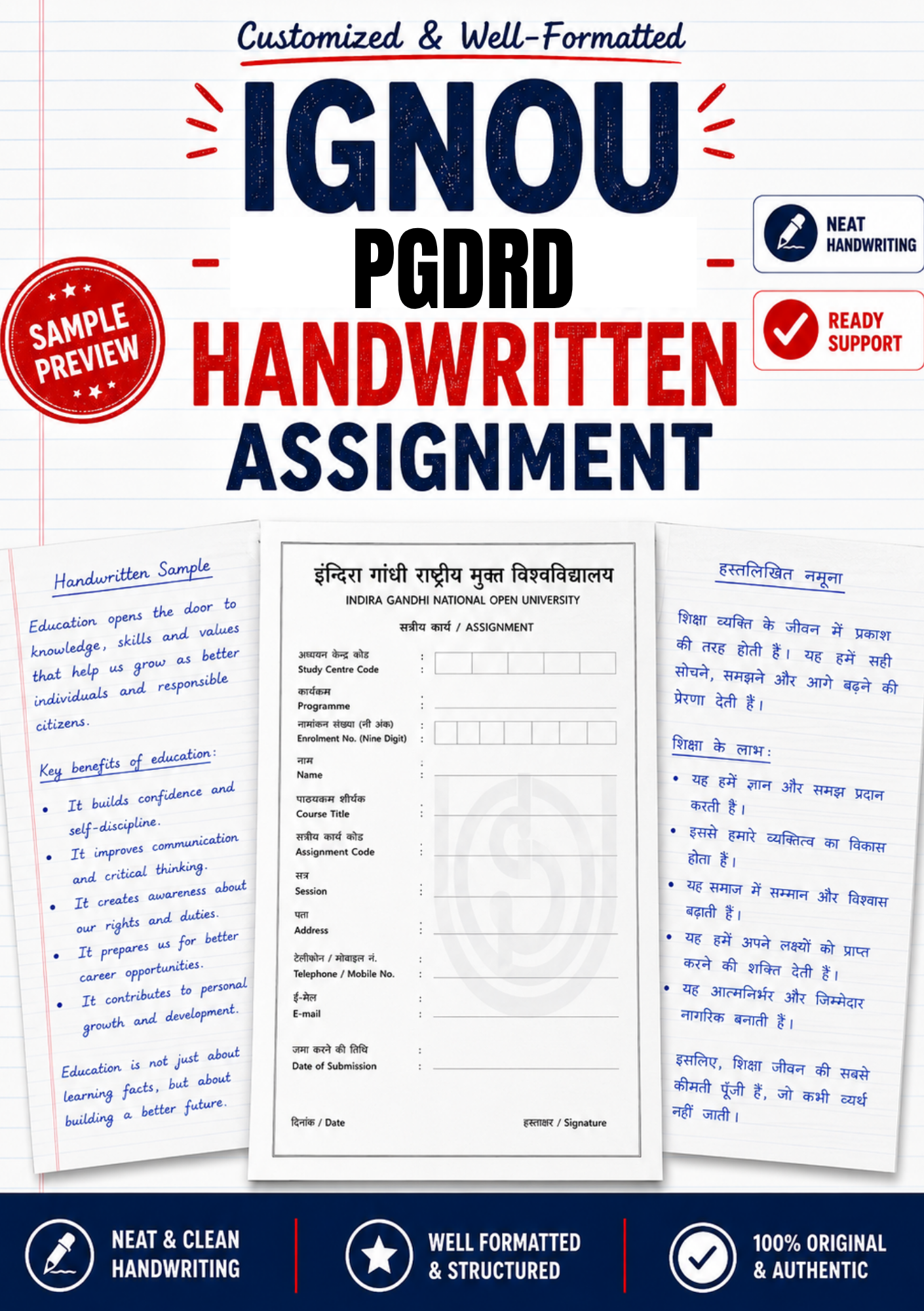
In short. The Post Graduate Diploma in Rural Development carries seven courses, and six of them have a tutor-marked assignment you must hand in: MRD 201, MRD 202 and MRD 203 as compulsory papers, plus exactly one elective chosen from MRDE 201, MRDE 202 and MRDE 203. The seventh, MRDP 205 Research and Project Work, carries no TMA at all. Shri Chakradhar Publication writes those four papers out by hand on A4, in the learner’s own handwriting copied from a sample photograph, and couriers the set with a free IGNOU-format front page and a printed copy of the official question paper. The rate is ₹320 per subject, hard copy only, with courier included in that price and no separate shipping charge. The booklets for the current cycle print two cut-offs, 31 March 2026 for the July 2025 session and 30 September 2026 for the January 2026 session, and they carry assignment codes in the form MRD-201/AST/TMA-1/2025-2026. Assignments carry 30 per cent of the final course result and the term-end examination carries the remaining 70 per cent.
Counting What Is in the Envelope Before You Sign for It
A PGDRD order is a physical parcel, and it is worth knowing exactly what should be inside it before the courier asks for a signature. Four things travel together for every paper ordered, and nothing else is included or implied.
The first is the answer script itself: loose A4 sheets written on one side, in continuous handwriting, following the three-section structure the SOCE booklet sets out. The second is the IGNOU-format front page, already laid out with the fields for enrolment number, regional centre, study centre, programme code, course code and the assignment code string, left blank only where your own details belong. It is supplied free with every paper. The third is a printed copy of the official question paper that the answers were written against, so the evaluator at your study centre can see the paper and the response side by side, and so you can check for yourself that the questions answered are the questions your booklet actually asks. The fourth is the packaging and the courier itself. The rate is ₹320 per subject, hard copy only, with courier included in that price and no separate shipping charge.
What is deliberately absent matters as much. No soft copy or PDF is sold. There is no emailed file, no download link and no scanned copy sent ahead of the parcel. The reason is not a commercial one: the SOCE booklet for every PGDRD paper carries a single flat instruction that the assignment must be submitted in handwritten form only, and a file is not a submission under that instruction. A page that sold you a PDF while quoting that line would be contradicting itself.
₹320 Buys a Written Paper, Not a Registration or a Grade
Pricing on this page is per course code, not per year, per semester or per diploma. A learner who owes only a single backlog elective pays for one paper. A learner starting PGDRD from scratch with three compulsory codes and one elective pays for four. There is no minimum order: one subject or fourteen, same rate.
Inside the rate sit the writing itself, the A4 stationery, the front page, the question-paper copy, the handwriting match against your sample, and the courier to your address. Outside it sit three things that are not on offer at any price. The first is your IGNOU registration and the programme fee, which go to the university and have nothing to do with this order. The second is the term-end examination, which is 70 per cent of each course result and is yours alone to sit. The third is any statement about how the assignment will be received: no claim is made about the marks any assignment will receive, about how an evaluator will assess it, or about whether it will be accepted. Assignment evaluation is entirely a matter for IGNOU.
That third exclusion is stated plainly rather than buried, because the alternative is the kind of marks promise that still appears on older listings across this store and across the wider market. A guarantee of that sort cannot be honoured by anyone who does not employ the evaluator, and the full handwritten range across every IGNOU programme is being rewritten specifically to remove such language.
Model Answers to Read From, or Pages You Can Actually Hand In
Two different PGDRD products are routinely confused, and the confusion costs learners a submission window. They are not substitutes and the difference is not quality, it is physical form.
A solved assignment is a soft-copy reference file of model answers for a course code and a session. You read it, you take what you understand from it, and you write your own script from it. A handwritten assignment is the answers written out by hand on A4 and submitted in hard copy at the study centre. One is study input. The other is the thing that crosses the counter.
| Point of difference | PGDRD solved assignment | PGDRD handwritten assignment |
|---|---|---|
| Physical form | Soft copy, read on a phone or laptop | Loose A4 sheets, written by hand |
| What you do with it | Read it, then copy it out yourself | Attach the front page and submit it |
| Handwriting | None. It is typed text | Matched to your own hand from a photo |
| Suits | A learner with time who wants to write | A learner short of time before a cut-off |
| Rate on this store | Priced per code in the PGDRD assignment category | ₹320 per subject, courier included |
Scroll the table sideways on a narrow screen.
The deciding line is not a seller’s opinion. Every PGDRD booklet on the SOCE server carries the instruction that the assignment must be submitted in handwritten form only. A downloaded file printed on a laser printer is typed output, whatever its contents, and it does not satisfy that instruction. This matters most to learners who already own the reference files and assume the purchase is finished: owning model answers and owning a submission are two separate states.
If what you actually want is the reference file rather than the written set, this is the wrong product and the honest thing is to say so. The store keeps a worked set of model answers code by code in its PGDRD solved assignment category, organised by MRD and MRDE code and session, and that is where a soft-copy order belongs. Nothing on this page is sold as one.
Four codes, four written papers, ₹1,280 for a full PGDRD year at ₹320 each.
Message the enrolment number, the medium and the elective you registered against, and a quote comes back in the same thread. Nothing is paid until the handwriting sample has been matched and shown to you.
MRD 201, 202 and 203: The Three Papers No PGDRD Learner Escapes
Three compulsory courses sit at the centre of the diploma and every enrolled learner owes an assignment against each of them, whatever elective they picked and whatever year they joined. The titles below are taken from the Common Prospectus July 2026 programme entry on page 266, and the assignment code strings are read off the live SOCE booklets for the current cycle.
| Code | Official title | Credits | Assignment code on the live booklet |
|---|---|---|---|
| MRD 201 | Rural Development: Indian Context | 6 | MRD-201/AST/TMA-1/2025-2026 |
| MRD 202 | Rural Development Programmes | 6 | MRD-202/AST/TMA-2/2025-2026 |
| MRD 203 | Rural Development Planning and Management | 6 | MRD-203/AST/TMA-3/2025-2026 |
Scroll the table sideways on a narrow screen.
Each of these three carries 6 credits, so the compulsory block is 18 credits. Add the single 6-credit elective and the 6-credit project and the diploma totals 30 credits, which is the figure the prospectus itself prints at the foot of the table. That arithmetic is worth checking rather than trusting, because IGNOU’s own live programme page for PGDRD lists all six theory courses plus the project as though every one were taken, and arrives at a different total. The prospectus figure is the one that matches the elective rule.
The same three codes are also the entire content of the Certificate in Rural Development, which the prospectus describes on page 345 as an 18-credit programme built from MRD 201, MRD 202 and MRD 203. That overlap is the single most common source of a wrong download, and the next section but one explains why. Learners who want the printed guides for these three papers rather than written answers will find them in the PGDRD books and study-material section.
One Elective Out of Three, and Why the Admission Form Named Different Ones
The elective block is where PGDRD orders go wrong most often, for a reason that is not the learner’s fault. The programme entry on page 266 of the Common Prospectus July 2026 offers three electives and instructs the applicant to select any one of them. Those three are listed below with the TMA number each one carries.
| Current code | Official title | Credits | TMA number | Legacy code in Annexure I(e) |
|---|---|---|---|---|
| MRDE 201 | Rural Social Development | 6 | TMA-4 | MRDE101 |
| MRDE 202 | Rural Health Care | 6 | TMA-5 | RDD6 |
| MRDE 203 | Communication and Extension in Rural Development | 6 | TMA-6 | RDD7 |
Scroll the table sideways on a narrow screen.
The right-hand column is the problem. Item 27 of the application instructions in the same prospectus tells PGDRD applicants to choose their elective from Annexure I(e). Annexure I(e), printed on page 432 of that document, lists the PGDRD elective choices as MRDE101, RDD6 and RDD7, with the note that details are given under the programme. None of those three strings appears anywhere else in the prospectus, and the programme entry they point at lists MRDE 201, MRDE 202 and MRDE 203 instead. An applicant following the form to the letter selects a code the programme page does not contain.
The three legacy codes are not invented. The PGDRD assignment booklet published by SOCE for the 2020-21 cycle carries exactly MRD-101, MRD-102, MRD-103, MRDE-101, RDD-6 and RDD-7, with assignment strings such as RDD-6/AST/TMA-5/2021. The annexure in the July 2026 prospectus is reprinting an elective list that the live booklets retired several cycles ago. For ordering purposes the rule is simple: the code on your current booklet is the code that gets written, and if your admission paperwork names RDD 6 while your booklet names MRDE 202, they are the same course under two generations of numbering.
Twenty-Four Disagreements Across Six Rural Development Documents
Six documents were read against each other to build this page: the Common Prospectus July 2026, the current SOCE booklets for MRD 201, MRD 202, MRDE 201 and MRDE 203, the Certificate in Rural Development booklet for MRD 203, the consolidated PGDRDOL booklet for 2024-25, the PGDRD booklet for 2020-21, and IGNOU’s own live PGDRD programme page. They do not agree. The twenty-four points below are what reading them side by side produced, and four of them are this store’s own errors rather than the university’s.
Check every one of these against ignou.ac.in and your Regional Centre before you write anything. Where two IGNOU documents disagree, the university decides which is right, not this page.
1. The prospectus programme entry lists the electives as MRDE 201, MRDE 202 and MRDE 203, while Annexure I(e), which the application instructions direct PGDRD applicants to, lists them as MRDE101, RDD6 and RDD7.
2. IGNOU’s live PGDRD programme page labels MRD-203 an elective course. The prospectus places it in the compulsory block.
3. That same live page totals the programme at 42 credits by counting all six theory papers plus the project. The prospectus prints 30, which is the figure consistent with taking only one elective.
4. The live page gives the duration as a minimum of 24 months and a maximum of 48. The prospectus programme table gives one year minimum and three years maximum.
5. The live page quotes Rs 4,500 for the programme plus a Rs 300 registration fee. The prospectus table prints Rs 4,500 per year, charged year-wise.
6. The title of MRD 203 is printed three ways: “Rural Development Planning and Management” on page 266 and on the live page, “Rural Development : Planning and Management” in the Certificate in Rural Development entry on page 345, and “Rural Development – Planning and Management” in the PGDRDOL booklet.
7. The PGDRDOL booklet drops a word from the title of MRDE 203, printing “Communication Extension in Rural Development” where every other document prints “Communication and Extension in Rural Development”.
8. MRD 201 is titled “Rural Development: Indian Context” on the current booklet and “Rural Development : Indian Context” on the 2020-21 booklet for the same course.
9. The project course is printed as MRDP205 in the prospectus introduction and MRDP 205 in the course table nine lines below it, and as MRDP205 again on the live programme page.
10. The elective codes are hyphenated as MRDE-201 on the SOCE booklets and run together as MRDE201 on the PGDRDOL booklet, for the same course in the same cycle.
11. MRD 203 exists as two different live papers. The PGDRD booklet sets one long answer worth 40 marks at up to 1000 words. The Certificate in Rural Development booklet for the same code sets two long answers worth 20 marks each at up to 700 words.
12. Those two booklets also print different assignment codes for the same course: MRD-203/AST/TMA-3/2025-2026 on the PGDRD paper and MRD-203/AST/TMA-3/2026 on the certificate paper.
13. The certificate booklet contradicts itself inside one file, heading the assignment MRD-203/AST/TMA-3/2026 while its own schedule table prints MRD-203/AST/TMA-1/2025.
14. That certificate booklet prints a single last date, 30 September 2025 for the July 2025 session. The PGDRD booklet prints two dates for the same session year.
15. The PGDRDOL booklet contradicts itself the same way, scheduling MRDE203/AST/TMA-6/2024-25 and then heading the assignment MRDE203/AST/TMA5/2024-2025, with the TMA number, the hyphen and the year span all different.
16. The 2020-21 PGDRD booklet contradicts itself identically, scheduling MRD-101/AST/TMA-4/2021 and heading that assignment MRDE-101/AST/TMA-4/2021. The same template fault has now recurred across three cycles.
17. The consolidated PGDRDOL booklet still live on the IGNOU web services server is the 2024-25 edition, with cut-offs of 31 March 2025 and 30 September 2025 that have both passed, while current per-course PGDRDOL booklets sit on the main domain.
18. The current booklet file names read Jan 26 June 26, while the covers inside them name the July 2025 and January 2026 sessions and print cut-offs in March and September 2026.
19. The cover header on the current booklets reads “Schedule for January July 2025 / January 2026”, which is not a readable session description.
20. MRDP 205 Research and Project Work carries no tutor-marked assignment at all. Six of the seven PGDRD courses have a TMA paper and the project does not, which is why only four papers are ever orderable.
21. This store’s own error: PGDRD project listings are titled and categorised under the code RDD 5, while the prospectus, IGNOU’s live page and this publisher’s own editorial site all call the project course MRDP 205.
22. This store’s own error: two PGDRD book combos are sold side by side, one built on MRD 101, MRD 102 and MRD 103 and the other on MRD 201, MRD 202 and MRD 203, with nothing on either telling a learner which generation applies to them.
23. This store’s own error: two near-identical PGDRD combos sit on near-identical slugs, one titled with RDD 6 and the other with RDD 7, while both slugs read as the RDD 6 product.
24. This store’s own error: the PGDRD guess-paper combos are still advertised against the June and December 2025 term-end examinations, which are closed.
Points 21 to 24 are listed because a page that audits the university while hiding its own inconsistencies is not worth reading. They have been passed to the store for correction and are noted here until they are fixed.
Your Deadline Depends on Which Programme Downloaded the Paper
The School of Continuing Education prints two cut-offs on every current PGDRD booklet, and they are not the dates most learners have heard. The paper for the July 2025 session is due by 31 March 2026. The paper for the January 2026 session is due by 30 September 2026. Those two dates appear identically on the MRD 201, MRD 202, MRDE 201 and MRDE 203 booklets checked for this page.
The 31 October date that circulates widely in IGNOU discussion belongs to the School of Management Studies and has never applied to PGDRD. Carrying a management deadline onto a rural development paper is the most expensive single mistake available here, because it moves a March cut-off seven months later in a learner’s head.
The sharper trap is closer to home. Because MRD 201, MRD 202 and MRD 203 are shared between PGDRD and the Certificate in Rural Development, there are two live booklets on the SOCE server for the same course code, and they do not carry the same cut-off. The certificate booklet for MRD 203 prints 30 September 2025 for the July 2025 session, where the PGDRD booklet prints 31 March 2026 for that same session. A PGDRD learner who downloads the shorter file name and works from it is writing a different paper, against a different mark split, to a date that is not theirs. Download the booklet whose file name begins with the PGDRD prefix, and check that the cover says Post Graduate Diploma in Rural Development before writing a word.
Papers expire and are replaced every cycle. A booklet marked 2025-2026 is not valid for a later session, and a set written against a retired paper cannot be re-used when the new one is published. This is why the session has to be named when the order is placed rather than assumed.
Your Elective Is TMA-4, TMA-5 or TMA-6, and the Number Is Not Yours to Pick
The assignment code is the string the evaluator checks first, and PGDRD numbers it in a way that surprises people. The format is the course code, then AST, then TMA and a number, then the session span: MRD-201/AST/TMA-1/2025-2026.
AST is simply IGNOU’s internal marker for an assignment, and it appears on PGDRD papers where other schools print Asst or nothing at all. The part worth understanding is the TMA number, because it is allocated across the whole programme rather than per learner. MRD 201 is always TMA-1, MRD 202 is TMA-2 and MRD 203 is TMA-3. The electives then continue the same run: MRDE 201 is TMA-4, MRDE 202 is TMA-5 and MRDE 203 is TMA-6. This was confirmed by opening the booklets rather than inferring it, and the same one-to-six mapping appears on the consolidated PGDRDOL schedule.
The practical consequence is that your fourth assignment is almost never numbered TMA-4. A learner who chose MRDE 203 submits TMA-1, TMA-2, TMA-3 and TMA-6, and that gap is correct. Numbers 4 and 5 belong to the two electives that learner did not take. Copy the string off your own booklet cover exactly as printed, including the two-year span, rather than renumbering it to look sequential.
The Set Is Written to Look Like Your Writing, Not a Writer’s
Every PGDRD script carries a declaration in your name on the front page, so a set in an obviously unfamiliar hand is a problem for the learner, not for the person who wrote it. Matching is therefore the first step of the order rather than an upgrade bought at the end. Send a photo of a page you have written yourself and the handwritten set is matched to your handwriting at no extra charge.
Rural development papers run long, which makes the match easier to get right than on a short science paper. One 1000-word answer, two of 400 and five of 100 gives roughly 2,200 words per course and close to nine thousand across a full four-paper year, and over that distance a hand settles into its everyday shape rather than its careful shape. The writer is matched to the sample before any payment is discussed, and the match is shown to you first.
Photographing one page so the hand can be read
A usable sample is one full side of ruled or plain A4 in ordinary daylight, photographed flat and square rather than at an angle, with the whole page in frame and nothing cropped. Write continuous sentences rather than a list of words, because joins and spacing between words carry more of a hand’s character than individual letters do. Use the pen you normally use. A sample written slowly and carefully in a pen you never touch produces a match to a hand you do not actually have.
If Your Marksheet Says MRD 101, This Order Still Works
PGDRD renumbered its entire course set at some point after the 2020-21 cycle, and a large share of the learners now clearing backlogs are carrying the old numbers on their records. The table below maps one generation onto the other, taken from the 2020-21 SOCE booklet and the current booklets rather than from any third-party list.
| On a 2020-21 record | On the current booklet | Course |
|---|---|---|
| MRD-101 | MRD 201 | Rural Development: Indian Context |
| MRD-102 | MRD 202 | Rural Development Programmes |
| MRD-103 | MRD 203 | Rural Development Planning and Management |
| MRDE-101 | MRDE 201 | Rural Social Development |
| RDD-6 | MRDE 202 | Rural Health Care |
| RDD-7 | MRDE 203 | Communication and Extension in Rural Development |
Scroll the table sideways on a narrow screen.
Any session is accepted, current cycle or older, including backlog courses, at the same ₹320 per subject. A learner who owes RDD 6 from 2021 and a learner starting MRDE 202 this month pay the same rate for the same work, and the set is written against whichever booklet the university currently issues for that learner’s session.
Medium is settled the same way. The service covers all mediums IGNOU issues the TMA paper in, at the same price. SOCE publishes PGDRD booklets in parallel English and Hindi files, marked E and H in the file name, and the prospectus records the medium of instruction for this diploma as English and Hindi. Learners in the online-mode variant of the diploma are a separate case worth naming: PGDRDOL runs its own booklets and its own study material, and the PGDRDOL study-material listings are kept apart from the regular PGDRD ones for exactly that reason. Say which of the two you are enrolled in when ordering.
What a Pricing Message Has to Contain, and What It Does Not
Five pieces of information are enough to price and start a PGDRD order. Anything beyond them slows the conversation down rather than speeding it up.
- The enrolment number, which fixes your session and your regional centre.
- The programme, written as PGDRD or PGDRDOL, because the two take different booklets.
- The course codes you want written, including the one elective you registered against.
- The medium, English or Hindi.
- One photograph of a page in your own handwriting.
What is not needed: your marks from any previous cycle, your study centre code, scanned copies of your identity documents, or the question paper itself, which is downloaded from the university rather than supplied by you. If you are unsure which elective is on your record, the admission record or the IGNOU student portal settles it, and guessing is the one shortcut worth refusing.
₹320 covers the writing, the A4 sheets, the front page, the question-paper copy and the courier. Nothing is added at delivery.
A single backlog elective is as valid an order as a full four-paper year, and the rate does not change between them.
Two Signatures Stand Between the Parcel and Your Grade Card
Delivery depends on your pin code and is confirmed for your order before you pay. No figure is promised on this page. What happens after the parcel arrives is more within your control, and it is worth doing in order.
Read the script before anything else, because your name goes on the declaration. Check that the course code, the assignment code string and the session on the front page match the booklet you actually downloaded, because the commonest post-delivery correction is a session line rather than an answer.
Then fill in the fields left blank on the front page in your own hand: enrolment number, name, address, programme code, course code, study centre code and the date. Submit the set at your study centre and take a receipt or a counter signature. That receipt is the only proof of submission a learner holds, and the second signature in the heading is yours on that register. The assignment status page on the IGNOU portal updates later, sometimes considerably later, and an unupdated status in the first weeks is not by itself evidence that anything has gone wrong.
The Rest of the PGDRD Shelf, and When Each Part Is Useful
A written set answers one need. Three others come up repeatedly in the same conversation, and each has its own home on this store rather than being bundled into this order.
Before the examination, most learners want the printed course guides and the condensed question banks, which sit in the guess-paper set built around the three compulsory rural development papers. Those are examination preparation and have nothing to do with the assignment cycle, so ordering both at once is normal rather than redundant. Learners who want to see how questions have actually been framed in past sittings will find the previous-year papers for this diploma answered in full more useful than any prediction.
The project is the other half of the diploma and the part this page cannot help with. MRDP 205 Research and Project Work carries 6 of the 30 credits and takes a synopsis, a supervisor and a field study rather than an assignment script. Sample reports are kept as rural development project and synopsis samples for learners who want to see the expected shape before drafting, and the same samples are available as bound hard-copy project reports. A written guide to the project course itself sits on this publisher’s editorial site, where the MRDP 205 project work explainer covers topic selection and submission format in more depth than a product page should.
Two neighbouring programmes come up often enough to name. Learners who began with the certificate before moving up will recognise the three compulsory codes immediately, and the certificate-level rural development guides cover the same material at certificate depth. Learners continuing into the master’s degree are entitled to credit transfer for everything except the project, and their written sets run through the MA Rural Development handwritten service, which adds MRD 004 and the wider MRDE elective bank. If you would rather write the papers yourself from scratch, the method is set out free on the editorial side in the rural development handwriting walkthrough for the MRD and MRDE codes, and nothing on this page is needed to follow it.
Answers to the Fifteen Things PGDRD Learners Write In About
My admission form made me pick RDD 6. Is that still a real course?
It is a real course under a retired number. RDD-6 was the Rural Health Care elective on the 2020-21 PGDRD booklet, and the current booklet issues the same course as MRDE 202. Annexure I(e) of the Common Prospectus July 2026 still prints RDD6 as an elective choice, which is why the form offered it. Order against the code on your current booklet, and mention the old number so the right paper is pulled.
Does the MRDP 205 project need an assignment written for it?
No. MRDP 205 Research and Project Work carries no tutor-marked assignment, and no booklet is published for it on the SOCE server. It is assessed as a project with a synopsis and a report. Six of the seven PGDRD courses have a TMA and the project is the exception, which is why a full year of this product is four papers and never five.
I submitted TMA-1, TMA-2, TMA-3 and TMA-6. Have I missed two papers?
No, that sequence is correct for a learner who chose MRDE 203. TMA numbers in PGDRD are allocated across the whole programme, not per learner: TMA-4 belongs to MRDE 201 and TMA-5 to MRDE 202, and you did not take those. A learner on MRDE 201 ends with TMA-1, TMA-2, TMA-3 and TMA-4, and a learner on MRDE 202 ends with TMA-5 in that slot.
I downloaded MRD-203-JULY25 and the questions look different. Which file is mine?
That file is the Certificate in Rural Development booklet, not the PGDRD one. The two programmes share MRD 203 but issue different papers against it: the certificate paper sets two long answers of 20 marks at 700 words, while the PGDRD paper sets one long answer of 40 marks at 1000 words. The dates differ too. Use the file whose name begins with the PGDRD prefix and whose cover names the Post Graduate Diploma.
The booklet says handwritten form only. Does that rule out a typed PGDRD script?
The instruction printed on every current PGDRD booklet is that the assignment must be submitted in handwritten form only. A typed or printed script does not meet that instruction on its face, and whether a particular study centre accepts one anyway is a decision for that centre rather than something this page can predict. The booklet wording is the part that is certain.
Which PGDRD product do I need if I plan to write the papers myself?
The soft-copy reference file, not this one. A solved assignment is a set of model answers you read and write from. This product is the writing itself, delivered as sheets you attach a front page to and hand in. If you intend to copy the answers out in your own time, buying the written set as well is paying twice for the same work.
Where does this store sell the PGDRD soft-copy answers, if not here?
In the PGDRD solved assignment category, organised code by code and session by session across MRD 201, MRD 202, MRD 203 and the three MRDE electives. That category is linked from the comparison section above. Nothing in this listing is a soft copy, and no soft copy or PDF is sold.
A rural development group chat says 31 October. Where does that date come from?
From the School of Management Studies, which prints 31 October and 30 April on its MBA and MCOM booklets. PGDRD belongs to the School of Continuing Education, which prints 31 March 2026 for the July 2025 session and 30 September 2026 for the January 2026 session. The dates are set per school, and a management deadline applied to a rural development paper moves the real cut-off seven months in the wrong direction.
Is the Hindi edition of the PGDRD paper the same price?
Yes. The service covers all mediums IGNOU issues the TMA paper in, at the same price. SOCE publishes each PGDRD booklet as parallel English and Hindi files, marked E and H in the file name, and the prospectus records the medium of instruction for this diploma as English and Hindi. Name your medium when ordering so the right file is used.
PGDRDOL and PGDRD both appear on the booklet server. Which set applies to an online-mode learner?
PGDRDOL is the online-mode version of the same diploma and takes its own booklets, which carry the codes run together as MRDE201 rather than MRDE-201 and are distributed through the online learning portal. Say PGDRDOL rather than PGDRD when ordering. Note that the consolidated PGDRDOL booklet still sitting on the IGNOU web services server is the 2024-25 edition with expired dates, so check the main domain for the current file.
Is there a minimum spend before an order is accepted?
There is no minimum order: one subject or fourteen, same rate. A learner clearing a single elective from an old cycle is a normal order, not an exception, and pays the same per-subject rate as a learner taking a full four-paper year.
Is anything billed after the ₹320 per subject?
No. The rate is ₹320 per subject, hard copy only, with courier included in that price and no separate shipping charge. The front page is free with every order and the question-paper copy is included. Nothing is collected at delivery.
Can anything be said about how the evaluator will mark it?
No claim is made about the marks any assignment will receive, about how an evaluator will assess it, or about whether it will be accepted. Assignment evaluation is entirely a matter for IGNOU. What can be said is structural: assignments carry 30 per cent of the final course result and the term-end examination carries the remaining 70 per cent, so the weight of the submission is fixed even though its outcome is not.
My PGDRD credits say 42 on the IGNOU website but 30 in the prospectus. How many papers is that?
Four assignments either way. IGNOU’s live programme page reaches 42 by listing all three electives alongside the compulsory courses and the project, as if every one were taken. The prospectus prints 30, which counts three compulsory courses, one elective and the project. Since only one elective is registered, the assignment load is three compulsory papers plus one elective paper. The discrepancy is noted in the warning box above and is worth confirming with your Regional Centre.
What happens if the sample photo does not produce a usable match?
You are told before anything is paid. The sample is reviewed and a writer matched to it at the start of the conversation, and the match is shown to you first. If the photograph is too dark, cropped, angled or written in an unfamiliar pen to work from, a fresh one is requested rather than the set being written against a poor reference.
Separating the Prospectus, the Booklet and the Price List
Three kinds of claim appear on this page and they do not carry equal weight. Keeping them apart is the only way a reader can check any of it.
From the Common Prospectus July 2026. The programme structure, the official course titles, the credit values, the 30-credit total, the one-elective rule, the Bachelor’s degree eligibility, the English and Hindi medium of instruction, the one-year minimum and three-year maximum duration, and the Annexure I(e) elective list. Programme entry on page 266, Certificate in Rural Development entry on page 345, annexure on page 432. The credit arithmetic was summed rather than assumed: 18 compulsory plus 6 elective plus 6 project equals the 30 the prospectus prints.
From live IGNOU assignment booklets. The two cut-off dates, the assignment code strings, the AST marker, the TMA numbering from 1 to 6, the question and mark pattern, the word limits, and the handwritten-form instruction. Read off the current SOCE booklets for MRD 201, MRD 202, MRDE 201 and MRDE 203, the Certificate in Rural Development booklet for MRD 203, the consolidated PGDRDOL booklet for 2024-25, and the PGDRD booklet for 2020-21, each opened rather than inferred from a file name. The official IGNOU assignment download service is where your own current file should be taken from, and ignou.ac.in remains the only authority on your enrolment.
From this publisher’s own commercial terms. The ₹320 per-subject rate, the hard-copy-only format, the courier inclusion, the free front page, the included question-paper copy, the handwriting match from a sample photograph, the absence of a minimum order, and the refusal to quote a delivery figure. These are undertakings by Shri Chakradhar Publication Pvt. Ltd. and carry no authority beyond that. They are not IGNOU policy and are not presented as such.
Important Notice
Shri Chakradhar Publication Pvt. Ltd. and shrichakradhar.com form an independent IGNOU study-support publisher. This is not the official website of Indira Gandhi National Open University, is not affiliated with, endorsed by or authorised by the university, and no page on this site should be treated as an official IGNOU communication.
Programme structures, course codes, submission dates and rules change, and only ignou.ac.in and your Regional Centre can confirm the current position for your enrolment.
You sign the declaration on the assignment cover page, so you should read and review the content before submitting it, and satisfy yourself that it represents your own understanding of the course.
No claim is made about the marks any assignment will receive, about how an evaluator will assess it, or about whether it will be accepted. Assignment evaluation is entirely a matter for IGNOU.
The Order Starts With One Line About Your Elective
Three compulsory codes are the same for everyone on this diploma. The fourth is yours alone, and naming it is the only decision that has to be made before writing can begin.
Any session is accepted, current cycle or older, including backlog courses, at the same ₹320 per subject.
Start a PGDRD order with your four codes
Clearing an old cycle instead? Quote a backlog paper under its old code