

Description
In short. This page covers the Tutor Marked Assignments of BASKH, the three-year Bachelor of Arts (Honours) Sanskrit run in Hindi medium by the School of Humanities over 148 credits, written out by hand in Devanagari one course code at a time and posted to you as a hard copy you sign and hand in at your Study Centre. The rate is ₹320 per subject, hard copy only, with courier included in that price and no separate shipping charge. The fourteen BSKC core papers numbered 101 to 114 are covered, as are the four BSKE discipline electives 141 to 144, the BEVAE 181 and BSKAE ability-enhancement papers, the BSKS and BPCS skill papers, and whichever generic elective from the BABG, BPAG, BPCG, BPYG, BSOG, BGDG or ONR pool sits on your record. Every live BASKH booklet read for this page prints 31 March for a July session and 30 September for a January session, with one documented exception that prints 31 October, so the date on your own paper is the one that governs. Any session is accepted, current cycle or older, including backlog courses, at the same ₹320 per subject. There is no minimum order: one subject or fourteen, same rate. No soft copy or PDF is sold.
Counting What a BSKC Order Actually Hands Over
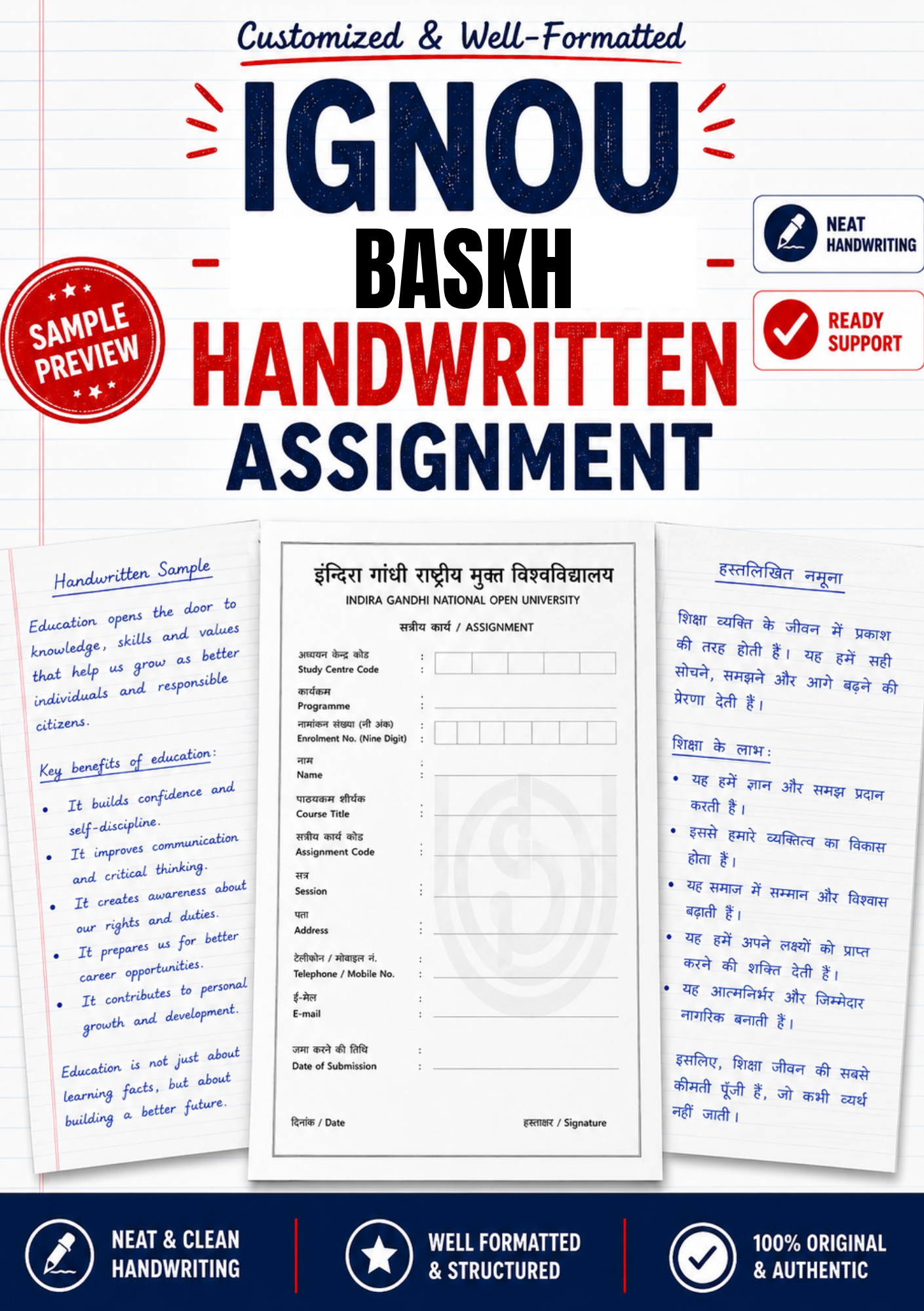
Four physical things reach your address against each code you name, and it is worth knowing what they are before the courier arrives rather than after. The first is the answer set itself: your BSKC, BSKE, BSKAE or BSKS paper written out in full by hand on A4 sheets, in Devanagari, in a hand matched to the sample page you sent. The second is the IGNOU-format front page, completed with your enrolment number, name, address, course title, assignment code and Study Centre name and code, laid out the way the Sanskrit booklets instruct on their first page. The third is a printed copy of the official question paper the set was written against, so that the code string you copy onto that cover sheet is read off IGNOU’s own document rather than reconstructed from a search result. The fourth is the courier packaging itself, which is already paid for.
What does not arrive matters as much on a Sanskrit order as what does. No soft copy or PDF is sold. Nothing is emailed, nothing is shared through a drive link, and there is no download area to log into afterwards. The reason is not a policy preference but the nature of the thing being bought: a BSKC submission is a physical object that a Study Centre clerk stamps and enters in a register, and a file on a phone cannot be stamped. A learner who wants reading material in electronic form is looking at a different product, and the section below on model-answer files says where that sits on this store.
Shri Chakradhar Publication prepares each set against the booklet actually in force for your enrolment, which on this degree is less obvious than it sounds. Four of the five live BASKH papers read for this page pair a July session with the January that follows it, while a fifth pairs January 2026 with July 2026, so two learners holding what they both call their current paper can be holding papers from different cycles. Naming your session in the first message is therefore not a formality, and the deadline section below explains what turns on it.
Adding Up ₹320: Four Inclusions and Two Exclusions
The figure is flat and it is per course code, not per semester, not per year and not per page. A BSKC paper that runs to thirty sheets because the course is Vedic literature costs the same as a four-credit BSKS paper that runs to twelve. Inside the figure sit four things: the writing itself, the free IGNOU-format cover sheet, the printed question paper, and courier to your address anywhere in India. There is no packing fee, no fuel surcharge, no separate charge for a Hindi or Devanagari paper, and no handling charge for an older cycle.
Two things sit outside it, and both are stated plainly rather than buried. The first is time: delivery depends on your pin code and is confirmed for your order before you pay. No figure is promised on this page, and any page that does promise one for a destination it has not been told is guessing. The second is the outcome. No claim is made about the marks any assignment will receive, about how an evaluator will assess it, or about whether it will be accepted. Assignment evaluation is entirely a matter for IGNOU.
Scale works the way you would expect and no better. There is no minimum order: one subject or fourteen, same rate. A learner clearing a single stranded BSKC 107 from a dropped semester pays ₹320. A learner ordering the whole fourteen-paper BSKC core pays fourteen times ₹320, with no bulk reduction offered, because cutting a flat per-paper rate for volume would simply mean the single-paper learner had been overcharged all along.
Two BSKC Products, One of Which Can Be Handed In
These two words get used interchangeably in Sanskrit learner groups and they describe two different objects. A solved assignment is a soft-copy reference file of model answers for one course code and one session, bought as a PDF, read on a screen or printed for study, and used as raw material you write from. A handwritten assignment is that content actually written out by hand on A4 sheets and delivered as a hard copy, which is the form a Study Centre receives. The first is a study aid. The second is the submission.
| Point of difference | BASKH solved assignment | BASKH handwritten assignment |
|---|---|---|
| Form it takes | Soft-copy PDF of model answers for one BSKC or BSKE code | Hand-written A4 sheets in Devanagari, posted to you |
| What you do with it | Read it, and write your own answers from it | Check it, sign the declaration on the cover, hand it in |
| Who it suits | A learner who intends to write the paper personally and wants reference material | A learner who cannot find the writing hours for a long Sanskrit paper |
| Delivery | Downloaded | Couriered, with the courier already inside the rate |
| Where it lives on this store | The BASKH solved-assignment category | This page |
Scroll the table sideways on a narrow screen to see all three columns.
IGNOU’s own instruction on the paper settles the point without ambiguity. The BSKC-114 booklet for 2026 directs the learner to write on answer booklets, to enter the enrolment number, name, address and date at the top right of the first page and the course title, assignment code and Study Centre name and code on the left, to write in a clear and legible script, and to underline the points being emphasised. Those are instructions to a person holding a pen. A downloaded file is a reference to write from, and it is not a submission; printing one and carrying it to the counter is not what the booklet describes.
If reference material is what you actually want, it is better bought as reference material. The store keeps a worked set of model answers for this degree in its Sanskrit Honours solved-answer files, code by code, which is where that query belongs and where it is answered properly. Some learners buy both for the same code, reading the file and ordering the written set for the paper they have no hours left for. That is a reasonable thing to do, and it is a different decision from mistaking one for the other.
Start with the codes, not with the semester. Electives, re-registration gaps and carried-over papers mean two BASKH learners in the same year rarely hold the same code list. Read yours off the admission record and send those.
₹320 per subject, hard copy, courier included. No minimum.
BSKC 101 to 114, and Why the Prospectus Prints Them in Devanagari
The core of this degree is fourteen papers at six credits each, which is 84 of the 148 credits, and the prospectus is explicit that this single block is more than half the programme. What it is not explicit about is the codes themselves. In the Common Prospectus July 2026 the BASKH entry sits at section 7.10 and is printed entirely in Hindi, with its explanatory prose in a legacy Devanagari font and its course codes written out in Devanagari syllables rather than roman letters, so that the first core paper appears as a Devanagari rendering of BSKC 101 and not as the string BSKC 101. The practical effect is that a learner searching the prospectus PDF for their own code finds nothing. The strings BSKC 109 and BSKC 110 do not occur in roman anywhere in the Common Prospectus July 2026, in any section, yet the BSKC-109 booklet is live on ignou.ac.in for the 2026-27 cycle. The titles below are decoded from that Devanagari and cross-checked against the live booklets and against the roman tables that other Sanskrit programmes print for shared codes.
| Semester | Code | Title as printed | English sense | Credits |
|---|---|---|---|---|
| I | BSKC 101 | लौकिक संस्कृत पद्य साहित्य | Classical Sanskrit verse literature | 6 |
| I | BSKC 102 | संस्कृत साहित्य का आलोचनात्मक विश्लेषण | Critical analysis of Sanskrit literature | 6 |
| II | BSKC 103 | लौकिक संस्कृत गद्य साहित्य | Classical Sanskrit prose literature | 6 |
| II | BSKC 104 | गीता में आत्मप्रबन्धन | Self-management in the Gita | 6 |
| III | BSKC 105 | लौकिक संस्कृत साहित्य (नाटक) | Classical Sanskrit literature, drama | 6 |
| III | BSKC 106 | काव्य शास्त्र और साहित्यिक आलोचना | Poetics and literary criticism | 6 |
| III | BSKC 107 | भारतीय सामाजिक संस्थान और राज्य व्यवस्था | Indian social institutions and polity | 6 |
| IV | BSKC 108 | भारतीय पुरालेख, शिलालेख और काल | Indian palaeography, epigraphy and chronology | 6 |
| IV | BSKC 109 | आधुनिक संस्कृत साहित्य | Modern Sanskrit literature | 6 |
| IV | BSKC 110 | संस्कृत साहित्य और विश्व साहित्य | Sanskrit literature and world literature | 6 |
| V | BSKC 111 | वैदिक साहित्य | Vedic literature | 6 |
| V | BSKC 112 | संस्कृत व्याकरण | Sanskrit grammar | 6 |
| VI | BSKC 113 | सृष्टि मीमांसा और ज्ञान मीमांसा | Cosmology and epistemology | 6 |
| VI | BSKC 114 | संस्कृत निबन्ध और सम्प्रेषण | Sanskrit essay writing and communication | 6 |
Scroll the table sideways on a narrow screen to reach the credits column.
Three of these codes are shared with other Sanskrit degrees, and that is where most of the ordering confusion on this prefix comes from. BSKC 101 to 106, 111 and 112 also form the major block of BAFSK, the four-year Sanskrit degree, where the prospectus prints them in roman. BSKC 107, 111, 113 and 114 are borrowed into BAASK, the Applied Sanskrit degree, alongside a separate BSKC 131, 132 and 133 band that BASKH never uses. If your record shows a BSKC number in the 130s you are on the wrong page and the Applied Sanskrit written-set listing is the right one; if it shows ten papers rather than fourteen, the four-year Sanskrit major listing is.
Four BSKE Electives for Four Slots, Plus the AECC, SEC and Generic Rows
The remaining 64 credits come from four categories, and only one of them involves a genuine choice. The discipline-specific electives are four papers at six credits each, two studied in the fifth semester and two in the sixth, which is 24 credits. The prospectus offers exactly four and requires exactly four, so the word elective describes the category rather than a decision you make. The ability-enhancement block is two papers at four credits, one in each of the first two semesters, totalling 8 credits. The skill-enhancement block is two papers at four credits, one each in the third and fourth semesters, also 8 credits, and here the prospectus does mark a choice. The generic electives are four papers at six credits across the first four semesters, 24 credits, one per semester from a pool.
| Category | Semester | Codes offered | Title as printed | Credits each |
|---|---|---|---|---|
| Discipline elective | V | BSKE 141 | आयुर्वेद के मूल आधार | 6 |
| Discipline elective | V | BSKE 142 | रंगमंच और नाट्यकला | 6 |
| Discipline elective | VI | BSKE 143 | संस्कृत परम्परा में दर्शन, धर्म और संस्कृति | 6 |
| Discipline elective | VI | BSKE 144 | साहित्यिक आलोचना | 6 |
| Ability enhancement | I | BEVAE 181 | पर्यावरण अध्ययन | 4 |
| Ability enhancement | II | BSKAE 181 | भारतीय ज्ञान परंपरा / Indian Knowledge System | 4 |
| Ability enhancement | II | BSKAE 182 | संस्कृत साहित्य | 4 |
| Skill enhancement, choose one | III | BSKS 186 or BPCS 187 | अभिनय और पटकथा लेखन / मानव संसाधन प्रबंधन | 4 |
| Skill enhancement, choose one | IV | BSKS 185 or BPCS 188 | संस्कृत छन्द और संगीत / सामाजिक मनोविज्ञान का अनुप्रयोग | 4 |
| Generic elective, choose one | I | BABG 171, BPAG 171, BPCG 171, BSOG 171, BPYG 171, ONR 03 | Pooled across disciplines | 6 |
| Generic elective, choose one | II | BPAG 172, BGDG 172, BPCG 172, BPYG 172 | Pooled across disciplines | 6 |
| Generic elective, choose one | III | BPAG 173, BPCG 173, BSOG 173 | Pooled across disciplines | 6 |
| Generic elective, choose one | IV | BPAG 174, BPCG 174, BPCG 176 | Pooled across disciplines | 6 |
Scroll the table sideways on a narrow screen to reach the credits column.
The arithmetic closes exactly, which is the test that the extraction above is sound rather than interleaved with a neighbouring programme. Fourteen core papers at six credits is 84. Four discipline electives at six is 24. Two ability-enhancement papers at four is 8. Two skill-enhancement papers at four is 8. Four generic electives at six is 24. The total is 148, which is the figure the prospectus itself prints in the footer row of its own semester grid, and the per-semester loads of 22, 22, 28, 28, 24 and 24 add to the same 148.
One row in that table carries a problem rather than a choice, and it is set out in the findings below: the second-semester ability-enhancement cell lists two codes where the arithmetic only permits one, and unlike the skill and generic tables it carries no instruction to pick one.
Twenty-Four Findings From Reading the BASKH Record Against Itself
These came out of reading the Common Prospectus July 2026 against five live booklets on ignou.ac.in and against this store’s own listings. None of them is a reason to panic, and several of them explain why two learners get different answers from the same search. The last four are this publisher’s own errors and are listed for the same reason as the rest.
Where the BASKH paperwork disagrees with itself, item by item.
1. Two booklets of the same programme and the same school print different January 2026 cut-offs. BSKC-109 prints 30 September 2026. BSKC-114 prints 31 October 2026. Both print 31 March 2027 for the July 2026 session.
2. Three assignment-code formats are live at once on this one degree. BSKC-114 prints BSKC-114/2026, a single year with no TMA token. BSKC-109 prints BSKC-109/2026-27, a two-year span, also with no TMA token. BSKS-185 prints both BSKS-185/2025-26 and BSKS-185/TMA/2025-26 on the same paper.
3. The programme code on the cover is not stable. BSKC-109 and BSKC-114 print (BASKH). BSKS-185 and BSKG-173 print (BSKH), one letter short.
4. BSKE-150 संस्कृत भाषा विज्ञान is listed in the prospectus as a major course of BAFSK, the four-year Sanskrit degree, yet its live booklet cover is issued under (BASKH).
5. Three different BSKC numbers carry the title संस्कृत व्याकरण across IGNOU’s own documents. The prospectus gives it to BSKC 112 in the BASKH table, to BSKC-114 in the BAASK table, and the live BSKC-134 booklet gives it to BSKC 134 under the BA General Sanskrit route.
6. The live BSKC-114 booklet titles that code संस्कृत निबन्ध और सम्प्रेषण, contradicting the BAASK table in the same prospectus that titles BSKC-114 संस्कृत व्याकरण.
7. BSKC 105 is titled लौकिक संस्कृत साहित्य (नाटक) in the BASKH section and लौकिक संस्कृत साहित्य in the BAFSK section of the same document.
8. BSKC 106 is printed as काव्य शास्त्र और साहित्यिक आलोचना in one section and काव्यशास्त्र साहित्यिक आलोचना in another.
9. BSKC 104 appears as गीता में आत्मप्रबन्धन in the BASKH tables and as गीता में आत्म प्रबंधन in the BAFSK table.
10. The strings BSKC 109 and BSKC 110 do not appear in roman letters anywhere in the Common Prospectus July 2026, although both codes are live and BSKC-109-2026.pdf is downloadable from ignou.ac.in.
11. The second-semester ability-enhancement table lists BSKAE 181 and BSKAE 182 together, with no instruction to choose one, while the skill-enhancement and generic-elective tables both carry that instruction explicitly. The 148-credit total only closes if exactly one of the two is taken.
12. BSKAE 181 भारतीय ज्ञान परंपरा is the only course in the whole BASKH section whose title is printed with an English gloss beside the Hindi. Every other title appears in Hindi alone.
13. The BASKH section states that generic electives are offered to learners of subjects other than BA Sanskrit (Honours), and then prints a Sanskrit generic-elective table of BSKG 171, BSKG 172 and BSKG 173 inside that same section.
14. None of those three BSKG codes appears in any of the four generic-elective cells of the BASKH semester grid, so the table and the grid do not agree about whether a Sanskrit Honours learner may take them.
15. The BSKG-173 booklet, a generic elective, is nevertheless issued under the Sanskrit Honours programme code on its cover, which contradicts the prospectus rule in finding 13.
16. BSKS-185 carries a blanket note that all questions in the assignment are compulsory, and then instructs the learner to answer any four of five long questions and any two of three short ones.
17. BSKE-150 carries the same contradiction: all questions compulsory, then any four of six in each of two sections.
18. The number of questions is not fixed across the degree. BSKC-109 prints seven and asks for any five at twenty marks. BSKC-114 prints eight and asks for any five at twenty marks. BSKS-185 prints eight across two sections for six answers. BSKE-150 prints twelve across two sections for eight answers.
19. BSKE-150 names its own cycle three different ways in one PDF: July 2025 and January 2026 on the cover, 2024-25 in the page-two heading, and 2025-26 in the course-code line.
20. Two character encodings are in circulation for one programme. BSKC-109 and BSKC-114 are set in Unicode Devanagari. BSKS-185 and BSKE-150 are set in a legacy Devanagari font, which is why copying text out of them produces roman nonsense.
21. Session pairing is not consistent. BSKC-109 and BSKC-114 pair January 2026 with July 2026. BSKS-185 and BSKE-150 pair July 2025 with January 2026. BSKG-173 pairs July 2026 with January 2027.
22. This store’s own Applied Sanskrit and four-year Sanskrit listings both present 30 September and 31 March as the Sanskrit pair. Finding 1 shows that BSKC-114 contradicts that, and those two pages are being corrected.
23. This store sells a BSKG 176 guess paper and a BSKG 176 solved file tagged to BASKH. The string BSKG 176 does not occur anywhere in the Common Prospectus July 2026. Until a live booklet is produced for it, treat it as unverified.
24. This store’s BSKC 113 guess paper for BASKH currently sits on a URL containing the programme code of an unrelated retailing degree. The listing is correct, the address is not, and it is queued for repair.
Findings of this kind are the reason the sourcing section at the foot of this page keeps three record sets apart rather than blending them into one confident-looking table. Where IGNOU’s own documents disagree, the document physically in your hand governs your submission, and no third party can overrule it.
One January Date on Four Papers, a Different One on BSKC-114
Submission dates on this degree are printed on the paper, not set by a rule you can look up once. Five live BASKH-labelled booklets were read for this page and four of them resolve to the same pattern: a July session is due the following 31 March, and a January session is due the following 30 September. BSKC-109 prints 30 September 2026 for January 2026 and 31 March 2027 for July 2026. BSKS-185 prints 31 March 2026 for July 2025 and 30 September 2026 for January 2026. BSKE-150 prints the same pair. BSKG-173, issued a cycle later, prints 31 March 2027 for July 2026 and 30 September 2027 for January 2027.
BSKC-114 is the exception and it is not a small one. It prints 31 October 2026 for the January 2026 session, a full month later than the four papers around it, while agreeing on 31 March 2027 for July 2026. A learner holding both BSKC-109 and BSKC-114 for January 2026 is holding two different deadlines for the same session of the same programme. The safe reading is the earlier of the two, because meeting 30 September also satisfies 31 October, and because the BSKC-114 booklet itself states that submitting the assignment before sitting the examination is compulsory and that failing to do so means no permission to sit.
| Booklet | Sessions it covers | First date printed | Second date printed |
|---|---|---|---|
| BSKC-109 | January 2026 and July 2026 | 30 September 2026 for January 2026 | 31 March 2027 for July 2026 |
| BSKC-114 | January 2026 and July 2026 | 31 October 2026 for January 2026 | 31 March 2027 for July 2026 |
| BSKS-185 | July 2025 and January 2026 | 31 March 2026 for July 2025 | 30 September 2026 for January 2026 |
| BSKE-150 | July 2025 and January 2026 | 31 March 2026 for July 2025 | 30 September 2026 for January 2026 |
| BSKG-173 | July 2026 and January 2027 | 31 March 2027 for July 2026 | 30 September 2027 for January 2027 |
Scroll the table sideways on a narrow screen to see both date columns.
Two further points follow from this. A date circulated by a news aggregator or a coaching page for IGNOU as a whole, commonly 30 April, is not your date; it belongs to other schools and other programmes, and the School of Humanities Sanskrit papers do not print it. And a BASKH paper expires. Each cycle IGNOU withdraws the previous booklet and issues a fresh one with new questions, so an answer set written against a withdrawn paper is the wrong content however neat the handwriting. Naming the session in your first message is what keeps the set matched to the paper your Study Centre expects.
Copying the Code Line Exactly, Whether or Not It Says TMA
The assignment code is the short string IGNOU prints near the top of the inner page, and it is the line that goes into the assignment-code box on your front page. On this degree there is no single template for it, which is why copying rather than reconstructing matters. BSKC-114 for 2026 prints पाठ्यक्रम कोड : BSKC-114/2026. BSKC-109 for the same session prints पाठ्यक्रम कोड : BSKC-109/2026-27. BSKS-185 prints a course-code line reading BSKS-185/2025-26 and, separately, an assignment-code line reading BSKS-185/TMA/2025-26. The BAG-route BSKC-134 booklet goes further and prefixes the programme, giving BAG/BSKC-134/2026-27.
Reading one of those strings is straightforward once you know it has no fixed number of parts. The first element is always the course code. The next element is the cycle, printed either as one year or as a two-year span depending on which booklet you are holding. The letters TMA, where they appear at all, simply mark the paper as a Tutor Marked Assignment, which every one of these is whether or not the token is printed. A learner who writes BSKC-114/TMA/2026 onto a cover sheet because another programme’s paper looked like that has written a string IGNOU did not issue.
The rule that follows is short: copy the line as printed, including the slashes, the hyphen style and the year span, and do not tidy it. The printed copy of the question paper that travels in the packet exists partly so that this line can be transcribed from the source. On codes the booklet prints in roman while the rest of the page is in Devanagari, which is the case on all five papers read here, the code itself stays in roman.
The Sample Photograph Comes Before Any Sheet Is Written
Send a photo of a page you have written yourself and the handwritten set is matched to your handwriting at no extra charge. On a Devanagari paper that step carries more weight than it does on an English one. A roman hand varies mostly in slant and letter width; a Devanagari hand varies in the length and weight of the शिरोरेखा, in how far the matras ride above and below the line, in whether conjuncts are drawn tight or spread, and in the writer’s habitual shortcuts on letters such as ञ and ङ. Those are the features a Study Centre clerk’s eye picks up without consciously looking for them, and they are the features the writing team works from.
The sequence is deliberately front-loaded. The sample photo is sent and the match is agreed before payment, so the risk sits with the publisher rather than with you. If the hand that comes back does not look like yours, that is established at the point where nothing has been spent and nothing has been written.
Lighting, angle and how much to write on it
Half a page of ordinary Devanagari is enough, written at your normal speed rather than carefully, because a carefully drawn sample produces a set that does not resemble your everyday hand. Use the pen you actually use. Photograph the page flat in daylight, straight down rather than at an angle, with the whole sheet in frame and no shadow across the writing. A page of Sanskrit verse copied out of your own study material works well, because it exercises the conjuncts and the matras that plain Hindi prose does not.
A Hindi-Medium Degree, Sanskrit Answers, and Papers From Closed Cycles
The Common Prospectus July 2026 lists BASKH with a single medium of instruction, Hindi, which separates it from the Honours degrees in Sociology, History and Anthropology that are offered in English and Hindi, and from English Honours, which is offered in English alone. In practice a Sanskrit answer script is bilingual on the page: the explanation is written in Hindi, the quoted verses, sutras and grammatical examples are in Sanskrit, and the course codes themselves stay in roman. The service covers all mediums IGNOU issues the TMA paper in, at the same price, so if a paper reaches you in a form other than the one described here, that is written too and the rate does not move.
Backlogs are routine on a three-year degree that people take up to six years to finish, and they are priced identically. Any session is accepted, current cycle or older, including backlog courses, at the same ₹320 per subject. A BSKC 107 stranded from a semester you dropped in 2024, a BSKE 142 you re-registered for twice, a BSKAE 182 that never got submitted: each is one subject at ₹320, and what determines the content is not how old the code is but which booklet was in force for the session you are submitting against. Send the session along with the code and the right paper is used.
One caution belongs here rather than in the findings box. Because the prospectus and the live portal do not fully agree on which Sanskrit codes belong to which Sanskrit degree, a code that appears on your record and not in the table above is not automatically an error. BSKE 150 is the clearest case: the prospectus assigns it to the four-year degree, IGNOU’s own booklet issues it under the Sanskrit Honours code, and it is written here either way. What cannot be written is a code for which no live booklet exists, because there would be no questions to answer.
What Goes in the Opening Message, Line by Line
Five lines settle an order, and nothing beyond them is needed at the start.
- The course codes. Read them off the admission record or the re-registration slip rather than from a semester chart, because electives and carried-over papers make the two diverge. BSKC 109, BSKE 142, BSKAE 181 and so on.
- The session you are submitting against. January or July, with the year. This decides which booklet the set is written from, and on this degree it also decides which of the two January dates in the findings box applies to you.
- The medium your paper was issued in. Almost always Hindi on BASKH, but say so rather than leaving it to be assumed.
- A photograph of a page in your own handwriting. The sample described above.
- The delivery address with the pin code. The pin code is what makes a delivery estimate possible for your order rather than a general claim on a web page.
What is not needed at this stage: your password or portal login, your fee receipts, your identity documents, or a scan of your study material. A quote at ₹320 a paper comes back against the codes, the sample is agreed, and only then does anything get written.
A stranded paper costs the same as a full semester’s worth. One pending BSKC code from a closed cycle is ordered on exactly the terms a fourteen-paper core order is.
₹320 per subject. Hard copy, Devanagari, question paper and IGNOU-format cover sheet included.
Checking the Set, Signing It, and Keeping the Counter Slip
Open the packet and read before you sign anything. Check that the course code on the cover sheet matches the code on your record, that the session printed matches the session you are submitting for, and that the assignment-code line has been transcribed exactly as the enclosed question paper prints it. Count the answers against the question paper and confirm that the number written matches what the paper asked for, which on this degree is five of seven on BSKC-109, five of eight on BSKC-114, and six across two sections on BSKS-185.
Then read the content itself. You sign the declaration on the assignment cover page, so you should read and review the content before submitting it, and satisfy yourself that it represents your own understanding of the course. On a Sanskrit paper that review is worth doing properly: the verses and sutras quoted are the part an evaluator looks at first, and they are the part you will be asked about if the evaluator queries anything.
Submission is in person or by the route your Regional Centre specifies, at the Study Centre allotted to you. Ask for a receipt or get the counter register entry acknowledged, and photograph both the signed cover sheet and the receipt before you hand the set over. Assignment marks appear on the IGNOU status page and later on the grade card, and they do so on the university’s own timetable, which no publisher can speed up or predict. Assignments carry 30 per cent of the final course result and the term-end examination carries the remaining 70 per cent, so the receipt in your phone is worth keeping until that 30 per cent shows up against the code.
The Other BASKH Shelves, and the Two Sanskrit Products Next Door
A written set answers one need and most learners have three or four. The store’s Sanskrit Honours course books and study guides cover the BSKC blocks themselves for learners reading the material rather than outsourcing the writing, and the solved guess papers built for the Sanskrit term-end examination address the 70 per cent that the assignment does not touch. Learners who want written sets for a programme other than this one can start from the full index of hand-written assignment listings across every IGNOU programme.
Two neighbouring Sanskrit degrees share this code prefix and are easy to land on by mistake. Applied Sanskrit is a four-year, 120-credit route with its own BSKC 131 to 133 band, and its Applied Sanskrit course-book shelf is separate from the Honours one. The four-year Sanskrit major uses ten of these same BSKC codes rather than fourteen. Checking which of the three your admission record actually names, before ordering, saves a wasted paper.
At the other end, learners finishing BASKH and continuing to the master’s degree will find the MA Sanskrit book and guide listings and the MSK model-answer files code by code arranged the same way. If you would rather write the paper yourself and just need the format settled, the sister site’s step-by-step guide to formatting and submitting an IGNOU handwritten assignment walks through the front page, the paper and the submission without selling anything. The current booklets are always free to download from IGNOU’s own assignment download service.
Sixteen Questions That Arrive Before a BSKC Order Is Placed
My BSKC-109 paper says 30 September and my BSKC-114 paper says 31 October. Which date is mine?
Both are real and both are printed by IGNOU for the January 2026 session. Four of the five live BASKH booklets read for this page give 30 September 2026 for January 2026, and BSKC-114 alone gives 31 October 2026. Working to the earlier date satisfies both, and your Regional Centre is the only authority that can confirm which applies to your enrolment. The two papers agree on 31 March 2027 for the July 2026 session.
The prospectus has no BSKC 109 in English letters anywhere. Does the code exist?
It exists. The BASKH entry in the Common Prospectus July 2026 prints its course codes in Devanagari syllables rather than roman letters, which is why a text search for BSKC 109 in that document returns nothing. The live booklet BSKC-109-2026.pdf is published on ignou.ac.in for the 2026-27 cycle and titles the course आधुनिक संस्कृत साहित्य. The same is true of BSKC 110.
BSKC-114 is Sanskrit grammar in one IGNOU table and Sanskrit essay writing in another. Which one gets written?
Whichever the live booklet for your session says. The Applied Sanskrit table in the prospectus titles BSKC-114 संस्कृत व्याकरण, but the booklet issued under the Sanskrit Honours code for 2026 titles it संस्कृत निबन्ध और सम्प्रेषण and asks essay and communication questions. On BASKH, grammar is BSKC 112. The question paper that travels in the packet removes the ambiguity entirely.
My booklet cover says BSKH, not BASKH. Is it the wrong paper?
It is almost certainly your paper. Two of the five live booklets read for this page, BSKS-185 and BSKG-173, print the programme code one letter short on the cover while naming the same Sanskrit Honours degree. The course code on the paper is what matters for matching it to your record, and BSKS 185 and BSKG 173 both belong to structures a Sanskrit Honours learner can be enrolled against.
BSKE-150 ka cover BASKH likha hai lekin prospectus mein ye BAFSK ka course hai. Order kar sakte hain?
Haan, likha jaata hai. The prospectus assigns BSKE 150 संस्कृत भाषा विज्ञान to the four-year Sanskrit major, while IGNOU’s own live booklet for it is issued under the Sanskrit Honours programme code. When a code is on your admission record and a live booklet exists for it, that booklet is what the set is written against, whatever the prospectus filing says. Rate is unchanged.
Can a downloaded BSKC solved PDF be submitted at the study centre as it is?
No. The BSKC-114 booklet instructs the learner to write the answers on answer booklets, to fill the enrolment number, name, address, course title, assignment code and Study Centre details on the first page by hand, and to write in a clear and legible script. A printed-out file is not what that describes. A solved file is reference material you write from; the written set is the thing that gets stamped.
What is the real difference between buying the reference file and buying the written set for the same BSKC code?
The reference file is a soft-copy PDF of model answers that you read and then write from in your own hand and your own words. The written set is those answers already on A4 in Devanagari, matched to your handwriting, with the IGNOU-format cover sheet and the question paper, couriered to you. The first saves you research time. The second saves you the writing hours. Some learners buy both for the same code.
Is a typed Devanagari answer sheet accepted if my handwriting is poor?
IGNOU’s instruction on the BSKC papers is to write legibly on answer booklets, which describes handwriting. Study Centre practice is set by your Regional Centre and only it can tell you what it will take. Poor handwriting is not a reason to type: the sample-photo step exists precisely so that an ordinary, imperfect hand can be reproduced rather than replaced with something that looks nothing like you.
Answers Sanskrit mein likhe jaate hain ya Hindi mein?
Dono, jaise paper maangta hai. The medium of instruction recorded for BASKH in the Common Prospectus July 2026 is Hindi, so the explanation and argument are written in Hindi. The verses, sutras, grammatical forms and quoted passages are written in Sanskrit because that is what the question asks for. The course codes themselves stay in roman, exactly as the booklet prints them.
My BSKAE table lists 181 and 182 both. Do both get written?
Only the one on your record. The prospectus lists BSKAE 181 भारतीय ज्ञान परंपरा and BSKAE 182 संस्कृत साहित्य together in the second-semester ability-enhancement cell without printing the choose-one instruction it prints over the skill and generic tables. The credit arithmetic settles it: the programme totals 148 only if one four-credit ability-enhancement paper is taken in that semester. If both appear on your portal list, ask your Regional Centre before ordering two.
BSKG 176 is on my list but I cannot find it in the prospectus. Will you write it?
Only against a live booklet. The string BSKG 176 does not occur anywhere in the Common Prospectus July 2026, and the Sanskrit generic-elective table there lists 171, 172 and 173 only. This store does carry BSKG 176 material tagged to this programme and that tagging is under review. Send the code with your session and the portal is checked for a current paper before anything is quoted.
One booklet says all questions are compulsory and then says answer any four. How many answers are written?
The number the section instruction asks for. BSKS-185 and BSKE-150 both carry a general note that all questions are compulsory and then set out per-section selection rules. The selection rules are the operative ones, because the marks arithmetic printed beside them only reaches 100 on that reading. On BSKS-185 that is four long answers at twenty marks and two short at ten.
Can two BSKE papers be ordered without the two core papers of the same semester?
Yes. Orders are built from codes, not from semesters, and there is no minimum order: one subject or fourteen, same rate. Fifth semester on this degree is BSKC 111, BSKC 112, BSKE 141 and BSKE 142, and any subset of those four can be ordered on its own.
I still owe BSKC 107 from an older cycle. Does an old Sanskrit paper cost more?
No. Any session is accepted, current cycle or older, including backlog courses, at the same ₹320 per subject. What the age of the paper changes is which booklet the set is written from, not the price, so send the session year along with the code.
Why does the assignment code on BSKC-114 have no TMA in it when BSKS-185 does?
Because IGNOU has not standardised the string on this degree. BSKC-114 prints BSKC-114/2026, BSKC-109 prints BSKC-109/2026-27, and BSKS-185 prints both BSKS-185/2025-26 and BSKS-185/TMA/2025-26 on the same paper. All of them are Tutor Marked Assignments regardless. Copy the line your own booklet prints, exactly as printed, and do not add or remove the TMA token to make it match another paper.
Does this page say anything about the marks a BASKH set will be given?
Deliberately not. No claim is made about the marks any assignment will receive, about how an evaluator will assess it, or about whether it will be accepted. Assignment evaluation is entirely a matter for IGNOU. What is promised is the writing, the cover sheet, the question paper and the courier at a fixed rate, and nothing beyond those.
One Prospectus, Five Booklets, and the Publisher’s Own Terms
Source one, the Common Prospectus July 2026. Programme structure, credits, categories, medium of instruction and course titles come from section 7.10 and from the programme table row listing BASKH under the School of Humanities with Hindi as its medium, three years minimum and six years maximum. The course titles were decoded from the legacy Devanagari encoding that section uses and then cross-checked against roman renderings of the same codes in the four-year Sanskrit and Applied Sanskrit sections of the same document, and against the live booklets. Where those sources disagree the disagreement is printed in the findings box above rather than resolved silently. The credit arithmetic was summed independently and reaches 148 both by category and by semester.
Source two, five live booklets on ignou.ac.in. BSKC-114-2026, BSKC-109-2026, BSKS-185 for 2025-26, BSKE-150 for July 2025 and January 2026, and BSKG-173 for 2026-27. Submission dates, assignment-code formats, question counts, marks splits, cover applicability and writing instructions were read off these papers directly and are not carried across from any other programme. A sixth booklet, BSKC-134-2026, was read to settle the BA General Sanskrit overlap on the संस्कृत व्याकरण title.
Source three, this publisher’s own commercial terms. The ₹320 rate, what is inside it, the hard-copy-only format, the handwriting-matching step, backlog acceptance and the absence of a minimum order are Shri Chakradhar Publication’s own undertakings and are not IGNOU rules. They are stated here so that a reader can tell at a glance which claims on this page come from the university and which come from the publisher.
Important Notice
Shri Chakradhar Publication Pvt. Ltd. and shrichakradhar.com form an independent IGNOU study-support publisher. This is not the official website of Indira Gandhi National Open University, is not affiliated with, endorsed by or authorised by the university, and no page on this site should be treated as an official IGNOU communication.
Programme structures, course codes, submission dates and rules change, and only ignou.ac.in and your Regional Centre can confirm the current position for your enrolment.
You sign the declaration on the assignment cover page, so you should read and review the content before submitting it, and satisfy yourself that it represents your own understanding of the course.
No claim is made about the marks any assignment will receive, about how an evaluator will assess it, or about whether it will be accepted. Assignment evaluation is entirely a matter for IGNOU.
Name Your BSKC Numbers to Begin
Send the codes exactly as they appear on your admission record, with the session and your medium, and a per-paper quote comes back along with the sample-photo step. Nothing is written until the handwriting match is agreed.
₹320 per subject, hard copy only, courier included, no minimum order, any session including backlogs. Delivery depends on your pin code and is confirmed for your order before you pay. No figure is promised on this page.
Get a quote for your Sanskrit Honours papers or ask something first on WhatsApp at +91 93546 37830.