

Description
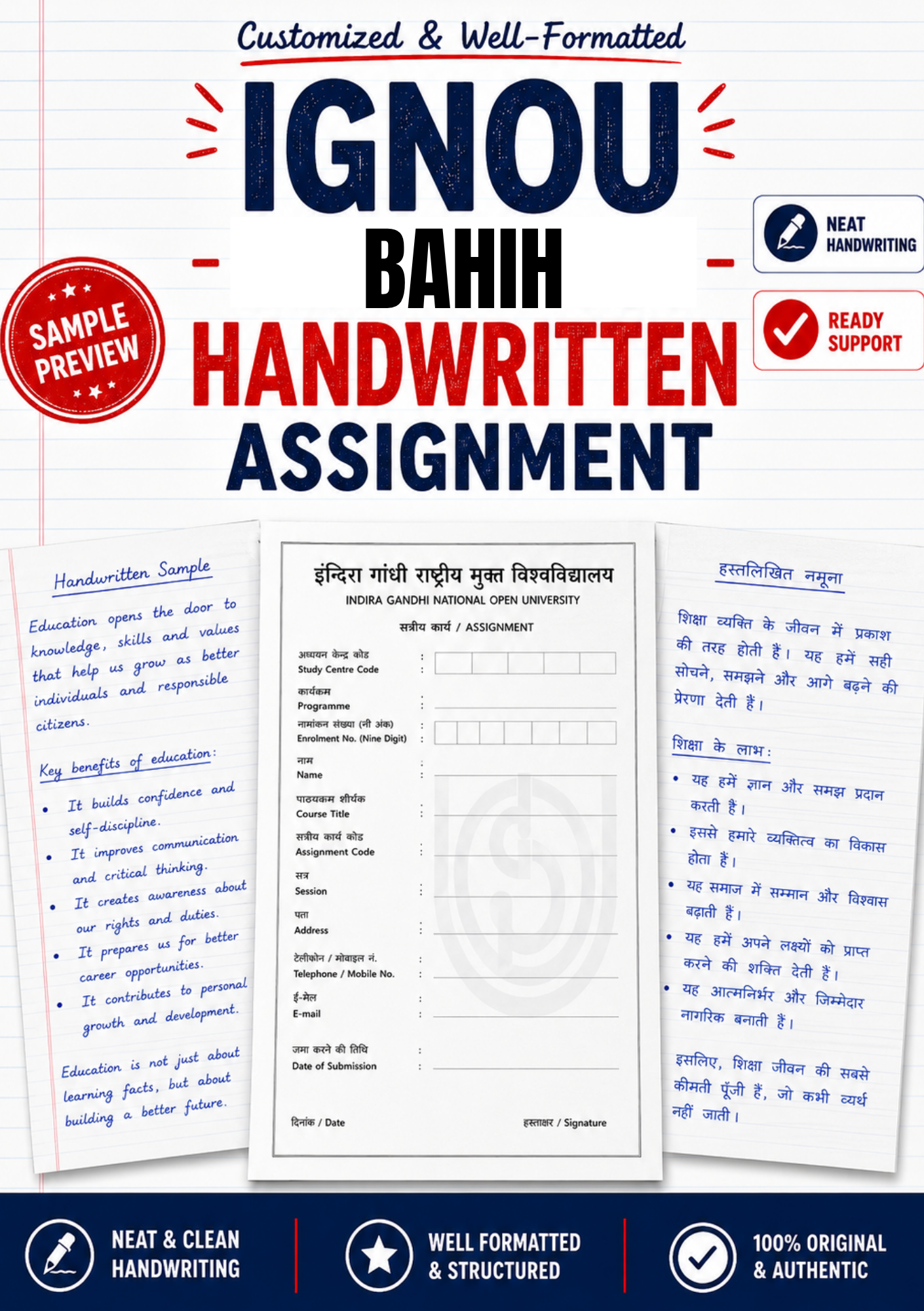
In short. Shri Chakradhar Publication prepares handwritten Tutor Marked Assignment answer sets for IGNOU’s Bachelor of Arts (Honours) History programme, code BAHIH, run by the School of Social Sciences across six semesters and 148 credits. The set is written out by hand against the exact BHIC or BHIE question paper you hold, including all fourteen six-credit BHIC core papers from BHIC-101 to BHIC-114, the BHIE discipline-specific electives in the fifth and sixth semesters, and the ability enhancement, skill enhancement and generic elective papers a History Honours learner picks up from the common pool. The rate is ₹320 per subject, hard copy only, with courier included in that price and no separate shipping charge. Each set arrives with a free IGNOU-format front page and a copy of the official question paper it was written against. The 2026-27 BHIC papers print 31st March 2027 for July 2026 session learners and 30th September 2027 for January 2027 session learners, which is a different pair of dates from the ones other disciplines in the same school print, and the cover of each BHIC paper names both BAHIH and BAFHI, so the Honours learner and the four-year Major learner are reading the same booklet. Any session is accepted, current cycle or older, including backlog courses, at the same ₹320 per subject.
Inside the Parcel That Reaches Your Address
A BAHIH order is a physical object, not a download link, and it is worth being precise about what is in the packet when the courier hands it over. For every subject you order, four things travel together.
The first is the answer set itself, written out by hand on loose sheets, question by question, in the order the booklet prints them. A 2026-27 BHIC paper runs to ten questions split across three assignment sections, so a single subject is a substantial physical bundle rather than a few pages. The second is an IGNOU-format front page, filled in and attached, carried free with every order. The third is a photocopy of the official question paper the set was written against, which matters more in History Honours than most learners expect, because the BHIC code set is stable while the questions under each code are replaced every cycle. The fourth is the packaging and the courier run itself, already inside the price you paid.
No soft copy or PDF is sold. That is a scope statement rather than a limitation being apologised for: the thing IGNOU asks a BAHIH learner to put into the hands of a Study Centre Coordinator is paper with handwriting on it, and that is the only thing this listing produces. If what you want is a file to read from while you write your own answers, the store sells that separately and the comparison further down this page explains exactly where the line falls.
Fourteen core papers, one rate. BAHIH carries more six-credit core papers than any ordinary three-year BA, and every one of them is priced the same.
₹320 per subject. Hard copy. Courier included. Free IGNOU-format front page. There is no minimum order: one subject or fourteen, same rate.
Where ₹320 Starts and Where It Stops
Pricing on this listing is per subject, not per semester and not per year, and that choice is deliberate for a programme built the way BAHIH is built. A History Honours learner in the third semester is sitting three core papers, one skill enhancement course and one generic elective at once, which is a five-course load; the same learner in the first semester is sitting four. Charging per semester would overcharge one of them and undercharge the other. Charging per subject lets you order the two BHIC papers you are behind on and leave the rest alone.
Inside the ₹320: the handwriting, the paper, the front page, the question-paper copy and the courier. Outside it: nothing that is then billed to you later. Delivery depends on your pin code and is confirmed for your order before you pay. No figure is promised on this page. That sentence is doing real work, because a courier run into a district headquarters in Bihar and a courier run inside Delhi are not the same journey, and a page that prints one number for both is printing a number that is wrong for one of them.
What is also outside the ₹320 is any statement about what happens after you submit, and the Important Notice at the foot of this page sets out that limit in full. The weight itself can be stated flatly. Assignments carry 30 per cent of the final course result and the term-end examination carries the remaining 70 per cent. For a BAHIH learner carrying fourteen core papers plus electives, that 30 per cent is being decided fourteen times over, and the BHIC-112 booklet prints the 30 per cent figure on its own cover.
Reference File or Submission Copy: Telling the Two Apart
These two things are sold a few clicks apart on this store and they are not substitutes, so it is worth defining both before comparing them.
A solved assignment is a soft-copy reference file of model answers for a course code and session. You open it, read it, and write from it. A handwritten assignment is the answers written out by hand on loose sheets and submitted in hard copy at the Study Centre. The first is study material. The second is the thing that crosses the Coordinator’s desk.
| Point of difference | Solved assignment | Handwritten assignment |
|---|---|---|
| Format | Soft copy, read on a phone or laptop | Loose sheets, written by hand, posted to you |
| What you do with it | Read it and write your own answers from it | Check it, sign the declaration, hand it in |
| Who it suits | A BAHIH learner with time to write fourteen papers out | A BAHIH learner short of writing time, or carrying backlog codes alongside the current semester |
| Handwriting | Not applicable | Matched to a sample page you send |
| Price on this store | Listed per code on the BAHIH solved-assignment shelf | ₹320 per subject, courier included |
Scroll the table sideways on a narrow screen.
IGNOU’s own instruction on the BHIC-112 booklet is the thing that settles which of the two can actually be submitted. The booklet tells the learner to submit the assignment to the Coordinator of the Study Centre, obtain a receipt and keep it, and notes that the Study Centre returns the evaluated assignment and sends the marks on to the Student Evaluation Division in New Delhi. It also notes that a Regional Centre may permit online submission and that you should check your own Regional Centre’s website. Nowhere in that instruction is a downloaded file a submission in itself. A solved assignment is a reference to write from; it is not a submission, and a PDF handed in as it stands is not what the booklet describes.
If a reference file is what you actually need, the honest move is to buy that and not this: the store keeps a per-code shelf of BAHIH solved assignments listed code by code, and it is a cheaper and better fit for a learner who intends to write the sheets personally.
All Fourteen BHIC Core Papers in the Honours Degree
The Common Prospectus for July 2026 lists fourteen core courses for BAHIH, every one of them six credits, and they account for 84 of the programme’s 148 credits. The table below reproduces the codes and the official titles exactly as the prospectus prints them, including the semester each sits in.
| Code | Official title | Credits | Semester |
|---|---|---|---|
| BHIC 101 | History of India –I | 6 | I |
| BHIC 102 | Social Formations and Cultural Patterns of the Ancient World | 6 | I |
| BHIC 103 | History of India –II | 6 | II |
| BHIC 104 | Social Formations and Cultural Patterns of the Medieval World | 6 | II |
| BHIC 105 | History of India –III (c. 750 – 1206) | 6 | III |
| BHIC 106 | Rise of the Modern West – I | 6 | III |
| BHIC 107 | History of India – IV (c. 1206 – 1550) | 6 | III |
| BHIC 108 | Rise of the Modern West – II | 6 | IV |
| BHIC 109 | History of India –V (c. 1550 – 1605) | 6 | IV |
| BHIC 110 | History of India –VI (c. 1750 – 1857) | 6 | IV |
| BHIC 111 | History of Modern Europe – I (c. 1780 – 1939) | 6 | V |
| BHIC 112 | History of India –VII (c. 1605 – 1750) | 6 | V |
| BHIC 113 | History of India –VIII (c. 1857 – 1950) | 6 | VI |
| BHIC 114 | History of Modern Europe –II (c. 1780 – 1939) | 6 | VI |
Scroll the table sideways on a narrow screen.
Two things in that table deserve a second look, because they trip up learners who assume the numbering follows the chronology.
The History of India sequence does not run forward across the semesters. BHIC-110, titled History of India VI, covers roughly 1750 to 1857 and sits in the fourth semester. BHIC-112, titled History of India VII, covers roughly 1605 to 1750 and sits in the fifth. A learner therefore studies the later period first and doubles back to the earlier one a semester later. Anyone matching a stack of question papers to a stack of blocks by eye, rather than by code, will mis-pair those two. When you send a code list, send the codes rather than the roman numerals.
The second point is a flat contradiction inside the prospectus itself, and it is covered in the conflict box further down.
On top of the 84 core credits, a BAHIH learner takes 24 credits of discipline-specific electives, 8 credits of ability enhancement compulsory courses, 8 credits of skill enhancement courses and 24 credits of generic electives. Those four figures and the core total add to exactly 148, which is the figure the prospectus states for the degree, and the per-semester loads of 22, 22, 28, 28, 24 and 24 add to the same number. The ability enhancement slots are BEVAE 181 in the first semester and either BEGAE 182 or BHDAE 182 in the second. The skill enhancement and generic elective slots are drawn from a shared pool that every BA Honours programme feeds from, which is why your own codes in those four columns may not match a classmate’s. Handwritten sets for those pooled codes are priced the same ₹320 per subject as a BHIC paper, and the store keeps separate shelves of generic elective books, ability enhancement compulsory titles and skill enhancement books if you would rather read the block before deciding.
The Five BHIE Elective Papers for Four Elective Slots
BAHIH has four discipline-specific elective slots worth 24 credits, two in the fifth semester and two in the sixth. The prospectus lists five BHIE codes against those four slots, and the choice is not spread evenly across the two semesters.
| Code | Official title | Credits | Offered in |
|---|---|---|---|
| BHIE 141 | History of China (C. 1840 – 1978) | 6 | Semester V, one of three |
| BHIE 143 | History of Environment | 6 | Semester V, one of three |
| BHIE 145 | Some aspects of European History: (C. 1789 – 1945) | 6 | Semester V, one of three |
| BHIE 142 | History of Modern East Asia: Japan (C. 1868 – 1945) | 6 | Semester VI, fixed |
| BHIE 144 | Traditions of History Writing in India | 6 | Semester VI, fixed |
Scroll the table sideways on a narrow screen.
The prospectus prints the words “Any two” above the fifth-semester group of BHIE 141, BHIE 143 and BHIE 145, and prints BHIE 142 and BHIE 144 in the sixth semester with no such instruction. Read literally, that means a History Honours learner exercises a real choice once, in the fifth semester, picking two codes from three, and takes whatever the sixth semester hands over. Among the School of Social Sciences honours programmes this is unusual in both directions: the Economics and Public Administration honours tables print four elective codes against four slots with no choice at all, while the Sociology honours table prints “Any two” above both semesters. BAHIH sits in between, with one free semester and one fixed one.
The practical effect on an order is simple. Two learners in the same BAHIH batch and the same fifth semester can be holding different question papers, because one took BHIE-141 and the other took BHIE-145. Send the codes off your admission record or your registration status page rather than naming the semester, and the set will be written against the paper you are actually sitting.
Four Places BAHIH Paperwork Contradicts Itself
These are not objections to the programme. They are places where two official documents, or one official document and the wider internet, say different things about BAHIH, and a learner who does not know about them can plan around the wrong one.
Read these before you pick a date or a code off a third-party page.
1. The School of Social Sciences does not run one submission-date regime. The 2026-27 BHIC-105 and BHIC-112 booklets both print 31st March 2027 for July 2026 session learners and 30th September 2027 for January 2027 session learners. The BSOE-142 booklet, same school and same 2026-27 session, prints 30th April 2027 and 31st October 2027. Both sets of dates are correct for their own discipline. A BAHIH learner who takes a sociology classmate’s dates as read is a month out in one direction on both cut-offs.
2. The prospectus prints the same date span for two different European history papers. BHIC-111, History of Modern Europe I, and BHIC-114, History of Modern Europe II, are both listed as c. 1780 to 1939 in the Common Prospectus course table. One of those spans is doing the work of two papers, and the prospectus does not say which. The blocks themselves, and the question paper for the code you hold, are the thing to go by.
3. The generic elective pool printed for BAHIH is not the pool printed for its sibling programmes. The second-semester generic elective list in the BAHIH structure table omits BPAG 172, which the Economics, Political Science and Sociology honours tables all carry in the same slot. BAHIH is the only one of the four missing it. Whether that is a genuine restriction or a printing omission is not something this page can settle; your Regional Centre and the registration portal can.
4. The prospectus states the elective arithmetic two ways in one paragraph. The Honours course-category description says there are four discipline-specific electives of six credits each, and then expresses the same thing in brackets as six courses multiplied by four credits. The total of 24 credits is correct either way, but the bracketed expression is inverted.
In-house, and ours to fix. The store’s own BAFHI handwritten listing advertises coverage of “BHIC-101 to BHIC-113” as a continuous run. The four-year History Major does not in fact take every code in that range, and BAHIH runs one code further, to BHIC-114. That BAFHI line is being corrected. The store’s handwritten category page also still prints a courier window in days; no such figure appears on this listing, and the category line is on the correction list.
31 March and 30 September: The Dates Your BHIC Paper Actually Prints
The two dates printed on the cover of a 2026-27 BHIC booklet are tied to your admission session, not to the calendar year you are sitting in. The July 2026 session learner is given 31st March 2027. The January 2027 session learner is given 30th September 2027. Both appear on the BHIC-105 and the BHIC-112 papers in those words.
Those dates are further out than most learners assume, and that is the trap rather than a relief. Aggregator pages circulate a single headline last date for all of IGNOU, and at the time this listing was written the widely repeated figure was 15th June 2026, tied to the June term-end examination cycle. That figure matches neither of the BAHIH dates. It is not that the aggregators are inventing it; it is that a term-end examination deadline and a Tutor Marked Assignment submission deadline are different deadlines, and a page that reports one as the other will have you writing to the wrong calendar.
There is a second timing fact that the dates alone do not convey. The BHIC question papers expire and are replaced each cycle. The code stays, the questions do not. A BHIC-105 paper written against the 2025-26 questions is a wrong submission in 2026-27 even though the code on the front is identical, and IGNOU’s own file naming makes this easy to get wrong: the previous cycle’s BHIC-105 paper is published under a file name prefixed BAFHI, the current cycle’s is not, and across recent sessions the same discipline’s papers have sat under three different directory structures on IGNOU’s servers. Pull your paper from IGNOU’s own assignment download service for the session you are enrolled in, and send that paper with your order rather than a code alone.
What BHIC-105/ASST/TMA/2026-27 Is Telling You
That string is printed on the question page of the BHIC-105 booklet, and the equivalent string, BHIC-112/ASST/TMA/2026-27, is printed on BHIC-112. It is worth decoding because it is the single fastest way to check that you and the writer are working from the same paper.
- BHIC-105 is the course code. It fixes the subject but not the questions.
- ASST and TMA both appear, which is a History Honours peculiarity. Most IGNOU schools print one token or the other. The School of Management Studies, for instance, prints a code shaped like MMPC-001/TMA/JULY/2026, with a single TMA token and the session name spelled out.
- 2026-27 is a two-year span, not a single session. One booklet carries both the July 2026 and the January 2027 cohorts, which is why one paper prints two different cut-off dates rather than one.
A BAHIH paper is also shared across programmes. The cover of the 2026-27 BHIC-105 and BHIC-112 booklets names both BAHIH and BAFHI, so the three-year History Honours learner and the four-year History Major learner are answering the same ten questions. That is useful to know if a friend on the Major programme offers you their paper, and it is also why the store keeps the BAFHI History Major handwritten listing as a separate product: the shared BHIC codes overlap, the full code sets do not.
The question pattern inside is consistent across both booklets read for this listing. Ten questions, all compulsory, in three sections: two questions at 20 marks and roughly 500 words each, three questions at 10 marks and roughly 250 words each, and five questions at 6 marks and roughly 100 words each. That totals 100 marks. Neither booklet prints a paper-size instruction, so neither A4 nor foolscap is specified for BHIC papers in this session.
One semester or six, the arithmetic is the same. Order the two codes you are behind on, or the whole BHIC run, at one rate.
₹320 per subject. Free IGNOU-format front page and a copy of the official question paper with every set. Courier included.
Your Own Hand, Copied From a Photo You Send
The declaration on an IGNOU assignment cover page is signed by you, and the sheets behind it are expected to look like your work. Send a photo of a page you have written yourself and the handwritten set is matched to your handwriting at no extra charge. That matching is part of the ₹320, not an upgrade sold on top of it.
What makes a usable sample page
A plain, well-lit photograph of a full page of your ordinary handwriting is enough. Rough notes are better than a carefully performed specimen, because the aim is to copy how you actually write rather than how you write when you are concentrating on penmanship. A full page, rather than a line or two, gives the writer enough letter forms, spacing and slant to work from. Send it before anything is paid, look at what comes back, and decide from there. That ordering is deliberate: the risk of the match being wrong sits with the publisher, not with you.
Where handwriting matters disproportionately in BAHIH is volume. A single BHIC paper is ten answers running from 100-word notes to 500-word essays. A learner clearing four or five codes in one go is looking at a stack of sheets thick enough that an inconsistent hand across the set becomes visible. A sample photo taken once is reused across every subject in the same order.
English, Hindi, Old Cycles and Carried-Over Papers
BAHIH is offered in English and Hindi, and IGNOU issues the BHIC question papers in both. The service covers all mediums IGNOU issues the TMA paper in, at the same price. A learner writing History of India III in Hindi pays what a learner writing it in English pays, and there is no separate Hindi rate anywhere on this listing.
One practical caution on medium. IGNOU’s published file names mark the English papers with an E or ENG token, and the Hindi papers separately. Because those file names vary in form from code to code within the same session, the safest thing is to download the paper yourself, confirm the language on the first page, and send that file with your order. Sending the paper removes the medium question entirely.
Session coverage is the other half of this. Any session is accepted, current cycle or older, including backlog courses, at the same ₹320 per subject. A BAHIH learner who cleared the first four semesters on time and is now carrying BHIC-106 from an earlier cycle alongside two current fifth-semester papers is a completely ordinary case, and the older code is not priced differently for being older. What the older code does need is its own question paper: an expired BHIC paper is not reconstructable from the code, and if you no longer have it, say so when you send your list so it can be sourced before anything is written.
The Short List of Things to Send Over WhatsApp
Five items settle an order. Anything beyond them is optional, and nothing on this list requires you to upload a document to a portal or create an account.
- Your BHIC and BHIE codes, written as codes. Not “fifth semester”, not “History of India VII”, because of the numbering inversion described above.
- Your session, meaning the admission cycle you are enrolled in, since that is what decides whether your cut-off is 31st March or 30th September.
- Your medium, English or Hindi, or simply the question paper file itself, which answers the question on its own.
- A photo of a page in your handwriting, for the match.
- Your delivery address with pin code, which is what the courier timeline is confirmed against.
Your enrolment number is useful for the front page but is not needed to quote a price. Nothing is paid before the handwriting sample has come back to you.
Backlog codes and current codes can travel in one parcel. An older BHIC paper and a current BHIE paper are the same ₹320 each and ship together.
Courier included in the rate, with no separate shipping charge. Free IGNOU-format front page on every subject.
Once the Parcel Is in Your Hands
The work left after delivery is short but it is yours, and it is worth setting out plainly rather than leaving it implied.
Read what has been written. You sign the declaration on the assignment cover page, so you should read and review the content before submitting it, and satisfy yourself that it represents your own understanding of the course. For a History Honours learner that reading is not a formality: the 500-word answers under a BHIC paper are argued answers, and if one of them takes a line you would not defend in a counselling session, you are better off knowing that before the Coordinator stamps the receipt.
Fill in and check the front page. The IGNOU-format cover travels with the set already prepared, but the enrolment number, the Study Centre code and your signature are yours to complete and verify.
Submit to the Coordinator of your Study Centre and take the receipt. Both BHIC booklets read for this listing instruct the learner to obtain a receipt and keep it, and the BHIC-112 booklet adds that a photocopy of the submitted assignment is worth keeping. They also note that some Regional Centres permit online submission and that the learner should check their own Regional Centre’s website, so confirm the mode before you travel to the Centre.
After that, the Study Centre returns the evaluated assignment and forwards the marks to the Student Evaluation Division in New Delhi. That is the point at which this product’s involvement has ended. No claim is made about the marks any assignment will receive, about how an evaluator will assess it, or about whether it will be accepted. Assignment evaluation is entirely a matter for IGNOU.
What History Honours Learners Add to the Same Order
Handwritten sets are rarely the only thing in a BAHIH learner’s basket, and the rest of the store is organised around the same code structure.
The commonest companion is the printed study support. The store’s shelf of BAHIH help books arranged by BHIC code is where learners go when they intend to write at least some of the sheets themselves and want a block summary to work from. Learners on the four-year route sometimes land here by mistake; the parallel shelf of BA History Major titles for BAFHI is the right one for them, and the two code sets overlap without being identical.
Reference answers come next. Alongside the BAHIH solved-assignment shelf linked earlier, there is a pooled shelf of generic elective solved assignments, which is where the GE codes in your first four semesters live, since those are shared across every BA Honours programme rather than owned by History.
Closer to the examination, learners move to bachelor-level guess papers for the 70 per cent that the assignments do not cover. There is no BAHIH-specific guess-paper shelf on the store yet, so the bachelor-level parent is the place to look for now.
Learners taking a second honours subject, or helping a sibling through one, often want the equivalent listing for that programme: the BAECH Economics Honours handwritten set is built on the same terms as this one. And if you landed here while comparing programmes rather than buying, the full handwritten assignment catalogue lists every programme the service covers.
For the editorial side of the same question, written rather than sold, the companion site’s article on the History programme’s handwritten assignments at ignouproject.com walks through the process for a learner who would rather write the sheets personally. It is written for the BAFHI code set, which shares most of the BHIC papers with BAHIH; a BAHIH-specific article is not yet published.
Things BAHIH Learners Check Before Paying
Does one order have to cover a whole semester?
No. Pricing is per subject, so a single BHIC code is a valid order. There is no minimum order: one subject or fourteen, same rate. A learner clearing one carried-over paper pays ₹320 and nothing else.
Can I submit a downloaded BAHIH solved assignment as it is?
No. A solved assignment is a soft-copy reference file of model answers; it is something to write from. The BHIC-112 booklet describes submission as handing the assignment to the Study Centre Coordinator and taking a receipt. A file is not that, and this listing does not sell a file.
Is a typed or printed BHIC answer set acceptable?
Nothing on the BHIC-105 or BHIC-112 cover addresses typing directly; what both do is describe a physical submission to a Study Centre Coordinator against a receipt. The widely circulated guidance treats handwriting as the expectation for Tutor Marked Assignments. Your Regional Centre is the only body that can confirm what it will accept for your enrolment, and it is worth one phone call before you decide.
What is the real difference between the BAHIH and BAFHI handwritten listings?
They share most of the BHIC codes, because IGNOU prints one booklet covering both programmes. They are not the same order, though: BAHIH is the three-year Honours route running to fourteen core codes including BHIC-114, while BAFHI is the four-year Major route with a different selection and its own minor and vocational components. Send the code list off your own admission record and the question of which listing you clicked stops mattering.
Which date applies to me, 31st March or 30th September?
It depends on your admission session, not on today’s date. The 2026-27 BHIC booklets print 31st March 2027 for July 2026 session learners and 30th September 2027 for January 2027 session learners.
My classmate in Sociology Honours was given 30th April. Is one of us wrong?
Neither. The 2026-27 BSOE-142 booklet prints 30th April 2027 and 31st October 2027, and the BHIC booklets print 31st March 2027 and 30th September 2027. They are both School of Social Sciences papers in the same session with different cut-offs by discipline. Use the dates printed on your own paper.
Why do I need to send the question paper if I have already sent the code?
Because the BHIC questions change every cycle while the code does not. A BHIC-105 set written against last session’s questions answers the wrong ten questions under a correct-looking code. Sending the paper you downloaded for your own session removes that risk entirely.
Can I order the BHIE electives before I have decided between them?
It is better not to. In the fifth semester the prospectus offers BHIE 141, BHIE 143 and BHIE 145 and asks you to take any two, so an order placed before you have registered your choice may be written against a paper you do not sit. The sixth-semester pair, BHIE 142 and BHIE 144, is printed without a choice, so those two can be ordered as soon as the papers are out.
Are the generic elective and skill enhancement papers covered too?
Yes, at the same rate. Those codes are drawn from a pool shared across every BA Honours programme rather than owned by History, so they are ordered exactly like a BHIC paper: send the code, the session and the paper.
Is Hindi medium charged differently?
No. The service covers all mediums IGNOU issues the TMA paper in, at the same price. Confirm the language on the first page of the file you downloaded and send that file with your order.
What paper size should a BHIC set be written on?
The 2026-27 BHIC-105 and BHIC-112 booklets print no paper-size instruction at all, so neither A4 nor foolscap is specified for these papers by IGNOU this session. Some IGNOU schools do specify foolscap for their own papers. If your Study Centre has told you a size, say so with your order and the set is written on it.
How long will the courier take to reach my pin code?
Delivery depends on your pin code and is confirmed for your order before you pay. No figure is promised on this page. You will be told the expected window for your own address, and the courier charge is already inside the ₹320.
What arrives if I order a single BHIC paper?
The handwritten answer set for all ten questions on that paper, a free IGNOU-format front page, a copy of the official question paper it was written against, and the courier delivery. No soft copy or PDF is sold.
Do assignments actually matter if the examination is the bigger half?
They matter by a fixed and published amount. Assignments carry 30 per cent of the final course result and the term-end examination carries the remaining 70 per cent, and the BHIC-112 booklet prints that weighting on its own cover. Across fourteen BAHIH core papers that 30 per cent is decided fourteen separate times.
Will the set come back in my handwriting?
Send a photo of a page you have written yourself and the handwritten set is matched to your handwriting at no extra charge. The sample is reviewed and the match shown to you before payment, and one sample covers every subject in the same order.
Can anything be said about the marks I will get?
No, and nothing on this page tries to. No claim is made about the marks any assignment will receive, about how an evaluator will assess it, or about whether it will be accepted. Assignment evaluation is entirely a matter for IGNOU.
Where Every Claim on This Page Came From
Important Notice
Shri Chakradhar Publication Pvt. Ltd. and shrichakradhar.com form an independent IGNOU study-support publisher. This is not the official website of Indira Gandhi National Open University, is not affiliated with, endorsed by or authorised by the university, and no page on this site should be treated as an official IGNOU communication.
Programme structures, course codes, submission dates and rules change, and only ignou.ac.in and your Regional Centre can confirm the current position for your enrolment.
You sign the declaration on the assignment cover page, so you should read and review the content before submitting it, and satisfy yourself that it represents your own understanding of the course.
No claim is made about the marks any assignment will receive, about how an evaluator will assess it, or about whether it will be accepted. Assignment evaluation is entirely a matter for IGNOU.
Send Your BHIC Code List
Codes, session, medium, a handwriting photo and a pin code are all that is needed to quote. Nothing is paid until the handwriting match has come back to you.
₹320 per subject, hard copy, courier included, free IGNOU-format front page, and a copy of the official question paper with every set.
Two routes to order: message WhatsApp on +91 93546 37830 with your BAHIH codes, or send the question paper file itself and let the quote follow from it.