

Description
In short. Shri Chakradhar Publication writes IGNOU BAAHD tutor marked assignments out by hand for Bachelor of Arts in Applied Hindi, a Hindi-medium School of Humanities programme of 120 credits taken as three years of forty credits rather than six semesters, built around ten major papers in the BHDC series and a run of minor, skill-enhancement and value-added slots in which the learner picks one title from as many as six. The rate is ₹320 per subject, hard copy only, with courier included in that price and no separate shipping charge. Sets are written on foolscap because both live BAAHD booklets read for this page ask for foolscap, every order is built from the codes printed on the learner’s own admission record rather than from a template year, and the two different last dates that BAAHD Year One papers carry are read off the learner’s own booklet before any schedule is agreed. Any session is accepted, current cycle or older, including backlog courses, at the same ₹320 per subject.
Answers, Cover Sheet and Question Paper in One Wrapper
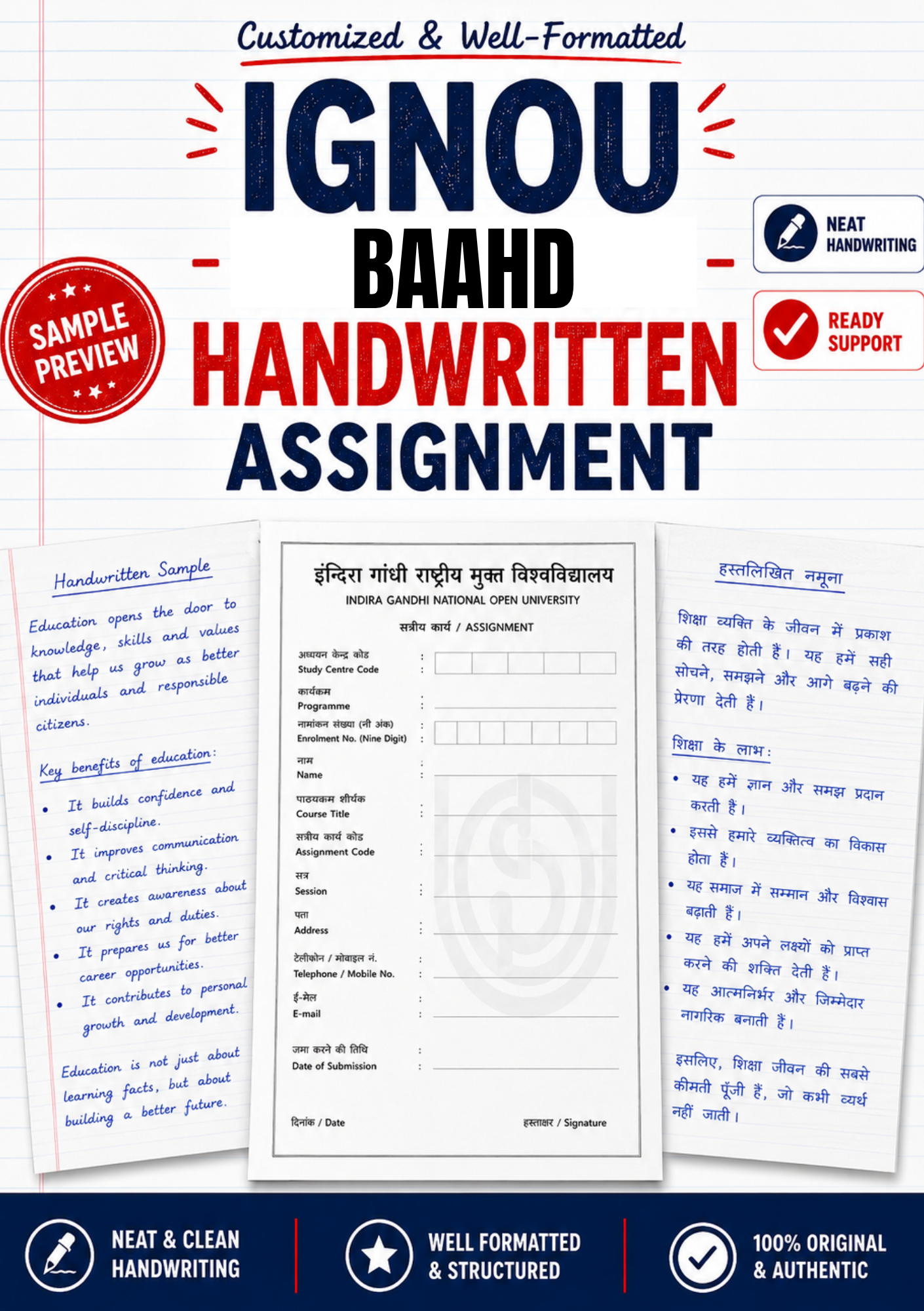
An Applied Hindi order arrives as paper. Each course code in the order produces its own set of answer sheets, written in Devanagari by hand on foolscap, numbered in the order the booklet numbers its questions, and left unbound so the study centre can staple or tag the bundle in whatever way the coordinator prefers. On top of each set sits an IGNOU-format assignment front page, filled in with the enrolment number, programme code, course code, assignment code, study centre and session, and left unsigned because the declaration on that sheet belongs to the learner alone.
Behind the answers travels a printed copy of the official tutor marked assignment paper the answers were written against. That copy matters more on BAAHD than on most programmes, because the Applied Hindi code set draws papers from several different course families and the papers do not all follow one template. Keeping the question paper with the answers is how a learner can check, at the counter, that the set in hand corresponds to the booklet the study centre is expecting.
No soft copy or PDF is sold. There is no emailed scan, no download link and no digital backup held on the learner’s behalf, so a photograph of the completed set before it leaves the learner’s hands is the only copy that exists outside the parcel. That is a deliberate scope, not an oversight: what is sold here is a physical submission object, and the model answers that circulate as files are a separate class of product with a separate purpose, set out further down this page.
The fourth item is the courier itself, carried inside the per-subject rate rather than added at checkout, and scheduled against the learner’s own pin code once that pin code is known.
Counting What ₹320 Buys and What It Will Never Buy
One course code, one rate. A BAAHD learner carrying eight slots in a year pays the same per-subject figure as a learner ordering a single repeat paper, and the figure does not move for a Devanagari-heavy literature paper, for a skill course written largely in Hindi prose, or for one of the minor-stream papers that IGNOU issues with an English title. There is no minimum order: one subject or fourteen, same rate.
Inside the figure sit four things: the writing itself, the IGNOU-format front page, the printed question paper, and the courier. Handwriting matching is inside it too. Send a photo of a page you have written yourself and the handwritten set is matched to your handwriting at no extra charge.
Outside the figure sit two things, and both are outside it permanently. The first is any statement about outcome. No claim is made about the marks any assignment will receive, about how an evaluator will assess it, or about whether it will be accepted. Assignment evaluation is entirely a matter for IGNOU. The second is any promise of a delivery date in advance of knowing where the parcel is going; pin codes in and around Delhi behave differently from pin codes in the hill districts, and a figure printed on a product page would be a figure invented for every learner who reads it.
Shri Chakradhar Publication also does not sell the act of submission. The learner, or someone the learner sends, hands the bundle in at the study centre and collects the receipt. That is worth saying plainly. Assignments carry 30 per cent of the final course result and the term-end examination carries the remaining 70 per cent. A written set sitting at home on the last date is worth exactly what an unwritten one is worth.
Model-Answer Files and Written Bundles Are Not the Same Purchase
Two different objects circulate under names that sound almost identical, and Applied Hindi learners lose time to the overlap. A solved assignment is a soft-copy reference file of model answers prepared against one course code and one session, read on a phone or a laptop and used as study material. A handwritten assignment is the answer set written out by hand on foolscap sheets and submitted in hard copy at the study centre. One is something to read from. The other is the thing that goes across the counter.
IGNOU’s own wording settles which of the two a coordinator is waiting for. The BHDS-183 booklet in the 2025-26 cycle tells the learner to write answers in their own handwriting, to use foolscap-size paper only, to write each question number before its answer, and to hand the work to the coordinator of the study centre by the printed date. A file read on a screen satisfies none of those instructions. Printing that file does not satisfy them either, because the instruction is about handwriting rather than about paper.
| Question | BAAHD solved assignment | BAAHD handwritten assignment |
|---|---|---|
| What it physically is | A soft-copy file of model answers for one BAAHD course code and session | Foolscap answer sheets written out by hand, plus front page and question paper |
| What the learner does with it | Reads it, works from it, writes their own answers using it as a reference | Checks it, signs the declaration on the front page, submits it at the study centre |
| Who it suits | A learner who intends to write the set personally and wants a worked model to study from | A learner who understands the course but has no realistic window to write eight papers by hand |
| Relationship to the booklet instruction | Does not meet the own-handwriting and foolscap instructions by itself | Prepared to follow the handwriting, paper and numbering instructions as printed |
| Price position on this store | Priced separately on the solved-assignment shelves, per code | ₹320 per subject, courier included, on this page |
Scroll the table sideways on a narrow screen to see all three columns.
This page does not sell a model-answer file, and nothing on it should be read as offering one. A BAAHD learner who wants the reference material instead will find it on the Applied Hindi solved-assignment shelf, which is the correct destination for that query and is priced on its own terms. A learner who would rather write the set personally and simply wants the method laid out will get further from a step-by-step guide to writing the set yourself than from any purchase.
The honest scoping matters because the two products are frequently described as substitutes and they are not. A downloaded file cannot be handed in. A written bundle cannot be studied from in the way a model answer can. Learners who buy both are not being sold twice; they are buying a reading aid and a submission object, and those are different needs.
Applied Hindi codes, written and couriered at ₹320 each
The rate is ₹320 per subject, hard copy only, with courier included in that price and no separate shipping charge. Any session is accepted, current cycle or older, including backlog courses, at the same ₹320 per subject.
Ten Major Papers in the BHDC Series, Year by Year
The Common Prospectus for July 2026 sets Applied Hindi out as three years of forty credits, and the discipline spine of those forty-credit years is ten major papers carrying six credits each. They are listed below in the order the prospectus prints them, with the Devanagari title it gives and a plain English gloss added here for learners who search in English. The gloss is this publisher’s rendering and is not an alternative official title.
| Year | Code | Title as printed in the prospectus | English gloss | Credits |
|---|---|---|---|---|
| I | BHDC 131 | हिंदी साहित्य का इतिहास | History of Hindi literature | 6 |
| I | BHDC 134 | हिंदी गद्य साहित्य | Hindi prose literature | 6 |
| II | BHDC 109 | हिंदी उपन्यास | The Hindi novel | 6 |
| II | BHDC 110 | हिंदी कहानी | The Hindi short story | 6 |
| II | BHDC 111 | हिंदी नाटक एवं एकांकी | Hindi drama and the one-act play | 6 |
| II | BHDC 112 | हिंदी निबंध और अन्य गद्य विधाएँ | The Hindi essay and other prose forms | 6 |
| III | BHDC 132 | मध्यकालीन हिंदी कविता | Medieval Hindi poetry | 6 |
| III | BHDC 133 | आधुनिक हिंदी कविता | Modern Hindi poetry | 6 |
| III | BHDC 105 | छायावादोत्तर हिंदी कविता | Hindi poetry after Chhayavad | 6 |
| III | BHDC 106 | काव्यशास्त्र | Poetics | 6 |
Scroll sideways on a narrow screen to reach the credits column.
Five of those ten codes are not exclusive to Applied Hindi. BHDC 105, BHDC 109, BHDC 110, BHDC 111 and BHDC 132 also appear in the major list of the four-year Hindi programme, which the same prospectus codes as BAFHD, so a learner who finds a written set advertised against one of those five has not necessarily found a set built for the Applied Hindi syllabus. The other five, BHDC 131, BHDC 134, BHDC 112, BHDC 133 and BHDC 106, sit outside the BAFHD major list entirely. If your record actually reads BAFHD rather than BAAHD, the BA Hindi Major handwritten set is the page built against that code list.
Four of the ten travel further still. BHDC 131, BHDC 132, BHDC 133 and BHDC 134 appear in the semester tables of the general Bachelor of Arts programme as well, where they sit as discipline-specific choices rather than as a Hindi spine, and where BHDC 131 is a first-semester course rather than a Year One one. Learners holding a mixed-discipline record should start from the BAM handwritten product instead, because the grouping, not the code, is what decides which booklet applies.
Minor, Skill and Value Slots: Choosing One Title From Six
The ten major papers account for sixty of the programme’s 120 credits. The other sixty sit in slots where the prospectus prints two, three or six alternative codes separated by a slash and the learner studies exactly one of them. This is the single most common reason a BAAHD order is quoted for the wrong code list, because a learner reading the prospectus table sees every option and assumes all of them are owed.
| Year | Slot type | Codes printed in the slot | Choose | Credits |
|---|---|---|---|---|
| I | Minor stream | BPYC 131 or BSOC 101 | One | 6 |
| I | Skill enhancement | BHDS 183 | Compulsory | 4 |
| I | Skill enhancement | BHDS 184 | Compulsory | 4 |
| I | Skill enhancement | CVG 002 | Compulsory | 4 |
| I | Skill enhancement | CBKG 002 | Compulsory | 4 |
| I | Common value-added | BHDG 175 or BSKE 143 or BPSE 141 | One | 6 |
| II | Minor stream | BPYC 134 or BSOC 102 | One | 6 |
| II | Skill enhancement | BHDG 173 or BHDLA 136 or BHDLA 135 or BESE 141 or BSKE 141 or BSKC 108 | One of six | 6 |
| II | Skill enhancement | BHDS 185 or BCOS 184 or BSKS 186 | One | 4 |
| III | Minor stream | BPYG 171 or BSOE 142 | One | 6 |
| III | Minor stream | BPYG 172 or BSOE 148 | One | 6 |
| III | Skill enhancement | BCOS 185 | Compulsory | 4 |
Scroll sideways on a narrow screen to read the full list of alternatives in each slot.
Two features of that table are unusual enough to be worth naming. The first is Year One, which carries four separate four-credit skill courses rather than one or two: translation theory and technique in BHDS 183, radio writing in BHDS 184, Vedic arithmetic in CVG 002 and methods of time-reckoning in CBKG 002. Sixteen credits of skill work in a single year is heavy by the standards of any other Hindi bachelor’s route, and two of those four courses have no literary content at all. The second is the six-way Year Two slot, where newspaper and feature writing, two different Hindi language-skill courses, an education technology course, an Ayurveda foundations course and a Sanskrit epigraphy course all sit behind one slash. Two Applied Hindi learners in the same year, both correct, can hold code lists that overlap in only the ten major papers.
The practical consequence for an order is simple. The ten BHDC codes can be assumed. Everything else has to be read off the admission record or the portal list, never inferred from the year. The same discipline applies on the Applied Sanskrit equivalent, which is built on the same forty-credit shape and the same slash-slot habit.
The credit arithmetic was checked against the prospectus before this table was published. Year One sums to forty: six, six, six, four, four, four, four and six. Year Two sums to forty: six, six, six, six, six, six and four. Year Three sums to forty: six, six, six, six, six, six and four. Three forty-credit years give the 120 credits the programme states for itself.
Where the BAAHD Record Disagrees With Itself
Applied Hindi is documented inconsistently, and the inconsistencies are the reason most of the free advice circulating about it is wrong. They are set out below rather than smoothed over, including the ones that belong to this store.
Eight disagreements found while this page was being built, and not resolved by anyone but IGNOU.
1. Four separate IGNOU programmes issue papers under the BHDC prefix. Applied Hindi (BAAHD), the four-year Hindi programme (BAFHD), the Hindi honours programme (BAHDH) and the general Bachelor of Arts all draw on it. A BHDC code on its own does not identify a programme, and no booklet read for this page printed the letters BAAHD anywhere.
2. BHDC 111 is printed as हिंदी नाटक एवं एकांकी in the Applied Hindi table of the July 2026 prospectus and as हिंदी नाटक एक एकांकी in the four-year Hindi table of the same document. One word differs and the sense changes.
3. The same four Year One and Year Three codes appear in three different scripts in one prospectus. BHDC 131 and BHDC 132 are given in roman transliteration in the general Bachelor of Arts table, BHDC 133 and BHDC 134 in English translation in that same table, and all four in Devanagari in the Applied Hindi table.
4. BHDG 175, one of the Year One value-added options, is spelled Madhyakaneen in two places in the prospectus and Madhyakaleen in a third. CBKG 002 is printed as Kalganana ki vidhiyan in one list and Kal Ganana ki Vidhiyan in another.
5. Two live booklets of the same 2025-26 cycle, from the same school, carry different last dates. The BHDC-131 paper prints 30 April 2026 for the July 2025 session and 31 October 2026 for the January 2026 session. The BHDS-183 and BHDS-184 papers print 31 March 2026 and 30 September 2026 for the same two sessions.
6. Three assignment-code formats coexist across three Year One papers of one cycle: BHDC-131/2025-26, BHDS-183/TMA/2025-2026 and BHDS-184/2025-26. Only one of the three carries the letters TMA.
7. BHDS 183 is classified as a skill enhancement course in the Applied Hindi prospectus table, while its own booklet describes it as a foundation course. The BHDS 184 booklet does print skill enhancement course on its cover.
8. The multiple entry and exit scheme is introduced in the prospectus for undergraduate programmes under the four-year framework, with exit points defined in semesters at 44 and 84 credits. The Applied Hindi section separately states that multiple entry and exit will apply to it, although it is a year-wise programme of three clean forty-credit years and is not listed under that framework.
In-house, and corrected rather than hidden: the Applied Hindi book shelf on this store is currently titled as an Honours Hindi category and sits under the Honours parent, which conflates BAAHD with BAHDH across the products filed there; a second, duplicate Applied Hindi assignment category is live with a malformed slug; and the Applied Hindi assignment category still advertises a 2025 session in its description. All three are on the correction list.
Programme structures, course codes, submission dates and rules change, and only ignou.ac.in and your Regional Centre can confirm the current position for your enrolment.
One further wrinkle sits on IGNOU’s own website rather than in the prospectus. IGNOU’s live BAAHD programme page names the programme Bachelor of Arts (Applied Hindi) (ODL), a form the prospectus does not use, and lists a single course, BHDS-185, twice, when BHDS-185 is only one of three alternatives in a single Year Two slot. Nothing about the page is wrong exactly; it is simply not a course list, and learners who treat it as one come away with one code out of roughly twenty-five.
Shri Chakradhar Publication also maintains the BAAHD book shelf on this store, which is the shelf named incorrectly above. It is linked here rather than quietly dropped, because the books on it are the right books even though the category heading above them is the wrong heading.
Two Deadlines Inside One Year of Applied Hindi
Most programme pages can print one pair of dates. Applied Hindi cannot, and the reason is visible in the booklets themselves rather than in anything a learner could be expected to guess.
The BHDC-131 booklet for the 2025-26 cycle prints its last date for the July 2025 session as 30 April 2026 and for the January 2026 session as 31 October 2026. The BHDS-183 booklet for the identical cycle, issued by the identical school, prints 31 March 2026 for July 2025 and 30 September 2026 for January 2026. The BHDS-184 booklet agrees with BHDS-183. A Year One Applied Hindi learner therefore holds a bundle in which one paper falls due a month later than three others in the July cycle, and a month earlier in the January cycle.
That is not a misprint this publisher can correct, and it is not a reason to pick whichever date looks safer. It is a reason to work to the earliest date in your own bundle, which for a July-session Year One learner is 31 March, and to treat the later date as slack rather than as the plan. The order schedule agreed on WhatsApp is built around the earliest date printed across the codes in the order, not around a single programme-wide figure.
Two further points about dates are worth stating because the circulating advice gets both wrong. The first is that 31 October and 30 April are widely quoted as the IGNOU assignment deadlines, and they are, for the School of Management Studies. They appear on a BAAHD paper by coincidence of one booklet rather than as a School of Humanities rule. The second is that a session’s paper expires. Each cycle IGNOU withdraws the previous booklet and issues a replacement with new questions, so an answer set written against the 2024-25 BHDC-131 paper is not a submission for the 2025-26 one even though the course code has not changed. Always read your dates from the booklet you downloaded yourself, through IGNOU’s own assignment download service, in the session you are actually registered for.
The Code Line Changes Shape Between Two Papers in One Year
Every tutor marked assignment paper prints an assignment code near the top, and the study centre uses it to file what it receives. On Applied Hindi that line does not have one shape.
The BHDC-131 paper prints BHDC-131/2025-26. The BHDS-183 paper prints BHDS-183/TMA/2025-2026, with the letters TMA in the middle and the second year written in full. The BHDS-184 paper prints BHDS-184/2025-26, like BHDC-131 and unlike BHDS-183, even though BHDS-184 sits in the same course family as BHDS-183 and was issued for the same cycle. Three Year One papers, three code lines, two of them matching and one not.
Reading the line is still straightforward once the variation is expected. The first segment is the course code and is the only part that identifies the paper. The optional middle segment is the assessment type, and its absence does not make the paper something other than a tutor marked assignment. The final segment is the cycle the booklet belongs to, and it is the segment learners most often copy wrongly, because a paper downloaded in October 2026 may still belong to the cycle that opened the previous July. Copy the line exactly as printed onto the front page of each set. Do not normalise it, do not add TMA where the booklet omits it, and do not update the year to the current one.
When the admission record and the booklet disagree about which cycle applies, the booklet downloaded from the university’s own portal in the learner’s own session is the document to follow, and the Regional Centre is the body to ask when that still leaves a question open.
Matching a Hindi Hand Before Any Money Changes Hands
Applied Hindi is written almost entirely in Devanagari, and Devanagari handwriting varies more visibly than roman handwriting does. The slope of the headline, how far the matras are carried above it, whether conjuncts are drawn in full or shortened, how the learner forms the characters that differ most between school styles: these are the features a coordinator who has seen the learner’s examination scripts will register without thinking about it.
Send a photo of a page you have written yourself and the handwritten set is matched to your handwriting at no extra charge. The writer assigned to the order works from that page, and the match is agreed before an order is confirmed rather than discovered after a parcel arrives.
What Makes a Usable Sample Page
A sample is most useful when it is ordinary. Half a page of continuous Hindi prose in the pen the learner normally uses, photographed straight on in daylight, shows more than a carefully drawn specimen does. A page copied out slowly in a careful display hand produces a match to handwriting the learner does not actually use. Where a learner’s record includes one of the minor-stream or value-added papers that IGNOU issues with an English title, a line or two of roman script on the same sample page is useful, because that set will contain English passages inside an otherwise Hindi bundle.
When a Hindi-Medium Programme Hands You an English Paper
The prospectus is unambiguous that Applied Hindi is a Hindi-medium programme. The master programme table lists its medium as Hindi alone, where most Bachelor of Arts routes are listed as English and Hindi, and the Applied Hindi section repeats the restriction in its own text. The ten BHDC papers and the BHDS skill papers are Hindi throughout.
The slash slots are where that tidy picture breaks. BPSE 141 on Gandhi and the contemporary world, BESE 141 on information and communication technology in education, BCOS 184 on electronic commerce and BCOS 185 on entrepreneurship all carry English titles in the Applied Hindi table, and the minor-stream philosophy and sociology options are printed with English titles and a Devanagari rendering alongside. A learner whose chosen options include two or three of those will submit a year’s work that is mostly Devanagari with an English paper or two inside it.
The service covers all mediums IGNOU issues the TMA paper in, at the same price. A set is written in whichever language the booklet for that code is issued in, and a bundle that mixes the two is written as a mixed bundle rather than forced into one script.
Session coverage is equally open. Any session is accepted, current cycle or older, including backlog courses, at the same ₹320 per subject. Applied Hindi is a young programme and its learners frequently carry one or two papers forward from an earlier cycle while the rest of the year runs normally, which means a single order quite often contains two different cycle labels. That is handled as a routine order rather than as a special case, provided the learner supplies the booklet or the exact cycle for the older code.
Five Lines, and the Order Can Be Quoted
An Applied Hindi order needs five things and nothing else. Supplying more does no harm; supplying fewer means a second message.
- Enrolment number and programme. Written as BAAHD, so the order is not built against the four-year or the honours Hindi code list by mistake.
- The exact course codes. Read off the admission record or the portal list, including the one chosen side of each slash slot rather than both.
- The session on the booklet. July or January, with the cycle label exactly as the paper prints it.
- The medium for any English-titled option. Only needed where a slot has been filled with one of the courses IGNOU issues outside Hindi.
- Delivery pin code. Which is what makes a delivery window answerable at all.
A sample page of handwriting can follow in the same thread or afterwards, and the quote does not depend on it. Open a WhatsApp thread with those five lines and the subject count, the writing medium and the earliest cut-off across your codes come back in one reply.
Quote first, writing afterwards, nothing paid on a guess
There is no minimum order: one subject or fourteen, same rate. Delivery depends on your pin code and is confirmed for your order before you pay. No figure is promised on this page.
Submission, Receipt and the Long Wait for Status
The parcel arrives unbound and unsigned, and three things happen before it leaves the learner’s hands. The front page of each set is signed, because the declaration on it is the learner’s own statement. The question numbers are checked against the booklet the learner downloaded, which is why a printed copy of that booklet travels with the set. And a photograph of the complete bundle is taken, because once it crosses the counter the learner has no copy.
You sign the declaration on the assignment cover page, so you should read and review the content before submitting it, and satisfy yourself that it represents your own understanding of the course.
Submission is to the coordinator of the learner’s own study centre, as both booklets read for this page instruct, and a dated receipt or acknowledgement should be asked for at the counter. That receipt is the only evidence the learner holds that the bundle was handed in on time, and it matters because the status record that eventually appears online lags submission by weeks and sometimes by a good deal longer. A missing status entry in the first month after a deadline is normal; a missing receipt is not recoverable.
After that the work is IGNOU’s. Assignments carry 30 per cent of the final course result and the term-end examination carries the remaining 70 per cent. The Applied Hindi learner who has handed in all eight or nine slots for a year has secured the opportunity to earn that share, which is a different thing from having earned it. No claim is made about the marks any assignment will receive, about how an evaluator will assess it, or about whether it will be accepted. Assignment evaluation is entirely a matter for IGNOU.
The Rest of the Applied Hindi Shelf
A written bundle is rarely the only thing an Applied Hindi learner needs in a cycle, and the other material sits in different places on this store. Reading material for the BHDC papers is on the wider bachelor-degree book list, where the Applied Hindi titles are filed under the mislabelled heading noted earlier. Learners preparing for the term-end paper rather than the assignment usually want BAAHD solved guess papers, which address the seventy per cent this page does not touch.
Learners who also hold codes from outside the Hindi discipline will find the per-code reference files in the bachelor-degree assignment index, and the term-end material for those same codes in guess papers for other bachelor programmes. Where a household has two learners on different programmes, every programme on the handwritten shelf is written at the same per-subject rate, so a joint order is quoted as one order.
Questions That Arrive With a BAAHD Enrolment Number
Is BAAHD the same programme as BAHDH or BAFHD?
No. The July 2026 prospectus lists three separate Hindi bachelor’s programmes at the School of Humanities. BAAHD is Bachelor of Arts in Applied Hindi, 120 credits taken as three years of forty credits each, examined year-wise. BAFHD is the four-year Hindi route with a different major list. BAHDH is the honours programme at 148 credits over six semesters. All three are Hindi medium and all three use BHDC codes, which is exactly why the three get confused. Your admission record, not the code prefix, settles which one you are in.
My booklet cover says B.A. (General). Am I downloading the wrong paper?
Probably not. The BHDC-131 booklet read for this page prints a general Bachelor of Arts label under the CBCS heading, and the BHDS-183 booklet prints the Hindi equivalent of the same thing. Neither names Applied Hindi anywhere on the cover. The booklets are issued against course codes rather than against programmes, so the cover describes the family the paper was written for and not the full set of programmes that study it. Match the course code and the cycle, and ask your Regional Centre if the cover still worries you.
Which Year One papers are due on 30 April and which on 31 March?
In the 2025-26 cycle the BHDC-131 paper printed 30 April 2026 for the July 2025 session, while the BHDS-183 and BHDS-184 papers printed 31 March 2026 for the same session. For the January 2026 session the same split appears as 31 October 2026 against 30 September 2026. Read the date off each booklet you downloaded rather than applying one figure to the year, and plan to the earliest of them.
Why does BHDS-183 print TMA in its code when BHDC-131 does not?
Because IGNOU’s booklet templates are not uniform across course families. BHDS-183 prints BHDS-183/TMA/2025-2026, BHDC-131 prints BHDC-131/2025-26, and BHDS-184 prints BHDS-184/2025-26 despite sharing a family with BHDS-183. All three are tutor marked assignments. Copy whichever line your own booklet prints, exactly as printed, onto the front page of that set.
If I already have the BAAHD solved assignment, what is still left to do?
The writing and the submission. A solved assignment is a soft-copy reference file of model answers for a course code and session; a handwritten assignment is the answers written out by hand on foolscap and submitted in hard copy at the study centre. Owning the file means you have something to study and write from. It does not mean you have a bundle the coordinator can accept.
Can a BAAHD solved assignment be copied out by hand at home?
Yes, and for a learner with time that is a reasonable route. The booklet asks for answers in the learner’s own handwriting on foolscap paper, and copying from a model while writing in your own hand satisfies that. What it does not do is remove the work: ten six-credit papers and several four-credit ones run to a great many foolscap sides. The declaration you sign also asks you to satisfy yourself that the content represents your own understanding, so reading the model rather than transcribing it blindly is the point of owning one.
Do the model answers and the written bundle cover the same questions?
They cover the same booklet when both are built for the same cycle, which is the thing to check rather than assume. A model answer file prepared against the 2024-25 BHDC-131 paper answers questions that the 2025-26 paper replaced. Sets written here are written against the booklet for the cycle the learner states, and the question paper travels with them so the pairing can be checked on arrival.
The booklet says foolscap. Is A4 acceptable?
Both BAAHD booklets read for this page instruct the learner to use foolscap-size paper only, and sets prepared here are written on foolscap for that reason. Whether a particular study centre accepts A4 in practice is a matter for that coordinator, and no assurance about it is offered on this page. Where a learner asks specifically for A4, that request is followed and the departure from the printed instruction is pointed out first.
I have to choose one code from six in Year Two. Which one gets written?
The one on your record. The Year Two six-credit skill slot prints BHDG 173, BHDLA 136, BHDLA 135, BESE 141, BSKE 141 and BSKC 108 behind one slash, and you study exactly one of them. Send the code you registered for and that is the paper written. Sending all six would be quoted as six subjects, which is why the code list rather than the year is what an order is built from.
Are CVG-002 and CBKG-002 really part of a Hindi degree?
Yes. The Applied Hindi table in the July 2026 prospectus places both in Year One as compulsory four-credit skill enhancement courses, CVG-002 on Vedic arithmetic and CBKG-002 on methods of time-reckoning, alongside translation theory and radio writing. The programme is built to pair Hindi literary study with skill courses from outside the discipline, so a Year One bundle genuinely contains arithmetic.
My record shows BHDC-104. Is that a BAAHD paper?
Not in the Applied Hindi table. BHDC-104 appears in the four-year Hindi major list, not among the ten BHDC papers the prospectus gives Applied Hindi. Its title is close enough to BHDC-133 that the two are easy to confuse. If BHDC-104 is genuinely on your record, check the programme code on that record before ordering, because the set you need may belong to a different Hindi programme entirely.
Can one Applied Hindi paper be ordered instead of a whole year?
Yes. There is no minimum order: one subject or fourteen, same rate. A single repeat paper, a pair of skill courses, or an entire forty-credit year are all quoted at the same per-subject figure.
Is a 2023-24 BAAHD backlog paper charged differently?
No. Any session is accepted, current cycle or older, including backlog courses, at the same ₹320 per subject. The one thing an older code needs is certainty about which booklet it is being written against, so send the cycle label or the booklet itself along with the code.
The books shelf here calls BAAHD “Honours Hindi”. Which is right?
The shelf heading is wrong and the books on it are right. Applied Hindi and Honours Hindi are separate programmes with separate structures, and the category on this store currently files the Applied Hindi titles under an Honours heading. It is named in the conflict box above and on the correction list, and it is flagged here rather than left for a learner to discover.
I write in a mixed Hindi-English hand. Can that be matched?
Yes, and on Applied Hindi it is worth saying so, because several of the slash-slot options are issued with English titles and English content inside an otherwise Devanagari year. Include a line or two of roman script on the sample page you send and both scripts are matched from the same sample at no extra charge.
Why is no delivery date or marks outcome promised on this page?
Because neither is in this publisher’s gift. Delivery depends on your pin code and is confirmed for your order before you pay. No figure is promised on this page. On the other question, no claim is made about the marks any assignment will receive, about how an evaluator will assess it, or about whether it will be accepted. Assignment evaluation is entirely a matter for IGNOU. A page that promised either would be promising something it cannot control.
Separating the Prospectus, the Booklets and the Shop’s Own Terms
Three kinds of statement appear on this page and they come from three different places. Keeping them apart is the point of this section.
From the IGNOU Common Prospectus, July 2026. The programme name Bachelor of Arts in Applied Hindi, the code BAAHD, the School of Humanities attribution, the Hindi medium, the eligibility of 10 plus 2, the minimum of three years and maximum of six, the 120-credit total taken as three forty-credit years, the year-wise examination mode, the January and July intake, the ten BHDC major papers with their Devanagari titles and six credits each, and every minor, skill enhancement and value-added slot with its alternatives. The credit arithmetic in the options section was summed against the prospectus total rather than trusted from the extracted table. The comparisons with BAFHD, BAHDH and the general Bachelor of Arts are drawn from the tables for those programmes in the same document.
From live tutor marked assignment booklets on ignou.ac.in. The submission dates, the assignment code strings, the question and marks patterns, the foolscap instruction, the own-handwriting instruction, the instruction to submit to the study centre coordinator, and the cover-page labelling. Three booklets of the 2025-26 cycle were opened for this page: BHDC-131, BHDS-183 and BHDS-184. Where they disagree, both readings are printed in the conflict box rather than averaged into one. The observation about the programme page naming comes from IGNOU’s own live BAAHD page, read on 8 October 2026.
From this publisher’s own commercial terms. The ₹320 per-subject rate, courier inclusion, the free IGNOU-format front page, the inclusion of a printed question paper, the no-minimum-order position, the handwriting match at no extra charge, the acceptance of any session including backlogs, and the refusal to print a delivery figure or any claim about marks. These are commitments made by Shri Chakradhar Publication Pvt. Ltd. and they carry no endorsement from the university.
Important Notice
Shri Chakradhar Publication Pvt. Ltd. and shrichakradhar.com form an independent IGNOU study-support publisher. This is not the official website of Indira Gandhi National Open University, is not affiliated with, endorsed by or authorised by the university, and no page on this site should be treated as an official IGNOU communication.
Programme structures, course codes, submission dates and rules change, and only ignou.ac.in and your Regional Centre can confirm the current position for your enrolment.
You sign the declaration on the assignment cover page, so you should read and review the content before submitting it, and satisfy yourself that it represents your own understanding of the course.
No claim is made about the marks any assignment will receive, about how an evaluator will assess it, or about whether it will be accepted. Assignment evaluation is entirely a matter for IGNOU.
Start With a Photograph of Your Admission Record
A correct Applied Hindi quote starts from the record itself, because it carries the programme code, the enrolment number and the one side of each slash slot you actually registered for. The rate is ₹320 per subject, hard copy only, with courier included in that price and no separate shipping charge. No soft copy or PDF is sold.
Message the Applied Hindi desk with your record
If you would rather settle the handwriting question first, that can come before anything else. Share a sample page for the handwriting match and the match is agreed before an order is placed.