

Description
In short. This page prepares the Bachelor of Arts in Applied Sanskrit tutor marked assignments by hand, one course code at a time, across the twenty-two slots the programme runs over three years at forty credits a year, from the BSKC, BSKG, BSKLA and BSKE Sanskrit papers issued by the School of Humanities to the BHDS, SSB, CVG, CBKG, BPYC, BSOC, BESE, BHDG and BCOS codes BAASK draws from elsewhere in the university. The rate is ₹320 per subject, hard copy only, with courier included in that price and no separate shipping charge. No soft copy or PDF is sold. Each set arrives with an IGNOU-format front page and a copy of the TMA question paper the answers were written against, matched to your own handwriting from a sample photograph, and the three live BAASK booklets read for this page print 30 September for a January admission and 31 March for a July one, which is not the pair most assignment-deadline pages give.
Four Things in the BAASK Parcel, and One Thing That Never Travels
An Applied Sanskrit order is a physical object from the first stroke to the courier label. Twenty-two codes means up to twenty-two separate bundles over the degree, and every one of them leaves the press as paper only. No soft copy or PDF is sold. A learner clearing four Year II codes together receives four separate tied bundles rather than one block, because the study centre logs assignments against a course code and not against a year.
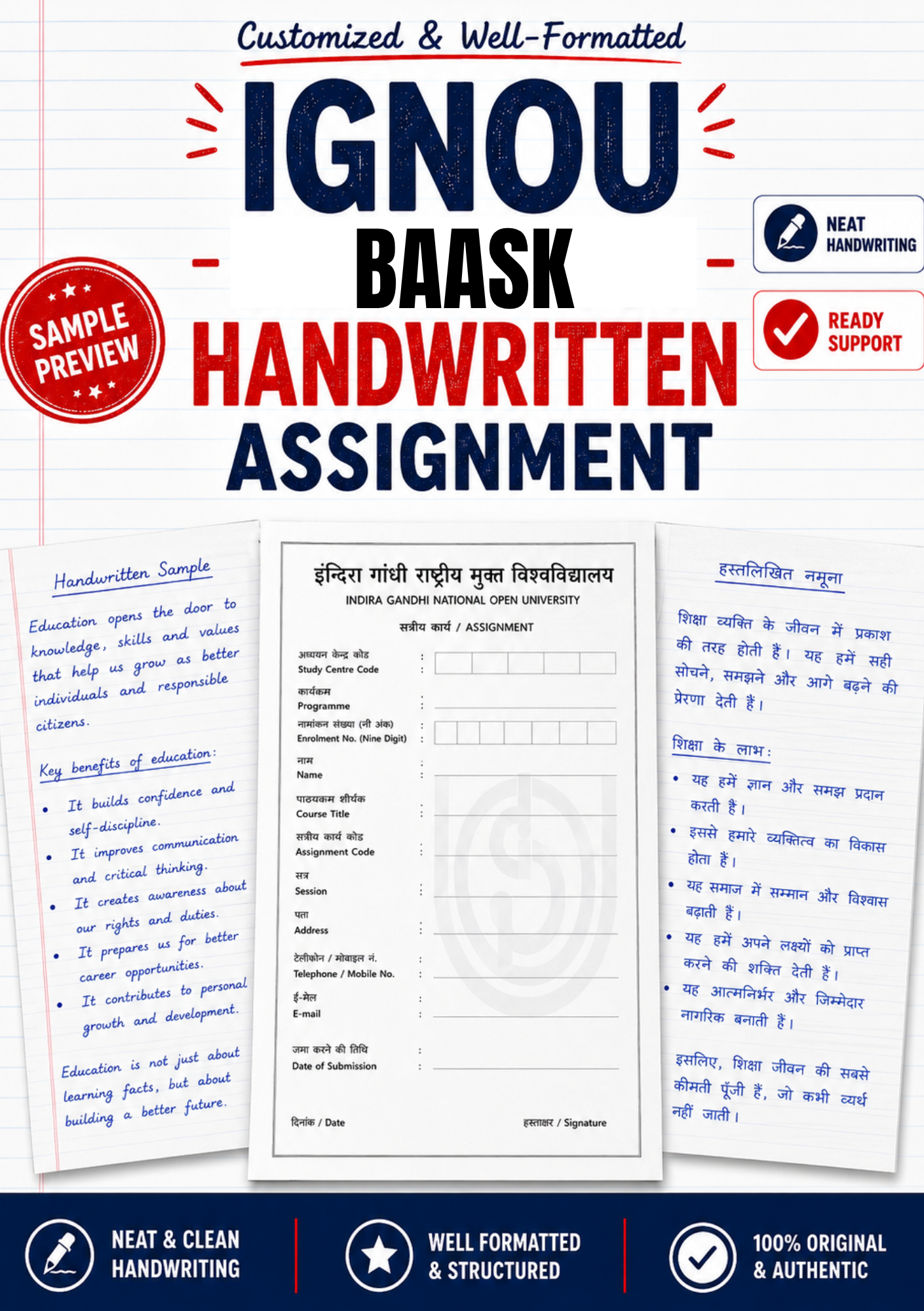
Each bundle holds four things. The answers come first: written out by hand in Devanagari against the questions printed on your own booklet, in the order the paper sets them, with the Sanskrit verses and prose passages quoted inside the answers written as Sanskrit rather than transliterated into roman. On top sits an IGNOU-format cover sheet, free with every order, with the fields left open for your enrolment number and your signature. Inside travels a copy of the TMA question paper the answers were written against, which carries unusual weight on this programme because three BAASK papers read for this page print three different question patterns, and a coordinator comparing your answers against a different year’s paper will find them out of order. Last, the sheets are tied rather than bound, so you can add the cover details yourself and attach the question paper where your centre prefers it.
Not one of the three BAASK booklets names a paper size, an ink colour, a margin width or a binding method. All three move from the question list to the submission note without saying what to write on. What they do say is that the answers should be written in clear and well-formed letters and that the points you want to stress should be underlined, and the 2026-27 paper adds a request to avoid matra and grammar errors, which in Devanagari is a request about the writing itself rather than about the content. Bundles are prepared on A4 in one dark ink here, because that is the format centres have come to expect, while the BAASK papers stay silent on the question and your Regional Centre is who settles a local preference.
One Code, One ₹320: Where the Figure Ends
The price attaches to a course code. The rate is ₹320 per subject, hard copy only, with courier included in that price and no separate shipping charge. A four-credit BHDS paper and a six-credit BSKC paper cost the same, even though the six-credit paper carries more writing, because BAASK sets here are priced per code rather than per credit. A full year is eight codes in Year I and seven in each of Years II and III, so a whole year is seven or eight units of the same figure, and the whole degree is twenty-two, although almost nobody orders it that way.
Five things sit under that one number: the Devanagari writing, the cover sheet in the format IGNOU asks for, the photocopied question paper, the match to your own hand, and the courier run to your door. Nothing is added at dispatch and no packing line appears on the total.
Outside the figure, and worth saying plainly: there is nothing here you can download. No soft copy or PDF is sold. Model answers read on a screen are a different product on a different shelf of this store, and the next section sets out where that line falls and why it matters more on a Devanagari programme than on an English one. Evaluation sits outside the figure too, and nothing on this page is a statement about how a Sanskrit answer will be graded.
There is no minimum order: one subject or fourteen, same rate. Delivery depends on your pin code and is confirmed for your order before you pay. No figure is promised on this page.
Downloadable Model Answers Against a Written BAASK Bundle
Applied Sanskrit learners ask this more often than any other question, and usually in the form of whether a downloaded file can be printed and handed across the counter. They are two different objects rather than two formats of one, and only one of them is something a coordinator can receive.
A solved assignment is a soft-copy reference file of model answers for a course code and session, opened on a phone or a laptop and used to see what a complete answer to a BSKC or BSKG question looks like before you write your own. A handwritten assignment is that same answer set put onto A4 in a learner’s own hand and carried to the study centre as a physical bundle. The first is study material. The second is the object the coordinator takes.
| Point of difference | Solved assignment, soft copy | Handwritten BAASK bundle, this page |
|---|---|---|
| Format | A file for one code and one session, read on a screen | Devanagari written on sheets, tied per code and couriered |
| What you do with it | Read it, then write the answers out yourself | Fill in the cover page, sign it, hand it over |
| Who it suits | A learner who wants the writing practice in the script and needs a model | A learner who has the reading done but not the hours of Devanagari writing |
| Where it sits on this store | On the Sanskrit solved-assignment shelves, priced per code | ₹320 per subject, courier included |
| Can it be submitted as it is | No, a printout of a file is not a written script | Yes, once you have read it and signed the declaration |
Scroll the table sideways on a narrow screen.
On what IGNOU itself asks for, the BAASK papers are specific in one direction and silent in another. All three booklets read for this page instruct the learner to write the answers into the answer book in clear and well-formed letters and to underline the points worth stressing, and all three close with the same warning that the assignment must be submitted before you are allowed to sit the examination. The verb they use throughout is to write. None of them mentions typing, printing or pasting. That silence is exactly why a downloaded file is not a substitute: the paper assumes a written final version in Devanagari, and the study centre assumes the same.
So the scoping should not be softened. A solved assignment is a reference to write from, not something to hand in, and printing one does not convert it into a script. If the reference file is what you actually want, this store keeps those on a separate shelf, and you can browse the Sanskrit solved assignment shelf where the BSKC and BSKLA model answers are filed rather than ordering here. One caveat belongs with that link: the store has no shelf named for BAASK on the solved-assignment side yet, so the Sanskrit shelf under the BA programme is the closest honest place to send you, and the gap is listed in this build’s correction queue rather than hidden.
A whole year of Sanskrit papers, or the one code you ran out of evenings on.
₹320 per subject · hard copy · courier inside the figure · front page and question paper included
Send your BSKC and BSKG codes on WhatsApp with the year printed on your booklet and a photograph of a page in your own Devanagari.
Twenty-Two BAASK Slots Across Three Years, Not Six Semesters
BAASK is the Bachelor of Arts in Applied Sanskrit, run by the School of Humanities, admitted in both the January and the July cycles, with a minimum duration of three years and a maximum of six, eligibility of 10+2 or its equivalent, and a stated medium of instruction of Hindi. The Common Prospectus July 2026 sets the programme at 120 credits and carries a note, printed in a legacy font that most extraction tools render as roman gibberish, saying the learner is expected to study forty credits in each year.
That is the first thing to get right before ordering. BAASK has no semester column anywhere in its structure table. It runs year-wise, three blocks of forty credits, which puts it out of step with almost every other current IGNOU undergraduate programme and means a page describing a BAASK semester is describing something that does not exist. The arithmetic was summed independently before this table was trusted: eight courses in Year I at six, six, six, four, four, four, four and six credits make forty; seven courses in Year II make forty; seven in Year III make forty; and the three years make 120, which is the figure the prospectus prints. That check matters here more than usual, and the next paragraph explains why.
The BAASK table is physically broken in the prospectus. Its header and the opening rows of Year I sit on one page immediately after the closing rows of a different programme’s table, and the rest of Year I together with the whole of Year II and Year III is printed further on, inside the narrative of the programme that follows BAASK in the document. The programme coordinator’s contact line sits between the two halves. Read linearly, the table either stops after four rows or hands Years II and III to the neighbouring programme. The three forty-credit markers are the only guard against that, and they close exactly, which is how the table below was confirmed rather than assumed.
Codes are reproduced with the spacing the prospectus itself uses, which is not consistent. Titles are given as printed, in Devanagari, with an English gloss in brackets. The prospectus prints no English course titles for BAASK anywhere, so every English phrase in the title column below is a gloss for your convenience and not IGNOU’s wording.
| Year | Course code as printed | Title as printed, with an English gloss | Type | Credits |
|---|---|---|---|---|
| I | BSKC-131 | संस्कृत पद्यसाहित्य (Sanskrit verse literature) | Core | 6 |
| I | BSKLA-135 | संस्कृत भाषा और साहित्य (Sanskrit language and literature) | Core | 6 |
| I | BPYC-131 / BSOC-101 | भारतीय दर्शन / समाजशास्त्र का परिचय (Indian philosophy, or an introduction to sociology) | Minor | 6 |
| I | BSKS186 / CBKG-002 | अभिनय और पटकथा लेखन / कालगणनाकी विधियाँ (Acting and screenplay writing, or methods of reckoning time) | Skill Enhancement course | 4 |
| I | SSB-003 / CVG002 | संभाषणम् / वैदिक अंकगणित (Spoken Sanskrit, or Vedic arithmetic) | Skill Enhancement course | 4 |
| I | BHDS 183 | अनुवाद सिद्धांत और प्राविधि (Translation theory and technique) | Skill Enhancement course | 4 |
| I | BHDS 184 | रेडियो लेखन (Writing for radio) | Skill Enhancement course | 4 |
| I | BSKE143 / BHDG-175 | संस्कृत परम्परा में दर्शन, धर्म और संस्कृति / मध्यकालीन भारतीय साहित्य और संस्कृति (Philosophy, religion and culture in the Sanskrit tradition, or medieval Indian literature and culture) | Value-Added | 6 |
| II | BSKC-133 | संस्कृत नाटक (Sanskrit drama) | Core | 6 |
| II | BSKG-180 | राष्ट्रीयता और भारतीय साहित्य (Nationality and Indian literature) | Core | 6 |
| II | BSKC-132 | संस्कृत गद्यसाहित्य (Sanskrit prose literature) | Core | 6 |
| II | BSKC-107 | भारतीय सामाजिक संस्थान और राज्य व्यवस्था (Indian social institutions and polity) | Core | 6 |
| II | BPYC133 / BSOC-102 | Logic / भारतीय समाजशास्त्र-1 (Logic, or Indian sociology I) | Minor | 6 |
| II | BESE141 / BHDG-173 | ICT in Education / समाचार और फीचर लेखन (ICT in education, or news and feature writing) | Skill Enhancement course | 6 |
| II | BCOS-184 | E-Commerce | Skill Enhancement course | 4 |
| III | BSKC-113 | सृष्टि मीमांसा और ज्ञान-मीमांसा (Cosmology and epistemology) | Core | 6 |
| III | BSKC-114 | संस्कृत व्याकरण (Sanskrit grammar) | Core | 6 |
| III | BSKC-111 | वैदिक साहित्य (Vedic literature) | Core | 6 |
| III | BSKE-151 | संस्कृत के लिए संगणकीय भाषाविज्ञान (Computational linguistics for Sanskrit) | Core | 6 |
| III | BPYG171 / BSOE-142 | अनुप्रयुक्त नीतिशास्त्र / भारतीय समाजशास्त्रीय परंपराएँ (Applied ethics, or Indian sociological traditions) | Minor | 6 |
| III | BPYG172 / BSOE-148 | धर्मदर्शन / सामाजिक स्तरीकरण (Philosophy of religion, or social stratification) | Minor | 6 |
| III | BCOS-185 | Entrepreneurship (उद्यमिता) | Skill Enhancement course | 4 |
Scroll the table sideways on a narrow screen.
Two features of that table change what a learner should order. The first is that no project, dissertation or field-work course appears anywhere in BAASK, so unlike several other three-year degrees there is no separate report to budget for and every one of the twenty-two slots is a taught course carrying a tutor marked assignment. The second is that the code column uses three different conventions at once. Some codes are hyphenated, some are printed with a space, and some run the letters and digits together, and all three styles appear inside a single twenty-two-row table. For an order it changes nothing, because the code is matched against the live paper rather than against its punctuation, but it is the reason a learner searching the assignment portal for their own code sometimes finds nothing on the first attempt.
The Eight Slash Slots Where Only One Side Is Yours
The real choice in Applied Sanskrit is not between subjects at large. It is between two named alternatives inside one slot, marked in the prospectus with a slash, and the prospectus states the rule in that same hard-to-read legacy font: where options are given with a slash sign, only one course is to be chosen. Eight of the twenty-two slots carry a slash, which accounts for forty-four of the 120 credits. The other fourteen courses, seventy-six credits in all, are fixed for everyone on the programme.
| Year | Choose one of | What the two sides are | Credits |
|---|---|---|---|
| I | BPYC-131 / BSOC-101 | Philosophy or Sociology | 6 |
| I | BSKS186 / CBKG-002 | A Sanskrit skill course or a certificate course in reckoning time | 4 |
| I | SSB-003 / CVG002 | Spoken Sanskrit or Vedic arithmetic | 4 |
| I | BSKE143 / BHDG-175 | Sanskrit tradition or medieval Indian literature, taught in Hindi | 6 |
| II | BPYC133 / BSOC-102 | Logic, titled in English, or Indian sociology, titled in Hindi | 6 |
| II | BESE141 / BHDG-173 | Education technology or news and feature writing | 6 |
| III | BPYG171 / BSOE-142 | Applied ethics or Indian sociological traditions | 6 |
| III | BPYG172 / BSOE-148 | Philosophy of religion or social stratification | 6 |
Scroll the table sideways on a narrow screen.
None of those eight is a language pair. That is worth stating because the slash slots on most other IGNOU undergraduate programmes offer the same course in English or in Hindi, and a learner who has read a page about one of those will assume the same here. In BAASK the two sides of a slash are genuinely different courses, from different disciplines, written by different schools, with different booklets and different question patterns. A learner who took BSOC-101 has not studied Indian philosophy at all, and a set written against BPYC-131 would be a well-written answer to a paper they never registered for.
Two of the slots reach outside the degree structure entirely. CBKG-002 is a course from a certificate programme in Bhartiya Kaal Garna, and CVG002 comes from the Vedic Ganit certificate, which means a BAASK learner can be sitting a certificate-programme paper inside a degree. That is also why the material for those two sits on this store under the certificate shelves rather than under a Sanskrit heading, and why the Bhartiya Kaal Garna help books are filed with the certificate titles rather than with the degree ones.
Where the Prospectus and the Portal Give Different BAASK Answers
Everything below came out of reading the Common Prospectus July 2026 against IGNOU’s own BAASK programme page on ignou.ac.in, against three live BAASK assignment booklets, and against this store’s own catalogue. None of it is a criticism of the university. The point is that a learner working from one of those documents alone will be misled about which courses they owe, so both readings are printed rather than one being quietly chosen. The last item is this store’s own and is listed with the rest.
Eight disagreements found while sourcing this page, the last of them ours.
1. One code, two different courses. The prospectus BAASK table gives BSKC-114 as संस्कृत व्याकरण, Sanskrit grammar, six credits, in Year III. IGNOU’s own BAASK programme page gives BSKC-114 as संस्कृत निबन्ध और सम्प्रेषण, Sanskrit essay and communication, and puts Sanskrit grammar under a separate code, BSKC-134. The BA Sanskrit Honours table in the same prospectus agrees with the portal on BSKC 114 and puts grammar at BSKC 112, while the three-year BA table puts it at BSKC134. Sanskrit grammar therefore carries three different codes across one document and one university website. If you are ordering a grammar paper, send the code printed on your own booklet and not the one from a table.
2. A course that is live but unlisted. BSKE-141 आयुर्वेद के मूल आधार appears as a BAASK Year II course on IGNOU’s programme page, and a BAASK assignment booklet for it is published on the assignment portal. It appears nowhere in the BAASK table in the Common Prospectus July 2026. The portal also lists BSKC-186, BSKC-134 and BSOS-185 for BAASK, none of which is in the prospectus table either, and BSKC-186 carries the same title as BSKS186, which is in the table.
3. The same course is worth different credits in the two documents. BSKC-131 is six credits in the prospectus and four on the portal. BSKC-132 is six in the prospectus and four on the portal. BCOS-184 is four in the prospectus and six on the portal. The prospectus figures are the ones that sum to the printed 120; the portal gives no total at all.
4. The slash disappears on the portal. The prospectus marks eight slots with a slash and says to choose exactly one course from each. IGNOU’s programme page lists both sides of every slash as separate courses with no slash and no note, so a learner counting Year I on the portal finds twelve courses where the prospectus has eight slots. Counting from the portal will make you order four papers you never registered for.
5. Three booklets, three question patterns. The 2023-24 BSKC-131 paper runs three parts worth forty-five, thirty and twenty-five marks with अथवा alternatives throughout and word guidance of about seven hundred and about two hundred words. The 2024-25 BSKC-113 paper runs three sections worth forty, thirty and thirty with no word limits, and prints सभी प्रश्न अनिवार्य हैं, all questions compulsory, directly above instructions to attempt any two of three and any three of four. The 2026-27 BSKG-180 paper drops sections altogether and prints eight questions of which you answer any five at twenty marks each. All three total one hundred and all three want a different amount of writing.
6. The assignment code line is punctuated three ways, and one paper carries three years at once. The three booklets print BSKC -131/TMA/2023-24, BSKC – 113/TMA/2025-26 and BSKG – 180/TMA/2026-27, with the separator before the number set three different ways. The middle paper is filed on the portal in a folder marked 2024-25, states on its cover that it is for the January 2025 and July 2025 sessions, and prints 2025-26 inside its own assignment code. Three year labels, one paper.
7. The programme is named five ways and the fee two ways. The prospectus fee table calls it Bachelor of Arts in Applied Sanskrit; the 2023-24 booklet heads it B.A. in Applied Sanskrit; the 2024-25 booklet heads it B.A. Applied Sanskrit Programme; the 2026-27 booklet heads it B.A. (Applied) Sanskrit; IGNOU’s own programme page heads it B.A. Applied in Sanskrit. On fees the prospectus prints ₹5,500 per year and ₹16,500 in total, while the programme page gives ₹4,500 per year and ₹13,500 in total and separately prints ₹5,500 per year on the same screen.
8. In house, and ours to fix. This store sells BAASK help books by code but has no BAASK shelf on the solved-assignment side and none on the guess-paper side, so a BAASK learner looking for model answers is sent to a Sanskrit shelf filed under a different programme. Separately, the handwritten category page on this store tells learners that IGNOU’s guidelines call for A4 sheets and blue or black ink. Not one of the three BAASK papers makes any statement about either. Both are being corrected at source rather than repeated here.
30 September and 31 March: the Pair Printed on Sanskrit Papers
Every IGNOU assignment booklet carries a submission block with two rows, one for each admission batch, and the School of Humanities fills both. The three BAASK papers read for this page print the same pairing across three different cycles, which is a stronger signal than any single paper would be.
The 2023-24 BSKC-131 paper gives 31 March 2024 for the July 2023 batch and 30 September 2024 for the January 2024 batch. The 2024-25 BSKC-113 paper gives 30 September 2025 for the January 2025 batch and 31 March 2026 for the July 2025 batch. The 2026-27 BSKG-180 paper gives 30 September 2026 for the January 2026 batch and 31 March 2027 for the July 2026 batch. The rule underneath all three is the same: a January admission submits by the 30 September that follows, and a July admission submits by the 31 March that follows.
That is not the pair most pages give. The 31 October and 30 April dates that circulate widely belong to the School of Management Studies and to its postgraduate programmes, and they travel onto Sanskrit pages written by people who checked one school and assumed the rest. Figures of 31 May, 15 June and 30 June also circulate on aggregator tables. A BAASK learner working to 30 April for a July admission is a month past the printed cut-off before they start writing, which is a cheaper error to avoid than to recover from.
One more thing follows from the covers rather than the dates. A BAASK paper is tied to a named pair of sessions and is replaced when that pair passes, so the questions on a 2023-24 paper are not the questions on a 2026-27 paper even for the same course code. That is a reason to order against your own booklet year rather than a reason to avoid an old one: any session is accepted, current cycle or older, including backlog courses, at the same ₹320 per subject. Assignments carry 30 per cent of the final course result and the term-end examination carries the remaining 70 per cent. Those thirty marks stay on the table whichever cycle your paper belongs to. Confirm your own pair of dates against the booklet you downloaded before you post anything, and the 2026-27 BSKG-180 paper published by the School of Humanities is the current one to check against.
Why Your TMA Line Reads 2025-26 on a 2024-25 Paper
The assignment code is the line printed inside the booklet under the सत्रीय कार्य heading, and it is the line you copy onto your front page. It is not something to build from a pattern, and BAASK is a good illustration of why, because the three live papers print it three different ways and one of them disagrees with the folder it is stored in.
- BSKC -131/TMA/2023-24, from the 2023-24 paper. Course code, a space, a hyphen, the number, then TMA and a two-year span.
- BSKC – 113/TMA/2025-26, from the paper whose cover names the January 2025 and July 2025 sessions, and which sits in the portal’s 2024-25 folder. The separator here is a dash with a space on either side, and the same booklet’s course-code line reads BAASK/BSKC -113/2025-26, adding the programme code in front.
- BSKG – 180/TMA/2026-27, from the current paper. Hyphen with a space on either side, and the year span advanced one cycle ahead of the sessions on the cover.
Three consequences follow, and all three matter at the counter. The course code and the assignment code are separate fields and both belong on the cover sheet. The year span inside the assignment code is what dates your paper, so a span you did not expect is a reason to check the cover rather than a reason to assume the file is wrong. And the span inside the code does not always match the sessions named on the cover or the folder the file was downloaded from, which is why the safest instruction anyone can give is to copy the line exactly as your own booklet prints it rather than to reconstruct it from a guide.
Every code you send is matched against the BAASK paper IGNOU publishes for the year you give, before a single line is written. The free originals sit on IGNOU’s assignment download service, and the other two papers read for this page are the 2023-24 BSKC-131 booklet and the BSKC-113 booklet filed under 2024-25. If a code you send has no live paper for the year you give, you are told before you pay rather than after.
A Devanagari Hand, Copied From Your Own Page
The set is written to look like your writing rather than like a publisher’s house hand. Send a photo of a page you have written yourself and the handwritten set is matched to your handwriting at no extra charge. What the writer takes from that photograph is the shape of your letters, the slant, the spacing, how you join and how heavily you press, and then holds it steady across however many codes you ordered.
Choosing the page you photograph
Roughly half a page of your everyday writing does the job, and sending more pages does not improve the match. Use something you composed yourself rather than a passage copied out of a book, since copying print alters the way anyone forms letters. Lay the sheet flat, shoot it in daylight with the whole page inside the frame, and keep a shadow off the middle of it.
On BAASK the script matters more than on most programmes, and this is the part learners get wrong. The answers will be in Devanagari, so the sample should be in Devanagari. A roman-script sample tells a writer nothing useful about how you form a मात्रा, how far your शिरोरेखा runs, or how you handle a conjunct, and those are the marks an evaluator reads first on a Sanskrit paper. If your Year I includes SSB-003 संभाषणम् and your Year III includes BSKC-114, the same hand carries across both, so one good sample at the start of the degree serves every order after it. The sample is reviewed and confirmed before anything is paid, so a mismatch is found before money changes hands rather than after a parcel arrives.
Hindi Medium, Sanskrit Verses, English Course Titles
The prospectus states the medium of instruction for BAASK as Hindi, and IGNOU’s programme page agrees. That single word does less work than it appears to. Eighteen of the twenty-two course titles in the structure table are Hindi phrases about Sanskrit rather than Sanskrit titles, with Hindi postpositions and Hindi grammar. One title, BCOS-184 E-Commerce, is printed in English only. Two titles are printed half in English and half in Hindi. One, BCOS-185, is printed in English with a Devanagari gloss beside it. And the only title in the table that is actually Sanskrit is संभाषणम्.
Inside the papers the mix goes further. A BSKC verse-literature or grammar paper quotes Sanskrit text and asks for commentary in Hindi, so a single answer sheet carries both languages, and the writing has to be fluent in both scripts’ conventions even though they share an alphabet. This is also why competitor listings for the same BAASK codes are advertised sometimes as Sanskrit medium and sometimes as Hindi medium: both descriptions have something behind them and neither is the whole picture.
For ordering, none of that changes the price. The service covers all mediums IGNOU issues the TMA paper in, at the same price. What it changes is which booklet your answers are written against, so send the code exactly as your admission record prints it rather than the side of the slash you recognise. Session coverage runs the same way: any session is accepted, current cycle or older, including backlog courses, at the same ₹320 per subject, so a BSKE paper left over from an earlier year is ordered on the same terms as a current BSKG-180.
The Six Lines That Settle a BAASK Order
There is no form and no account. One WhatsApp message carrying six lines does the whole thing, and sending more than these slows the order rather than speeding it.
- Your course codes, exactly as registered. BSKC-113, BSKG-180, BHDS 184 and so on, including which side of any slash slot you took. Where your record and the prospectus print different spacing, send the version on your record.
- The year span printed on your booklet. Copy it from the assignment code line rather than giving the year you are submitting in, because on this programme the two often differ.
- Which year of the programme you are in. First, second or third, not a semester number, because BAASK has no semesters and a semester number cannot be mapped back to codes.
- The script your answers need. Devanagari for almost everything, but say so if a paper you hold is one of the English-titled ones.
- A photograph of a page in your own handwriting. Half a page, in the script the answers will be written in.
- A delivery address with its pin code. The pin code is what the courier route is confirmed against before you pay.
Front page details are not needed in advance. The IGNOU-format cover sheet arrives with the fields ready and you fill in your enrolment number and sign it yourself, which is the right order of events given what that signature declares.
Forty credits a year means seven or eight codes. Send only the ones you still owe.
₹320 a code · written by hand in Devanagari · question paper inside the bundle · no minimum, one paper counts
Ask for a BAASK quote on WhatsApp and include the year span off your own booklet so the right cycle is written.
What to Check Before the Bundle Leaves Your Hands
Open the bundles and read them before anything else happens. You sign the declaration on the assignment cover page, so you should read and review the content before submitting it, and satisfy yourself that it represents your own understanding of the course. On a Sanskrit paper that is not a formality, because several BAASK questions ask for a commentary or an interpretation rather than a recall, and you should be able to stand behind what is written under your name.
Then check four mechanical things, and the third is the one BAASK learners miss. That the question paper inside each bundle matches the booklet you downloaded, question by question. That the assignment code line on your paper and on the bundle agree, including the year span and the spacing around the number. That the Devanagari in the answers matches the sample you sent, because a run of submissions in one hand across three years is exactly what the declaration on each cover describes. And that the cover sheet carries your enrolment number, your name, the programme code BAASK and the course code before it goes anywhere.
At the study centre, hand the bundles over per course and ask for an acknowledgement. The BAASK booklets are blunt about the consequence of not submitting at all: they close by saying that submitting the assignment before sitting the examination is compulsory and that otherwise you will not be allowed into the examination. Keep whatever receipt you are given, because if a score is missing from the grade card months later that slip is the only proof the bundle was handed in. Marks travel from the centre to the Student Evaluation Division, which is why an assignment status line can take weeks to move.
Where BAASK Learners Shop Next on This Store
A written assignment answers the thirty per cent. It does nothing for the seventy that follows, and Applied Sanskrit learners usually order for both ends of the course at once. Because BAASK pulls its twenty-two slots from four schools, its material is shelved in more than one place here.
For the Sanskrit papers themselves, the BAASK help book shelf carries the titles by code across all three years, and the single titles most often asked for are the Year I book for SSB 3 संभाषणम्, the Year II book for BSKC 107 and the Year III book for BSKC 111 वैदिक साहित्य. Where a course is shared with the Applied Hindi degree, the book is catalogued for both, which is why the BSKE 143 title is filed against BAASK and BAAHD together.
Closer to the examination, learners move to guess papers, and here the shelving is honest rather than tidy: there is no BAASK guess-paper shelf, so Sanskrit learners use the BA Sanskrit Honours guess papers, which cover several of the same BSKC codes, and anyone continuing to a master’s asks about the MA Sanskrit guess papers for the MSK codes. Model answers for the honours side of the same subject sit on the BASKH solved assignment shelf, which is worth knowing about only because several codes overlap and not because the two programmes are interchangeable.
On the written side, every programme this store writes for sits on the handwritten assignment hub, and a learner holding codes from two programmes at once, which happens after a programme change or a lateral move, usually finds the customised handwritten order route simpler than placing two separate orders. If you would rather do the writing yourself, the sister site sets out the method from downloading the booklet to handing the bundle across the counter in its step-by-step handwritten assignment guide, and the closest programme-level reading for a Sanskrit learner is its BAFSK page for the other Sanskrit BA. There is no BAASK article on that site yet, so those are the honest links rather than a page that does not exist.
What Applied Sanskrit Learners Ask Before Paying
What is the BAASK assignment last date for the 2026-27 cycle?
The 2026-27 BSKG-180 booklet prints 30 September 2026 for learners admitted in the January 2026 session and 31 March 2027 for learners admitted in the July 2026 session. The two earlier BAASK papers print the same pairing shifted back a cycle, so the rule is stable: a January admission submits by the following 30 September and a July admission by the following 31 March. Programme structures, course codes, submission dates and rules change, and only ignou.ac.in and your Regional Centre can confirm the current position for your enrolment.
Is the BAASK deadline 31 October like the pages I keep finding say?
No. The 31 October and 30 April pair belongs to the School of Management Studies and its postgraduate programmes. BAASK sits in the School of Humanities and its own booklets print 30 September and 31 March across three separate cycles. Pages giving 31 October, 30 April, 31 May or 15 June for a Sanskrit paper have taken a figure from another school.
Does BAASK have semesters, and which semester am I in?
It has none. The programme is built year-wise at forty credits a year across three years, twenty-two courses in all, and the structure table carries a Year column and no semester column. If you have been given a semester number for BAASK it came from somewhere other than the prospectus. Send your year, first, second or third, and the codes on your record.
Is BSKC-114 Sanskrit grammar or Sanskrit essay writing?
Both answers are IGNOU’s own, which is the problem. The Common Prospectus July 2026 gives BSKC-114 as संस्कृत व्याकरण in the BAASK table. IGNOU’s BAASK programme page gives BSKC-114 as संस्कृत निबन्ध और सम्प्रेषण and files grammar separately as BSKC-134, and the BA Sanskrit Honours table puts grammar at BSKC 112. Order against the title printed on the booklet you downloaded and send that booklet year with the code.
Both sides of a slash are on my portal list. Do I have to do both?
No. The prospectus prints eight slash slots in BAASK and states that only one course is to be chosen from the options in each. IGNOU’s programme page lists both sides separately without the slash, which is why counting from the portal gives twelve Year I courses where the structure table has eight slots. Order the side your admission record shows, because the other side is a different course with a different booklet.
Can I print a downloaded BAASK solved assignment and submit the printout?
No. A solved assignment is a reference file of model answers for one code and one session, read on a screen while you work out your own wording; a handwritten assignment is that answer set written onto A4 by hand and carried to the study centre as a physical bundle. All three BAASK booklets tell you to write the answers into the answer book and none of them mentions printing. What this page sells is the written bundle, and the reference file sits on another shelf of this store.
Are BAASK answers written in Sanskrit or in Hindi?
Both appear on one sheet. The stated medium of instruction is Hindi and eighteen of the twenty-two course titles are Hindi phrases, but a BSKC verse, drama or grammar paper quotes Sanskrit text and expects the quotation to be reproduced as Sanskrit with the discussion in Hindi. Three courses in the table are titled in English. The service covers all mediums IGNOU issues the TMA paper in, at the same price, so none of this changes what you pay.
My booklet says 2025-26 in the code but I downloaded it from a 2024-25 folder. Which is right?
Both are on the same file. The BSKC-113 paper is stored in the portal’s 2024-25 folder, names the January 2025 and July 2025 sessions on its cover, and prints BSKC – 113/TMA/2025-26 as its assignment code. Copy the assignment code line exactly as your own booklet prints it onto the front page, and send that same line when you order, because it is what identifies the paper your answers belong to.
How many questions will a BAASK paper have?
It depends entirely on which paper. The 2023-24 BSKC-131 booklet runs three parts worth forty-five, thirty and twenty-five marks with अथवा alternatives and word guidance of about seven hundred and about two hundred words. The 2024-25 BSKC-113 booklet runs three sections worth forty, thirty and thirty with no word limits. The 2026-27 BSKG-180 booklet prints eight questions of which you answer any five at twenty marks each. All three total one hundred, which is why the booklet itself rather than a template decides how much writing a code takes.
Do you write BSKE-141 आयुर्वेद के मूल आधार? It is not in the prospectus list.
Yes, if a live paper exists for the year you give. BSKE-141 is listed as a BAASK course on IGNOU’s own programme page and a BAASK booklet for it is published on the assignment portal, although it does not appear in the BAASK table in the Common Prospectus July 2026. Send the code with the year span printed on your booklet and the paper is checked before anything is written.
What paper and pen should BAASK answers be written on?
None of the three BAASK booklets says. All three move from the questions to the submission note without naming a paper size, an ink colour or a margin, and what they do ask for is clear well-formed letters, underlined key points and, on the 2026-27 paper, care with matra and grammar. Bundles leave here on A4 in one dark ink because that is what centres are used to receiving, and a local requirement is something only your Regional Centre can confirm.
Can I order one BAASK paper rather than a whole year?
Yes. There is no minimum order: one subject or fourteen, same rate. A learner who wrote six of the seven Year III codes and ran out of time on BSKE-151 sends one code and pays once. Four-credit and six-credit papers cost the same.
Is a backlog Sanskrit paper from an older cycle extra?
No. Any session is accepted, current cycle or older, including backlog courses, at the same ₹320 per subject. Send the year span from the booklet you were originally issued rather than the year you are submitting in, because a BAASK paper is replaced when its session pair passes and the 2023-24 questions are not the 2026-27 questions.
Will the handwriting really look like mine in Devanagari?
Send a photo of a page you have written yourself and the handwritten set is matched to your handwriting at no extra charge. For BAASK send that sample in Devanagari rather than in roman script, because the things a writer copies, the matra shapes, the shirorekha and the conjuncts, do not carry across from a Latin-script sample. The sample is confirmed before payment, so you see the hand before you commit to it.
When will my BAASK bundle reach me?
Delivery depends on your pin code and is confirmed for your order before you pay. No figure is promised on this page. Courier already sits inside the ₹320 and there is no separate shipping charge to add later.
Will this get my assignment passed or scored well?
No claim is made about the marks any assignment will receive, about how an evaluator will assess it, or about whether it will be accepted. Assignment evaluation is entirely a matter for IGNOU. What this page commits to is the writing, the cover sheet, the question paper copy and the courier at a stated rate.
Three Record Sets, Kept Apart, Behind This Page
From the IGNOU Common Prospectus July 2026. The BAASK programme code, its school, the three-year structure at forty credits a year, all twenty-two course codes with their printed Devanagari titles, course types and credits, the eight slash slots and the rule that one course is to be chosen from each, the stated medium of instruction, the duration, the eligibility and the fee. The credit arithmetic was summed independently and reaches 120, which is the figure the prospectus prints, and that check is what confirmed the correct reading of a table whose rows are split across non-adjacent pages and interleaved with two neighbouring programmes. The BSKC titles were cross-read against the BA Sanskrit Honours and the BA Sanskrit major tables in the same document, which is how the BSKC-114 collision in the warning box above was found. The forty-credits-per-year rule and the slash rule are both printed in a legacy font that extracts as roman characters and had to be decoded rather than read.
From three live IGNOU assignment booklets and IGNOU’s own programme page. The BSKC-131 paper for the July 2023 and January 2024 sessions, the BSKC-113 paper for the January 2025 and July 2025 sessions, and the BSKG-180 paper for the January 2026 and July 2026 sessions, all issued by the School of Humanities for BAASK. Read off them directly: both submission dates on each paper, the assignment code line in all three of its punctuations, the question patterns and mark splits, the word guidance where it exists, the instruction to write clearly and underline key points, the warning that submission precedes the examination, and the absence of any paper, ink or margin instruction in any of the three. The BAASK programme page on ignou.ac.in supplied the course list, credits and fee figures that disagree with the prospectus. Not one figure in the deadline section above was imported from another school or another programme.
From Shri Chakradhar Publication as publisher. The commercial terms are the publisher’s own and have nothing to do with IGNOU: the rate, what travels inside the bundle, the handwriting match, the session and medium coverage, and the refusal to print a delivery figure. Written and reviewed by BK Sahni, Founder, Shri Chakradhar Publication Pvt. Ltd. and ignouproject.com, who has guided 5,00,000 students till date. ORCID 0009-0005-8092-459X.
Important Notice
Shri Chakradhar Publication Pvt. Ltd. and shrichakradhar.com form an independent IGNOU study-support publisher. This is not the official website of Indira Gandhi National Open University, is not affiliated with, endorsed by or authorised by the university, and no page on this site should be treated as an official IGNOU communication.
Programme structures, course codes, submission dates and rules change, and only ignou.ac.in and your Regional Centre can confirm the current position for your enrolment. The two older booklets referenced on this page are cited because they establish the deadline pattern across three cycles, not because they are current.
You sign the declaration on the assignment cover page, so you should read and review the content before submitting it, and satisfy yourself that it represents your own understanding of the course.
No claim is made about the marks any assignment will receive, about how an evaluator will assess it, or about whether it will be accepted. Assignment evaluation is entirely a matter for IGNOU.
Send Your BSKC and BSKG Codes
The rate is ₹320 per subject, hard copy only, with courier included in that price and no separate shipping charge. There is no minimum order: one subject or fourteen, same rate.
Two ways in. Message your codes and booklet span straight through on WhatsApp if you already know what you registered for, or send a photograph of your admission record and have the BAASK codes read off it first if the slash slots on your paperwork are not clear.
Send a photo of a page you have written yourself and the handwritten set is matched to your handwriting at no extra charge.